Glassowl

The House of Glassowl
There are noble families in Antaea whose names carry centuries of accumulated gravity: bloodlines whose very titles summon images of battle standards and dynastic marriages and the careful, deliberate accumulation of land and power across generations. The Glassowls are not that kind of noble family. They are something considerably more interesting: a family that built its standing from nothing except talent, nerve, and the audacity to believe that the sky was not a limit but a destination. The following portraits are drawn from correspondence, ship manifests, worker accounts, and one extended conversation with Shannon Glassowl himself, who shook my hand so firmly I took notes with my other one for the rest of the afternoon.
Shannon Glassowl
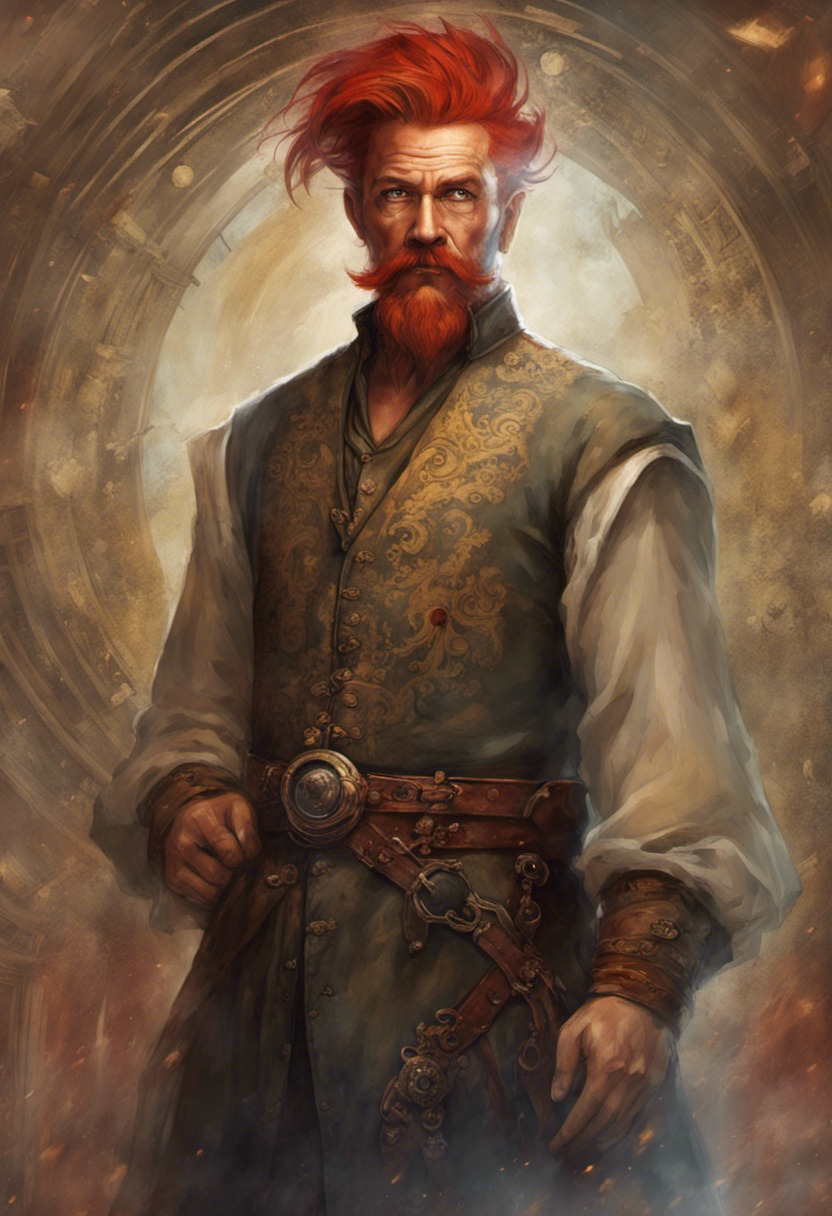
Shannon Glassowl is the kind of man who enters a room and makes everyone else feel as though the ceiling has dropped a foot. At six feet and eight inches tall, carrying two hundred and forty pounds of what his shipwrights diplomatically call "structural muscle," he is an imposing physical fact before he has said a single word. He is fifty-six years old. He does not look it, and he does not act it, and his employees, who love him in the way that people love someone whose standards are mercilessly high but entirely fair, will tell you that he has always been exactly this way.
The hair is the first thing visitors notice: a vivid, uncompromising red, cut short and worn with a certain careless flair that on most men would look accidental and on Shannon looks intentional. The mustache and beard are the same fiery color, wide and well-maintained, framing a face that is perpetually on the verge of a grin. There is a scar that runs from above his left eye to his left ear: a scar he acquired under circumstances he has told in at least six different versions depending on his audience, none of which are likely to be true. He wears it with the ease of a man who considers it a conversation piece rather than a mark.
His charm is not performed. That is the thing that catches people off-guard about Shannon Glassowl. He smiles upon meeting anyone (a genuine, unhurried smile) and extends a hand for what his friends warn is a gently enthusiastic handshake, by which they mean that he has calibrated his grip for the comfort of others and still occasionally forgets. Within ten minutes of a first meeting, most people feel as though they have known him for years. Within twenty, they are explaining their problems to him. This appears to be his natural effect on the world, and he has never quite understood why others find it remarkable.
What Shannon Glassowl has built is, by any honest accounting, without parallel. He is the owner, master designer, and driving force behind the only shipyard operation in all of Dort that builds flying ships at scale: not one at a time, not as a novelty or a commission for the extremely wealthy, but as a sustained enterprise. Four dockyards operate simultaneously under his direction, releasing a new vessel into the skies at least once a month. He negotiates the contracts. He manages the teams of builders, apprentices, and suppliers. And when a new ship is ready for its first flight, Shannon Glassowl is on board for the launch: not as ceremony, but as quality assurance. He will not put his name on something he has not personally flown.
He longs for formal acceptance as nobility, and he is candid about it to a degree that most aspirants to elevated status find alarming. He has more money than nearly anyone he knows. He builds the ships that the aristocratic world cannot function without. He operates on a code of ethics for himself and his business that would shame half the noble houses of Antaea. And yet the formal title eludes him, which he finds more interesting than frustrating. He is not a man who wastes time on bitterness when there is another hull to commission.
Lady Mary Glassowl
Lady Mary is the reason the name Lady appears before Glassowl at all; she came to it honestly, by birth, from a lineage that has maintained its noble standing through the careful accumulation of reputation across generations. The Wettin family of Rockhaven in Irna produced her, and she departed from their world of practiced propriety with no apparent regret and has not looked back in thirty-some years.
She is a regal woman in her late fifties: six feet and two inches tall, one hundred and fifty pounds, with a posture that suggests someone told her once how to stand correctly and she decided to continue doing it indefinitely regardless of context. She is slender and built well, and she carries herself with the composed ease of someone who is entirely comfortable being the tallest woman in any room she enters. Her hair is jet black, without a single grey at an age when most peers have made their peace with silver, a fact she acknowledges only by declining to discuss it.
She is, underneath the bearing and the title, an incorrigible prankster.
This surprises people who encounter her formal posture before they encounter her personality. It does not surprise anyone who works for the Glassowl enterprise for more than a week. Lady Mary has a gift for comedy that draws heavily on the physical geography of her situation: she is tall, she is aware that she is tall, and she has spent decades developing a catalog of observations on the subject that she deploys with excellent timing and a perfectly maintained straight face. She will flirt with anyone she finds interesting, which is nearly everyone, and the flirtation is warm and genuine and leads precisely nowhere, which her audience generally understands within two exchanges and finds charming rather than frustrating.
Her word in the business is Shannon's word. This is not a courtesy arrangement or a polite fiction maintained for social consumption; it is operational reality. Every foreman on every Glassowl dockyard knows that an instruction from Lady Mary has the same weight as an instruction from Shannon, because she has earned that weight through the same currency he has: showing up, working hard, and knowing every aspect of the operation she oversees. When production falls behind schedule, Lady Mary does not issue memoranda. She goes to the docks. She works alongside the crews. She does not ask anyone to do something she is unwilling to do herself, which is a quality her workers repay with a loyalty that money alone cannot purchase.
When a ship is delivered, she throws a party. Not a perfunctory gathering with decent food and an early end: a genuine celebration, with the crews and their families, honoring the completion of something difficult with the recognition that difficult things deserve. She knows the workers' families by name. She remembers children's birthdays. She keeps track of who is struggling and ensures, through indirect channels she has never publicly acknowledged, that they are quietly helped. The workers of the Glassowl shipyards are not merely employees. They are, in the way that Lady Mary organizes her world, hers, and she takes the responsibility of that seriously.
She married Shannon in a story that her workers have heard so many times it has achieved the status of founding myth. At twenty, she commissioned a ship from Shannon's father for her birthday: a perfectly reasonable transaction that she used, with considerable ingenuity, as a series of excuses to be present at the dockyard whenever a particular young shipwright was working the line. Shannon, by all accounts, was entirely oblivious to this campaign. His father was not. The elder Glassowl eventually enlightened his son, who responded, characteristically, by asking Lady Mary if she would like to have dinner, in the sheepish and direct manner of a man who has no particular talent for subtlety but a great deal of sincerity. She said yes. The rest is, as Shannon himself is fond of saying, documented in the ship manifests.
The Wettin family of Rockhaven has opinions about all of this. Lady Mary finds their opinions interesting.
Leander Glassowl
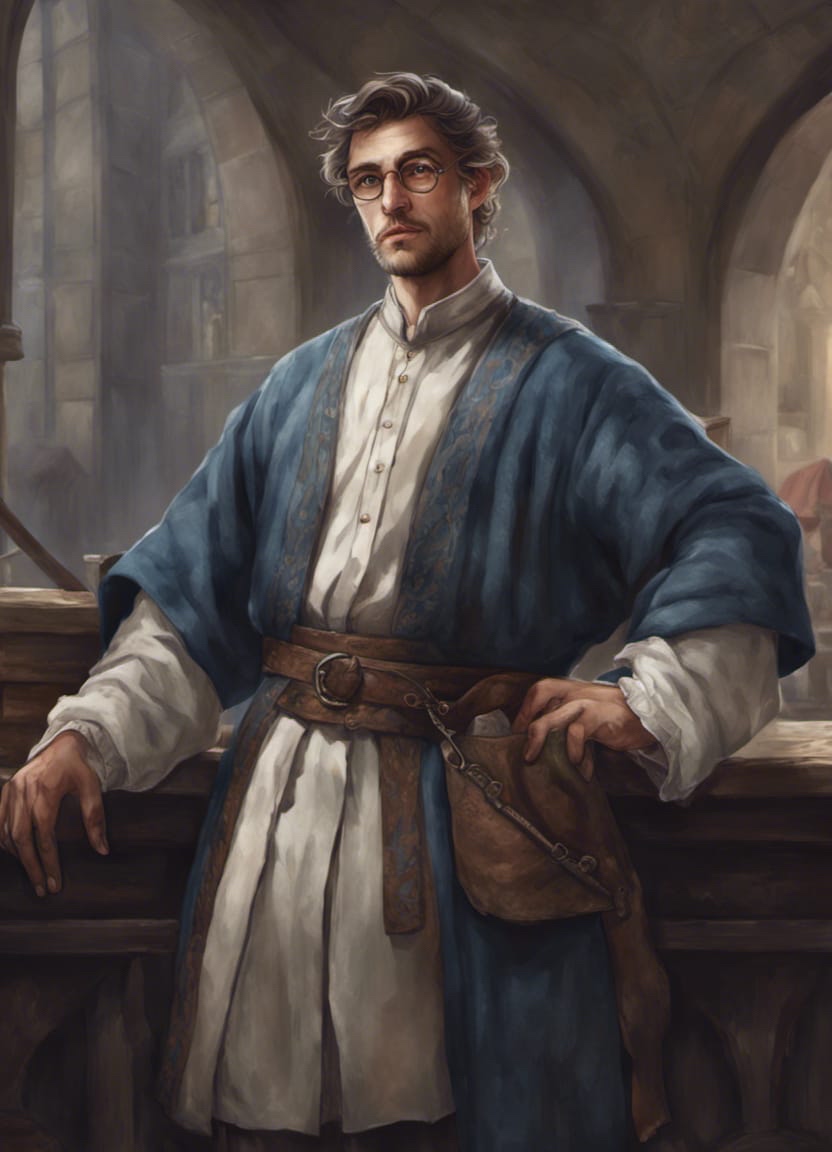
The third Glassowl is thin, wiry, and in his mid-twenties: a young man who inherited his father's height in partial measure and his mother's dark coloring not at all, arriving instead at a brown-haired, blue-eyed, spectacled configuration that suggests a scholar who wandered into the wrong family by accident and stayed because the work was interesting.
The spectacles are essential. Leander wears them perched on his nose with the absent-minded assurance of someone who has stopped noticing they are there. His hair is unruly in a way that implies he owns a comb and considers it a suggestion rather than a directive. His clothes are fine (the Glassowl enterprise can certainly afford them) and practical, suitable for the daily reality of an accountant who spends significant time in dockyard offices where ledgers compete for desk space with hull schematics and rigging diagrams. He wears the family's shipbuilding emblem without particular ceremony. He is not a man who invests heavily in signals.
What Leander invests heavily in is numbers, and he is very good at them. In a family whose fortunes rest on the construction of flying vessels (an enterprise with extraordinary material costs, complex supply chains, intricate contract structures, and the perpetual financial variable of what happens when a new ship design requires unexpected modification) having someone who understands the mathematics of the enterprise at a deep level is not merely useful. It is essential. Leander understood this before he was old enough to be hired for the role, growing up with ledgers as a kind of secondary education running parallel to everything else.
He is not indifferent to the ships themselves, exactly. He admires what they represent and appreciates what goes into building them. He simply finds the financial architecture of the operation more compelling than the physical architecture, which is a preference his father accepted with good grace and his mother found quietly hilarious. The numbers tell a story, Leander has explained more than once, that the hull cannot. The numbers reveal whether the business is healthy or merely busy, whether a contract is profitable or merely large, whether the enterprise that his parents have built across decades is sustainable or running on confidence and momentum.
In The Heavens, where the Glassowl ships arrive and depart and where the family's commercial reputation is most visible and most leveraged, Leander has acquired the informal title of "prince": a designation applied by those who know who his father is and feel that the son of the man who builds every flying ship in Dort deserves something honorific. Leander is generally too absorbed in whatever he is reading to notice when the title is used, which the people who use it find appropriate.
He assists in contract negotiations with a quiet effectiveness that surprises clients who arrive expecting to deal with Shannon and find themselves instead across a table from a studious young man who politely declines to be underestimated. He has his mother's instinct for when a negotiation is going the wrong direction and his father's stubbornness about terms that matter. The combination, those who have negotiated against him report, is inconvenient.
He is deeply respected in The Heavens and increasingly in the wider Glassowl orbit. He does not appear to have noticed this either.