Bocay
Bocay: The Border at the Bay
"The Oshala temple is outside the walls. It has always been outside the walls. If you ask why, people will tell you the story in a way that makes it sound like their idea. It wasn't. It's the way Bocay tells you something without saying it."
A Jazirah merchant, describing the town to an Iskash correspondent
At a Glance
| Continent | Antaea |
| Region / Province | Western Antaea, Bahia de Mourayo rangeland coast (south of Claragua) |
| Settlement Type | Town |
| Population | ~5,800 |
| Dominant Races | Human (majority) |
| Ruler / Leader | Elder Council; First Elder Consuela Arroyo |
| Ruling Body | Council of Elders, seven members; customary governance |
| Primary Deity | Echo |
| Economy | Animal husbandry (cattle, sheep, goats), fishing, leatherwork, coastal trade, the Bocay elixirs |
| Known For | Exceptional beef and dairy, the Bocay elixir line with its rearing-goat seal, the Dueling Grounds where disputes become public spectacle, and being one of the last Antaean towns before the long western road toward Jazirah |
First Impressions
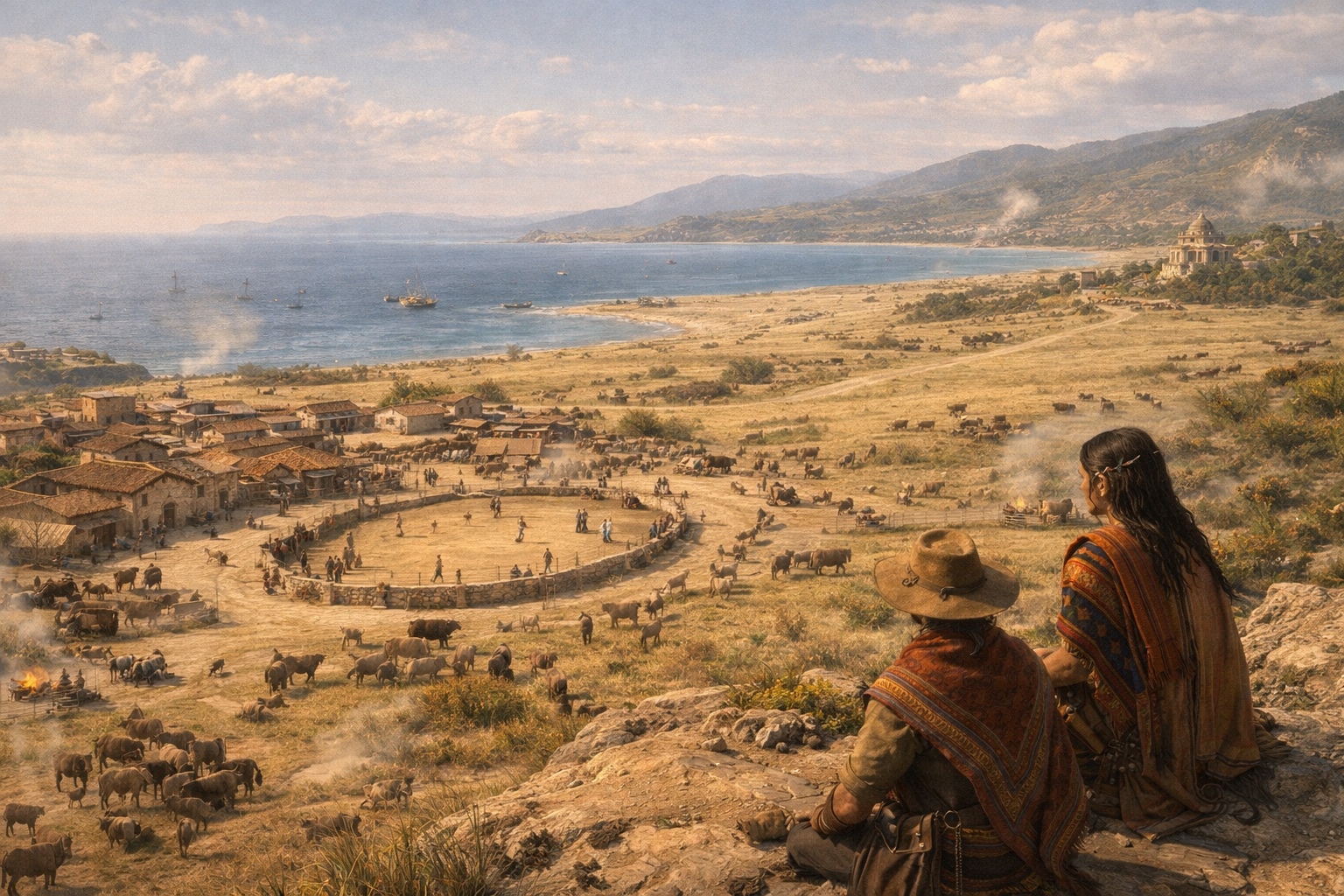
Bocay sits on open rangeland where the pasture runs directly to the bay's edge. There are no defensive walls in the conventional sense; the town has organized itself along the bay coast and trusted the geography and its own reputation for dealing with threats directly. The herds are visible from anywhere in the town, spread across the grass that runs from the settlement edge out to the horizon. The smell is grass, livestock, and salt water.
The Dueling Grounds are at the town's center: a cleared oval of packed earth, visible from the main square, with low stone benches on three sides. This placement is deliberate. Bocay has decided that the mechanism by which it resolves its disputes should be visible to everyone, which is either a statement of community values or a deterrent against initiating conflicts that will be watched.
On the outskirts (specifically, on the western caravan road that runs toward Jazirah) there are two Oshala temples. They are well-maintained, adequately attended by the Jazirah traders who pass through, and not attended by anyone from Bocay proper. This arrangement has not been formally codified. It is simply understood.
The bay here is the western extent of the Bahia de Mourayo. The same reef system that makes Claragua's harbor safe is further along the coast; here the bay is shallower and the fishing boats work closer to shore.
Geography & Setting
Bocay is positioned where the Antaean grasslands meet the bay, on the rangeland coast south of Claragua. The land is the town's primary asset: the pasture is consistently good, the bay provides fish and coastal access, and the overland road west toward Jazirah brings the trade that supplements the ranching economy. Bocay is not administered as a border post; it is simply a town whose traffic patterns and stories are shaped by being one of the last reliable stops before the western road gets long and empty.
The rangeland to the south and east is the ranching territory. The bay provides fish. The hills to the northwest have the specific plant varieties that the elixir producers use. Trade with Jazirah provides the spice components that complete the elixir formulas.
The People
Demographics
Bocay is predominantly human, with a cultural character shaped by generations of ranching independence. The population is stable and does not draw newcomers easily; the culture's expectation that trust must be earned through demonstrated reliability over time makes the town a slow integration for outsiders. Those who have integrated are genuinely members of the community. Those who have not are comfortable enough but remain visitors.
The Jazirah trader community passing through is not a permanent population but is a constant presence during the trading seasons. The town's cautious welcome extends to them in its commercial form without its social form.
Economy
Animal husbandry is the foundation: the cattle produce beef that regional buyers specify by name, the sheep produce wool and dairy, the goats produce the milk that goes into the aged cheese. The leatherwork is the craft industry, converting hides into the tooled leather objects that carry the town's visual art tradition.
The Bocay elixirs are the premium product. Produced by two families using formulas that are closely guarded, the elixirs are sold in sealed bottles with the rearing-goat emblem and are bought at premium prices by buyers across Antaea and into export trade. The formulas combine native highland plants with specific Jaziran spices acquired through the border trade; the specific formulas are not replicable without both components.
Primary Exports
- Prime cattle beef: The quality is consistent and specific enough that Antaean buyers specify Bocay origin
- Aged cheeses: The goat dairy variety in particular; a distinct flavor from the specific pasture
- Leather goods: Saddles, bags, belts; the tooled pattern work is the differentiating feature
- Bocay elixirs: The premium product; sold to the medicinal and luxury markets; the rearing-goat seal is the authentication mark
Primary Imports
- Metal goods: No significant smithing tradition; tools and hardware from the Antaean interior
- Jaziran spices: Essential for the elixir formulas; the border trade's primary inbound component
- Grain: Pasture land is not grain land; staples come in by trade
Key Industries
- The Ranching Families: Numerous family operations; not formally organized; the Elder Council manages the land access and water rights
- The Bocay Elixir Houses: Two families holding the formulas; the Pedrosa family (medicinal emphasis) and the Murillo family (senses and performance emphasis)
- The Leatherwork Guild: The most formally organized trade in the town; manages the tooled pattern traditions and apprenticeship
Food & Drink
Bocay eats what its economy produces at a quality that visitors remark on. The beef here is not merely adequate; it is the product of generations of selective breeding and specific pasture conditions, and the cooking tradition that has developed around it has had centuries to optimize. The slow-cooked stews that are the working meals are built from cuts that would be served as centerpiece elsewhere. The cheese is aged in the hill caves behind the town and has the quality that comes from specific mineral conditions in the stone.
The produce from the coast (fish from the bay, shellfish from the shallow eastern section) provides the alternative protein tradition that coexists with the cattle economy without competition. The bay fish is not the same as the open-ocean fish available in Claragua; it is shallower-water and smaller, but prepared well.
Milk and fermented milk products appear at every meal. The goat cheese tradition has produced a range of aged varieties; the fresh cheese is sold to Claragua for regional distribution.
Culture & Social Life
Independence is Bocay's governing value, and it is genuinely held rather than performed. The Elder Council governs because the elders have earned trust through demonstrated competence over decades; no other basis for authority is recognized, and the formal governance structure is minimal by design. The Dueling Grounds tradition makes conflict resolution public and witnessed because the alternative (private grudges, unwitnessed agreements, undocumented resolutions) is considered a threat to community integrity.
Trust is slow to build and permanent once built, and its loss is equally permanent. The social stakes of being found to have acted dishonorably are high enough that the system functions without significant enforcement. This is the culture's achievement and its rigidity: it is very good at maintaining standards it has established and less good at reconsidering whether those standards are always appropriate.
The border position shapes the culture's relationship with Jazirah specifically. Bocay knows what Iskash's expansion means. The town has not had a formal confrontation with Jazirah's agenda (the Oshala temples on the outskirts are an accommodation, not a capitulation), but the question of what happens when the accommodation is no longer sufficient is present.
Festivals & Traditions
The Autumn Drive
When the seasonal cattle movement is completed (the herds brought in from the furthest rangeland, the season's production assessed) Bocay marks it with a shared meal that involves the entire community and lasts two days. This is the social event of the year and the occasion when the previous season's standings (which families had good years, which had difficulties, what the community owes and what it is owed) are acknowledged publicly. Debts are settled at the Autumn Drive. The Dueling Grounds see their highest use in the two weeks before it.
The Elixir Day
The Pedrosa and Murillo families each produce a limited seasonal batch that is sold at a specific market day once a year. This is the only occasion when the elixirs are available directly from the producers rather than through the intermediary distribution system. The buyers who attend include collectors, bulk purchasers, and the curious. The atmosphere is commercial without being impersonal; both families take the occasion seriously as a ritual as much as a transaction.
Music & Arts
The music runs fast and with a specific emotional layering: driving rhythm on top, something heavier underneath, the combination specific to Bocay's tradition and difficult to replicate without growing up in it. The instruments are the guitar and the cajón, and the best musicians are the ones who know when the rhythm wants to break and when it wants to hold. Visitors from Claragua, with its more formal performing arts tradition, find Bocay's music harder to categorize and often harder to stop listening to.
The leatherwork tradition is the primary visual art. The tooled patterns on the better pieces narrate: local history, the bay landscape, specific events in the town's memory. The most significant pieces are not decorative objects; they are documents in leather. The Guild maintains the pattern vocabulary and the tradition of what each pattern means.
Religion
Primary Faith
Echo is Bocay's primary faith in the specifically Bocayan sense: not a cathedral religion, but a civic one. The shrines in the residential lanes and near the school are where people go to keep the town's most important asset intact: trust.
That doesn't erase the other devotions. Martus is still loud in the market and the dueling culture, and Ryujin still owns the docks. But when the Elder Council needs the town to move as one (water rules, border pressure, a dispute that could fracture families), it is Echo's language of mutual obligation and shared stability that the town reaches for.
Secondary / Minority Faiths
Oshala has a formal presence in the two temples on the outskirts. These are maintained for the Jazirah traders, are not attended by Bocay's permanent residents, and represent the accommodation that the town has made without making it central. The temples are there because the border trade requires the traders to have somewhere for their observance, and excluding them entirely would cost the town commercially. The placement, outside the town proper, communicates what the town has not said in words.
Hesira, the deity of hearth and marriage, finds natural expression among Bocay's ranching families: communities where the domestic partnership is the functional unit of the economy, where the household is maintained through harsh seasons and the bond between couples is tested by the real demands of the work. The Autumn Drive's communal meal is, among other things, a celebration of households that endured another season intact. Hesira's following in Bocay is informal and domestic rather than organized through a formal temple; the shrines are in kitchens and at hearthsides across the ranching families' compounds.
Jula, the deity of peace and measured reconciliation, is observed by those in Bocay who understand most clearly what is at stake in the current arrangement with Jazirah. First Elder Consuela Arroyo's long deliberation over the Oshala temples' growing community is, in Jula's terms, exactly the kind of governance the faith is meant to support: the slow, costly maintenance of arrangements that prevent worse outcomes. A modest Jula shrine near the Elder Council Hall is frequented by council members before difficult sessions and by the border traders who need the peace to hold.
Jusannia, the women's deity of birth and generative power, has a following among the women of the ranching families that is older than the town's formal religious structure. The specific knowledge of birth, midwifery, and the cycles of generation that the ranching economy makes impossible to ignore (cattle calving, the management of breeding stock, the human family's parallel seasons) gives Jusannia's observance a practical dimension that the women here understand as inseparable from the spiritual one. Her presence is domestic and unannounced, but consistent.
Nyxollox, the gentle deity of peaceful death and transition, tends the losses that Bocay's dueling culture makes visible. The Dueling Grounds produce mortal outcomes; the community that has spent generations building a trust economy around witnessed resolution has equally needed a framework for processing the deaths it has witnessed. The fishing community's losses at sea add another dimension. Nyxollox's presence in Bocay is quiet (a shrine maintained by the community in the older part of the residential district) but genuine, and attended more often than the town discusses publicly.
Secret or Forbidden Worship
Amnyth, the death deity, has a small following operating in the usual concealed manner. The Elder Council is aware that something of this character operates in the town and has been unable to identify who or where. The Dueling Grounds arbiter has noticed patterns in some of the combats that suggest preparation or knowledge that shouldn't be available to the winners, which he has mentioned to First Elder Consuela without specifics.
History
Founding
Bocay began as a seasonal cattle camp: the specific location on the bay provided water, the pasture was good, and the bay meant fish as a food backup. Permanent settlement followed when the ranching families stopped moving and started building. The Elder Council tradition predates formal governance structures; Bocay has always been governed this way.
Key Events
The Oshala Temple Dispute (approx. 30 years ago)
When Jazirah traders began using the border road in significant numbers, the pressure to accommodate Oshala's faith became commercial rather than theological. The Elder Council's resolution, temples permitted but positioned outside the town, satisfied neither the Iskash-aligned traders nor the community members who wanted no temples at all. Both sides accepted it as the best available outcome, which is the Council's definition of a good decision.
The Elixir Discovery (approx. 60 years ago)
The Pedrosa family's first elixir was developed by an herbalist who had identified the specific highland plant combinations and recognized that the Jaziran spices transformed their properties. The Murillo family's formula was developed independently and is different in character. The commercial success of both has made them the town's most distinctive product.
The Last Formal Duel (approx. 10 years ago)
The most significant Dueling Grounds resolution in recent memory involved a land access dispute between two ranching families that had been generating tension for a generation. The combat was formal, witnessed by the entire town, arbitrated by the current Grounds arbiter. The result settled the dispute in a way that both parties accepted, which is not universal in Dueling Grounds outcomes.
Current State
Bocay is prosperous and aware of increasing external pressure. The Jazirah expansion's western movement is not yet at the border, but it is getting closer, and the Oshala temples' attendant community is larger than it was five years ago. The Elder Council's current primary concern is maintaining the arrangement that has kept Bocay independent without provoking a confrontation that the town's size cannot win.
Leadership & Governance
The Elder Council: Overview
Seven members, chosen by community consensus when an elder seat becomes vacant (through death, incapacity, or the rare case of a council member choosing to step back). There are no elections in the formal sense; there is a period of observation, discussion, and gradual alignment around the person who most clearly embodies the community's trust. The process takes months and is rarely contested by the time it concludes.
The Council sets land access rules, water rights, and community obligations. It does not manage the economy. It adjudicates disputes that the Dueling Grounds do not resolve, a category that includes disputes between parties who decline the grounds and disputes where the violence is not appropriate.
First Elder Consuela Arroyo
Human, Female; sixties
Consuela has been on the Council for fifteen years and First Elder for six. She is the person the community turns to when the formal Council process is too slow for the decision required, which is a function she performs without having been given it explicitly. She is direct in the way of someone who has spent decades ensuring that the things she says are accurate, because Bocay's trust economy does not forgive careless statements.
Her concern about the Oshala temples' growing community is the Council's principal current external worry. She has been watching the attendance numbers for three years and has not yet found a response that doesn't either concede ground or invite confrontation.
Rodrigo Salcedo: Dueling Grounds Arbiter
Human, Male; fifties; the Grounds and its adjacent records building
Rodrigo manages the Dueling Grounds' formal procedures: the documentation, the witness registration, the rules of engagement, and the post-combat assessment that determines whether the result is accepted as final. He is the most thoroughly neutral person in Bocay's public life, by role requirement and by personal disposition. He has overseen forty-seven formal combats. He has seen three outcomes that he did not subsequently believe were purely the result of the combat.
Notable Figures
Elder Matías Pedrosa: Elixir Family Patriarch
Human, Male; seventies; the Pedrosa compound
Matías holds the primary medicinal elixir formula in memory and has been in active practice for fifty years. He is not the most commercially visible member of his family (his daughter Pilar manages the sales and distribution), but he is the one who knows what the formulas do and why. He is specific about this distinction.
Pilar Pedrosa: Elixir Sales and Distribution
Human, Female; forties; the Elixir Day market and distribution networks
Pilar has built the Pedrosa elixir distribution to the point where the product is available in four Antaean cities and two Jazirah trading posts. She is pragmatic about the Jazirah market and is aware that her family's reliance on Jaziran spice imports creates a dependency that the current political situation makes uncomfortable. She has been exploring alternative spice sources for two years.
Tomas Ryujin-Keeper: Fisher Priest
Human, Male; fifties; the fishing dock
Tomas maintains the Ryujin shrine at the dock and manages the fishing community's ceremonial life with the practicality of someone who is primarily a fisherman and secondarily a priest, in that order. The fishing community's faith is direct and specific: the sea has moods, the deity who governs those moods deserves acknowledgment, and the acknowledgment consists of doing the work correctly. Tomas represents this view.
Key Locations
Seat of Power
- The Elder Council Hall: A modest building adjacent to the main square; the meeting room is open to community members when the Council is in session for public matters; the records here go back to the town's founding
Houses of Worship
- The Martus Shrine: Near the market; the spinning coin emblem on the entrance; busier during the trading season
- The Ryujin Dock Shrine: At the fishing dock; small, maintained by the fishing community; the one on the bay's edge that gets wave-washed in heavy weather and is repaired without complaint
- The Echo Shrines: Several, distributed through the residential areas; the largest is near the school
Inns & Taverns
- The Ranchers' Rest: The main inn; large enough for the seasonal trading traffic; the beef served here is the argument for Bocay's food reputation
- The Bay Stall: A smaller establishment at the water's edge, primarily the fishing community's; the fish here is the morning's catch and the atmosphere is different from the main inn in ways that are hard to quantify
Shops & Services
- The Leatherwork Guild Hall: The primary artisan space; finished pieces and work in progress; the most significant tooled pieces are displayed for sale on specific presentation days
- The Pedrosa and Murillo Distribution Points: Not storefronts; the elixirs are not sold casually; acquisition requires introduction or attendance at the annual Elixir Day
The Market
- The Bocay Market: Open on specified days; livestock, dairy, leather goods, and the goods that come in from the border trade. The Jaziran spices that pass through here are available to local buyers at lower prices than the trade route typically offers, which is the tangible benefit of the border position.
Other Points of Interest
- The Dueling Grounds: Central location, visible from the main square; the worn stone benches; the packed-earth oval; the records building adjacent where forty-seven combats are documented
- The Highland Herb Areas: The specific slope sections where the elixir plant varieties grow; accessible to the public but the harvest is managed; the Pedrosa family's grandfather planted some of the current stands
Secrets, Rumors & Hooks
- Rodrigo Salcedo's concern about the three anomalous Dueling Grounds outcomes has a specific pattern: all three involved disputes that had Jazirah dimensions, trade agreements, border land questions, a case where the Oshala temple community had a stake in the outcome. He has not told the Elder Council because he doesn't have evidence, only a pattern. The pattern is three years old and growing.
- The Amnyth following that the Elder Council knows exists has, in the Council's judgment, one member on the Council itself. Consuela has suspected for two years and has not yet identified which of the seven. She has been conducting conversations designed to reveal the answer. She has narrowed it to two.
- The Murillo family's elixir formula, the "senses and performance" variety, has a category of effect that the family does not advertise in its public description. Pilar Pedrosa knows what it is; the two families have a complicated relationship around this knowledge. The buyers who specifically seek the Murillo variety for this effect are a subset that neither family acknowledges publicly.
- The bay section nearest Bocay has a specific floor feature, a grid of stone structures visible at low tide during the year's lowest water, that predates any recorded settlement. The fishing community treats the area as unlucky and doesn't fish it. Tomas the Ryujin-Keeper has been diving it. He has told no one what he has found.