Delsol
Delsol: Where the Turkey Runs and the Tide Turns
"You want to steal from us? Go ahead. But if you break the Turkey's Oath, there is no hole deep enough on this island to hide you."
Merchant Toren, turkey export specialist
At a Glance
| Continent | Antaea |
| Region / Province | Sea of the Heavens (island) |
| Settlement Type | Town |
| Population | ~2,200 |
| Dominant Races | Humans, Dwarves, Smalings |
| Ruler / Leader | Council Elder Thrain, Head of the Council of Elders |
| Ruling Body | Council of Elders |
| Primary Deity | Echo |
| Economy | Turkey Export & Fishing |
| Alliance | The Heavens Sphere |
| Known For | Exporting the finest live wild turkeys in the known world; and a communal culture that punishes betrayal with extraordinary severity |
First Impressions
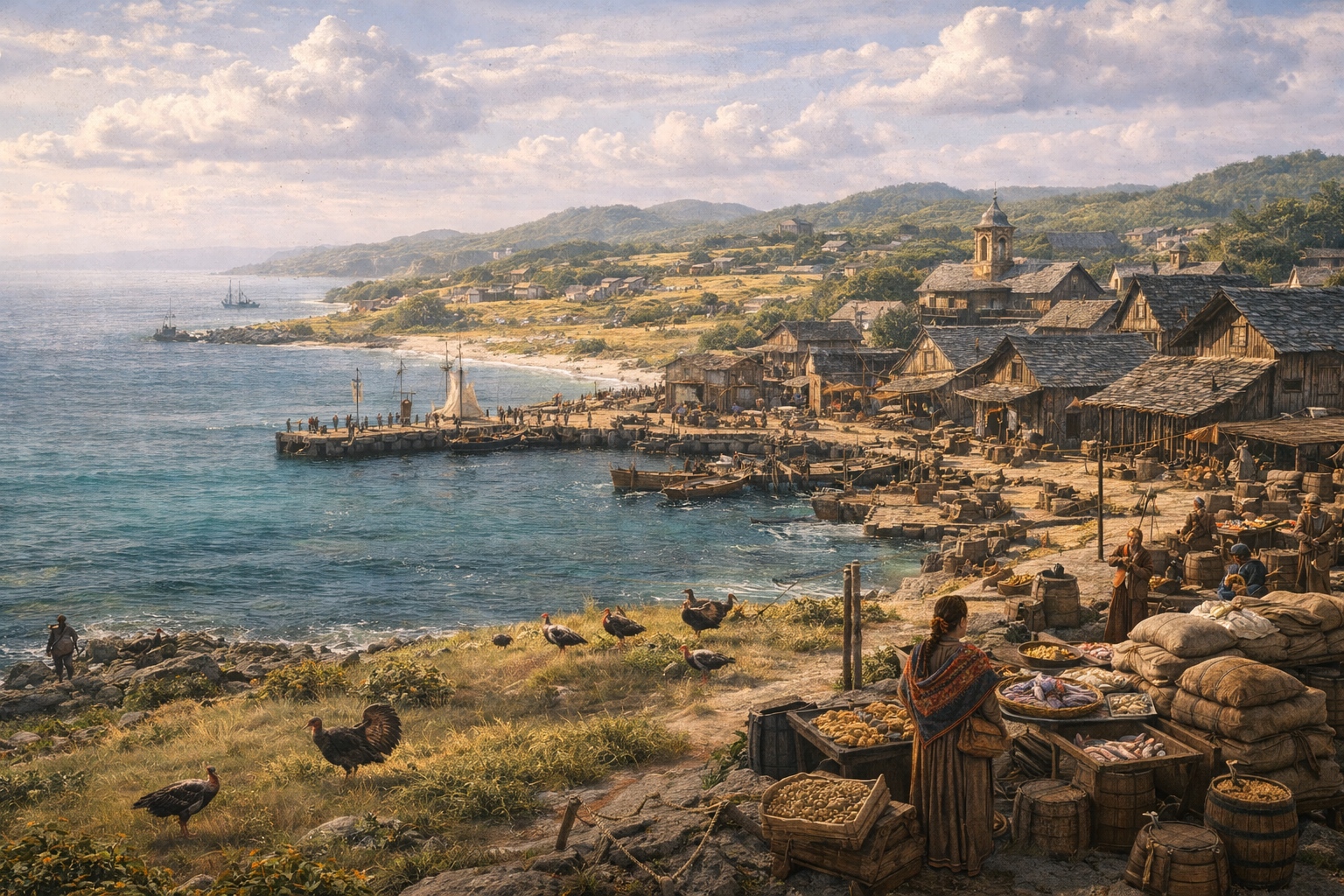
The smell of Delsol reaches you before the docks do: salt air mixed with something warmer, earthier, unmistakably alive. The wild turkey flocks that roam the western plains are not just a source of income; they are the ambient sound and constant presence of the island. Their gobbling carries on the wind, a background to everything that happens in this town.
The harbor is modest, the docks practical, the buildings constructed from local timber with the particular low-slung sturdiness of island architecture designed to survive storms. Cobblestone streets wind up from the waterfront through a town center that smells of fresh fish and roasting grain, then give way to the open fields and low hills of the interior. The market is busy and good-humored; the people of Delsol are easy-going in the way of communities that have worked out their social arrangements and are comfortable with them.
Watch what happens when a stranger speaks too carelessly about the turkeys. The warmth in the room doesn't disappear, exactly, but it becomes attentive. Delsol is welcoming. It is also genuinely watchful of its most valuable asset, and the line between hospitality and calculation is thinner than it appears.
Geography & Setting
Delsol occupies one of the islands in the Sea of the Heavens, east of mainland Antaea. The island's eastern shoreline faces open water toward the outer sea, and the town is built on a protected natural harbor on the western coast, sheltered from the worst of the ocean weather by the island's spine of low hills. The western plains extend inland from the town, gradually rising into terrain of mixed forest and grassland that hosts the wild turkey population.
The climate is temperate maritime: reliable seasons, moderate rainfall, no extremes. The terrain is varied enough for multiple uses: the harbor for fishing and trade, the coastal land for small farms and orchards, the interior for the turkey habitat. The island's self-contained nature has created a settlement that, by Heavens Sphere standards, is unusually food-self-sufficient; Delsol imports relatively little compared to other islands in the region.
The Sea of the Heavens shipping lanes pass close enough that Delsol receives regular trade visits, and Merchant Toren's live-turkey export vessels are a recognized feature of those routes.
The People
Demographics
Humans form the majority in Delsol, as in most island settlements, with a strong Dwarven minority concentrated in governance and trade roles. Smalings are present in meaningful numbers and are primarily involved in the agricultural work that sustains the turkey habitat: the careful cultivation of the specific plants and grains the birds prefer, which contributes directly to the flavor that makes Delsol turkeys irreplaceable. Elves pass through as merchants and sea traders but rarely settle.
The community is relatively closed to new permanent residents. Not hostile (genuinely warm, in fact), but the Turkey's Oath and the community's social structure create an implicit expectation that full membership requires demonstrated commitment. Long-term visitors who contribute to the economy and respect local customs are tolerated well; those who come purely to observe and profit from information about the turkey trade find themselves politely managed.
Economy
Delsol's economy is built on a unique and carefully maintained product: the live wild turkey. The birds roam the western plains, consuming a specific combination of local flora that produces a flavor universally recognized as superior to any domestic turkey. This flavor cannot be replicated once the birds leave the island; it requires the local diet, the local air, the local everything. Delsol has invested in the maintenance of this habitat as a strategic asset.
The trade model is unusual: rather than butchering locally and shipping preserved meat, Delsol exports the turkeys alive. Specially constructed ships with ventilated holding areas transport them to distant markets, where Toren's contacts butcher and sell the birds fresh. This requires logistical sophistication and generates premium prices.
Fishing and small-scale agriculture support local food needs. The island grows enough not to depend on imports for staples, which gives Delsol a degree of economic independence unusual for its size.
Primary Exports
- Live wild turkeys: The signature product; exported via specialized vessels to distant buyers who pay premium prices for fresh Delsol meat
- Fresh and preserved fish: Secondary export; the harbor waters are productive
- Dried and preserved island fruits: Modest export from the small farming operations
Primary Imports
- Raw building materials: Timber and stone supplements beyond what the island produces
- Metals and tools: The island has no significant ore deposits; everything metal comes from outside
- Luxury goods: For the merchant class and the Council's trade relationships
Key Industries
- Wild turkey husbandry and export: The defining industry; encompasses habitat maintenance, hunting party management, and live transport logistics
- Fishing: The island's reliable secondary income; the harbor fleet is modest but consistent
- Small-scale agriculture: Particularly the cultivation of food plants that sustain the turkey habitat; Farmer Gilda's domain
Food & Drink
Turkey is everywhere in Delsol: roasted, stewed, dried, served as the centerpiece of any significant meal. The town has developed a cuisine around the bird: slow-roasted with island herbs, served in broths with root vegetables, used as the basis for celebration feasts. Interestingly, the Delsol natives eat turkey very rarely on a day-to-day basis; the finest birds are always reserved for export. What locals eat most commonly is fish, the island's daily abundance, with turkey reserved for festivals and hosted meals.
The local ale is brewed from island grain and is decent rather than exceptional. Imported wines are preferred by those who can afford them. A specific island specialty is Flan de Pavo, a turkey-egg custard with island spices that visitors consistently find memorable.
Culture & Social Life
Delsol operates on a culture of earned trust and swift consequences for betrayal. The easy-going demeanor of the islanders is real, not performance; they genuinely like meeting people, trading stories, and sharing meals. But underneath the hospitality is a very clear community calculus: the turkeys are the livelihood, the livelihood requires protection, and anyone who threatens it (through theft, poaching, information leakage, or habitat damage) will be dealt with in terms disproportionate to what the town's casual atmosphere would suggest.
The Council of Elders governs by consensus and long institutional memory. Major decisions move slowly; small ones are resolved by whoever is most affected. Social status is linked to community contribution rather than birth; the elder whose family has farmed the turkey habitat for generations holds more standing than a wealthy merchant who arrived recently.
Festivals & Traditions
The Turkey's Oath
Performed seasonally, before each major hunting party dispatch. The Turkey's Oath is both a rite of passage and a binding community commitment. Each member of a hunting party swears (publicly, before witnesses) to protect the turkey flocks from predators, to take only what is designated for export, and to report any threat to the habitat without delay. The Oath was originally sworn only by hunters, but over generations it has expanded to include anyone in the community whose work directly involves the turkey trade. Young adults take their first oath as a coming-of-age marker. Breaking the Oath, in any form, is treated as community betrayal and results in permanent exile.
Music & Arts
Delsol's music is folk and outdoor: flutes made from island reeds, drums from stretched hide, simple string instruments. The songs tend toward the narrative: long ballads about the Great Storm, the founding of the hunting traditions, legendary catches. Art in Delsol is primarily functional and folk-craft based: painted murals on tavern and market walls depicting the island's history, carved wooden objects in everyday use, decorated fishing gear. The most valued aesthetic objects in town are the intricate turkey-feather fans and weavings made for ceremonial use, which have become recognized trade goods in their own right.
Religion
Primary Faith
Echo holds the primary place in Delsol's public life, not because the island is unusually pious, but because its defining institution is communal: the Turkey's Oath and the collective management of a living export resource. Delsol survives by acting like a single organism when pressure arrives (storms, disease, buyer leverage), and Echo's domain of unity and shared responsibility names that truth cleanly.
Echo's hall is less a grand temple than a civic shrine with a meeting room: oath-registers, habitat rules, and the Council's public notices sit comfortably beside the altar. The clergy (and lay attendants) are expected to be practical mediators: keeping people aligned matters more than winning arguments.
Secondary / Minority Faiths
Ryujin is observed by the fishing fleet and anyone whose work involves the water, with a dock-side shrine that receives daily small offerings.
Kraut is revered by the agricultural community who maintain the turkey habitat; Farmer Gilda is among his most devoted followers.
Martus has a strong presence among the export traders and ship crews: long voyages with living cargo are always a gamble, and the spinning coin appears on warehouse doors whether or not anyone admits it's prayer.
Solis is respected by farmers and hunters alike for his role in timing.
Thulgard, the deity of community resilience and collective protection, is the faith that names Delsol's most important historical event and its cultural outcome. The Great Storm devastated the fishing fleet and damaged the turkey habitat; the community's response (collective investment in restoration, shared rebuilding labor, cooperative food arrangements with the other island towns) is described by Delsol itself as the moment when its culture of communal commitment crystallized. The Turkey's Oath ceremony, the Hunting Party Brotherhood's collective management of a shared resource, and the council's consensus governance are all Thulgard's legacy in institutional form. The Storm Monument at the harbor's highest point marks the dead; Thulgard's faith names what their surviving community became.
Oruka, the deity of beasts, hunting, predation, and the sustainable harvest, has a genuine home among the Turkey's Oath community whose entire livelihood depends on understanding and maintaining a relationship with a wild animal population. Korran Deepline's lifelong tracking knowledge, the Hunter's Guild's managed quotas and seasonal rotations, Farmer Gilda's ecological understanding of what the turkey flocks require to sustain their flavor and their numbers, all of this is Oruka's domain: not domination of the natural world but the sustained, careful relationship between human communities and the wild populations they depend on. The Guild's Oath ceremony has Oruka's character even where it names Echo's domain.
Morbina, the deity of disease and plague, is propitiated in Delsol with the specific urgency of a community that survived the Year of the Plague only by watching it reduce the turkey breeding population by nearly a third. When the illness struck both people and livestock, the community's survival and its economy's survival were threatened simultaneously, and the direct response, investment in agricultural diversification, is exactly what communities that have survived epidemic do. Small Morbina offerings are maintained by families who lost members during the Plague year and by the habitat workers who know what another such event would mean for the flocks.
Lantha, the moon deity of night, watchfulness, and coastal navigation, is observed by Delsol's fishing fleet and the island sailors who navigate the Sea of the Heavens in conditions that require precise reading of the night sky. The fishing crews who depart before dawn, the coastal watch that monitors the harbor alongside the plains watch, and the shipping lanes that pass close enough for regular trade visits all give Lantha the observational context the deity requires. The dock shrine receives Lantha offerings on the nights before significant passages, alongside the Ryujin devotions.
Nyxollox, the gentle deity of peaceful death and transition, marks Delsol's losses in a community that has known significant collective death: the Great Storm's casualties, the Year of the Plague's toll, the ongoing risk of the hunting work in the island hills and the fishing work at sea. The Storm Monument is the community's most public act of mortality acknowledgment; Nyxollox's faith provides the quieter, ongoing framework: the household shrines, the preparations before dangerous departures, the ceremonies that mark individual deaths with the gentleness the deity promises.
Secret or Forbidden Worship
A small cult venerates Demergat in private, concentrated among certain sailors and hunters who have come to see the island's storms and hard seasons as a darker, older bargain than the public faith prefers to name. The Council suspects it exists and treats it as a boundary risk rather than a theological one.
History
Founding
Delsol was established by a group of Human and Dwarven seafarers who found the island's natural harbor during a storm and stayed through necessity. The discovery that wild turkeys of exceptional quality inhabited the western plains transformed a survival camp into a permanent settlement. Early generations focused on understanding the birds: their habits, their preferred habitat, what made them what they were. The Turkey's Oath tradition began informally in these early years as a set of practical agreements about who could hunt where.
Key Events
The Great Storm of the Year of the Howling Wolf
A catastrophic storm devastated the fishing fleet and threatened the turkey habitat, damaging the western plains' vegetation in ways that took a generation to recover. The community's response, collective investment in habitat restoration and the rebuilding of the fishing fleet through shared labor, is cited as the moment when Delsol's culture of communal commitment crystallized. The Storm is referenced in the Turkey's Oath ceremony to this day.
The Expansion Era and the Council Formation
As the turkey export trade grew and attracted outside interest, the informal leadership of founding families evolved into the formal Council of Elders. This period saw the establishment of the live-export shipping model, the first formal Oath ceremonies, and the negotiation of trading relationships with Heavens Sphere partners. Merchant Toren's great-grandfather built the first purpose-designed turkey transport vessel during this era.
The Year of the Plague
An illness of unknown origin struck both people and livestock. The turkey flocks were affected, reducing the breeding population by nearly a third before the disease ran its course. The crisis drove investment in agricultural diversification (the island cannot depend on a single product surviving a single bad year) and strengthened the connection between the farming and fishing communities that persists today.
Current State
Delsol is stable and prosperous, though not without concerns. The Heavens Sphere's political complications cast a shadow over trade relationships, and there is ongoing pressure from external buyers to negotiate exclusive contracts that would give them priority access to the export supply. The Council has resisted these arrangements on principle (Delsol will not be dependent on any single buyer), but the financial incentives are substantial and the younger generation is not unanimous on the question.
Leadership & Governance
The Council of Elders: Overview
Delsol is governed by a Council of Elders comprising representatives from the major community constituencies: fishing, farming, trade, and the turkey husbandry tradition. Leadership is earned through longevity and demonstrated contribution; the Council Head position rotates every five years by seniority. Decisions require consensus, which makes governance slow but durable. The Council is trusted by the community in the specific, earned way of institutions that have consistently delivered.
Council Elder Thrain
Dwarf, Male: A dwarf in his sixth century, physically diminished but mentally precise
Elder Thrain is the current Council Head, a position he has held for three terms. He has a long white beard worn in the formal braided style for Council sessions and left loose at all other times, and the particular stillness of someone who has learned not to waste movement. He spent his early centuries as a maritime trader before retiring to Delsol and working his way into the Council through decades of quiet competence.
He is an excellent chairman: he listens, he synthesizes, he breaks ties without being seen to take sides. His weakness is conservatism: he is deeply suspicious of any change to the systems that have worked, and the question of exclusive trade contracts has exposed a divide between his caution and the financial pragmatism of the younger traders that he has not yet resolved.
Captain Elira: Fleet Commander
Elf, Female: Slender, silver-haired, with the precise coordination of someone raised on moving decks. She runs the fishing fleet and is the Council's primary voice on maritime matters. She is younger in spirit than most of the Council and is quietly aligned with the faction that wants to reconsider the trade contract terms.
Guard & Militia
Delsol maintains a small community watch of about thirty, focused primarily on the western plains where the turkey flocks graze. These are less soldiers than rangers: knowledgeable about the island's terrain, capable of tracking threats (human or animal), and deeply committed to the Oath. A secondary coastal watch monitors the harbor.
Law & Order
Delsol follows Antaean custom supplemented by the Turkey's Oath framework. The Oath creates a community social contract that carries quasi-legal weight; violations are tried before the Council and punished by graduated sanctions up to and including exile. Theft of a turkey carries the same social condemnation as theft of a person's livelihood, because in Delsol, it is.
Notable Figures
Merchant Toren: Turkey Export Specialist
Human, Male: The export warehouse at the harbor
A bald, neat-bearded man in his late forties with the look of someone who has spent decades in negotiation and not lost a round he couldn't afford to lose. He manages the live-turkey export operation from provisioning through delivery and commands trade relationships across the Heavens Sphere and beyond. He is not on the Council but functions as its commercial arm. He wants to grow the export operation but is caught between the Council's conservatism and the buyers' demands. He knows every major merchant in the region by name and most of them by weakness.
Farmer Gilda: Turkey Habitat Specialist
Smaling, Female: The western plains farms above town
Barely over three feet but impossible to ignore in the fields she manages. Gilda knows the western plains' ecology with the intimacy of someone who has spent forty years studying it. She introduced crop rotation and selective planting techniques that have stabilized the turkey habitat against climate variation. She is a devout follower of Kraut, practical about it rather than mystical, and she will tell you at length what each of the major herb varieties on the plains contributes to the flavor profile of the Delsol turkey.
High Attendant Mara Brightcoin: Echo's Hall
Human, Female: Echo's Hall, civic quarter
A woman of middle age with an accountant's eyes and the patience of someone who has mediated trade disputes for twenty years. She keeps the most reliable records in Delsol (trade volumes, oath registrations, community census), and those records are available to anyone with standing to ask. She is consulted by the Council before any significant trade decision and her analysis is respected even when her conclusions are uncomfortable.
Korran Deepline: Senior Hunting Party Leader
Human, Male: Various; wherever the turkey flocks are
The oldest active hunting party leader on the island, a lean man with sun-darkened skin and the unhurried patience of a born tracker. He trains the young hunters who take their first Oath and is the Council's practical authority on everything related to the turkey population's health. He is worried about something; the flocks in the northwestern plains have been moving their range slightly southward over the past three years, which he cannot explain and the Council has not yet accepted as a concern.
Key Locations
Seat of Power
- The Elder Hall: A long, low timber building in the town center, open on three sides during good weather. The Council meets here weekly; citizens may attend but not speak unless addressed. The walls are hung with the Turkey's Oath records going back to the settlement's founding.
Houses of Worship
- Echo's Hall: Central position in the civic quarter; part shrine, part meeting house. The Oath registers and habitat rules are kept here alongside the altar, and disputes are mediated here before they harden into faction.
- The Ryujin Dock Shrine: A carved stone alcove at the harbor's edge; small, well-maintained, always has fresh offerings before the fishing fleet departs.
- The Martus Market Shrine: A practical little shrine near the export accounting office; busy on shipping days and very busy before anyone attempts an unlucky voyage.
Inns & Taverns
- The Feathered Coin: The main gathering place, run by a cheerful Human woman named Bessa who cooks outstanding Flan de Pavo and keeps the island ale flowing freely. The walls are covered with the painted murals that define Delsol's art tradition. Newcomers are welcomed here; it's where you establish your first credibility with locals.
- The Tidewatch: A quieter waterfront establishment preferred by the fishing crews and merchant captains who want their conversations private.
Shops & Services
- Toren's Export House: The operational center of the live-turkey trade; rows of secured holding pens, ventilated and climate-controlled, and the accounting office where turkey contracts are formalized.
- The Oath Register: A civic hall rather than a shop; this is where the Turkey's Oath records are kept, where new oaths are formally registered, and where violations are reported and processed.
The Market
- The Delsol Market: Daily, open-air, in the central plaza. Fish is always available; turkey products (primarily eggs, feathers, and preserved items) are available seasonally. Island fruits and agricultural goods fill out the stalls. Outsiders are welcome but prices are quoted by locals in a way that signals clear awareness of who has leverage.
Other Points of Interest
- The Turkey Plains: The western interior, home to the wild flocks. Visitors may be permitted to observe from the perimeter in the company of a hunting party member; unescorted access is not allowed and the request will be declined politely and absolutely.
- The Storm Monument: A rough stone marker at the harbor's highest point, inscribed with the names of those lost in the Great Storm. Flowers are left there on the Storm's anniversary each year.
Guilds & Organizations
- The Hunting Party Brotherhood: The semi-formal organization of all oath-taking turkey hunters and habitat workers. The Brotherhood sets hunting quotas, coordinates predator response, and manages the Oath registration process. It is the most powerful civil organization in Delsol after the Council itself.
- The Harbor Trade Association: A loose commercial guild of fishing captains and merchants, coordinated by Merchant Toren. Less formalized than the Brotherhood, focused on negotiating trade terms and coordinating shipping schedules.
The Criminal Element
Delsol's criminal landscape is almost exclusively focused on the turkey trade. Turkey poaching, taking birds outside the designated harvest, is the crime the community fears most, because it could disrupt the breeding population that the entire economy depends on. Two attempts at organized poaching in the island's history both ended badly for the poachers. The most recent, approximately thirty years ago, resulted in the exile of seven people, two of whom were long-term Delsol residents. The story is still told.
There is occasional petty theft at the market and the harbor, handled through the Council system with proportionate penalties. This is considered a separate moral category from anything touching the turkeys.
Secrets, Rumors & Hooks
- Korran Deepline's concern about the turkey flocks shifting range is real and he understands what is causing it: a subtle change in the water table on the northwestern plains, which is affecting the specific herbs that give the birds their flavor. The change is gradual but will become significant within a generation. He does not know why it is happening, but someone does, and they are not Delsol-born.
- The Turkey's Oath was not always the ceremony it is now. The original version included a clause that no longer exists, a provision about what happens if the turkey population falls below a specific threshold. The Council removed it two hundred years ago. The clause bound the entire community to a course of action that at least one current Council member would find alarming to rediscover.
- Merchant Toren has been offered an exclusive contract by a buyer whose identity he is not revealing to the Council. The terms are exceptional. He is considering whether to present it honestly or to structure the negotiation in a way that makes it harder for the Council to refuse. He has not yet decided.
- A Smaling traveler who spent two months on Delsol last year departed with significantly more information about the turkey habitat and husbandry techniques than any tourist should have. She was friendly, seemed genuinely interested, broke no laws, and has not been seen since. Farmer Gilda noticed the systematic nature of her questions about three weeks after she left.
- The Echo worshippers are not merely a quiet religious minority. They have been quietly documenting the Council's decision-making for the past decade, building what amounts to an institutional memory archive that the Council itself does not maintain. Their intentions are benevolent. Their archive contains things the current Council would prefer were forgotten.