The Shattered Domain
The Shattered Domain
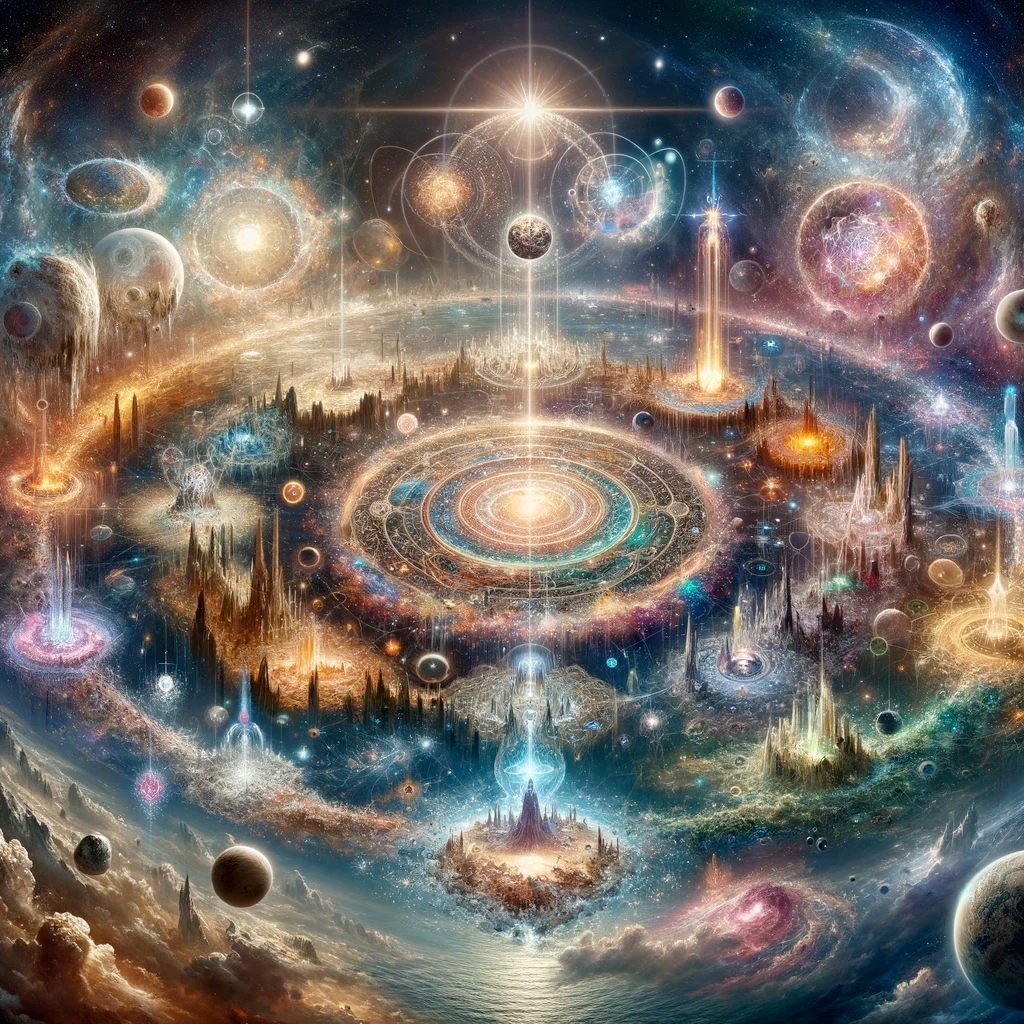
The Shattered Domain, also called the Plane of Ix, is the plane where the gods live and where mortal souls go when a deity has claimed them. It was built from what remained after Ix broke: each fragment of the primordial became a god, each god eventually claimed territory, and the domain grew around them as they grew around it. The plane is simultaneously ancient and still forming. New shards are discovered. New gods crystallize from the universe's own need. Territory expands and contracts with the ebb of mortal belief. The Shattered Domain is the most politically active plane in the cosmos, which is another way of saying it is the most dangerous one for an unprepared mortal visitor to wander through without knowing whose land they are standing on.
Structure
The domain arranges itself in a grand circle. Deities whose alignment tends toward what mortals call good occupy one hemisphere; those whose nature trends toward what mortals call evil occupy the other. This is less a moral judgment than an architectural fact; the domain organized itself this way, presumably because the fragments of Ix sorted by the aspects of his nature they carried, and those aspects did not blend evenly. The boundary between hemispheres is not a wall; it is a transition that deities are perfectly capable of crossing and do, for politics, for trade, and occasionally for reasons no one publishes.
Each deity's territory is a realm unto itself, shaped entirely by the god who holds it. The size of a territory is proportional to the deity's worshipper base and the accumulation of soul coins in their vaults; a god with declining followers occupies less land, and a god whose worship is spreading finds their borders growing outward into whatever marginal space the domain has available. Some territories share borders and reflect that in how they look; a deity of war who borders a deity of harvest produces frontier terrain that is complicated. Some territories are isolated completely, sovereign islands with no geographic neighbor.
Over a hundred divine territories exist in the domain. A number of them are vacant, unclaimed land where no deity has established presence. These territories are the remains of gods who diminished entirely, whose worship collapsed until the shard went inert and the land it held went unattended. Finding an inert shard in a vacant territory and knowing what to do with it is the kind of discovery that changes things significantly.
The Soul Coins
When a soul passes through the Veil and travels the Silver Road to Sheol, its ultimate destination is determined by the life it lived and the devotion it carried. Souls claimed by a deity do not remain in Sheol; they continue to their patron's territory in the Shattered Domain, where they arrive not as free souls but as coins.
The transformation is not metaphorical. The soul is transmuted into a physical object: a coin whose obverse bears the name and face of the person it was, and whose reverse carries a symbol indicating the nature of the soul's relationship to the deity who holds it. The coin's weight shifts to reflect the depth of devotion the soul had in life; a fervent worshipper produces a heavier coin, a casual practitioner a lighter one. The difference matters because the coins are a deity's primary source of power.
Each god draws strength from their collected coins. The vault is the measure of their influence, and the weight of individual coins within it the measure of their followers' commitment. A god with many light coins is more vulnerable than a god with fewer but heavier ones. This creates the dynamic that shapes most divine politics: it is not merely the quantity of worshippers that matters but the quality of their devotion.
Gods trade soul coins. The exchange is a complex barter driven by what each deity needs and what they are willing to part with. Cultural practitioners, those who observe religious custom without deep personal belief, are the usual trade currency, their lighter coins changing hands in arrangements that serve divine agendas mortals rarely understand. Fervent devotees are almost never traded; the coin's weight to its deity is too significant. Racial deities find their followers' coins non-transferable in any meaningful sense; the devotion encoded in them is too specific to the identity of the worshipper to carry value to a different patron.
In rare circumstances, a god burns a coin. The act releases the spiritual energy compressed within it in a concentrated surge, useful in moments of crisis or conflict where a deity needs power beyond what their vault passively generates. The soul does not survive this intact. The burning severs it from its divine rest and casts it onto the Silver Road without a destination, without a coin, and without a path forward. These souls join the Silver Road's population of wanderers, distinct from the souls trapped by traumatic death in that their displacement was deliberate rather than accidental, which makes their situation arguably worse. They are known in the domain as the Spent.
Thresh
The Shattered Domain has an architect. Her name is Thresh, and she is a Primitive God, one of Ix's first creations, predating the shattering that produced everything else in the plane. She is not in any current pantheon because she does not require worship and does not seek it. She is the law that structure must be maintained, which is either the most abstract of functions or the most practical one, depending on where you are standing and whether your territory is currently stable.
When the domain formed from Ix's breaking, someone had to put the pieces somewhere. The fragments became gods, the gods needed land, the land needed to be organized into something that would not immediately collapse back into undifferentiated divine residue. Thresh did this. She has been doing it in the same way ever since: methodically, without preference, and with a comprehensive memory for every territorial adjustment that has been made in the domain's history.
Her function today is threefold. She establishes territory for gods who are newly arrived: new shards crystallizing, Ex Nihilo gods who have come into being, Bound Gods who have severed their geographic tie and need somewhere to exist. She maintains the structural integrity of the domain's geography, which requires ongoing attention in a plane whose landscape shifts constantly with the politics of divine power. And she arbitrates territorial disputes, not by issuing judgments but by producing the historical record of where a boundary has been and what the domain's structural logic says it should be, and allowing the relevant parties to conclude what they will from that information.
The gods fear her. This is not entirely rational, and most of them know it is not entirely rational, which does not help. Thresh has never threatened a deity. She has never made a territory smaller to punish its holder or denied territory to a god she disapproved of. She applies her function without favoritism, which is exactly what makes her frightening: a being that powerful, that central to the infrastructure of the plane, and completely beyond the leverage that divine politics normally provides. You cannot offer Thresh worship. You cannot threaten her with the consequences that govern relationships between gods. You cannot appeal to her interest in your success because she has no investment in your success. What you can do is annoy her, and annoy her badly enough that the structural attention she gives your territory becomes minimal, your borders become subject to the kind of drift that happens when someone qualified to prevent it has other priorities. No god has deliberately tested this. The result of testing it is too obvious to make testing it appealing.
Mortal visitors to the domain who find themselves without a specific deity to attend occasionally find Thresh instead. She answers questions accurately, without editorial comment, and at a level of detail that is more information than most visitors know how to process. She does not turn mortals away. She has no reason to.
Entry
The Shattered Domain is one of the more accessible planes for determined mortal travelers. Advanced teleportation, planar shift workings, properly constructed portals, and the occasional wish all produce reliable entry. The domain does not have the lethal environmental barriers of the Tidal Realm or the navigational hazards of the Mineral Plane's solid geology. It is survivable by a prepared mortal, which is part of why the gods have opinions about mortal visitors.
Those opinions are mixed in a specific way: gods like mortal visitors who worship them. A living practitioner who enters the domain and makes their way to their patron deity's territory is, from the deity's perspective, doing something genuinely pleasing; it demonstrates devotion of the kind that adds weight to future coins, and it gives the deity an opportunity to interact directly with a follower in a way that Prime-side restrictions prevent. A mortal who enters the domain and presents themselves before a deity they do not worship is a more complicated proposition. The deity may be hospitable, indifferent, or something else depending on their nature. The domain does not guarantee safety for mortals, it merely does not kill them by existing.
The souls present in the domain, those living in their patron deity's territory as the beings their coins have made them, can sense mortal visitors. They are not hidden, and living mortals are perceptible to them in a way that creates awareness throughout whatever territory the mortal is traveling through. This means that entering a deity's territory without that deity's knowledge is not a viable strategy.
Role in the Cosmos
The Shattered Domain is the divine plane, the place where the gods actually exist rather than the places they influence. Their power originates here, flows from here into their worshippers' prayers, and returns here in the form of devotion that thickens their coins and expands their territory. Without the Shattered Domain, the gods would not be gods in any operational sense; they would be abstract forces without a location to concentrate from.
The domain also serves as the endpoint for a significant portion of mortal souls. The souls that reach Sheol, are weighed, and are found to have genuine claim by a deity travel onward to the domain rather than remaining in any of the Soul Planes. The Shattered Domain is therefore the actual final destination for a substantial part of the mortal population, not a waypoint but an ending, or what passes for one when the soul has become something that no longer ages or needs.
The vacant territories are a cosmological concern that no one has solved. Inert shards in unoccupied land are discoverable, and a discovered inert shard is either a dead divine fragment with no remaining potential or something that, under the right circumstances, could become active again. The domain does not distinguish between these possibilities on its surface. Thresh knows the history of every vacant territory. She does not volunteer this information, but she does not withhold it from direct questions either.
Mortals in the Shattered Domain
Arrival
Most portal arrivals to the Shattered Domain emerge in the neutral territory surrounding the Ocean of Belief, the open land between deity territories that functions as the domain's version of common ground. This is the safest arrival point for mortals without a specific divine affiliation directing them, as it belongs to no deity and therefore triggers no immediate territorial protocols.
Mortals arriving directly into a deity's territory do so either because they constructed the portal to arrive there specifically, because their deity has established an arrival point for worshippers, or because their navigation was imprecise and they emerged somewhere that is already someone's land. The third case requires immediate orientation, because the territory's soul-population is already aware of the arrival and the deity will be informed shortly.
Echo maintains the domain's most hospitable arrival infrastructure for mortals: a clearly marked entry point in his territory for travelers who have announced their visit in advance, and a functional if unofficial tolerance for those who have not. He finds mortal visitors genuinely interesting, which is not a standard divine position and is one of the reasons his territory sees more mortal traffic than most.
Environmental Effects
The Shattered Domain feels like walking through a place that is actively being thought about. The territories have a quality of intentionality to them; the landscape reflects the deity who holds it in a way that is not decorative but functional, as if the terrain is an extension of divine cognition rather than a backdrop for it. Entering a deity's territory and reading its character from the environment is a reliable practice. The environment is honest in a way the deity may not be.
Magic functions in the domain in accordance with the deity whose territory is being traversed. Workings aligned with a deity's domain are enhanced within their territory. Workings that directly oppose a deity's nature find resistance. Neither effect is a deliberate imposition; it is simply what happens when magic is practiced in a space that is saturated with a specific divine presence. The neutral territory around the Ocean of Belief does not have this property, which is one more reason it functions as common ground.
The soul-beings inhabiting each territory are aware of mortal presence and will communicate with it if given the opportunity. They are not hostile toward living visitors unless the territory's deity has reason to be hostile, in which case the soul-population's behavior reflects that clearly. In Echo's domain, soul-beings approach mortal visitors with the enthusiasm of a population that genuinely enjoys the company and has been instructed to be welcoming.
Navigation and Survival
Knowing the domain's geography before arrival is the most significant navigational advantage a mortal traveler can have. Which territories border which, the current alignment of major divine politics, which paths between territories pass through contested or unfriendly land: none of this is static, and maps of the domain age quickly as territory shifts with the tide of mortal worship. The most current information is available from scholars who maintain regular contact with the domain and from Thresh, who knows the current state of every border.
The practical rules for mortal survival in the domain are few but important. Entering a deity's territory without that deity's awareness is not possible and should not be attempted. Entering a deity's territory without that deity's approval is possible but inadvisable unless the mortal is confident in how the deity regards uninvited visitors. Traveling through neutral territory does not require divine permission, but it should be done with awareness of which deity territories the route passes near, as proximity to a border creates awareness in the territory's soul-population whether the mortal crosses it or not.
Gods do not frequently harm mortal visitors directly. They are operating under constraints that make mortal elimination politically expensive; doing something to a mortal who is also a worshipper of another deity creates a diplomatic problem with that deity that may not be worth the immediate satisfaction. Non-worshippers have less protection under this logic. Mortals who enter the Shattered Domain having taken no deity's claim are navigating without this layer of protection, which their travel planning should account for.
Departure
Mortal practitioners return through their portals or workings. The domain does not impede departure, and no deity has the standing to prevent a mortal from leaving the plane against their will, a constraint that the gods generally resent and that Thresh enforces not because she has authority over the gods but because the alternative, a plane where mortals are trapped, would create structural consequences for the domain's relationship with mortal religions that she finds unacceptable. The gods find this position typical of Thresh and respond to it the way they respond to everything she says: by accepting it and quietly being irritated.
Locations
The Ocean of Belief
The Ocean of Belief is the domain's central feature, a vast metaphysical sea that fills the space between the organized territory of the god-hemispheres and the island of Godless at its center. It is not water in any physical sense but behaves like water in its navigation: it has currents, it has depth, and things travel across it rather than through it. Mortal visitors who arrive in the neutral territory find themselves on its shore, with the god-territories arranged around the horizon and Godless visible in the middle distance.
The Ocean reflects belief in a literal sense, the accumulated faith of mortals across the planes flowing toward this plane and pooling here in a medium that has physical presence without being matter. Divine territories that are growing expand toward the Ocean's shore; territories that are diminishing retreat from it. The Ocean is therefore a navigational record of the relative state of divine power at any given moment, readable by anyone who knows what they are looking at. Thresh reads it constantly. The gods monitor their own shoreline and try not to make it obvious when they are monitoring everyone else's.
Godless
Godless is an island at the center of the Ocean of Belief, the final destination for souls whose lives produced no genuine devotion to any deity. The souls here did not go to Sheol and pass through to a divine territory. They went to Sheol, were weighed, and arrived here because nothing claimed them and they had claimed nothing.
The island is not a punishment, exactly. It is an outcome. The souls on Godless exist in a state of permanent proximity to divine power (surrounded by the Ocean of Belief, visible to every deity whose territory borders it, aware of what they refused or failed to reach) without access to any of it. They are not tortured. They are witnesses. Whether they experience this as peaceful or as the most refined form of deprivation the cosmos has devised depends on who they were in life.
No deity has claimed Godless or attempted to incorporate it into their territory. Thresh has confirmed, when asked, that this is structurally possible. No deity has pursued it. The reasons vary by deity, but the common thread is that a population defined by rejection of divine claim is not an acquisition that flatters the acquiring deity, and the symbolic statement of claiming Godless would be read in ways that most gods prefer not to make.
The Shattered Center
At the bottom of the Ocean of Belief, in a depth that does not correspond to the Ocean's visible surface extent, is the location where Ix broke. It is not accessible by crossing the Ocean; reaching it requires descending into the Ocean itself, through its metaphysical depth, to a place where the water becomes something else and the something else becomes the scar of a primordial ending.
The Shattered Center is not a place scholars visit and return from with comprehensive reports. What is known of it comes from Thresh, who describes it as the point of original structure: the location from which the domain's geography radiates, the anchor of the entire plane's coherence, and the site of a residual presence that she declines to characterize beyond confirming it exists. Whether what remains at the Shattered Center is a remnant of Ix in any meaningful sense, or simply the cosmological impression left by something of Ix's magnitude ceasing to exist, is a question she treats as technically answerable but not by her.
Gods do not visit the Shattered Center. This is not a rule. It is a choice they all make independently and do not discuss.
Echo's Domain
Echo is the god of Unity and Knowledge, and his territory in the Shattered Domain reflects a god who came into being because mortals created the conditions for him; he is an Ex Nihilo god, called into existence by the universe's recognition that mortal communities needed a divine expression of harmony and memory. He knows his origin precisely. He finds it clarifying rather than diminishing.
His territory is the domain's most navigable for mortal visitors. The landscape is open and well-lit, the soul-population actively welcoming, and Echo himself maintains a practice of meeting mortal visitors personally when they present themselves at his border, something no other deity does with the same consistency. He is genuinely interested in mortals: what they know, what they remember, what connections they carry between people and places. He collects the stories they bring the way other gods collect devotion, which is another way of saying that visiting Echo's domain and telling him something he did not know is a form of currency that he values above most offerings.
The soul-beings in Echo's territory are the most communicative in the domain. They have been encouraged to speak freely with mortal visitors, to share what they know of the plane and of the gods, and to remember the visitors accurately when they leave. This last detail, that Echo's territory maintains a record of every mortal who has entered it, is worth knowing before deciding whether to visit, or what to say while there. Echo does not use this record against anyone. He simply does not forget, and the record exists because that is what he is.