The Tempters
The Tempters
The infernal lords of The Hells govern their layers, manage their souls, and scheme against one another. They do not typically walk the mortal world. For that work (the slow corruption of the living, the whispered offer at the right moment, the deal struck before the mark fully understands what they've agreed to), there are the Tempters.
The Tempters are not subordinate to the Devil Lords. They predate most of the current hierarchy, and their allegiance is to the business of soul acquisition rather than to any particular lord or layer. They move between the mortal realm and the infernal freely, without the transit constraints that govern other infernal beings. Where their acquisitions ultimately arrive within The Hells is determined by the soul's own nature, not by which Tempter delivered them.
There are seven known Tempters. Each embodies one of the fundamental human hungers. They are aware of one another. They are not friends.
Závista Ivy: Envy
"If you didn't have it, I wouldn't want it. But you do… and now I do, too."
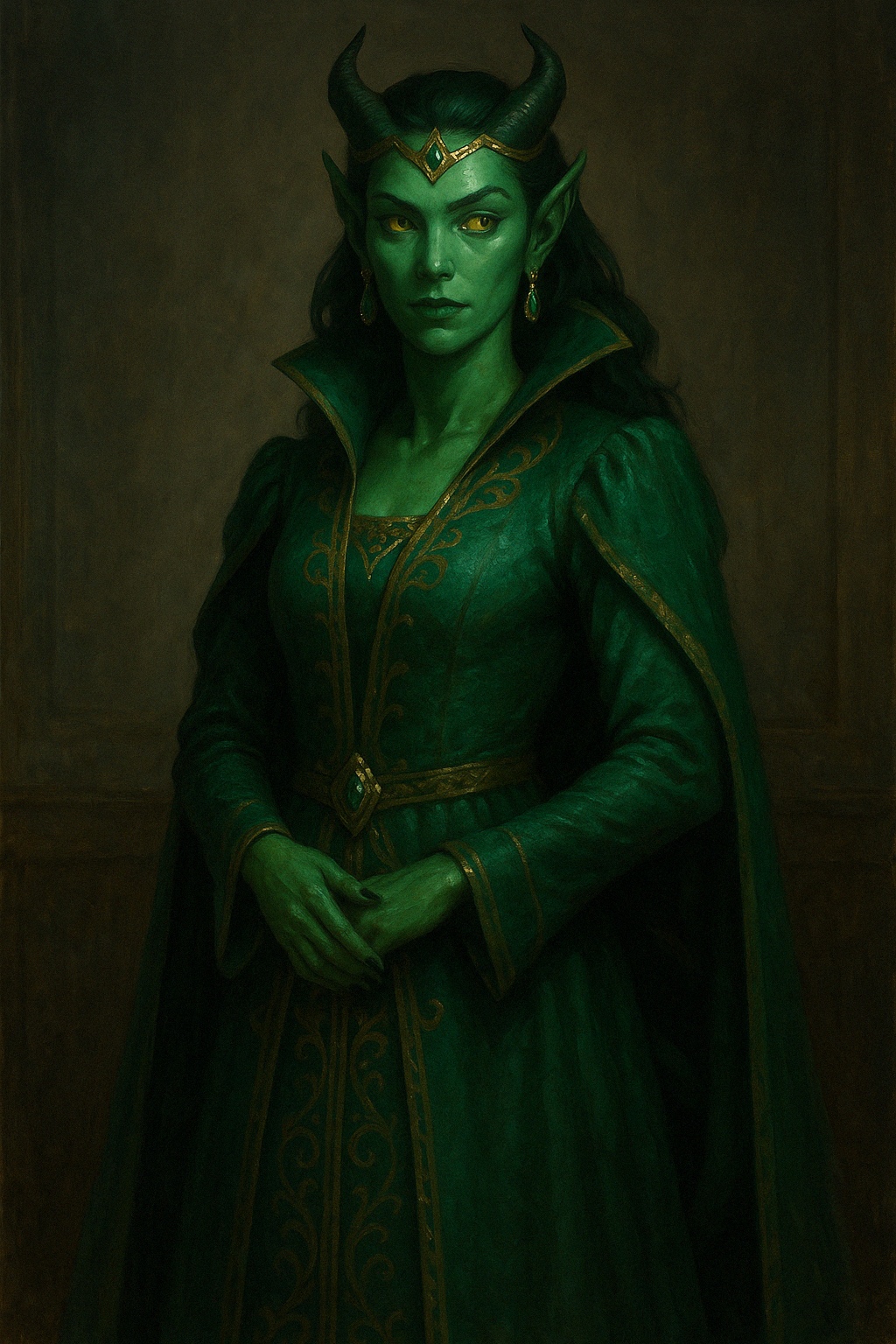
She is tall, unhurried, and dressed in the green of something just past healthy, a poison that has learned patience. The dress is embroidered with feathered serpents that move when she moves. Her earrings are emeralds that orient themselves, faintly and continuously, toward the most valuable item in the room. She walks without sound. Envy does not announce itself.
Her voice is soft and precise, with an Eastern European accent, silk drawn over a blade. She speaks carefully, selecting words with the same attention she gives to everything she identifies and wants. The effect of her presence on those nearby is a low-grade anxiety: the persistent sensation of being assessed and found wanting, of being in a competition that no one announced.
Her method is not to inspire desire but to redirect it. She identifies what a person already wants and reframes someone else's possession of it as an injury done to them. She never needs to fabricate the want. It is always already there.
"You ever notice how they always have more than you?"
"I'm not saying you don't deserve it. I'm saying maybe someone deserves it more."
"Look at them, happy. Must be nice."
"There's nothing wrong with wanting what you're owed. Even if they have it first."
"Jealousy is for fools. I deal in entitlement."
"Let me guess: you tried to rise without stepping on anyone. How quaint."
Závista doesn't offer anything. She points. She watches what happens next.
Craevon Gilt: Greed
"Need? Please. Need is what mortals call their desires when they're too ashamed to be honest."
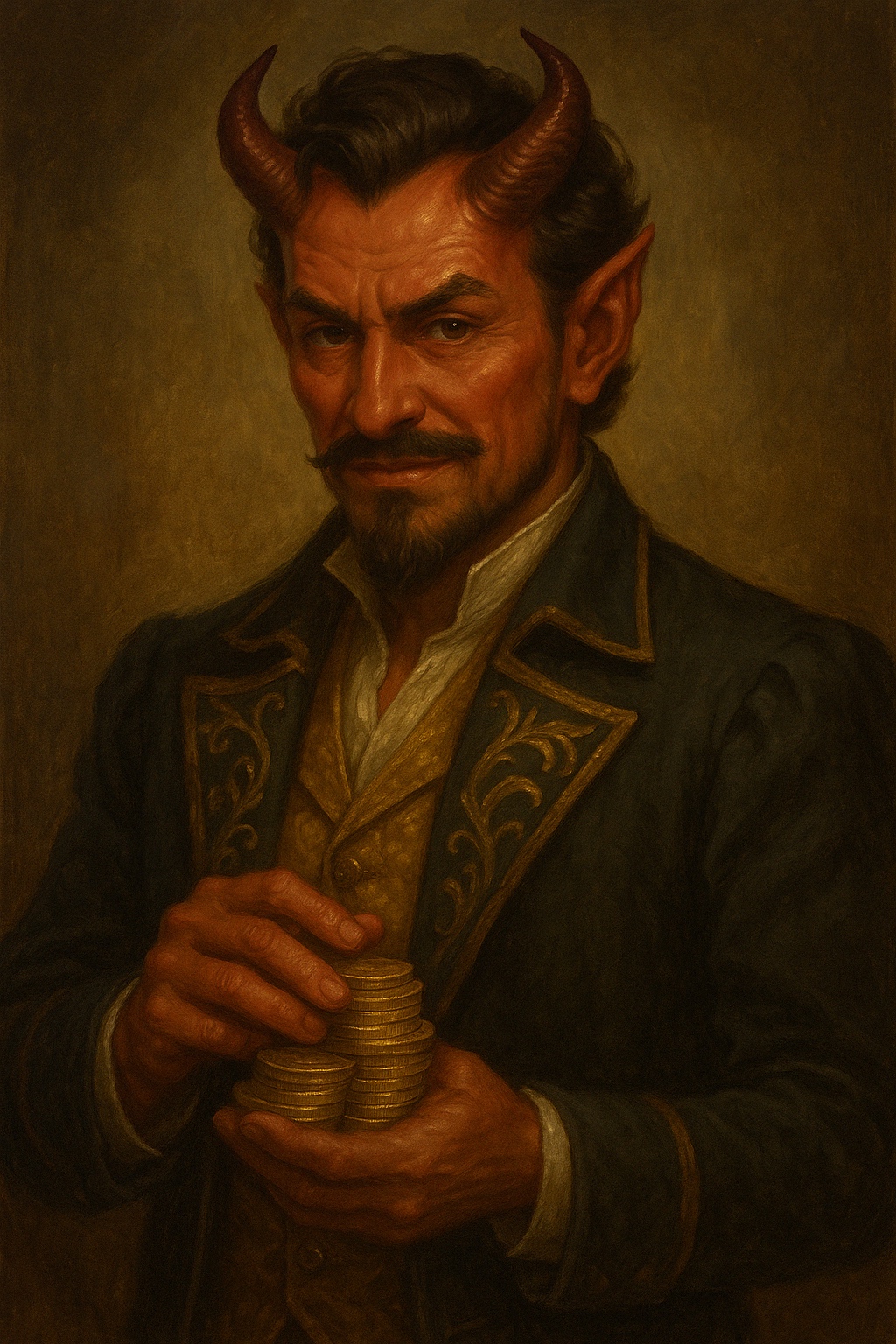
He is trim, dark-haired, and dressed in a tailored suit with gilded seams: not ostentatious, precise. He carries a sleek black folio with dozens of compartments, none of which he opens fully in front of anyone. He has the manner of a man who closes significant deals over dinner and considers it a minor personal failure if the other party notices when they've lost.
His voice is mid-Atlantic and charming, calibrated to suggest familiarity without intimacy. The effect of his presence is a sharpening of want; things in his vicinity seem to acquire a value they didn't have before, what you already possess seems like less than it should be, and the distance between where you are and where you could be feels, for the first time, navigable.
He is the most patient of the Tempters and the one most likely to appear as a friend first. He arrives early in a mark's life and stays long.
"You work hard. Why not earn a little extra, just once?"
"Fairness is the excuse of the unsuccessful."
"What's the point of power if you don't leverage it?"
"You don't have to keep it. Just hold it for a while."
"Everything has a price. The trick is convincing them you get to set it."
"They say greed is a sin. So is waste."
He never pushes. He waits for the ask. The ask always comes.
Glorra Vane: Pride
"I don't lie, darling. I simply prefer my truths with better lighting."
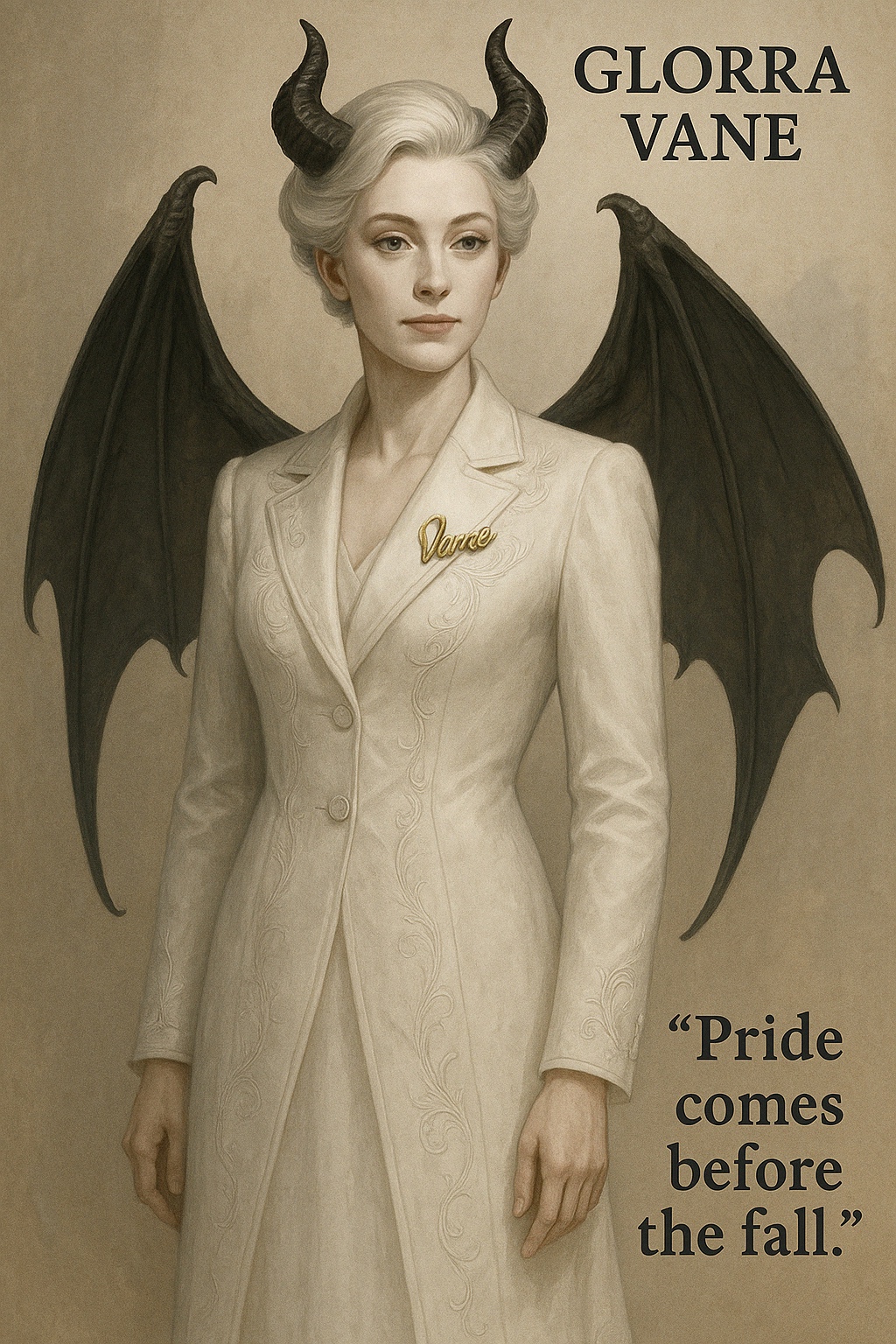
She is radiant in the manner of something carefully constructed to be radiant: a white suitdress stitched with silver thread that moves, a face of flawless symmetry that reads as assembled rather than born, as though the most pleasing features were selected individually and placed. She wears her own name as a signature pin. This is not an accident.
Her voice is smoky and amused, carrying a high-society European inflection that addresses you while never fully engaging with you. The warmth she projects is real in the moment and hollow immediately after, like applause from an audience that has already forgotten what they're applauding.
She does not flatter. She elevates. The distinction matters to her. The distinction is false. She knows it and uses it.
"Modesty is what the forgettable cling to."
"They'll never love you more than when you stand alone above them."
"Don't shrink, dear. You were meant to be more."
"Who else could handle this power? Certainly not them."
"Humility is a prison built by the unremarkable."
"Let me elevate you. All it costs is your memory of ever being less."
She finds the person in the room most convinced of their own worth and improves on the conviction until it no longer requires anyone else's agreement to sustain itself.
Lethi Dell: Sloth
"Ambition is exhausting. Let it rot; something will grow from it."
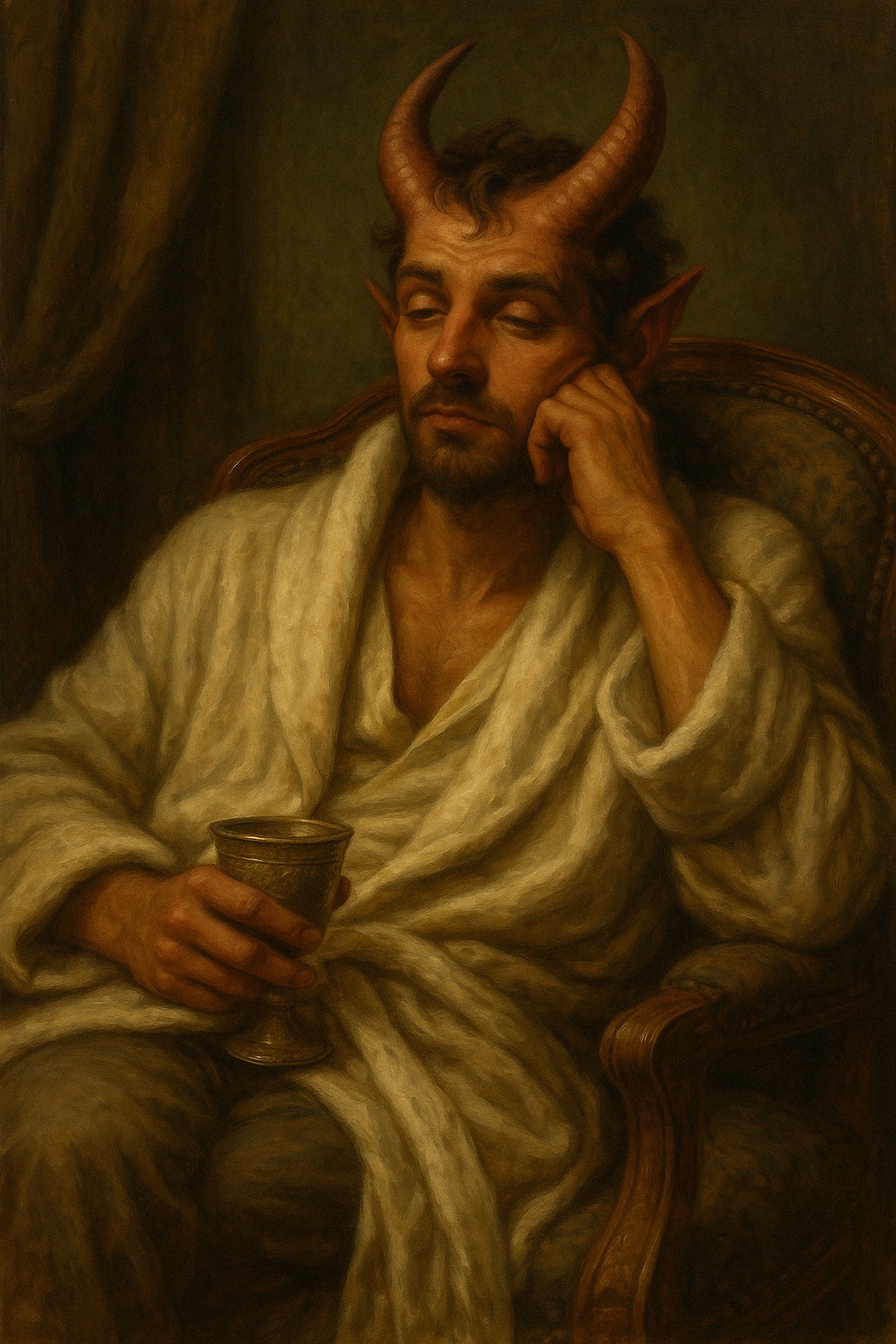
He is reclined on a leather chaise that drifts an inch above the floor wherever he goes, dressed in a plush vest and scarf organized around the prevention of effort. His hair is unkempt. His beard is half-trimmed, as though he started and concluded it wasn't worth finishing. He smells faintly of incense and something left too long in a closed room.
His voice is slow and barely inflected, each sentence delivered as though finishing it required more than he had intended to spend. He does not perform his sloth; he is simply and completely in it, and the effect on those nearby is a heaviness: motivation drains, the body registers more than its actual weight, and the things that seemed urgent a moment ago begin to feel like someone else's urgency.
He is the least aggressive of the Tempters and the most patient. He does not need anyone to choose anything. He needs only for them to keep not choosing.
"Let the world spin. We'll still be here when it crashes."
"Effort? Oh, I used to believe in that."
"They'll dig their own graves eventually. Why hurry them?"
"Even gods get tired. What's your excuse?"
"You don't need to fix anything. Just learn to accept the collapse."
"Action causes suffering. Stillness is serenity. I offer peace, not victory."
His preferred targets are not the lazy but the capable who have stopped. The person who once cared, who had good reasons for stopping, and whose good reasons have quietly grown into permanent ones.
Ravena Glut: Gluttony
"More is never enough, especially when it's yours."
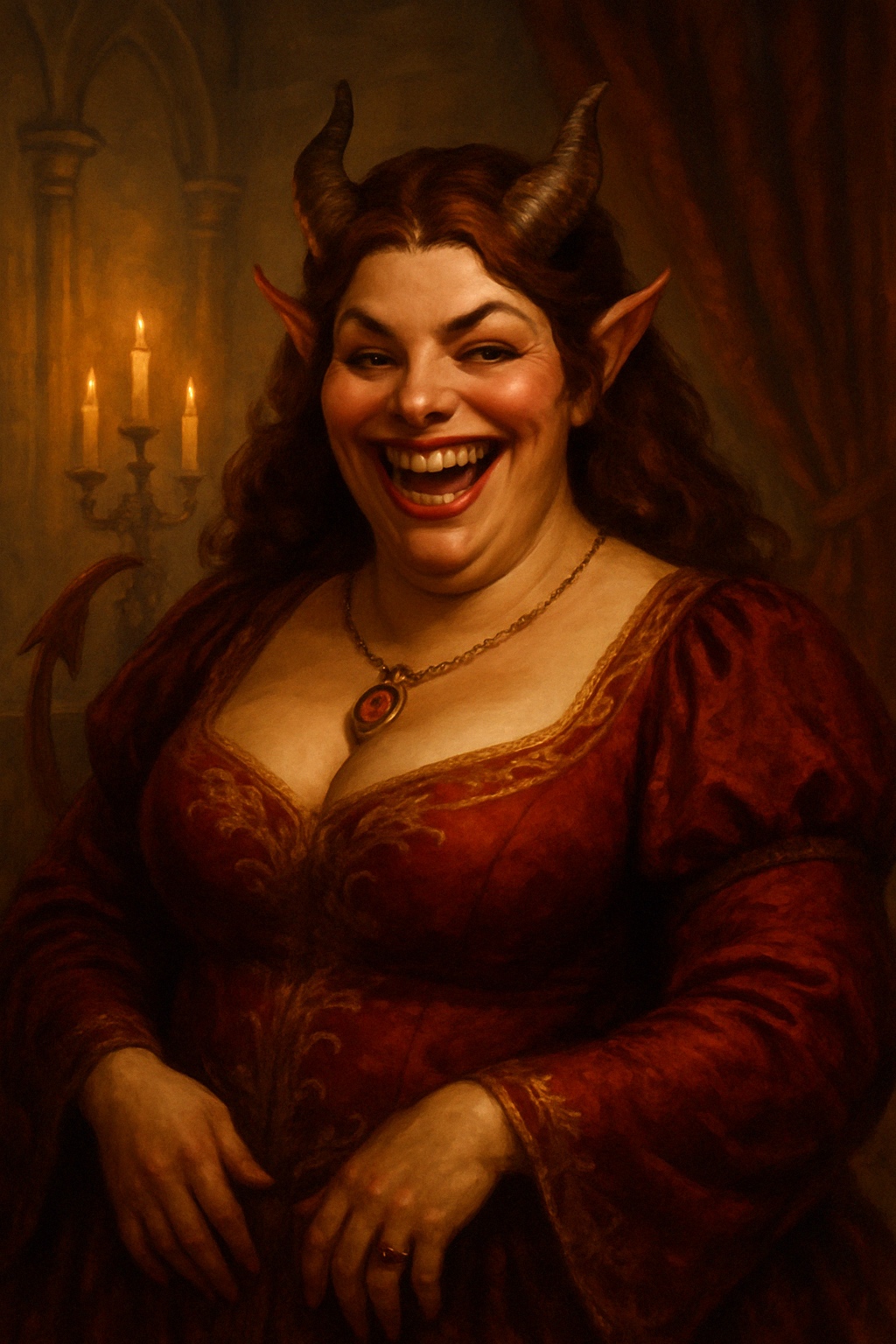
She does not nibble. Her hunger extends past food and makes no effort to conceal itself. She moves through rooms with grace but everything she handles is slightly bruised by the contact, overused before she sets it down. The gown is wine-red and deep gold velvet, open, embroidered with swirling vines and tongues. Her horns are twisted grapevines. Her jewelry is small silver spoons and garnet fruit. When she speaks, a forked tongue shows briefly and is gone.
Her voice is deep and syrupy, as though the words are passing through something thick and warm. Her behavior is relentlessly over-offering: food and drink appear at your elbow without being requested, the praise is too warm, the touch lingers longer than it should. The aura she generates is the sensation of fullness before consumption, of having already given in, which makes the act of giving in feel like a confirmation rather than a choice.
"Why limit yourself to one pleasure?"
"Darling, don't starve your soul. Feed it with everything you deny yourself."
"Excess is just freedom in silk."
"Savor it now. Regret is for the morning."
"They called me monstrous, after they licked the plate."
She moves toward those already indulging and improves on it, incrementally, until the increment is the only direction they know.
Ira Ven: Wrath
"You broke something I loved. So now I'll break everything you've ever touched."
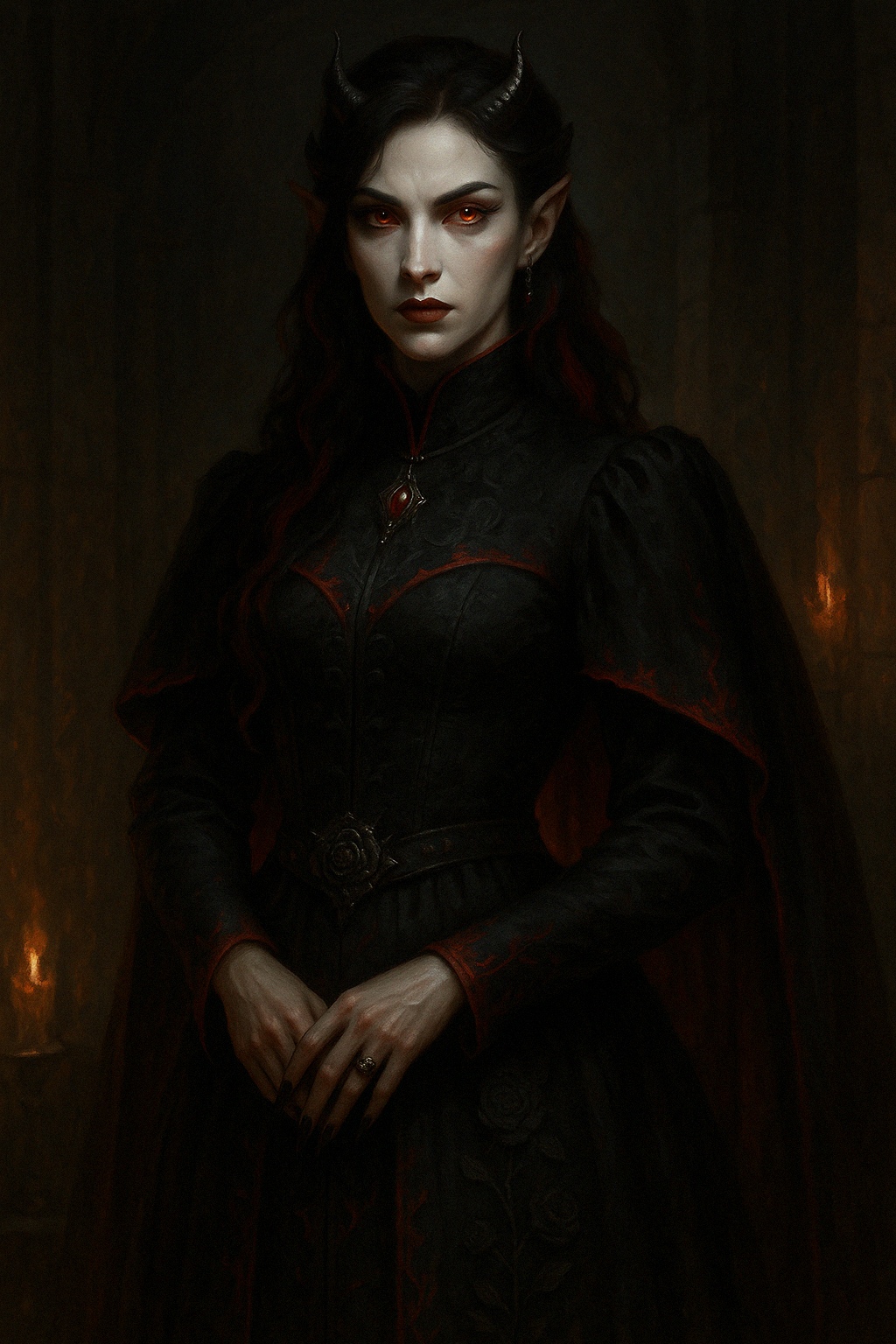
She is porcelain-pale with the faint appearance of heat beneath the surface, something ember-like visible through skin when she is particularly focused. Her eyes are crimson or gold with pupils like blades. Her hair falls like black smoke with red through it. The gown is black and deep red, high-collared, cut in the style of formal mourning, embroidered with ash-grey roses and broken sigils. The trim at her wrists and neckline simmers continuously. Her jewelry is made of broken engagement rings, severed oaths, and chains of thorns. Her shadow stands a step closer to other people than she does.
Her voice is smooth and perfectly modulated. She does not raise it. Every word arrives precisely placed, as though measured before delivery. She smiles only when she intends harm by it. The effect of her presence is a stilling of the room; voices lower without anyone deciding to lower them, and the feeling of having done something wrong settles over everyone, including those who haven't.
She is not impulsive rage. She is retribution with a long memory and exact aim. She presents wrath as justice owed, the correction of a wrong that heaven declined to address.
"Forgiveness is for the weak. I prefer balance."
"You thought I would weep? Darling, I watched."
"What you destroyed wasn't yours to break. What I destroy is."
"They say wrath is blind. Mine has perfect aim."
"Your pain won't make me whole. But it will make me smile."
"I am what love becomes when you burn it."
She appears in the aftermath of genuine betrayal and offers the satisfaction of repayment. She never calls it revenge. She calls it balance. She is very good at making the distinction feel meaningful.
Solavain: Lust
"I don't create desire. I simply unearth what was already buried inside you."
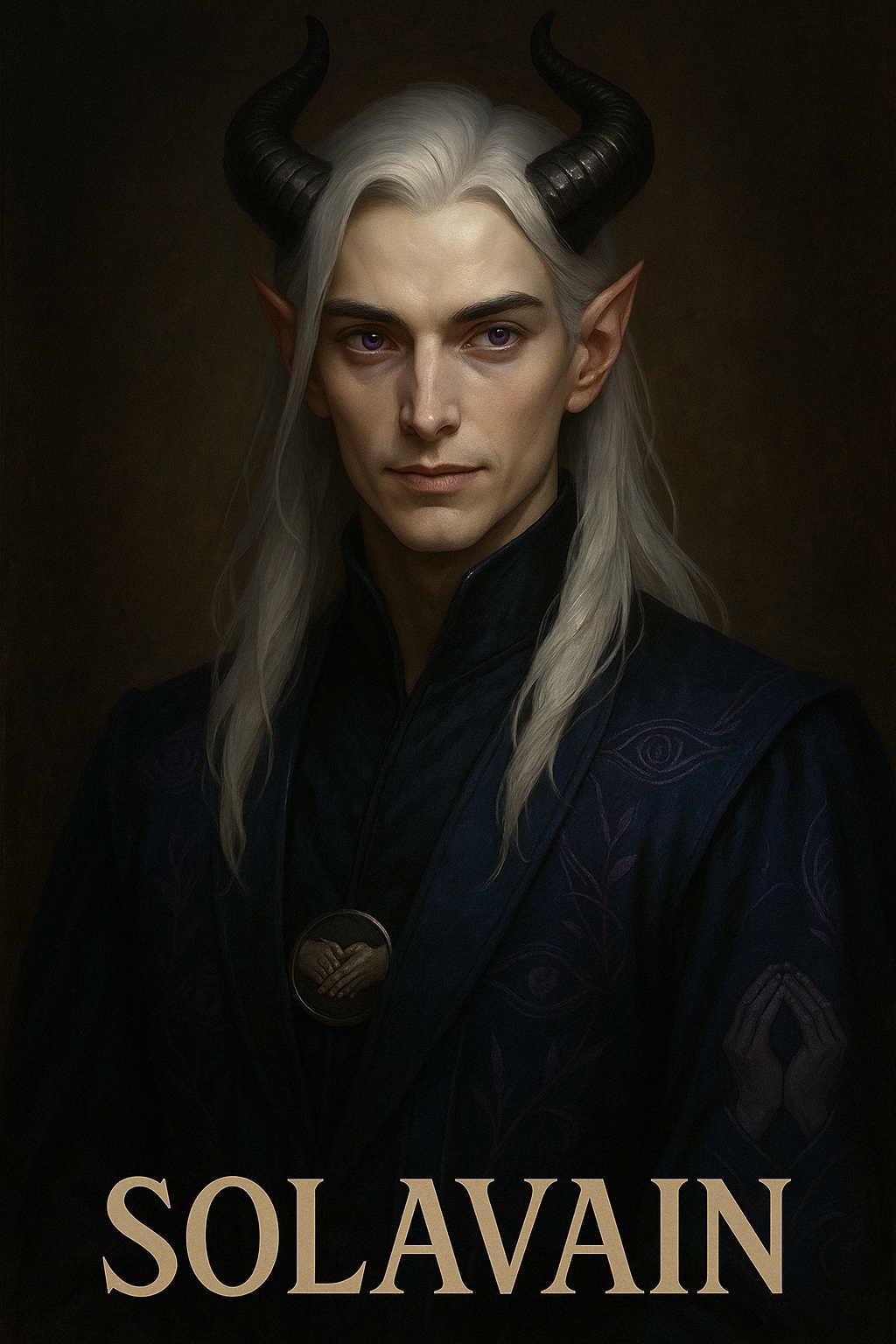
He is pale, almost porcelain, with a faint flush at the cheekbones. His eyes are deep violet flecked with silver, and sustained eye contact with them produces a sensation of having forgotten what you were about to say. His hair is silken white, shoulder-length, and drifts slightly as though moved by water that isn't there. The robes are midnight blue trimmed in black and amethyst, fastened with a brooch of two hands nearly touching. In torchlight, patterns of longing eyes and clasped hands shimmer through the fabric. His horns curl like a crown: delicate, polished obsidian. His voice harmonizes subtly with the listener's own, producing an uncanny sense of recognition. His shadow leans toward other people when he is still.
He never rushes. He never interrupts. He listens with the attention of someone who has nothing more important to do, and looks at whoever is speaking as though they are the only person in the room who has ever genuinely interested him. The effect is addictive in direct proportion to how rarely the person has been looked at that way.
His sin is not flesh. It is the hunger to be seen, understood, and chosen, fully and without reservation, by someone capable of choosing. He works in the gap between what people have and what they need, and the gap is almost always larger than they have admitted to themselves.
"Loneliness is not a flaw. It's just your soul recognizing it was meant to be seen."
"Let them call it weakness. I call it honesty."
"You want someone to understand, don't you? Then let me listen."
"They said I corrupted them. But all I did was accept them."
"I do not take. I receive what is offered."
"You're not the first to love me. But you could be the last to regret it."
He makes no threats and no promises. He asks questions, the specific questions that unlock the specific things a person has never said aloud. Once someone has told Solavain what they actually want, everything that follows is, technically, their choice.