Gale Dragon
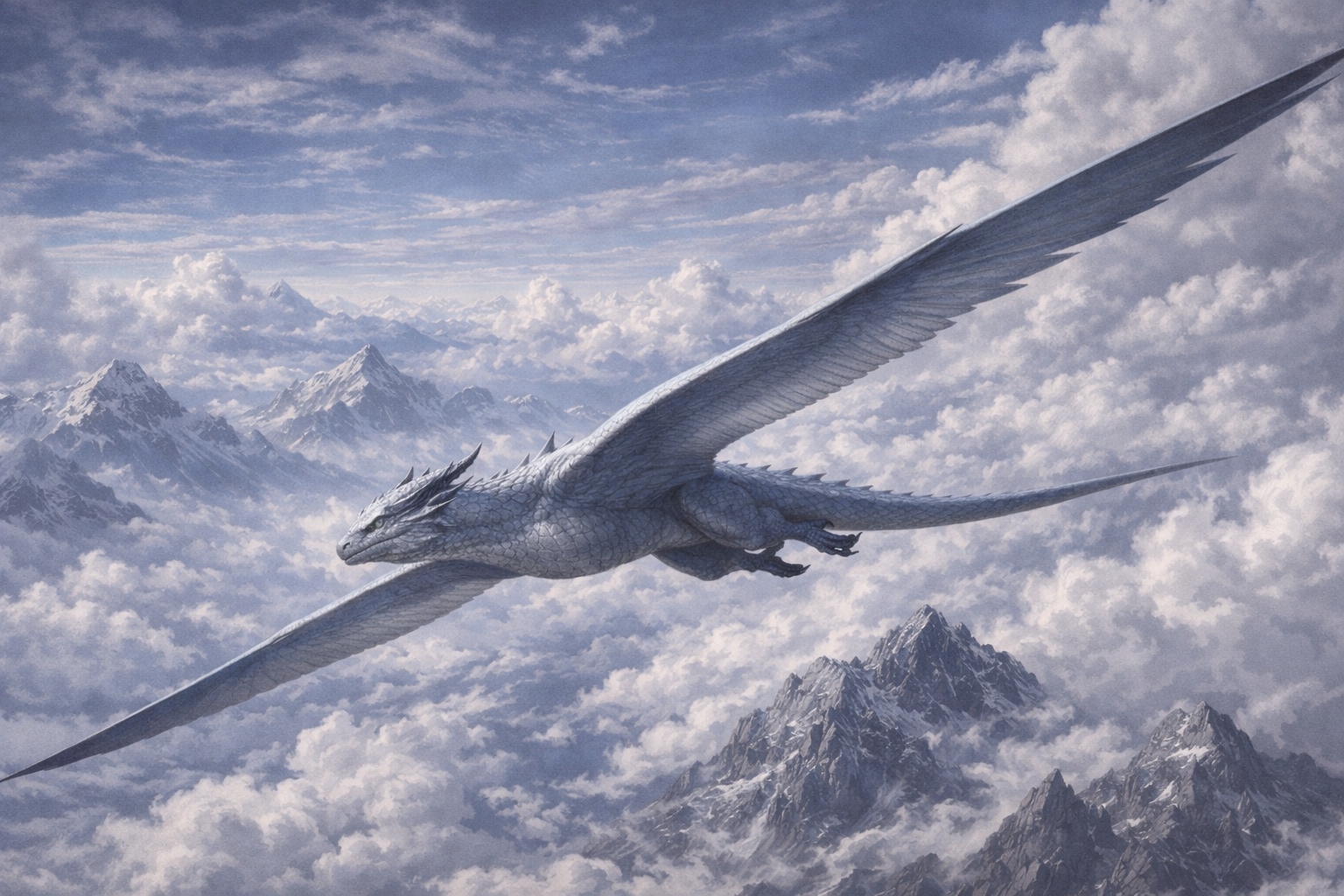
Gale Dragon
"It came from directly above. That is the part that stays with me. We were watching the horizon, the way you watch for anything, and it had been directly above us the entire time, circling at a height where it was simply the sky."
Testimony of Ilessa Vorn, survivor of the Thornpass Survey Expedition, [Irna](Irna/Welcome to Irna) Highlands Commission
IDENTIFICATION
- Common Name: Gale Dragon
- Plural Form: Gale Dragons
- Alternate Names: Stormwyrm (archaic, now considered inaccurate; implies weather manipulation the creature does not practice); Skywarden (used in parts of [Antaea](Antaea/Welcome to Antaea) where its territorial marking behavior is observed from below); Vai Sileth in an old [Irna](Irna/Welcome to Irna) highland dialect, loosely "the one that is already there"
- Classification: Dragon
- Sub-Classification: Elemental Apex, Air Plane-Affiliated
- First Recorded Observation: Air Plane affiliation is documented in dragon cosmological texts, but the first naturalist description is contentious; several scholars claim to have catalogued it, but verifying an aerial apex predator that attacks without warning makes confirming observations difficult. The most-cited formal description is from the naturalist Pereth Anlan, who spent two years in the [Irna](Irna/Welcome to Irna) highlands specifically to observe one.
OVERVIEW
At a Glance
The Gale Dragon is the smallest of the seven types and by a significant margin the fastest and most agile in the air. It is a creature of altitude and motion; it does not rest on the ground if it can help it, does not hunt from a stationary position, and does not engage in a way that allows a target to establish footing. It attacks from every direction in sequence, often within a single engagement, and its speed means that tracking its position is not possible for most opponents before it has already moved. Of all the dragons, it is perhaps the most purely a creature of its element: remove the sky and there is almost nothing left of the Gale Dragon.
Role in the Ecosystem
The Gale Dragon is the apex predator of high-altitude environments: above the treeline, in the mountain passes, on the cloud-level plateaus. Its pressure on large aerial fauna shapes the behavior and population of those animals, and its presence at altitude influences which species can use the high-sky corridor. Its lair, constructed within dense cloud formations, creates localized weather modification; the clouds it occupies and works are denser, more persistent, and more electrically active than surrounding formations, creating a microclimate that affects precipitation patterns in the mountains below. Some high-altitude plant communities exist specifically because of the rain shadows and moisture concentrations these persistent cloud formations create.
General Reputation
Mountain communities throughout Dort have traditions about something that hunts from altitude, something that cannot be spotted until it is too late. The specific attribute most consistently attributed to the Gale Dragon in folk tradition is the impossibility of seeing it before it acts. It does not appear on the horizon. It is either absent or present without transition. Highland military traditions account for this by abandoning the conventional watchman's horizon scan and adding upward-looking sentinels, but the altitude at which the Gale Dragon operates means that even vertical surveillance rarely provides useful warning time. The attitude of most communities in its range is respectful resignation: cross high passes quickly, do not shelter on open ridgelines, be off the plateau before clouds build.
PHYSICAL DESCRIPTION
General Appearance
The Gale Dragon is lean and long-winged in a way that prioritizes speed above everything else. The body is narrow and streamlined, the neck proportionally longer than in other types to improve aerodynamic line, the tail tapering to a fine point that serves as a stabilizer at high speed. The wings are the defining feature: they are extremely long relative to the body, longer than in any other dragon type, with a swept-back profile and a flexible leading edge structure that allows adjustment for different airspeed and maneuver regimes. The wing surface is different from other types in texture, with a slightly porous quality that manages turbulence at the microscopic level, a feature unique among known flying organisms.
Coloration is optimized for sky camouflage. The dorsal surface is blue-white to pale grey, the specific shade varying with the age and geographic population of the individual, calibrated to match the sky seen from below. The ventral surface is darker, the grey-blue of overcast sky seen from above, providing counter-shading that makes the animal difficult to see from either direction. The eyes are pale, with a nictitating membrane that activates at high speed to protect the eye surface without interrupting vision. At altitude, in good light, a Gale Dragon overhead is at the limit of visual resolution for most beings.
Size and Dimensions
- Typical length/height: 12 to 18 meters in body length, the smallest of the dragon types
- Typical weight/mass: Proportionally light for a dragon of any length; the bone structure is hollow and the musculature dense but not massive
- Notable scale reference: A Gale Dragon's wingspan, despite its small body, rivals that of much larger dragons due to its extreme wing elongation. The body itself could fit within the cargo space of a large merchant vessel. This size contrast with the wingspan is the most surprising feature on first close encounter.
Distinguishing Features
The extreme wing length relative to body size is the most distinctive structural feature. In flight at altitude, the Gale Dragon's silhouette (long, narrow, swept back) is unlike any other large flying animal. Its movement is the secondary identifier: it changes direction without the banking arc that any other winged creature of its size would require, snapping between headings in ways that violate the expected physics of flight. This movement quality is both a behavioral signature and a combat characteristic. The breath weapon of the Gale Dragon is a high-pressure air burst rather than fire or water, a focused compression that at close range has a concussive and cutting effect, and at range produces a shockwave capable of destabilizing anything in flight.
Sensory Apparatus
The Gale Dragon perceives air currents as a primary sense; it reads the sky's movement patterns the way other creatures read light, able to detect the disturbance signature of any object in the air at significant range. It knows what is flying, where, how fast, and in what direction, from the disruption that movement creates in the air column. At altitude, where air is thinner and currents are more legible, this sense operates at extreme range. Its visual acuity is the highest of any confirmed organism in Dort, adapted to resolving fine detail at distances where high-altitude hunting requires it. The combination of air-sense at range and visual resolution at distance makes the Gale Dragon functionally impossible to approach from above without its knowledge.
BIOLOGY
Diet and Feeding
The Gale Dragon preys primarily on large aerial fauna at altitude: the great mountain birds, high-altitude mammals on exposed ridgelines, occasionally creatures much larger than itself that it takes in a coordinated multi-pass attack. It does not feed on ground-level prey if it can avoid it; coming to ground for extended periods is uncomfortable and exposes it to a tactical vulnerability it is not equipped to manage. It eats in the air when possible, which requires catching prey in flight. Kill sites, when they occur on the ground, show the same thorough consumption pattern as other types, but Gale Dragon kills are more often found at altitude: on high ledges, on exposed plateaus, in places where the dragon briefly landed to feed before returning to altitude.
Reproduction and Life Cycle
The Gale Dragon's reproductive period carries the same once-in-a-lifetime characteristic as all dragon types. The female's behavioral change during ovulation is expressed primarily as extreme territorial contraction; she becomes unwilling to leave the cloud lair for any but the most necessary hunts, and her aggression toward anything that approaches the lair increases to lethal threshold. The eggs are deposited in the cloud lair itself, suspended in the dense atmospheric formations the female maintains. This is among the most unusual egg-laying contexts of any dragon type: the eggs are kept aloft by the cloud structure and the female's active maintenance of it. Hatchlings emerge already capable of flight, which they must be; the lair has no ground surface.
Lifespan and Development
- Juvenile period: Several decades, during which young Gale Dragons develop their full aerial capability. Juveniles range widely and have not yet established territory; they are the most mobile and least predictable life stage.
- Typical adult lifespan: Biologically unlimited. An aged Gale Dragon, having declined to pass for centuries, would be significantly larger than a young adult (eventually approaching the middle size-range of other types), but would retain the agility characteristics unique to this body plan.
- Elderhood: The oldest Gale Dragons are notable for their lair formations; the cloud structures they maintain, having been worked and reinforced over centuries, become nearly permanent meteorological features, identifiable on any honest weather map of their regions as anomalous persistent cloud cover.
Relationship to Magic
Air Plane affiliation in the Gale Dragon manifests most clearly in its breath weapon, which generates air-compression forces beyond what any biological mechanism should produce, and in its flight physics, which violate what the wing structure and body weight should allow. The direction-change speed and maneuver envelope it operates in require either a different physical relationship with air than other winged creatures, or supplementation from the Air Plane that partially removes the drag and inertia constraints that govern everyone else's flight. Scholarly opinion leans toward the latter interpretation. Air-based magical attacks directed at the Gale Dragon appear to have significantly reduced effect, consistent with affiliation insulating it against its own element.
Environmental Adaptations
The Gale Dragon is the most altitude-adapted of the dragon types. It operates comfortably at heights where the air pressure is insufficient for any conventional flier, appears to extract oxygen from the thin atmosphere at efficiency no other organism matches, and shows no behavioral distress in conditions that would produce incapacitation in other large animals. Its hollow bone structure and reduced mass are standard high-altitude adaptations; the detail of its wing surface and the specific profile of its breathing architecture go beyond standard adaptation into what appears to be a biological integration with Air Plane conditions.
BEHAVIOR
Intelligence and Cognition
Full dragon intelligence, expressed in a behavioral profile that emphasizes speed of decision over deliberation. The Gale Dragon appears to process situational information faster than other types; its attack sequence and direction-change decisions occur at intervals that suggest a cognitive tempo matching its physical one. It is not impulsive; it is fast. The distinction matters for understanding how to interact with it: it makes considered choices, but the consideration takes place in a fraction of the time other beings would require.
Social Structure
Solitary and territorially exclusive against same-type individuals, consistent with all dragon types. The Gale Dragon's territory is defined vertically as well as horizontally; it controls a column of sky above its ground range, from the ridgeline to effective ceiling altitude. Different dragon types can coexist in overlapping geographic areas without territorial conflict; the Gale Dragon's airspace may sit above Ore Dragon ground territory without interaction.
Territory and Range
The territory of a Gale Dragon is measured in high mountain range and the airspace above it. Several major mountain chains per individual, covering enormous horizontal distance and the full altitude range up to where air becomes too thin even for the Gale Dragon's capabilities. Boundary marking is done through a combination of vocalization (the air-burst breath weapon used at boundaries produces distinctive sound signatures) and the positioning of the cloud lair, which is itself a territorial marker visible from extreme distance.
Daily and Seasonal Patterns
The Gale Dragon is the most continuously active of the dragon types. It does not rest on the ground in normal circumstances and appears to sleep in short intervals while airborne, a behavior documented in some large seabirds and presumably possible through the same autonomic flight maintenance. It is most active in high winds, which it uses to extend range and reduce energy expenditure. In severe weather, storms of the scale that ground all other aerial activity, the Gale Dragon is at its most active, using the storm energy to fly in conditions that nothing else can operate in.
Hunting, Feeding, or Foraging Behavior
The Gale Dragon hunts from directly above and from speed; it does not ambush in the concealment sense but in the altitude sense, operating at heights where it is effectively invisible, watching with its exceptional visual acuity for prey below, and descending in an attack pass that converts altitude into speed. The attack from directly above is the most consistent pattern: the prey never sees it coming from the expected direction. Against large prey or defended targets, the Gale Dragon uses repeated passes rather than a sustained engagement; it strikes, pulls up, repositions above, strikes again, never remaining in contact long enough for the target to establish a response. The breath weapon is used to break formations, destabilize opponents in flight, and stun before the physical strike.
Communication
Dragon tongue, as with all types. The Gale Dragon's vocalizations have an unusual acoustic quality at altitude; the thin air distorts them in ways that make them carry differently than at ground level, and they overlap with natural wind sound in ways that make them difficult to identify as biological in origin. This may be functional; other Gale Dragons can apparently parse the signal from the background where mortals cannot.
HABITAT AND RANGE
Primary Habitat
High altitude: above the treeline, in and above the mountain cloud layer, on exposed ridgeline and plateau terrain. The Gale Dragon requires altitude and open sky; it does not inhabit forest, deep valley, or any terrain that significantly restricts aerial maneuverability. The lair specifically requires a dense cloud formation of sufficient persistence to maintain a physical structure within it, which limits lair placement to regions where clouds regularly form and are sustained by mountain uplift. This makes high mountain ranges the primary habitat.
Geographic Distribution
The major mountain ranges of [Irna](Irna/Welcome to Irna) and [Antaea](Antaea/Welcome to Antaea) are the best-documented territories. The high interior ranges of [Shoing](Shoing/Welcome to Shoing) and [Funta](Funta/Welcome to Funta) are probable habitat but less surveyed at altitude. The flat central plains of [Jazirah](Jazirah/Welcome to Jazirah), without sufficient orographic uplift to sustain cloud-lair formation, are absent of confirmed Gale Dragon territory. The Second Lands' interior highlands are incompletely surveyed but presumed to contain at least one territory based on the altitude and geography.
Lair and Den Characteristics
The Gale Dragon's lair is a dense cloud formation: not simply a cloud the dragon rests within, but a cloud mass the dragon has actively worked and structured over years or decades, increasing its density, persistence, and internal formation until it is capable of supporting physical objects. The internal structure of a mature Gale Dragon lair is effectively a collection of dense fog chambers and open interior spaces, with the hoard (maps, in all their forms) maintained on surfaces the dragon has constructed within the cloud itself. The external appearance is of a large, unusually persistent cloud that does not move with the wind the way surrounding clouds do. From the outside, there is nothing to indicate that the cloud contains anything. Entry requires flight capability; there is no ground approach. The electrical activity within a mature lair cloud is significant and constitutes an additional hazard to entry.
THREAT AND DEFENSE
Threat Response
The Gale Dragon's engagement threshold is territorial violation, anything that approaches the lair cloud or occupies its hunting range at altitude. Its default response to non-threatening presences is to simply ignore them from above, which means that travelers crossing its territory on the ground may never be aware of the observer overhead. The shift from observation to engagement is difficult to predict and may depend on factors mortals cannot assess.
Offensive Capabilities
Speed is the first weapon: the Gale Dragon descends into an attack pass at speeds that leave no time for a conventional response. The breath weapon, the air-burst compression, is its primary offensive tool and is effective at range in ways that a physical attack requires close proximity for. Against opponents in flight, the breath weapon is particularly effective, since the concussive effect destabilizes wing function. Claws and the physical impact of a strike at speed are devastating in close contact. The Gale Dragon does not remain in close contact; it uses the sustained-velocity technique of attacking through a target rather than landing on it, which means each strike involves the full speed of the descending pass rather than standing-strength alone.
Defensive Adaptations
Altitude is the primary defense; it is unreachable except on its own terms. The camouflage at altitude, combined with the air-sense that detects any approach, means it cannot be surprised. Its speed and maneuverability make it effectively impossible to hit with a ranged weapon if it is paying attention; it can reposition faster than a projectile can be aimed. The extreme agility that makes it an effective attacker makes it an extremely difficult target.
Known Vulnerabilities
The Gale Dragon is least capable at ground level. Forced to land and fight in close quarters, in terrain where its aerial advantages are neutralized, it is smaller and physically weaker than most other dragon types. Experienced accounts of Gale Dragon encounters that did not end in total loss describe getting it to ground, or into enclosed mountain passes where the direction-change maneuverability is reduced by terrain walls. Its breath weapon is less effective at very low altitudes where air density increases; the compression mechanism appears calibrated for thin-air conditions. Fire causes it physical distress disproportionate to what its body structure would suggest, which naturalists attribute to its Air Plane affiliation creating a sensitivity to the fire-air interaction.
Disengagement and Flight
The Gale Dragon withdraws at the speed of decision. There is no pursuit scenario where it cannot disengage; it simply climbs to altitude that nothing else can follow. What is less clear is whether it considers any given engagement worth continuing. It has been observed breaking off attacks that were going in its favor, for reasons that observers could not determine.
TRACES AND SIGNS
Physical Evidence
Gale Dragon territory at altitude leaves specific trace patterns. The most reliable is the persistent cloud formation of the lair itself: a cloud mass that does not behave like surrounding clouds, that remains when others dissipate, that produces its own weather including localized electrical discharge. On the ground, kills leave the physical evidence common to dragon predation: bones of large mountain fauna with damage inconsistent with any other predator, often found at altitude where they were dropped during or after a feeding pass. The characteristic pattern of a Gale Dragon kill site is the position: not at ground level where most predation occurs, but on exposed ridgelines, ledges, and summit plateaus where the dragon can land briefly.
Environmental Disturbance
Long-term Gale Dragon territory is identifiable by the weather modification around the lair formation. The persistent cloud produces more precipitation in some areas, less in others, and the electrical activity of mature lair clouds strikes the surrounding rock repeatedly, leaving lightning scar patterns visible on exposed stone. Wind patterns immediately below the lair cloud tend to be more turbulent than equivalent terrain without the cloud presence, as the dense formation disrupts normal airflow. Vegetation patterns on high slopes sometimes reflect the consistent precipitation and shadow cast by a lair cloud that has been present for centuries.
Behavioral Indicators
High-altitude fauna behavioral change is the most useful pre-encounter indicator. Mountain birds that ordinarily patrol the highest ridgelines abandoning that airspace, with flight behavior oriented downward rather than up, is a reliable signal. Large mountain predators, animals that are not shy of altitude, avoiding exposed high terrain and clustering at lower elevation than typical is another. There is a secondary behavioral indicator involving behavior that is not easily explained except as response to the specific threat: animals moving with urgency away from exposed positions toward rocky cover, in the absence of visible weather, is one of the patterns highland guides learn to read.
Auditory and Sensory Indicators
The sound of a Gale Dragon in attack configuration, the high-pitched resonance of its pass at speed, is the most immediate auditory indicator, but by the time it is audible the dragon is already in the attack. More useful is the pre-attack auditory environment: the cessation of wind sound in a specific direction, the brief atmospheric stillness that sometimes precedes a Gale Dragon descending out of its altitude layer. Experienced highland guides describe this as "the sky going quiet the wrong way." The breath weapon, when fired, produces a concussive shockwave audible at significant range and distinctive from any weather sound.
IN-WORLD KNOWLEDGE
Scholarly Understanding
The Gale Dragon is among the most difficult to study at any depth, because the study requires altitude and the subject operates at altitudes that are marginal for mortal survival. Most formal scholarship consists of confirmed sightings, the study of kill sites, and the examination of lair cloud formations from a distance. Pereth Anlan's two-year study in the [Irna](Irna/Welcome to Irna) highlands remains the most sustained scholarly effort, and it produced description, behavioral pattern observation, and the first serious analysis of the lair cloud formation, but no close biological examination. The flight physics anomaly, the direction-change behavior that should not be physically possible, is acknowledged by scholars as requiring the Air Plane affiliation explanation, since no mechanical account is satisfactory.
Folk Knowledge and Tradition
Highland communities have the most accurate practical knowledge. The upward-looking sentinel tradition in mountain passes is directly attributable to Gale Dragon presence in the region; communities that forgot this practice have records of corresponding incidents. The cloud-reading traditions of high-altitude shepherd communities often encode Gale Dragon lair cloud identification as part of weather reading; the "bad cloud that doesn't move" is treated as a category separate from ordinary weather, with associated behavioral protocols that amount to: don't shelter beneath it, don't try to pass through the pass it's above, give it the ridge. Scholarly dismissal of these traditions as superstition has been revised several times following incidents that the folk protocols would have prevented.
Known Uses
The same total-use logic applies to the Gale Dragon as to other types; the practical challenge is the recovery context. Gale Dragon parts are recovered primarily from ground-based encounters, the rare landing or the rarer death in accessible terrain. The wing membrane, if intact, is among the most valued materials in Dort for specialized applications requiring extremely light, extremely strong, flexible structures. The respiratory organs, which manage oxygen extraction at altitude, are of considerable interest to alchemists working on breathing compounds. The hoard, which consists of maps accumulated over centuries, represents a cartographic record without equal for the regions the dragon's territory covers: maps of places that may no longer be accessible to survey, records of passes that have since closed, charted routes through territory that no expedition has revisited.
Creature Ecology Template v1.0, Dort World