Anansi
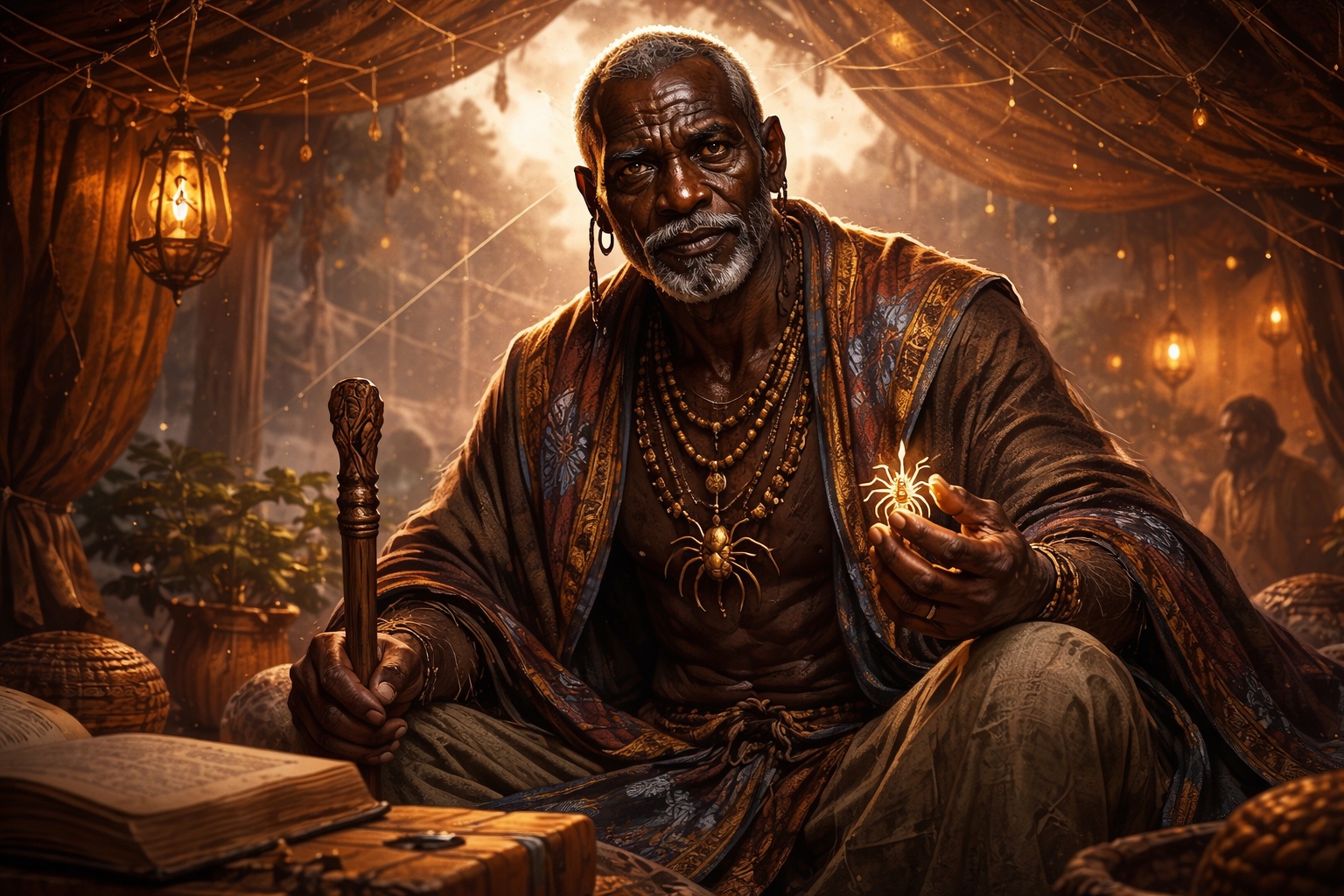
Anansi
The Weaver of Stories. The Laughing Witness. The Web Between Moments.
At a Glance
- Portfolio: Story, oral tradition, trickery without malice, evolution of narrative, communal memory, illusion, adaptive identity
- Virtues (as the faithful name them): Wit, adaptability, creativity, hospitality, joy, interpretive wisdom
- Vices (what Anansi opposes): Stagnation, dogma, harmful deceit, rigid authority over truth, joyless solemnity
- Symbol: A spider suspended at the center of a web whose threads dissolve into script or smoke
- Common worshippers: Bards, actors, illusionists, rogues, traveling merchants, caravan masters, festival organizers, street performers, political manipulators with a conscience
- Common regions: Strongest in Funta; widely present in cities with strong tavern, theatre, and marketplace cultures
Names & Identifiers
- Common name (internal): The Weave
- Formal name (legal/ceremonial): The Order of the Living Thread
- A follower: A Threadbearer
- Clergy (general): Weavers
- A temple/shrine: A Storyhall or Webhouse
- Notable colloquial names: "Tavern Priests," "Spiderfolk," "Laughing Clerks"
Origin & History
Anansi was not born in conquest, nor carved from dominion. He emerged in accident.
When two minor shards of Ix (neither large enough to claim territory nor stable enough to anchor a domain) collided in the Shattered Domain, the impact did not produce fire, sea, death, or light.
It produced illusion.
From the interference of divine fragments came pattern. From pattern came connection. From connection came awareness. Anansi did not rise as a sovereign god. He coalesced as a witness: a consciousness born in the tension between narratives.
He observed first.
He watched as the greater shards claimed domains, as mortals bound themselves in fear and devotion, as history calcified into doctrine. He saw something the others did not: stories were being born faster than gods could control them.
So he began to tell them.
Not to dominate, but to reshape.
Anansi's earliest manifestations in the mortal realm were subtle: an old traveler at a fire correcting a tale with a better ending; a jester whose insult prevented a war; a thief whose legend grew larger than his crime; a weaver who dreamed myths into her tapestries.
Where other gods demanded scripture, Anansi whispered revision.
Where other gods established temples, Anansi sanctified taverns.
He established his place among the gods not by territorial claim but by inevitability. Every deity, every mortal, every infernal power: all become stories.
And stories belong to him.
He is tolerated by most shards because he does not seek dominion. He is resented by those who require rigidity. He is feared quietly by gods who depend on unchanging dogma.
Anansi has never needed to expand. He simply persists wherever narrative exists.
Bridhel
Amaterasu came to him deliberately. She had watched mortals make songs and stories out of suffering they had no other way to carry, and she understood that this was a real thing happening in the world that no god was tending. Her own gift was warmth and growth, which was not the same. She needed the other half: the understanding that a story is not a record of reality but an operation performed on it, that a thing retold is a thing changed, that this is not a flaw in stories but their entire function.
Anansi, who coalesced out of the interference between two shards and has never been sovereign over anything, found the request extremely funny and agreed at once.
Bridhel got her mother's conviction that suffering can be transformed rather than merely endured, and her father's knowledge that the transformation is done with narrative rather than with light. Anansi is fond of her and takes no credit, which is consistent: he is a witness god, and he regards claiming authorship of a daughter as the same category error as claiming authorship of a story that other people are still telling.
The Divine Compact
What Anansi promises:
Relevance. Voice. The power to reshape how events are remembered.
Common boons:
- Charismatic presence when storytelling or performing
- Heightened instinct for social leverage
- Subtle illusory magic tied to narrative framing
- Luck that favors improvisation
Rare miracles:
- Entire events rewritten in public memory
- Illusions indistinguishable from lived experience
- A mortal's humiliation turned into triumphant legend
- The prevention of violence through perfectly placed wit
Social benefits:
Belonging to networks of performers, informants, and cultural influencers. Access to Storyhalls across regions. Mutual protection among traveling artists.
Afterlife promise / fear:
The faithful do not seek static paradise. They believe their essence joins the Eternal Weave, their voice becoming part of the background hum of future tales.
To be forgotten entirely is the only true death.
Costs / conditions:
Followers must never declare a story final. They must resist rigidity. They must not weaponize deception for cruelty. Those who attempt to fix narrative permanently often find their own stories unraveling.
Core Doctrine
-
All Stories Breathe.
A tale must evolve with each telling, or it suffocates. -
Truth Is Layered, Not Singular.
What is remembered shapes reality as surely as what occurred. -
Trickery Must Enlighten.
Deception that harms for selfish gain is corruption; deception that reveals hidden truth is sacred. -
Joy Is Divine Resistance.
Laughter weakens tyranny. Wit unravels oppression. -
No Narrative Is Owned.
Once spoken, a story belongs to those who carry it forward.
Soul Coins & Divine Economy
How Anansi gains soul coins:
- Oral storytelling that reshapes listeners
- Improvised performance
- Creative adaptation of old myths
- Public acts of harmless trickery that expose hypocrisy
What makes a coin "heavy":
Authentic creativity. Personal risk taken in service of narrative evolution. A moment when a story changes a community.
What Anansi spends coins on:
- Illusions of immense subtlety
- Protection of Storyhalls
- Nudging events toward irony or poetic resolution
- Weakening rigid divine influence in key regions
Trade:
Anansi rarely trades coins. When he does, it is for information, not territory.
Infernal competition:
He opposes infernal forces that weaponize deception for despair. His clergy undermine such actors by exposing their narratives publicly rather than confronting them militarily.
Sacred Spaces
Anansi's sacred spaces are not monumental.
Storyhalls are often taverns, theaters, caravan wagons, or open plazas. A place becomes sacred not by architecture but by gathering.
Common elements:
- Circular seating (no singular authority point)
- Web motifs subtly woven into beams or textiles
- A central fire or lantern
- Elevated but modest performance space
A neglected Storyhall does not lose power; it simply becomes quiet. Silence, not decay, is its danger.
Organizational Structure
The Order of the Living Thread has minimal hierarchy.
- Weavers: Full clergy, recognized storytellers with proven improvisational mastery.
- Threadkeepers: Senior Weavers who safeguard relics and organize festivals.
- Threadbearers: Lay members.
Authority is earned through audience respect and narrative influence, not appointment.
No single High Weaver exists permanently. Leadership rotates organically based on cultural weight.
Entering the Faith
Recruitment is passive.
The faith attracts those who already feel called to storytelling or performance.
Soft entry: attending Storyhall gatherings.
Formal initiation: telling a known myth before a Weavers' circle and altering it meaningfully without diminishing its spirit.
If the audience breathes differently by the end, initiation is complete.
The Faithful in Practice
- They answer questions with parables.
- They laugh at tension first.
- They defuse hostility through reframing.
- They distrust written absolutes.
- When challenged, they ask: "Who benefits from this version?"
Taboos
- Fixed Canon: Declaring a single immutable version of a tale sacred above all others.
- Cruel Deception: Manipulation that produces lasting harm.
- Joyless Assembly: Gatherings devoid of humor or creative spark.
- Silencing Others: Denying someone the right to tell their story.
Obligations
- Share stories regularly.
- Adapt tales creatively.
- Host travelers when possible.
- Challenge rigid authority through wit rather than violence.
Holy Days & Observances
All holy days across Dort are listed in the Festival Calendar.
The Great Tale Festival
Date: First full moon of autumn.
Storytellers gather for competitive narrative exchange. The Whispering Mask is ceremonially worn by the victor for one year.
The Night of a Thousand Pranks
Date: Midwinter's Eve.
Harmless pranks are exchanged. Laughter is mandatory. Harm results in exile.
Sacred Relics & Artifacts
The Whispering Mask
- Description: Driftwood mask with spider filigree.
- Origin: Gift to Malaika, the First Believer.
- Powers: Enhances improvisational clarity; whispers potential narrative branches.
- Status: Held by current Festival Laureate.
The Trickster's Coin
- Description: Coin that lands on its edge.
- Powers: A focus for illusion magic.
- Status: Circulates unpredictably among Webbed Deceivers.
Sects
The Taleweavers
Emphasize oral preservation and adaptation.
The Laughing Shadows
Focus on humor as resistance.
The Webbed Deceivers
Operate in espionage and subtle political manipulation, carefully monitored by orthodox Weavers.
Heresies
The Immutable Narrators
Insist sacred stories must be preserved unaltered.
Anansi's clergy consider this spiritual suffocation.
Cults
The Shadowy Quills
Attempt literal reality alteration through written narrative.
Often destabilize local reality unintentionally.
Presence in the Shattered Domain
- Territory aesthetic: Endless twilight marketplace suspended in webs of light. Every spoken word manifests briefly as luminous thread.
- Likely allies: Deities of creativity, illusion, adaptability.
- Likely rivals: Deities of rigid law or absolute historical canon.
- Stance on the Godless: Mild amusement. Everyone becomes a story eventually.
Adventure Hooks
- A rival faith is attempting to canonize a single version of a foundational myth.
- The Whispering Mask has begun whispering contradictory futures.
- A cult's written narrative has altered a town's memory of a war.
- A Trickster's Carnival prank exposed a secret that destabilized a kingdom.