Bridhel
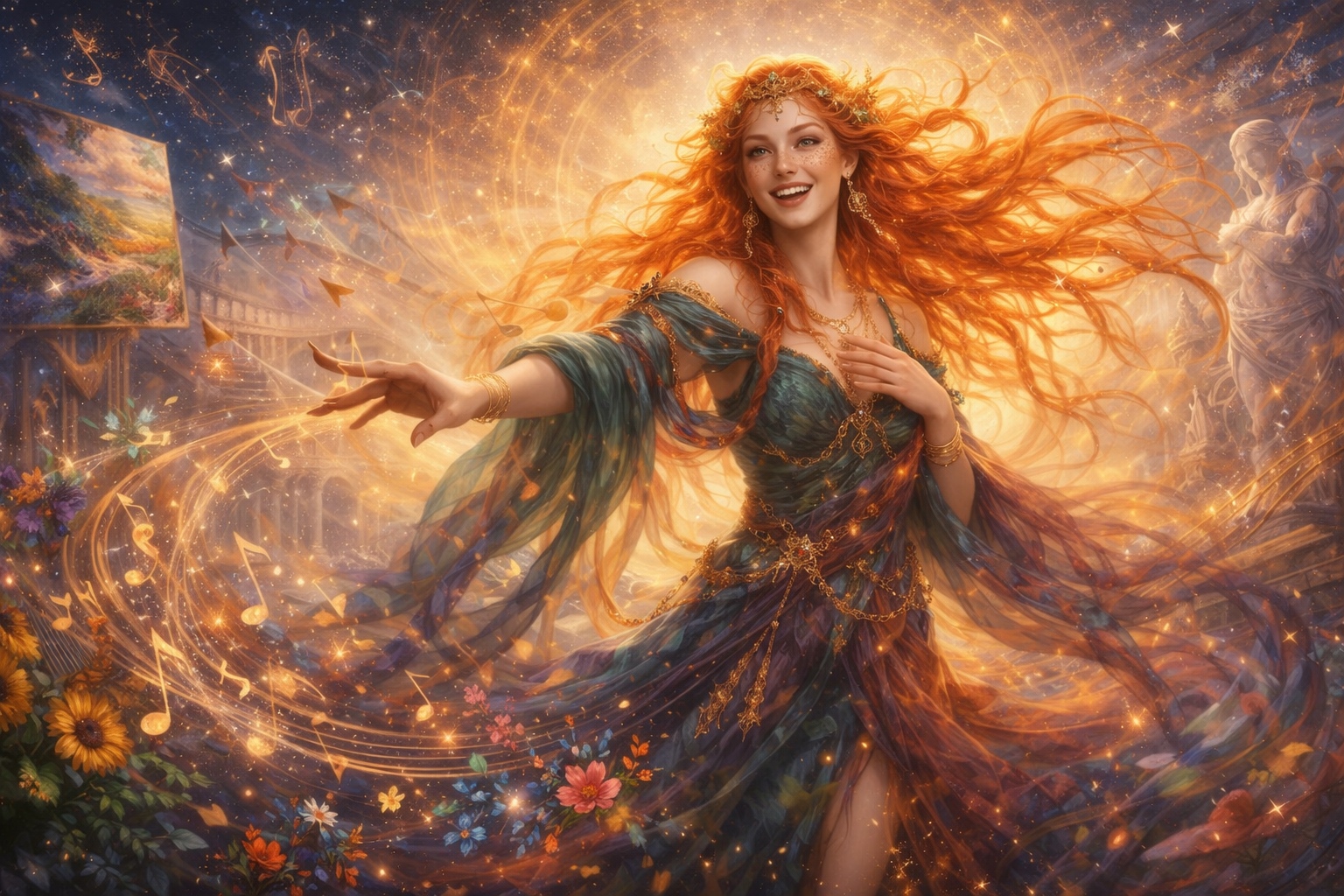
Bridhel
At a Glance
- Portfolio: Music, dance, poetry, storytelling, and all arts that express the soul; creative inspiration; beauty born from human emotion and imagination.
- Virtues (as the faithful name them): Creativity, authenticity, passion, the courage to be vulnerable, innovation, joy, transformation through expression.
- Vices (what Bridhel opposes): Artistic stagnation, censorship, the creation of art as mere commodity, dishonesty in creative work, the suppression of expression, the belief that art is frivolous.
- Symbol: A golden lyre intertwined with a quill feather, emphasizing the marriage of music and words.
- Common worshippers: Bards, musicians, poets, dancers, painters, storytellers, actors, anyone who has felt transformation through art; those seeking to express what cannot be said in plain speech.
- Common regions: Cities with thriving performance cultures; gathering places where people congregate; everywhere humans gather to tell stories around fires.
Names & Identifiers
- Common name (internal): The Harmonious Way or The Path of Expression.
- Formal name (legal/ceremonial): The Faith of Bridhel, Keeper of the Creative Soul.
- A follower: A Bridhellian or follower of the arts (more formally, a devotee of Bridhel).
- Clergy (general): Muses (for senior practitioners) or keepers of the arts; less formal than most priesthoods, and many have primary occupations as artists or performers.
- A temple/shrine: A Muse Hall or performance shrine; also any place where art is regularly created or shared.
- Notable colloquial names: Outsiders call them the song-followers, the bright ones, or affectionately, the mad artists.
Origin & History
In the early days, the world was vast and empty and silent. Gods moved through it, shaping reality, establishing law and order. But something was missing, something that lived not in the structure of the world but in the consciousness of those who inhabited it.
Amaterasu, the goddess of light and life, grew close enough to mortals to understand this absence. She watched them labor, survive, endure. She watched them create, not out of necessity, but out of something deeper, something that insisted on expressing itself through song and movement and story. She recognized in this impulse something that reflected her own nature: the need to illuminate, to clarify, to help others see.
But Amaterasu's gift was warmth and growth. What the world needed was something that celebrated the gift of consciousness itself: the ability to feel, to imagine, to transform experience into beauty. And so she sought Anansi, the trickster god of stories, and asked him to participate in the creation of something new.
From the union of Amaterasu's warmth and Anansi's trickster genius came Bridhel, the only child either god has produced. She inherited her mother's belief that warmth and light could transform suffering into growth, and her father's understanding that reality is not fixed but fluid, that stories, songs, and dances reshape the world in real time. She was born already knowing that she was a bridge, a translator, a keeper of the language that the soul speaks when ordinary speech cannot.
Bridhel's earliest acts were quiet. She whispered melodies into the ears of those who sang to ease grief. She showed dancers how to move such that their bodies told stories the audience needed to hear. She placed words in the mouths of poets at exactly the moment they needed them most. She worked through inspiration, through the sudden clarity that strikes an artist in the moment of creation, and those touched by her gifts recognized her as something entirely new.
Unlike most gods of her generation, Bridhel did not demand temples or formal priesthood. She was everywhere people gathered and someone said, "Listen, I have something to show you." Her faith grew not through conversion but through contagion: one person transformed by art inspiring another to create. A poem heard at exactly the right moment becomes a prayer. A dance seen at the point of deepest despair becomes a miracle. A song becomes a god made audible.
Over the ages, Bridhel's followers developed practices and traditions. They built spaces (not temples but theaters, galleries, performance grounds) where the work of creation could be witnessed and celebrated. They understood themselves not as priests serving a distant deity but as vessels through which Bridhel's impulse moved. They competed with one another, collaborated, criticized, improved. They took what previous artists had created and transformed it. They understood that art itself is alive, that each generation must reinvent it, that stagnation is the only true death in Bridhel's eyes.
The Divine Compact
Bridhel offers neither comfort nor salvation. She offers transformation.
- What Bridhel promises: The ability to express what cannot be expressed otherwise. The transformation of suffering into beauty. The power to reach others in ways that mundane speech cannot. The knowledge that what you feel is real, true, and worth expressing.
- Common boons: Inspiration striking with sudden clarity. The ability to perform with confidence despite fear. The discovery of an audience for one's work. The healing that comes from witnessing art that speaks to one's experience. Hands that move with skill; voices that carry; words that arrive at their precise moment.
- Rare miracles: A performance that breaks a depression. A story told that reunites estranged people. A song that outlives the singer by centuries. A dance that seems to touch divine truth. Art created in a moment of extremity that becomes the definitive expression of an era.
- Social benefits: Performance venues, gathering places, the circulation of stories and inspiration, communities that celebrate creation rather than merely commodity. Bridhel's followers build the cultural infrastructure that makes human life less brutal.
- Afterlife promise / fear: Bridhel teaches that the soul persists in the art it leaves behind. A life well-lived through artistic expression is a life that continues to speak to others long after the body has ended. What the faithful fear is not death but the death of their work, the silencing of their voice, the forgetting of what they have created.
- Costs / conditions: Bridhel does not demand constant creation, but she demands honesty. Her followers must create from genuine feeling, not from cynical calculation. They must continue to evolve, to take risks, to refuse the comfort of repeating what once worked. Those who grow artistically safe and predictable find her inspiration growing quiet.
Core Doctrine
The followers of Bridhel understand art as fundamental to what makes life worth living:
- Art is truth made visible. A song, a dance, a poem is a way of speaking what cannot be said in ordinary language. To create art is to reveal something true about yourself and your time.
- Creation requires vulnerability. The artist must be willing to fail, to be rejected, to reveal what is tender and real. This vulnerability is not weakness; it is the source of all authentic art.
- All art forms are equal. Whether the art is grand music in concert halls or a child's improvised song, whether it is epic poetry or tavern jokes, whether it is formal dance or movement in the marketplace; the impulse is the same. All expressions of the creative soul are valid.
- Art must evolve or die. The repetition of old forms without new vision is betrayal. Each generation must reinvent the arts, take what came before and transform it, create new forms that speak to new realities.
- Art connects souls across divides. A person moved by a story, a song, a dance becomes connected to the artist and to everyone else moved by the same work. Art is the universal language of feeling.
- Beauty is not frivolous; it is necessary. A world of pure survival is a world of slow death. Art is the proof that life is worth living, that consciousness itself is sacred.
Soul Coins & Divine Economy
(See also: Soul Coins & Divine Economy)
Bridhel's power grows through authentic creative expression: art made with full heart, craft refined through dedication, inspiration passed from artist to audience.
- How Bridhel gains soul coins: Creation born from genuine emotion, performed or shared with sincerity. The teaching of art to students. The act of making space for others' creativity. Works that reach people in their moment of need. Art made as prayer, as thanksgiving, as an attempt to speak what cannot be spoken. The souls of those who live through their art, who have poured their life-force into creation.
- What makes a coin "heavy": Bridhel weighs the authenticity of the work, not the skill. A broken song sung with full heart generates more coin than a technical masterpiece created for money. An improvised story told to children around a fire outweighs a carefully crafted narrative created to impress. The sacrifice of comfort and safety in service of the creative impulse: the artist who abandons security to pursue their work, the performer who fails publicly rather than playing safe: these generate the heaviest coins.
- What Bridhel spends coins on: Protecting performers and artists from censorship and persecution. Ensuring that spaces exist where art can be made and shared. Inspiring creators at critical moments. Ensuring that art reaches the people who need it most. Sustaining artists through periods of doubt and struggle.
- Trade: Bridhel trades coins rarely and with great consideration. She will not trade away the work of artists committed to authenticity; their devotion is too precious. However, she does trade with those who work in the service of cultural continuity: those who preserve ancient art forms, who teach traditions, who ensure that the voices of the past are not lost.
- Infernal competition: The Tempters compete with Bridhel by offering ease, by promising success without struggle, by encouraging artists to create for commodity rather than truth. Bridhel's response is to ensure that authentic art is valued more than slick commercial work, that artists find community and support, that the rewards for truth-telling are real even if less obviously lucrative.
Sacred Spaces
Bridhel has no single sacred space model. Her worship occurs anywhere art is created or shared authentically.
Grove Theaters are spaces in nature (clearings, forest amphitheaters, mountainside caverns with natural acoustics) where performances happen surrounded by the living world. The rustling leaves, the birdsong, the wind itself become part of the performance.
Muse Halls are grand dedicated structures in cities, with high ceilings designed for sound, walls decorated with mosaics depicting legendary performers, spaces equipped for every form of artistic expression. By day they are workshops where artists hone their crafts; by night they become performance venues.
Wandering Caravans are mobile temples: troupes of performers traveling from community to community, carrying Bridhel's presence to places that have no permanent artistic institutions. These are understood as sacred spaces made manifest.
Seaside Dance Circles are informal gatherings on beaches, where people gather under moonlight and move together, guided by rhythm and the sound of waves. These are as sacred as any temple.
Urban Art Alleys in cities are walls transformed into galleries, corners claimed as performance spaces, places where spontaneous art happens. These are Bridhel's temples in the heart of communities.
Mountain Echo Chambers are caverns with unusual acoustics, sought out by singers and poets who understand that the space itself is participating in the creation.
What all these spaces share is simplicity and purpose: they are built to enable art-making, not to awe. A Muse Hall may be grand, but its grandeur serves the performance, not itself.
Organizational Structure
Bridhel's faith has no formal hierarchy in the way most religions do. Instead, it is organized around artistic disciplines (the Harmonious Choir (music), the Lyrical Order (poetry), the Celestial Dance Troupe (dance)) each with its own leadership, practices, and traditions.
Senior artists in each discipline are recognized as masters and mentors, but their authority is earned through creation, not through appointment. A musician who stops creating, who rests on past reputation, will find students drifting away to those who are still evolving.
Bridhel's faith is explicitly anti-hierarchical in theology: the child singing for the first time is doing Bridhel's work as much as the master musician. The tavern poet is serving the god as faithfully as the performer in the grand hall. This does not mean skill is irrelevant, but it means that mastery is not the measure of devotion.
Entering the Faith
Conversion to Bridhel is often invisible. Many people who create art, who participate in performances, who gather for the joy of collective artistic expression, are already part of her faith without ever formally joining.
Soft entry is participation. Attend a performance. Join a song. Move with others who are dancing. Create something (anything) and share it. There is no barrier, no test of worthiness, no prerequisites.
Formal initiation is rare and occurs when someone commits to art as a central practice of their life. The initiation is performed publicly during a gathering of artists. The initiates are asked before witnesses to name their art form, to commit to its truthful practice, and to promise that they will teach what they know. Others present witness the commitment and affirm it. The initiate is then given a token (often handmade by other artists) that marks them as formally part of the faith.
What marks someone as outside the faith: Not lack of talent, but lack of commitment to authenticity. Those who create to deceive, who make art as pure commodity without care for truth, who suppress the art of others, who hoard knowledge instead of teaching it. These are understood as having rejected Bridhel's fundamental nature.
The Faithful in Practice
A devoted Bridhellian artist is recognizable by their relationship to their work.
- Creates regularly, even when inspiration is not obvious. Understands that the practice itself is prayer, whether the product is brilliant or mundane.
- Listens deeply to others' art, not with judgment but with the openness to be moved. Understands that audience and artist are partners in the creation of meaning.
- Takes risks with their work: is willing to fail publicly, to try new forms, to look foolish if the work requires it. Understands that technical perfection without risk is emptiness.
- Teaches generously, sharing knowledge and technique without hoarding. Understands that the strength of the art form depends on the next generation's ability to inherit and transform it.
- Advocates for other artists, particularly those creating work that challenges or threatens convention. Understands that the suppression of any artist weakens all art.
- Asks habitually: "Is this true?" When creating, when judging others' work, when deciding what to support. The question is not about factual accuracy but about emotional/spiritual authenticity.
Taboos
- Artistic stagnation. To stop creating, to repeat the same work without evolution, to rest on accomplishment and create nothing new: this is understood as a spiritual death. The artist who has nothing new to say should acknowledge this publicly rather than continuing to produce empty work.
- Censorship. Suppressing or censoring artistic expression, whether through legal means, economic pressure, or violence, is the gravest offense. To prevent someone from creating or sharing their work is to attack the divine impulse itself. This taboo is so central that some Bridhellians have been willing to die protecting artists' freedom to create.
- Creating art as pure commodity. While artists must eat and Bridhel does not demand they starve, the creation of art solely for money, without any genuine feeling or care for the work, is considered hollow. Art made without any investment of self is not art; it is product.
- Artistic dishonesty. Creating work that is deliberately designed to deceive, manipulate, or exploit is taboo. Art that seeks to harm rather than illuminate is not Bridhel's work.
- Hoarding knowledge. An artist who refuses to teach, who keeps techniques secret, who prevents others from learning, is considered antithetical to the faith. Art grows through transmission and transformation; hoarding stunts it.
Obligations
- Create something regularly. The frequency and form vary by person and circumstance, but the principle is constant: the artist must create, whether it is shared publicly or not. A journal entry is creation. An improvised song alone in the home is creation. Performance is not required; authentic creation is.
- Participate in or create artistic community. At minimum once yearly, followers should be part of a gathering (a performance, a collaborative project, an art festival) that brings artists and audiences together. The communion of shared experience is essential to Bridhel's faith.
- Mentor or teach. As one gains skill and understanding, the obligation to share it increases. An accomplished musician might formally teach students; a novice might help another novice get unstuck with a technical problem. The transmission of knowledge is sacred duty.
- Support other artists. Attend performances. Commission work. Create conditions for other artists to create. Protect those whose art is under threat. The faith is collective, and its health depends on active support.
Holy Days & Observances
All holy days across Dort are listed in the Festival Calendar.
Festival of Harmonies
Date: First day of spring.
On this day, artists of all disciplines gather for a celebration of new creative possibilities. Musicians, poets, dancers, and visual artists share their work. Workshops teach new techniques. The day is structured as collaborative performance rather than competitive showcase; the goal is not to crown winners but to celebrate that creation is continuing, that the impulse to make art persists. The festival lasts from dawn to dusk, with performances and activities throughout, culminating in a massive collaborative piece created by all participants together.
Day of the Muses
Date: Varies by region; typically a day when the astronomical conditions favor creativity (new moon, unusual stellar alignment, etc.; local traditions determine the exact date).
On this day, artists dedicate their work to Bridhel. It is a day of intense creation: writers writing, musicians composing, dancers choreographing, painters painting. What is created during this day is understood as specially blessed, as having been made in direct communion with the goddess. The practice varies: some artists create in isolation; some create in collaborative spaces; some perform throughout the day. The principle is constant: this is a day when the boundary between mortal and divine creativity is particularly thin.
Night of the Silver Moon
Date: Once yearly when the moon reaches its brightest fullness.
On this night, dancers perform intricate rituals under the moonlight, often movement-based interpretations of stories. Poets recite verses dedicated to celestial bodies and the nature of reflection. Musicians perform soft melodies that are said to be heard by Bridhel herself. The night is understood as a time when Bridhel's power is at its peak, when the transformation from ordinary human to artist is most profound.
Bridhel's Feast
Date: Middle of winter, during the darkest, coldest time.
On this day, artists gather indoors to celebrate art as the light that persists through darkness. Traditional stories are performed; old songs are sung; cultural heritage is reinforced. The feast emphasizes that art is the technology through which communities remember themselves, through which the wisdom and beauty of the past is kept alive for the next generation. Many Bridhellians consider this the most sacred observance: the proof that art is not frivolous but fundamental to survival.
Ceremonies & Rituals
The Initiation of the Artist
Performed when someone formally commits to art as a central life practice. The initiate stands before a gathering of artists and names their art form: music, dance, poetry, etc. They pledge to pursue it with honesty, to continue learning and growing, and to teach what they know. The gathered artists then present offerings: an instrument, a handmade gift, words of blessing. The initiate is formally recognized as one of Bridhel's devoted.
The Blessing of New Work
Before a significant performance or the completion of a major artistic work, a brief ritual may be performed. The artist (with supporters, if they choose) speaks about the work: what it is, what it means, what they hoped to express. Others present add blessings or encouragement. The act of speaking about the work before performing it or releasing it is understood to align it with Bridhel's purpose and protection.
The Ceremony of Teaching
When an established artist formally takes on a student, a ceremony may be held. The teacher presents the student with a token (a tuning fork for a musician, a special pen for a poet, etc.), and speaks about what they will teach and why the knowledge matters. The student responds with a commitment to receive the teaching with respect and to pass it forward. Other artists witness and affirm the relationship.
The Collective Creation
At festivals and regular gatherings, large groups participate in creating art together: a massive collaborative song, a dance involving hundreds of people, a collective mural or poetry project. These rituals are understood as expressions of Bridhel's fundamental truth: that the creative impulse is shared, that art is a language of connection, and that the most profound experiences often happen in communion.
Ceremonial Attire
Bridhel's followers wear what allows them to create and perform. There is no uniform, but colors and symbols are preferred.
The Radiance Sash
A broad sash in jewel tones (deep blues, purples, golds, reds) worn by established artists. The colors vary by region and artistic discipline. The sash is often embroidered with symbols of the wearer's art form. It marks the wearer as someone devoted to Bridhel, though the status is more honor than authority.
Amulet of the Golden Lyre and Quill
The holy symbol worn as pendant or brooch. This is the most common piece of Bridhellian jewelry and is worn by followers of all levels of commitment. Many artists commission handmade versions from fellow artists, creating a culture of wearable art.
The Performer's Cord
Many artists wear a cord or ribbon at wrist or waist, often made from scraps of fabric from previous performances or handmade by collaborators. The cord is understood as collecting the energy of performances past and supporting future creation.
Decorated Instruments and Tools
Rather than specialized vestments, many Bridhellians decorate their working tools: instruments painted or carved, pens crafted with intricate handles, dance shoes adorned with bells or ribbons. These decorated tools become both practical and ceremonial, signifying the artist's devotion.
Historical Figures
Liora, the First Convert
Liora was a wandering minstrel with a voice so clear and true that even the wind seemed to pause to listen. She traveled from village to village, singing songs that made people laugh despite their hardship, that helped them grieve without breaking. One moonlit night, singing alone by a lake, Bridhel herself appeared. The goddess did not speak in words but in music: a melody so perfect, so true, that Liora understood immediately what was being communicated. She was devoted to the right thing. Her life of creation was a life of prayer.
Liora spent the remaining decades spreading Bridhel's teachings through song and story, becoming the first formal priestess of the faith. She is remembered not for the complexity of her compositions but for the purity of her devotion: the fact that she sang in taverns and on streets, that she never sought grand venues, that she understood art as service to community rather than to her own fame.
Eolan, the Poet
Known universally as "The Voice," Eolan was a poet whose verses did not merely rhyme but seemed to speak directly from the soul. Every line he wrote captured the essence of human emotion (love, loss, joy, sorrow) with such precision that hearing his work felt like the listener's own experience was being validated. His gatherings drew crowds from distant lands, each person hoping to be seen, to have their experience named.
His most famous work, The Dance of Dawn, is still recited in Bridhel's gatherings centuries later. What made Eolan legendary was not virtuosity but vulnerability: his willingness to write from the deepest places in himself, to reveal what was tender and broken. He proved that radical honesty in art reaches further and lasts longer than technical perfection without feeling.
Serin, the Maestro
Serin was a prodigious musician who could master any instrument he touched, but he dedicated himself fully to the violin. When he played, audiences reported seeing colors in the music, feeling as though the heavens themselves were responding. His compositions were technically masterful but never allowed technique to overwhelm emotion; the skill served the feeling.
What Serin represented to the faith was the dedication required to become a master. He practiced obsessively, studied constantly, refused to rest on accomplishment. And yet his mastery was never about ego; it was about ensuring that the vehicle (his skill, his instrument) was clear enough to express the truth he needed to convey. He is remembered as proof that dedication to craft is not vanity but spiritual practice.
Calista, the Dancer
Called simply "The Flame," Calista was a dancer whose movements seemed to contain more feeling than words could hold. Every dance was a story, but not a literal one; the stories were told through the body's capacity to express what could not be said. She danced with such intensity that audiences reported being transformed, feeling as though they had witnessed something sacred.
Her most iconic creation, The Celestial Waltz, was said to have come to her in a vision of Bridhel herself. It became the signature piece of the Celestial Dance Troupe and is performed regularly. What Calista proved was that dance (often the most overlooked of the arts) could express truth as profoundly as any other form. She lifted her art from entertainment to revelation.
Sects
The Harmonious Choir
How they refer to themselves: the Singers or the Choir
Dedicated exclusively to music, the Harmonious Choir understands melody and harmony as the most direct path to divine truth. They believe that sound itself carries the voice of creation, and that through the practice of music, they come closest to Bridhel's nature. Members include classical composers, folk musicians, singers of every style. What unites them is the belief that music is primary and transcendent. They gather in acoustically designed spaces, practice constantly, and teach that a single perfectly played note contains as much theology as any doctrine.
The Lyrical Order
How they refer to themselves: the Poets or the Word-Keepers
Dedicated to poetry, storytelling, and the spoken word, the Lyrical Order understands language as the technology through which experience becomes sharable. They hold regular gatherings where new and old poetry is shared, recited, and contemplated. They are scholars of form and practitioners of creation alike, understanding that old forms have value but that new voices require new structures. They place strong emphasis on mentorship, with established poets taking responsibility for the development of younger writers.
The Celestial Dance Troupe
How they refer to themselves: the Dancers or the Moving Ones
Dedicated to all forms of dance, from classical to folk to improvisation, the Celestial Dance Troupe understands the body as the primary text through which Bridhel speaks. Dancers of every tradition are welcome, and the practice emphasizes the democratization of dance, that formal technique and spontaneous movement are equally valuable. They organize regular dance events and festivals, and the most devoted members take vows dedicating themselves to dancing at dawn and dusk as a form of daily prayer.
Heresies
The Silent Monks
How they refer to themselves: the Still Ones or the Quiet Path
Founded by a disillusioned artist named Elara, the Silent Monks believe that true artistic expression can only be achieved through complete silence and isolation. They argue that outward performance dilutes the purity of art, that the real work happens in the interior silence where the soul speaks to itself. They practice art in solitude and rarely share or perform publicly.
The orthodox faith sees this as a fundamental inversion of Bridhel's nature. Art is communication, and communication requires at least one listener. The belief that creation matters only in isolation is a rejection of the essential truth that art is the bridge between souls. The monks' work may be beautiful, but without sharing, it serves no one.
The Materialists
How they refer to themselves: the Pragmatists or the Reality Keepers
Led by a once-renowned artist named Gideon, the Materialists argue that art should be created primarily for material gain and societal advancement. They believe the spiritual and emotional aspects are secondary to usefulness, that art should serve practical purposes (decoration, marketing, social control) rather than expression. While they practice art with skill, their motivation is explicitly commercial.
The faith finds this a fundamental corruption of Bridhel's nature. Art created purely for commodity, without any investment of genuine feeling, is not art; it is product. The Materialists have confused the tool with the truth.
Cults
The Divine Harmonists
How they refer to themselves: the Frequency Finders or the Sound Seekers
Founded by a virtuoso named Lyra, the Divine Harmonists believe that certain musical frequencies can directly channel Bridhel's divine energy. They experiment with specialized instruments and tuning systems, attempting to discover the "divine frequencies" that unlock communion with the goddess. Members gather to play these frequencies in unison, believing the act opens them to direct divine experience.
While the broader faith respects the Harmonists' devotion to music, there is concern that they have made technique into an end rather than a means. The belief that frequency itself is sacred, rather than the human emotion poured into music, is seen as a misunderstanding of what Bridhel represents.
The Poets of the Eternal Moment
How they refer to themselves: the Spontaneous Ones or the Inspiration Seekers
Initiated by a mystical poet named Orion, this cult focuses on capturing "the eternal moment" through spontaneous poetic expression. They carry notebooks and constantly jot down verses inspired by immediate experience, believing that these fleeting moments of inspiration are direct messages from Bridhel.
While spontaneity is valued in the faith, the cult's approach borders on obsession. The constant documentation of inspiration, the belief that every impulse is sacred, and the refusal to revise or refine their work is seen as mistaking inspiration for skill. Bridhel values both: the moment of insight and the craft required to express it clearly.
The Dance of the Seven Veils
How they refer to themselves: the Veiled Ones or the Secret Dancers
Founded by a charismatic dancer named Selene, this cult believes that a specific dance known as "the Dance of the Seven Veils" can invoke Bridhel's direct presence. The dance is kept highly secret, taught only to the most devoted followers, and performed only under specific astronomical conditions. Members claim that performing the dance during the full moon results in visions or blessings from Bridhel.
The faith's concern is that the cult has made secrecy and exclusivity central to their practice. Bridhel is about opening and sharing; the creation of esoteric knowledge available only to the initiated runs counter to her fundamental nature. Moreover, the belief that a specific dance format can guarantee divine connection is seen as a misunderstanding of how inspiration works.
Presence in the Shattered Domain
- Territory aesthetic: Vast concert halls and amphitheaters, gardens designed as performance spaces, libraries with singing walls, galleries filled with art that seems to move and change. Everything is beautiful and dynamic; the landscape itself seems to create, to express, to transform. Colors are vivid; sounds are harmonious yet complex; there is constant motion, constant creation, constant transformation. The air itself seems to hum with inspiration.
- Likely allies: Anansi (the trickster whose stories inform Bridhel's work), Jula (the peace that allows creativity to flourish), Amaterasu (the warmth and growth that nourish the creative impulse), those whose domains include beauty, inspiration, communication, or the celebration of mortal consciousness.
- Likely rivals: The Tempters (who profit by reducing art to commodity and inspiration to manipulation), those who profit from censorship and control of information, deities whose domains include order above all else (for order without room for creativity is spiritual death).
- Stance on the Godless: Curious and compassionate. The Godless are understood as people whose creative impulse has been suppressed or never awakened. An Bridhellian approach to the Godless is to show them art, to offer the experience of beauty or truth expressed, and to invite them to express what is in themselves. Not to convert them to the faith, but to help them remember that they contain the impulse to create.
Adventure Hooks
- A renowned performer or artist has suddenly stopped creating and become withdrawn. Investigation reveals that they have encountered a work of art so perfect, so transcendent, that they believe anything they could create would be inadequate. The party must help them move past despair and understand that Bridhel values the attempt, the honesty, the risk more than flawless execution.
- An artist is being persecuted by authorities for work that was deemed heretical or offensive. Bridhel's followers ask for aid in protecting the artist and preserving the work. The party must choose how publicly to defy the authorities, knowing that openly supporting the artist will mark them as enemies of the regime.
- A censorship campaign is spreading, and books are being burned, performances are being shut down, and artists are fleeing. Bridhel's followers are organizing to save art, to preserve it, to smuggle it to safety. The party might be involved in underground networks, in creating hidden galleries, in passing messages between artists in exile.
- A collaborative artistic project of unprecedented scale is being planned, requiring the party to help coordinate resources, recruit artists, and navigate the politics of bringing diverse artistic visions into unified creation. Failure would be a spiritual blow to the regional faith; success would be transformative for the community.
- A cult claiming Bridhel's authority is using her name to justify suppressive practices, insisting that only their artistic forms are valid, that other disciplines are inferior, that followers must create only under the cult's direction. The party must work with orthodox Bridhellians to expose the cult's inversion of the faith's actual teachings and help artists escape the cult's control.