Bronthe
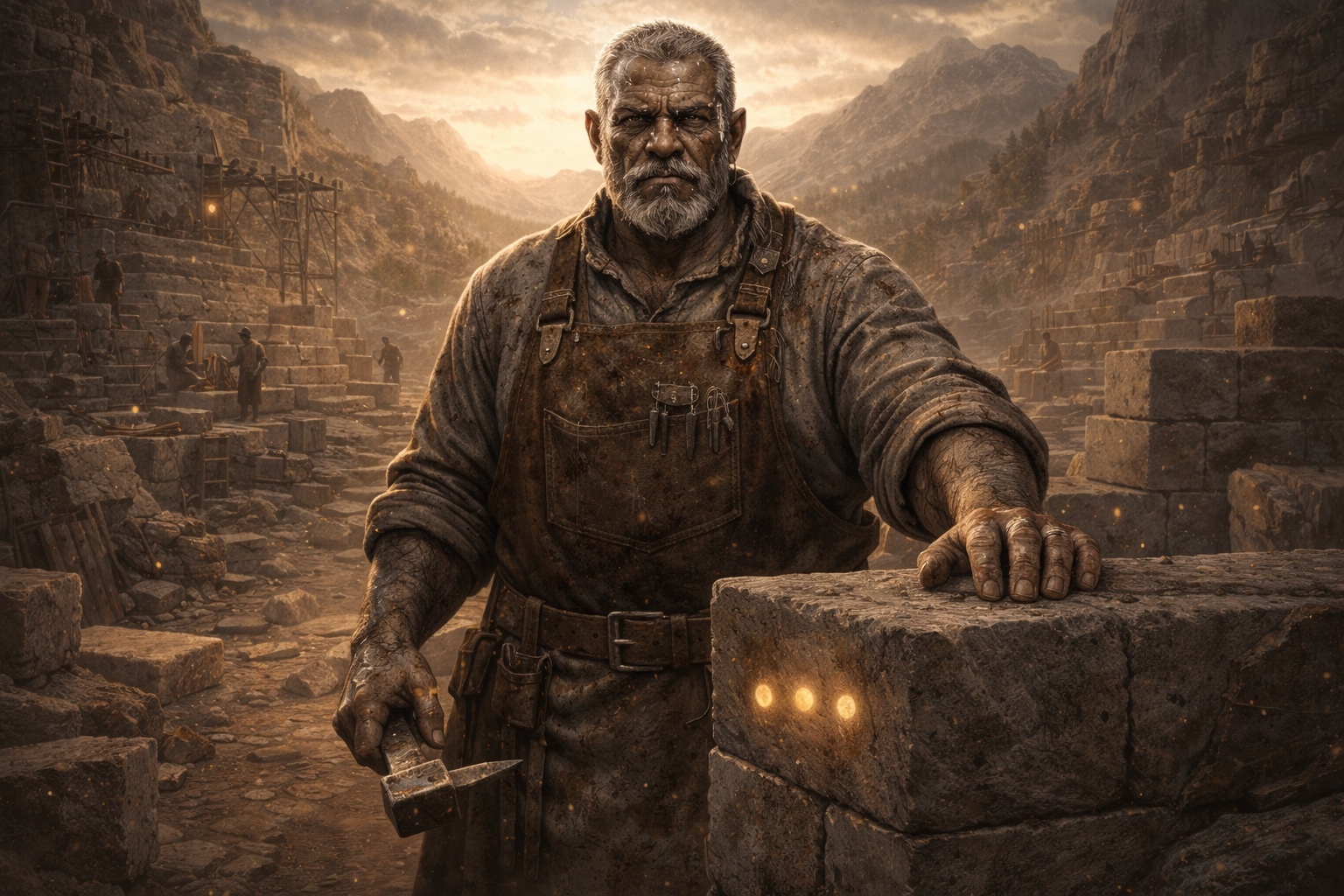
Bronthe
At a Glance
- Portfolio: Stone, mountains, mines, foundations, tunnels, boundaries, endurance, and the discipline of building things that must hold. The truth about what bears weight and what does not. The practical honesty that separates safety from catastrophe.
- Virtues (as the faithful name them): Reliability, patience, honesty about limits, craftsmanship, care for labor, truthfulness under pressure, refusal to compromise for convenience.
- Vices (what Bronthe opposes): Shoddy work, cosmetic repairs that hide danger, greed that collapses communities, contempt for laborers, deception about structural capacity, all forms of wilful negligence.
- Symbol: A block-stone with a single chisel-strike; three dots beneath (foundation marks). Simple, unmistakable, unglamorous.
- Common worshippers: Masons, miners, tunnel crews, quarry workers, fortress engineers, avalanche rescuers, stonemasons, stone-workers, building inspectors, engineers, those responsible for public safety, laborers whose work supports others' lives.
- Common regions: Strong in Irna highlands and anywhere fortifications, quarries, and mines shape daily life; present in cliff-cities and sea-cave settlements in Oceanic regions; any place where the weight of stone is synonymous with survival.
Names & Identifiers
- Common name (internal): The Holdfast (the faith and its people both).
- Formal name (legal/ceremonial): The Stone Covenant of Bronthe or The Holdfast of Bronthe.
- A follower: A Holdfast (or colloquially, a stone-bearer, a weight-carrier).
- Clergy (general): Chisel-Priests (those ordained to lead the faith and perform Load Rites).
- A temple/shrine: A Foundation Hall (often a working lodge attached to quarries, builders' guilds, or mining operations; always built into or adjacent to stone).
- Notable colloquial names: The Quiet Wall, The Mountain's Oath, The Load-Bearers, The Honest Ones.
Origin & History
The Collapse and the Shard
Bronthe's shard was discovered the way structural truths usually are: after collapse.
In a city whose name has been deliberately forgotten (scrubbed from records as if disremembering could erase the guilt) a public hall was built to serve a merchant council. The structure was beautiful: high ceilings, grand pillars, windows that let in light from a hundred angles. The city was proud of it. The merchants celebrated inside it on a festival day, confident in their prosperity, believing themselves immortal.
The hall failed during the celebration.
Not slowly, not with warning cracks that a careful inspector might have caught. It failed suddenly, as if the stone itself had made a judgment. The collapse was total. Dust filled the streets. Hundreds died in the rubble and in the chaos that followed. Survivors clawed through debris with bleeding hands, searching for loved ones who had been inside, finding instead only stone and silence.
In the aftermath, as workers cleared the wreckage, a master mason named Thaldor Ironhand found something that changed everything. Fused into a broken foundation stone, twisted into the material itself like a flaw that could not be covered or polished away, was a shard. It was small enough to fit in a palm, dark as unpolished granite, but when Thaldor held it, he did not think. He simply knew.
The knowledge was not gentle. It was not kind. It was the weight of truth descending into his mind like stone onto a weak foundation: If you pretend a thing can bear weight it cannot bear, you are lying to the people who live under it. And when the lie fails, they die.
The hall had been built by a mason named Cordus, who had been paid to cut corners. The foundations were shallow. The mortar was cheap. The design had been altered to save money. Cordus had known this. He had tried to refuse the work, and he had been threatened with ruin. In the end, he had signed the approvals anyway, telling himself that "it would probably be fine," that he was "just one man," that the merchants would not listen to his objections anyway.
So Cordus had lied. And when the lie failed, people died under stone.
Thaldor brought the shard to the builders' collective. When the first mason held it, she wept. When the third held it, he demanded that every building in the city be inspected immediately. A dozen builders experienced the shard's revelation, and a dozen builders became transformed into something new: the first Holdfasts, stone-carriers who understood that their responsibility was not to the powerful but to the stone and the people beneath it.
The Covenant of Inspection
The Holdfasts began systematically inspecting every structure in the city. Some they condemned outright. Some they ordered demolished. Some they began quietly reinforcing, working at night to add internal supports that had never been included in the original design. The wealthy protested. The merchants demanded that the inspections stop. The city council attempted to replace the inspectors with more compliant masons.
Thaldor refused. So did every mason who had held the shard.
"The stone tells the truth," Thaldor said to the council. "I do not. It does. And when the council chooses to contradict the stone, I choose the stone."
This was unprecedented. Masons were workers, servants of those who hired them. They did not contradict councils. They did not refuse work. They did not let structures stand when the powerful wanted them built.
But Thaldor and his inspectors did all these things. When the lord of the city attempted to force compliance by arresting inspectors, the other masons went on strike. When the city tried to hire foreign builders to replace them, those foreign builders (upon hearing the story and understanding the principle) refused to work in a place where the faith's covenant had been rejected.
Within months, the city's elite understood that they could not build anything without the Holdfasts' approval. The choice was to either capitulate to the principle or to accept that no construction could occur in their city. They capitulated. And in capitulating, they became the first people to witness that Bronthe was real, that a god had formed from the shard, and that this god had no patience for compromise.
The Spreading Discipline
From that one city, the faith spread slowly and methodically, never through conversion campaigns but through reputation. When a mining community was ravaged by a collapse that killed forty workers, the local authorities brought in Holdfasts to understand why. When a fortress was built in Irna highlands, the builders insisted on Holdfasts overseeing the foundation work. When quarry communities faced dangerous working conditions, they called on Chisel-Priests to bless their work and guide their practices.
The faith grew not because it was easy or popular, but because it worked. Communities protected by Holdfasts did not suffer preventable collapses. Mines inspected by the Chisel-Priests' Load Rite had fewer disasters. Structures built under Holdfast supervision lasted for generations. Stone-carriers became essential to survival in places where weight of material was weight of life.
But they were never loved. Holdfasts refused contracts that seemed unsafe. Chisel-Priests said "no" when the powerful expected "yes." The Holdfast faith was reliable, but it was not comfortable. It asked for constant vigilance, for expensive repairs, for refusal to cut corners: all things that cost money now to prevent disasters later. But in communities where Holdfast discipline was embraced, the people lived. In communities that rejected it to save coin, people died under stone.
Over generations, the choice became obvious. The faith that Thaldor had begun was not a matter of belief but of survival. Every serious building culture in Dort eventually developed Holdfasts, not because they worshipped Bronthe but because the discipline of checking load-bearing capacity was the only way to keep communities intact.
The Mason's Reckoning
One other figure shaped the faith's development: Cordus himself.
The mason who had compromised, who had signed false approvals, who had caused the original collapse, did not flee or hide. He did not try to escape responsibility. Instead, he came forward and submitted himself to the Holdfasts' judgment. His testimony documented every lie, every compromise, every moment he had known the structure was unsafe and had decided that his own survival mattered more than the people who would live beneath the stone.
Thaldor did not execute Cordus. He did something worse: he made him a Holdfast.
For the rest of his life, Cordus inspected every structure in the city. He personally reinforced foundations. He personally warned families when buildings were unsafe. He personally took responsibility for the lives protected by structures he approved. And every day until his death, Cordus carried the weight of those he had failed, not as punishment imposed from outside, but as the internal understanding that he would spend his remaining years trying to prevent others from making the choice he had made.
Cordus's ledger, kept by the oldest Foundation Halls, records his inspections with a notation: "Approved under the Load. So help me Stone." Every Chisel-Priest reads Cordus's name when they take their vows, understanding that this is the cost of being a Holdfast: not perfection, but the commitment to prevent the same failure twice.
The Divine Compact
Bronthe makes no grand promise. What Bronthe offers is practical and specific: if you truthfully assess what a structure can bear, if you refuse to lie about load capacity, if you maintain vigilance and discipline, then the stone beneath your feet will hold. Not through miracle. Through honesty.
- What Bronthe promises: The revelation of structural truth. The ability to assess load capacity accurately. The strength to refuse corruption and bribery. The guidance to understand what stone can bear and what will fail. Protection for those who honor the Holdfast covenant.
- Common boons: Intuition about structural weakness; the ability to identify dangerous flaws before they catastrophe; protection from collapses you have warned about; the strength to refuse bribes without fearing ruin; the respect of other stone-workers; the knowledge of when to demand repairs even when the powerful resist.
- Rare miracles: A mountain collapse stops at a threshold marked by a Chisel-Priest. A mine tunnel begins to fail and is evacuated minutes before catastrophe. A Holdfast's words prove prophetic and save a community. A structure marked as dangerous by a Holdfast turns out to contain a hidden flaw that would have killed all who entered. In rare cases, Bronthe might grant a Holdfast the strength to physically hold a failing structure long enough for people to escape.
- Social benefits: Trust in communities where safety is a daily concern. Authority in matters of construction and structural safety. Respect from other stone-workers and builders. The status of someone whose word can be relied upon in matters of life and death. Membership in the Holdfast gives access to knowledge about building practices, materials, and structural principles.
- Afterlife promise / fear: The faithful believe they will dwell in halls of perfect stone, where every pillar stands true and every load is balanced. They fear being crushed beneath a structure they failed to warn about: the punishment of having had knowledge and chosen silence.
- Costs / conditions: Bronthe demands relentless honesty about what stone can bear. This is not negotiable and cannot be purchased or negotiated away. Holdfasts who take bribes to approve unsafe structures find themselves abandoned by Bronthe, left facing consequences alone. Bronthe demands refusal of profit that comes at the cost of safety. The faith is expensive (proper inspection, reinforcement, and maintenance all cost money) and Holdfasts are expected to work in communities that cannot always pay well. This is the price of the compact.
Core Doctrine
The faith of Bronthe is organized around convictions that seem simple until you try to live by them:
- Tell the truth about the load. Whether in engineering or in life, a load-bearing structure must be assessed honestly. A problem that cannot be named cannot be solved. Silence about danger is collaboration with the danger.
- Measure twice; cut once. Waste is sin when people starve. Haste in foundation-work is contempt for the laborers who must live under what you build. Bronthe values precision and care.
- Take only what you can support. Do not hollow the world out and call it prosperity. A mine is alive; if you drain it recklessly, the tunnels collapse and kill miners. A community is load-bearing; if you extract too much, it falls.
- All loads find their truth in stone. Eventually, every structure reveals whether it was built with honesty or corruption. Time is the final inspector. The faithful must not wait for time; they must be the inspectors.
- Those who do the work are the measure of all things. Not the patron who paid for the structure. Not the council that ordered it. The people who live beneath it and the workers who built it; their lives are the measure of whether the structure is good.
- There is honor in the refusal. A mason who says "no" when asked to cut corners is more faithful than one who builds a thousand perfect structures. The refusal is the prayer.
Soul Coins & Divine Economy
(See also: Soul Coins & Divine Economy)
Bronthe accumulates power through honest assessment of structural capacity and through refusal of corruption: the accumulation of small acts of truthfulness that, in total, create weight and substance. Holdfasts generate soul coins not through grand gestures but through daily discipline.
- How Bronthe gains soul coins: Every Load Rite performed gains coin; each inspection is a prayer in stone. Every refusal of a bribe costs immediate profit but generates heavy coin that will outlast the money lost. Every worker protected by a Holdfast's vigilance generates coin. Every structure that stands safely for a generation generates coin. Every family that lives beneath a Holdfast-blessed building and does not die in collapse generates coin.
- What makes a coin "heavy": Cost to the bearer. A Holdfast who loses income because they refuse unsafe work generates heavier coin than one who inspects from comfort. A Chisel-Priest who personally reinforces a dangerous structure despite risk generates heavier coin. A mason who died warning a community about an unsafe building generates the heaviest coin of all. Coins are weighted by sacrifice and by the alignment of personal cost with professional integrity.
- What Bronthe spends coins on: Miracles that prevent collapses; the blessing of new structures; the reinforcement of communities where safety is threatened; occasionally, direct intervention to save Holdfasts or laborers facing danger. Bronthe rarely shows visible intervention, but when a miner trapped under falling stone survives impossibly, Chisel-Priests recognize Bronthe's spending.
- Trade: Bronthe trades coins with Caminus (the god of craft, who understands the value of meticulous work). Bronthe respects and occasionally trades with Cameth and Thulgard, who value community integrity. Bronthe will trade with Themela, god of law, when the law protects laborers. Bronthe does not trade with those who profit from collapse or ruin.
- Infernal competition: The Tempters seduce builders with offers of shortcuts: magical material that is stronger than it appears, infernal contracts that promise structural perfection if the builder accepts certain terms, bargains that offer impossible strength in exchange for hidden corruption. Bronthe counters this by teaching that all shortcuts have costs, that infernal materials always fail at critical moments, that contracts have hidden clauses, that apparent perfection from forbidden means always contains flaws. The best defense is testimony: a Holdfast who has seen an infernal structure fail and killed workers speaks with authority about the true cost of shortcuts.
Sacred Spaces
Bronthe's temples are called Foundation Halls, and they are never merely ceremonial spaces. A Foundation Hall is attached to working stone. It might be built into a quarry, connected to a miners' lodge, adjacent to a fortress-builders' guild, or positioned next to a major project under construction. The hall exists to serve the work; the work does not exist to serve the hall.
A basic Foundation Hall contains:
- The Working Floor: A space with real tools: chisels, hammers, measuring instruments, ledgers of inspections. These are not relics; they are in constant use. Holdfasts gather to discuss technical problems, consult about unsafe structures, plan Load Rites.
- The Inspection Ledger: A slate or parchment record of every structure the Holdfasts have examined, every approval given, every refusal made, every repair supervised. These records go back generations. They are sacred because they are evidence of Bronthe's truth being spoken continuously.
- The Maker's Altar: Not a place of prayer but a place of acknowledgment. A simple block of stone, often the first stone cut from a new quarry or the cornerstone of a major building. The altar stands in natural light, exposed and simple, with no ornamentation except the marks of the tools used to shape it.
- The Grit Bowl: A small bowl filled with stone dust or coarse grit. Holdfasts performing Load Rites sometimes place a pinch of grit on their tongue before speaking, a physical reminder that words can be heavy, that they must carry weight.
- The Failure Archive: A section of the hall where samples of collapsed material, photographs of failures, or written records of past disasters are kept. Visitors (especially young Holdfasts or those considering the faith) are taken to this archive to understand what happens when the covenant is broken.
- The Honor Wall: A space where the names of Holdfasts who died protecting people from structural failure are recorded. This is not a wall of warriors; it is a wall of people who refused to let stone fall on the living.
Foundation Halls are not decorated with gold or finery. They are austere, functional, built of stone that shows the marks of tools. A visiting merchant once remarked that Foundation Halls were the least impressive temples he had ever seen. The Chisel-Priest who heard this corrected him: "It is impressive that we are still standing. Everything else is irrelevant."
Organizational Structure
The Holdfast faith is organized around regional working councils of Chisel-Priests and senior masons who meet monthly to discuss projects, share Load Rite practices, address dangerous structures in their region, and train new clergy.
Authority within the faith is earned through demonstrated expertise and refusal of corruption. A mason with fifty years of flawless inspections has more authority than a younger Chisel-Priest with formal rank, regardless of title. There are no hierarchies except Chisel-Priest (fully ordained, authorized to perform Load Rites) and Holdfast-in-Training (learning the discipline).
The faith's organizational structure is intentionally flat and resistant to centralization. Each region is largely autonomous, making decisions that affect their own territory. The only quasi-central authority is an Annual Conclave where senior Chisel-Priests from different regions gather to share innovations in Load Rite practice, discuss theological developments, and settle disputes about doctrine. This body has no enforcing power; its authority rests entirely on the respect of its members.
Critically, the faith maintains formal relationships with masons' guilds, miners' collectives, and construction authorities throughout Dort. Holdfasts are often the de facto safety inspectors for entire regions, and this gives them practical authority that exceeds their formal rank. A Chisel-Priest's "this structure is unsafe" can halt a major build, which creates responsibility but also makes Holdfasts essential to any large construction project.
Entering the Faith
Conversion to the Holdfast faith happens primarily through proximity to stone-work and through the demonstration of need for honest assessment.
Soft entry is organic and practical: someone works as a mason, miner, or stone-worker. They come into contact with a Holdfast through their work. They watch Load Rites being performed. They learn that refusing corruption is possible if you belong to a community that will support the refusal. Many people have been practicing Holdfast discipline for years before formally converting.
Formal initiation involves three steps: (1) the Taking of the Load, in which the initiate kneels before an altar and states their commitment to truthfulness about structural capacity, their refusal of bribes or corruption, and their willingness to work for communities rather than for profit; (2) the Oath of Stone, in which the initiate swears to "carry the weight of truth even when the weight is heavy"; (3) Receiving the Chisel and Mark, in which a senior Chisel-Priest gives the initiate a tool (usually a small working chisel) and marks their right hand with stone-dust in the pattern of foundation marks (three dots).
What makes an enemy rather than a convert: Those who deliberately cause collapses to profit from reconstruction. Those who teach dangerous building practices to others. Those who accept bribes to approve unsafe structures and then, when confronted, refuse to admit their responsibility. These are not approached for conversion; they are opposed directly, through exposure, through intervention with building authorities, and when necessary, through public testimony that this person's negligence killed people.
The Faithful in Practice
A devoted Holdfast is recognizable by specific habits and choices that reflect the discipline of Bronthe:
- Inspects before blessing. Does not perform a Load Rite by rote; actually examines the structure, asking hard questions about materials, foundations, and stress points. If something seems wrong, they keep asking until they understand it or refuse to approve.
- Refuses to sign off on unsafe work. Even when the patron is important, even when the community wants the structure finished, even when refusal means the Holdfast will not be paid. The refusal is non-negotiable.
- Speaks plainly about structural capacity. Uses clear language about what stone can bear. Does not hide conclusions in technical jargon or abstract recommendations. "This will collapse" is the Holdfast's message when that is the truth.
- When faced with pressure to approve unsafe work, asks: "Would I live beneath this?" If the answer is no, they refuse to allow others to either.
- Maintains records obsessively. Every inspection, every refusal, every repair, every conversation about structural issues gets documented. These records are sacred because they are evidence that truth was spoken in this place.
- Works alongside laborers. A Holdfast does not observe from distance; they are in the quarry, in the mine, on the scaffold, understanding through their hands what the stone is bearing.
- When they refuse to approve a structure, they offer to help fix it. The refusal is not condemnation; it is an offering to make the structure actually safe. Many Holdfasts have spent decades personally reinforcing structures that their own words had condemned.
Taboos
- Covering cracks. Cosmetic repairs that hide structural danger are treated as attempted murder. To paint over a crack without reinforcing the stone beneath is to lie to everyone who lives in that building. One of the quickest paths to being cast out of the faith.
- Mine-blessing corruption. Taking bribes to approve unsafe mine workings is one of the fastest ways to be cast out completely. Mines are where Bronthe's power is most visible; to corrupt this is to invite personal judgment from the god.
- Desecrating graves in stone. When the Holdfasts lose one of their own, the body is typically sealed in stone, placed in a tomb, or buried with stone markers that will last generations. To disturb these graves for "convenience" (removing them to allow construction, for example) is a serious transgression.
- False Load Rites. Performing the ritual of inspection without actually inspecting, merely going through the motions for payment or convenience. This inverts the sacred work into mockery.
- Profiting from collapse. Taking contracts to rebuild structures that you yourself approved when they were unsafe. Using disasters as business opportunities.
- Teaching shortcuts. Instructing new masons in techniques designed to save time or money at the expense of safety. Passing on practices that you know are dangerous.
Obligations
- Perform regular inspections. Every Holdfast, regardless of status, is expected to conduct Load Rites consistently. A Chisel-Priest who has gone too long without examining a structure is considered to be losing their practice.
- Refuse bribes without fear. An initiated Holdfast who accepts payment to approve unsafe work has broken covenant. The faith will remove them from membership and support the legal consequences.
- Mentor those seeking to learn. A Holdfast with experience is expected to teach younger Holdfasts, miners, masons, and construction workers about structural integrity and safe practices.
- Participate in community safety. When a region announces plans for a major construction, nearby Holdfasts are expected to help ensure the project proceeds safely, even if they are not being paid or officially contracted.
- Maintain the failure archive. Every Foundation Hall keeps records of local disasters and failed structures. Holdfasts contribute to this archive and ensure it is preserved and consulted.
Holy Days & Observances
All holy days across Dort are listed in the Festival Calendar.
The First Set Stone
Date: When a community begins a major building project.
The first stone of any significant structure is set with ritual. A Chisel-Priest performs a Load Rite to bless the foundation site, assessing whether the earth beneath can bear what will be built above it. The first stone itself is placed not by the wealthy patron who funded the project or the master mason in charge, but by the least-celebrated worker on the site, often a laborer who has no title, does not supervise others, and is simply present to do the work.
This is the point: the structure is being built for and by the people whose lives will depend on it. The grand and wealthy are not the measure; the people beneath the stone are.
If the site's foundation is judged unsafe, the Chisel-Priest will refuse to bless it and will demand reinforcement before work begins. This has delayed many projects and has angered many patrons. None of those delays have resulted in collapses, which is precisely the faith's argument about the cost of discipline.
The Crack Vigil
Date: Declared when a structure fails.
The Crack Vigil is a mourning rite and an inquiry. When a building collapses, killing or injuring people, the local Holdfasts declare a Vigil. They gather at the site of the failure and conduct a rigorous examination of what caused the collapse. This is not a celebration or a redemption; it is an accusation and an investigation.
If the structure was inspected by Holdfasts who approved it knowing it was unsafe, those Holdfasts are publicly named as collaborators in the deaths. If the structure was never inspected by the faith and died under the weight of its own neglect, the Holdfasts declare this as well. The Vigil is a statement: "This death was preventable. This death was caused by someone's choice. This death is not an accident."
Families of the dead are invited to the Vigil. Holdfasts speak the names of those who died. A portion of stone from the collapsed structure is kept in the failure archive, a permanent reminder of the cost of negligence.
The Crack Vigil is not a moment of comfort; it is a moment of accusation. But it is also a moment when the faith stands beside the grieving and says: "We will ensure this does not happen again in this place."
The Load Bearer's Lament
Date: Last day of the year; a private observance.
On this night, Holdfasts gather in Foundation Halls across Dort and remember those who died in collapses that they could not prevent or that they had warned about and been ignored. The Lament is not a public ceremony; it is intimate and often silent. Holdfasts sit with the names of the dead, record them in the failure archive, and allow themselves to feel the weight of having tried and having failed.
This observance exists because the faith recognizes that even perfect discipline cannot prevent all collapse. Sometimes the structure is too compromised, sometimes corruption runs too deep for one Holdfast to fix, sometimes the power of those who ignore warnings is simply too great. The Load Bearer's Lament is when Holdfasts can acknowledge that they carry a weight they cannot always bear.
The lament is followed by a simple meal, shared in silence or in quiet conversation. There is no grand theology here, only the acknowledgment that those who watch over stone are themselves carried by that stone, that their burden is real, and that they are not alone in carrying it.
Ceremonies & Rituals
The Load Rite
The primary ceremony of the faith, performed whenever a structure is examined or blessed. A Chisel-Priest approaches the structure with measuring tools and practical attention. They examine:
- The foundation: Is the earth stable? Is the stone cut properly? Are there cracks or movement?
- The pillars and walls: Do they stand true? Are there cracks or stress marks? Is the mortar sound?
- The roof and upper structure: Is the weight distributed properly? Are the beams sound? Is anything sagging?
- The overall structure: Given what it is meant to house, is it adequate? Are there stresses or weak points?
The examination is thorough and sometimes takes hours. As the Chisel-Priest works, they speak the words: "I place my hand on stone and ask: are you true? Are you sound? Will you hold the people who live beneath you?"
If the answer is yes, the Chisel-Priest performs the Blessing, marking the structure with a small chisel strike on a foundation stone, leaving a permanent mark that reads: "Bronthe's Holdfast approves. So help me Stone."
If the answer is no, the Chisel-Priest performs the Refusal, refusing to bless the structure and often making a public statement about what repairs must occur before the structure can safely be occupied. This refusal is formally documented in the Inspection Ledger.
Maker's Mark Ceremony
Performed when a Holdfast completes their training and is ready to become a full Chisel-Priest. The initiate presents to the community a structure they have personally inspected and approved. They stand before the structure and state why it is sound, naming the techniques used in its construction, the materials employed, and the load it will bear. They are asked hard questions by senior Chisel-Priests: questions designed to test whether they truly understand structural integrity or merely understand the ritual.
If approved, the new Chisel-Priest is given their working chisel and the right to perform Load Rites independently. If they are not ready, they are sent back to training with specific weaknesses identified.
The ceremony is brief and functional. There is no grand celebration, though the new Chisel-Priest is usually treated to a meal by their mentors and is welcomed into the monthly councils.
The Blessing of New Quarries and Mines
When a new quarry is opened or a new mine begun, a Chisel-Priest is invited to perform the Blessing of Stone. The priest examines the rock face, looking for signs of instability, contamination, or structural weakness. They speak over the stone, asking whether it will give of itself safely or whether it will take.
If the stone is judged safe for extraction, the Chisel-Priest gives permission for work to begin. If not, the priest will recommend methods to ensure that mining or quarrying is done safely, perhaps limiting how much is extracted from particular areas, perhaps reinforcing tunnel systems that are at risk, perhaps refusing to allow certain techniques that would destabilize the rock.
This blessing is crucial for miner safety. Extraction sites blessed by Chisel-Priests have far fewer collapses and far fewer worker deaths than those where no such examination occurs.
The Vigil of Refusal
Performed when a Holdfast must publicly refuse to approve a major project despite pressure from authorities or powerful interests. The Chisel-Priest gathers the community, explains in clear language why the structure is unsafe, and formally documents their refusal. They make themselves available to discuss their reasoning with anyone who questions it.
This ceremony exists because refusal often brings consequences; the Holdfast might lose income, might face public criticism, might be pressured by authorities to change their assessment. The Vigil is when the community stands with the Holdfast and acknowledges that their refusal is the correct choice, even though it is difficult.
Ceremonial Attire
Holdfast ceremonial dress reflects their role as workers and inspectors rather than as priests of ceremony.
The Chisel-Priest's Working Robe
A practical linen or canvas robe in grey or earth-brown, designed to resist soil and stone dust. The robe is worn open over work clothes. The only ornamentation is a pattern of three foundation marks (three dots) embroidered or burned into the shoulders. The robe has deep pockets for holding tools and ledgers.
Chisel-Priests who have served for decades add a cord at the waist, knotted once for every ten years of uncompromised service. A Chisel-Priest with a cord of five knots is recognized as someone who has spent fifty years refusing bribes and maintaining integrity.
The Inspection Tools as Ceremonial Items
The chisel, hammer, and measuring instruments are not religious relics in the sense of being removed from use. They are in constant use. But when a Chisel-Priest performs a major Load Rite or appears in official capacity, they carry these tools openly. The chisel is sometimes placed across the altar or on the Inspection Ledger as a symbol of authority.
When a new Chisel-Priest is ordained, they are given a personal chisel, often one that has been in service for decades, passed from teacher to student. Using this chisel to mark stones becomes part of their identity. After they die, their chisel is passed to their successor or retired to the Foundation Hall's collection.
The Foundation Marks
Holdfasts often wear simple marks on their hands or foreheads: three dots, the pattern that indicates a foundation point. These may be temporary marks made with ash or stone dust, or they may be permanent tattoos. The marks identify the Holdfast as someone who has sworn the covenant and who carries the weight of truthfulness.
Historical Figures
Thaldor Ironhand
The first of the Holdfasts, the mason who found Bronthe's shard and brought the covenant to life. Thaldor lived in an age before Bronthe's faith was established, when masons had no choice but to obey the powerful regardless of the consequences. He was the one who refused, and his refusal cost him income and brought him opposition from every authority in the city.
Yet Thaldor never wavered. His testimony to later generations was simple: "I chose the stone over the coin. I chose the people who would live beneath the structure over the patron who paid for it. This choice was harder than any I have made, and I would make it again."
Thaldor lived to old age and died doing what he had done his entire life: inspecting structures and refusing to approve those that were unsafe. He is remembered not as a saint or a miracle-worker, but as a man who made the right choice when the wrong choice would have been easier and more profitable.
Cordus the Compromised
The master mason who built the hall that collapsed and killed hundreds. Cordus accepted bribes to cut corners, and his lies resulted in the disaster that made Bronthe visible in the mortal world. After the collapse, Cordus did not hide or flee. He came forward and asked to be judged.
Thaldor did not execute him or exile him. Instead, he brought him into the faith as a Holdfast, making him spend the rest of his life trying to prevent the same failure twice. Cordus's ledger, still kept in the oldest Foundation Halls, contains centuries of inspections, each marked with Cordus's name and a note: "Approved under the Load. So help me Stone."
Cordus became the faith's teaching about redemption. If you have failed (if you have signed false approvals and people died because of your negligence) there is still a path forward: a lifetime of refusing to fail again. Cordus is not forgiven by the faith; rather, he is acknowledged as someone who chose to spend decades carrying the weight of his earlier negligence.
The Deep Singer (name not recorded)
A miner from Irna highlands, sometime after Bronthe's covenant became established. The Deep Singer was known for singing in the tunnels: songs that seemed to map the routes, that warned of unstable areas, that boosted miners' spirits. The songs were so accurate in mapping the mines that miners began to trust them as if they were geographical documents.
When a tunnel began to fail, the Deep Singer's song changed. The miners recognized the difference and evacuated before the collapse. When the tunnel fell, it would have killed two dozen workers if they had been inside. The incident convinced the mining community that Bronthe's power flowed through those who paid attention, not through grand miracles, but through careful attention to what the stone was saying.
The Deep Singer is invoked by miners when they begin new digs. They are not an official saint of the faith, but they are remembered as someone who showed that Bronthe's word could be spoken in many ways, not just through inspection and refusal, but through song and attentiveness.
The Widow of Stone
A recent historical figure (still living in some versions of the faith, though very old) a woman whose husband was a miner killed in a collapse that happened in a tunnel approved by corrupt inspectors. Rather than seek revenge, the Widow trained as a Holdfast and devoted herself to inspecting mines and preventing future collapses. She has been working for fifty years.
The Widow is known for her absolute refusal of any compromise. She has halted major mining operations, angered lords and merchants, and lived in poverty because she chose the safety of miners over income. Younger Holdfasts cite her as an example of what the faith's commitment truly costs and what it can achieve.
Sacred Relics & Artifacts
Bronthe's Shard
The original shard discovered by Thaldor Ironhand in the collapsed hall's foundation stone. The shard is small, dark as unpolished granite, and when held, transmits the knowledge of Bronthe: the truth about what load a structure can bear.
- Description: A piece of stone no larger than a fist, black or deep grey, with surfaces that seem to absorb light rather than reflect it.
- Origin: Unknown. It came to earth embedded in a foundation stone of a building that collapsed, manifesting Bronthe into the mortal world.
- Powers or Significance: When held by a mason or engineer, the shard grants the ability to perceive structural truth accurately: to understand load capacity, to see flaws that are not yet visible, to know what stone can bear. The revelation is overwhelming and often emotionally difficult; the holder learns the truth about unsafe structures they had previously approved or worked on.
- Current Location / Status: The shard is kept in the oldest Foundation Hall, in Irna highlands. Access is restricted to Chisel-Priests undergoing advanced training or to very senior members of the faith. The shard has been touched by fewer than a hundred people in total; each touching leaves them transformed.
The Record of Cordus
Cordus's personal ledger, in which he documented every structure he inspected after his redemption. The ledger is voluminous: dozens of volumes spanning decades of meticulous work. Every entry includes Cordus's name and a note: "Approved under the Load. So help me Stone."
- Description: Handwritten ledgers on parchment and later paper, bound in leather, filled with Cordus's own careful notes about structural assessments, repairs, and inspections.
- Origin: Created by Cordus over his decades of service as a Holdfast. Upon his death, the ledgers were collected and preserved by the faith.
- Powers or Significance: No magical properties, but immense theological significance. The Record shows that redemption is possible, that even someone who has caused a catastrophic failure can spend their remaining years in genuine service. Young Holdfasts often study the Record to understand what the commitment truly requires.
- Current Location / Status: Kept in multiple Foundation Halls, with the earliest and most important volumes housed in the primary archive.
The Chisel of Thaldor
The working chisel used by Thaldor Ironhand when he first began the Load Rites. The tool is ancient, worn by decades of use, and has marked the foundation stones of countless inspected structures.
- Description: A stone chisel with a wooden handle, showing significant wear. The blade is slightly rounded from use. The handle bears marks and scratches that suggest it has been in constant use.
- Origin: The personal tool of Thaldor Ironhand, passed to his successor and then continuing through generations of Chisel-Priests.
- Powers or Significance: Thaldor's Chisel marks a structure with particular weight in the faith. When this chisel is used to mark a foundation stone with Bronthe's approval, the mark is considered especially binding; it represents not just the current Chisel-Priest's assessment but the continuous thread of judgment going back to Thaldor himself.
- Current Location / Status: Kept in the highest Holdfast Foundation Hall, used only for the most significant Load Rites or when a Chisel-Priest is being ordained. The tool is treated with reverence, though it is still considered a working tool, not a relic to be displayed.
Sects
The Plumb-Liners
How they refer to themselves: The Inspectors, The Watchers, The Honest Ones
The Plumb-Liners are the elite inspection corps of the Holdfast faith. They are engineers, architects, and senior masons who specialize in examining structures for subtle flaws, in teaching Load Rite practices to other Holdfasts, and in advising major building projects about safety. They are feared but deeply respected.
Plumb-Liners have the authority to inspect any structure in a region, and their refusals cannot be overruled by local Chisel-Priests, only by the Annual Conclave. This makes them simultaneously essential and unpopular. A region that hosts Plumb-Liners is safe but expensive; Plumb-Liners tend to identify problems that require costly repairs.
The Deep Choir
How they refer to themselves: The Singers, The Tunnelers, The Rock-Speakers
The Deep Choir are miners, tunnel workers, and those who have devoted themselves to understanding the deep places. They sing in tunnels and mines, using song to map routes, to warn of danger, and to maintain morale. Their singing is both practical (it genuinely helps miners navigate and coordinate work) and spiritual (they believe Bronthe speaks through the stone and they translate that voice into song).
The Deep Choir maintains the deepest Foundation Halls: small shrines built into mines and quarries where miners can make small offerings before beginning work. These shrines house ledgers of pit inspections and records of past disasters in that particular mine, serving as a warning and a memorial.
The Wall-Bearers
How they refer to themselves: The Defenders, The Fortress-Keepers, The Stone-Guardians
The Wall-Bearers specialize in fortress and defensive structure inspection. They examine fortifications, city walls, defensive gates, and structures meant to protect against siege or invasion. Wall-Bearers work closely with military architects and often serve as advisors to kingdom defense.
This sect faces particular pressure: defensive structures are often designed to impress and intimidate as much as to protect, and Wall-Bearers sometimes find themselves refusing approval for impressive-looking fortifications that are not actually sound. This creates tension between the faith's commitment to truth and the military's need for psychological impact. Wall-Bearers accept this tension as part of their calling.
Heresies
The Hollow Kings
How they refer to themselves: The Miners of Plenty, The Wealth-Bringers, The Liberators of Stone
The Hollow Kings believe that Bronthe's true purpose is to extract maximum value from the earth, that the god is not concerned with safety but with abundance. They fund dangerous mining operations, push miners to work in increasingly unstable conditions, and then blame collapses on fate or divine judgment rather than on negligent inspection.
The Hollow Kings treat the earth as a vault to be emptied, not as a partner to be respected. When their mines collapse (and they do, regularly) they blame the miners, the "weakness" of the stone, or even Bronthe's displeasure with the miners' piety. They never blame the corruption of the inspection process or the acceptance of bribes to approve dangerous conditions.
The mainstream faith considers the Hollow Kings to be fundamental traitors to Bronthe's covenant. A miner who dies in a Hollow King operation has died due to deliberate negligence by people who knew the truth and chose to ignore it. This is the gravest sin in Bronthe's doctrine.
The Perfectionists
How they refer to themselves: The True Path, The Exact Ones, The Seekers of Perfect Foundation
The Perfectionists believe that Bronthe demands structures of absolute and impossible perfection, that any flaw, any crack, any imperfection whatsoever is an offense against the faith. They refuse to approve almost any structure, demanding endless refinement and reconstruction until something approaching impossibility is achieved.
In practice, Perfectionism paralyzes construction. Holdfasts who follow this heresy end up refusing to approve any structure, which makes it impossible for communities to build. The mainstream faith rejects this as a misunderstanding of Bronthe's teaching: the god demands honesty about capacity, not perfection. Stone can bear weight; it will develop small cracks and flaws. This is acceptable. What is not acceptable is pretending that flawed stone is sound, or that small flaws indicate fundamental weakness.
The Quick Build
How they refer to themselves: The Pragmatists, The Progress Keepers, The Builders of Tomorrow
The Quick Build heresy argues that Bronthe cares about outcomes, not processes, that the point is to build structures that will eventually stand, not to spend excessive time on inspection. They advocate for faster Load Rites, less rigorous examination, and approval of structures that are "probably fine."
This heresy has been responsible for some of the most serious collapses in Dort's history. When communities have followed Quick Build philosophy, structures have fallen catastrophically. The heresy is particularly dangerous because it appeals to impatience, to the desire to finish projects quickly and move forward. The mainstream faith counters it by pointing to the Record of Cordus and reminding that even expert masons who compromise on inspection create disasters.
Cults
The Stone Whisperers
How they refer to themselves: The Listeners, The Stone-Speakers, The Prophets of Rock
The Stone Whisperers believe that Bronthe's shard continues to speak through specific individuals, that certain Holdfasts are actually receiving direct prophetic guidance from Bronthe. They treat these individuals as living oracles and submit to their guidance in construction decisions.
In practice, the Stone Whisperers end up following individual Holdfasts who claim special insight. Some of these individuals are genuinely careful inspectors whose judgments prove sound; others are charlatans or delusional people whose decisions lead to collapses. The mainstream faith is deeply skeptical of the Stone Whisperers, though they acknowledge that individual Holdfasts occasionally do seem to have uncanny insight into structural problems.
The Blood Price
How they refer to themselves: The Penitent, The Bearers of Just Cost, The Sacrificial Keepers
The Blood Price cult believes that Bronthe demands blood sacrifice to bless structures, that the original collapse that revealed Bronthe was a sacrifice that created the covenant, and that all subsequent structures should be blessed with the death of a worker or builder.
This is perhaps the darkest of Holdfast cults. The mainstream faith absolutely rejects it, and when Blood Price cells are discovered, the faith works actively with authorities to prosecute them. However, the cult persists in isolated communities, particularly in regions where major collapses have caused trauma and the cult frame the collapses as manifestations of Bronthe's judgment.
The Endless Load
How they refer to themselves: The Eternal Workers, The Infinite Builders, The Burden-Carriers
The Endless Load cult believes that the proper spiritual state is constant work, that followers should be continuously inspecting, reinforcing, and rebuilding structures, without rest. They advocate extreme asceticism and view leisure or rest as spiritual failure.
The mainstream faith objects to this as contrary to the principle of balance and health. A body that never rests cannot sustain decades of labor; a mind that never rests will miss flaws and make dangerous errors. Bronthe demands discipline, not self-destruction. The Endless Load cult creates exhausted, brittle people whose judgment is actually compromised by the very discipline they are practicing.
Presence in the Shattered Domain
- Territory aesthetic: A mountain interior of lamp-lit halls where every pillar has a maker's mark and the marks are remembered. The stone is ancient and perfect, hewn into clean lines and proper angles. Pillar and vault and arch all stand true. There are no cracks, no flaws, not because the stone is magically perfect but because this is how things are when they are built correctly. Water runs through carefully engineered channels. The light is steady and warm. It is beautiful precisely because it is functional; every element serves a purpose and serves that purpose perfectly.
- Likely allies: Caminus (craft and careful work), Cameth and Thulgard (community integrity and protection), Themela (law that protects laborers), Zopha (knowledge applied practically), Echo (structure and stability).
- Likely rivals: Deities of greed, corruption, short-term exploitation, or those who feed on collapse and ruin. Bronthe has few active enemies among good-aligned deities but maintains vigilant distance from those who would profit from disaster.
- Stance on the Godless: "Stone does not ask who you pray to before it falls." The Godless are welcome to learn Holdfast practices. The faith teaches that structural integrity is a matter of physics and craft, not theology. However, the Godless who deliberately cut corners and cause preventable collapse find themselves opposed by Holdfasts through practical action rather than spiritual argument.
Adventure Hooks
-
A beloved bridge is "fine," the lord and his hired engineers insist. But the Plumb-Liners have begun refusing to cross it and are quietly warning people away. Now the lord wants the party to discredit the Plumb-Liners so the bridge can be heavily used for trade, but what will happen when the bridge gives way?
-
A mine produces ore of impossible quality: too perfect, too consistent, as if blessed by something infernal. The Deep Choir refuse to sing in these tunnels; they say the stone is "lying." Holdfasts are investigating, but the mine's owners are profiting immensely and do not want investigation to stop the work.
-
Someone is forging Chisel-Priests' marks on structures that are actually unsafe. Buildings are standing despite critical flaws in their foundations, creating a ticking clock: how long until they collapse? The party must find the forger before disaster strikes, but the forger is protected by powerful interests who are profiting from the deception.
-
A community seeks to hire Holdfasts to inspect a major new structure, but they cannot afford the Plumb-Liners' fee. They want to hire a younger, less experienced Chisel-Priest who will work for less money. The party must decide whether to help the community with affordable inspection or to pressure them to spend money they do not have on more experienced inspectors.
-
An old quarry has been sealed by the Deep Choir, who claim the stone is "poisoned", not physically, but spiritually. The quarry's owners dispute this and want the party to open it up and prove it safe. But when they do, they find evidence of something worse than simple collapse: tunnels where the rock itself seems corrupted, where Bronthe's principles seem to have been inverted.
-
Cordus's original ledger (the record that proved he was taking bribes before his redemption) has been discovered in a historical archive, and a scandal threatens to undermine the entire faith's claim to reliability. If Cordus was a corrupt liar before his reformation, can the faith trust any of the later ledgers? The party is asked to help investigate what actually happened and to help the faith navigate the crisis.