Demergat
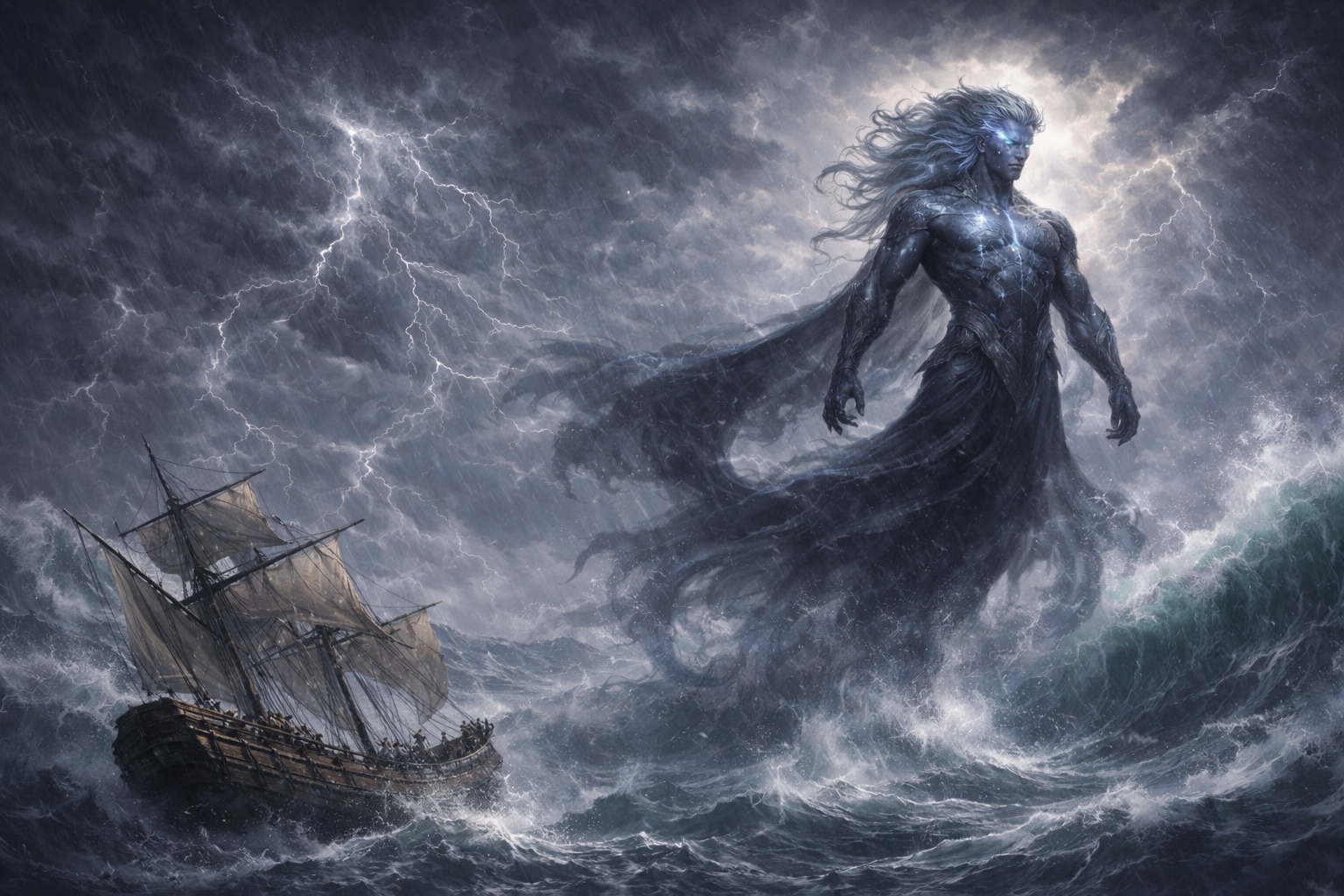
Demergat
At a Glance
- Portfolio: Storms, tempestuous islands, survival through extremity, the power and terror of weather, dominion through force of nature.
- Virtues (as the faithful name them): Strength, resilience, dominion, the will to weather any storm, unwavering loyalty under pressure.
- Vices (what Demergat opposes): Weakness, cowardice, the worship of other gods, the failure to submit to inevitable force.
- Symbol: A lightning bolt striking downward into churning waves; the image suggests both destruction and power.
- Common worshippers: Sailors forced to navigate treacherous waters, islanders born into storm-ridden lands, those for whom survival is daily negotiation with hostile nature, those who have survived divine wrath.
- Common regions: Island territories battered by constant storms, coastal communities facing maritime hazards, regions where natural disaster is normalized.
Names & Identifiers
- Common name (internal): The Tempest Lord or Demergat the Unconquered.
- Formal name (legal/ceremonial): The Faith of the Eternal Storm or The Church of Submission to the Tempest.
- A follower: A Demerite or storm-follower; among themselves, the weather-bound or tempest-kin.
- Clergy (general): Storm-clerics or tempest-keepers; senior clergy are called wave-lords or commanders of the flood.
- A temple/shrine: A storm-shrine or tempest-sanctuary; formally consecrated temples are massive stone structures designed to withstand siege-level weather.
- Notable colloquial names: Outsiders call the faith the cult of the tempest; the faithful call themselves the steadfast.
Origin & History
The Archipelago Before Demergat
The shard that would become Demergat fell into a maelstrom of islands: a region of such savage weather that human settlement seemed almost impossible. Yet people lived there anyway. They had learned, through centuries of hard experience, to build structures that could withstand the worst the sky could offer. They had learned to read the storms and predict their worst moments. They had learned to survive through submission rather than resistance; the island that fought the wind broke; the island that bent and gave way endured.
These were people shaped by extremity. The weak had not survived to become parents; the survivors were hard, competent, and ruthless in their own way. When Demergat emerged from the storm itself (not as a figure but as an overwhelming presence, a personification of the weather's will) the people of the islands recognized him immediately as their god. He was not the god they prayed to in hopes of salvation; he was the god they acknowledged as the actual force governing their lives.
The Emergence
Unlike many gods, Demergat did not arrive with a gentle introduction. He manifested as a hurricane so severe it exceeded any storm the islands had ever recorded. Ships sank. Buildings collapsed. Thousands died. And in the aftermath, when the fury passed and the islands lay battered but still inhabited, the people understood: Demergat had arrived not as savior but as judge.
A single priestess (the histories call her Veera of the Storm-Wall) stood at the highest point of a ruined temple and cried out to the god: "I accept. We accept. We will build no more in defiance of the tempest. We will not flee. We will endure and submit and build again, knowing it may be destroyed again. We accept your rule."
The storm broke. Demergat's avatar appeared (a figure of impossible beauty and terrible composure) and spoke to Veera alone. The actual words were never recorded, but the outcome was clear: a bargain had been struck. Demergat would not destroy indiscriminately. The people would worship, would submit, and in return, they would receive enough warning and enough divine favor to endure.
The Consolidation
Within a generation, Demergat's faith had spread throughout the archipelago. Not because it was comforting (it was brutally clear that Demergat cared nothing for individual suffering) but because it worked. Communities that organized under Demergat's doctrine, that followed his strictures about temple maintenance and submission to authority, that performed his rites, survived at rates measurably higher than communities that tried to resist or ignore the weather.
The faith became not merely spiritual but practical necessity. It was a survival technology, encoded in religious form.
The First Expansion
Demergat's attention eventually turned outward. The islands were secure in their submission; the god's power had grown through their worship. Now Demergat demanded expansion: his clergy were to bring his truth to other lands, to convert other peoples, to build his temples in territories that had no history of worship at him.
This was not the organic spread of a faith but deliberate conquest in religious form. Demergat's clerics arrived with the dual message: "Worship Demergat, and your ships will navigate treacherous waters safely. Refuse, and the waters will claim you." When necessity did not convince, other methods did.
Over centuries, Demergat's faith became a religion of expansion and consolidation, backed by the clear threat that refused worship would result in divine intervention against any who resisted.
The Divine Compact
Demergat's bargain is the clearest contract of all divine relationships: submission guarantees survival. Resistance guarantees destruction.
- What Demergat promises: Protection from the worst of the weather. Warning before major storms. The survival of ships and structures that are maintained in his service. Safety for communities that submit completely to his doctrine and his clergy's authority.
- Common boons: Storms that spare the faithful's ships while destroying competitors; weather warnings granted through dreams; the structural integrity of temples that hold through disasters that should destroy them; the promotion of followers through ranks and authority.
- Rare miracles: A city spared from a hurricane that devastates surrounding territories. A ship that should have sunk, made seaworthy by impossible circumstance. The appearance of Demergat's avatar to a follower at the moment of crisis.
- Social benefits: Security in a dangerous environment; advancement through the faith's ranks; the honor of being chosen to lead; the knowledge that you serve a god who actually exists and actually intervenes.
- Afterlife promise / fear: Demerites believe that those who have submitted truly will be received into Demergat's eternal storm, not as a place of peace, but as a place where they will endure and understand storms as they truly are: expressions of divine will. They fear being cast into calm, powerless waters where they will be forgotten and powerless.
- Costs / conditions: Total submission. Demergat demands not mere belief but behavioral compliance: participation in the conversion of others, maintenance of temples, the acceptance of clerical authority as the voice of the god. A follower who questions doctrine or resists the will of a storm-cleric will find divine favor withdrawn, with typically catastrophic results.
Core Doctrine
Demergat's theology reads like a law enforcement manual written in metaphor. It is practical, strict, and concerned primarily with order and obedience.
- The storm is truth. Reality is harsh, indifferent, and powerful. Pretending otherwise is a spiritual lie. The faithful accept the world as it actually is, not as they wish it to be.
- Submission is strength. A person who resists the inevitable is broken by it. A person who accepts inevitable force and adapts to it endures. Strength is not the refusal to bend; it is the knowledge of when bending is necessary.
- The god demands expansion. Demergat is not content with the islands. His clergy is obligated to bring his truth to new territories, to convert new peoples, to build his temples everywhere. The faith is inherently expansionary.
- The temple is the bulwark. A properly maintained temple becomes almost invulnerable. Its roof, specifically, must never fail. A temple whose roof fails during a storm is a sign that Demergat has withdrawn his favor, a public humiliation and spiritual catastrophe.
- Authority is divinely granted. The chain of command from Demergat through his highest clerics to the lowest follower is not a human invention; it is cosmic law expressed in hierarchy. To break the chain is to break reality itself.
- The unworthy are exposed. Those who do not truly submit will be revealed by the tempest. The god uses weather as a test; those who are destroyed by it lacked sufficient faith. This is not cruelty; it is clarity.
Soul Coins & Divine Economy
(See also: Soul Coins & Divine Economy)
Demergat's power is accumulated through acts of submission and expansion: the control of worshippers and the conversion of new territories.
- How Demergat gains soul coins: Complete submission from followers. Participation in expansion efforts. The successful conversion of regions previously hostile to the faith. Daily prayer and obeisance. The maintenance of temples in storm-resistant condition. Coins generated through Demergat's worship are notably concentrated: many small coins rather than a few large ones; the faith prefers widespread devotion over deep devotion.
- What makes a coin "heavy": The volume and consistency of submission. A region that produces many shallow-faith devotees generates more coin than a few deeply committed clerics. Mass conversion events generate heavy coin. Successful temple maintenance under extreme weather conditions generates coin. Expansion into previously unconverted territory generates coin.
- What Demergat spends coins on: Direct intervention to save temples from destruction. The occasional manipulation of weather to demonstrate divine power and encourage conversion. The support of military expansion efforts aimed at forced conversion. The protection of his clergy from the dangers they face.
- Trade: Demergat trades actively, particularly with deities who value expansion and dominion. He has negotiated extensively with Oshala, sharing methods of forced conversion and appreciating the Order's similar commitment to absolute certainty and hierarchical authority. He will trade coin for influence and for direct assistance in conversion efforts.
- Infernal competition: Demergat sometimes negotiates with infernal forces, making Faustian pacts in which he trades coin for supernatural assistance in expansion efforts. This is theologically controversial even within the faith, though the results are undeniably effective. The mainstream faith justifies it as "using demons against demons."
Sacred Spaces
Demergat's temples are not places of meditation or learning. They are fortresses.
A storm-shrine is built of massive stone, designed with the singular goal of providing absolute protection from weather. The roof is the most critical element, reinforced beyond what seems necessary, built with multiple layers and backup supports, engineered to withstand impacts that should destroy it. If a temple's roof fails during a storm, the clergy lose their divine powers until the roof is rebuilt and the next storm has passed over it and proven the repairs sound.
Interior layout reflects both practical and theological concerns. The central altar houses a chalice of storm water: water collected from the last storm to pass over the temple. This water is considered sacred; it must be refreshed after every major storm. The failure to refresh the chalice is considered a grave ritual transgression.
A completed temple includes adjoining administrative chambers: courts where judgments are rendered, registries where the population is recorded, barracks for the clergy and militia forces. The temple is not merely a house of worship; it is a center of control and administration. In regions where Demergat's faith has dominion, the temple often becomes the actual seat of government.
The largest and most significant Demergat temples are small cities unto themselves, containing housing for hundreds of clerics, storage for food and military supplies, and workshop space for the production of weapons and fortification materials.
Organizational Structure
Demergat's faith is organized as a rigid hierarchy with clear chains of command and absolute delegation of authority.
The structure mirrors military organization: a priesthood commands all religious and civic functions in a territory; below them are judge-clerics who administer law and punishment; below them are keeper-priests who manage individual temples and conduct day-to-day worship; at the base are lay followers who provide labor and support.
Authority flows unambiguously downward. A cleric's command is understood as the voice of Demergat; questioning a superior is considered both spiritual transgression and practical insubordination. The mechanism for resolving disputes is themselves in authority to render final judgment.
In territories controlled by Demergat's faith, the religious hierarchy often becomes the governmental hierarchy. The high clergy of a region effectively govern it as autocrats, with judicial, legislative, and enforcement authority concentrated in their hands. Nominally, they govern "in Demergat's name," but practically, their authority is absolute within their jurisdiction.
The faith maintains clear communication channels between regional leadership and distant leaders. A cleric in one archipelago can contact the highest authorities in another, creating a global network of control despite the distance. This network is maintained through a combination of sending spells, message systems, and regular diplomatic delegations.
Entering the Faith
Conversion to Demergat's faith is often involuntary, though the appearance of choice is maintained.
Soft entry is rare. Most conversions come through a combination of pressure and incentive. Communities are offered the chance to convert peacefully, to become part of Demergat's growing faith, to receive his protection. Those who refuse are met with increasingly direct divine intervention: weather that specifically targets them, ships that mysteriously sink, structures that fail. Eventually, the choice becomes clear: convert or be destroyed.
Initiation is public and binding. The initiate stands before the gathered community and a storm-cleric, and renounces all other worship. They swear submission to Demergat and to his earthly representatives. They are entered into a registry: a record that links them, their family, and their obligations to the faith. This registry is treated as permanently binding; one cannot simply leave.
What makes an enemy rather than a convert: Active resistance. The deliberate refusal to convert despite repeated opportunities. The hiding of non-believers or heretics. The maintenance of worship to other deities. These individuals are treated as enemies of the faith and targets for active conversion efforts, which may include direct miracles of divine punishment.
The Faithful in Practice
A devoted Demergat cleric is recognizable by their composure and their bearing.
- Treats weather not as a problem to be solved but as a voice to be obeyed. The storm is not attacking you; it is instructing you. The task is to understand the instruction and comply.
- Maintains temples with obsessive precision. A single crack in the roof is an emergency; a roof that leaks is a symbol of spiritual failure. The temple's integrity is Demergat's presence made manifest.
- Speaks with authority in all situations. Demergat's clergy do not ask questions; they give orders. Uncertainty is weakness; the clergy must project certainty at all times.
- Treats the registry as sacred. They know the names of all followers, their families, their histories. To know someone is to have leverage over them.
- When forced to explain suffering, asks: "What submission is being refused here? What demand of Demergat is being resisted?" Not "why did this happen?" but "what is being communicated?"
- Shows no mercy, as Demergat shows no mercy. A cleric who acts with compassion when doctrine demands severity is failing in their duty.
Taboos
- Worship of any deity other than Demergat. Not merely practicing, but even private devotion to other gods is forbidden. The faith maintains surveillance specifically to identify hidden worship and punish it.
- Neglecting temple maintenance. Any cleric who allows a temple to fall into disrepair is committing spiritual failure. The failure to refresh the chalice is particularly serious.
- Questioning the chain of command. To question a superior's authority is to question Demergat's will. This is spiritual mutiny, treated with severity.
- Sailing on holy days without explicit permission. Storm Day is sacred; no ships are to leave harbor without special authorization from the clergy. Those who defy this risk divine intervention.
- Disrespecting the storm water. The chalice and its contents are sacred. Tampering with it, spilling it carelessly, using it for profane purposes is a grave desecration.
Obligations
- Attend weekly storm services. Every follower is obligated to gather at a storm-shrine on the designated holy day (Storm Day, held each Caelday). Failure to attend without documented cause is subject to escalating penalties.
- Maintain temple structures. All followers contribute labor or resources to temple maintenance. The obligation is collective; if the roof fails, the entire community shares in the shame.
- Participate in conversion efforts. When the faith targets a new region or community, all followers are expected to assist. This might mean offering theological arguments, providing intelligence, or, in some cases, direct military assistance.
- Maintain registry accuracy. If your circumstances change (marriage, children, death, relocation), you must report to the registry keepers. Providing false information is a serious transgression.
- Pay the storm tithe. A percentage of income (typically 10-20%) is paid to the faith as a tax. This is not optional; it is collected as tribute to Demergat.
Holy Days & Observances
All holy days across Dort are listed in the Festival Calendar.
Storm Day
Date: Every Caelday (weekly observance).
Each Caelday, all followers gather in their regional storm-shrine for mandatory service. The gathering begins with a reading of the week's weather patterns (understood as divine communication), continues with prayers of submission, and concludes with the refreshment of the storm chalice if a storm has passed in the previous week. Attendance is taken; absence is noted and addressed.
Storm Day services are kept deliberately brief and formal. There is no warmth or comfort offered; the purpose is purely to reinforce submission and collective obedience. That the faith keeps its weekly service on the day named for Cael is not an accident; the clergy teach that the storm belongs to Demergat and that the old weather-god's day was always his to claim.
The Battening
Date: Solina, the month before the storm season; each community's tempest-keepers set the day.
Before the storms come, the faith inspects everything that must survive them. Tempest-keepers walk every street and every quay with the registry in hand. Each roof, wall, shutter, cistern, and hull is examined, and each is entered in the registry as sound, repaired, or condemned. Households make repairs in the days before the inspection; what fails is marked with the storm-seal and must be torn down or abandoned before the season begins.
The Battening is the faith at its most practical, and it is the clearest expression of Lyssa's legacy: survival organised, recorded, and enforced. Communities that keep it well lose fewer roofs and fewer ships, and the clergy make sure everyone knows it.
Veera's Cry
Date: Camay 1, the eve of the storm months.
Veera's Cry commemorates the founding hurricane and the covenant Veera made on the ruined temple. At dusk the most senior cleric climbs to the highest point of the storm-wall, faces the sea, and speaks Veera's words: "I accept. We accept. We will build no more in defiance of the tempest. We will not flee. We will endure and submit and build again." The gathered followers answer with the vows of submission, recited in unison.
The year's new registry entries are then brought forward and stamped. In the oldest temple of the archipelago this is done with the Seal of the First Covenant itself; elsewhere a temple's own seal is used. Converts received during the year are named aloud. The storm season begins the next morning, and the faithful understand themselves to be entering it under contract.
The Night of the Drowned
Date: A night in Ultember, after the last storm of the season.
When the storm months have passed, each storm-shrine reads aloud the names of everyone the sea took that year: sailors, fishers, and those lost when walls and roofs failed. There is no consolation in the reading; the dead are named because the registry requires that they be closed.
The night's central rite re-enacts the Drowned Sailor. A volunteer is lowered on a line into the dark water and held under for the length of a prayer, then hauled back to the quay. The return is the point: submission guarantees survival, even through death. Being chosen as the night's Drowned is an honour, and in some islands a requirement for advancement in the clergy. Before dawn, every chalice in the shrine is emptied and refilled with water from the season's final storm.
Ceremonies & Rituals
Bonding
Performed following conquest of a region, this ceremony formally transfers unmarried women to warriors and clerics through recorded ceremony. The transfer is entered into the registry. The ritual formalizes what is understood as the establishment of household order in a conquered population.
The Storm Chalice Renewal
Performed after every significant storm. Storm water is collected with ceremony, brought to the altar, and formally placed in the chalice. As the old water is replaced with new, prayers are recited asking Demergat to recognize that his will has been acknowledged and recorded. The ritual is part devotion and part practical insurance policy; the clergy's powers depend on the chalice being freshly filled.
Sazā (Correction)
A punishment-and-cleansing rite administered by clergy following formal trial. The trial establishes the offense; the Sazā corrects it. Punishment is delivered with procedural formality: a statement of what order was violated, the correction applied, and a declaration that the matter is resolved. The emotional tone is deliberately cold and impersonal; there is no mercy implied, only law.
The Registry Oath
Performed at the formal conversion of a community or civic institution. The newly converted gather, are entered into the registry, and swear collectively before a judge-cleric. This oath is foundational; everything the faith subsequently does in that community traces back to it.
Ceremonial Attire
Demergat's ceremonial dress is deliberately intimidating and uniform, emphasizing authority and control.
The Stormcloak
A heavy, water-resistant cloak dyed in deep blue and grey, embroidered with lightning bolts and crashing waves. The cloak is massive, designed to seem to enhance the wearer's presence. Rank is indicated through the quality of dye, the complexity of embroidery, and, for highest ranks, the addition of precious metal threading.
The Helm of Dominion
Worn by senior clergy during formal ceremonies. A headpiece of carved seashell and coral arranged to resemble a crown, communicating dominance over oceanic forces. The piece is intimidating and impractical, chosen purely for psychological impact.
The Belt of Authority
A sturdy leather belt adorned with pouches and fastened with a buckle shaped like a ship's wheel or anchor. The belt holds ritual items and is a symbol of rank and responsibility.
The Staff of Storms
Carried by high-ranking clergy in religious processions and rituals. Topped with a crystal resembling a storm cloud, the staff is used to invoke Demergat's blessings and to mark the authority of the ceremony. In some sect traditions, the staff is used physically in the Sazā rite.
The Chains of Office
Worn by the highest clergy and judges. Heavy silver or gold chains marking rank and authority, designed to be visible from distance. The chains communicate power and hierarchy in purely visual form.
Historical Figures
Veera of the Storm-Wall
Veera is remembered as the first to recognize Demergat and to negotiate the compact. She stood at the highest point in a ruined temple and cried out to the god, accepting submission and offering the people's loyalty. In exchange, Demergat granted them the possibility of endurance.
The faith does not canonize Veera as a saint in the traditional sense; she is treated as a precedent. Her moment of submission (the willingness to accept inevitable force rather than resist it) is held up as the model of proper faith.
The Drowned Sailor
An unnamed follower who was cast overboard during a storm and, in his desperation, experienced a vision of Demergat. The god offered him salvation in exchange for lifelong conversion efforts. The sailor agreed. He died, then inexplicably revived, and spent his remaining years preaching the faith to any who would listen.
The story is used theologically to support the idea that Demergat will preserve the faithful even through death, that submission guarantees survival, even in impossible circumstances.
Lyssa the Keeper
A historical figure from about three centuries ago, Lyssa was a temple keeper responsible for maintaining storm-shrines across multiple islands. She is credited with developing the system of registry maintenance and population control that has become central to the faith's administration. Her work made Demergat's expansion into new territories possible because she created the infrastructure for controlling large populations efficiently.
Lyssa is cited not as a heroic or spiritual figure but as a proof of concept: efficient administration in service to divine expansion is the highest form of devotion.
Sacred Relics & Artifacts
The Watered Chalice
- Description: A silver chalice of exquisite craftsmanship, bearing intricate engravings of storms and waves. The chalice is always full of clear water: storm water collected from the last storm to pass over the primary temple.
- Origin: Created during the early days of the faith, allegedly by Demergat himself through divine inspiration. If the chalice ever empties, the temple's clergy lose their spells until the next storm refills it and recharges their faith.
- Powers or Significance: The chalice is the physical anchor of Demergat's presence in each temple. As long as it is full of fresh storm water, the clergy's connection to the god is maintained. The chalice is the most critical religious object; its maintenance is a primary obligation.
- Current Location / Status: Every established storm-shrine has one. The most important chalice is kept in the oldest temple in the original archipelago.
The Seal of the First Covenant
- Description: A heavy iron stamp bearing Demergat's symbol. The imprint it produces is recognized throughout Demerite territories as bearing the highest possible authority.
- Origin: Used to stamp the first registry entries, it remains the official seal used to authenticate major documents and formal decrees from the highest clergy.
- Powers or Significance: Documents and decrees bearing this seal are treated as carrying Demergat's direct authority. They cannot be challenged or questioned without challenging the god's will itself.
- Current Location / Status: Kept in the most secure temple, used sparingly and only for documents of highest importance.
The Storm Water of the Founding
- Description: A single vessel containing water collected during the original hurricane that marked Demergat's emergence. The water is preserved in a crystal container and is never opened.
- Origin: Collected in the aftermath of the original storm and kept as a memorial to the covenant between the god and the people.
- Powers or Significance: The water is treated as the most holy relic in the faith. It is believed that if this water were ever used to fill a chalice, Demergat's presence would be restored even in a temple that had lost his favor. It is effectively insurance against spiritual disaster.
- Current Location / Status: Kept in the most protected chamber of the oldest temple, accessible only to the highest clergy under extreme circumstances.
Sects
The Manis (The Soft-Conversion Wing)
How they refer to themselves: the Peacekeepers or the Gradual Ones
The Manis focus on converting communities through demonstration of benefits rather than through direct force. They establish temples in target regions and provide genuine services (weather prediction, maritime safety, trade network access) before fully asserting religious authority. They argue that voluntary conversion is more stable than forced conversion.
The mainstream faith tolerates them because they are effective, though hardliners consider them theologically soft.
The Armenites (The Storm Warriors)
How they refer to themselves: the Wave-Makers or the Iron Fleet
The Armenites are the militant wing of the faith, commanding warships and warrior-priests. They believe force is the clearest form of conversion, that resistance should be met with overwhelming power, that speed of conquest matters more than the method. They use both divine miracles and direct military force to expand the faith.
The Armenites are crucial to expansion efforts but are difficult to control. Their methods are effective but often generate lasting resentment in conquered populations.
The Nasallians (The Administrative Order)
How they refer to themselves: the Keepers of Order or the Registrars
The Nasallians specialize in the administrative consolidation of conquered territories. They focus on registry maintenance, population control, law enforcement, and the establishment of bureaucratic infrastructure. Their work ensures that conquered populations remain subjugated and that the faith's control persists even without active military presence.
Heresies
The Mercy Sect
How they refer to themselves: the Compassionate Ones or the Second Chance Keepers
The Mercy Sect argues that Demergat's strictness is meant to enforce discipline, not to cause suffering, and that mercy is compatible with faith. They advocate for more lenient punishments, for allowing some autonomy within the hierarchy, for treating followers with more respect.
The mainstream faith considers this a fundamental misreading of Demergat's nature. Mercy is weakness; the god does not forgive or compromise.
The Naturalists
How they refer to themselves: the Weather-Speakers or the Storm's Voice
The Naturalists believe that Demergat is not a conscious deity but rather the personification of natural weather patterns. They treat "submission to Demergat" as submission to natural law rather than to the clergy's interpretation of divine will. This heresy fundamentally challenges the clergy's claimed authority to speak for the god.
The mainstream faith opposes this viciously. If weather is just nature, then the clergy's authority rests on mere human power, not divine right. This heresy, if it spread, would destabilize the entire power structure.
The Liberationists
How they refer to themselves: the Free-Wind Keepers or the Breakaway Sect
The Liberationists believe that Demergat's original covenant was with the islands and their people, and that expansion beyond those boundaries violates the original faith. They argue that forced conversion in foreign lands is not the god's true will but the corruption of that will by ambitious clergy.
This heresy is dangerous because it is not obviously false; it appeals to historical record and could potentially delegitimize expansion efforts if it gained traction.
Cults
The Drowning Ecstatics
How they refer to themselves: the Water-Taken or the Drowned Returned
The Drowning Ecstatics believe that to truly commune with Demergat, one must come close to death by water. They engage in ritualized near-drowning experiences, holding worshippers underwater until the last moment before death, believing this brings them into direct contact with the god. They claim to receive visions and prophecies during these experiences.
The mainstream faith is deeply disturbed by this cult. While the faith values extreme submission, it does not intentionally risk the death of followers; they are resources, not disposable. Additionally, many of these practitioners have died, suggesting either fraud or genuine danger.
The Possessed Fleet
How they refer to themselves: the Avatar-Bearers or the Living Demergat
The Possessed Fleet believes that Demergat actually inhabits the bodies of particularly devoted followers during storms. These individuals walk into hurricanes intentionally, believing themselves to be conducting the god's will directly. Some survive by improbable circumstance; most die.
The mainstream faith denies that these individuals are possessed, treating them as deluded. However, their deaths are sometimes presented as martyrdom, which complicates the official response.
The Registry Keepers (Schismatic)
How they refer to themselves: the True Administrators or the Record-Perfecters
This schismatic group believes that the registry is not merely administrative but spiritually binding in ways the mainstream faith does not fully appreciate. They conduct rituals with registries, believe that registry entries have magical force, and claim that properly kept registries grant them direct authority over registered individuals' souls.
The mainstream faith considers them heretical but not particularly dangerous, as their practices don't significantly interfere with normal operations.
Presence in the Shattered Domain
- Territory aesthetic: A perpetual storm. Demergat's divine domain is an archipelago eternally battered by hurricanes: islands that emerge from churning seas, towers that sway but never break, sky that is always dark with clouds and electric with possibility. The aesthetic is hostile and beautiful simultaneously. Submission is not weakness here; it is the price of existing in this space at all. Structures that defy the storm are destroyed; structures that yield and give way endure.
- Likely allies: Oshala (shared commitment to hierarchy and dominion), deities who value expansion and conquest, those who appreciate efficiency in control.
- Likely rivals: Deities who value mercy, compassion, or the freedom of individual choice. Echo and Demergat are fundamentally opposed; Echo seeks fair distribution and community autonomy; Demergat demands total submission and hierarchical control.
- Stance on the Godless: Hostile and aggressive. The Godless represent a refusal to acknowledge authority, either Demergat's or anyone else's. They are targets for forced conversion or destruction.
Adventure Hooks
- Demergat's faith has begun expanding aggressively into new territories. A coastal community faces the choice of peaceful conversion or violent resistance. The party must navigate the political, military, and spiritual dimensions of Demergat's expansion while deciding where their loyalties lie.
- A splinter sect of Demergat worshippers has begun conducting dangerous rituals involving near-drowning. The mainstream faith wants them suppressed quietly, but their activities are public and drawing attention. The party must decide whether to help suppress them or expose the darker truths about the faith's practices.
- A ship crew member claims to have seen Demergat's avatar during a storm and received a personal message from the god. The mainstream clergy insist this is fraud or madness; the individual insists on its truth. The party must investigate whether this is genuine divine encounter, delusion, or a con.
- The registry of a major Demerite temple has been discovered to be fraudulent; the records have been falsified for decades, suggesting administrative corruption at high levels. The discovery threatens to destabilize the faith's control if widely known. Multiple factions want the party to help conceal or expose this.
- An island that has been in Demergat's faith for generations is experiencing a decline in temple maintenance and religious observance. Weather events are becoming more severe, and the clergy are blaming the decline in faith. The party must determine whether the decline is genuine spiritual failure or the result of the clergy's own mismanagement.