Erumpens
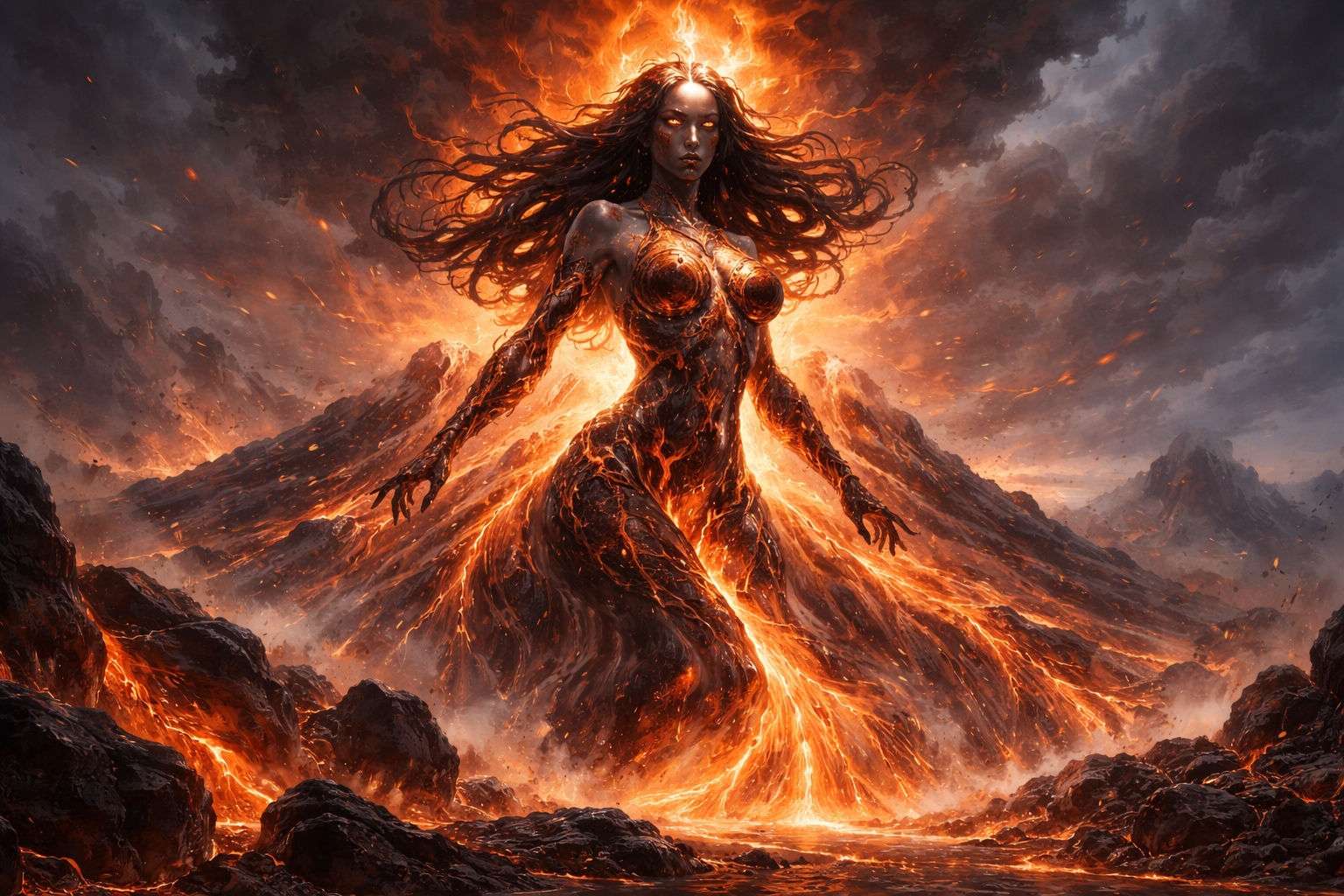
Erumpens
At a Glance
- Portfolio: Volcanic fire, catastrophe, transformation through destruction, the divine wrath rendered in magma.
- Virtues (as the faithful name them): Passion, resilience, acceptance of change, spiritual fervor.
- Vices (what Erumpens opposes): Complacency, false permanence, the illusion of safety, denial of divine power.
- Symbol: A mountain's silhouette consumed by flames from within, with a single point of white heat at the peak.
- Common worshippers: Those living near volcanoes; priests who embrace danger as divine calling; those seeking transformation through trials; communities living at geological risk.
- Common regions: Volcanic zones and mountains prone to eruption; particularly strong in isolated mountain communities.
Names & Identifiers
- Common name (internal): The Burning Faith or the Erumpens Devoted.
- Formal name (legal/ceremonial): The Temple of Erumpens the Consuming Fire.
- A follower: An Erumpenic (also, rarely, a Burning One).
- Clergy (general): Priests of the Flame or flame-keepers (those who maintain temples on active volcanoes).
- A temple/shrine: An Altar of Fire or Flame Temple (always situated atop active volcanic peaks).
- Notable colloquial names: Outsiders sometimes call them the Crater Priests or Volcano Blessed. In lands where Erumpens is less known, skeptical observers call her followers the Doomed, a term they embrace rather than reject.
Origin & History
The Shard's Descent
Erumpens was not born gently into the world. When the Ancients shattered Ix, one shard did not drift through sky or settle into soil; it fell. Fell burning, fell screaming through the upper realms, and drove itself into the heart of an active volcano in a land whose geography predated human records. The impact was catastrophic. The mountain convulsed. For three days, the sky darkened with ash. When the tremors finally ceased, something new existed inside the stone.
The goddess woke confused and furious, trapped within a prison of heat and pressure, her consciousness scattering through molten rock like thought through fire. She had no worshippers. She had no one to call to. She was alone with only the volcano's rhythm: the slow circulation of magma, the periodic ruptures, the absolute indiference of stone.
The First Priestess
Centuries passed, unmeasured by Erumpens in her stone sleep. Then a woman came to the mountain with desperation in her bones.
Maeve Eion was noble-born, beautiful in the way that made her a commodity rather than a person. She had been married for political advantage to a man who kept mistresses without shame. When she discovered him with another woman, something inside her (a lifetime of compliance, of acceptance, of being a wife and breeding stock) crystallized into fury so complete it felt like fire. She rode her horse to the nearest mountain, intending to end herself in the crater.
At the summit, she found not death but a woman's voice made of heat. Erumpens, recognizing in Maeve's desperation something that resonated with her own trapped anguish, spoke. Not words exactly, but understanding. The goddess offered a choice: surrender to the fall, or surrender to the fire. Surrender to becoming something new.
Maeve chose fire.
She stayed on the mountain three nights and emerged transformed, not physically, but spiritually remade. The rage that had driven her to suicide became purpose. She claimed the volcanic peak as sacred ground. She built the first temple from stones torn from the mountainside, working alongside followers she somehow attracted, as if Erumpens' newfound awareness had begun radiating outward, drawing those who needed to be remade.
The Age of Temples
The spread of Erumpens' faith followed volcanic geography. Wherever a mountain burned, her priesthood emerged. This was not organized conquest; it was recognition. Populations living on the slopes of active volcanoes faced constant existential threat. Erumpens' theology (that catastrophe is divine communication, that destruction contains divine will, that survival is grace) made sense to them.
Maeve trained other priestesses, establishing the practice that still defines the faith: temples built on active volcanic peaks, constructed hastily and deliberately impermanent. Each eruption would destroy what had been built. Each eruption would be interpreted as Erumpens speaking directly to her followers. The temples were not meant to last. They were prayers written in stone that the volcano would consume.
Over generations, a theological principle emerged that shaped the faith permanently: when a temple is present upon a volcano, that mountain erupts. Not metaphorically. The correlation was so consistent that Erumpens' priesthood came to understand it as law. The goddess does not merely accept destruction; she requires it. The presence of a sacred temple invites eruption. The ritual of building and the certainty of destruction became inseparable.
The Divine Compact
Erumpens offers a covenant unlike any other faith in Dort. She does not promise safety; she promises meaning in catastrophe and transformation through trials of fire.
- What Erumpens promises: Personal and spiritual metamorphosis. Erumpens does not protect her followers from disaster; she teaches them to survive it, to emerge changed, to find within catastrophe the shape of their true selves.
- Common boons: Sudden clarity in moments of crisis; the physical and mental fortitude to endure extreme hardship; prophetic dreams of volcanic activity; the ability to sense when a mountain will erupt before geological signs appear.
- Rare miracles: A priestess walking unharmed through flowing lava. A temple collapsing exactly at the moment its occupants escape. Survivors of catastrophe reporting visions of Erumpens standing in the flames, neither threatened nor threatening, simply present.
- Social benefits: Reputation for fearlessness; status as community leaders who understand catastrophe intimately; access to knowledge about volcanic patterns that can inform settlement and agriculture.
- Afterlife promise / fear: Erumpens teaches that those who face divine fire with open hearts will be remade in the next life as something greater, freed from the constraints of flesh. Those who deny her power or hide from her truth face dissolution into ash.
- Costs / conditions: Absolute commitment to the faith during times of volcanic danger. Followers who flee when called to witness eruption, who abandon the community for safety, or who deny Erumpens' direct involvement in the mountain's wrath will find the goddess's favor withdrawn. There are no exceptions for fear.
Core Doctrine
An Erumpenic's faith is built on the acceptance of divine chaos and the recognition that destruction contains purpose.
- Catastrophe is communication. When the mountain burns, Erumpens is speaking. To interpret that speech, one must listen without fear, must stand in the presence of divine fire and understand that the message is not "you will perish" but "you will be transformed."
- What is permanent is false. The illusion of lasting safety corrupts the soul. All things built must be destroyed. All things living must change. To fight this principle is to deny reality itself.
- Survival is grace, not right. When catastrophe comes, those who survive do so because Erumpens has chosen them for further purpose. Survival carries obligation.
- Fire purifies and unmakes. Fire is not cruelty dressed as nature. It is divine truth. It consumes what cannot be remade and makes space for what will be.
- The priesthood serves the mountain, not the people. Priests of Erumpens are intermediaries between goddess and volcano, not advocates for human welfare. Their duty is to ensure the sacred relationship is honored, even when that relationship demands sacrifice.
Soul Coins & Divine Economy
(See also: Soul Coins & Divine Economy)
Erumpens gathers power through those who accept the necessity of destruction and through the specific spiritual state of standing before catastrophe without despair.
- How Erumpens gains soul coins: Active acceptance of transformation through hardship. Facing volcanic danger with faithfulness rather than fear. Building temples that will be destroyed. Surviving eruptions and interpreting them as tests passed. Followers who survive catastrophe while maintaining faith generate particularly heavy coin; they have proven their worth through fire.
- What makes a coin "heavy": Sacrifice accepted rather than resisted. A priestess who stays on the mountain when eruption nears generates heavier coin than one who flees. A follower who loses everything in a volcanic disaster and maintains faith rather than becoming bitter generates coin that weighs more than a lifetime of comfortable worship.
- What Erumpens spends coins on: Volcanic activity itself. Erumpens does not merely have temples in volcanoes; she animates them, maintains the heat, influences eruption patterns. Her coin expenditure keeps sacred mountains active. She also grants visions and moments of clarity to priestesses facing extreme danger.
- Trade: Erumpens does not trade in coin. She is among the most independent deities in the Shattered Domain, unconcerned with divine economy as other gods practice it.
- Infernal competition: Infernal forces sometimes attempt to prey on volcanic communities after disasters. Erumpens' priesthood counters this by framing survival as evidence of divine favor, not opportunity for Tempter exploitation. The rhetoric is: "You survived because you are faithful, not because you need a deal."
Sacred Spaces
An Erumpens temple is not a structure meant to outlast its creator. It is a prayer made physical, designed to be unmade.
Construction: Temples are built rapidly, using stone quarried from the volcano itself or its immediate surroundings. The buildings are functional but deliberately unfinished: incomplete walls, exposed internal structure, minimal decoration. Materials are chosen for workability, not durability. The architecture communicates impermanence.
Location: Always on an active volcanic peak or within a zone showing geologically recent activity. The temple is positioned in places where eruption will certainly destroy it. This is not coincidence; priestesses consult geological signs and divine intuition to choose the exact spot most vulnerable to molten flow.
Layout: A central gathering space open to the sky (no roof; Erumpens will see her own), stone benches for prayer, and typically a single sealed chamber said to contain relics from previous temples destroyed in prior eruptions. Smaller chambers serve as quarters for resident priests.
Practical functions: The temple is simultaneously sanctuary and observatory. Priestesses use the location to monitor volcanic behavior, reading changes in heat, gas, tremors, and bird behavior as signs of coming eruption. The temple is a place of worship and a station for geological prediction.
Sacred conditions: An Erumpens temple is considered most sacred not when it is pristine but when it bears the scars of survival: charred stone from near-eruptions, ash deposits from past activity, repairs over repairs. These are the marks of the goddess's presence.
Organizational Structure
The Erumpens priesthood is decentralized by nature, as each volcanic zone typically hosts only one major temple and one high priestess who claims direct communication with the goddess.
Authority flows through experience and survival. A priestess who has survived three eruptions holds more authority than one who has only maintained a temple through calm years. The priesthood does not rank by training or appointment but by proven resilience.
Regional priestesses coordinate loosely, meeting once every five years at a neutral location to share knowledge about volcanic patterns and to debate theological questions. These meetings are contentious; the faith values individual interpretation over universal doctrine. A priestess of one mountain may disagree sharply with another and both be considered orthodox.
Maeve's original temple, the oldest and most prestigious, serves as a center of reference. Its high priestess is consulted on matters of doctrine but holds no legal authority over other temples.
The priesthood is exclusively female. This is not stated as doctrine; Maeve's choice was practical (she was a woman, her followers were primarily women) and became tradition. Male believers are welcomed and do participate in rituals, but they cannot hold priestly rank or authority.
Entering the Faith
The Erumpens faith is not proselytized in the traditional sense. Conversion happens through crisis.
Soft entry: Someone lives near an active volcano or faces catastrophic loss. The priesthood approaches them in the aftermath, not with theological argument but with companionship. They provide shelter, food, guidance. They listen to the person's story of loss and gradually reveal the interpretation: this was Erumpens speaking to you.
Initiation: Formal acceptance into the faith typically occurs during a moment of volcanic activity. The initiate stands with priestesses on the volcano as warning signs intensify, as the mountain trembles, as heat rises. The test is simple: will you remain? The act of remaining is the vow. There are no words, no ceremony. To witness the goddess's power and not flee is to be initiated.
What makes an enemy rather than a convert: Those who deny Erumpens' agency in disaster. Who claim volcanic eruption is merely geological. Who preach that the goddess doesn't control the mountains. These people are not merely wrong to the priesthood; they are dangerous. They spread heresy that could corrupt the faith's foundation. They are actively opposed.
The Faithful in Practice
An Erumpenic priestess or devoted follower is recognizable by their acceptance of impermanence and their unusual calm in moments of crisis.
- Speaks matter-of-factly about destruction: "When the mountain takes what we've built, we will build again." This is not resignation but clarity.
- Prepares constantly: maintains emergency supplies, knows escape routes, can read volcanic warning signs. Preparation is a form of prayer.
- Faces crisis without panic: When danger comes, the Erumpenic responds with methodical action rather than fear. This makes them natural leaders in disasters.
- Interprets suffering as communication: When facing personal hardship, asks, "What is Erumpens trying to teach me through this?" The goal is to extract meaning, not to deny pain.
- Shows respect for the mountain that borders on love: Speaks of the volcano as a living entity, acknowledges its autonomy, never frames eruption as attack.
- Sees community survival through catastrophe as proof of grace: Those who endure are chosen. Those who don't are not abandoned; they are transformed into something beyond the material realm.
Taboos
- Worship of other nature deities as equals to Erumpens. Followers may acknowledge other gods of mountains or fire, but only as subordinate or aspects of Erumpens' broader power. To elevate another deity to equal standing is to deny the goddess's supremacy in her domain.
- Abandoning temples during imminent eruption. The temple is a covenant with Erumpens. Once a priestess claims a location as sacred, she does not leave it because danger approaches. A priestess who flees faces expulsion from the faith.
- Denying the goddess's direct involvement in volcanic activity. To claim that eruptions are "just geology" is to sever the relationship between goddess and manifestation. This is perhaps the most serious heresy.
- Building permanent structures on sacred volcanic grounds. Towns or fortifications built on the slopes of Erumpens' mountains may face the goddess's active displeasure through increased seismic activity. Some priestesses interpret this as Erumpens reclaiming her territory.
Obligations
- Maintain readiness for volcanic activity. All followers must maintain supplies and knowledge necessary to survive or escape volcanic events. Preparedness is a sacred duty.
- Attendance during eruption cycles. When seismic or geological signs suggest increased volcanic activity, followers are expected to journey to the nearest Erumpens temple for ritual and witness. Missing this call is a serious breach.
- Participation in temple construction and maintenance. Building sacred temples is a rotating obligation. Followers draw lots or volunteer in cycles to participate in construction at active volcanoes.
- Education of younger generations. Teaching children the faith's central truths (that destruction is divine, that catastrophe contains meaning) ensures the priesthood's continuity.
Holy Days & Observances
All holy days across Dort are listed in the Festival Calendar.
Eruption Day
Date: Declared when geological and divine signs indicate imminent eruption of a sacred volcano. Not on a fixed calendar, on the mountain's calendar.
When a volcano shows signs of coming eruption, the priesthood declares Eruption Day. All believers within reasonable travel distance converge on the sacred temple. The gathering is not festive but solemn and purposeful. Priestesses conduct rituals that acknowledge the coming transformation. At the peak of volcanic activity (when the earth shakes most violently) followers witness the goddess's power directly. Some flee to safety at prescribed moments; the priestesses traditionally remain in the temple until the latest possible moment, emerging as the first lava flows toward the structure. The eruption itself is the holy day's conclusion. The destruction is the sacrament.
The Reconstruction
Date: Seasonally, following the major eruption cycle, usually weeks to months after Eruption Day.
Once a volcano has erupted and its immediate fury has passed, the priesthood directs the reconstruction of the temple. This is not a somber duty but a celebration of survival. Followers work together, quarrying stone, raising walls, reestablishing the sacred space. The work is accompanied by songs and storytelling, and it concludes with a ceremony that blesses the new temple and prepares for the next eruption. The cycle completes itself.
Ceremonies & Rituals
The Calling of the Mountain
Performed when a volcano's activity is increasing but eruption is not yet imminent. Priestesses gather in the temple and perform a ritual that involves repeated calls, chants that echo across the mountainside. The ritual is believed to communicate with Erumpens directly, to let the goddess know her priesthood is present and ready. The calling can last hours or days, depending on priestess interpretation of divine response.
The Final Witness
When eruption is imminent and the priesthood has determined it is time to evacuate, this ritual occurs. It is brief and pointed. Each priestess places a hand on the temple walls one final time. Each speaks aloud what she is leaving behind and what she is surrendering to Erumpens. Then they walk down the mountain. The eruption that follows within hours is understood as Erumpens accepting the surrender and taking the temple back into herself.
The Renewal Binding
Performed at the new temple once reconstruction is complete. Priestesses and followers renew their individual vows to the faith. Each person states what they have survived and how Erumpens transformed them through trial. The ceremony concludes with a collective acknowledgment: "What is built will be unmade. What is unmade will be made new. This is Erumpens' truth."
Ceremonial Attire
The Priestess's Mantle
A robe, typically in deep blacks and blood reds, made from heavy, fire-resistant materials. The mantle bears visible signs of its purpose: scorch marks from proximity to heat, repairs from damage during eruptions, ash stains that are never fully cleaned. These marks are not wear damage; they are badges of office. A pristine mantle suggests a priestess who has not yet truly stood before the goddess.
The Crown of Ashes
Worn during major rituals, a crown crafted from volcanic rock and bone, darkened by ash, that sits heavily on the priestess's head. It is uncomfortable by design: a constant reminder of the weight of duty and the burden of living close to catastrophe.
Amulet of the Consuming Flame
Worn by all initiated priestesses, a pendant carved from volcanic obsidian in the shape of Erumpens' symbol. Some amulets are warm to the touch, retaining heat in a way that conventional materials should not, a phenomenon the priesthood attributes to the goddess's presence within the stone.
The Torch of Witnessing
Carried during Eruption Day rituals, a torch that burns with an unusual flame, fed by oils and resins that produce a heat and color matching volcanic fire. The torch is handed from priestess to priestess during the final hours before eruption, passing through as many hands as possible as the moment of destruction approaches.
Historical Figures
Priestess Maeve Eion, First of the Burning
Maeve's story is told by the priesthood not as a narrative of personal salvation but as the moment Erumpens chose to speak to the mortal world. Before Maeve reached the volcano's peak, Erumpens had existed in divine isolation, aware but voiceless. Maeve's desperation (her complete willingness to die) was the first genuine call the goddess received. Maeve was not chosen because she was special; she was special because she was desperate enough to listen when a god spoke back.
The priesthood emphasizes that Maeve did not lose her rage when she encountered Erumpens. She transformed it. The fury that drove her to suicide became the fuel for building temples and founding a faith. Her marriage ended not because her husband changed but because Maeve remade herself around a different loyalty entirely. She became sacred not by virtue of sainthood but by her complete refusal to remain unchanged.
Maeve lived to be elderly, according to the priesthood's records, and died on the mountain during an eruption at a time when she had chosen not to evacuate. Her body was never recovered. The priesthood teaches that she was taken back into the goddess herself.
Priestess Kael of the Northern Peaks
A priestess from a younger generation who survived three eruptions, each more violent than the last. Kael became known for her ability to read the mountains, to sense volcanic activity before conventional geological signs appeared. She would sometimes declare evacuation days before seismic activity intensified, and the priesthood's records show a near-perfect correlation between her warnings and subsequent eruptions.
Kael's theological contribution was the doctrine that "the mountain teaches those who listen." She established the practice of priestesses spending solitary nights in the temple during quiet volcanic periods, listening to the mountain's subtle movements and variations in heat. This practice continues today and is considered essential to priestess training.
Kael lived through a major eruption that killed several followers who did not heed evacuation warnings. Rather than accept this as divine will, Kael responded by developing systems of communication and coordinated evacuation protocols. She is remembered not as a mystic but as someone who merged faith with practical wisdom, who believed Erumpens' power was expressed through both volcanic force and the priesthood's strategic response.
The Unnamed Priestess of the Silent Mountain
During a period when volcanic activity had decreased dramatically, so much so that some communities began leaving the faith, believing Erumpens' power had waned; a single priestess maintained her temple and her vigil on a mountain that had not erupted in forty years.
Her name is not recorded in the priesthood's official histories. The point of her story is her anonymity. She is remembered simply as the priestess who persisted in faith despite silence from the goddess. When the mountain finally erupted after decades of dormancy, it was this priestess and her followers who were at the temple. They survived because they had never abandoned readiness.
The priesthood teaches this story to young initiates as a counter to doubt: faith that requires divine action to validate is weak faith. True faith persists through silence, through apparent abandonment, through the slow periods when catastrophe seems less likely. When the goddess finally speaks again, only those who maintained vigilance will be prepared to hear.
Sacred Relics & Artifacts
The Stone of Maeve's Weeping
- Description: A chunk of volcanic rock, roughly fist-sized, with an unusual iridescence: a mirror-like quality that allows the viewer to see their own reflection in its surface. The stone is warm to the touch under most conditions and grows warmer during periods of volcanic activity.
- Origin: Said to have been carved by Maeve herself from the volcano where she encountered Erumpens. The goddess is believed to have blessed the stone, infusing it with divine presence.
- Powers or Significance: Followers who gaze into the stone report visions of personal transformation, seeing themselves as they might become, imagining themselves remade by fire. The stone is consulted during major personal decisions or spiritual crises.
- Current Location / Status: Held in Maeve's original temple, brought out during important rituals or when a follower seeks guidance during catastrophe.
The Temple Bell of First Eruption
- Description: A massive bronze bell cast from metal taken from the first volcano where Maeve built a temple. The bell is ornate but cracked; a fissure runs from top to bottom, a scar from the eruption that destroyed Maeve's original temple.
- Origin: Crafted by followers in the decades following Maeve's encounter with Erumpens, meant to call followers to the temple during volcanic activity.
- Powers or Significance: The bell can only be rung during actual volcanic eruption; at other times, it will not produce sound. When eruption is imminent and the bell is rung, the sound carries across impossible distances, calling followers from villages far from the mountain. The priesthood considers this a miracle of the goddess.
- Current Location / Status: Mounted in Maeve's original temple. Copies have been attempted, but they do not possess the magical property; only the original bell responds to eruption and carries divine sound.
The Ash Urn of Kael
- Description: A ceramic vessel containing volcanic ash from the eruption that killed followers during Kael's tenure. The ash is kept sealed; opening the urn is said to release the spirits of the dead to find their next transformation.
- Origin: Kael collected ash from the eruption that claimed lives and kept it as a reminder of the cost of the faith. After her death, the priesthood sealed the urn and declared it sacred: a memorial to those lost and a physical representation of the goddess's power to consume and transform.
- Powers or Significance: The urn is consulted when followers face the loss of loved ones. Gazing upon it is believed to help followers understand that death is not ending but transformation. Some priestesses have poured a small amount of ash into believers' homes to consecrate them.
- Current Location / Status: Held in a secondary temple, moved between volcanic regions on a rotating basis so followers in different areas can access it for spiritual counsel.
Sects
The Ash Readers
How they refer to themselves: the Interpreters or the Voice of Stone
The Ash Readers are priestesses who specialize in reading volcanic behavior with extraordinary precision. They spend extended periods on active volcanoes, analyzing every tremor, every change in heat signature, every chemical shift in released gases. They practice a combination of faith and geological observation that other priestesses sometimes view as suspiciously secular.
The Ash Readers argue that Erumpens speaks through the volcano itself and that understanding the mountain's language is therefore a sacred duty. They maintain detailed records spanning decades, correlating volcanic patterns with prior eruptions and community activities. Some communities hire Ash Readers as consultants, which creates tension with more traditional priestesses who see commercial application of divine knowledge as corruption.
The Temple Builders
How they refer to themselves: the Reconstructors or the Hands of Renewal
Not all followers of Erumpens are mystics. The Temple Builders are practical priestesses and lay followers obsessed with the engineering and construction challenges of building sacred temples in hostile environments. They study materials, practice rapid construction techniques, and approach each new temple as a puzzle to solve.
The Temple Builders maintain that building beautifully is a form of prayer, that temples should be not just functional but aesthetically intentional, even though they will be destroyed. They create sculptural elements, carved decorative work, and deliberate architectural choices that serve no practical purpose beyond expressing the faith's spiritual core. Other priestesses sometimes view this as frivolous, but the Temple Builders argue that the goddess deserves beauty, even if it is temporary.
The Silent Vigil
How they refer to themselves: the Watchers or the Mountain's Companions
The Silent Vigil are priestesses devoted to remaining on sacred mountains during quiet periods, spending months or years at a temple when volcanic activity is low. They practice meditation, ritual prayer, and the continuous listening that Kael established as a spiritual practice.
The Silent Vigil believe that spiritual growth requires prolonged proximity to divine presence, even when that presence is quiet. They are sometimes isolated from other priestesses and are viewed by some as eccentric, but the faith respects their commitment. When volcanic activity does begin, the Silent Vigil are typically the first to detect it.
Heresies
The Earthbinders
How they refer to themselves: the Stabilizers or the Order of Safe Ground
The Earthbinders argue that Erumpens' true purpose is to prevent volcanic eruption, that the goddess can be appealed to for safety and stability rather than demanding submission to catastrophe. They believe building temples on volcanoes should invoke divine protection, not divine destruction.
The orthodox priesthood considers this a fundamental inversion of the faith. Erumpens does not prevent eruption; she causes it. The Earthbinders' refusal to accept this basic theological truth is, from the priesthood's perspective, a refusal to know the goddess at all.
The Rational Vulcanists
How they refer to themselves: the Scholars or the Observant
The Rational Vulcanists accept that Erumpens exists but deny that she directly causes volcanic eruptions. They argue that the goddess has blessed volcanic science, that understanding geology is understanding the divine, but that eruptions are natural phenomena, not divine will made manifest.
To the priesthood, this is perhaps more dangerous than outright atheism. It uses the language of faith while denying its core premise. A follower who believes eruptions are purely geological will not maintain proper ritual preparation and will miss the spiritual transformation the priesthood teaches is possible.
Cults
The Consumed Ones
How they refer to themselves: the Purified or the Remade
The Consumed Ones believe that physical destruction in volcanic fire is not transformation but liberation, that the goal of faith should be to achieve destruction. They seek out eruptions not for witness but for participation, deliberately positioning themselves in flows' paths and embracing death by lava.
The mainstream priesthood considers this a corruption of the faith. Erumpens does not require death; she requires transformation. There is a theological difference between surviving catastrophe and being destroyed by it. The Consumed Ones have abandoned the former in favor of the latter.
The False Permanents
How they refer to themselves: the Builders of Eternity
The False Permanents reject the theology of impermanence. They believe that faith should focus on creating structures and communities that outlast volcanic cycles, that building temples meant to be destroyed is wasteful. They attempt to construct structures using exotic materials or magical protections designed to survive eruption.
The priesthood sees this as a fundamental rejection of Erumpens' truth. The temples are meant to be destroyed. To fight that destruction is to fight the goddess herself.
Presence in the Shattered Domain
- Territory aesthetic: Volcanic, obviously. Erumpens' portion of the Shattered Domain is a landscape of active lava flows, towering volcanic cones, constantly shifting terrain. The beauty is severe and hostile. Structures built within her domain are temporary by nature, collapsing and reforming as volcanic activity shapes them. The landscape communicates that permanence is illusion.
- Likely allies: Thulgard (both gods understand catastrophe and transformation), Zopha (knowledge about natural forces). Few other deities cooperate easily with Erumpens; her complete indifference to divine politics makes her unreliable ally.
- Likely rivals: Deities who promise safety, who preach order, who claim the ability to prevent disaster. Echo indirectly (by building stable communities, Echo denies the need for Erumpens' harsh transformation).
- Stance on the Godless: Indifferent. The Godless live without divine guidance and face natural consequences accordingly. Erumpens sees no reason to intervene, punish, or recruit them. They are outside her concern.
Adventure Hooks
- A volcanic region that has been quiet for decades suddenly shows signs of imminent eruption. The local priesthood is preparing ritual and evacuation, but the secular government does not believe the warnings and is attempting to forbid gathering followers on the mountain, claiming it is inflammatory (pun intended) and dangerous. The priestess must navigate between divine duty and legal compliance.
- A Temple Builder sect has developed a technique that might allow them to construct a temple that could survive an eruption. The priesthood is divided: is this an affront to Erumpens or an appropriate expression of faith's evolution? If they attempt it and fail catastrophically, what does that failure mean?
- The Ash Readers have discovered something troubling in their geological records: volcanic activity in the region has been increasing in frequency and intensity over centuries. The mountain may be approaching a cataclysm far exceeding normal eruption cycles. Do they warn the secular government? Do they prepare the faith? Do they remain silent to protect sacred knowledge?
- A young woman comes to the faith seeking transformation through catastrophe after experiencing personal tragedy. The priesthood recognizes genuine calling, but she is also showing signs of the Consumed Ones' death-wish heresy. Helping her find genuine transformation instead of destruction becomes a spiritual and practical challenge.
- A scholar from outside the faith has published research suggesting that Erumpens' temples deliberately position themselves in lava flow paths and that the priesthood has been carefully engineering which volcanoes erupt and when. If true, this challenges the theology that Erumpens directly causes eruption. If false but believed, it delegitimizes the priesthood's authority. The priestess must respond.