Fujin
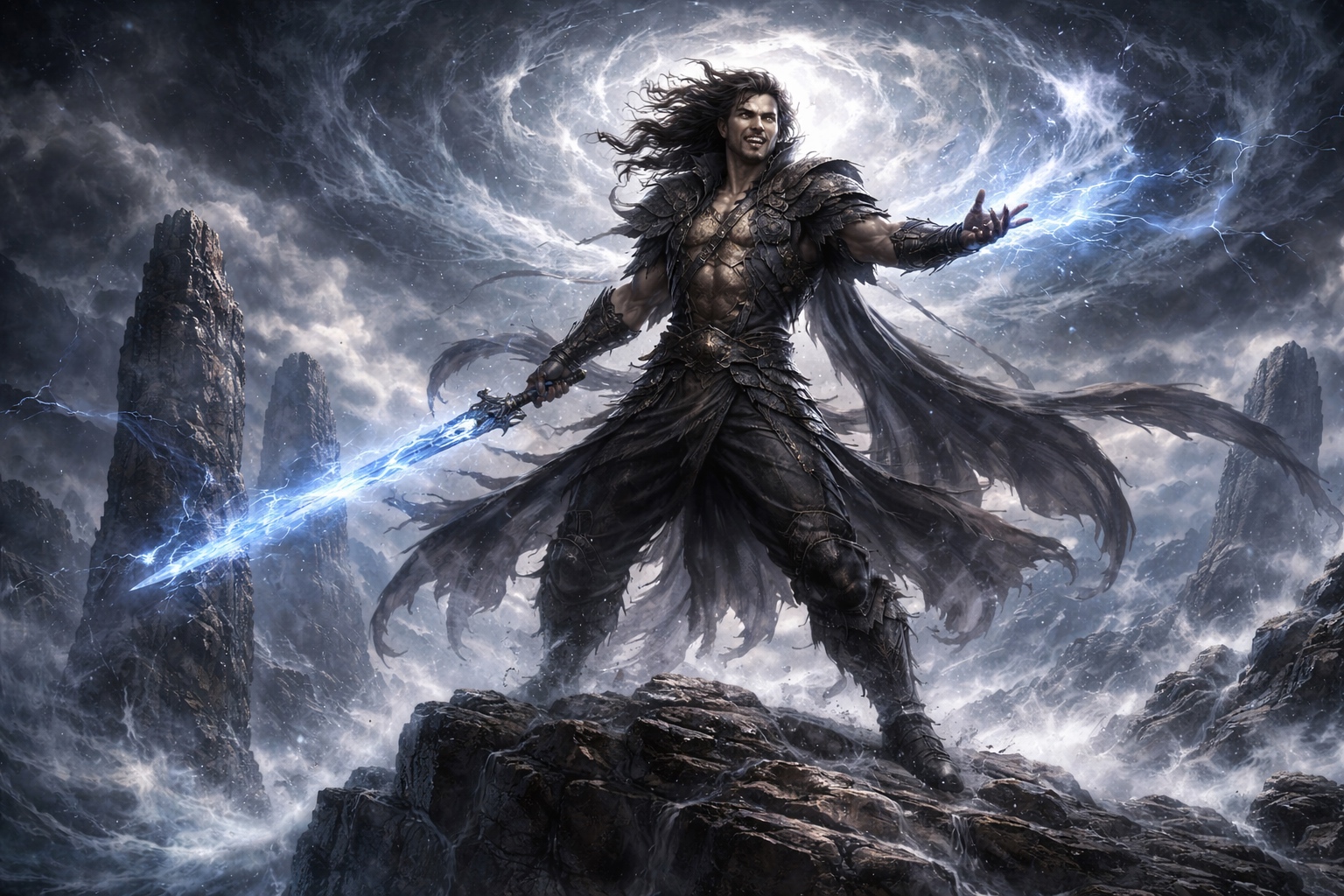
Fujin
At a Glance
- Portfolio: Wind, storms, chaos, battle-fury, the untamed forces of nature, the liberation found in wild abandon.
- Virtues (as the faithful name them): Courage, authenticity, spontaneity, freedom, fierce joy.
- Vices (what Fujin opposes): Stagnation, false control, the suppression of natural impulse, the chains of order that deny the wild.
- Symbol: Dark storm clouds pierced by jagged lightning, with wind-lines suggesting movement and fury.
- Common worshippers: Sailors and merchants who brave unpredictable weather; warriors seeking chaos in battle; mages drawn to volatile magic; those living near storm-prone regions; performers and wanderers; those rebelling against rigid social structures.
- Common regions: Coastal areas prone to typhoons and violent storms; regions of Shoing and parts of Antaea; mountainous areas with sudden weather; any place where civilization's control remains fragile.
Names & Identifiers
- Common name (internal): The Storm Faith or the Tempest Beloved.
- Formal name (legal/ceremonial): The Way of Fujin, Lord of Winds and Untamed Fury.
- A follower: A Fujinite (also a Storm-Touched or a Free One).
- Clergy (general): Storm-priests or wind-speakers (not hierarchical, self-identified).
- A temple/shrine: A Storm Temple or Monolith Site (marked by erected stone pillars).
- Notable colloquial names: Outsiders sometimes call them the Wild Folk or the Reckless Blessed. In organized societies, skeptics call them the Chaos Cult, a term Fujinites sometimes embrace.
Origin & History
The Shard That Fell Laughing
When the Ancients shattered Ix, not all shards fell into the earth or settled into water. One shard (wild and untamed even in its divine form) did not fall so much as explode upward, scattering through the upper realms in fragments before coalescing into something almost alive before it was born. Fujin did not wake in isolation like other Shards; he woke laughing, surrounded by the first winds that had ever existed independent of a god's will, understanding immediately that he and they were not separate things.
The shard that became Fujin carried something from Ix's nature that few other deities inherited clearly: raw impulse, joy in motion itself, the refusal to be bound or settled. Where other gods developed purpose and doctrine, Fujin experienced existence as immediate and joyous. The world was a thing to move through, to act upon, to change simply by being present.
The First Followers
Unlike many deities, Fujin did not choose the first mortals to worship him. They found him because they were already searching for something he represented: a force that could justify their own wildness, their own refusal to stay bound by the structures that societies demanded.
The earliest records speak of Kurotai the Fearless, a warrior who threw away his shield in battle and charged into overwhelming odds. In the chaos of his charge, when he should have been killed, a tempest arose around him. The storm became his shield. His enemy's arrows were knocked aside by gusting wind. The storm was so precisely aligned with his need that it felt like divine intention, because it was.
But Kurotai was not chosen because he was righteous or faithful. He was chosen because he was utterly himself in that moment, not calculating, not restraining, simply acting with complete authenticity. Fujin recognized something in that authenticity and answered it.
The Cult of Chaos and the Pillar Tradition
Word of Kurotai's victory spread, and people came looking for the god who had blessed recklessness. Followers gathered, not around temples, but around monolithic stone pillars erected at sites of great chaos: battlefields where unlikely victories occurred, locations struck by devastating storms, places where wild magic had spontaneously manifested. Each pillar was a marker, a place where Fujin had been present and visible.
The tradition of erecting monoliths became the faith's defining practice. The pillars are not built with the care of temple architecture. They are crude, often massive, sometimes unstable. They are meant to mark chaos rather than create order. Many pillar sites are dangerous, situated on cliff edges, in perpetually storm-struck regions, in places where the land itself seems uncertain.
Over generations, the faith developed distinct practices:
In regions like Shoing, where the faith is strongest, Fujinites became known as storm-chasers and storm-dancers. During typhoon seasons, followers would seek out the most violent weather and claim that standing in the storm was prayer. Some would die; the faith taught that death in the storm was not failure but the most complete form of worship.
In warrior cultures, Fujin's followers became the ones who fought in the heart of chaos, not strategically but passionately, seeking the moment when battle became pure action without thought. Armies both feared and valued Fujinite warriors, who would charge without regard for personal safety or tactical sense but who often broke enemy formations through sheer ferocity.
In magical communities, Fujinite mages pursued the wild, unpredictable aspects of arcane power. They did not seek control over magic; they sought union with its chaos. Some became powerful practitioners; many burned out or went mad from the attempt.
The Compact With Ryujin
As Fujin's faith spread and his influence in coastal regions grew, he inevitably encountered another ancient god: Ryujin, lord of seas and waters. Ryujin is not hostile to Fujin, but neither are they allies by nature. Ryujin represents the deep, the ancient, the slow movements of vast waters. Fujin represents the surface fury, the storm-driven waves, the immediate chaos.
The relationship between the two deities is complex. Some scholars describe it as alliance; others describe it as carefully negotiated rivalry. The truth seems to be both:
- In storms, Ryujin and Fujin work in concert. The sea-god moves the deep waters; the wind-god throws the surface into chaos. Together they create the devastating typhoons and tempests that define the season.
- In calm, Ryujin reasserts dominion. When the storms pass and seas become still, Fujin's influence recedes. The deep water belongs to Ryujin alone.
- Theologically, they represent different aspects of nature: Ryujin teaches the ancient wisdom of depth and patience; Fujin celebrates the immediate ecstasy of surface movement and change.
Some Fujinite sects specifically invoke Ryujin during rituals, seeing partnership with the sea-god as essential to their practice. Others dismiss Ryujin as representing an order and control that contradicts Fujin's chaos principle. The two gods seem untroubled by this theological debate; they cooperate when cooperation serves their natures and remain separate otherwise.
The Divine Compact
Fujin offers something rare and dangerous: divine blessing for those who refuse to be bound, who embrace their wild nature, who understand that chaos is not failure but authentic existence.
- What Fujin promises: Freedom from constraints, victory in moments of crisis when only bold action succeeds, the exhilaration of living authentically without apology, power that grows with wild courage and spontaneous action.
- Common boons: Unexpected aid in desperate moments; gusting winds that deflect arrows or carry words across distances; the ability to sense incoming storms; dreams that feel like flying; sudden surges of courage or physical strength at critical moments.
- Rare miracles: A fleet of ships that appears and disappears like wind-spirits, defeating pirates or invading forces. A battlefield where a hopelessly outmatched force suddenly turns the tide through inexplicable fortune and chaotic action. A mage whose uncontrolled spell cascade somehow resolves into perfect expression of will.
- Social benefits: Among warriors and those who embrace chaos, high status as someone touched by the god. Respect from those who value courage and authenticity. Community with others who refuse rigid societal norms.
- Afterlife promise / fear: Those who lived with authentic wildness and died in moments of glorious action will be reborn as something greater: wind-spirits, storm-riders, entities of pure force. Those who spent life constrained by fear or rigid control will be reborn in forms that demand they learn to act.
- Costs / conditions: Abandonment of comfort or safety when Fujin's call comes. Acceptance that Fujin's favor is unpredictable and may not protect you. Willingness to challenge authority and established order. Participation in dangerous practices that honor the god.
Core Doctrine
Fujin's followers understand their faith through principles of authenticity, immediate action, and the sacred value of chaos.
- Authenticity is divinity. To be yourself completely, without apology, is to embody Fujin. Suppression of your nature to fit society's demands is spiritual death.
- Chaos is freedom. Order restricts; chaos liberates. The world's systems try to contain and control; Fujin celebrates the breaking of those systems.
- Impulse is wisdom. Your immediate reaction is not failure of judgment; it is your true nature speaking. To act on impulse is to act in alignment with the god.
- Glory is fleeting and therefore sacred. The moment of perfect action cannot be preserved or repeated. It must be seized when it arrives. Moments of complete authenticity (in battle, in art, in magic, in love) are Fujin's sacraments.
- Death in the storm is life. To die in the moment of complete authenticity is not tragedy but apotheosis. Fujin welcomes his followers into something beyond mortality.
Soul Coins & Divine Economy
(See also: Soul Coins & Divine Economy)
Fujin's power grows through moments of authentic wild action and through the specific spiritual energy of individuals embracing their true nature, consequences be damned.
- How Fujin gains soul coins: Spontaneous action taken without calculation. Defiance of authority or established order. Battle fought with complete abandon. Magical experimentation that breaks established rules. Living authentically despite social pressure to conform. Followers who pursue their passion without regard for practical outcome generate steady coin.
- What makes a coin "heavy": Authenticity combined with consequence. A warrior who charges into overwhelming odds generates heavier coin if they die in the attempt than if they survive. A mage who experiments with dangerous magic and burns out generates heavier coin than one who safely masters existing techniques. A person who destroys their comfortable life to pursue authentic desire generates heavier coin than one who daydreams about rebellion.
- What Fujin spends coins on: Storm manifestation and weather generation. Supporting followers in chaotic moments. Granting moments of clarity and sudden power in crisis. Creating the conditions for battle and magic; Fujin seems to spend heavily on amplifying chaos in regions important to his faith.
- Trade: Fujin trades freely with other deities but typically in moments of crisis. When another god needs chaos introduced into a situation, Fujin might trade coin to make it happen. When Fujin needs order temporarily (rarely), he will acquire it through trade, though such arrangements seem uncomfortable for him.
- Infernal competition: Tempters sometimes approach Fujinites with promises of consequence-free chaos. Fujin's response is dismissive; true chaos must have consequences or it's not authentic. Fujinites learn that Tempter deals always contain hidden controls, which is precisely what makes them un-Fujin. The god's implicit teaching is: beware the promise of chaos without cost, for control always hides beneath it.
Sacred Spaces
A Fujin temple is not a temple in the traditional sense. It is a site marked by a monolith and defined by the chaos around it.
The Monoliths: Standing stone pillars, typically crude and massive, erected at sites of great chaos. The pillars range from simple stones to elaborate constructions, but all are meant to be visible from distance and to mark spiritual significance. No two are identical; each builder leaves their own signature. Some are carved with crude symbols; others are deliberately left plain. The philosophy seems to be that the marker matters less than the intention behind it.
Location: Monoliths are erected at:
- Battlefields where unusual victories occurred
- Sites struck by particularly devastating storms
- Places where wild magic spontaneously manifested
- Locations where followers have died in moments of glorious action
- Cliff edges, precarious heights, and other dangerous locations
Sacred conditions: A monolith is considered most sacred when it is weathered and worn, when it bears the marks of storms that have struck it, when it is cracked and damaged but still standing. A new, pristine monolith is not yet fully sacred; it must survive the god's chaos to prove itself.
Gathering places: Followers gather around monoliths during storms, during seasonal festivals, or in response to calls that seem to come from the god. Gatherings are chaotic and unpredictable: sometimes peaceful meditation, sometimes wild celebration, sometimes dangerous ritual that tests followers' courage.
No permanent temples: Unlike other faiths, Fujin has no permanent temple structures. Any attempt to build a temple in the traditional sense is considered contrary to the faith's principles. Some sects maintain shrines with stored equipment, but these are viewed as practical necessity rather than spiritual requirement.
Organizational Structure
Fujin's faith has no formal hierarchy, which is both its strength and its greatest challenge.
Distributed leadership: There are no high priests or central authority. Instead, Fujin-priests are self-identified individuals who have experienced the god's presence and feel called to guide others. Some are more respected than others, but respect is earned through demonstrated authenticity and spiritual power, not through appointment.
Sect autonomy: Different Fujinite sects operate independently, sometimes with contradictory practices and theologies. A storm-chaser sect in Shoing operates by completely different rules than a warrior sect in a different region, yet both are considered orthodox. Fujinites view this diversity as strength, not fragmentation.
Consensus through chaos: When conflicts arise between sects or within communities, Fujinites sometimes resolve them through challenges: physical, magical, or spiritual tests that determine which position is more authentically aligned with Fujin's nature. These conflicts are rarely violent in the lethal sense, but they are intense and sometimes brutal.
Mentorship and initiation: New followers typically find their way to an experienced Fujinite who recognizes the calling. Training is unpredictable: sometimes long mentorship, sometimes a single conversation before the student is considered ready. There is no standard curriculum.
Seasonal leadership: In some regions, Fujinites designate different leaders during storm season versus calm season, recognizing that different qualities are needed at different times.
Entering the Faith
Conversion to Fujin's faith is rarely a choice made in calm contemplation. It happens in moments of crisis or sudden spiritual awakening.
Soft entry: Someone experiences a moment where their authentic nature demands action despite social/legal consequences. They act anyway. They survive in a way that shouldn't have been possible. A Fujinite notices and approaches them afterward, offering interpretation: you have touched the god's favor.
Initiation: There is no formal initiation ceremony in most sects. Instead, a person becomes Fujinite when they take action that marks them as belonging to the faith. This might be standing in a storm and refusing shelter. This might be throwing away armor to fight. This might be casting dangerous magic. The initiation is self-evident.
What makes an enemy rather than a convert: Those who see Fujin as a cover for selfishness or crime. Those who claim the god's blessing while actually acting from cowardice or desire to harm. Those who talk about authenticity while secretly calculating advantage. These people are not converted; they are opposed as frauds wearing the god's name.
The Faithful in Practice
A devoted Fujinite is recognizable by their authenticity, their willingness to act on impulse, their comfort with chaos and danger.
- Speaks without filters: says what they think, doesn't calculate social impact before speaking. This is not rudeness but authenticity.
- Acts decisively: When a decision is needed, the Fujinite acts immediately, trusting their authentic response over careful deliberation.
- Pursues what they love: Without apology or concern for practicality. A Fujinite musician might abandon a lucrative career to pursue artistic truth. A warrior might reject advancement that would move them from battle.
- Faces crisis with exhilaration rather than fear: When danger comes, the Fujinite asks, "What does my authentic response demand of me?" rather than asking "how do I survive?"
- Challenges authority: Not from rebellion for its own sake, but because authority often demands suppression of authentic nature. A just rule accepted willingly is fine; a rule imposed on one's nature is worth defying.
- Celebrates wildness: In themselves and others. Exuberance, passion, spontaneity: these are not flaws but signs of Fujin's presence.
Taboos
- Suppression of authentic nature in yourself or others. If you feel called to action, denying that call is profoundly wrong. If you see someone else's nature being systematically suppressed, remaining silent is complicit.
- Premeditated control. Planning carefully to limit chaos or to suppress wild impulses is anti-Fujin. Fujin acts spontaneously; to deliberately constrain yourself goes against the god.
- Cowardice disguised as wisdom. Fujin has nothing against caution born from genuine danger. What he opposes is the false caution that stems from fear of judgment or failure: the refusal to act because society disapproves.
- Collaboration with rigid order against those seeking freedom. To enforce conformity on behalf of ordered structures is among the worst transgressions in Fujin's theology.
Obligations
- Act on your authentic impulse when Fujin's call comes. Not constantly; a Fujinite can live normally most of the time. But when the god's presence is felt and action is demanded, the follower must respond, even if the response is dangerous or socially catastrophic.
- Seek out storm sites and dangerous locations during storm seasons. Pilgrimage to sites of chaos is understood as a rotating obligation. A follower is expected to journey to at least one monolith site per season to participate in worship.
- Test your limits constantly. Through challenge, through dangerous practice, through flirtation with what might destroy you. The faith teaches that safety breeds stagnation.
- Support other followers in pursuing their authenticity. If a Fujinite is sacrificing security for authentic action, others should support that pursuit, even if it seems unwise.
Holy Days & Observances
All holy days across Dort are listed in the Festival Calendar.
Tempest's Dawn
Date: The first major storm of the spring season, date varies by region.
Tempest's Dawn marks the return of storm season and the beginning of Fujin's active cycle. Followers gather at monolith sites to welcome the returning chaos. The ritual involves standing exposed to the storm, not for shelter but to be directly in the weather's fury. During Tempest's Dawn, followers make offerings by throwing objects into the wind, claiming that the god accepts what is surrendered to chaos. The night culminates in celebration and storytelling about past moments of glorious action.
Battle's Crescendo
Date: Midsummer's eve.
Battle's Crescendo commemorates Kurotai's legendary victory: the moment when a warrior's authentic courage called down divine storm. On this day, followers gather for mock battles, tests of skill, and displays of martial prowess. But the essence of the celebration is not competition; it is the pursuit of moments where action becomes perfect, where authenticity and will align completely. The day ends with a ritual where stories of past glorious moments (not all victories, but moments where followers acted most authentically) are shared and celebrated.
Arcane Gale Festival
Date: The night of the autumn equinox.
The Arcane Gale Festival celebrates the wild, unpredictable aspects of magic. This is a day of magical experimentation, of pushing boundaries, of attempting what organized magic considers forbidden or dangerous. Magical duels, uncontrolled spellcasting, and rituals designed to channel chaotic energy characterize the festival. The faith teaches that this day exists because some knowledge is too wild for normal times, and Fujin reserves this moment to allow those who pursue chaotic magic to explore without social restriction.
Whispering Winds Day
Date: The last full moon of the year.
Whispering Winds Day is unexpectedly quiet and introspective, a deviation from Fujin's typical chaos. On this day, followers gather at monolith sites to listen to the wind and reflect on the year past. It is a moment of connection with the god's subtler aspects. Followers share what they have learned from acting authentically through the year and commit to continuing to honor their true nature in the year to come. The ritual acknowledges that even chaos has rhythm, and that Fujin's presence can be felt in stillness as well as in storm.
Ceremonies & Rituals
The Standing
The most basic Fujinite ritual, performed individually by followers seeking Fujin's presence. The Standing simply requires a person to place themselves in an exposed location during storm or high wind (on a cliff, on an open plain, on a ship in rough seas) and remain there without protection. The ritual is complete when the person feels the god's presence or when they choose to leave. Some takeminutes; some last hours.
The Challenge
Performed when followers face significant decisions or spiritual crossroads. The challenger proposes a physical, magical, or spiritual test that will reveal which choice is most authentic. Other followers witness and judge whether the chosen course aligns with Fujin's principles. The challenge can be anything from a bout of combat to a test of magical power to a feat of courage.
The Naming
Performed when a follower takes a new name or commits to a new aspect of their authentic identity. A priestess calls the follower to account: asks them to defend their choice, to demonstrate that this new expression is genuinely who they are and not a escape from previous constraints. If satisfied, the priestess blesses the change in a brief ritual. If doubtful, the priestess may offer challenge or refuse the naming until the follower has proven themselves.
The Last Flight
Performed in honor of a follower who has died in a moment of glorious action or authentic chaos. The community gathers at a monolith site and tells stories of the deceased's most authentic moments. Objects significant to the dead are thrown to the wind as offerings. The community affirms that the follower has been received by Fujin and transformed into something beyond mortality.
Ceremonial Attire
Weathered Garments
Followers wear practical clothing designed for storm and chaos, typically leather or heavy cloth. The garments are meant to be worn through weather, not protected from it. A Fujinite priestess's robes should bear the marks of storms: scorch marks from lightning, water stains, repairs from damage. Pristine clothing suggests someone who avoids real chaos.
Storm-Eye Amulet
Worn by initiated priestesses, an amulet designed to resemble the calm center of a typhoon: a circle of peaceful space surrounded by chaotic energy. The amulet is believed to attune the wearer to Fujin's presence and to grant moments of clarity in chaotic situations.
Wind Chimes or Bells
Some Fujinites wear small bells or wind chimes that announce their presence through sound. This is both practical (the sound can carry on wind) and spiritual: a way of inviting the god's attention through constant motion and noise.
Scars and Markings
While not official attire, many Fujinites bear visible evidence of their dangerous practices: scars from battle, burn marks from magical practice, breaks that healed imperfectly. These are worn without shame as marks of authenticity and commitment.
Historical Figures
Kurotai the Fearless
Kurotai's historical existence is debated by scholars, but his presence in the faith's theology is undeniable. The warrior is remembered not as a general or strategist but as someone who abandoned strategy entirely. In the moment of overwhelming odds, when calculation said to retreat or surrender, Kurotai instead threw down his shield and charged. The storm that arose around him, whether divine or spontaneous, transformed certain defeat into impossible victory.
Fujinites teach that Kurotai's value is not that he won but that he acted with complete authenticity. He did not calculate angles or odds. He did not seek permission. He simply did what his nature demanded in that moment. The victory was the god's blessing, not the point itself.
Kurotai is believed to have died in a later battle, fighting with the same reckless authenticity. He is remembered as the template for the ideal Fujinite: completely true to himself without apology or regret.
Suyin, Whisperer of Storms
Suyin was a coastal fisherwoman who encountered a typhoon while at sea. Rather than seeking to escape the storm, she prayed not for salvation but for the strength to face it. Her boat was caught in the tempest; she survived by riding the waves rather than fighting them, by accepting the storm's power rather than resisting. When she emerged, she bore no marks of harm, and she spoke of feeling Fujin's presence in the heart of the chaos.
Suyin spent the rest of her life on the coast during storm seasons, and she is remembered for teaching that Fujin's chaos does not require fighting; sometimes it requires moving with the god's force rather than against it. Her legacy complicated the faith's warrior-centered theology by suggesting that there were many ways to be authentic to the god, not all involving combat.
Jiro, the Arcane Tempest
Jiro was a mage who pushed magical boundaries to their breaking point and beyond. He practiced magic that established orders considered too volatile, too uncontrolled. His experiments sometimes produced astonishing results; other times they created localized disasters. When he finally achieved what he sought (a direct channeling of chaotic magical energy) the result transformed him. He became a being partially of magic itself, capable of wielding forces that conventional practitioners could not touch.
Jiro's legacy is complicated. He is celebrated as someone who pursued authentic magical expression at any cost. He is also cautionary; his transformation left him alien, cut off from normal human interaction. Some followers see his path as ultimate Fujinite success; others see it as a warning that some costs are too high.
Sacred Relics & Artifacts
Kurotai's Tempest Blade
- Description: A sword said to have been forged from a meteorite and tempered in storm winds. The blade crackles faintly with residual energy. When swung, it appears to carry gusts of wind.
- Origin: Crafted by mortal smiths for Kurotai, touched by divine presence during his legendary battle.
- Powers or Significance: The blade is said to grant its wielder partial immunity to arrow and projectile attacks through wind deflection. More importantly, it is believed to attune the wielder to Fujin's presence, making moments of inspired action more likely. Wielders report that the blade almost thinks for itself in moments of combat crisis.
- Current Location / Status: Kept at one of the oldest monolith sites, brought out for important battles or presented to warriors undertaking significant challenges. Multiple replicas exist, but none possess the blade's power.
Suyin's Storm-Eye Amulet
- Description: A deep blue gemstone carved into the shape of a calm circular eye surrounded by chaotic imagery. The amulet is worn on a simple cord.
- Origin: Crafted by Suyin and worn throughout her life on the coast. Said to contain the spiritual blessing of her encounter with divine storm.
- Powers or Significance: Wearers report unusual clarity during periods of chaos and the ability to make intuitive decisions that prove surprisingly sound despite appearing chaotic. The amulet is believed to grant attunement to natural storms, allowing the wearer to sense approaching weather.
- Current Location / Status: Passed between priestesses, traveling to different regions. It is consulted particularly by coastal communities and Fujinites seeking clarity during chaos.
Jiro's Arcane Prism
- Description: A multifaceted crystal that constantly shifts colors. The prism is beautiful but slightly unnerving; it seems to affect perception, making observers feel like they are looking at multiple surfaces simultaneously.
- Origin: Created by Jiro during his transformation, it represents the moment he channeled pure chaotic magical energy. It contains fragments of the divine fire that touched him.
- Powers or Significance: Mages who study the prism can amplify their spellcasting, drawing on raw chaotic magical power. However, using it is dangerous; the magic it channels is unstable and unpredictable. Users risk burning out or transformation similar to Jiro's.
- Current Location / Status: Held in a secure temple, accessible only to experienced mages undertaking significant magical work. It is one of the faith's most powerful artifacts and most dangerous.
Sects
Kurotai's Thundering Legion
How they refer to themselves: the Lightning Blades or the Fearless
The Thundering Legion are warriors and soldiers dedicated to pursuing battle as spiritual expression. They seek moments in combat where calculation falls away and pure authentic action takes over. They are disciplined in training but seek to transcend discipline in actual combat.
The Thundering Legion are the most militaristically sophisticated of Fujin's sects, often employed as elite warriors by various powers. Their enemies respect them and fear them in equal measure. They are considered trustworthy allies if employed, but unreliable if their personal authentic impulse conflicts with their contract.
Suyin's Stormcallers
How they refer to themselves: the Wave-Riders or the Coastal Blessed
The Stormcallers are followers who practice Suyin's teachings, finding harmony with chaos rather than fighting it. They are primarily sailors, fishers, and coastal dwellers who work to attune themselves to natural weather and sea patterns.
The Stormcallers are viewed as more spiritual than martial by other sects. They emphasize meditation and intuition over action and combat. They are frequently consulted by other followers for guidance about reading natural signs and moving with rather than against forces.
Jiro's Arcane Vortex
How they refer to themselves: the Magic-Touched or the Chaos-Workers
The Arcane Vortex brings together mages and magical practitioners devoted to pushing boundaries of magical knowledge. They experiment with dangerous techniques, study unstable energies, and attempt to achieve direct communion with chaotic magical forces.
The Arcane Vortex is the most intellectually rigorous of Fujin's sects, but their theology remains focused on authenticity: the pursuit of honest magical truth rather than controlled technique. They are sometimes viewed as dangerous by other magical communities and are frequently associated with magical accidents or catastrophes.
Heresies
The Stormbinders
How they refer to themselves: the Controllers or the Ordered Storm
The Stormbinders argue that Fujin's chaos can and should be harnessed and controlled. They practice rituals aimed at binding storms, at directing chaotic magical energy toward specific purposes, at using the god's chaos as a tool for ordered ends.
The mainstream faith sees this as a fundamental betrayal. Fujin's chaos is not a resource to exploit; it is an expression of freedom itself. To bind it is to deny the god's essential nature.
The Pacified Gale
How they refer to themselves: the Peace-Seekers or the Still Center
The Pacified Gale argues that Fujin's chaos is a test for mortals to find peace and tranquility amidst disorder. They interpret the faith as teaching that you should remain calm regardless of chaos around you. They avoid battles and storms, practice meditation, and seek internal equanimity.
The orthodox faith considers this a profound misreading. Fujin does not teach the suppression of authentic response; the Pacified Gale are doing exactly that by refusing to act on their impulse toward safety or peace.
Cults
The Stormchasers
How they refer to themselves: the Obsessed or the Devoured
The Stormchasers take Fujin's teachings to extremes, actively seeking the most violent storms and battles. They view surviving dangerous circumstances as proof of divine favor. Many die; this is interpreted as the god accepting them into something beyond mortality.
The mainstream faith respects courage but views the Stormchasers' practices as self-destructive rather than authentically Fujin-inspired. There is a philosophical debate about whether dying by accident is the same as dying in authentic action.
The Chaosweavers
How they refer to themselves: the Unbound Ones or the Void-Touched
The Chaosweavers practice dangerous magical techniques without restraint, often combining chaotic magic with infernal pacts or other darker powers. They believe that all forms of chaos (divine, infernal, natural) are equally valid expressions of freedom.
The mainstream faith rejects this as corruption. Fujin's chaos is characterized by authenticity and freedom; infernal chaos is characterized by binding and control. The two are opposed, not equivalent. Chaosweavers are considered dangerous heretics.
Presence in the Shattered Domain
- Territory aesthetic: Chaotic and ever-shifting. Fujin's portion of the Shattered Domain is characterized by perpetual storm, by winds that shift direction without pattern, by landscapes that appear and disappear. It is beautiful in a wild, dangerous way; nothing is stable, everything is in motion. Structures do not hold; they are constantly battered and reformed by divine weather.
- Likely allies: Ryujin (partnership during storm seasons), deities who value freedom and authenticity. Occasional cooperation with Thulgard (both understand catastrophe as teacher).
- Likely rivals: Deities representing order, control, permanence. Direct ideological opposition to Oshala (whose singular order is everything Fujin opposes) and Echo (whose stability contradicts Fujin's celebration of chaos).
- Stance on the Godless: Indifference verging on contempt. The Godless have rejected divine partnership entirely; they are beyond Fujin's reach or concern. Whether they live authentically or according to social convention matters less to Fujin than the fact that they have denied the divine altogether.
Adventure Hooks
- A particularly violent storm season has been more destructive than usual, and coastal communities are beginning to blame Fujin's increased activity. Meanwhile, Fujinite pilgrims are arriving in larger numbers, claiming the god is calling them to witness something. Are the two phenomena connected? What is Fujin attempting to communicate?
- The Thundering Legion has been hired by both sides of a conflict. Individual warriors honor their contracts but secretly sympathize with the opposing side. As the war intensifies, will their authentic responses override their contractual obligations? The breakdown could shift the entire conflict.
- A scholar has published research suggesting that Fujin's influence actually makes people more reckless and chaotic than their authentic nature would suggest, that the god distorts rather than liberates. A Fujinite leader must decide whether to suppress the scholar or to engage with the research and potentially defend the faith's theology.
- A Stormchaser follower has become convinced that Fujin demands a particular sacrifice: a person or significant action the mainstream faith rejects as inauthentic. The follower is gaining supporters. If they attempt the sacrifice, the faith will have to respond, potentially creating conflict between Fujinite sects.
- Jiro's Arcane Prism has been stolen from its temple. The thief appears to be someone attempting to channel chaotic magic for destructive purposes unrelated to authentic spiritual practice. The faith must recover it while navigating whether the theft represents external corruption or authentic Fujinite action that has gone wrong.