Lethira
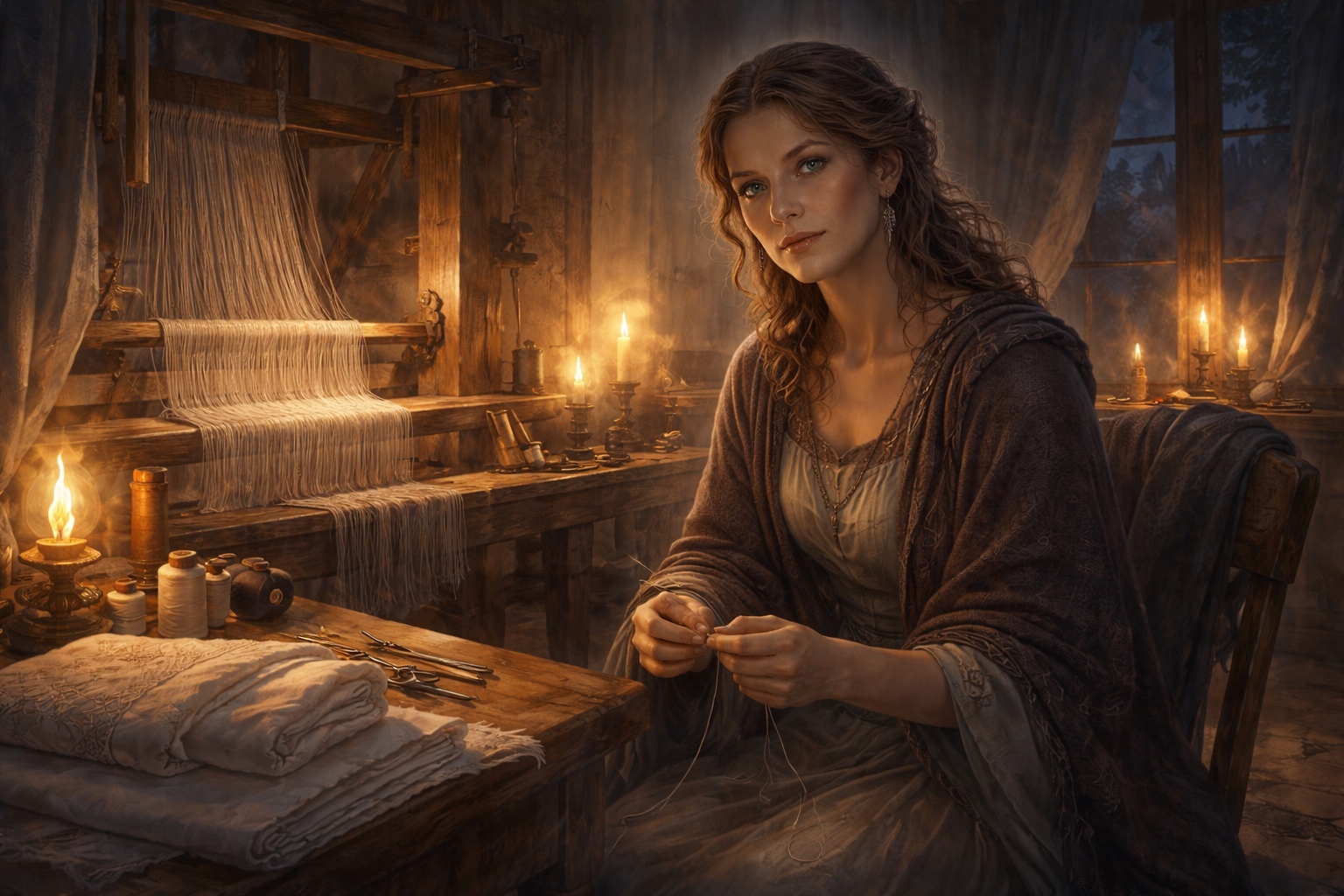 # Lethira
At a Glance
- Portfolio: Sorrow, longing, heartbreak, homesickness, estrangement, and the domestic handcrafts (weaving, spinning, mending, sewing) understood as the practice of working through grief with the hands. She is the specific patron of burial clothes, mourning shawls, and garments made or repaired in periods of loss.
- Virtues (as the faithful name them): Patience with one's own sorrow, the courage to feel rather than suppress, endurance through grief, the discipline of making something when broken, compassion for others in their pain.
- Vices (what Lethira opposes): Rushing sorrow, mocking grief, performing happiness to deceive those who love you, abandoning a making halfway through, using others' pain as entertainment or currency.
- Symbol: A needle trailing a single thread that curves downward into the shape of a teardrop: craft and grief made the same image.
- Common worshippers: Weavers, seamstresses, and tailors who make funeral and mourning clothes; the recently heartbroken; those estranged from family; homesick travelers; those in long-distance partnerships; grieving parents whose children are alive but gone; those recovering from failed ambition or the loss of a life they had imagined.
- Common regions: Dort-wide, though Lethira's shrines are especially common in port towns where families are frequently separated, in frontier communities where children leave and do not always return, and in any region with strong textile traditions that have grown up alongside the practical need to make burial clothes with care.
Names & Identifiers
- Common name (internal): The Quiet Loom or simply the Mender's Faith, reflecting both the central practice and the theology of working through difficulty rather than around it.
- Formal name (legal/ceremonial): The Faith of Lethira, She Who Weaves in the Dark, or The Thread-keepers' Way in more common usage.
- A follower: A Mender, one who mends, in the practical and the metaphorical sense simultaneously. Those in the early stages of engagement with the faith, not yet formally initiated, are sometimes called those who have taken up thread, an acknowledgment that they have begun the practice before formalizing it.
- Clergy (general): Loom-wardens, those who maintain the practical and theological tradition of making as grief-work. Senior clergy who have served extended time and who specialize in sitting with others through long grief are called Thread-keepers. Those who specialize in the making and care of burial clothes are called Shroud-wardens, a role treated with particular respect in communities where death is frequent.
- A temple/shrine: A Loom-house, which is always a working space: looms, spinning wheels, baskets of thread and fabric, needles, frames for embroidery. The shrine is never merely ceremonial; it is a place where actual making happens. Household shrines are called Thread-corners and are common in the homes of practicing Menders.
- Notable colloquial names: The Quiet One, She of the Unfinished Cloth, the Grief-tender, and in some regions simply the Loom Mother, though Lethira's clergy notes that she does not govern motherhood (that is Jusannia's domain) but is sometimes invoked alongside her by mothers whose children have gone.
Origin & History
The Weaver Who Did Not Know
The city is not named in the foundational accounts, not because it was unimportant but because the woman at the center of the story was insistent, in her lifetime, that her grief was not exceptional. Every city has someone like me, she said. Probably several. Her name was Vanya.
Vanya was a weaver by trade, not an artist in the manner of Bridhel's followers, not making beautiful things for display or sale, but a worker. She made cloth. She made garments. In the later part of her career, when she had established enough of a reputation, she specialized in burial clothes, a specialized work that most weavers preferred to avoid, but that Vanya found she could do well. The families who came to her were in sorrow. She understood, she said, what they needed, which was not art but care. She made burial clothes the way a person prepares a meal for someone grieving: not to be admired, but to be used in a moment of need, to be good enough that it could be forgotten in favor of more important things.
Her son's name was Ollen.
He left at nineteen, full of the certainty particular to that age that he understood something about the world that his mother did not. He was not wrong, exactly; he understood different things than she did. He went east with a merchant company. He wrote twice in the first year, then once, then stopped. The merchant company, Vanya learned eventually, had dissolved after a dispute over accounts. Where Ollen had gone after that, she never established.
He was not dead. This she was certain of with a certainty she could not explain and did not try to. He had simply gone on, in some direction, into a life that did not include writing to his mother.
Forty Years of Midnight Weaving
Vanya continued her work. This was not, she would have said, heroic. She needed to eat. She had skills. The families in her city continued to die and to need burial clothes; she continued to make them.
What changed was the quality of her attention.
She had always worked at night; her eyes were good in low light, and the quiet of the hours after dark suited the meditative rhythm of the loom. After Ollen left, the night work took on a different character. She wove while she thought about him. Not obsessively, not in the way that breaks a person, but consistently, steadily, the way a river moves. His name was part of the rhythm of the shuttle. She wove her longing into the cloth.
She also wove her sorrow for other people's sorrows. The burial clothes she made were for other mothers' children, and she made them as she would have wanted his made, if he had died. With care. With attention. With the hands doing something specific and good even when the heart did not know what to do.
She took on apprentices, not because she wanted to but because younger weavers kept finding their way to her workshop and asking to learn. She taught them the craft and, without intending to, the practice: the midnight sitting with what you felt, the hands keeping moving, the discipline of finishing what you started even when the work was hard and the grief was harder.
What Was in the Loom
In the forty-third year after Ollen left (Vanya was old by then, her hands slower but her technique unchanged) she was working late on a burial shroud for a family she had known for thirty years. The shuttle caught on something it had no reason to catch on: a small resistance in the threads, a small heat where there should have been none.
She stopped the loom and found it tangled in the warp threads, woven partway in as though it had been there since she had first strung the loom, or since the thread itself was spun. The shard was small and warm and the color of old linen, not silver, not gold, the color of cloth worn soft through long use.
When she touched it, Vanya did not feel elevation or transformation. She felt, she said later, understood. As though something had been listening to the midnight weaving for forty-three years and finally said: yes. That. That is the right thing.
The shard's principle came slowly, not in a rush: Sorrow is not weakness. It is the proof that something mattered. The cloth you weave while crying is still cloth. It will keep someone warm.
What Came After
Vanya finished the burial shroud that night. She set the shard on the corner of her worktable (not reverently, not yet understanding what it was) and completed the work she had started, because that was what she did. The family received it the next morning and found it the finest thing she had ever made.
The shard stayed on her worktable for another three years while she tried to understand what it meant. She did not call herself a priestess or a founder or any kind of religious figure. She was a weaver. But the apprentices who had been learning her practice began to notice that something had shifted, not in the cloth, which was always good, but in the quality of what happened to people who came to her workshop in grief.
People came not only for burial clothes but for the sitting. For the chance to work alongside someone who did not require them to be done with their sorrow, who would hand them a needle and a scrap of cloth and not say anything at all while they worked, and who would still be there when they looked up, doing exactly the same thing.
This was, it turned out, what people in grief needed most: not to be fixed, but to be accompanied, and to have something to do with their hands while they waited for the worst of it to pass.
The Divine Compact
Lethira's bargain is the least transactional of any deity's in the pantheon. She does not offer to end sorrow. She does not promise that the grief will conclude, that the estranged child will return, that the heartbreak will resolve into something easier. What she offers is company, and a practice that makes the time survivable.
- What Lethira promises: That sorrow will not destroy those who move through it with intention rather than around it. That the hands can keep working when the heart cannot. That grief, properly sat with, does not remain at its worst intensity forever. That the things made during periods of loss (the burial clothes, the mending, the midnight weaving) are real things, of genuine value, regardless of what is happening inside the maker.
- Common boons: Steadiness in the hands during hard work. The ability to complete a task even when distracted by grief. The quality of presence: the capacity to sit with someone else in their sorrow without needing to fix or redirect it. The sense, sometimes, of not being entirely alone in the middle of the night with a piece of unfinished cloth. Burial clothes made by practicing Menders are consistently described by the families who receive them as feeling different (heavier in meaning, more complete) than technically equivalent work made without the practice behind it.
- Rare miracles: A person working through an estrangement completes a garment (a mending, a shroud, a shawl) and finds, when they set it down, that something they have been carrying has genuinely shifted. Not resolved. Not ended. But changed in character, become something they can carry differently. A burial cloth arrives in time, perfectly completed, when by ordinary calculation there was not enough time to make it. A piece of work lost in a fire is found to have a copy no one remembered making.
- Social benefits: Recognition in the textile trades as someone whose work carries weight. Access to the Loom-houses and their networks of support, which are extensive in communities with strong weaving traditions. The practical skill that Lethira's training produces; her followers are excellent craftspeople, because the practice demands attention and patience that improve the work.
- Afterlife promise / fear: The faithful believe that the things made in grief are preserved, not physically, but in significance. That the burial cloth made with care for the child you barely knew is remembered somewhere. That the midnight weaving done while longing for someone gone is not wasted thread. What they fear is the unfinished: the garment abandoned, the grief never sat with, the sorrow managed around rather than through, leaving something incomplete that cannot be put down.
- Costs / conditions: The practice requires showing up. The Mender who begins a piece and abandons it halfway through (not because of crisis but because it became too difficult emotionally) is understood to have broken faith with the sorrow itself, to have turned away from what needed to be lived. Lethira does not demand perfection; she demands presence. Her blessings thin for those who perform the practice without genuine engagement.
Core Doctrine
The faithful of Lethira organize their understanding around these convictions:
- Sorrow is not a problem to be solved. It is a condition to be moved through. Those who attempt to manage it, shortcut it, or end it artificially find that it waits for them. The practice of the faith is designed to accompany the sorrow, not to eliminate it.
- The hands know what the heart does not yet. Craft (repetitive, specific, physical) provides a kind of knowledge that thinking alone cannot. The weaver who works through a grief often understands, when they set the finished work down, something they could not have articulated at the beginning. The making teaches.
- Lethira is not a death goddess. This distinction matters to the faith and is explicitly taught. Nyxollox governs the process of dying, Damballa governs death's transition, Morbina governs disease and decay. Lethira governs the living who grieve, not the dead, not the dying, but those who are still here and who miss something or someone. Her domain requires no corpse.
- Sorrow comes in three forms, each requiring different tending. The faith names them: Longing (for what is gone: a place, a time, a person who still lives but is no longer present); The Hollow (estrangement, the loss of connection while both people still breathe: the child who left, the friendship that drifted, the self you used to be); and Heartbreak (the acute grief of love withdrawn or failed). Each form of sorrow responds differently to the practice, and a skilled Thread-keeper can recognize which a person is carrying.
- Every piece of work carries the condition in which it was made. This is not supernatural; it is practical. A burial cloth made carelessly by someone who resents the work carries that resentment into the hands of the family that receives it. A garment mended with attention by someone working through their own grief carries that steadiness into the cloth. The practice is not separate from the product; it is the product.
- Sitting with sorrow is an act of respect for what mattered. The temptation to rush grief, in oneself or in others, is understood as a subtle form of contempt for whatever was lost. To sit with sorrow is to acknowledge that what is grieved was real and worthy of the grief. The faith does not sentimentalize this; it makes it plain.
Soul Coins & Divine Economy
(See also: Soul Coins & Divine Economy)
Lethira accumulates power through the sustained practice of grief-accompanied craft, and through the act of companioning others through their sorrow, two practices that are understood within the faith as the same thing performed differently.
- How Lethira gains soul coins: Every genuine act of craft-as-grief-work generates coin: the midnight weaving, the burial cloth made with full attention, the mending done while sitting with someone who cannot speak. Sitting with another person in their sorrow, without trying to fix it, generates coin. Completing a piece that was begun in grief generates coin. Finishing what someone else could not finish (the work left incomplete when a person collapsed with sorrow) generates particularly significant amounts.
- What makes a coin "heavy": The sorrow worked through rather than avoided. A burial cloth made by a person who has lost their own child, made for another family, generates heavier coin than technically superior work made without that depth. The Thread-keeper who sits through an entire night with someone in heartbreak without speaking a word, who simply keeps their hands moving on their own work and is present, generates heavier coin than a more skilled counselor who intervenes and redirects.
- What Lethira spends coins on: The quality of presence that her followers can offer: the ability to sit with sorrow without flinching. The steadiness of the hands during hard work. The sense of company that can arrive, sometimes, in the middle of the night when a person is alone with an unfinished cloth. Providing, on rare occasions, the specific item that needed to be in the right place at the right time: the burial cloth that could not possibly be finished on time, that somehow is.
- Trade: Lethira trades most regularly with Jula, whose domain of peace is what arrives, sometimes, after the sorrow has been fully sat with; she sends coin in exchange for the moments of genuine easing that can follow a long grief. She trades with Jusannia on the specific grief of mothers estranged from living children. She has careful and tender arrangements with Nyxollox and Damballa: they send her the living who are left behind; she does not intrude on their domain with the dying themselves. She has a complex relationship with Amador, who generates much of what lands in her care; they do not trade, but they understand each other.
- Infernal competition: The Tempters offer the ability to simply stop feeling the sorrow, not to work through it, but to have it removed. The numbing of what hurt, the erasure of the memory that aches. Lethira's answer is consistent: A heart that cannot ache cannot love. The thread that never breaks was never under tension. What the Tempters are offering is not relief; it is impoverishment. The faith counters this offer primarily by demonstrating that the sorrow, properly sat with, does eventually change, not disappear, but become something that can be carried without destroying the person carrying it.
Sacred Spaces
Lethira's sacred spaces are always working spaces. A Loom-house without active looms and spinning wheels in use is not functioning as a Loom-house.
Loom-houses are built for practical work and long occupation. They are warm (thread and cloth work require warmth) and well-lit, with good light from windows during the day and lamp positions carefully considered for night work. The looms themselves are the altar; there is typically no separate shrine-space. The largest and oldest loom in a Loom-house is called the hearthpiece, not because it is near a hearth (though it may be) but because it is the center around which the rest of the space is organized. The hearthpiece is always occupied: if no one else is working on it, a Thread-keeper maintains a running piece on it, advancing slowly, available to be taken up by anyone who arrives in need of something to do with their hands.
The floor of a Loom-house is almost always scattered with thread; this is not disorder but evidence of use. The spaces between looms and wheels are wide enough to pass easily, designed for the movement of people who may be shaky or distracted. The seating is varied: some low, some at working height, some with backs for those who are exhausted. The theology of the space is made visible in its arrangement: whatever condition you arrive in, there is a place for you here.
Thread-corners are household shrines: a corner or shelf set aside for a small loom or frame, or simply for needle and thread, with a token that represents whatever the person is currently carrying. The thread-corner is where daily practice happens. Many Menders spend ten or twenty minutes there each morning before beginning other work.
Organizational Structure
The faith of Lethira is deliberately non-hierarchical, not from ideology but from practical observation that grief does not sort itself by rank. Thread-keepers hold authority within their regional Loom-houses, but that authority is almost entirely practical (managing the space, training new weavers, making decisions about what the house takes on) rather than doctrinal.
Regional Loom-houses operate with considerable independence. They maintain relationships with one another through the practice of visiting: Loom-wardens who travel between houses, bringing technical knowledge, carrying news of practices that have emerged in one region that might serve another, and providing additional hands when a community has experienced a large loss and needs more people to sit with the grieving than are locally available.
The concept of the Traveling Shroud-warden is specific to Lethira's faith: a Loom-warden who has specialized in burial clothes and who travels a regular circuit through communities that cannot sustain their own dedicated practitioners. Shroud-wardens are treated with particular respect wherever they go; the work they do is understood to be among the most demanding in the faith.
There is no central council or authority. Major theological questions are resolved through Loom Gatherings: irregular meetings of Thread-keepers from multiple houses, usually prompted by a specific question that has arisen. These gatherings do not issue binding doctrine; they discuss and produce statements that carry influence.
Entering the Faith
Lethira's faith is not entered by seeking it out so much as by finding oneself already practicing it.
Soft entry is the most common path. Someone loses a person they love (to death, to estrangement, to heartbreak) and is given, by a friend or a neighbor, the name of the local Loom-house. They arrive not knowing what to expect and are handed something to work on and a place to sit. They are not spoken to unless they speak first. Over many visits, they find that they are mending something, in multiple senses of the word.
Formal initiation involves three elements: (1) the First Sitting, a person announces to the Thread-keeper that they wish to formally join, and the Thread-keeper asks them to articulate what sorrow they are currently carrying and what they are making in relation to it. This is not a public declaration; it is a private conversation; (2) the Commitment Piece, the initiate begins a piece of work that they commit to completing, however long it takes; (3) the Completion, when the piece is finished, it is brought to the Loom-house and offered: either given to someone who needs it (burial clothes or practical garments go to those in need) or placed in the Loom-house as a teaching piece. The act of giving the completed work away is the final act of initiation. The practice of making is always in service of something outside the maker.
What makes an enemy: Those who mock grief, who rush the bereaved back to ordinary function before they are ready, who exploit others' sorrow for attention or advantage. Also: those who make burial clothes carelessly and pass them off as made with intention. The faith has no appetite for persecution, but Thread-keepers are known to be direct in their criticism when someone in the textile trades is representing themselves as practicing what Lethira's faith teaches without actually doing so.
The Faithful in Practice
A devoted Mender is recognizable by their habits and the quality of their attention.
- Always has something in progress. Not because they cannot stop, but because the practice of making is continuous. A Mender without a current piece is considered to be between sorrows, which is acceptable, but the thread-corner still holds something: an ongoing project, a mending that has been waiting.
- Does not rush others through grief. When a friend, neighbor, or stranger is in sorrow, the Mender's instinct is not to comfort toward resolution but to accompany. To say I'm not going anywhere. To offer, practically, the chance to sit and do something with the hands.
- Makes burial clothes with full attention. Those who do this work approach it as Vanya did: as care for people who cannot care for themselves at this moment, as the making of something that will be present at a significant moment without being noticed. The quality of attention is understood to matter.
- Names the sorrow. The faith's practice of naming (Longing, The Hollow, Heartbreak) is not merely taxonomic. Naming what you are carrying is the beginning of the work. A Mender who does not know what they are grieving cannot effectively work with it.
- Completes what they begin. This is the most literal and practical obligation. A Mender does not abandon pieces. If a piece becomes too difficult to continue, they bring it to the Loom-house and ask for help finishing it. Abandonment is the vice; seeking help is not.
Taboos
- Rushing someone through their sorrow. The instruction to feel better soon, move on, or get past it is understood as a minor but real violation of the faith's core principle. Within the faith, Menders are expected to refrain entirely from these phrases. To grief's neighbors, they offer presence instead of prescription.
- Mocking grief. Using another person's sorrow for entertainment, gossip, or social gain. This is the more serious form of the same offense.
- Abandoning a piece mid-making. Leaving a piece unfinished and unmended (not because of crisis or incapacity, but because the emotional difficulty of the work became too great) is considered a failure of practice. The faith is clear that this is a practice failure, not a moral failure; no one is condemned for it. But it requires acknowledgment and recommitment.
- Performing happiness to deceive. Presenting oneself as recovered from grief when one has not, in a way intended to mislead those who might otherwise offer support. The practice depends on honesty about what one is carrying; the faith has no use for performed wellness.
- Making burial clothes without intention. The production of burial clothes by rote, without the attention the faith requires, is a form of disrespect both to the craft and to the family that will receive the work. Shroud-wardens who discover this in others (particularly in people representing themselves as Menders) are expected to address it directly.
Obligations
- Maintain a practice. Every Mender is expected to have an ongoing craft practice, not necessarily weaving (the faith includes sewers, embroiderers, basket-weavers, and any maker of textile-adjacent things), but something that the hands can do that occupies the body while the mind works through what it is carrying.
- Make at least one intentional piece per year. A piece begun and completed in a period of quiet reflection, not necessarily of sorrow, but of genuine attention. This is considered the minimum of active practice.
- Offer mending freely. Those with the practical skill are expected to offer it without charge to those who cannot pay. This means literal mending (clothing repair) as well as the metaphorical version. The Loom-house's door is not locked.
- Sit with those in sorrow. When a person in grief asks, or when one is clearly in need, the Mender's obligation is to be present: to sit, to not fix, to simply accompany. This is understood as the most demanding and most important of the obligations.
- Complete the burial clothes when needed. Shroud-wardens and those with the training to do so are expected to be available when a community needs burial clothes on short notice, which is to say, almost always. The faith is practical about this: no one can do everything, but the expectation is that the capacity exists and is made available.
Pillars of the Faith
The faith of Lethira is organized around five pillars, understood as both individual practices and collective values:
- Patience: With one's own sorrow and with others'. The willingness to wait: for the grief to change, for the piece to be finished, for the person in the next chair to be ready to speak, or not to speak.
- Making: The practice of creating something specific and real while feeling what you feel. Not as distraction but as container. The hands provide a place for the sorrow to go that is not destruction.
- Sitting: The practice of being present with sorrow rather than fleeing it. The capacity to stay in the room with something that hurts, to not flinch away, to not require the sorrow to end before you will remain.
- Compassion: For others in their grief, and for oneself in one's own. The faith explicitly includes self-compassion as a pillar: the ability to give yourself the same presence you would offer a friend.
- Memory: Honoring what is gone through craft. The burial cloth made for someone who mattered. The shawl woven in remembrance. The mending done in acknowledgment that the thing mended is worth the effort of repair. Memory is not nostalgia; it is respect.
Holy Days & Observances
The Sitting
Date: First day of autumn, when the light begins to change.
The Sitting is the faith's primary observance. All Loom-houses open their doors for an entire day and night, keeping the space available and the work in progress. Menders bring their current pieces and work alongside anyone who comes. Thread-keepers do not speak unless spoken to. Food is provided: plain, warm, the kind that can be eaten with one hand while the other keeps working. The atmosphere is quiet but not silent: the sound of looms, of spinning wheels, of needles through cloth, of occasional conversation. No ceremony is performed; the Sitting is its own ceremony. The theology of the day is in the accumulation of people who came and stayed.
It is the day on which most new participants first enter a Loom-house, guided there by someone who knows what they are going through.
The Finishing
Date: Last day of spring, when the last frost has passed.
The Finishing is a day of completion. All Menders are expected to complete (or formally acknowledge and release) pieces they have been working on. The pieces are brought to the Loom-house: finished pieces are displayed, given away, or donated to those in need; pieces that cannot be finished for reasons of capacity or grief are brought to the Thread-keeper and released with acknowledgment. A piece formally released is not abandoned; it is set down. The distinction matters.
The Finishing is also when burial clothes from the previous year that were held aside (made during the long winter months, exceeding the immediate need) are distributed to families in the region who could not afford their own. This distribution is done quietly, without ceremony.
The Long Night
Date: The winter solstice.
The faith keeps the solstice as a night of particular vigil. Thread-keepers work through the night at the hearthpiece in each Loom-house, and the space is open to anyone who cannot sleep, which in winter, in grief, is many people. The Long Night is understood as the night when the sorrow is most present: the longest dark, the most light gone from the sky. The practice of the night is simply to stay awake and keep working, to not give in to the idea that the darkness is permanent because it is at its longest.
By morning, the night has turned, imperceptibly but genuinely. The faith marks this not with celebration but with acknowledgment: the light is returning. The thread continues. The piece is not finished yet.
Vanya's Thread
Date: A day in late summer, variable by region.
This observance commemorates the founding, not in a grand ceremonial sense but in the specific sense of continuing Vanya's practice. On Vanya's Thread, Menders work specifically on burial clothes: those who have the skill make them, those who are learning work alongside, and the clothes are given to families who will need them in the coming year. The day is practical and specific. It is also, quietly, an acknowledgment of the grief that Vanya carried for forty-three years and never set down, and of what that sustained grief produced.
Ceremonies & Rituals
The First Sitting
The initiation ceremony, described in the Entering the Faith section. It is intentionally intimate and private. The Thread-keeper who conducts it asks three questions: What are you carrying? What are you making? Are you willing to stay with it until it is finished? The answers do not need to be eloquent. They need to be honest.
The Completion Ceremony
When a piece that was begun in grief is finished, a Completion can be held, informally, with the Thread-keeper and whoever else is present in the Loom-house at the time. The maker shows the completed work, names what it cost to make it, and then gives it away or places it in the Loom-house's care. The Thread-keeper says: The thread held. The cloth is made. What you carried, you carried until the work was done. Then the piece is released.
Many Menders describe the Completion as the most significant ritual in the faith's practice, not because of its formality, which is minimal, but because the experience of finishing something that began in the worst period of a grief and handing it to someone else is genuinely, observably different from not doing so.
The Burial Cloth Making
When a death has occurred and burial clothes are needed, the Shroud-warden or available Loom-warden brings the appropriate materials and, often, other Menders who are willing to sit and work together. The making is not silent; it is accompanied by whatever conversation arises. People talk, or don't talk. They work. The family may or may not be present; sometimes families find it comforting to be in the room while the clothes are made; sometimes they cannot bear it.
There is no formal ceremony in the making itself. The ceremony is in the completion and the giving-over, which is conducted simply: the warden brings the finished clothes to the family and says: These were made for [name], by those who understood that they mattered. The family receives them without needing to respond.
The Release of an Unfinished Piece
When a piece cannot be completed (because the grief has changed, because the maker cannot return to it, because it was begun for a reason that has resolved in a way that does not require completion) a Release can be held. This is not the same as abandonment. The maker brings the unfinished piece to the Thread-keeper, explains what it was and why they cannot finish it, and the Thread-keeper either takes it on, completes it, or unravels it with intention, returning the thread to usable form.
The unraveling is the more significant of these options. To unravel a piece is to acknowledge that the materials are real and valuable, that the grief that went into it was real and valuable, and that neither the grief nor the materials were wasted even if the piece will not be what it was meant to be.
Ceremonial Attire
The Mender's Apron
Worn during all working ceremonies and ordinary practice. It is practical in character: heavy cloth, multiple pockets, designed to protect clothing during sustained work. The apron bears no formal marking; it simply shows the evidence of use: thread stains, small patches, the texture of long occupation. Thread-keepers often have aprons that have been repaired so many times they are more patch than original cloth, which is considered a sign of commitment rather than wear.
The Grief Shawl
The most recognized garment associated with the faith. A grief shawl is made by a Mender for a specific person in specific sorrow, not purchased, not made in advance, but made during the period of the grief in question, incorporating the attention and patience of the making into the cloth. It is given when it is finished, which may be days or months after the grief began. The recipient may not even be in acute grief when they receive it; the shawl is understood as acknowledging the grief that was, not necessarily the grief that is.
The practice of making grief shawls for others has spread well beyond the faith's formal membership. Many people who know nothing of Lethira's theology have been given a grief shawl by a neighbor or friend, and many have understood without explanation what it meant.
The Thread-keeper's Pin
Worn by Thread-keepers at the left shoulder, the side of the heart. A simple pin, always in the shape of Lethira's symbol: a needle trailing a thread that curves into a teardrop. The pin is typically made of plain metal (iron or bronze) without ornamentation. It is often given to a Thread-keeper by the person who trained them.
The Shroud-warden's Kit
Not attire in the traditional sense, but the Shroud-warden's tools of practice: a specific set of needles, threads, and cutting tools maintained with particular care, carried in a cloth case that was itself made by the warden's teacher. The kit is considered a form of sacred object, not because of supernatural properties but because it represents the warden's commitment to the work. Shroud-wardens generally have more personal attachment to their kits than to any other possession.
Historical Figures
Vanya the Weaver
The founder, who refused to understand herself as such. Her accounts of her own history (preserved by her apprentices who wrote down what she said in her later years) are notably resistant to elevation. She was a weaver. She found something in her loom. She kept doing what she had always done, and other people found that they needed to be near it.
Vanya is invoked by those who are carrying a longing that may never be resolved: the estranged child who does not write, the love that ended without explanation, the grief for something that simply went. She is also invoked by those who are working through grief while performing practical work, particularly those who make burial clothes as a living. She is not invoked for comfort, exactly. She is invoked for company.
Her image in the faith is simple: an old woman at a loom, night-lit by a single lamp, working.
Margis of the River Towns
A Thread-keeper from three generations after the founding who developed the formal understanding of the three types of sorrow (Longing, The Hollow, Heartbreak) that is now standard doctrine. Before Margis, the faith understood that sorrow took different forms but had not clearly named the distinctions.
Margis worked in a river town where separation was a constant condition of life: people left on boats, sometimes returned, sometimes did not. The range of grief she encountered was wide enough that she found herself needing vocabulary to describe what she was seeing. She developed the three-part framework over a decade of practice and wrote it down in a short text called The Thread Comes Loose in Three Ways, which remains in use.
Margis is invoked by those trying to understand what they are carrying: those who do not know whether what they feel is grief-for-the-dead or grief-for-the-living-gone. Thread-keepers invoke her when working with people who cannot name their sorrow, which is a significant part of the work.
Warden Hesha Three-Seasons
A Shroud-warden of some two hundred years ago who became the faith's most famous practitioner of the burial-clothes work. She was known for traveling to communities where a disaster had killed many people at once, bringing other Menders with her, and managing the making of burial clothes for large numbers of dead in short periods of time, work that most practitioners found overwhelming.
Her innovation was organizational: she developed a system for distributing the work across many makers while maintaining consistent quality and attention, and for keeping all the makers present to their practice even under conditions of high volume. The system she developed is still used in its essentials by Shroud-wardens today.
Hesha is invoked when the scope of the grief exceeds what one person or one community can sit with: when a disaster has been large, when the loss is collective and not merely individual. Her invocation is specifically about the capacity to continue in difficult conditions.
Sacred Relics & Artifacts
Vanya's Shuttle
When Vanya died, her apprentices could not agree on what to do with her loom. The loom itself was old and not particularly remarkable; she had built it herself when she was a young woman and repaired it many times. But the shuttle, the small implement that carries the weft thread through the warp, was the thing that had touched the shard, that had caught on it after forty-three years of midnight work.
The shuttle was kept. It passed through the hands of her apprentices and their students, and through an unbroken chain of careful keeping, it remains in the care of the Loom-house that now occupies the space where Vanya's workshop stood. It is plain wooden, worn smooth, stained with years of thread. It shows no supernatural properties. What it is understood to hold is the accumulated weight of forty-three years of intentional making under sorrow, which the faith considers sufficient significance for any object.
- Description: A plain wooden shuttle, worn smooth and stained, showing no specific distinguishing features except its age and the quality of its wear.
- Powers or Significance: No reliably reproducible supernatural properties. Those who hold it sometimes describe a sense of steadiness: the feeling of being in a room where someone kept working through a long and uncertain time. Whether this is the shuttle's quality or the quality of the attention brought to it is not distinguished by the faith.
- Current Location / Status: In the original Loom-house. It is brought out on Vanya's Thread and on the Sitting, and otherwise kept in the care of the current Thread-keeper.
The Margis Text
The original handwritten copy of The Thread Comes Loose in Three Ways (Margis's taxonomy of sorrow) survives in one of the river-town Loom-houses. It is in Margis's own hand, which is small and neat and, in the marginal notes, shows signs of having been written under emotion: the handwriting changes texture in the passages about The Hollow, which Margis appears to have known personally.
- Description: A small bound text, the covers replaced several times. Margis's hand is distinctive and consistent throughout.
- Powers or Significance: No supernatural properties. Its authority is intellectual and theological; it is the foundational document of the faith's understanding of the forms of sorrow, and it is studied by all Thread-keepers. The marginal notes are considered as important as the main text.
- Current Location / Status: In the Loom-house at the third tributary of the Irna river, in the care of the current Thread-keeper there. Copies exist in every Loom-house.
Hesha's Kit
Hesha Three-Seasons' original Shroud-warden's kit (the needles, threads, and cutting tools she carried through her three seasons of large-scale disaster work) is preserved in the faith's teaching center for Shroud-wardens. The tools themselves are no longer used (they are too fragile) but are displayed as an example of what sustained use over many years of significant work looks like.
- Description: A cloth case, the fabric of which has been replaced several times while the tools inside are original. The needles are of exceptional quality and show the particular wear pattern of heavy use.
- Powers or Significance: Used as a teaching object. Shroud-wardens in training are shown Hesha's kit as an example of what they are being trained for, not the individual act of making burial clothes, but the capacity to do it at scale, with consistency, under pressure, for a long time.
- Current Location / Status: In the Shroud-warden training house. Shown to initiates during their training.
Sects
The Loom-keepers
How they refer to themselves: the Loom-keepers or the Weavers of Through
The Loom-keepers hold that the making IS the healing, that the act of weaving, spinning, sewing is not merely a container for sorrow but is itself the work of moving through it. In their understanding, a person who finishes a piece has genuinely moved through something, not merely kept their hands busy while the sorrow passed on its own. The craft is active, not passive; the making changes the maker.
This position has theological implications: the Loom-keepers emphasize the quality and intentionality of the craft itself as spiritually significant. They tend to be the better technical craftspeople within the faith, because their theology requires that the work be good, not beautiful in the artist's sense, but skilled in the craftsperson's sense. A piece made with genuine attention is theologically better than a beautifully designed piece made carelessly.
The Menders
How they refer to themselves: the Menders or the Thread-through
The Menders hold that the craft provides a container for sorrow (a frame within which the sorrow can be held while it does its natural work) but that the sorrow itself moves through on its own timing, and that the making simply keeps the person present long enough for that to happen. The distinction from the Loom-keepers is subtle but real: the Menders are less invested in the quality of the work as spiritually significant and more invested in the duration and consistency of the practice.
Menders tend to be the better pastoral counselors within the faith; their theology does not require them to correct a person's technique, only to keep them present and working. They are the practitioners most often found sitting with people who cannot do much (who are in the earliest and most acute periods of grief) because they understand that even a person who can only hold a needle and move it through cloth in an approximation of a stitch is doing the practice correctly.
The Loom-keepers and Menders disagree about the theology without particular animosity. Each finds the other's emphasis useful in different circumstances, and most Thread-keepers have sympathies in both directions.
Heresies
The Numbing
How they refer to themselves: the Eased or the Practical Path
This heresy argues that sorrow, when it has lasted long enough or become severe enough, can be legitimately ended through spiritual means, not worked through, but removed. The Numbing's practitioners have developed, or claim to have developed, rites that actually accomplish this, though the faith suspects these rites are closer to infernal bargains than to legitimate theology.
The faith considers this heresy not merely theologically wrong but practically dangerous. Those who have undergone Numbing rites return to ordinary life, but they report that they also lose other things: the depth of their joy, their sensitivity to others, their capacity to care deeply about anyone or anything. The faith's analysis is that sorrow and love are not separate faculties; they are the same faculty, and what can be numb to one will be numb to both.
Thread-keepers are trained to recognize Numbing theology and to respond with the faith's specific counter: this is not what relief looks like. Relief, when it comes, leaves you more capable of feeling, not less.
The Permanent Sitting
How they refer to themselves: the Long-kept or the True Menders
This heresy inverts the faith's teaching of patience into an argument for never completing a grief, that to move through a sorrow is to abandon what was lost, and that true devotion requires maintaining the grief at its original intensity indefinitely. Practitioners of the Permanent Sitting refuse to complete pieces they have begun in sorrow, maintaining them in their unfinished state as a testament to what they are grieving.
The faith is sympathetic to the impulse; grief does not end cleanly, and the desire to honor what is lost is genuine. But the theology is clear: sorrow is meant to be moved through, not preserved. A grief maintained at full intensity indefinitely is not faithfulness to what was lost; it is a refusal to continue living, which is not what the lost would have wanted and is not what Lethira teaches. The Thread-keeper's obligation to someone in Permanent Sitting is to sit with them until they are ready to finish something, not to argue, but to remain present and continue making.
Cults
The Grief-market
How they refer to themselves: the Grief-workers or the Sorrow Traders
A cult that has taken the faith's understanding that grief is real and valuable and turned it into a system of exploitation. The Grief-market's practitioners position themselves as specialized grief-workers who can, for a fee, manage a person's grief more efficiently than the standard practice. They charge significant amounts for what amounts to the faith's ordinary pastoral work, performed without the theological depth, and they have developed a reputation for creating dependency: returning worshippers who feel they have not yet processed their grief fully and need more sessions.
The faith opposes them primarily through education: making clear that genuine practice is available without charge, that the Loom-house's door is not locked, and that what the Grief-market sells is something that cannot be efficiently transacted. Grief takes the time it takes. Anyone promising to speed it for payment is selling something other than what they claim.
The Unravelers
How they refer to themselves: the True Release or the Honest Ones
A cult that has extended the practice of releasing an unfinished piece into a general theology of dissolution: the argument that all commitments, not just grief-work, are better abandoned than completed. The Unravelers have developed a practice of helping people unravel not just their textile work but their other commitments: relationships, obligations, responsibilities. They invoke Lethira's name for this work.
The faith is direct in its opposition: Lethira governs the releasing of sorrow, not the releasing of every difficulty. The Unravelers have made a genuine misreading of the faith's teaching that incompleteness-with-acknowledgment is better than abandonment; they have replaced acknowledge and release with simply release, dropping the acknowledgment and the need for genuine reason. A Thread-keeper who encounters the Unravelers is expected to engage with them directly and carefully, because they are genuinely, if incorrectly, trying to address something the faith also addresses.
Presence in the Shattered Domain
- Territory aesthetic: A large, warm, lamp-lit space that is difficult to describe as having precise dimensions. It is always night here, or always the hour just after sunset, when the dark has arrived but has not yet become oppressive. The looms are in use but the weavers are not visible unless you look for them. Thread is everywhere, organized, not tangled. The sense is of a space that has been worked in for a very long time by people who knew exactly what they were doing. The air smells of wool and wood and lamp oil. It is quiet except for the sound of making.
- Likely allies: Jula (peace as what becomes possible when sorrow has finished its work), Jusannia (who shares many worshippers and whose domain of motherhood produces much of what Lethira's domain then holds), Hesira (who tends the covenant that many of Lethira's worshippers once had and now grieve), Nyxollox (who sends her the living left behind).
- Likely rivals: Any force that profits from grief's prolongation, that keeps people circling in sorrow without ever letting it change, that sells false resolution or false numbness. Also forces that mock grief as weakness or productivity loss, that treat the human capacity for sorrow as a malfunction to be corrected.
- Stance on the Godless: Compassionate and undemanding. Grief does not sort itself by theology. Those who arrive at a Loom-house in sorrow without any belief in Lethira are handed something to work on and a place to sit, exactly like everyone else. The faith does not require belief; it requires only the willingness to show up and keep the hands moving. Many of Lethira's most devoted followers came to the faith not through conviction but through a particular night when they needed to be in a warm room with other people who understood that the grief was real.
Adventure Hooks
-
A community has been struck by a plague that has left many families simultaneously needing burial clothes. The local Shroud-warden has sent for help, but the messengers have not returned. A party must reach the community and determine what has happened to the messengers, while also working out whether there is something unusual about the plague, and perhaps helping the Shroud-warden manage a situation that has grown beyond her capacity.
-
The Margis Text has been taken from its Loom-house, not stolen in the ordinary sense, but borrowed by a well-meaning scholar who believed it should be studied in a larger institution and did not ask permission. The Thread-keeper who cares for it wants it returned, and the scholar is not entirely wrong that it would be better preserved and more widely studied in a larger archive. The question is who has the right to make that decision.
-
A member of the Unraveler cult has convinced a significant weaver (someone whose work supplies burial clothes to half a dozen communities) that all their professional obligations are merely accumulated grief that should be released. The weaver has begun unraveling years of completed contracts and commitments. The communities that depend on their work are in difficulty. A party must untangle the situation without destroying the weaver's genuine need for relief.
-
Someone is leaving grief shawls on the doorsteps of people in a city: beautiful, clearly made with care, containing within their weave specific information about the grief of the recipient that no one else should know. The recipients are not troubled by the shawls, which they find helpful, but the city's authorities are troubled by the information. A Thread-keeper believes the shawls are being made by someone with Lethira's genuine blessing; the city's authorities believe they are being made by someone with access to private information. Both may be right.
-
A Grief-market cult has established itself in a port city and is charging significant sums for services that Loom-house Menders provide freely. The cult is not technically doing anything illegal and many of its clients are satisfied, partly because the Grief-market employs several genuinely skilled practitioners who left the faith over a doctrinal dispute. The Thread-keeper wants to address this without simply making it a commercial competition, which would be exactly the wrong frame. The underlying doctrinal dispute that drove the skilled practitioners out needs to be understood and possibly resolved.