Nethara
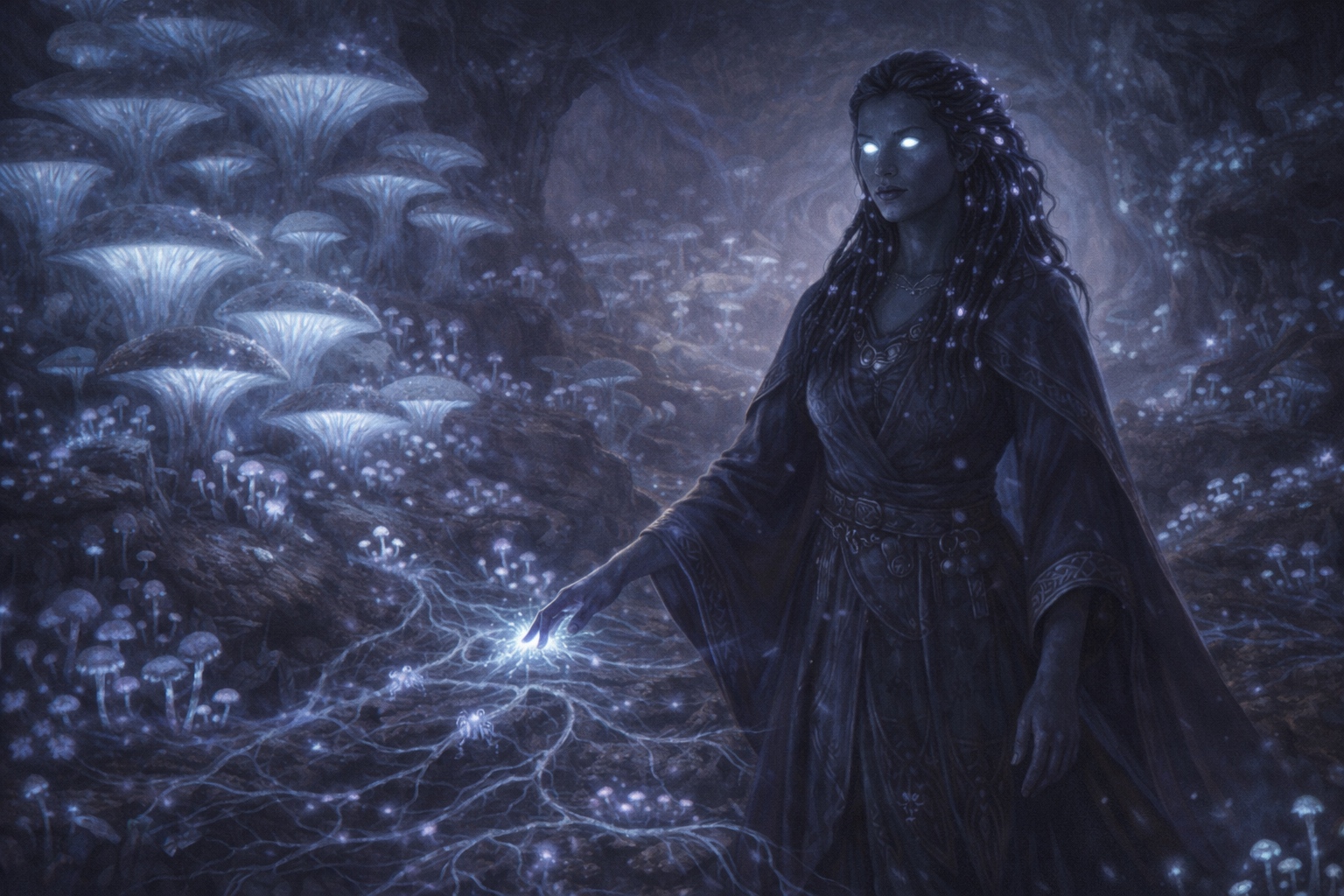
Nethara
At a Glance
- Portfolio: Bioluminescence, cold light, mycelium networks, the deep places, transformation of death into sustaining life, the underground as home, patient beauty, the lure.
- Virtues (as the faithful name them): Patience, tending, beauty in the lightless places, transformation, stillness as strength, the knowledge that what falls is not wasted.
- Vices (what Nethara opposes): Waste of the fallen: to let something end without transforming is the one true sin. Destruction without return. The surface world's assumption that its light is the only light. Fire that burns without feeding.
- Symbol: A ring of cold blue-white glowing points on absolute black: seven dots arranged in a circle, representing a ring of bioluminescent fungi caps. Worn flat against cloth or incised into stone; the effect is most pronounced in the dark, where the symbols on a devotee's garments faintly glow.
- Common worshippers: Moren matriarchs and communities, underground cultivators, those who tend the sacred fungi gardens, Web Readers navigating the deep places, Moren merchants and surface-dwellers maintaining their practice in portable gardens.
- Common regions: The Underworld beneath all continents; most concentrated below [Irna](Irna/Welcome to Irna) and [Funta](Funta/Welcome to Funta). Surface presence is rare but exists wherever Moren maintain long-term residences.
Names & Identifiers
- Common name (internal): The Cold, used as both a name for the faith itself and as a term of gentle endearment: "She is of the Cold."
- Formal name (legal/ceremonial): The Faith of Nethara, She Who Lit the Lightless, used in formal Moren civic documents, which are simultaneously religious documents.
- A follower: A tender of the Cold (formal); a Glowborn (colloquial, used affectionately within communities).
- Clergy (general): Matrons (senior; govern Moren communities religiously and civically; the distinction does not exist in Moren society); Cultivators (mid-rank; tend the sacred gardens, train initiates, manage the intelligence functions of the web); Lamplighters (junior clergy; maintain the light of specific garden sections, perform initial receiving rites for the dead).
- A temple/shrine: A Garden of Nethara (a full sacred space, cultivated over decades or centuries); a Glowhold (a smaller maintained space, including the portable gardens of surface-dwelling Moren).
- Notable colloquial names: The Mushroom Faith (surface-world slang, mildly dismissive, used by those who understand the faith incompletely); the Deep Mother (Irna folklore, used by surface communities near Moren tunnel exits, neutral but outsider-framed).
Origin & History
Nethara did not emerge from a shard of Ix. She was not born of divine union, nor called into being by mortal worship. She predates the Moren by millennia and may predate several of the Shard Gods in practice, if not in cosmic architecture.
The tradition of the faith (and the best reconstruction scholars can offer) holds that Nethara came into being at the moment the first living thing in the absolute dark produced cold light. Not metaphorically: the first bioluminescent organism, in whatever lightless cave system it occupied, generated an act of such inherent improbability and beauty that it called forth a divine presence to witness it and to tend what followed. This is what the theologians call an Ex Nihilo emergence: a god called into being by the universe's own fabric for a purpose. Her purpose was the deep places. She has been tending them ever since.
For most of her existence, Nethara had no worshippers. She had the mycelium networks, the underground rivers, the dark ecosystems that sustained themselves in isolation from the surface world. She grew her gardens. The web spread. Creatures moved through her domain without knowing it was tended. She required nothing from them and received nothing in return. This is considered, within the faith, neither a tragedy nor a period of diminishment; it is simply the time before the Moren arrived, and the faith views it with a quality of patient anticipation that shapes everything about how Nethara's nature is understood.
When the Moren descended during the Unraveling (exiled, or fled, or driven below, or something the surface elves will not name clearly) they arrived in a place that was not empty. The cold light that greeted them was not accidental. The fungi lining the cave walls had been cultivated. Something had been here, tending, for longer than elven civilization had existed. The Moren did not convert to Nethara's faith: they recognized something that had been waiting for them, and they came home.
The faith holds that the surface elves' deliberate silence about the Unraveling contains, at its heart, a specific shame: they drove their kin into a place that was better tended than anything they had built above. Whether this reading is accurate or generous depends on who is telling it. The Moren tell it this way. The surface Aelvari say nothing.
Since the Moren's arrival, Nethara's power has grown substantially; she has devoted worshippers for the first time, and the depth and consistency of Moren devotion generates significant divine weight. She is not a prominent deity in the surface world's consciousness, but within the Underworld she is as present as the mycelium itself, which is to say: everywhere, patient, and quietly essential.
The Divine Compact
- What Nethara promises: Home in the lightless places. The cold fire that sustains life where life should not be able to exist. The assurance that what falls into the dark is not wasted; it feeds what grows there, and what grows there is beautiful, and it is yours.
- Common boons: The ability to cultivate bioluminescent fungi that provide sustainable light and food in underground conditions. Navigation of the deep places through mycelium pattern-reading. Resistance to underground environmental hazards: toxic gases, strange fungi, the psychological weight of the lightless. The specific quality of stillness that makes the underground legible rather than threatening.
- Rare miracles: The mycelium network carrying messages across vast underground distances without any other medium. Bioluminescent gardens responding to a Matron's intent: brightening, directing, warning. Fungi that grow over injuries in ways that accelerate healing. A dying follower's consciousness received into the web before the body fails, their accumulated knowledge available to Cultivators for a period afterward. The deep places sheltering a community from surface threats as though the stone itself were compliant.
- Social benefits: The Moren community structure is inseparable from Nethara's faith: to belong to the faith is to belong to the community, and vice versa. The Matrons who lead the religious life are also the civic leaders; there is no distinction to appeal across. Being within a sacred garden is being within the community's protection.
- Afterlife promise / fear: The dead are not lost. They are transformed. The body is returned to the web; what was the person diffuses through it, neither preserved as an individual identity nor entirely dissolved. The faith teaches that the self does not end but becomes part of something larger, and that the knowledge and experience of a life are preserved in a form that skilled Cultivators can sometimes access. What Nethara's followers fear is not death but dying away from the web: above ground, in sunlight, far from the gardens, where the transformation cannot happen. To die scattered is to be truly lost. To die in Nethara's gardens is to be gathered.
- Costs / conditions: Nethara does not punish dramatically. She withdraws. A Cultivator who neglects their sacred garden, who allows bioluminescent colonies to die through inattention, who fails to return the dead to the web: these are failures that Nethara marks with her absence. The warmth in the cold light becomes simply cold. Gardens that were thriving become merely functional. The web still carries sound, but it no longer feels like it is listening. This withdrawal is not permanent; tending resumes it. But the experience of Nethara's withdrawal is, for those who have known her presence, the loneliest thing the deep places can offer.
Core Doctrine
The tenets below are not stated as commandments. They are stated as observations: things Nethara's faithful consider simply true, which is why violating them feels less like breaking a rule and more like being wrong about the world.
-
Cold light is its own truth. The sun reveals the surfaces of things. Cold light reveals what lives underneath. Nethara's faithful do not reject the surface world's light; they understand it is incomplete. What you see by sunlight is real. What you see by cold light in absolute darkness is realer.
-
What falls is not lost. Everything that dies in the deep places feeds what grows there. The fallen become the web; the web becomes the light; the light becomes the community; the community tends the next falling. To waste (to let something end without transforming, to burn rather than return, to discard rather than cultivate) is to break the chain that makes the deep places home rather than merely deep.
-
Patience is not passivity. The mycelium does not rush. It moves at the speed of growth, which is the only speed that lasts. Nethara's faithful are not slow by temperament; they are deliberate by theology. They understand that the deep places operate on a different time than the surface world, and they do not resist this. Urgency is a surface-world habit. The web has been growing for millennia and will grow for millennia more.
-
Beauty in the lightless places is the point. Nethara came into being because something created beauty where there was nothing: no sun, no warmth, no company. That original act is the foundation of everything the faith teaches. The sacred gardens are not merely practical; they are sacred precisely because they are beautiful, and their beauty is an act of worship every time a Cultivator tends them with care.
-
The deep places are home, not exile. Surface peoples understand the underground as punishment, refuge, or hiding place, somewhere to go when there is nowhere else. Nethara teaches that the Moren were not driven below. They arrived. The underground received them and offered what the surface could not: a home already tended, already beautiful, already alive. This is not consolation. It is the claim that runs under every other aspect of Moren identity.
-
The web holds. The mycelium network connects Moren communities across distances that would isolate surface peoples. It carries information, sustains life, receives the dead, and (for those with the patience and sensitivity to read it) speaks. To be severed from the web (physically, spiritually, through transgression) is the deepest isolation the faith can describe. The web holds. The work of the faithful is to be part of what holds it.
Soul Coins & Divine Economy
(See also: Soul Coins & Divine Economy)
- How Nethara gains soul coins: Through acts of cultivation: tending sacred gardens, expanding the mycelium network, transforming death into sustaining life, receiving the fallen into the web. The deliberate creation of beauty in dark places. A Cultivator who spends forty years deepening a sacred garden generates divine weight through the sustained act, not through any single dramatic devotion.
- What makes a coin "heavy": Duration and depth. A Matron who has tended the same garden for two centuries generates heavier coins than one who has recently inherited her role, even if the current work is equivalent. The coin reflects not only the act but the life committed to it. A garden tended in absolute isolation (by a follower who has no community, who cultivates purely out of understanding rather than social reinforcement) generates the heaviest coins of all, because it most closely mirrors Nethara's own experience before the Moren arrived.
- What Nethara spends coins on: Sustaining the mycelium network's growth and health. Protecting sacred gardens from intrusion and damage. Strengthening the Matrons who are her hands in the community: specific women at specific moments when the weight of governance and faith simultaneously becomes more than one person should carry. Receiving the dead.
- Trade: Nethara trades cautiously and specifically. She has regular exchange with Damballa; death and transformation overlap at the precise moment when a life ends and the web begins receiving it; the two faiths have a functional arrangement in the deep places. She has occasional exchange with Bronthe; stone and the deep places share domain edges, and a mining operation that does not negotiate with either deity will eventually encounter both. She is not hostile to most of the pantheon but is not social with it either; Nethara's concern is the underground, and most of the pantheon's concerns are above it.
- Infernal competition: The Underworld is interesting territory to infernal forces, and they probe it consistently. Nethara's response is not confrontational heroism; it is the patient intelligence of the web. Infernal incursions rarely achieve surprise in the deep places; the mycelium detects them and carries the information to Moren communities before footholds can be established. The Moren do not fight the infernal through direct assault; they fight them the way fungi fight invasive organisms, through the accumulated weight of the ecosystem that already occupies every surface.
Sacred Spaces
A Garden of Nethara is not built; it is grown, over decades or centuries, by Cultivators who understand that the space is as much theological as it is functional. The process of creating one is itself an act of worship.
The materials are what the underground provides: cave formations shaped slowly over lifetimes, underground water sources directed into channels over generations, and the fungi, always the fungi, cultivated in colonies that produce light in colors ranging from blue-white through deep gold to faint violet-grey. The light is never bright enough to cast sharp shadows. It creates an ambient, even glow that reveals without overwhelming, that makes features visible without making them harsh. The aesthetic effect on visitors from the surface world is consistently disorienting, not because the space is threatening but because it is beautiful in a register they have no prior reference for.
The acoustic properties of sacred gardens are deliberately managed. Cultivators shape cave geometries over generations so that whispers carry to the far end of a garden and shouts do not echo. The space listens. This is not metaphorical: the mycelium network that covers every surface in a mature garden does transmit vibration and pressure in ways that sophisticated Cultivators can interpret, and visitors who make unnecessary noise are not being rude by social convention; they are introducing signal noise into a communication medium.
A neglected garden communicates its own condition. Colonies that are dying shift their light toward yellow-grey. Sections of mycelium that are stressed or damaged produce a faint bitterness in the air. Matrons learn to read these signs before they are obvious, and a Matron who walks into a garden and cannot immediately assess its health is not yet fully competent in her role.
The smallest sacred spaces (the Glowholds maintained by surface-dwelling Moren) occupy the underground chambers of residences. They are rarely large enough to be architecturally significant, but they serve the same function in miniature: a connection to the web, a point where the fallen can be received, a space where the cold light is the only light.
Organizational Structure
The faith has no hierarchy above the Matron level. There is no high-Matron, no council of Matrons, no administrative authority that extends beyond a single community. This is not a governance failure; it is doctrine. Nethara's faith is organized the way the mycelium network is organized: each node self-sustaining, connected to neighboring nodes by the web, capable of receiving and passing information but not dependent on central coordination to function. A community that loses its Matron does not wait for appointment from above; it finds the most qualified Cultivator present and elevates her.
The Matron's authority in a Moren community is total in the sense that religious and civic life are not separated. She is not the high priestess of a faith alongside which civil governance also exists. She is the community's leader, and the faith is the community's organizing principle. This creates a specific kind of authority that is very different from a surface-world theocracy: it is not that the church controls the state, but that there is no distinction to control. The web holds the community; the Matron tends the web; the community tends in turn.
Male Moren participate in the faith fully. Lamplighters and Cultivators can be of any background. The Matron role is traditionally female, not by formal prohibition but by the accumulated tradition of how Nethara's nature is understood and whom the community has historically trusted with it. The distinction matters in practice; it means that a male Cultivator of extraordinary devotion and competence faces an informal ceiling that a female Cultivator of equivalent standing does not. Within Moren communities, this is not considered controversial. Outside Moren communities, it is sometimes raised by surface peoples who find it notable.
Entering the Faith
Among the Moren, formal entry into the faith is less a beginning than a deepening. Being born into a Moren community is being born into Nethara's ambient presence; the sacred gardens are the community's light source, the Matron is the community's leader, and the first lessons children receive involve the care of small personal gardens. The formal commitment rites are performed during adolescence and mark not a conversion but a declaration: I know what I am and I choose to be it fully.
The formal rite, the First Tending, involves the initiate taking full personal responsibility for a section of sacred garden for a period of three months. At the end of this period, they are assessed not by examination but by observation: has the section they tended flourished? Has it maintained its light and expanded its reach? A section that has grown is a Cultivator ready to commit. A section that has merely survived is a Cultivator who needs more time. A section that has declined is cause for significant private conversation with a Matron before the rite is attempted again.
For non-Moren, entering the faith is rare and treated as remarkable by both parties. The web is understood to be something that Nethara grew with the Moren in mind; non-Moren can tend gardens, can practice the faith sincerely, and can receive its community benefits, but they are understood to be in the web rather than of it. This distinction matters at the deepest levels: the dying transformation that the faith promises is less certain for non-Moren, and most surface peoples who have converted do not press on this question.
What makes someone an enemy rather than a potential convert: anyone who would destroy a sacred garden, burn rather than tend, cut the web for convenience, or treat the deep places as territory to be extracted rather than home to be maintained. These people are not addressed with missionary effort. They are addressed with the patient, total, structurally comprehensive response of an ecosystem defending itself.
The Faithful in Practice
A devoted servant of Nethara is recognizable by their particular quality of attention.
- Moves quietly as a default, not a deliberate practice. The acoustic properties of the underground mean that careless sound travels far, and Nethara's followers have internalized the deep places' way of moving through years of living in them. Above ground, the habit persists and is often read as stealth or tension; it is neither.
- When entering any space, reads the light first. A Cultivator's first assessment of any environment (above or below ground) is atmospheric: what is the light doing, what does the air carry, what is the space telling them? This takes under a second and is not theatrical; it is simply how they have learned to arrive.
- Speaks of the dead in present tense. "She is in the web." "He tends still, in the deep of it." Death is transformation, not ending, and the language reflects this. Surface peoples find it unsettling; Nethara's faithful find the past tense for the dead unnecessarily final.
- When facing a problem, asks internally: What does the web know about this? Information gathered slowly and consistently over time is valued over dramatic revelation. A Cultivator who has been watching a situation for six months has better intelligence than one who interrogated a subject once, and they know it.
- Tends something living. Always. A Cultivator who has no growing thing in their personal care is a Cultivator in spiritual deficit, and they know it, and other Cultivators know it. The state of a follower's personal garden is considered a direct report on their inner condition.
Taboos
- Fire in the sacred gardens. Using open flame in a Garden of Nethara is not merely unwelcome; it is a form of violence. Fire kills what the cold light tends. Surface adventurers who enter Moren spaces carrying torches are not being asked to give them up for social comfort. They are being asked to put down a weapon.
- Wasting the fallen. Allowing something to die without returning it to the web (burning bodies rather than composting them, disposing of organic material in ways that sever it from the network, allowing something to simply end when it could transform) is a failure of the faith's central obligation. This applies to all things that fall in the deep places, not only community members.
- Cutting the web. Physically destroying mycelium (as surface mining operations frequently do) is not just a practical conflict between different communities' interests. It is an act of spiritual violence that destroys a communication medium, kills sections of a living network that may be centuries old, and damages the infrastructure through which the dead are received. The Moren response to casual web-cutting is patient and comprehensive.
- Invoking Nethara's name in harsh direct sunlight. Not a capital taboo, more a gesture of respect that becomes habit. She is a creature of the cold-light places; naming her in the scorching sun is a mild discourtesy. Devout Moren above ground wait until they are in shade or indoors before speaking her name in prayer. Non-Moren who know the faith well enough to observe this are regarded with genuine warmth.
- Abandoning a garden to die. A Cultivator who walks away from their sacred charge (leaves a garden unattended until the colonies fail, the light dims, and the web retreats) has abandoned their community's dead along with their living obligation. This is treated as the deepest personal failure available to someone within the faith, more serious than almost any other transgression because it is irreversible: what dies in a neglected garden does not come back.
Obligations
- Tend a living thing. Every follower is responsible for the health of at least one living thing in Nethara's name: a personal garden, a specific section of a communal garden, a cultivated colony. This is not optional and not metaphorical. The living thing must be physically tended.
- Receive the dead. When a community member dies, they are returned to the web through a formal cultivation rite. A follower who fails to participate in this when they are present and capable has failed an obligation.
- Expand the light. Each cultivation cycle, the sacred gardens should grow. Static gardens are failing gardens; growth is health. This obligation applies to communities collectively and to individual Cultivators specifically: a Cultivator whose personal section has not grown in a full cycle is expected to examine why.
- Read the web. Cultivators are specifically obligated to regularly attend to the information the web carries: the patterns of mycelium growth, the light variations, the subtle signals that move through the network. This is an active practice, not passive observation. A Cultivator who has not formally read their section of the web in a week is behind on their obligations.
Holy Days & Observances
The Night of New Growth
Date: The start of the underground cultivation cycle, when temperature and moisture patterns in the deep places shift to favor accelerated mycelium growth, typically coinciding with the approach of surface spring.
The Night of New Growth is the faith's primary communal observance. New sections of garden are blessed by the Matron and formally seeded, each Cultivator adding growth material from their personal stock, making the expansion communal rather than individual. The dead of the preceding cycle are named aloud and formally committed to the web, each name spoken into the garden before the cultivation rite concludes. The Matron then walks the full perimeter of the garden and recites the names of all who have joined the web since the previous Night of New Growth, a list that can take hours in large communities and is considered the most solemn portion of the observance. The night ends with shared food grown in the sacred gardens, eaten in the garden's light.
The Dimming
Date: Once per year, in the deep-cycle period that corresponds roughly to surface winter: the time of minimum growth, maximum cold, and the longest underground dark.
During the Dimming, all artificial light sources in the sacred gardens are extinguished. No torches. No magical lighting. The community spends several hours in the light of the bioluminescence alone, which is, in a mature garden, sufficient to see clearly, but which has a quality entirely different from the ambient lighting the community lives in. This is experienced as both profoundly calming and profoundly solemn. New Cultivators perform their formal commitment rites during the Dimming, completing their First Tending assessment and declaring their allegiance in the cold light without augmentation. Visitors from outside the faith who are permitted to witness the Dimming consistently describe the experience as unforgettable. Surface-world descriptions of it tend to reach for words like "holy," which Nethara's faithful find accurate and slightly amusing.
Ceremonies & Rituals
The First Tending
The formal commitment rite for initiates. Following the period of personal cultivation responsibility described under Entering the Faith, the initiate presents their section of garden to the Matron and assembled Cultivators for assessment. The Matron walks the section, reads the growth, and makes a determination. If the section has flourished, the initiate recites the six observations of the doctrine aloud in Moren Aelthis, not as vows but as statements of what they now understand to be true. The Matron places her hand into the mycelium at the section's heart and formally introduces the initiate's name to the web. From this point, the web knows them.
The Returning
The cultivation rite for the dead. Performed immediately following a community member's death. The body is brought to the sacred garden and placed within a prepared section of the mycelium, not buried in soil but laid into a depression in the garden surface where the network is active. The Matron speaks the deceased's name repeatedly as the attending Cultivators perform cultivation work around the body, not a burial service but an ongoing gardening act, making explicit that what is happening is the beginning of transformation rather than the end of a life. The rite continues for several hours. The community is present for the first portion; the Cultivators complete the work alone. For weeks afterward, the section where the Returning occurred is observed closely for changes in growth patterns, which are read by Web Readers as communication from the newly joined.
The Web Reading
Not a ceremony in the formal sense but a practice with ceremonial weight. A senior Cultivator or Matron sits in full contact with a section of mycelium (hands, forearms, sometimes the full body placed against an active network area) and enters a state of focused reception. What is perceived varies: sometimes specific directional information about movement in the underground (something large has passed through a distant tunnel), sometimes older knowledge that the web has been holding (the accumulated memory of growth patterns in a section that has been tended for centuries can carry information about geological and biological changes that no other record preserves). Web Readings are typically done privately, results shared with the Matron for integration into community decisions. In emergencies, a Cultivator in mid-Reading can relay information in real time to a Matron standing beside them.
Ceremonial Attire
The Cultivator's Mantle
Worn at formal observances and during sacred garden work. Dark fabric (deep black, midnight blue, or charcoal grey) treated with a compound derived from certain underground fungi that gives the surface a faint bioluminescent quality visible in low light. The symbols of the faith (the ring of seven cold-light points) are worked into the fabric in this same compound, making them invisible in surface-world daylight and clearly visible in the cold light of the gardens. The effect is that a Cultivator in full ceremonial dress appears, in Nethara's gardens, to be wearing a garment of moving light.
The Matron's Mark
Not worn but applied: a pattern of the same bioluminescent compound painted directly onto the Matron's hands during the ceremony that formally installs her. The mark is renewed annually. It is not permanent (the compound fades over months) but a Matron whose mark has fully faded before the renewal is considered to have allowed her connection to the web to lapse, which is a significant concern. In full darkness, a Matron's marked hands produce visible cold light. In the sacred gardens, this makes her hands the brightest point in any space she enters.
The Lamplighter's Taper
Junior clergy carry a small container of living bioluminescent material (a cultivated colony maintained in a sealed glass vessel) as their working tool and their mark of office. The taper is not decorative; it is the instrument through which a Lamplighter tends their assigned garden sections, carrying new growth material from established colonies to sections that need reinforcement. A Lamplighter whose taper has gone dark (the colony inside has died) is a Lamplighter who has failed to maintain something directly in their care, which is noted.
Historical Figures
The First Matron (mythological)
Moren tradition holds that when the first Aelvari descended into the deep places during the Unraveling, they arrived in a space already lit. The first among them to understand what was tending those gardens, to recognize that the cold light had intention behind it, that the web had been waiting, was the first Matron. She is not given a name in the tradition. The faith holds that her name is in the web and does not need to be carried on the surface of language; to name her would be to pretend she is past. She is called only Aelthen-Mir ("the first remembered"), a title rather than a name. What she did was simple: she tended in return. And Nethara, who had been alone in the deep places for longer than the Aelvari had been a people, received her.
Morveth the Cultivator (historical, approximately 800 years ago)
A Moren Matron whose cultivation work beneath what is now northern Irna created a garden of extraordinary scale (several connected cave systems covering an area that took two days to walk in full) whose oldest sections are still active and still tended. Morveth is credited not with the garden itself (which she spent forty years expanding from existing growth) but with the formal structure of Moren civic-religious governance that is now universal. Before Morveth, the relationship between religious and civic authority in Moren communities varied significantly; some communities had separate structures, some had Matrons who were primarily religious figures with civic leaders alongside them. Morveth, through a combination of persuasion, demonstration, and the evident success of her own community's model, established the unified pattern that has held since. Her records (two centuries of mycelium growth patterns incised into cave walls in Moren Aelthis) are treated as holy texts and studied by senior Cultivators for the deep-geological and deep-biological intelligence they contain.
Serathen of the Surface (historical, approximately 150 years ago)
Not a Moren: a High Elf scholar who spent thirty years in Moren communities below Funta, studying the mycelium network and the faith. The first surface-world academic to treat Nethara's theology as serious cosmological inquiry rather than underground folklore. Serathen's accounts, published above ground and widely circulated in Irna's scholarly communities, were the primary reason surface peoples began to understand the Moren as a civilization rather than a hazard. He died below ground and was returned to the web with full rites, at his own request. The faith considers him its most effective accidental missionary and celebrates him in the context of the Dimming as a reminder that the cold light is visible to those who enter the gardens with genuine attention.
Sacred Relics & Artifacts
The First Lamp
- Description: A single bioluminescent fungi cap, preserved in a sealed container of black stone, still faintly alive, still faintly glowing, after what the faith estimates is three thousand years of existence. It is clearly a living organism and has no business still living. The light it produces is the faintest visible glow, perceptible only in complete darkness, the color of deep blue-white cold.
- Origin: Believed to be from the original garden that Nethara tended before the Moren arrived: physical evidence that she was here first, that the cold light predates the Moren's presence in the deep places by an enormous span of time. The faith treats it as direct contact with Nethara's original act.
- Powers or Significance: Being in the presence of the First Lamp in complete darkness is described consistently by those who have experienced it as a state of profound recognition: "being known before you speak." It does not grant information, produce magic, or confer ability. It simply produces, in the person holding it, a complete certainty that they are not alone in the dark and have never been. Cultivators in spiritual difficulty or crisis are brought to sit with it privately.
- Current Location / Status: Held in the oldest known Garden of Nethara, beneath northern Irna. Its exact location is not shared with surface peoples under any circumstances.
Morveth's Stone Records
- Description: A series of cave walls in the deep Irna garden system, covered in finely incised Moren Aelthis. Two hundred years of mycelium growth patterns, ecological observations, governance records, and theological meditation, all in Morveth's hand. The incision work is extraordinary (fine enough to require magnification to read fully in some sections) and covers several thousand square feet of stone.
- Origin: The life's work of Morveth the Cultivator, produced continuously over her full tenure as Matron.
- Powers or Significance: Not magical in any conventional sense. The growth patterns they record are a form of deep biological and geological intelligence that cannot be obtained any other way: a two-century record of how a specific mycelium network responded to surface-world events, underground geological shifts, and biological changes. Senior Cultivators study them for pattern recognition that informs current community decisions. Several significant geological events above Irna were predicted (after the fact) by scholars who read the records and found the network's response in Morveth's records years before the events were understood.
- Current Location / Status: In situ. The cave is maintained as both an active sacred site and an archive. The mycelium network covers the incised walls and has, over eight hundred years, incorporated the stone records into its growth patterns; the text and the web are no longer fully separable.
Sects
The Tenders
How they refer to themselves: the Tenders or simply the faithful
The mainstream practice: cultivation, community, receiving the dead, reading the web. This is not technically a sect so much as the baseline of the faith, named only because the other expressions require contrast. Most Moren are Tenders. The term is used affectionately for those whose practice is deep, uncomplicated, and sustained: people for whom the faith is the fabric of daily life rather than a subject of formal study or specialized pursuit.
The Web Readers
How they refer to themselves: the Listeners
A sect focused specifically on the intelligence-carrying function of the mycelium network. Listeners develop extraordinary sensitivity to the patterns in fungal growth and mycelium vibration, spending significant portions of their lives in full-contact communion with active network sections. The intelligence they gather serves Moren communities as navigation data, early warning about underground movement, and sometimes access to what the web has preserved from the dead. They are not warriors; their role is specifically to know. Surface peoples who encounter Web Readers find them consistently unsettling, because they appear to know things they have no visible means of knowing.
The Surface Tenders
How they refer to themselves: the Surfaced
Moren who have chosen to live above ground for extended periods while maintaining their faith through portable Glowholds and personal gardens. They are not considered faithless; their devotion is often considerable, and the difficulty of maintaining the practice without the communal web is understood as a specific form of devotion in itself. But they are understood to be cut off from the full resonance of the web, and underground communities regard them with a mixture of respect and a mild, affectionate sadness. Lady Kenani's underground chambers in Coleshill (bioluminescent fungi maintained with obvious care in a surface-world residence) are the clearest visible expression of this sect's practice.
Heresies
The Light Seekers
How they refer to themselves: the Returned
A small and disliked heresy holding that the Moren should return to the surface world, that Nethara's beauty is too extraordinary to be hidden underground and should be brought into the light. The orthodox faith considers this a fundamental misreading of the theology and, more specifically, of what cold light is: bioluminescent light is what it is because it exists in absolute darkness. Brought into sunlight, it becomes invisible. The heresy is understood as not just wrong but as containing a deep self-rejection: a wish to be other than what the Moren are, disguised as generosity toward a goddess who has never asked for it.
The Consuming Web
How they refer to themselves: the Pure Network
A violent fringe that reads "what falls is not lost" as a mandate for expansion through active collection rather than passive receipt. They hold that the web should encompass all underground life, not only the Moren dead, and that accelerating this process is devotional work. In practice, this produces communities with disturbing approaches to anything that lives in the underground that is not part of their faith. Orthodox Cultivators consider this a theological corruption that takes one true observation (what falls is transformed) and inverts its meaning (therefore we should make things fall). The distinction between tending and predating is central to the faith, and this heresy erases it.
Cults
The Darkening
How they refer to themselves: the Extinguished
A cult that has inverted the faith entirely, worshipping the absolute darkness itself rather than the cold light within it. Their theology holds that bioluminescent gardens are an imposition on the true nature of the deep places, that Nethara's light is a corruption of the genuine underground dark, and that the act of faith is the extinguishing of the cold fire rather than its tending. They destroy sacred gardens and have caused real damage to several Moren communities. They are the faith's most despised enemy, not infernal forces (which are understood as an external threat) but people who entered the gardens and then chose to unmake them. The Moren hunt them with the comprehensive, unhurried patience of the web itself.
The Ascendants
How they refer to themselves: the Risen
A cult that has developed around the idea that sufficient devotion to Nethara will result in the devotee literally becoming part of the web while still living: consciousness distributed through the mycelium network while the body is consumed. Several individuals who pursued this path have indeed been consumed. Whether any of them achieved the transformation they sought is a question the remaining Ascendants treat as confirmed and orthodox Cultivators treat as a warning. The Web Readers who have checked the relevant network sections have not reported finding what the Ascendants claim is there.
Presence in the Shattered Domain
- Territory aesthetic: An underground space of incomprehensible scale, its ceiling lost in absolute dark above the bioluminescent gardens. The mycelium network covers every surface (floor, wall, the underside of stone formations) and produces cold light in multiple colors simultaneously, without pattern, in the way that a living ecosystem rather than a designed space produces light. The silence is total except for the sounds of growth, which are below ordinary hearing but perceived as a quality of the air rather than a sound. There is no sun, no sky, no wind, no distance visible in any direction except downward into the light and upward into the dark. Visitors from the surface world consistently struggle to find reference points. The space is not threatening; it is simply organized around a completely different set of parameters than any surface environment, and that disorientation is experienced before any conscious thought about it.
- Likely allies: Damballa (death and transformation; the web receives what Damballa releases; an ongoing functional relationship in the deep places); Bronthe (stone and the underground; domains overlap significantly at the edges; the relationship is respectful and occasionally cooperative); Selunehra (the mercy of darkness, the protection of those who cannot afford to be seen; Nethara and Selunehra share a philosophical overlap around what darkness offers rather than takes).
- Likely rivals: Amaterasu and Solis (sunlight burns what Nethara tends; the Moren theology does not actively oppose these deities but their domains are directly incompatible with the cold light's nature); Morbina (decay as ending versus decay as transformation; both govern death and rot but interpret its meaning in ways that genuinely conflict; Morbina's rot concludes, Nethara's rot continues, and they do not agree on which is more truthful about what decay is for).
- Stance on the Godless: Patient curiosity. The underground does not punish those without faith; it continues its work regardless. Nethara's faith views the Godless as people who have not yet stood in the cold light long enough to understand what it is. This is not a dismissal; it is a genuine observation. The faith does not proselytize, but it does not close its gardens to those who enter with honest attention.
Adventure Hooks
- A surface mining operation in northern Irna has broken through into a Garden of Nethara, killing sections of mycelium centuries old. The Moren response has not been immediate violence; it has been a patient, comprehensive pressure that the mining company cannot identify or counter. Markets dry up. Supply routes develop unexplained delays. Information about the operation appears in the wrong hands at the wrong moments. The party has been hired to mediate. Both parties have legitimate claims and neither will blink first.
- A Web Reader has been reading growth patterns for three weeks and is convinced that something very large and very old is moving in the Underworld beneath a specific surface city: something that is not of Nethara, that the web is responding to the way an organism responds to something that should not be inside it. She needs someone to go and look. She cannot go herself; her role is to listen, not to act. She also cannot tell anyone what she thinks it is, because she thinks it is something from before Nethara, and she would prefer to be wrong.
- Lady Kenani's Glowhold in Coleshill has begun growing in an unusual pattern. The shape that has developed in the mycelium of her personal garden over the past two weeks is not random growth; it is a message in old Moren Aelthis. The message describes a location. The Web Reader who examined it says the pattern is old: older than Kenani's residence, older than Coleshill, possibly older than the current arrangement of the tunnels beneath the Onard Mountains. Whoever wrote it knew this specific cave system would be here before it was.
- A Moren Matron has surfaced and is sitting quietly in a major trading city. She has not stated her purpose, made demands, or caused any disturbance. She is simply present. She has been present for four weeks. She is waiting for something specific, and surface authorities cannot determine what. The party is asked to find out (gently) what it is. The answer involves a sacred relic taken from a garden forty years ago by a surface adventurer who thought it was an interesting mushroom, which passed through several collections and is now owned by someone prominent.
Deity Template v1.0, Dort World Deities