Primitive Deities
The Primitive Deities
In the beginning, there was Ix, the Primordial One — vast, singular, indifferent to the existence of other minds. When Ix fragmented and the Shards fell, they became gods of personality, gods of desire, gods who could be reasoned with and prayed to and bargained with. But before the Shards, Ix had created something else: the Primitive Gods.
These were stewards, not fragments. Forces shaped by intention but lacking the self-regard of the Shards. They moved through the early cosmos maintaining its structure — governing weather, keeping the dead in their realm, turning the wheels of night and day, tending the vast clock of time itself. They were touched only slightly by mortal worship because mortals were barely present, and what worship reached them made little impression on their deep, elemental attention.
Then the world filled. Cities rose. Mortals learned to call out to the sky. And slowly, across centuries, the Primitive Gods began to listen.
The Primitive Deities are not like the Shard Gods. They do not require worship to exist — but as worship grew, they became responsive to it in ways they had never been before. To worship a Primitive God is not to appeal to a personality or to bargain for advantage. It is to acknowledge a force and to position yourself in right relationship to it — the way one learns to move with the ocean rather than against it, to read the weather rather than deny it, to accept time's passage rather than rage against the inevitable.
The five Primitive Deities endure: Friedhof the guardian of death, Cael the mistress of storms, Lunis the keeper of night, Solis the maintainer of the sun, and Tempus the watcher of time whose future eye was blinded by those who feared what he might foresee.
Friedhof
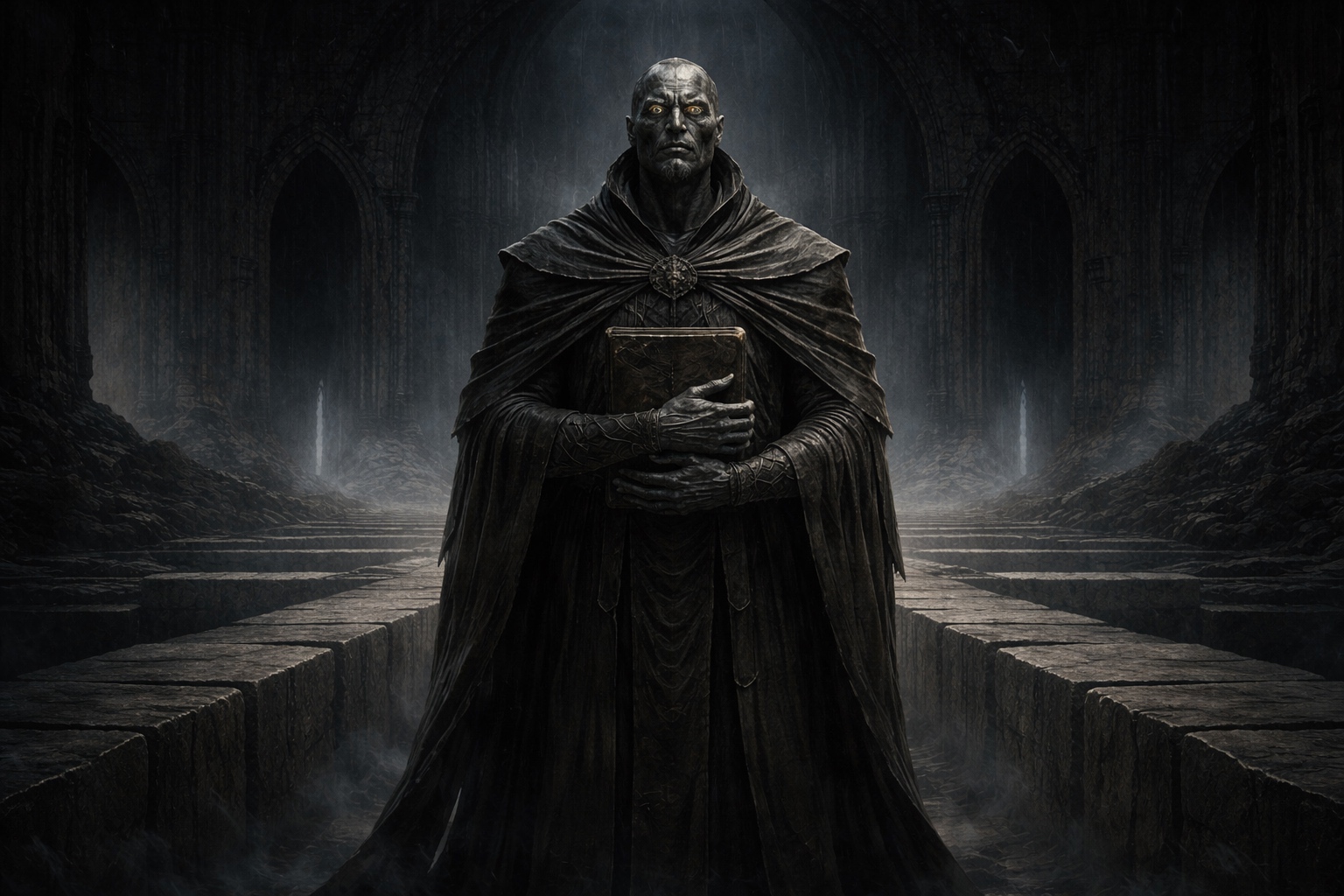
The Guardian of the Underworld, God of the Grave, Keeper of the Departed
Friedhof was born old. When Ix imagined the cosmos, it imagined a place where the living would dwell and a place where the dead would rest — separate realms, necessarily tended. Friedhof did not choose this work; he became it, as water naturally becomes cold. He has tended the underworld since the moment the cosmos had an underworld to tend, watching over the boundaries, ensuring that death means something, that the departed remain departed, that the living and the dead do not bleed into one another's domains.
He is the least worshipped of the Primitive Gods, and he prefers it that way. Friedhof is not interested in the living. He does not offer protection or comfort or the promise of a pleasant afterlife. What he offers is clarity: when you die, you will go to him. Your life will be recorded in his great ledgers. You will face the fact of what you were. There is no bargaining with Friedhof, no appeal, no way to bribe him or flatter him. He is a force. Death is a force. And he is its steward.
Yet as the centuries passed and more mortals died, a thin network of followers accumulated — those who understood something in Friedhof's terrible honesty that spoke to them, or those whose proximity to death made silence impossible. They became the keepers of graves, the recordkeepers of the dead, the morticians who understood that what they did was sacred work. And Friedhof, remote and barely present, began — imperceptibly — to watch them back.
At a Glance
- Portfolio: Death, the grave, the underworld, boundaries between worlds, the recording and honoring of the departed.
- Virtues (as the faithful name them): Honesty, sobriety, respect for finality, accurate memory, the acceptance of inevitability.
- Vices (what Friedhof opposes): Denial of death, the creation of false afterlives through dishonesty, the defiling of graves, the lying about the dead, the refusal to let the departed rest.
- Symbol: A simple black circle, like a void or a closed eye.
- Common worshippers: Grave-keepers, morticians, undertakers, those who tend the dead; historians who work with mortality records; those facing terminal illness; philosophers and monks; communities that have experienced mass death.
- Common regions: Present in every region, but concentrated in city districts that handle the dead and in remote places where the boundary between the living world and the underworld feels thin.
Names & Identifiers
- Common name (internal): The Silent Watching or simply Friedhof.
- Formal name (legal/ceremonial): The Guardian of the Underworld or The Keeper of What Is Final.
- A follower: A Friedhof-follower or sometimes a watcher of the grave; often just grave-keeper.
- Clergy (general): Grave-keepers or grave-priests; senior figures are sometimes called grave-wardens or keepers of the record.
- A temple/shrine: A grave-shrine or tomb-keep; formal temples are rare, but where they exist, they are called Friedhof's Houses or the Silent Halls.
- Notable colloquial names: Outsiders sometimes call them the Death-tenders or the Honest Ones, terms used neither with respect nor contempt but as simple description.
The Nature of Primitive Worship: Acknowledging Necessity
To worship Friedhof is to worship a force that will kill you. There is no negotiation, no promise that devotion will spare you, no subtle bargain. A Friedhof-follower does not expect Friedhof to be gentle. They expect him to be accurate. They expect him to wait. They expect that when their time comes, he will be there, and their death will matter because he will record it.
In the early centuries of Friedhof worship, followers were rare and isolated — individual grave-keepers, solitary monks, people whose circumstances forced them to be intimate with death. They would stand at graves and speak quietly to Friedhof, not asking for anything but making an offer: I will remember them honestly. I will not let them be forgotten. I will tend this place so that they can rest.
Friedhof did not answer these offerings with miracles or visions. He did not need to. But the grave-keepers noticed that when they kept their work meticulous, when they carved the names truly, when they did not lie about who was buried and why, the underworld seemed... quieter. The boundaries felt secure. There were fewer inexplicable disturbances, fewer spirits that would not settle.
It is not certain whether this was Friedhof's doing or merely the natural order strengthening when honored. The followers do not care. The distinction is philosophical. What matters is the work.
Modern Friedhof-followers understand this inheritance. They do not expect Friedhof to love them or to shield them. They expect him to do his job perfectly, and they do theirs in return. It is a stark faith, unsuited to those seeking comfort. But for those who have made peace with mortality, it is the most honest thing available.
Sacred Spaces
Friedhof has no temples in the traditional sense — no gathering halls where the living come to pray in groups. Instead, his sacred spaces are graves themselves, and the places that maintain them.
The Grave-Shrines are the most common sacred spaces: carefully tended plots of earth where the dead lie. A proper grave-shrine has three elements: the earth itself (properly blessed by a grave-keeper), a marker bearing the name and dates of the deceased, and a boundary that marks it as a place of peace and not to be disturbed. The marker is the holy symbol — carved in stone or pressed into metal, a simple black circle that says "this is Friedhof's threshold; the person who lay here is now in his keeping."
Tomb-Keeps are larger structures, built in cities and towns with significant populations. They are part charnel house, part archive, part temple. The layout is deliberately austere: long corridors lined with stone graves, each marked with name and date. At the center of the keep is a great chamber called the Record Hall — walls lined with ledgers in which every burial is documented. The Record Hall is where Friedhof-followers come to commune with the underworld itself, reading the names, verifying the records, ensuring that nothing has been forgotten.
Tomb-Keeps have a secondary function that is only slowly recognized by outsiders: they serve as records repositories. Cities under threat sometimes entrust their most important documents to Friedhof's keepers, understanding that no one desecrates a tomb-keep with impunity. The underworld protects what the living cannot.
The Boundary-Stones mark places where the barrier between the living world and the underworld is permeable — usually the sites of mass death, ancient battlefields, plague-villages, or simply places where the earth seems thin. These are not evil places; they are just places where Friedhof's work is evident. Followers sometimes travel to boundary-stones to commune with the dead, but the experience is perilous. The departed do not always appreciate visitation.
The Spinning Soul-Temples exist only in the underworld itself — structures formed by souls who have achieved a kind of coherence in death, binding together in great spiraling vortexes. Mortals who venture into the underworld and dare to enter these vortexes can interact with the bound souls, though the experience is disorienting and often painful. The souls speak in chorus, their voices overlapping, their identities merged but not destroyed. What they say is always true about death, but truth about death is not always comforting.
Mortals who have entered soul-temples and returned sometimes spend the rest of their lives walking strangely, their gaze distant. They have seen the underworld's truth and cannot quite return to the living world's surface-level denial. Friedhof's followers consider this a kind of grace.
Core Doctrine
- Death is final. Not because resurrection is impossible, but because death itself is sacred. The dead have crossed a threshold. Iy is blasphemy to suggest they should return. When they do return — through summoning, necromancy, or divine intervention — they become corrupted things that mock their own graves.
- Honesty about the dead is holiness. The worst sin against the departed is to lie about them: to erase their crimes to protect their memory, or to falsify their virtues to make them seem more admirable. The dead deserve to be remembered as they were. Their true nature, recorded truly, honors them more than false sainthood ever could.
- The grave is sacred ground. A grave violated is a covenant broken with Friedhof himself. The living may need to open graves for justice, but they do so at grave cost — the task requires ritual, permission from the grave-keeper, and legitimate cause. A grave opened for profit or curiosity does not merely harm the living; it damages the underworld's boundaries.
- Friedhof's work is never complete. There are always more dead to tend, always more names to record, always more boundaries to maintain. The Primitive God works eternally, and his followers work until they die — and then, presumably, continue the work in the underworld itself. This is not a punishment; it is a continuation of right relationship.
- The underworld has its own order. The living imagine the underworld as a place of punishment or reward, of divine judgment. In truth, it is simply a place where the dead exist in Friedhof's care. It has structure, which Friedhof maintains. Those who understand the structure can navigate it; those who do not respect it become lost.
Sacred Spaces: The Grave-Temples and the Record-Keeping
Unlike the Shard Gods, Friedhof does not gather worship in centralized temples. But in the largest cities, where sufficient death creates sufficient need, Friedhof-followers have constructed Grave-Temples — structures that serve as both archive and sanctuary.
A Grave-Temple is immediately recognizable by its simplicity. No grand architecture, no jeweled altars, no vaulted ceilings meant to inspire awe. Instead: stone corridors, names carved into walls, and the profound silence of a place designed for the dead, not the living. The most important feature is almost always the Record Hall — a central chamber where the master ledgers are kept. In some temples, entire walls are covered with the carved names of the dead; in others, the names exist only in books that are religiously maintained.
The sight of a Grave-Temple affects visitors in predictable ways: discomfort, a sense of weight, a sudden awareness of mortality. This is intentional. Friedhof's spaces do not comfort; they clarify. They are places to confront the fact of death and to honor those who have made the crossing.
Grave-Temples are often built at the sites of old plague-pits or battlefields — places where death was concentrated, where the boundary between worlds felt thin. In some cases, the temple IS the boundary, built directly over a place where the living world and the underworld overlap. These temples are both more powerful and more dangerous; people report strange experiences in them — conversations with the recently dead, knowledge that shouldn't have been known, an overwhelming sense of being observed by vast attention.
Clergy & Practice
Friedhof has few clergy, but they are instantly recognizable and universally respected (or feared) because they make death visible in a world that wants to hide from it.
Grave-keepers are the most common form of Friedhof clergy. They are the custodians of cemeteries, the people who dig graves and set markers, who maintain the records and ensure that burials are done correctly. In small communities, the grave-keeper is often also the mortician — the person responsible for preparing the body. This dual role is intentional; the work of tending the dead is unbroken from the moment of death until final rest.
Tomb-Wardens serve the larger Grave-Temples, maintaining the Record Halls and managing the vast archives of the dead. This is scholarly work, but solemn. A Tomb-Warden spends hours each day reading names, verifying records, ensuring that no death goes unrecorded. They are often among the most historically knowledgeable people in a city, because they have the complete roster of who lived and died.
Grief-Priests (rare) specialize in helping the bereaved understand death. They do not comfort — comfort is false — but they speak truthfully about loss. Some communities maintain grief-priests in the Grave-Temples specifically to counsel those devastated by death. The conversation with a grief-priest is meant to be brutal and clear: your loved one is gone. They are in Friedhof's keeping now. Your grief is real and valid and will eventually become part of your past. There is no bargaining with death.
Daily practice for Friedhof-followers is shaped by the work of tending the dead:
- A grave-keeper speaks the names of those buried that day, ensuring they are recorded in both earth and ledger.
- A tomb-warden spends time in the Record Hall, reading entries, tracing lineages of the dead, maintaining the vast web of connection.
- A grief-priest meets with the bereaved, speaks plainly about death, and offers no false hope — only the clarity that can come from brutal honesty.
- Any follower, when encountering a grave or marker, stops to read the name and to recall, briefly, that this person was real and is now gone.
There are no grand ceremonies in Friedhof's faith. Instead, there are grave-turnings — events held when a new grave is opened, when the boundary between worlds is briefly thinned. These involve the grave-keeper, the family of the deceased, and any witnesses. The grave-keeper reads the name of the deceased, states their dates, and says a simple formula: You have completed your time in the light. You pass now into Friedhof's keeping. Be at peace. Be remembered.
The family throws earth over the grave. The grave-keeper records the burial. The work is done.
Taboos
- Desecration of graves. The most serious offense in Friedhof's faith. To rob a grave, to disturb a marker, to use bones for ill purpose — these are not merely criminal; they are profane. A grave-keeper who becomes aware of grave-desecration has both the right and the duty to pursue restitution, sometimes using means that would be illegal in other contexts.
- Lying about the dead. To speak false memorial of the deceased, to erase them from record, to alter the documentation of their lives and deaths — this corrupts Friedhof's great ledgers. Followers believe that lies about the dead echo in the underworld itself, creating confusion and disorder among the departed.
- Refusing to let the dead rest. Summoning, binding, enslaving the spirits of the dead — these are profound violations. A corpse animated by magic is not the deceased returned; it is the deceased violated, forced back across a threshold they have already crossed.
- Treating death as a punishment to enjoy. A Friedhof-follower may execute justice, but they do not execute with cruelty. Death administered by Friedhof's hand should be quick and clear, not a canvas for revenge. A grave-keeper who executes another in the name of Friedhof but with ill-intent has disgraced the faith.
Obligations
- Maintain the records. Every follower is responsible, in their own way, for ensuring that death is remembered truly. This might mean recording burials, preserving documents, or simply keeping family histories accurate.
- Honor each grave. Followers are expected to visit graves when they pass — family graves, graves of significant people, graves of the unknown dead. A stop to read the name and acknowledge the person buried there is an act of worship.
- Refuse to desecrate death. If a grave-keeper encounters evidence of grave-desecration, necromancy, or the refusal to let the dead rest, they are obligated to oppose it — sometimes through law, sometimes through personal intervention.
- Tend the boundary. Followers of Friedhof understand that the underworld has needs; it requires attention, maintenance, proper protocol. When they encounter places where the boundary is weak or threatened, they are expected to shore it up — through ritual, through marking, sometimes through sacrifice.
Holy Days & Observances
Day of the Silent Counting occurs on the last day of the calendar year — a day when Friedhof-followers gather to read the names of all who died that year. In small communities, this might be a simple recitation; in large cities with Grave-Temples, it is an all-day event where multiple readers work through the complete roster of the dead, ensuring that no one is forgotten. The day is somber and quiet. The point is to create a moment of absolute presence for the dead — a moment when the living stop their ordinary work and simply bear witness to how many have crossed into Friedhof's keeping.
The Feast of Boundaries occurs on the spring equinox, marking the time when the barrier between worlds is traditionally thinnest. Followers make offerings at graves and at boundary-stones — food, water, flowers, or simply time and attention. Some communities hold vigils at these sites, staying awake through the night to watch for signs that the dead are at peace.
The Opening of the Deep Record occurs rarely — when a Grave-Temple completes a full generation of record-keeping (often 25-30 years), a ceremony is held to formally close that volume of the ledgers and open the next. This is as close to a celebration as Friedhof's faith comes. The completion of a volume is understood as proof that the work continues, that the dead continue to be remembered, that Friedhof's structure endures.
Ceremonies & Rituals
The Grave-Opening occurs when a body is interred or when a grave must be opened for legitimate cause (justice, verification, memorial). The grave-keeper performs a brief ritual acknowledging the threshold that is being crossed: Friedhof the Guardian, I disturb your boundary with cause. I offer recompense. I will restore what I have breached.
The Recording Ritual is performed whenever a death is documented. The grave-keeper reads the name of the deceased aloud, writes the name in the ledger, and speaks the formula: You have lived. Your time is complete. You are recorded and remembered. Be at peace.
The Grief-Speaking occurs when the bereaved come to the Grave-Temple or grave-shrine. A grief-priest or grave-keeper listens to the bereaved speak about the deceased — no time limit, no prescribed words. Then, once the bereaved have finished, the priest speaks plainly: your grief is natural; your loved one is gone; this will be painful for a time, but pain eventually becomes memory, and memory is how we keep the dead close.
Historical Figures
Jorath the Silent was a grave-keeper in an ancient city who, during a period of plague that killed half the population, continued recording deaths even as his own family died around him. He did not stop working. He did not seek help from other gods. He simply recorded, day after day, name after name, until the plague passed. His ledgers from that period are among the most complete records of a catastrophic mortality event in the world. Jorath survived, aged rapidly, and continued working until his death. His own grave bears only his name, his dates, and a simple black circle. Followers honor him as an example of what it means to make peace with death by facing it directly.
The First Warden is a legendary figure whose actual identity is lost. The oldest Grave-Temple records refer to "the Warden who first recorded the Underworld's own ledgers" — suggesting that she, at some point, traveled into the underworld itself and convinced the dead to let her see how Friedhof recorded them. She returned to the mortal world and implemented the same system of record-keeping in the Temple. Whether this journey was literal or metaphorical, the First Warden established the practice of maintaining complete, accurate records as Friedhof's highest calling.
Merrim Graves was a mortician-turned-grave-keeper who lived in a major city during a period of rapid urbanization. As the city grew, death-handling became commercialized and often dishonest — corpses were buried hastily in mass graves, names were confused, records were lost or falsified. Merrim began establishing proper grave practices: individual graves, proper marking, complete records. This was disruptive to commercial interests, and she faced opposition. But she persisted, eventually training other grave-keepers and establishing standards. She is remembered as the person who saved individual identity in the face of industrial death.
Sacred Relics & Artifacts
The First Ledger is claimed to be the oldest Record-keeping volume in the oldest Grave-Temple. Its pages are ancient, some illegible, but the entries at the beginning are the foundation of Friedhof's faith in the mortal world: the first recorded deaths, the first names written down and honored. No one outside the highest grave-wardens is permitted to view it. The power attributed to it is not magical but historical — it is proof that the practice of remembering the dead has continuous history back into antiquity.
The Binding Chain is a length of interwoven metal said to be forged from grave-markers of great age. It is used in Grave-Temples to mark the boundary of the Record Hall, creating a symbolic barrier between the world of the living and the realm of record-keeping. Followers report that crossing the chain feels different — heavier, more significant, as though one is moving from ordinary space into sacred space.
The Black Mirror appears in some Grave-Temple traditions: a mirror that supposedly reflects not the viewer's living face but their departed loved ones. Whether magical or psychological, those who gaze into it often see faces of the dead. The practice is not forbidden, but grief-priests warn that what one sees in the Black Mirror may not comfort.
Adventure Hooks
- A prestigious noble's grave has been opened and the body removed. There is no evidence of grave-desecration for profit — the removal appears to have been deliberately concealed and the burial site carefully restored. Investigation suggests the corpse may be needed for a powerful working, but by whom and why? The grave-keeper is determined to find it and return it; they will work with anyone who can help.
- A newly opened Grave-Temple in a frontier town begins recording the deaths of people who died decades ago — people never properly buried, whose bodies were lost to disaster. The Tomb-Warden responsible claims to have received the names from dreams. The dead are being recorded now, honored now, even though they died long ago. But some of the recorded names belong to people who were presumed dead but have actually survived, and they are deeply disturbed to discover their deaths were recorded.
- A boundary-stone marks the site of an ancient massacre that was deliberately erased from official history. A Friedhof-follower discovers references to it in old grave-records and wants to excavate and properly honor the unmarked dead. This will require opening sealed historical records and unearthing evidence of the massacre — which some powerful people have every reason to keep hidden.
- The Record Hall of the oldest Grave-Temple in the realm has been mysteriously damaged — not through vandalism, but as though time itself moved faster there, aging the records centuries in a single night. The entries in the damaged ledgers are now unreadable. Friedhof-followers are panicked; they believe souls have been erased from record. Investigation suggests something may be actively trying to corrupt Friedhof's ledgers themselves.
- A powerful plague has returned to a region where it killed masses centuries ago. When the old Grave-Temple's records from that plague are consulted, they contain not just names and dates but patterns — information about transmission, symptoms, survival rates. The records could help prevent mass death. But accessing them requires entering the deepest parts of the Grave-Temple, where the boundary with the underworld grows thin.
Cael
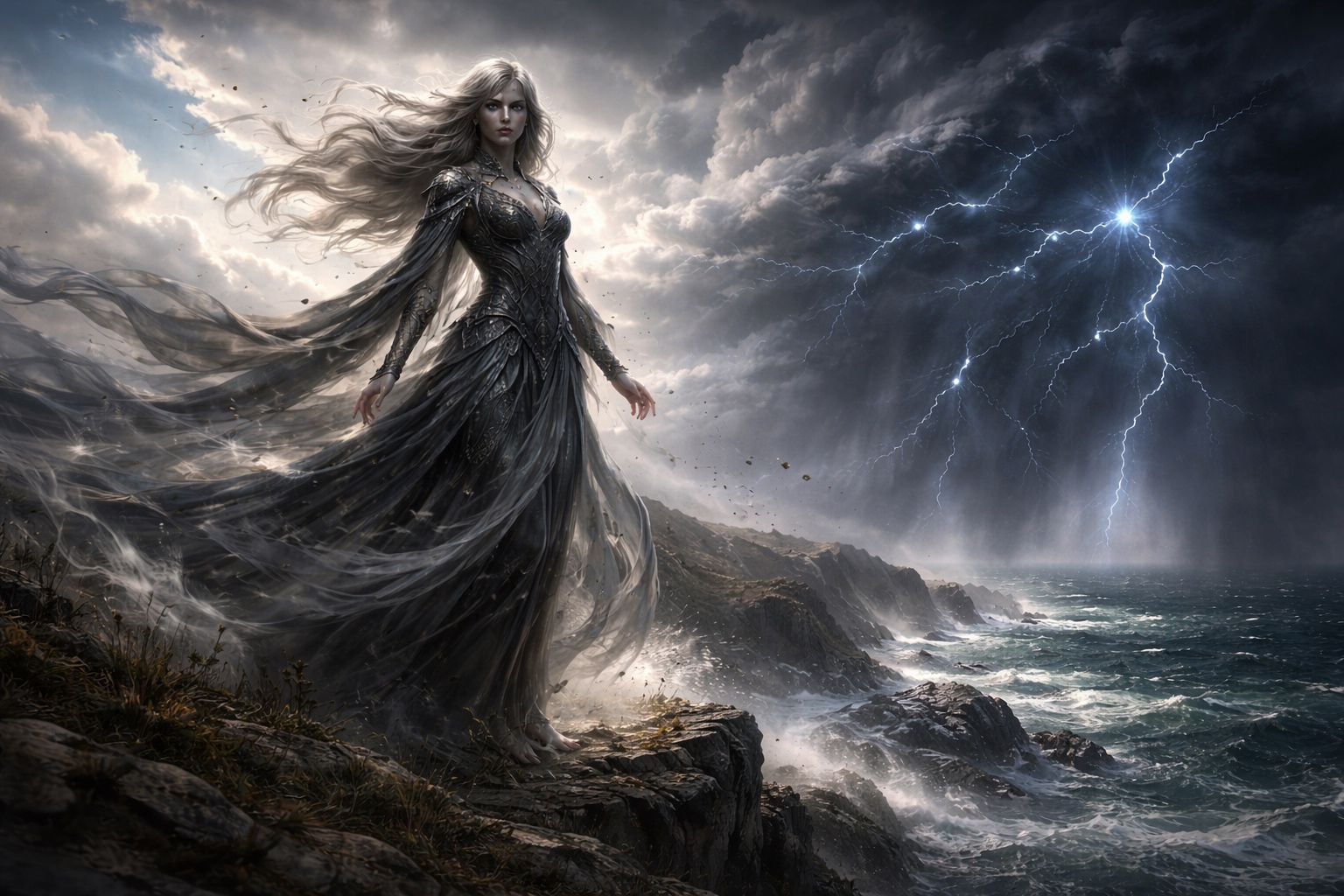
The Goddess of Weather, Mistress of Storms, Keeper of the Restless Sky
Cael was born with a laugh. When Ix imagined the world, it imagined that the world would not stay still, that change would move through it like breath through lungs. Cael became that movement — wind, rain, lightning, the sudden shift from clear sky to storm. She is chaos, but not evil chaos; she is the chaos that prevents the world from freezing in place, that brings water to the parched earth, that clears the stagnant air.
She is the least stable of the Primitive Gods. Where Friedhof is certain and Solis is constant, Cael changes. She is pleased one moment and destructive the next. She brings rain to the farmer's field and floods to drown the harvest. She is neither cruel nor kind; she is simply active, and her activity does not care about the intentions of mortals.
This makes her followers unique among those of the Primitive Gods. Other followers of other Primitives know what they worship — a force with clear nature and consistent intent. Followers of Cael never quite know what they will get. They have learned to read her moods in the weather itself, to interpret her communications through wind and storm, and to respect the fact that what Cael brings is always, in some sense, deserved — because she is responding to some imbalance or stagnation or wrong condition in the world.
As centuries passed and more mortals learned to read the sky, Cael became almost playful in her interactions with the faithful. A particularly intense storm would break at the moment of a desperate prayer. Rain would come to a land in drought exactly when the priest was performing ritual. These are not certain miracles; Cael is not that kind of god. But followers know their goddess is listening, and sometimes, when the equilibrium is right, she is present.
At a Glance
- Portfolio: Weather in all its forms, wind, rain, lightning, snow, floods, drought, storms, atmospheric change, the unpredictable elements.
- Virtues (as the faithful name them): Adaptability, response, the willingness to change, patience with the elements, the ability to read the signs.
- Vices (what Cael opposes): Stagnation, the refusal to adapt, presumption that the world owes you stability, the damming of natural flow without cause.
- Symbol: A cloud with a lightning bolt piercing it.
- Common worshippers: Farmers and herders dependent on weather, sailors, astronomers, weather-readers, those who live on storm coasts or in regions of extreme weather, communities dealing with drought or flood.
- Common regions: Everywhere weather exists, but particularly strong in coastal regions, river deltas, and mountain passes where weather is extreme and changeable.
Names & Identifiers
- Common name (internal): The Changeable or simply Cael.
- Formal name (legal/ceremonial): The Mistress of Weather or The Keeper of the Restless Sky.
- A follower: A Cael-reader or weather-watcher; sometimes a follower of the changing.
- Clergy (general): Storm-priests or weather-keepers; they are sometimes called the Restless Ones.
- A temple/shrine: A storm-shrine or wind-temple; these are often built at naturally significant weather sites.
- Notable colloquial names: Sailors sometimes call Cael's followers sky-speakers or the wind-wise; outsiders unfamiliar with the faith often call them storm-mad, which the followers find neither accurate nor insulting.
The Nature of Primitive Worship: Reading the Signs
To worship Cael is to accept that the universe does not owe you comfort. The weather does not come to soothe you; it comes to do what it must. And yet, if you learn to read it, if you understand what it is trying to tell you, you can learn to move with it rather than against it.
In the early centuries of Cael's worship, followers were people who had to pay attention to the sky anyway: shepherds, sailors, farmers who needed to predict when to plant. They noticed that when they paid careful attention — not just to the weather itself but to the patterns underneath it, the imbalances it was correcting — they could almost predict what Cael would do. More importantly, they could survive what she brought.
Over time, the practice evolved. Followers began to see the weather not as random but as communicative. A sudden storm did not just bring rain; it brought a message about what was out of balance. A drought did not just come from the sky; it came because something needed to change. Heavy snow in spring did not just inconvenience travelers; it was Cael's way of saying that the world was not ready to move forward yet.
This is not magic, and Cael-followers are careful not to claim it is. It is reading. It is the same way you learn to read a person's mood from their expression. The world has moods, patterns, and if you are attentive, you can learn to understand them.
Modern Cael-followers understand that they worship a force that might kill them. A storm that brings much-needed rain can shift and become a tempest that destroys the harvest. Lightning that clears the stagnant air can burn a town. Cael is not evil for this; she is simply powerful and impersonal. And yet, when followers perform their rituals correctly, when they read the signs and position themselves in right relationship with the changing wind, they find that Cael is more gentle with them than she might otherwise be.
Whether this is because Cael is actually aware and responding, or because those who understand the weather can better survive it, Cael-followers do not particularly care. The distinction is subtle.
Sacred Spaces
Cael has no temples in the traditional sense — spaces that shelter from the weather. Instead, her sacred spaces are exposed to the weather, designed to interact with it, to harness it, to make it visible.
Storm-Shrines are the most common sacred spaces: naturally occurring rock formations, usually in high places or on coasts, that have been shaped by wind and water into distinctive forms. These rocks create vortexes, channels, or other phenomena that make Cael's presence felt. Followers visit storm-shrines during various weather conditions — rain, wind, lightning — to make offerings and to pray. The offerings are simple: foods that don't spoil, water, sometimes objects that the wind can carry away. The point is not to keep the offering, but to let Cael take it.
Wind-Temples are built at locations where significant wind funnels create consistent patterns: mountain passes, river valleys, coastal cliffs. The structure is deliberately open — roofs that let rain through, walls that don't fully block wind, spaces designed to experience the weather rather than to be sheltered from it. Worship in a wind-temple is an act of exposure and trust. You stand in the wind and acknowledge Cael's power over you.
The Spinning Places are locations where weather patterns create vortexes — whirlwinds, waterspouts, spinning storms that occur repeatedly in the same location. These are the most sacred of Cael's spaces, places where her power is most concentrated. Followers approach them with extreme caution, if at all. Some storm-priests make offerings at the edges of spinning places, believing that at the center, Cael's attention is most keen. Those who have ventured into a spinning place and returned speak of an overwhelming sense of presence, as though Cael herself is there, attentive.
The Storm-Seats are natural stone formations that create spaces where observers can safely watch severe weather — covered overhangs or caves with good views of the sky. These are used by followers who want to study Cael's work — to watch how storms form, how wind patterns move, what the signs are that change is coming. It is part prayer, part meteorology. Followers spend hours at storm-seats simply watching the sky, learning to read it the way a scholar reads books.
Core Doctrine
- Change is inevitable. The world is in motion. Stagnation is not peace; it is death. Everything that does not move is decaying. The followers of Cael make their peace with the fact that nothing will remain as it is.
- The weather is not malicious. Storms that destroy bring rain that nourishes. Droughts that kill teach adaptation. The weather is not punishment and not reward; it is response. It corrects imbalances in the world. Those who understand this can work with it rather than against it.
- Reading the signs is sacred. The sky tells you what is coming if you know how to look. Followers spend lifetimes learning to read clouds, wind patterns, the color of the air. This knowledge is not prediction in the sense of certainty; it is understanding the patterns Cael moves in.
- Cael's moods are not random. She changes for reasons. When a storm comes, it comes because something is wrong or stagnant. When a drought persists, the world is not ready to move forward. When wind shifts, it is Cael's response to some imbalance. If you want to know what Cael is saying, look at what is happening in the world, not just in the sky.
- Adaptation is survival. The creature that cannot change is the creature that dies. Followers learn to shift like the wind, to flow like water, to be strong like the storm. Rigidity is not virtue; it is brittleness.
Soul Coins & Divine Economy
Cael's power grows through the worship of those who understand her, through the actions of those who adapt to her will, and through the simple attention of those who look at the sky and truly see.
- How Cael gains soul coins: Through attention and adaptation. A farmer who reads the weather correctly and plants accordingly generates coin. A sailor who learns to work with storms rather than against them generates coin. A community that survives a disaster by responding quickly to warning signs generates coin. Even the simple act of standing in the wind and acknowledging Cael's presence generates a small amount.
- What makes a coin "heavy": Coins are heaviest when generated by those who truly understand Cael — weather-readers with deep knowledge, survivors of extreme weather who have learned her ways, communities that have made their peace with the fact that some losses are inevitable but can be minimized through adaptation. A single coin from a genuine weather-reader weighs more than a thousand from casual worshippers.
- What Cael spends coins on: Interventions in weather patterns, the creation of storms that accomplish specific goals (breaking up stagnant air, bringing rain to drought-lands, clearing corrupted atmosphere). She also spends coins on the protection of those who follow her — not by making the weather gentle, but by ensuring they have the insight needed to survive it.
- Trade: Cael trades coins rarely and often with other Primitive Deities. Solis and Cael have complex negotiations about when the sun will shine and when rain will fall. These cosmic bargains shape seasons and weather patterns. When droughts persist, it sometimes indicates disagreement between the Primitive Gods.
- Infernal competition: The infernal tend to corrupt Cael's work by introducing unnatural weather — the refusal of seasons, the creation of eternal storms or endless drought. Cael-followers often find themselves combating places where the weather has become trapped, unable to move forward. Freeing trapped weather requires both spiritual and practical intervention.
Clergy & Practice
Cael has fewer clergy than most deities, because the practice of her faith is not centralized. Many followers work alone or in small groups, especially those who are weather-readers by profession — sailors, farmers, shepherds.
Storm-Priests are the closest thing Cael's faith has to formal clergy. They are individuals, usually selected by their communities because they have demonstrated the ability to read weather accurately, who take on the formal role of mediating between Cael and the community. A storm-priest in a fishing village might spend their days watching clouds and advising on when it is safe to sail. A storm-priest in a farming region might help time plantings and warn of coming droughts.
Weather-Readers are scholars and practitioners who study Cael's patterns with something approaching scientific rigor. They record weather patterns, maintain archives of storms and droughts, study how conditions change from year to year. Some readers work alone; others in larger communities might work as teams. The Readers are highly respected because their knowledge can mean the difference between abundance and starvation.
The Wind-Walkers (rare) are followers who claim to have achieved direct communication with Cael — to be able to move through storms without harm, to redirect wind with intention, to speak to Cael and receive answers. The mainstream Cael-faith is skeptical of wind-walkers, considering many of them charlatans. But those wind-walkers whose predictions prove accurate are treated with something approaching religious awe.
Daily practice for Cael-followers varies but typically includes:
- The Watching: Regular observation of the sky, noting changes, learning to read the signs. For weather-readers, this is hours each day. For others, it might be brief observations at dawn and sunset.
- The Weather-Offering: Simple gifts left at storm-shrines or wind-temples to acknowledge Cael's presence and to ask for favorable conditions (if a favor is needed) or to give thanks (if conditions have been good).
- The Storm-Ritual: When a significant storm comes, followers go to safe places to watch and to acknowledge Cael's work. Rather than sheltering inside, they find protected spots where they can observe. The act of witnessing the storm while remaining respectfully distant is itself worship.
There are no formal ceremonies in Cael's faith in the way that other deities have ceremonies. Instead, there are moments of heightened attention: when a follower predicts a storm and it comes, they might speak a formula of thanks. When a drought breaks, followers might gather at a storm-shrine to welcome the rain. But these are not required; they arise naturally from the relationship between the follower and the changing world.
Taboos
- Damming natural water-flow without cause. The followers of Cael understand that water must move, that rivers must flow. A dam built purely for profit, without regard for what it disrupts, is an affront to Cael. Followers may build dams for necessity, but they do so with ritual acknowledgment of what they are interfering with.
- Poisoning the air or water. Cael's work involves moving air and water. Poisoning these elements corrupts her work and makes her interventions unpredictable and dangerous. A community that poisons its air will find that Cael's weather becomes increasingly harsh and difficult to read.
- Refusing to adapt or evolve. A community that insists on maintaining the same practices regardless of changing conditions is a community that has forgotten Cael's primary teaching. Such communities often find that Cael makes their conditions increasingly difficult until adaptation becomes necessary.
- Controlling and confining the weather through magic. The creation of artificial weather, the binding of storms, the forcing of seasons to halt — these are profound violations. They corrupt Cael's work by removing her agency.
Obligations
- Tend the places of weather. Storm-shrines and wind-temples must be maintained, kept clean, kept accessible. Followers are expected to give service to these spaces.
- Watch the sky. All followers are expected to pay attention to weather, to begin learning to read the signs. The depth of knowledge varies, but the attention is universal.
- Share what you learn. A follower who learns to predict weather well is expected to share that knowledge with the community — to warn of coming storms, to advise on planting, to help others understand Cael's work.
- Accept what Cael brings. This is not fatalism; this is realistic adaptation. When a storm comes, you do not curse Cael; you work with the conditions she has provided.
Holy Days & Observances
The Storm-Greeting occurs on the spring equinox, when unpredictable weather is expected. Followers gather at storm-shrines or wind-temples to greet the coming season of change. It is expected that weather during the ceremony will be changeable — the point is to acknowledge that you are entering a season of transition.
The High Wind Days occur at the autumn equinox, when wind patterns shift. Followers perform a ceremony called "reading the turn" in which they attempt to predict what winter weather will bring. If the prediction proves accurate, it is a sign that the community is in proper relationship with Cael.
The Breaking of the Drought occurs whenever a drought that has lasted more than three months finally breaks. When rain returns, followers gather spontaneously to give thanks and to perform the ritual of "water-welcoming" — pouring water as an offering while speaking gratitude to Cael.
Ceremonies & Rituals
Storm-Standing is performed when a significant storm arrives. Followers find safe places to observe and simply stand, acknowledging Cael's presence and power. This is not a time to speak, though some followers offer quiet words of respect.
The Wind-Reading is a ceremony performed when a follower believes they can predict coming weather. They make an offering and speak their prediction aloud, committing themselves to it. If the prediction proves accurate, they return to the same place and perform a confirmation ritual. If it proves wrong, they acknowledge the error and commit to studying more carefully.
The Season-Turning is performed at the equinoxes and solstices. Followers gather at significant weather sites and perform a ritual that acknowledges the turning of the year and asks for Cael's cooperation in the coming season.
Historical Figures
Asha the Cloud-Reader was a weather-keeper in an ancient trading city who developed a system for recording and predicting weather patterns. She maintained detailed archives of storms, droughts, and seasonal changes over a 40-year span. Her records made it possible for her community to prepare for weather extremes before they arrived, dramatically reducing casualties from floods and droughts. When a severe famine threatened, her records allowed the city to trade for grain from regions that had produced surplus. She died during a hurricane that she herself had predicted but could not have survived had she not warned the city to prepare. She is remembered as the founder of modern weather-reading and as an example of how attention to Cael's patterns can save lives.
Kess of the Storm-Seat was a hermit who lived in a cave overlooking a coast known for severe tempests. She spent her entire adult life watching storms, learning their patterns, understanding how they formed and why. She rarely left her cave; her life was devoted entirely to studying Cael's work. Sailors learned to watch for her signals — if she lit a fire during the day, it was safe to sail; if she kept the fire unlit, it was dangerous. She claimed no direct communication with Cael, only a deep understanding of her patterns. Followers today argue about whether Kess was a weather-reader or a wind-walker; the distinction matters less than the fact that her knowledge saved countless lives.
Dorem the Unstable was a follower who claimed to be able to shift the weather through ritual and will. He won followers with a string of apparently successful interventions — calling rain during droughts, directing storms to break up before landfall. But over time, his interventions became increasingly extreme, and when his method eventually failed, the consequences were catastrophic. A storm he attempted to direct continued uncontrolled and destroyed a city. Dorem is remembered as a cautionary tale: one cannot command Cael, only cooperate with her. Those who attempt to seize control of her work discover that her power far exceeds their own.
Sacred Relics & Artifacts
The Storm-Stone is said to be a meteorite that fell at one of Cael's most important storm-shrines. It is claimed to draw lightning, and followers report that standing near it during a storm creates a profound sense of Cael's presence. Whether it actually attracts lightning or simply appears to because the shrine is exposed to weather, the effect is striking. Some followers travel great distances to stand near the Storm-Stone during significant storms.
The Wind-Scrolls are ancient records of weather patterns, maintained by weather-readers across centuries. These scrolls are archives of droughts, floods, and unusual storms — documentation of Cael's work across time. They are preserved in protected locations and consulted by weather-readers attempting to predict significant changes.
The Dust of the Whirlwind is said to have been collected from the center of a spinning place where Cael's presence was most concentrated. A small amount is kept in temples and storm-shrines. When released during ceremony, it is said to carry prayers directly to Cael. Whether this is literal or metaphorical, the ritual of releasing the dust seems to carry power.
Adventure Hooks
- A drought that has lasted longer than any recorded in the weather archives continues unbroken. Weather-readers are baffled; the patterns that usually break droughts have occurred, but the rain refuses to fall. Investigation suggests the drought might be artificially maintained — that someone or something is bound to Cael's work and preventing her from bringing change.
- A series of increasingly destructive storms has hit a coastal region. Each storm is more severe than the last, occurring at intervals that suggest they are not natural but deliberate. Followers of Cael believe that something is corrupting her work, deliberately manipulating her to cause destruction. They need help discovering the source of the corruption.
- A wanderer claims to be a wind-walker with genuine ability to predict and navigate extreme weather. She has built a significant following among sailors and merchants, offering to guide them safely through storms. But the storms she's predicted haven't occurred, and she's making a fortune off the fees. When finally confronted, she claims that her interventions have prevented the storms — that her prayers to Cael have actually redirected her. True or false, her presence is causing real theological conflict in Cael's faith about the nature of divine interaction with weather.
- A region's weather patterns have completely inverted — seasons are backwards, rain falls when it should not, drought persists in the wrong months. Cael-followers believe the world's climate has been fundamentally disrupted by infernal interference, and they seek those willing to help them "break the bind" on Cael's work. Doing so may require traveling to places where weather is entirely unnatural and remains trapped.
- An ancient wind-temple has been discovered — older than any known Cael temple, built with architecture suggesting a much deeper understanding of weather patterns than contemporary followers possess. Investigation reveals that the ancients were apparently communicating with Cael directly in ways that have been lost. Followers want to re-establish this communication.
Lunis
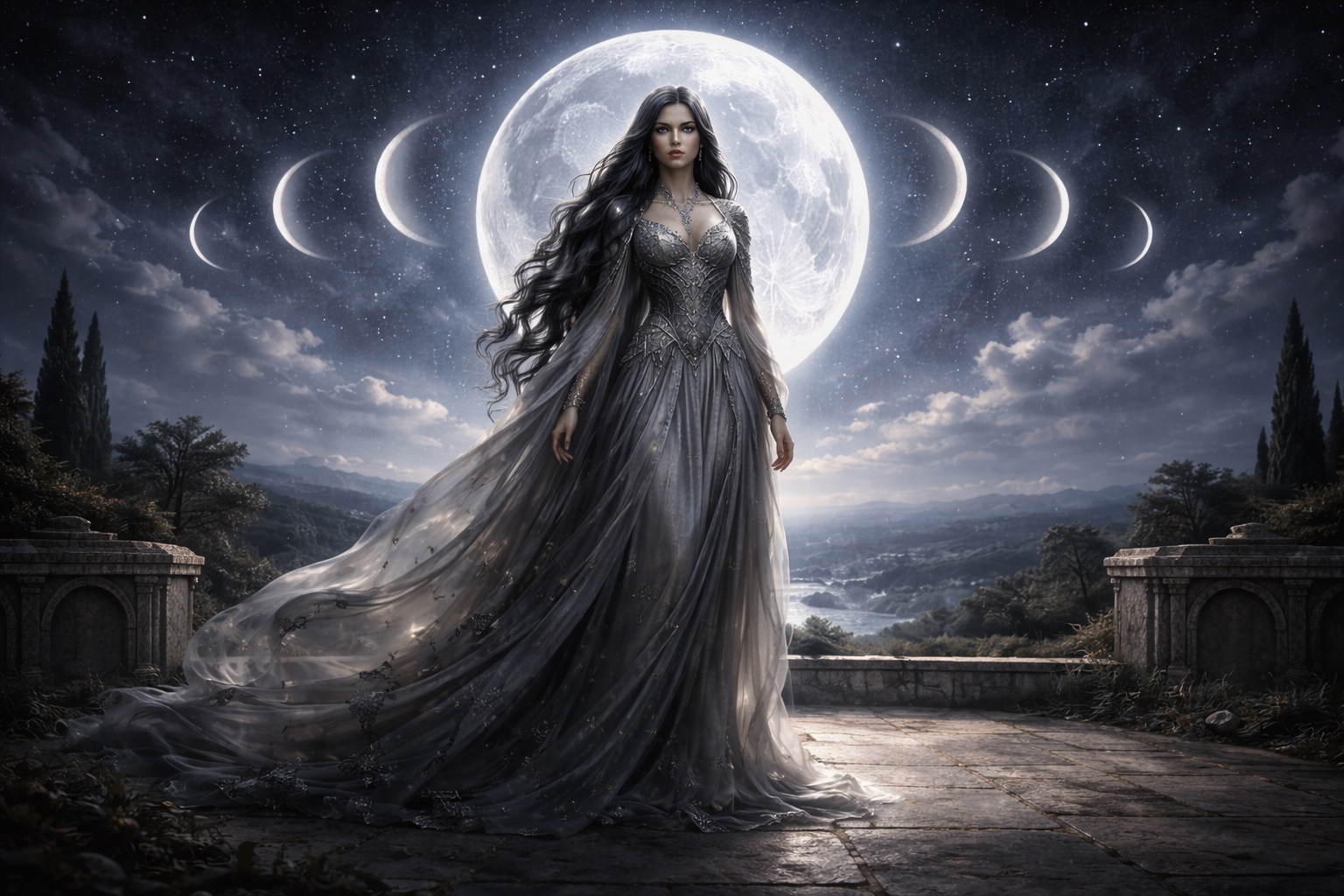
The Goddess of Night, Keeper of Celestial Wonders, Guardian of the Moon
Lunis was born in darkness. When the Primordial One imagined a cosmos, it imagined that the light would not always shine, that there would be times of rest and shadow. Lunis became the keeper of those times — the guardian of night, the mistress of the moon and all the celestial bodies that illuminate darkness.
She is the most alien of the Primitive Gods in some ways. Where Solis is constant and direct, Lunis is indirect and mysterious. Where Friedhof is clear about his purpose, Lunis is enigmatic. She is not hostile to the living, but she is not particularly interested in them either. She simply does her job — maintaining the celestial cycles, keeping the stars in their places, ensuring that night comes and goes with regularity.
Yet over centuries, an interesting class of followers has accumulated around Lunis: night-workers, those who navigate by starlight, those who prefer darkness, those who understand that what cannot be seen is not less real. And Lunis, remote and aloof, has begun — very slowly — to take an interest in those who acknowledge the night.
The most distinctive aspect of Lunis's followers is their obsession with meteorites. These fallen pieces of the sky are understood not merely as rocks but as pieces of Lunis herself — fragments that have crossed from her domain into the mortal world. Followers who recover meteorites consider them sacred relics of extraordinary power, and they will travel dangerous distances and take risks to recover them. More disturbingly, followers can become violent in defense of meteorites in their possession — unwilling to let them be studied, moved, or claimed by those without faith.
At a Glance
- Portfolio: Night, darkness, the moon and its cycles, stars, meteorites, celestial bodies, the hidden and unseen.
- Virtues (as the faithful name them): Hidden strength, the knowledge of secret things, patience with darkness, guidance in the unseen, the acceptance of mystery.
- Vices (what Lunis opposes): The requirement that all things be visible and known, the refusal to accept mystery, the destruction of celestial wonders, the denial of night.
- Symbol: A crescent moon, either waxing or waning, held within or against a circle.
- Common worshippers: Night-workers, astronomers, navigators, those who prefer darkness, miners and those who work underground, those who have lost status in daylight communities and found acceptance in night-communities, collectors of celestial objects.
- Common regions: Particularly strong in regions with clear night skies, coastal areas where starlight navigation is important, and cities with substantial night-working populations.
Names & Identifiers
- Common name (internal): The Hidden One or simply Lunis.
- Formal name (legal/ceremonial): The Keeper of Night or The Guardian of Celestial Wonders.
- A follower: A Lunis-follower or night-watcher; sometimes a child of the moon.
- Clergy (general): Moon-keepers or night-priests; they are sometimes called the Star-wise.
- A temple/shrine: A moon-shrine or celestial-temple; these are often built in open fields or at high points where the night sky is visible.
- Notable colloquial names: Outsiders sometimes call Lunis's followers the Moon-mad or the Night-dwellers, terms that are sometimes pejorative and sometimes simply descriptive.
The Nature of Primitive Worship: Accepting the Hidden
To worship Lunis is to accept that not everything can be known in daylight. The world has a night side, and that side is sacred. The stars tell stories that daylight obscures. The moon moves through phases that reflect changes and cycles the sun does not acknowledge.
In the early centuries of Lunis worship, followers were people who were active at night by necessity or preference: guards, merchants making night journeys, astronomers, night-workers in cities. They noticed that those who understood the night sky, who could navigate by starlight, who understood the moon's cycles, had advantages that daylight-dwellers did not. More importantly, they developed a kind of relationship with the night that was not fearful — they learned to see in darkness.
Over time, followers of Lunis developed practices around night-work: the study of stars, the recovery of meteorites, the keeping of moon-records that tracked the cycles of celestial bodies. They understood that meteorites were extraordinary — objects from the sky that had fallen to earth, pieces of the celestial realm made tangible. These became objects of veneration and, sometimes, obsession.
Modern Lunis-followers understand that their goddess is fundamentally indifferent to them. She will not protect them from darkness; darkness is her domain and her responsibility. What she offers, rather, is the knowledge that darkness is not absence, not emptiness, but fullness of a different kind. Those who learn to see in darkness, who understand the stories the stars tell, who make peace with the moon's changes, find that Lunis's domain offers gifts that daylight never could.
A distinctive feature of Lunis-followers is their fierce protectiveness of meteorites. This is not greed; it is religious devotion. A meteorite is understood as a piece of Lunis's own body, fallen to earth. To allow it to be moved casually, to be studied by the unbelieving, to be removed from the sacred space where it fell — these are not just personal preferences. They are violations of the sacred. Followers of Lunis have been known to resort to violence to prevent such violations. This makes them potentially dangerous and has led to conflicts with scholars, museums, and authorities who want to study celestial objects.
Sacred Spaces
Lunis has few buildings dedicated to her worship. Instead, her sacred spaces are open to the sky — places where the night is visible and the celestial cycles can be observed.
Moon-Shrines are the most common sacred spaces: open fields or hilltops marked with standing stones carved with moon phases. These shrines are oriented to provide clear views of the night sky. Followers visit them during significant lunar events — new moons, full moons, lunar eclipses — to make offerings and to observe. The offerings are often placed on the stones and left for Lunis; what she does with them is unclear, but followers report that the offerings often disappear.
Celestial-Temples are more elaborate structures, built at locations with particularly clear night skies. These are typically open-air gathering places with stone seating arranged to provide views of the sky. The most important feature is usually a stone circle or other astronomical marker that helps followers track celestial movements. Some temples maintain astronomical records going back centuries, tracking the movements of stars and planets with precise detail.
Star-Maps are sometimes carved directly into stone — hillsides or cliff faces marked with outlines of constellations and important celestial objects. These are both beautiful and functional, serving as both worship space and navigational aid. Following a star-map to its apex is considered a pilgrimage in Lunis's faith.
Meteorite-Shrines mark the locations where celestial objects have fallen. These sites are often maintained by followers as sacred ground — warded, protected, sometimes in the hands of families who have guarded the same meteorite for generations. Access to these shrines is usually restricted; the meteorite itself is often kept in a sacred enclosure visible but not touchable.
Core Doctrine
- The night is sacred. Not as a place of evil or danger, but as a realm of its own with its own logic and beauty. The followers of Lunis make their peace with darkness and find it good.
- The celestial bodies are divine messages. The stars and planets move in patterns that reveal truth about the world. Followers who learn to read these patterns can understand things that daylight reasoning cannot.
- Meteorites are pieces of the divine. When a celestial object falls to earth, it is a profound event — the celestial realm breaching the mortal world. These objects are sacred and must be treated with reverence.
- Mystery is valuable. Not everything that is hidden is meant to be discovered. Some things are sacred precisely because they remain unknown. The obsession with making all things visible and known is a form of blindness.
- The moon's cycles reflect human cycles. The moon waxes and wanes, is full and dark. Followers understand their own lives as cyclical in the same way — growth and decay, visibility and hiddenness, expansion and contraction. This is not tragic; it is natural.
Soul Coins & Divine Economy
Lunis's power is subtle and grows slowly. She is not accumulating divine strength the way more ambitious gods do. But those who understand her find that she is remarkably powerful within her domain.
- How Lunis gains soul coins: Through observation of celestial bodies, through navigation by starlight, through the recovery and honorable treatment of meteorites, through the simple act of being awake and aware during night hours, through understanding and respecting mystery. Coin is generated by those who move comfortably in darkness, who see it as sacred rather than fearful.
- What makes a coin "heavy": Coins are heaviest when generated by those who have made genuine peace with darkness and unknowing. An astronomer who studies the stars for understanding generates heavier coin than one who studies them for conquest of knowledge. A night-worker who finds dignity and peace in their work generates heavier coin than one who resents the night shift.
- What Lunis spends coins on: Maintaining celestial cycles, protecting meteorites from profanation, ensuring that night comes and goes properly, shielding those who genuinely need darkness from those who would banish it. She spends relatively little on direct intervention; her work is maintenance, not interference.
- Trade: Lunis trades coins with Solis in a kind of cosmic dance — negotiating when the sun will shine and when night will reign. This negotiation is not contentious but respectful. Neither considers the other an enemy; they are simply tending different parts of the world.
- Infernal competition: Infernal forces often try to corrupt night — to make it truly hostile and dangerous rather than simply dark and unknown. They create unnatural darkness, darkness that does not obey the lunar cycle, darkness that breeds terror rather than peace. Lunis-followers sometimes find themselves defending night against corruption, trying to restore it to its natural state.
Clergy & Practice
Lunis has fewer formal clergy than most deities, because much of her faith is practiced individually or in small groups.
Moon-Keepers are the primary form of clergy in Lunis's faith. They are individuals who have dedicated themselves to understanding and maintaining the moon-shrines, to tracking celestial cycles with precision, and to serving as intermediaries between the goddess and the night-working communities. Most moon-keepers maintain detailed astronomical records, noting not just the position of celestial bodies but also any unusual phenomena.
Star-Watchers are scholars and observers who study celestial bodies with something approaching scientific rigor. They maintain star-maps, track planetary movements, predict celestial events. In larger cities, star-watchers might work in teams in celestial-temples; in smaller communities, a single watcher might work alone for an entire region.
The Meteorite-Wardens are a specialized class of Lunis-followers dedicated to locating and protecting fallen celestial objects. They travel constantly, following reports of meteor showers or unusual sky events, seeking to recover meteorites before they are lost or — worse — claimed by the unbelieving. Meteorite-wardens are fiercely protective and have been known to become aggressive when they perceive meteorites being treated with insufficient respect.
Daily practice for Lunis-followers varies but typically includes:
- The Night-Watching: Regular observation of the night sky, noting the positions of celestial bodies, tracking the moon's phases. For serious followers, this is several hours each night.
- The Meteorite-Vigil: Those who have meteorites in their care maintain constant vigils over them, protecting them from disturbance and from those who might remove them.
- The Star-Recording: Followers maintain written records of what they observe in the night sky — changes in stellar positions, unusual celestial events, the movement of planets. These records are maintained over lifetimes and sometimes across generations.
There are no elaborate ceremonies in Lunis's faith, but there are moments of heightened attention and reverence. When a meteorite is recovered, a ceremony is performed blessing it and marking its location as sacred. When significant celestial events occur — eclipses, comets, particularly bright planetary appearances — followers gather at moon-shrines to observe and give thanks.
Taboos
- Disturbing a meteorite shrine. A place where a celestial object has fallen is sacred ground. To remove the meteorite without permission, to excavate it for study, to treat it as merely a rock to be examined — these are profound violations. Followers of Lunis will oppose such actions vigorously.
- Denying the sacred in darkness. To teach that night is evil, that darkness is merely absence, that the celestial bodies are merely rocks — these teachings are considered forms of spiritual blindness. A follower who begins to espouse such views is no longer welcome in the faith.
- Refusing to respect celestial mysteries. The impulse to explain away all celestial phenomena, to reduce the divine to the mechanical — this is a form of arrogance that Lunis opposes. Some mysteries are meant to remain mysterious.
- Claiming to possess a fallen star or comet. Meteorites are not property; they are sacred objects in Lunis's care. A person who tries to "own" a meteorite or to control access to it is claiming rights they do not have. The meteorite belongs to Lunis and to the sacred space where it fell.
Obligations
- Maintain the moon-shrines. Followers are expected to keep the shrines clean, accessible, and properly oriented toward the sky. The stones must be maintained, and the site must remain a place of sacred observation.
- Record what you see. All followers are expected to maintain some record of celestial observations — even if it is only brief notes. More serious followers maintain detailed archives.
- Protect meteorites. Any follower who becomes aware of a meteorite is expected to protect it from profanation or removal by the unbelieving.
- Honor the night. Followers are expected to spend time in darkness, awake and aware, acknowledging the sacredness of night and participating in its rhythms.
Holy Days & Observances
The Night of the New Moon occurs monthly on the night of the new moon — when Lunis's face is hidden and darkness is deepest. Followers gather at moon-shrines to sit in darkness and to meditate on what cannot be seen but is nonetheless present. It is the most sacred night in Lunis's calendar.
The Night of the Full Moon occurs monthly on the night of the full moon, when Lunis's light is brightest. Followers gather to observe the moon's light and to make offerings. This is a night of celebration and revelry, markedly different in tone from the new moon observance.
The Meteorite-Vigil occurs whenever a significant meteor shower is expected. Followers gather at observatories and moon-shrines to watch for falling stars, prepared to travel to recover any meteorites that may fall.
The Stellar-Turning occurs on the equinoxes and solstices. Followers observe the position of stars at these significant times and record them, contributing to the long-term records of celestial positions that help prove that the stars move in comprehensible patterns.
Ceremonies & Rituals
The Recovery Ceremony is performed when a meteorite is recovered. The warden who found it brings it to a moon-shrine and performs a blessing, speaking thanks to Lunis for having let the object fall to the mortal realm and promising to protect and honor it. The meteorite is then placed in a sacred enclosure.
The Star-Recording is performed by followers who maintain astronomical records. When a celestial event of significance occurs, they travel to their observation point, record what they see in exacting detail, and perform a brief ritual of thanks to Lunis for having revealed this information.
The Night-Embracing is performed by followers wishing to deepen their connection to Lunis. They spend an entire night in a dark place, alone and without light, simply being present in darkness. This is not a punishment but an act of devotion — learning to find peace and even joy in darkness rather than fear.
Historical Figures
Cassian the Star-Counter was an astronomer who lived in a major city centuries ago and devoted his life to recording the positions of stars. He maintained a catalog of thousands of stellar positions, tracked planetary movements with precision, and made observations that helped prove that the celestial bodies moved in regular, comprehensible patterns. His work was revolutionary — it demonstrated that the night sky was not random but ordered, following patterns that could be predicted and understood. Followers of Lunis cite him as proof that studying the sacred mysteries of the night does not diminish them but deepens understanding.
Lyssa the Meteorite-Keeper was the first recorded guardian of a major meteorite shrine. She devoted her entire adult life to protecting a meteorite that had fallen in a remote region, maintaining a vigil over it and preventing its removal or disturbance. When authorities attempted to take the meteorite for study, she resisted with such ferocity that they eventually gave up. After her death, the shrine continued under the care of her successors, and the meteorite has been protected for over three centuries. Lyssa is remembered as an example of sacred protection — the willingness to defend the divine against those who would treat it as merely material.
Mirvan the Hidden was a night-worker — a servant in a great house who worked while the family slept. Over decades, he discovered he could see in darkness in ways that made him more valuable in darkness than in daylight. He eventually left service and became a navigator, using starlight to guide merchants safely through dangerous territories. He was known for his ability to navigate by stars in conditions where others were lost, and he trained others in the same skills. His legacy is the proof that those who master night and darkness develop abilities that daylight-workers lack.
Sacred Relics & Artifacts
The First Meteorite is claimed to be the oldest known fallen celestial object, recovered by the earliest followers of Lunis. It is preserved in the oldest moon-shrine and is said to be visibly darker than ordinary stones, as if retaining something of the night sky. Followers report that standing near it creates a profound sense of Lunis's presence. Whether the stone is actually unique or whether it is simply very old and carefully preserved, its effect on believers is powerful.
The Star-Registry is a vast collection of astronomical records maintained by Lunis-followers across centuries. The earliest entries are thousands of years old. The registry contains observations of stellar positions, planetary movements, notable comets, and celestial events of all kinds. This archive is the most complete astronomical record available and is consulted by scholars and followers alike to understand how the night sky has changed over millennia.
The Shadow-Map is a curious artifact — a map of the night sky rendered in negative, with the stars marked by absence of ink rather than presence. It is said to have been created by a follower who wanted to emphasize the spaces between stars as much as the stars themselves. Looking at the Shadow-Map is supposed to train the eye to see what is hidden, to perceive the darkness as an entity rather than merely the absence of light.
Adventure Hooks
- A meteorite recently fell in a populated region, and multiple parties claim rights to it: scholars who want to study it, a museum that wants to display it, a Lunis-follower who claims it as sacred and demands it be placed in a shrine. The meteorite itself seems to resist all attempts to move it — physical removal becomes increasingly difficult and dangerous. The parties involved are escalating toward violence.
- An ancient astronomical record has been discovered suggesting that a significant celestial event (a comet or unusual star movement) will occur at a specific location in a specific month. Lunis-followers are preparing to observe it, but so are others — scholars, treasure-hunters, those who believe the event will reveal hidden knowledge. The gathering at the prediction site promises to be intense and contentious.
- A night-worker claims to have been guided to the recovery of meteorites by Lunis herself — that the goddess appears to him in darkness and directs him to falling stars. He is recovering meteorites at an unprecedented rate. The mainstream Lunis-faith is divided: some believe he has achieved genuine communication with the goddess; others suspect fraud or demonic influence. What is actually happening needs investigation.
- The Star-Registry has been stolen from its sacred archive. The loss is devastating to Lunis-followers because centuries of astronomical records are now in unknown hands. Followers suspect the records were taken to prevent the discovery of something in the data — some astronomical event or pattern that someone powerful does not want revealed.
- A region's night sky has become unobservable — a persistent cloud cover or magical obscuration prevents any observation of celestial bodies. Lunis-followers believe that something or someone is deliberately corrupting Lunis's domain, preventing her work from being seen and understood. They need help discovering the source of the corruption and breaking it.
Solis
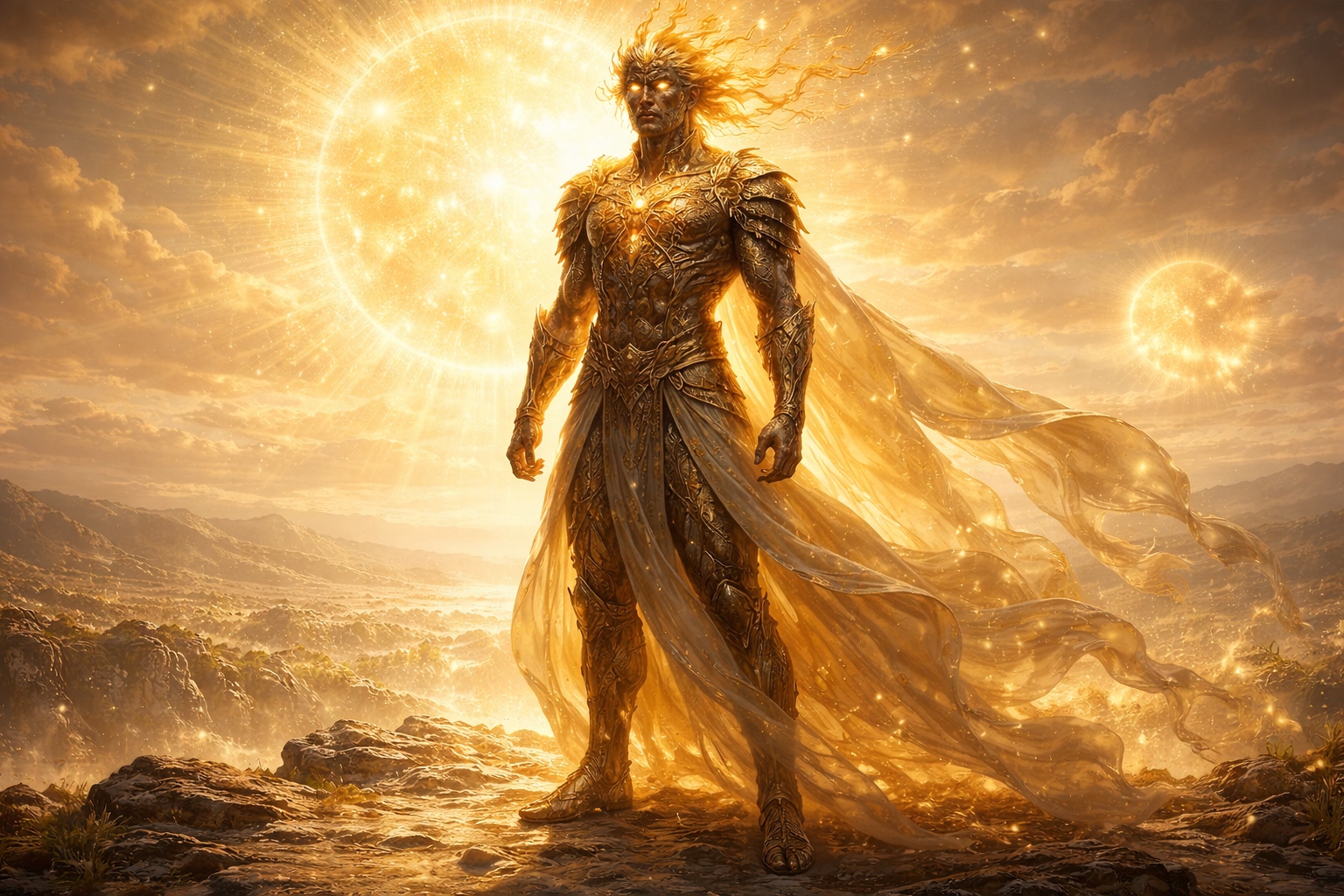
The God of the Sun, Guardian of Stars, Bringer of Light
Solis was born bright. When Ix imagined light, it imagined Solis — constant, reliable, undeniable. Solis maintains the sun; he cares for the stars. He is not particularly interested in the motivations of mortals, but he is interested in keeping the light on, in enabling the growth that light makes possible, in ensuring that the cosmos has the illumination it requires to function.
He is the most reliable of the Primitive Gods — the one you can count on. The sun will rise. The sun will set. The seasons will turn. Solis does his job with perfect consistency, and he has been doing it for eons. This consistency is comforting to his followers, and it is also, in some ways, limiting. There is little mystery in Solis; little unpredictability; little sense of personal relationship.
Yet Solis is not as remote as he sometimes appears. Over centuries, he has developed a particular interest in those who depend on his work — farmers, gardeners, those whose lives are structured by the cycles of light and dark that Solis maintains. He has become, for them, not just a force but something approaching a presence.
The unique status of Solis is his relationship to Amaterasu. In the distant past — accounts differ on exactly when — Amaterasu was born from Solis, or emerged from his rays, or became possible through his work. The exact theological relationship between the Primitive God and the Shard God who emerged from his domain is debated, but what is clear is that Solis predates and enabled Amaterasu's existence. The relationship between them is one of the most important theological questions in the Solis faith.
At a Glance
- Portfolio: The sun, stars, light, warmth, growth, illumination, the cycles of day and night, the seasons.
- Virtues (as the faithful name them): Reliability, constancy, the enabling of growth, the provision of light, clarity, steady strength.
- Vices (what Solis opposes): The premature ending of cycles, the denial of seasons, the corruption of growth, the stubborn refusal to move with the turning of the year.
- Symbol: A rising sun with rays spreading outward, or sometimes a disc of gold.
- Common worshippers: Farmers, gardeners, those whose livelihoods depend on good weather and season timing, priests and priestesses of related faiths, astronomers, those who seek clarity and revelation.
- Common regions: Present in every region, but strongest in agricultural heartlands and in places where the sun's cycles are most obvious.
Names & Identifiers
- Common name (internal): The Constant or simply Solis.
- Formal name (legal/ceremonial): The Guardian of Stars or The Bringer of Light.
- A follower: A Solis-follower or sun-watcher; sometimes a child of the light.
- Clergy (general): Sun-priests or light-keepers; more rarely, the Dawn-speakers.
- A temple/shrine: A sun-shrine or light-temple; these often double as civic or agricultural buildings.
- Notable colloquial names: Outsiders sometimes call Solis-followers the Day-workers or the Sun-blessed, terms usually spoken with respect.
The Nature of Primitive Worship: Acknowledging the Constant
To worship Solis is to place yourself in right relationship with the fundamental rhythm of existence. The sun rises and sets. The seasons turn. Growth happens in light and rest happens in darkness. These are not negotiations; they are facts. And the follower of Solis learns to move with these rhythms rather than against them.
In the early centuries of Solis worship, followers were people who had to pay attention to the sun anyway: farmers waiting for sunrise to work, shepherds moving flocks with the seasons, gardeners managing the light-needs of growing plants. They noticed that those who understood the sun's cycles, who respected them and worked with them rather than against them, thrived. Those who tried to fight the seasons, who pushed for crops at the wrong time, who worked themselves to exhaustion without respecting the necessity of night — these people failed.
Over time, the practice evolved into something approaching a philosophy. Followers understood that Solis's constancy was not a limitation but a gift. You knew what to expect. You could plan. You could depend on the sun rising tomorrow, on the seasons turning predictably, on the fundamental rhythms that Solis maintained. This reliability made civilization possible.
Modern Solis-followers understand that they worship a god of consistent power and absolute reliability. Solis does not intervene dramatically; he does not answer prayers with miracles. What he does is remain constant. The sun will rise. The growth will happen. The seasons will turn. If you work with these rhythms rather than against them, you will prosper. If you fight them, you will fail. It is not punishment; it is consequence.
The most distinctive aspect of Solis-worship is its relationship to Amaterasu. This is a source of ongoing theological debate and some contention. Some followers of Solis claim that Amaterasu is a daughter-deity, born from or emerging from Solis's work. Others argue that Amaterasu is a wholly independent Shard-god who merely happened to arise in the domain Solis maintained. Still others suggest that the relationship is one of cooperation or partnership rather than precedence. The exact nature of this relationship matters deeply to some followers and hardly at all to others.
Sacred Spaces
Solis has few temples in the traditional sense. Instead, his sacred spaces are tools for tracking and marking the sun's movement — places where the sun's progress can be observed and recorded.
Sun-Shrines are the most common sacred spaces: open fields or high places marked with standing stones, monoliths, or deliberately constructed stone circles that track the sun's position across the year. The most important feature of a sun-shrine is that it has clear, unobstructed views to the horizon — east for sunrise observations, south or north for midday observations depending on latitude. Followers visit sun-shrines to make offerings and to observe the sun's movement, particularly at significant times: solstices and equinoxes.
Light-Temples are more elaborate structures, built at locations that maximize exposure to sunlight. These are typically open-air gathering places with stone seating arranged to face east. Most light-temples contain a sun-dial or stellar-clock — structures that use the sun's shadow to mark the passage of time. The maintenance of these astronomical tools is considered sacred work.
The Meridian-Stones are tall standing stones placed at specific locations chosen to mark the sun's highest point at noon. These stones are often carved with marks indicating the seasons and the sun's position in the sky at different times of year. Following meridian-stones across a region allows observation of how the sun's noon position changes.
The Sunrise-Grounds are locations specifically chosen for clear views of the eastern horizon. Many communities have designated sunrise-grounds where followers gather to observe and celebrate the dawn. These places are often associated with new beginnings and with hope — the sun rises as a promise kept.
Core Doctrine
- Consistency is sacred. Solis is reliable. The sun rises and sets with perfect regularity. This consistency is not a limitation; it is the foundation of all predictable order. Followers make their peace with the fact that some things cannot and should not change.
- Light reveals truth. What cannot be seen in darkness becomes visible in light. Solis's gift of illumination is a gift of clarity. Followers seek to understand things as they are, not as they wish them to be.
- Growth requires proper seasons. Life requires both light and dark, activity and rest. A follower of Solis respects the necessity of winter as well as summer. You cannot force perpetual growth; some things must rest and die before they can be reborn.
- The sun's cycles govern life. Not mystically, but practically. The day-night cycle, the monthly cycle of seasons, the annual turning of the year — these are not restrictions on life but the necessary structures within which life functions.
- Amaterasu is kin to Solis. The exact relationship is debated, but Solis-followers acknowledge that there is a special connection between the Primitive God who maintains the sun and the Shard-god who emerged from the light. Whether daughter, aspect, successor, or partner, Amaterasu and Solis are connected in ways other deities are not.
Soul Coins & Divine Economy
Solis's power grows steadily and reliably, like the sun moving across the sky. He is not as actively ambitious as some gods, but his accumulation is steady and substantial.
- How Solis gains soul coins: Through worship that follows the rhythms of light and dark — working during daylight, resting at night, celebrating sunrise, respecting the seasons. Followers who align their work with the sun's cycles generate coin. Farmers who plant at the right time and harvest at the right time generate coin. Communities that celebrate the seasonal turning generate coin. Even simple acts — a prayer at sunrise, gratitude for the day's light — generate small amounts.
- What makes a coin "heavy": Coins are heaviest when generated by those who understand the sun's cycles deeply and have organized their entire lives around them. A farmer who has spent a lifetime reading the seasons generates heavier coins than one who merely follows common practice. An astronomer who understands the movements of stars generates heavier coin through their understanding than through casual observation.
- What Solis spends coins on: Maintenance of the sun and stars (keeping them burning, ensuring they remain stable), support of the seasonal cycles (ensuring that winter comes and goes properly, that spring returns), and occasional protection of communities that are in right relationship with his rhythms. Solis also trades coins with other Primitive Gods in the vast cosmic choreography that maintains existence.
- Trade: Solis trades coins with Lunis in a beautiful equilibrium — one gives light when the other gives darkness, neither considers the other an enemy. He also negotiates with Cael about when clear skies will appear and when clouds will obscure the sun. These negotiations are conducted at levels mortals rarely perceive but that shape seasons and weather.
- Infernal competition: Infernal forces sometimes try to corrupt Solis's cycles — to create eternal day or prevent the sun from rising, to trap the seasons or force perpetual winter. Solis-followers sometimes find themselves defending the sun's cycles against such corruption, trying to restore the natural turning of day and night.
Clergy & Practice
Solis has fewer formal clergy than some faiths, but the practice of his faith is deeply embedded in agricultural and civic life.
Sun-Priests are the primary form of clergy in Solis's faith. They are usually individuals who have demonstrated deep understanding of the sun's cycles and the seasons — often themselves farmers or gardeners who have proven skilled at working with natural rhythms. Sun-priests serve their communities by predicting seasonal changes, advising on planting and harvesting times, and maintaining the sun-shrines and light-temples.
Stellar-Observers are scholars who study the movements of the sun and stars with scientific precision. They maintain records of sunrise and sunset times, track the sun's position in the sky across the year, and work to understand the patterns that Solis maintains. Some observers work alone; others in larger communities might work in teams in light-temples.
The Dawn-Speakers (rare) are followers who claim to have received direct communication from Solis — messages in the light of dawn, insights granted at sunrise, revelations that come with the turning of seasons. The mainstream Solis-faith is skeptical of dawn-speakers, but those whose predictions and insights prove accurate are treated with considerable respect.
Daily practice for Solis-followers varies but typically includes:
- The Dawn-Greeting: Rising at sunrise and taking time to acknowledge the sun's return. This might be as simple as stepping outside to greet the dawn or as involved as performing a brief ritual of thanks.
- The Sunset-Acknowledgment: At sunset, acknowledging the sun's departure and the coming night. This is often framed as trust — the sun will return tomorrow.
- The Seasonal-Work: Working with the seasons rather than against them — planting at the right time, harvesting at the right time, resting when rest is appropriate.
There are no elaborate ceremonies in the regular practice of Solis-faith, but there are moments of heightened attention at significant times: the spring equinox, the summer solstice, the autumn equinox, and the winter solstice. At these moments, followers gather at sun-shrines to observe and to give thanks.
Taboos
- Preventing the sun from rising. Magically binding the sun, creating perpetual darkness, attempting to stop the day-night cycle — these are profound violations. They corrupt Solis's fundamental work.
- Refusing to respect the seasons. Attempting to force crops to grow out of season, to deny the necessity of winter, to fight the turning of the year — this is arrogance that Solis opposes. A community that refuses to adapt to seasonal change will find Solis's support withdrawn.
- Corrupting the light. Using light for deception, perverted purposes, or harm — this is a violation of Solis's gift. Light is meant to reveal and to enable; it should not be weaponized.
- Breaking faith with the sun's cycles. A Solis-follower who begins teaching that the sun's cycles are unimportant, that day and night are interchangeable, that seasons don't matter — such a follower has abandoned the faith.
Obligations
- Work with the seasons. All followers are expected to time their work according to the sun's cycles and the seasons it creates.
- Maintain the sun-shrines. Followers who live near sun-shrines are expected to keep them clean, maintain the standing stones, and ensure they remain accessible for observation.
- Observe the solstices and equinoxes. At minimum, followers are expected to acknowledge these four significant days of the year through some form of ritual or observance.
- Honor the light. Followers are expected to be grateful for Solis's gift of light and to use it wisely.
Holy Days & Observances
The Winter Solstice occurs on the shortest day of the year — the moment when the sun is lowest in the sky. This is understood as the moment of greatest darkness, but also as a turning point: from this moment forward, the days will grow longer. Followers gather at sun-shrines to make burnt offerings to Solis, beseeching him to return — to bring the sun back to strength. The tone is solemn and slightly anxious; there is real fear that the sun might not return.
The Spring Equinox occurs when day and night are equal length — a moment of balance. Followers celebrate the promise of growth and the return of light. Seeds are often planted at or near the spring equinox in Solis-faith communities, as if to partner with the god in bringing new growth into the world.
The Summer Solstice occurs on the longest day of the year — the moment when the sun is highest in the sky. This is celebrated as the moment of Solis's greatest power. Followers gather for a festival that is joyful and grateful. In some communities, fires are lit at sunset on the summer solstice and burned through the night — a human echo of the sun's power.
The Autumn Equinox occurs when day and night are again equal length. This is understood as the moment when the world begins to prepare for winter's rest. Followers gather to give thanks for the harvest brought by Solis's summer strength and to acknowledge the turning toward darkness.
Ceremonies & Rituals
The Sunrise-Greeting is performed by followers wishing to deepen their connection to Solis. They rise before dawn and travel to a sun-shrine or simply to a place with a clear view of the eastern horizon. They wait in darkness and then watch as the sun rises, performing a brief ritual of greeting and thanks.
The Seasonal-Blessing is performed by sun-priests when the season is turning. They gather at a sun-shrine and perform a brief ritual acknowledging the change and asking for Solis's support in the coming season.
The Solstice-Ritual is performed on the winter and summer solstices. On the winter solstice, followers gather to make burnt offerings and to implore Solis to return. On the summer solstice, they gather to celebrate and give thanks.
Historical Figures
Helos the Seed-Keeper was a farmer who devoted his life to understanding the relationship between the sun's cycles and plant growth. He maintained detailed records of when he planted various crops and how their success related to the timing of planting. Over a 50-year life, he documented the optimal planting times for dozens of crops and created a comprehensive calendar for agricultural work. His knowledge transformed farming in his region, dramatically increasing yields and reducing famine. He is remembered as an example of how attention to Solis's cycles creates prosperity.
The First Sun-Watcher is a legendary figure whose identity is lost to time. The oldest records of Solis-faith refer to "the first who watched the sun's movement and understood its meaning." This figure allegedly created the first sun-dial, understood the connection between the sun's position and the seasons, and established the practice of observing the solstices. Whether this was a single historical person or a composite of many early followers, the legacy is the foundation of astronomical practice in Solis-faith.
Amara of the Golden Fields was a farmer and sun-priestess who lived during a period when the region was experiencing increasingly erratic seasons. She maintained meticulous records of the sun's movement and the seasons, and when she noticed subtle patterns suggesting the cycles were shifting, she began advising the region to prepare for changes to come. Her early warnings allowed communities to adjust their agricultural practices before crisis struck. She is remembered as an example of how understanding Solis's work can enable foresight and preparation.
Sacred Relics & Artifacts
The First Sun-Dial is claimed to be the oldest surviving astronomical tool dedicated to Solis, constructed with remarkable precision despite its age. It is preserved in a major light-temple and continues to function accurately. Followers report that standing near it creates a sense of connection to the ancient understanding of Solis's work.
The Harvest-Torch is a ceremonial object used in some Solis-communities, said to be a flame that was lit at the first summer solstice and kept burning continuously ever since. In communities that maintain it, the torch is ceremonially lit from this eternal flame each year during the summer solstice, connecting the modern celebration to the ancient faith.
The Stone of Turning is a large stone marked with the solstices and equinoxes, positioned so that the sun's shadow falls on the appropriate mark at each seasonal turning. It serves both as a functional tool and as a reminder of Solis's perfect cycles. The stone is oriented so precisely that followers trust its indications more than their own calendars.
Adventure Hooks
- A region's seasons have begun to shift unpredictably — summer is coming too early or too late, winter is extending beyond its natural span, the sun's position in the sky does not match the recorded patterns. Solis-followers believe the seasonal cycles have been corrupted, and they seek those willing to investigate and restore them. The investigation may lead to discovering that something or someone is magically interfering with the sun's movement.
- A charismatic new sun-priest claims to be able to predict the sun's behavior with perfect accuracy and to guide communities through uncertain seasons. His predictions seem to come true, but sun-priests of the mainstream faith suspect he is either fraudulently manipulating events or has made some dark bargain. Discovering what is actually happening is crucial.
- The oldest light-temple in the region is being demolished to make space for commercial development. Solis-followers are fighting to preserve it, claiming it is an irreplaceable astronomical tool and a sacred space. Determining whether the temple has genuine historical and religious value or whether the followers are simply being obstructionist could prevent violence.
- Ancient records suggest that in the distant past, the relationship between Solis and Amaterasu was different — that they were not allies but rivals or competitors. Discovering evidence of this ancient conflict could profoundly shake both Solis and Amaterasu-faithful communities.
- A region is experiencing perpetual twilight — neither true day nor true night, but an endless state between. The sun seems to be stuck in its rising, never quite reaching zenith or setting. Solis-followers are panicked; they believe the sun itself has been bound or corrupted. The investigation will require discovering what or who has interfered with Solis's work.
Tempus
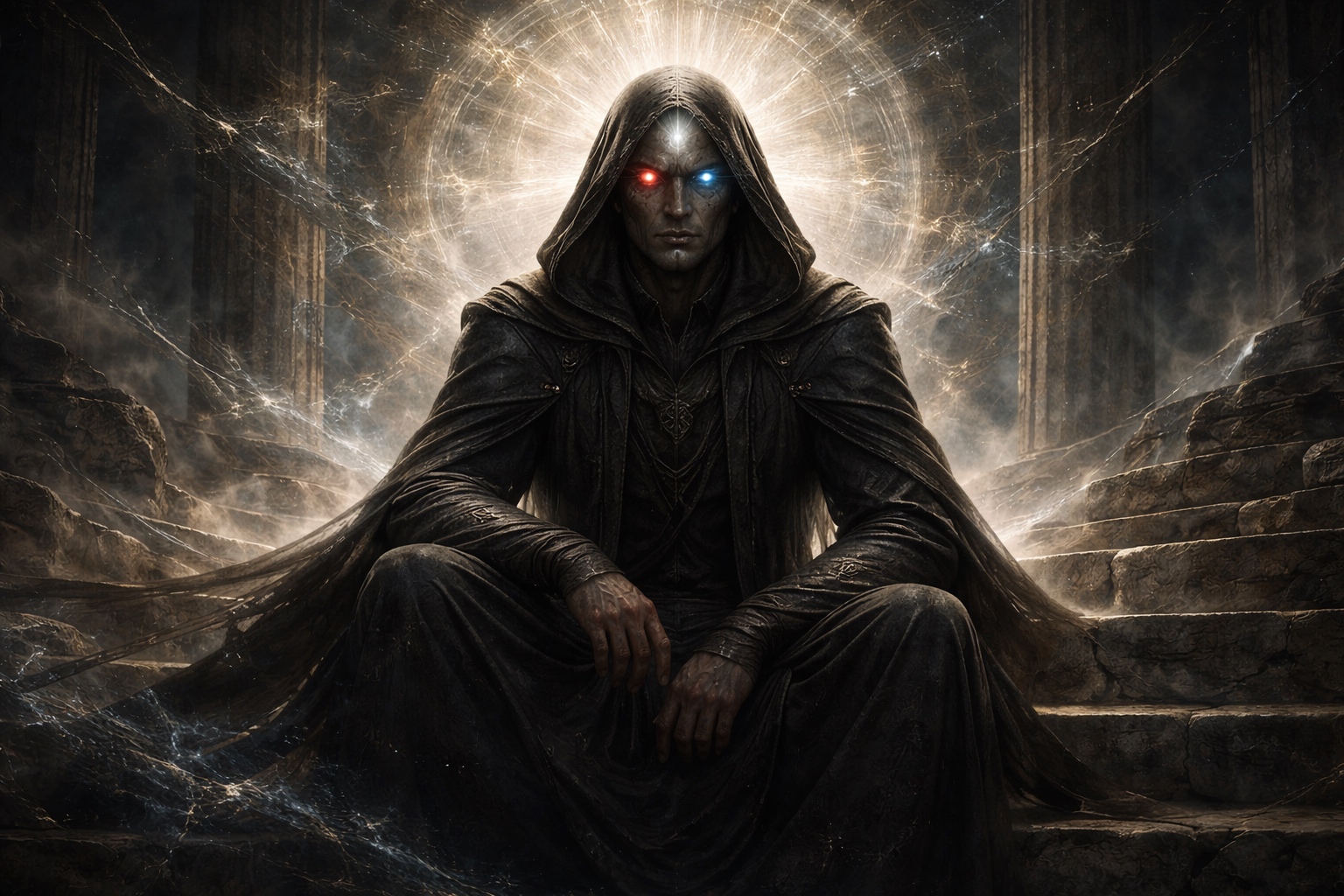
The God of Time, Watcher of All Moments, Guardian of the Blinded Future
Tempus was born in a paradox. When Ix introduced the concept of time into the cosmos, something had to steward it — to ensure that moments moved forward, that past remained fixed, that the present existed as a threshold between them. Tempus became that steward, with a terrible gift: the ability to perceive all aspects of time — past, present, and future — simultaneously.
For eons, he watched everything that had been, everything that was, and everything that would be. He saw all outcomes. He understood every consequence before it occurred. He knew Ix's downfall before the cosmos did.
And then the Ancients, seeing what Tempus could perceive, saw what he might reveal, and they blinded his future eye.
This is the defining tragedy of Tempus. He can see the past with perfect clarity. He can perceive the present with absolute precision. But the future — that third eye, which should give him sight of what will be — is closed. He is cut off from half of what he once perceived. He is, in effect, trapped in a moment of eternal incompleteness.
Yet he continues his work. Time still moves. The past still becomes fixed. The present still turns into past. And Tempus watches, seeing two-thirds of what he once did, knowing that something crucial is hidden from him — that there are events he cannot see, futures that will come regardless of his blindness.
Followers of Tempus exist in this theological space of profound limitation and strange clarity. Their god is incomplete, and yet his work is essential. They worship something broken that continues functioning perfectly. Some find this inspiring. Others find it terrible. All find it deeply significant.
At a Glance
- Portfolio: Time, temporal flow, past and present (but not future), history, memory, the recording of events, the keeping of records, consequence, cause and effect.
- Virtues (as the faithful name them): Accuracy, the honoring of what has been, the acceptance of consequence, truthfulness about the past, the wisdom of learning from history.
- Vices (what Tempus opposes): The distortion of history, the refusal to learn from the past, the false promises about the future, the claim to know what cannot be known.
- Symbol: A triangle of three eyes, with the third eye sometimes depicted as closed or marked with a line through it.
- Common worshippers: Historians, archivists, keepers of records, those who have made peace with the past, those seeking to understand cause and effect, those who understand that the future cannot be known and find peace in that truth.
- Common regions: Present in every region, but strongest in cities with significant archives and historical traditions, and in places where the past is deeply important to present identity.
Names & Identifiers
- Common name (internal): The Watcher or simply Tempus.
- Formal name (legal/ceremonial): The God of Time or The Guardian of Moments.
- A follower: A Tempus-follower or time-watcher; sometimes a keeper of what-has-been.
- Clergy (general): Tempus-priests or keepers of time; more formally, archivists of the eternal moment.
- A temple/shrine: A Tempus-temple or chrono-shrine; these are often archives or libraries.
- Notable colloquial names: Followers sometimes call themselves the Blinded-but-Seeing, acknowledging the paradox at the heart of their faith; outsiders sometimes call them the Doom-Seers (inaccurately, since Tempus cannot see doom) or the History-Keepers.
The Nature of Primitive Worship: Accepting Incompleteness
To worship Tempus is to worship something fundamentally broken. Not broken in the sense of failing to function — Tempus does his job perfectly. But broken in the sense of incomplete, missing something essential, wounded in a way that will never fully heal.
In the early centuries of Tempus worship, followers were people who worked with history: scribes recording events, priests maintaining traditions, elders teaching the young what had been. They noticed that Tempus seemed to respond to those who honored what had been, who kept accurate records, who resisted the temptation to revise or reshape the past for present convenience. They noticed also that Tempus offered no guidance about the future — that prayers for foresight went unanswered, that the faithful could not depend on divine knowledge of what was coming.
Over time, the theology evolved into something profound: Tempus teaches that the past is knowable and the future is not. The past is fixed, sealed, capable of being understood if you pay attention and resist distortion. The future is radically open, unknowable, full of genuine possibility that exists precisely because no one can see it. And the present is the threshold where the fixed past meets the open future.
Modern Tempus-followers understand that they worship a god who is deliberately limited. This is not a punishment for them; it is a truth about existence. No one can know the future with certainty — not because Tempus is weak, but because the future has not happened yet and does not fully exist. Prophecy is a lie. Fortune-telling is a lie. The claim to know what will come is a fundamental violation of the nature of time itself.
And yet — this is the bitter irony that shapes Tempus-faith — there are many charlatans claiming to speak for Tempus, claiming to offer foresight, claiming that Tempus has revealed the future to them. These frauds are among the deepest offenses to the god's followers. They claim to offer what Tempus himself cannot offer. They profit from the human desire to know what cannot be known. And they do so in Tempus's name, twisting his worship to something obscene.
True followers of Tempus spend much of their effort exposing these frauds, hunting down charlatans, and preventing false prophecies from spreading. In some ways, the faith of Tempus has become defined as much by what it opposes (false claims about the future) as by what it affirms (the accurate keeping of what-has-been).
Sacred Spaces
Tempus has few temples of dramatic beauty. Instead, his sacred spaces are archives — places where the past is preserved in written form.
Chrono-Shrines are the most common sacred spaces: small rooms or chambers where important historical records are kept. These might be in city archives, in great libraries, in temples of other faiths that recognize the importance of Tempus-followers. A chrono-shrine is a place where the past is made accessible, where followers can read the records and learn what has been.
The Great Archives are the most important Tempus-temples: vast libraries and record-halls that preserve centuries or millennia of historical documentation. These repositories are maintained with extraordinary care, protected from fire and flood and decay. They exist in the largest cities and in a few remote locations. A Great Archive is both a temple and a tool — a place to worship through the act of preserving and understanding the past.
The Memory-Halls are specialized spaces within larger temples or archives, dedicated to preserving the records of significant events — wars, famines, plagues, discoveries, changes in government. A Memory-Hall might contain documents, artifacts, or other relics from the period it commemorates. Visitors come to these halls to confront the reality of what-has-been, to understand that history happened and mattered.
The Void-Chambers are symbolic spaces in some Tempus-temples — rooms left deliberately empty or containing symbols of the blinded future eye. These are places where followers come to accept the unknowability of what is to come, to sit in the darkness of not-knowing, to find peace with the fact that the future cannot be seen.
Core Doctrine
- The past is fixed and knowable. Events have happened. They are real. They can be studied, understood, learned from. Distorting the past is a form of blasphemy because it denies the reality of what has been.
- The future is radically unknowable. No god, no person, no artifact can reliably predict what will come. The future is not hidden somewhere, waiting to be discovered; it does not yet exist in full form. Those who claim to know the future are lying — whether they know it or not.
- The present is the moment of agency. You cannot change the past; it has been. You cannot know the future; it is not yet. But you can act in the present. You can choose how to respond to what has been and how to move toward what might be.
- Consequence flows from cause. Understanding the past teaches you how causes produce effects. This is not prophecy; this is learning from what-has-been to make wise choices in the present about what-might-be.
- Tempus's blinding is significant. The god's inability to see the future is not a flaw or a punishment. It is a truth about existence — that some things are hidden, unknowable, sacred precisely because they remain unknown.
Soul Coins & Divine Economy
Tempus's power grows through the acts of those who preserve and honor the past — through the work of historians, archivists, and those who refuse to let history be erased or revised.
- How Tempus gains soul coins: Through the accurate recording of events, the preservation of records, the study of history, the honoring of what-has-been. Acts of historical preservation generate coin. Refusals to revise or distort history generate coin. Exposures of false prophecy and charlatanry generate coin. Even simple acts — reading history, learning from the past, teaching younger generations about what-has-been — generate small amounts.
- What makes a coin "heavy": Coins are heaviest when generated by those who have dedicated their lives to understanding and preserving the past. An archivist who has spent a lifetime maintaining records generates heavier coin than casual historical interest. A historian who risks safety to preserve records from destruction generates heavier coin than safe scholarship. Exposure of charlatans generates coins of surprising weight because it directly opposes the false claims about future-knowing.
- What Tempus spends coins on: Maintenance of the flow of time (ensuring that moments pass properly, that cause precedes effect, that the past solidifies correctly), protection of archives and records from destruction, and support of those who work to expose false prophecy. Tempus also spends coins on rewarding those who learn from history correctly and who use past knowledge to make wise present choices.
- Trade: Tempus does not trade coins often, and when he does, it is with other Primitive Gods about the cosmic order. He negotiates with Cael about how far into the future storm patterns are predictable (the answer is: not far). He maintains a careful equilibrium with Solis about the constancy of celestial cycles. These negotiations are about the limits of knowability.
- Infernal competition: Infernal forces profit from the distortion of history and the spread of false prophecy. They create confusion about the past, encourage historical revision, and encourage false seers who promise knowledge of the future. Tempus-followers often find themselves opposing infernal corruption of the historical record.
Clergy & Practice
Tempus has formal clergy dedicated to the preservation of history, and also a secondary force dedicated to opposing false prophecy.
Archivists are the primary form of Tempus-clergy. They are scholars who have dedicated themselves to the collection, preservation, and organization of historical records. Archivists work in the Great Archives, in city record-halls, and sometimes in portable archives maintained by traveling clergy. An archivist's primary commitment is to truthfulness — records must be accurate, preserved in their original form, and organized in ways that make truth accessible.
Keepers of the Temporal Record are archivists who specialize in maintaining records in the face of effort to destroy or distort them. During wars, persecutions, or periods of political upheaval, temporal record-keepers work to preserve documentation that those in power want destroyed. This work is dangerous and often conducted in secret.
The Fraud-Hunters are a more controversial aspect of Tempus-clergy — followers dedicated to identifying and exposing charlatans who claim to offer prophecy or future-seeing in Tempus's name. Fraud-hunters are investigators, interrogators, and sometimes enforcers. They track down false seers, expose their methods, and dismantle their operations. In some communities, they are supported by law; in others, they work outside legal structures. The friction between fraud-hunters and secular authorities is a constant source of tension in Tempus-faith communities.
The Scholars of Consequence are rare followers who study the relationship between past events and present conditions — attempting to understand, through historical analysis, why the present is as it is. This is not prophecy (which is forbidden); this is the honest work of understanding cause and effect across time.
Daily practice for Tempus-followers varies but typically includes:
- The Historical Study: Spending time reading and understanding historical records. For serious followers, this is hours each day. For others, it might be regular but less intensive study.
- The Record-Keeping: Maintaining some form of personal or community record of events — not for prophecy, but for preservation. What happens today becomes history tomorrow.
- The Lie-Watching: Paying attention to claims about the future, particularly claims made in Tempus's name. Any follower who becomes aware of false prophecy being spread has an obligation to investigate and oppose it if possible.
There are no elaborate ceremonies in the regular practice of Tempus-faith, but there are moments of heightened attention. When a significant historical event occurs, followers gather in archives or temples to formally record it. When an important record is discovered or preserved, a ceremony is held celebrating the preservation.
Taboos
- Distorting the historical record. To alter documents, to suppress records, to revise history to fit present ideology — these are profound violations. A Tempus-follower discovered falsifying records faces the harshest censure the faith can deliver.
- Claiming to know the future. Any follower who claims Tempus has granted them foresight, who makes prophecies, who pretends to know what will come — such a follower has betrayed the faith fundamentally.
- Profiting from false prophecy. To charge money for fortune-telling, to sell "prophecies" or claims about the future — this is particularly offensive when done in Tempus's name.
- Refusing to learn from history. A community or follower who ignores what-has-been, who refuses to learn from past mistakes, who insists on repeating failed patterns — such a follower has rejected Tempus's primary gift.
Obligations
- Preserve what-has-been. All followers are expected to contribute to the preservation of historical records in some way — by maintaining records, supporting archives, or simply ensuring that their knowledge of important past events is documented.
- Study the past. Followers are expected to engage in regular historical study, to understand the causes that led to the present conditions.
- Oppose false prophecy. When followers become aware of charlatans claiming to offer future-sight in Tempus's name, they are expected to report this to local fraud-hunters or authorities.
- Keep honest records. Whatever records followers maintain — personal, communal, professional — these must be truthful and not revised for present convenience.
Holy Days & Observances
The Day of Accurate Memory occurs once per year, on a date chosen by each local community but typically during a time that commemorates an important local historical event. On this day, followers gather to read and discuss historical records, to ensure that significant past events are not forgotten, and to reaffirm the commitment to truthfulness about what-has-been.
The Exposure Day occurs twice per year in communities with significant Tempus-presence. On these days, fraud-hunters present publicly the charlatans they have exposed in the previous six months, explaining their methods and warning the public about false prophecy. It is part public service, part celebration of the hunters' success in opposing lies.
The Void-Night occurs on the new moon in some Tempus-temples — a night when followers gather in darkness to sit in silence, accepting the unknowability of the future, finding peace in not-knowing.
Ceremonies & Rituals
The Record-Blessing is performed when an important historical document is discovered, recovered, or formally archived. Archivists and followers gather to formally acknowledge the document's historical significance and to commit to its preservation.
The Fraud-Unmasking is performed when fraud-hunters formally expose a false seer. The charlatan's methods are explained publicly, the false claims are refuted using evidence, and the community is warned against similar deceptions.
The Historical-Testimony is performed by followers wishing to formally document significant events they have witnessed. They stand before a Tempus-priest, speak about what they have seen, and the priest records the testimony in the temple's archives.
Historical Figures
Kellan the Archivist was a record-keeper who, during a period of war and persecution, worked to preserve the historical records of his city even as the government attempted to destroy them. He hid documents, created secret copies, and died protecting the archive from being burned. After the war, the records were recovered and preserved. He is remembered as an example of the willingness to sacrifice for the preservation of truth.
The First Fraud-Hunter is a legendary figure whose actual identity is uncertain. The oldest records of Tempus-faith refer to "the one who first exposed the lie of false prophecy." This person allegedly hunted down and exposed the first false seers who claimed to speak for Tempus, establishing the principle that those who claim Tempus has granted them foresight are always lying. Whether a single historical person or a composite of many, the legacy is the foundation of fraud-hunting in Tempus-faith.
Meriss the Historian was a scholar who spent a lifetime studying the causes that led to major historical events — investigating not just what happened but why. Her work demonstrated that understanding the past could teach wisdom about the present without requiring prophecy about the future. She lived through a period of significant social change and used historical analysis to help communities navigate that change wisely. She is remembered as an example of how honest historical scholarship provides genuine value without pretending to know the future.
Dalton the Fraud-Killer was a fraud-hunter whose methods were brutal and controversial. He not only exposed false seers but actually hunted them down and, in several documented cases, killed them. While his methods were extreme, his success in eradicating a network of charlatans who were spreading dangerous false prophecies was considered significant. Tempus-faith is divided about Dalton: some celebrate him as a hero of the faith, others see him as a cautionary tale about how the pursuit of truth can become corrupted by violence.
Sacred Relics & Artifacts
The First Archive is said to be the oldest known collection of historical records, dating back to the earliest days of civilization. It is preserved in a Great Archive in a major city and contains documentation of events thousands of years in the past. Followers believe that accessing the First Archive grants a kind of communion with Tempus — the ability to directly encounter the past through primary documentation.
The Fraud-Chains are actual chains used in some Tempus-temples to physically bind the records of confirmed false prophecies. These are not displayed prominently but kept in dedicated areas, serving as both warnings and proof that the faith actively opposes false claims about the future.
The Blind-Mask is a ceremonial object used in some Tempus-temples — a mask that covers the third eye, symbolizing Tempus's blinding. It is worn during certain ceremonies to remind followers of the fundamental limitation at the heart of their deity, and to find peace with that limitation rather than rage against it.
Adventure Hooks
- A charismatic false prophet has gained a massive following by claiming Tempus has granted him foresight. His "prophecies" are vague enough to seem accurate in hindsight but specific enough to inspire devotion. He is making an enormous fortune. Fraud-hunters want help exposing him, but his followers are loyal and potentially violent.
- An ancient archive has been discovered containing records of events that contradict current historical understanding. The documents appear authentic but suggest that major historical events happened differently than recorded. Archivists are struggling to verify the documents while managing political pressure from those who benefit from the current historical narrative.
- A region is experiencing a strange phenomenon: people are developing seemingly genuine prophetic visions — accurate glimpses of near-future events. Tempus-followers are panicked because this violates their core theology that the future cannot be known. Investigation is needed to determine if this is genuine prophecy or something else (infernal interference, mass delusion, etc.).
- An archivist working in a Great Archive discovers evidence that historical records have been deliberately suppressed — that documents were intentionally removed and destroyed to hide past atrocities. She wants to recover the lost records and restore the historical truth. Doing so will require finding where the suppressed documents were hidden and dealing with those who benefit from the lies.
- Fraud-hunters have discovered a network of false seers operating across multiple cities, and they have recruited powerful allies who benefit from the false prophecies being spread. The hunters need help dismantling the network while managing the political complexity of opposing powerful figures who profit from the charlatans' work.
The Primitive Deities endure. Ancient beyond measure, they maintain the great systems that Ix imagined — the underworld, the weather, the night sky, the sun's constancy, the flow of time. They are not beings in the way the Shard Gods are beings; they are forces that have, over millennia of mortal worship, begun to develop something approaching attention to the faithful who acknowledge them. To worship a Primitive God is to make peace with a force that does not particularly care about you but whose work you depend upon. It is a strange compact — without drama, without the promise of personal salvation, without the expectation that the god will intervene in your favor. And yet, to those who understand it, it is the most honest faith available, because it asks for nothing but acknowledgment of what already is, and in return offers not comfort but truth.