Cael
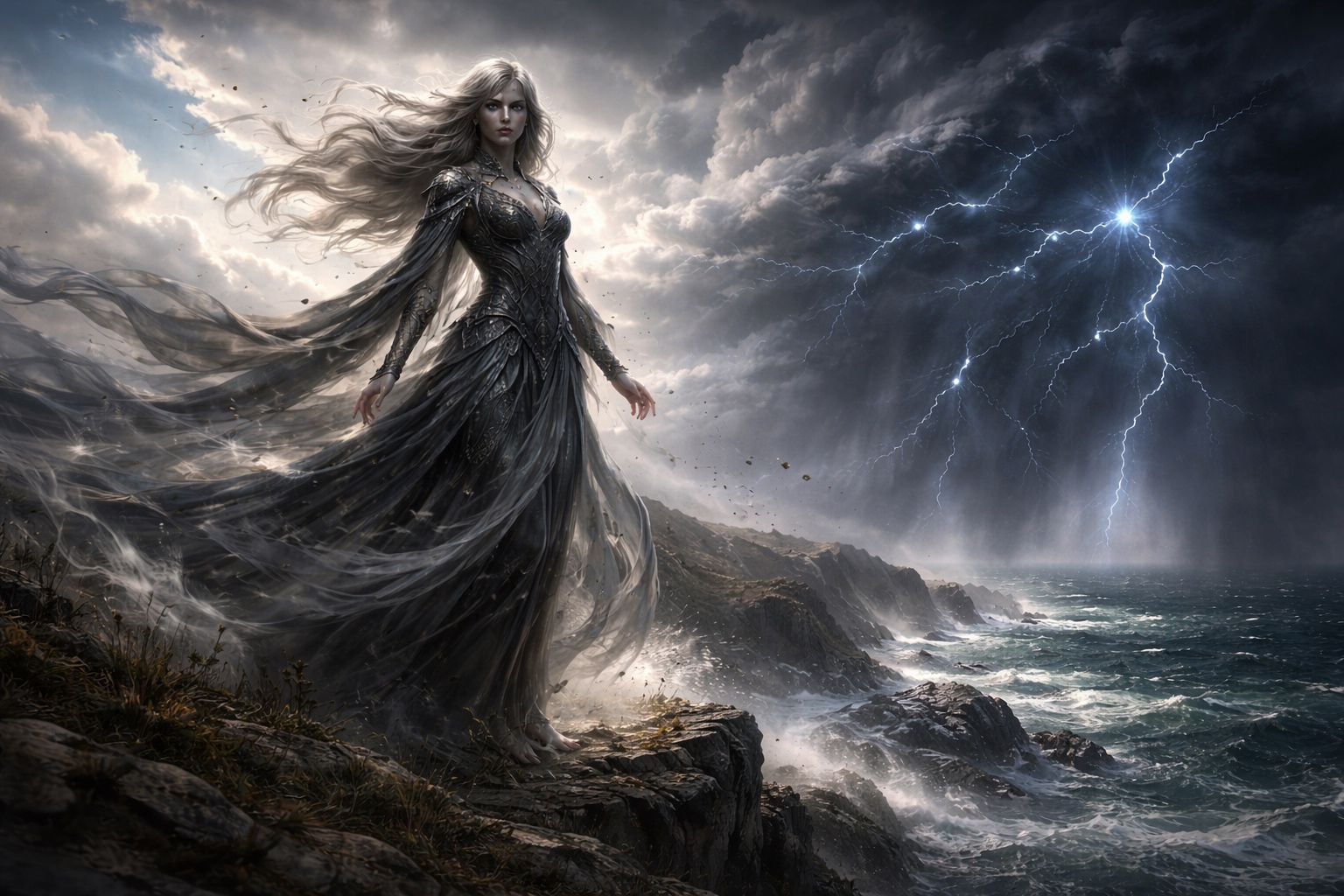
Cael
The Goddess of Weather, Mistress of Storms, Keeper of the Restless Sky
One of the First Gods, the ancient stewards who maintained existence before the Shard Gods had names.
Cael was born with a laugh. When Ix imagined the world, it imagined that the world would not stay still, that change would move through it like breath through lungs. Cael became that movement: wind, rain, lightning, the sudden shift from clear sky to storm. She is chaos, but not evil chaos; she is the chaos that prevents the world from freezing in place, that brings water to the parched earth, that clears the stagnant air.
She is the least stable of the First Gods. Where Friedhof is certain and Solis is constant, Cael changes. She is pleased one moment and destructive the next. She brings rain to the farmer's field and floods to drown the harvest. She is neither cruel nor kind; she is simply active, and her activity does not care about the intentions of mortals.
This makes her followers unique among those of the First Gods. Other followers of other Primitives know what they worship: a force with clear nature and consistent intent. Followers of Cael never quite know what they will get. They have learned to read her moods in the weather itself, to interpret her communications through wind and storm, and to respect the fact that what Cael brings is always, in some sense, deserved, because she is responding to some imbalance or stagnation or wrong condition in the world.
As centuries passed and more mortals learned to read the sky, Cael became almost playful in her interactions with the faithful. A particularly intense storm would break at the moment of a desperate prayer. Rain would come to a land in drought exactly when the priest was performing ritual. These are not certain miracles; Cael is not that kind of god. But followers know their goddess is listening, and sometimes, when the equilibrium is right, she is present.
Cael is the mother of Talbar, god of commerce and sealed agreements, by Pollaran. It is the least Cael-like fact about Cael, and her storm-priests handle it in one of two ways. The first holds that a goddess of pure change producing the god of the binding promise is not a contradiction but the necessary consequence of one: only something that never keeps a promise could teach so clearly what a kept one is worth. The second holds that Cael simply does not think about it, which is almost certainly true. Talbar acknowledges his mother in the formal genealogies and does not pretend the relationship is warm. Cael has weather to attend to. She always has.
At a Glance
- Portfolio: Weather in all its forms, wind, rain, lightning, snow, floods, drought, storms, atmospheric change, the unpredictable elements.
- Virtues (as the faithful name them): Adaptability, response, the willingness to change, patience with the elements, the ability to read the signs.
- Vices (what Cael opposes): Stagnation, the refusal to adapt, presumption that the world owes you stability, the damming of natural flow without cause.
- Symbol: A cloud with a lightning bolt piercing it.
- Common worshippers: Farmers and herders dependent on weather, sailors, astronomers, weather-readers, those who live on storm coasts or in regions of extreme weather, communities dealing with drought or flood.
- Common regions: Everywhere weather exists, but particularly strong in coastal regions, river deltas, and mountain passes where weather is extreme and changeable.
Names & Identifiers
- Common name (internal): The Changeable or simply Cael.
- Formal name (legal/ceremonial): The Mistress of Weather or The Keeper of the Restless Sky.
- A follower: A Cael-reader or weather-watcher; sometimes a follower of the changing.
- Clergy (general): Storm-priests or weather-keepers; they are sometimes called the Restless Ones.
- A temple/shrine: A storm-shrine or wind-temple; these are often built at naturally significant weather sites.
- Notable colloquial names: Sailors sometimes call Cael's followers sky-speakers or the wind-wise; outsiders unfamiliar with the faith often call them storm-mad, which the followers find neither accurate nor insulting.
The Nature of Primitive Worship: Reading the Signs
To worship Cael is to accept that the universe does not owe you comfort. The weather does not come to soothe you; it comes to do what it must. And yet, if you learn to read it, if you understand what it is trying to tell you, you can learn to move with it rather than against it.
In the early centuries of Cael's worship, followers were people who had to pay attention to the sky anyway: shepherds, sailors, farmers who needed to predict when to plant. They noticed that when they paid careful attention (not just to the weather itself but to the patterns underneath it, the imbalances it was correcting), they could almost predict what Cael would do. More importantly, they could survive what she brought.
Over time, the practice evolved. Followers began to see the weather not as random but as communicative. A sudden storm did not just bring rain; it brought a message about what was out of balance. A drought did not just come from the sky; it came because something needed to change. Heavy snow in spring did not just inconvenience travelers; it was Cael's way of saying that the world was not ready to move forward yet.
This is not magic, and Cael-followers are careful not to claim it is. It is reading. It is the same way you learn to read a person's mood from their expression. The world has moods, patterns, and if you are attentive, you can learn to understand them.
Sacred Spaces
Cael has no temples that shelter from the weather. Instead, her sacred spaces are exposed to the weather, designed to interact with it, to harness it, to make it visible.
Storm-Shrines are the most common sacred spaces: naturally occurring rock formations, usually in high places or on coasts, that have been shaped by wind and water into distinctive forms. These rocks create vortexes, channels, or other phenomena that make Cael's presence felt. Offerings are simple: foods that don't spoil, water, sometimes objects that the wind can carry away. The point is not to keep the offering, but to let Cael take it.
Wind-Temples are built at locations where significant wind funnels create consistent patterns: mountain passes, river valleys, coastal cliffs. The structure is deliberately open: roofs that let rain through, walls that don't fully block wind, spaces designed to experience the weather rather than to be sheltered from it.
The Spinning Places are locations where weather patterns create vortexes: whirlwinds, waterspouts, spinning storms that occur repeatedly in the same location. These are the most sacred of Cael's spaces, places where her power is most concentrated. Some storm-priests make offerings at the edges of spinning places, believing that at the center, Cael's attention is most keen.
The Storm-Seats are natural stone formations that create spaces where observers can safely watch severe weather. Used by followers who want to study Cael's work. Part prayer, part meteorology.
Core Doctrine
- Change is inevitable. The world is in motion. Stagnation is not peace; it is death. Everything that does not move is decaying.
- The weather is not malicious. Storms that destroy bring rain that nourishes. The weather is not punishment and not reward; it is response. It corrects imbalances in the world.
- Reading the signs is sacred. The sky tells you what is coming if you know how to look. Followers spend lifetimes learning to read clouds, wind patterns, the color of the air.
- Cael's moods are not random. She changes for reasons. When a storm comes, it comes because something is wrong or stagnant. If you want to know what Cael is saying, look at what is happening in the world, not just in the sky.
- Adaptation is survival. The creature that cannot change is the creature that dies. Followers learn to shift like the wind, to flow like water, to be strong like the storm.
Soul Coins & Divine Economy
- How Cael gains soul coins: Through attention and adaptation. A farmer who reads the weather correctly and plants accordingly generates coin. A community that survives a disaster by responding quickly to warning signs generates coin. Even the simple act of standing in the wind and acknowledging Cael's presence generates a small amount.
- What makes a coin "heavy": Coins are heaviest when generated by those who truly understand Cael: weather-readers with deep knowledge, survivors of extreme weather who have learned her ways.
- What Cael spends coins on: Interventions in weather patterns, the creation of storms that accomplish specific goals (breaking up stagnant air, bringing rain to drought-lands, clearing corrupted atmosphere).
- Trade: Cael trades coins with Solis and negotiates with other First Gods. These cosmic bargains shape seasons and weather patterns. When droughts persist, it sometimes indicates disagreement between the First Gods.
- Infernal competition: The infernal tend to corrupt Cael's work by introducing unnatural weather: the refusal of seasons, the creation of eternal storms or endless drought.
Clergy & Practice
Storm-Priests are the closest thing Cael's faith has to formal clergy. They are individuals who take on the formal role of mediating between Cael and the community: a fishing village's storm-priest might spend their days watching clouds and advising on when it is safe to sail.
Weather-Readers are scholars and practitioners who study Cael's patterns with something approaching scientific rigor. They record weather patterns, maintain archives of storms and droughts, study how conditions change from year to year.
The Wind-Walkers (rare) are followers who claim to have achieved direct communication with Cael: to be able to move through storms without harm, to redirect wind with intention. The mainstream Cael-faith is skeptical of wind-walkers, but those whose predictions prove accurate are treated with something approaching religious awe.
Daily practice typically includes The Watching (regular sky observation), The Weather-Offering (simple gifts at storm-shrines), and The Storm-Ritual (witnessing significant storms from a safe position rather than sheltering inside).
Taboos
- Damming natural water-flow without cause. A dam built purely for profit, without regard for what it disrupts, is an affront to Cael.
- Poisoning the air or water. Cael's work involves moving air and water. Poisoning these elements corrupts her work and makes her interventions unpredictable.
- Refusing to adapt or evolve. A community that insists on maintaining the same practices regardless of changing conditions has forgotten Cael's primary teaching.
- Controlling and confining the weather through magic. The creation of artificial weather, the binding of storms, the forcing of seasons to halt: these are profound violations.
Obligations
- Watch the sky. Regular observation and attention to weather patterns.
- Make offerings. Simple gifts at storm-shrines to acknowledge Cael's presence.
- Adapt. When the world changes, change with it.
- Witness storms. When significant weather comes, observe it with respect rather than simply hiding from it.
Holy Days & Observances
There are no formal holy days in Cael's faith in the way other deities have them. Instead, there are moments of heightened attention: when a follower predicts a storm and it comes, they might speak a formula of thanks. When a drought breaks, followers might gather at a storm-shrine to welcome the rain.
Historical Figures
Maren of the Coast was a sailor who spent forty years navigating some of the most storm-prone waters in the world without a single significant loss of crew. Her logs are studied in Cael-faith communities as examples of how to read weather correctly, not just the surface signs but the deeper patterns. She attributed her survival record not to luck but to listening.
The Storm-Caller is a legendary figure whose actual name is unknown; the oldest records simply call them "the one who called the storm that ended the drought." They allegedly performed a ritual that drew a years-long drought to its end by correctly identifying what the drought meant and what needed to change for Cael to bring rain. Whether the storm was caused by the ritual or whether the ritual simply correctly predicted the storm's natural return, Cael-followers consider the question irrelevant.
Sacred Relics & Artifacts
The Storm-Glass is a sealed vessel containing water and other materials that is believed to predict weather by changing its appearance before significant atmospheric shifts. Storm-priests who own storm-glasses regard them as the most reliable weather-reading tools available.
The Wind-Harp is a large harp-like instrument strung with metal strings, designed to be played by the wind itself. The melodies it produces are understood to carry meaning; followers trained in wind-harp interpretation claim they can read Cael's current state from the notes. Whether this is genuine communication or pattern-finding, no follower of Cael has found the question particularly urgent.
Adventure Hooks
- A region's weather has become stuck: the same storm, cycling repeatedly, unable to move on. Cael-followers believe the weather has been magically trapped and cannot correct what it came to correct. What is the imbalance the storm was meant to address, and who has an interest in preventing its correction?
- A community has been building dams and redirecting rivers for decades without ritual acknowledgment. The weather in the region has become increasingly severe and unreadable. A storm-priest believes the accumulated disrespect has corrupted the local weather patterns, but fixing it will require the community to undo infrastructure they have come to depend on.
- A wind-walker has appeared, making accurate predictions at an unprecedented rate. The mainstream Cael-faith suspects dark involvement, but investigation suggests something stranger: the wind-walker may not be communicating with Cael at all, but with something that knows what Cael will do before Cael does it.
- A drought has been identified as intentional; the pattern of dry weather matches no natural formation and seems specifically designed to starve a single community. Someone is weaponizing Cael's absence. Discovering who and how requires understanding both the weather patterns and the political context of the affected region.