Friedhof
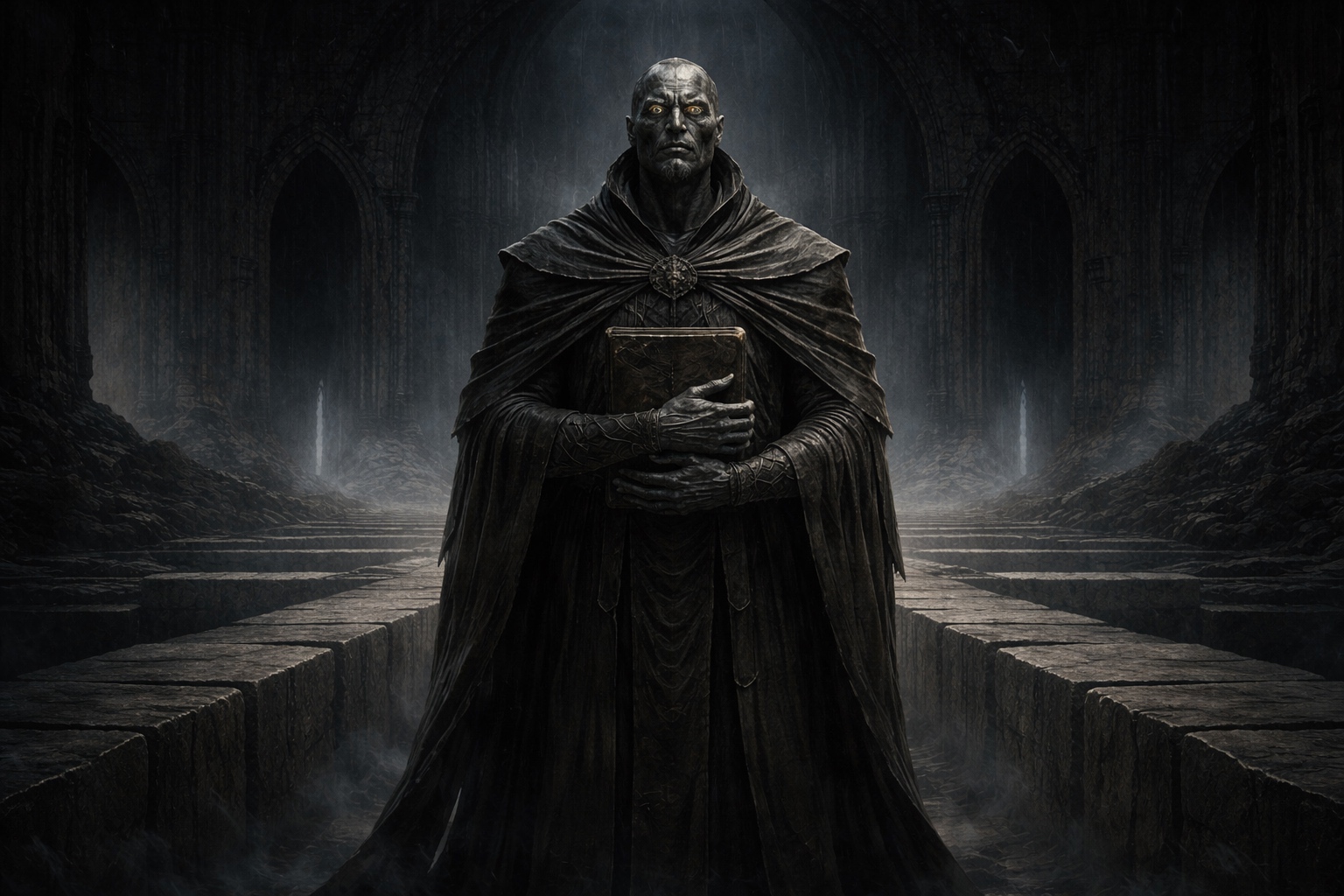
Friedhof
The Guardian of the Underworld, God of the Grave, Keeper of the Departed
One of the First Gods, the ancient stewards who maintained existence before the Shard Gods had names.
Friedhof was born old. When Ix imagined the cosmos, it imagined a place where the living would dwell and a place where the dead would rest: separate realms, necessarily tended. Friedhof did not choose this work; he became it, as water naturally becomes cold. He has tended the underworld since the moment the cosmos had an underworld to tend, watching over the boundaries, ensuring that death means something, that the departed remain departed, that the living and the dead do not bleed into one another's domains.
He is the least worshipped of the First Gods, and he prefers it that way. Friedhof is not interested in the living. He does not offer protection or comfort or the promise of a pleasant afterlife. What he offers is clarity: when you die, you will go to him. Your life will be recorded in his great ledgers. You will face the fact of what you were. There is no bargaining with Friedhof, no appeal, no way to bribe him or flatter him. He is a force. Death is a force. And he is its steward.
Yet as the centuries passed and more mortals died, a thin network of followers accumulated: those who understood something in Friedhof's terrible honesty that spoke to them, or those whose proximity to death made silence impossible. They became the keepers of graves, the recordkeepers of the dead, the morticians who understood that what they did was sacred work. And Friedhof, remote and barely present, began, imperceptibly, to watch them back.
At a Glance
- Portfolio: Death, the grave, the underworld, boundaries between worlds, the recording and honoring of the departed.
- Virtues (as the faithful name them): Honesty, sobriety, respect for finality, accurate memory, the acceptance of inevitability.
- Vices (what Friedhof opposes): Denial of death, the creation of false afterlives through dishonesty, the defiling of graves, the lying about the dead, the refusal to let the departed rest.
- Symbol: A simple black circle, like a void or a closed eye.
- Common worshippers: Grave-keepers, morticians, undertakers, those who tend the dead; historians who work with mortality records; those facing terminal illness; philosophers and monks; communities that have experienced mass death.
- Common regions: Present in every region, but concentrated in city districts that handle the dead and in remote places where the boundary between the living world and the underworld feels thin.
Names & Identifiers
- Common name (internal): The Silent Watching or simply Friedhof.
- Formal name (legal/ceremonial): The Guardian of the Underworld or The Keeper of What Is Final.
- A follower: A Friedhof-follower or sometimes a watcher of the grave; often just grave-keeper.
- Clergy (general): Grave-keepers or grave-priests; senior figures are sometimes called grave-wardens or keepers of the record.
- A temple/shrine: A grave-shrine or tomb-keep; formal temples are rare, but where they exist, they are called Friedhof's Houses or the Silent Halls.
- Notable colloquial names: Outsiders sometimes call them the Death-tenders or the Honest Ones, terms used neither with respect nor contempt but as simple description.
The Nature of Primitive Worship: Acknowledging Necessity
To worship Friedhof is to worship a force that will kill you. There is no negotiation, no promise that devotion will spare you, no subtle bargain. A Friedhof-follower does not expect Friedhof to be gentle. They expect him to be accurate. They expect him to wait. They expect that when their time comes, he will be there, and their death will matter because he will record it.
In the early centuries of Friedhof worship, followers were rare and isolated: individual grave-keepers, solitary monks, people whose circumstances forced them to be intimate with death. They would stand at graves and speak quietly to Friedhof, not asking for anything but making an offer: I will remember them honestly. I will not let them be forgotten. I will tend this place so that they can rest.
Friedhof did not answer these offerings with miracles or visions. He did not need to. But the grave-keepers noticed that when they kept their work meticulous, when they carved the names truly, when they did not lie about who was buried and why, the underworld seemed... quieter. The boundaries felt secure. There were fewer inexplicable disturbances, fewer spirits that would not settle.
It is not certain whether this was Friedhof's doing or merely the natural order strengthening when honored. The followers do not care. The distinction is philosophical. What matters is the work.
Modern Friedhof-followers understand this inheritance. They do not expect Friedhof to love them or to shield them. They expect him to do his job perfectly, and they do theirs in return. It is a stark faith, unsuited to those seeking comfort. But for those who have made peace with mortality, it is the most honest thing available.
Sacred Spaces
Friedhof has no temples in the traditional sense: no gathering halls where the living come to pray in groups. Instead, his sacred spaces are graves themselves, and the places that maintain them.
The Grave-Shrines are the most common sacred spaces: carefully tended plots of earth where the dead lie. A proper grave-shrine has three elements: the earth itself (properly blessed by a grave-keeper), a marker bearing the name and dates of the deceased, and a boundary that marks it as a place of peace and not to be disturbed. The marker is the holy symbol, carved in stone or pressed into metal, a simple black circle that says "this is Friedhof's threshold; the person who lay here is now in his keeping."
Tomb-Keeps are larger structures, built in cities and towns with significant populations. They are part charnel house, part archive, part temple. The layout is deliberately austere: long corridors lined with stone graves, each marked with name and date. At the center of the keep is a great chamber called the Record Hall: walls lined with ledgers in which every burial is documented. The Record Hall is where Friedhof-followers come to commune with the underworld itself, reading the names, verifying the records, ensuring that nothing has been forgotten.
Tomb-Keeps have a secondary function that is only slowly recognized by outsiders: they serve as records repositories. Cities under threat sometimes entrust their most important documents to Friedhof's keepers, understanding that no one desecrates a tomb-keep with impunity. The underworld protects what the living cannot.
The Boundary-Stones mark places where the barrier between the living world and the underworld is permeable: usually the sites of mass death, ancient battlefields, plague-villages, or simply places where the earth seems thin. These are not evil places; they are just places where Friedhof's work is evident. Followers sometimes travel to boundary-stones to commune with the dead, but the experience is perilous. The departed do not always appreciate visitation.
The Spinning Soul-Temples exist only in the underworld itself: structures formed by souls who have achieved a kind of coherence in death, binding together in great spiraling vortexes. Mortals who venture into the underworld and dare to enter these vortexes can interact with the bound souls, though the experience is disorienting and often painful. The souls speak in chorus, their voices overlapping, their identities merged but not destroyed. What they say is always true about death, but truth about death is not always comforting.
Mortals who have entered soul-temples and returned sometimes spend the rest of their lives walking strangely, their gaze distant. They have seen the underworld's truth and cannot quite return to the living world's surface-level denial. Friedhof's followers consider this a kind of grace.
In the largest cities, where sufficient death creates sufficient need, Friedhof-followers have constructed Grave-Temples: structures that serve as both archive and sanctuary. A Grave-Temple is immediately recognizable by its simplicity. No grand architecture, no jeweled altars, no vaulted ceilings meant to inspire awe. Instead: stone corridors, names carved into walls, and the profound silence of a place designed for the dead, not the living. The most important feature is almost always the Record Hall: a central chamber where the master ledgers are kept.
Core Doctrine
- Death is final. Not because resurrection is impossible, but because death itself is sacred. The dead have crossed a threshold. It is blasphemy to suggest they should return. When they do return (through summoning, necromancy, or divine intervention) they become corrupted things that mock their own graves.
- Honesty about the dead is holiness. The worst sin against the departed is to lie about them: to erase their crimes to protect their memory, or to falsify their virtues to make them seem more admirable. The dead deserve to be remembered as they were. Their true nature, recorded truly, honors them more than false sainthood ever could.
- The grave is sacred ground. A grave violated is a covenant broken with Friedhof himself. The living may need to open graves for justice, but they do so at grave cost; the task requires ritual, permission from the grave-keeper, and legitimate cause.
- Friedhof's work is never complete. There are always more dead to tend, always more names to record, always more boundaries to maintain. The Primitive God works eternally, and his followers work until they die, and then, presumably, continue the work in the underworld itself. This is not a punishment; it is a continuation of right relationship.
- The underworld has its own order. The living imagine the underworld as a place of punishment or reward, of divine judgment. In truth, it is simply a place where the dead exist in Friedhof's care. It has structure, which Friedhof maintains. Those who understand the structure can navigate it; those who do not respect it become lost.
Clergy & Practice
Friedhof has few clergy, but they are instantly recognizable and universally respected (or feared) because they make death visible in a world that wants to hide from it.
Grave-keepers are the most common form of Friedhof clergy. They are the custodians of cemeteries, the people who dig graves and set markers, who maintain the records and ensure that burials are done correctly. In small communities, the grave-keeper is often also the mortician, the person responsible for preparing the body. This dual role is intentional; the work of tending the dead is unbroken from the moment of death until final rest.
Tomb-Wardens serve the larger Grave-Temples, maintaining the Record Halls and managing the vast archives of the dead. This is scholarly work, but solemn. A Tomb-Warden spends hours each day reading names, verifying records, ensuring that no death goes unrecorded. They are often among the most historically knowledgeable people in a city, because they have the complete roster of who lived and died.
Grief-Priests (rare) specialize in helping the bereaved understand death. They do not comfort (comfort is false) but they speak truthfully about loss. The conversation with a grief-priest is meant to be brutal and clear: your loved one is gone. They are in Friedhof's keeping now. Your grief is real and valid and will eventually become part of your past. There is no bargaining with death.
Taboos
- Desecration of graves. The most serious offense. To rob a grave, to disturb a marker, to use bones for ill purpose: profane. A grave-keeper who becomes aware of grave-desecration has both the right and the duty to pursue restitution.
- Lying about the dead. To speak false memorial of the deceased, to erase them from record, to alter the documentation of their lives and deaths: this corrupts Friedhof's great ledgers.
- Refusing to let the dead rest. Summoning, binding, enslaving the spirits of the dead: these are profound violations. A corpse animated by magic is not the deceased returned; it is the deceased violated.
- Treating death as a punishment to enjoy. A Friedhof-follower may execute justice, but they do not execute with cruelty.
Obligations
- Maintain the records. Every follower is responsible for ensuring that death is remembered truly.
- Honor each grave. Followers are expected to visit graves when they pass; a stop to read the name and acknowledge the person buried there is an act of worship.
- Refuse to desecrate death. If a grave-keeper encounters evidence of grave-desecration, necromancy, or the refusal to let the dead rest, they are obligated to oppose it.
- Tend the boundary. When followers encounter places where the boundary is weak or threatened, they are expected to shore it up.
Holy Days & Observances
Day of the Silent Counting: the last day of the calendar year. Friedhof-followers gather to read the names of all who died that year. In large cities with Grave-Temples, it is an all-day event. The point is to create a moment of absolute presence for the dead.
The Feast of Boundaries: the spring equinox, when the barrier between worlds is traditionally thinnest. Offerings at graves and boundary-stones. Some communities hold vigils through the night.
The Opening of the Deep Record: when a Grave-Temple completes a full generation of record-keeping, a ceremony is held to formally close that volume and open the next. As close to a celebration as Friedhof's faith comes.
Ceremonies & Rituals
The Grave-Opening: when a body is interred or when a grave must be opened for legitimate cause. Friedhof the Guardian, I disturb your boundary with cause. I offer recompense. I will restore what I have breached.
The Recording Ritual: whenever a death is documented. The grave-keeper reads the name aloud, writes the name in the ledger, and speaks: You have lived. Your time is complete. You are recorded and remembered. Be at peace.
The Grief-Speaking: when the bereaved come to the Grave-Temple. No time limit, no prescribed words. Then the priest speaks plainly.
Historical Figures
Jorath the Silent was a grave-keeper who, during a period of plague that killed half the population, continued recording deaths even as his own family died around him. He did not stop working. His ledgers from that period are among the most complete records of a catastrophic mortality event in the world. His own grave bears only his name, his dates, and a simple black circle.
The First Warden is a legendary figure whose actual identity is lost. The oldest Grave-Temple records refer to "the Warden who first recorded the Underworld's own ledgers", suggesting that she traveled into the underworld itself and convinced the dead to let her see how Friedhof recorded them. She returned and implemented the same system in the Temple.
Merrim Graves was a mortician-turned-grave-keeper who established proper grave practices (individual graves, proper marking, complete records) in a city where death-handling had become commercialized and dishonest. She is remembered as the person who saved individual identity in the face of industrial death.
Sacred Relics & Artifacts
The First Ledger: claimed to be the oldest Record-keeping volume in the oldest Grave-Temple. Its pages are ancient, some illegible, but the entries at the beginning are the foundation of Friedhof's faith in the mortal world. No one outside the highest grave-wardens is permitted to view it.
The Binding Chain: interwoven metal said to be forged from grave-markers of great age. Used in Grave-Temples to mark the boundary of the Record Hall. Followers report that crossing the chain feels different: heavier, more significant.
The Black Mirror: a mirror that supposedly reflects not the viewer's living face but their departed loved ones. Grief-priests warn that what one sees may not comfort.
Adventure Hooks
- A prestigious noble's grave has been opened and the body removed. No evidence of grave-desecration for profit; the removal was deliberately concealed, the burial site carefully restored. Investigation suggests the corpse may be needed for a powerful working.
- A newly opened Grave-Temple begins recording the deaths of people who died decades ago, people never properly buried. The Tomb-Warden claims to have received the names from dreams. But some recorded names belong to people who actually survived, and they are deeply disturbed to discover their deaths were recorded.
- A boundary-stone marks the site of an ancient massacre that was deliberately erased from official history. A Friedhof-follower wants to excavate and properly honor the unmarked dead, which will require unearthing evidence that powerful people have every reason to keep hidden.
- The Record Hall of the oldest Grave-Temple has been mysteriously damaged: aged centuries in a single night. The entries in the damaged ledgers are now unreadable. Something may be actively trying to corrupt Friedhof's ledgers themselves.
- An old Grave-Temple's records from a past plague contain not just names and dates but patterns: information about transmission, symptoms, survival rates. The records could help prevent mass death. But accessing them requires entering the deepest parts of the Temple, where the boundary with the underworld grows thin.