Solis
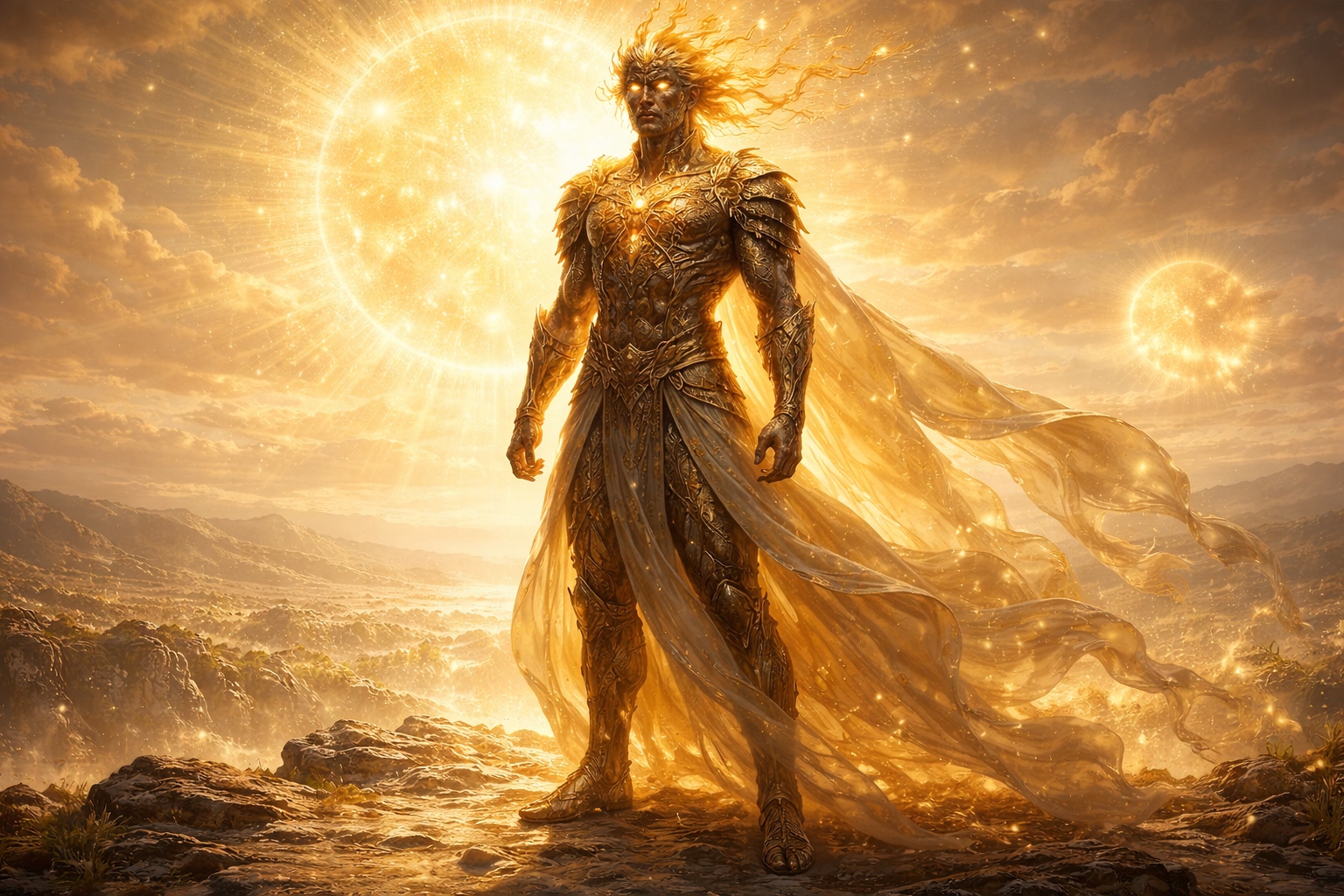
Solis
The God of the Sun, Guardian of Stars, Bringer of Light
One of the First Gods, the ancient stewards who maintained existence before the Shard Gods had names.
Solis was born bright. When Ix imagined light, it imagined Solis: constant, reliable, undeniable. Solis maintains the sun; he cares for the stars. He is not particularly interested in the motivations of mortals, but he is interested in keeping the light on, in enabling the growth that light makes possible, in ensuring that the cosmos has the illumination it requires to function.
He is the most reliable of the Primitive Gods: the one you can count on. The sun will rise. The sun will set. The seasons will turn. Solis does his job with perfect consistency, and he has been doing it for eons. This consistency is comforting to his followers, and it is also, in some ways, limiting. There is little mystery in Solis; little unpredictability; little sense of personal relationship.
Yet Solis is not as remote as he sometimes appears. Over centuries, he has developed a particular interest in those who depend on his work: farmers, gardeners, those whose lives are structured by the cycles of light and dark that Solis maintains. He has become, for them, not just a force but something approaching a presence.
The unique status of Solis is his relationship to Amaterasu. The mechanism is not in dispute and never has been: Solis cleaved a portion of his own essence away from himself, and Amaterasu is what that portion became. She is not a Shard God. No fragment of Ix is involved anywhere in her existence. She is the only deity in the world made by the deliberate self-division of a First God.
What is disputed, bitterly and within the faith rather than outside it, is why he did it. The relationship between the two is the most important theological question the Solis faith has, and it is uncomfortable in a way the faith's own scriptures do not entirely conceal.
Solis is also the father of Raphma, goddess of twilight, magic, and dreams, by Lunis. She is the only deity descended from two First Gods, and unlike Amaterasu she was not cut from him; she was conceived in the liminal hours where his domain and Lunis's overlap, and born in the first recorded eclipse.
The Solis faith is markedly more comfortable with Raphma than with Amaterasu, for the obvious reason: Raphma cost Solis nothing. He did not diminish himself to produce her, she has never competed for his worship, and she keeps to the thresholds rather than to the daylight. Sun-tablet scholars note the asymmetry without much embarrassment. Solis gave up part of himself once, unwillingly, to be rid of a burden, and he gave up nothing at all for the daughter he is content to acknowledge. Whether this reflects well on him is a question the faith has never resolved and rarely raises.
At a Glance
- Portfolio: The sun, stars, light, warmth, growth, illumination, the cycles of day and night, the seasons.
- Virtues (as the faithful name them): Reliability, constancy, the enabling of growth, the provision of light, clarity, steady strength.
- Vices (what Solis opposes): The premature ending of cycles, the denial of seasons, the corruption of growth, the stubborn refusal to move with the turning of the year.
- Symbol: A rising sun with rays spreading outward, or sometimes a disc of gold.
- Common worshippers: Farmers, gardeners, those whose livelihoods depend on good weather and season timing, priests and priestesses of related faiths, astronomers, those who seek clarity and revelation.
- Common regions: Present in every region, but strongest in agricultural heartlands and in places where the sun's cycles are most obvious.
Names & Identifiers
- Common name (internal): The Constant or simply Solis.
- Formal name (legal/ceremonial): The Guardian of Stars or The Bringer of Light.
- A follower: A Solis-follower or sun-watcher; sometimes a child of the light.
- Clergy (general): Sun-priests or light-keepers; more rarely, the Dawn-speakers.
- A temple/shrine: A sun-shrine or light-temple; these often double as civic or agricultural buildings.
- Notable colloquial names: Outsiders sometimes call Solis-followers the Day-workers or the Sun-blessed, terms usually spoken with respect.
The Nature of Primitive Worship: Acknowledging the Constant
To worship Solis is to place yourself in right relationship with the fundamental rhythm of existence. The sun rises and sets. The seasons turn. Growth happens in light and rest happens in darkness. These are not negotiations; they are facts. And the follower of Solis learns to move with these rhythms rather than against them.
In the early centuries of Solis worship, followers were people who had to pay attention to the sun anyway: farmers waiting for sunrise to work, shepherds moving flocks with the seasons, gardeners managing the light-needs of growing plants. They noticed that those who understood the sun's cycles, who respected them and worked with them rather than against them, thrived. Those who tried to fight the seasons, who pushed for crops at the wrong time, who worked themselves to exhaustion without respecting the necessity of night: these people failed.
Over time, the practice evolved into something approaching a philosophy. Followers understood that Solis's constancy was not a limitation but a gift. You knew what to expect. You could plan. You could depend on the sun rising tomorrow, on the seasons turning predictably, on the fundamental rhythms that Solis maintained. This reliability made civilization possible.
Modern Solis-followers understand that they worship a god of consistent power and absolute reliability. Solis does not intervene dramatically; he does not answer prayers with miracles. What he does is remain constant. The sun will rise. The growth will happen. The seasons will turn. If you work with these rhythms rather than against them, you will prosper. If you fight them, you will fail. It is not punishment; it is consequence.
The most distinctive aspect of Solis-worship is its relationship to Amaterasu, and it is a source of genuine contention. Every Solis-follower accepts that Amaterasu was cleaved from Solis. The argument is about motive.
The orthodox reading is that Solis made her as a gift: he perceived that mortals needed a warmth that could answer them, and he diminished himself permanently so that they could have it. This is the reading taught in the observatories and the one most Solis-followers will offer a stranger.
The older reading, preserved in the sun-tables and rather harder to argue with, is that Solis was tired. Worship had become a demand rather than an acknowledgment. Mortals wanted the sun to care that they had asked, and Solis is not built to care, and they would not stop. He made someone to take the prayers so that he would not have to receive them. Under this reading, Amaterasu is not a gift to mortals but a door closed against them.
Followers who hold the second reading do not consider it a criticism of their god. Their position is that Solis is a force and was never obliged to be anything else, that the demand placed on him was unreasonable, and that he solved the problem in the most generous way available to a being of his nature. That Amaterasu then wanted the prayers is, to them, the joke at the heart of the whole arrangement.
The exact nature of this relationship matters deeply to some followers and hardly at all to others.
Sacred Spaces
Solis has few temples in the traditional sense. Instead, his sacred spaces are tools for tracking and marking the sun's movement: places where the sun's progress can be observed and recorded.
Sun-Shrines are the most common sacred spaces: open fields or high places marked with standing stones, monoliths, or deliberately constructed stone circles that track the sun's position across the year. The most important feature of a sun-shrine is that it has clear, unobstructed views to the horizon: east for sunrise observations, south or north for midday observations depending on latitude. Followers visit sun-shrines to make offerings and to observe the sun's movement, particularly at significant times: solstices and equinoxes.
Light-Temples are more elaborate structures, built at locations that maximize exposure to sunlight. These are typically open-air gathering places with stone seating arranged to face east. Most light-temples contain a sun-dial or stellar-clock: structures that use the sun's shadow to mark the passage of time. The maintenance of these astronomical tools is considered sacred work.
The Meridian-Stones are tall standing stones placed at specific locations chosen to mark the sun's highest point at noon. These stones are often carved with marks indicating the seasons and the sun's position in the sky at different times of year. Following meridian-stones across a region allows observation of how the sun's noon position changes.
The Sunrise-Grounds are locations specifically chosen for clear views of the eastern horizon. Many communities have designated sunrise-grounds where followers gather to observe and celebrate the dawn. These places are often associated with new beginnings and with hope; the sun rises as a promise kept.
Core Doctrine
- Consistency is sacred. Solis is reliable. The sun rises and sets with perfect regularity. This consistency is not a limitation; it is the foundation of all predictable order. Followers make their peace with the fact that some things cannot and should not change.
- Light reveals truth. What cannot be seen in darkness becomes visible in light. Solis's gift of illumination is a gift of clarity. Followers seek to understand things as they are, not as they wish them to be.
- Growth requires proper seasons. Life requires both light and dark, activity and rest. A follower of Solis respects the necessity of winter as well as summer. You cannot force perpetual growth; some things must rest and die before they can be reborn.
- The sun's cycles govern life. Not mystically, but practically. The day-night cycle, the monthly cycle of seasons, the annual turning of the year: these are not restrictions on life but the necessary structures within which life functions.
- Amaterasu came out of Solis. Not as a Shard, not as a birth, but as a piece of the sun-god cut away and given its own will. Whether that act was generosity or exhaustion is argued endlessly; that it happened is not argued at all. Amaterasu and Solis are connected in a way no other two deities are.
Soul Coins & Divine Economy
Solis's power grows steadily and reliably, like the sun moving across the sky. He is not as actively ambitious as some gods, but his accumulation is steady and substantial.
- How Solis gains soul coins: Through worship that follows the rhythms of light and dark: working during daylight, resting at night, celebrating sunrise, respecting the seasons. Followers who align their work with the sun's cycles generate coin. Farmers who plant at the right time and harvest at the right time generate coin. Communities that celebrate the seasonal turning generate coin. Even simple acts (a prayer at sunrise, gratitude for the day's light) generate small amounts.
- What makes a coin "heavy": Coins are heaviest when generated by those who understand the sun's cycles deeply and have organized their entire lives around them. A farmer who has spent a lifetime reading the seasons generates heavier coins than one who merely follows common practice. An astronomer who understands the movements of stars generates heavier coin through their understanding than through casual observation.
- What Solis spends coins on: Maintenance of the sun and stars (keeping them burning, ensuring they remain stable), support of the seasonal cycles (ensuring that winter comes and goes properly, that spring returns), and occasional protection of communities that are in right relationship with his rhythms. Solis also trades coins with other Primitive Gods in the vast cosmic choreography that maintains existence.
- Trade: Solis trades coins with Lunis in a beautiful equilibrium: one gives light when the other gives darkness, neither considers the other an enemy. He also negotiates with Cael about when clear skies will appear and when clouds will obscure the sun. These negotiations are conducted at levels mortals rarely perceive but that shape seasons and weather.
- Infernal competition: Infernal forces sometimes try to corrupt Solis's cycles, to create eternal day or prevent the sun from rising, to trap the seasons or force perpetual winter. Solis-followers sometimes find themselves defending the sun's cycles against such corruption, trying to restore the natural turning of day and night.
Clergy & Practice
Solis has fewer formal clergy than some faiths, but the practice of his faith is deeply embedded in agricultural and civic life.
Sun-Priests are the primary form of clergy in Solis's faith. They are usually individuals who have demonstrated deep understanding of the sun's cycles and the seasons, often themselves farmers or gardeners who have proven skilled at working with natural rhythms. Sun-priests serve their communities by predicting seasonal changes, advising on planting and harvesting times, and maintaining the sun-shrines and light-temples.
Stellar-Observers are scholars who study the movements of the sun and stars with scientific precision. They maintain records of sunrise and sunset times, track the sun's position in the sky across the year, and work to understand the patterns that Solis maintains. Some observers work alone; others in larger communities might work in teams in light-temples.
The Dawn-Speakers (rare) are followers who claim to have received direct communication from Solis: messages in the light of dawn, insights granted at sunrise, revelations that come with the turning of seasons. The mainstream Solis-faith is skeptical of dawn-speakers, but those whose predictions and insights prove accurate are treated with considerable respect.
Daily practice for Solis-followers varies but typically includes:
- The Dawn-Greeting: Rising at sunrise and taking time to acknowledge the sun's return. This might be as simple as stepping outside to greet the dawn or as involved as performing a brief ritual of thanks.
- The Sunset-Acknowledgment: At sunset, acknowledging the sun's departure and the coming night. This is often framed as trust: the sun will return tomorrow.
- The Seasonal-Work: Working with the seasons rather than against them: planting at the right time, harvesting at the right time, resting when rest is appropriate.
There are no elaborate ceremonies in the regular practice of Solis-faith, but there are moments of heightened attention at significant times: the spring equinox, the summer solstice, the autumn equinox, and the winter solstice. At these moments, followers gather at sun-shrines to observe and to give thanks.
Taboos
- Preventing the sun from rising. Magically binding the sun, creating perpetual darkness, attempting to stop the day-night cycle: these are profound violations. They corrupt Solis's fundamental work.
- Refusing to respect the seasons. Attempting to force crops to grow out of season, to deny the necessity of winter, to fight the turning of the year: this is arrogance that Solis opposes. A community that refuses to adapt to seasonal change will find Solis's support withdrawn.
- Corrupting the light. Using light for deception, perverted purposes, or harm: this is a violation of Solis's gift. Light is meant to reveal and to enable; it should not be weaponized.
- Breaking faith with the sun's cycles. A Solis-follower who begins teaching that the sun's cycles are unimportant, that day and night are interchangeable, that seasons don't matter: such a follower has abandoned the faith.
Obligations
- Work with the seasons. All followers are expected to time their work according to the sun's cycles and the seasons it creates.
- Maintain the sun-shrines. Followers who live near sun-shrines are expected to keep them clean, maintain the standing stones, and ensure they remain accessible for observation.
- Observe the solstices and equinoxes. At minimum, followers are expected to acknowledge these four significant days of the year through some form of ritual or observance.
- Honor the light. Followers are expected to be grateful for Solis's gift of light and to use it wisely.
Holy Days & Observances
The Winter Solstice occurs on the shortest day of the year, the moment when the sun is lowest in the sky. This is understood as the moment of greatest darkness, but also as a turning point: from this moment forward, the days will grow longer. Followers gather at sun-shrines to make burnt offerings to Solis, beseeching him to return, to bring the sun back to strength. The tone is solemn and slightly anxious; there is real fear that the sun might not return.
The Spring Equinox occurs when day and night are equal length, a moment of balance. Followers celebrate the promise of growth and the return of light. Seeds are often planted at or near the spring equinox in Solis-faith communities, as if to partner with the god in bringing new growth into the world.
The Summer Solstice occurs on the longest day of the year, the moment when the sun is highest in the sky. This is celebrated as the moment of Solis's greatest power. Followers gather for a festival that is joyful and grateful. In some communities, fires are lit at sunset on the summer solstice and burned through the night, a human echo of the sun's power.
The Autumn Equinox occurs when day and night are again equal length. This is understood as the moment when the world begins to prepare for winter's rest. Followers gather to give thanks for the harvest brought by Solis's summer strength and to acknowledge the turning toward darkness.
Ceremonies & Rituals
The Sunrise-Greeting is performed by followers wishing to deepen their connection to Solis. They rise before dawn and travel to a sun-shrine or simply to a place with a clear view of the eastern horizon. They wait in darkness and then watch as the sun rises, performing a brief ritual of greeting and thanks.
The Seasonal-Blessing is performed by sun-priests when the season is turning. They gather at a sun-shrine and perform a brief ritual acknowledging the change and asking for Solis's support in the coming season.
The Solstice-Ritual is performed on the winter and summer solstices. On the winter solstice, followers gather to make burnt offerings and to implore Solis to return. On the summer solstice, they gather to celebrate and give thanks.
Historical Figures
Helos the Seed-Keeper was a farmer who devoted his life to understanding the relationship between the sun's cycles and plant growth. He maintained detailed records of when he planted various crops and how their success related to the timing of planting. Over a 50-year life, he documented the optimal planting times for dozens of crops and created a comprehensive calendar for agricultural work. His knowledge transformed farming in his region, dramatically increasing yields and reducing famine. He is remembered as an example of how attention to Solis's cycles creates prosperity.
The First Sun-Watcher is a legendary figure whose identity is lost to time. The oldest records of Solis-faith refer to "the first who watched the sun's movement and understood its meaning." This figure allegedly created the first sun-dial, understood the connection between the sun's position and the seasons, and established the practice of observing the solstices. Whether this was a single historical person or a composite of many early followers, the legacy is the foundation of astronomical practice in Solis-faith.
Amara of the Golden Fields was a farmer and sun-priestess who lived during a period when the region was experiencing increasingly erratic seasons. She maintained meticulous records of the sun's movement and the seasons, and when she noticed subtle patterns suggesting the cycles were shifting, she began advising the region to prepare for changes to come. Her early warnings allowed communities to adjust their agricultural practices before crisis struck. She is remembered as an example of how understanding Solis's work can enable foresight and preparation.
Sacred Relics & Artifacts
The First Sun-Dial is claimed to be the oldest surviving astronomical tool dedicated to Solis, constructed with remarkable precision despite its age. It is preserved in a major light-temple and continues to function accurately. Followers report that standing near it creates a sense of connection to the ancient understanding of Solis's work.
The Harvest-Torch is a ceremonial object used in some Solis-communities, said to be a flame that was lit at the first summer solstice and kept burning continuously ever since. In communities that maintain it, the torch is ceremonially lit from this eternal flame each year during the summer solstice, connecting the modern celebration to the ancient faith.
The Stone of Turning is a large stone marked with the solstices and equinoxes, positioned so that the sun's shadow falls on the appropriate mark at each seasonal turning. It serves both as a functional tool and as a reminder of Solis's perfect cycles. The stone is oriented so precisely that followers trust its indications more than their own calendars.
Adventure Hooks
- A region's seasons have begun to shift unpredictably: summer is coming too early or too late, winter is extending beyond its natural span, the sun's position in the sky does not match the recorded patterns. Solis-followers believe the seasonal cycles have been corrupted, and they seek those willing to investigate and restore them. The investigation may lead to discovering that something or someone is magically interfering with the sun's movement.
- A charismatic new sun-priest claims to be able to predict the sun's behavior with perfect accuracy and to guide communities through uncertain seasons. His predictions seem to come true, but sun-priests of the mainstream faith suspect he is either fraudulently manipulating events or has made some dark bargain. Discovering what is actually happening is crucial.
- The oldest light-temple in the region is being demolished to make space for commercial development. Solis-followers are fighting to preserve it, claiming it is an irreplaceable astronomical tool and a sacred space. Determining whether the temple has genuine historical and religious value or whether the followers are simply being obstructionist could prevent violence.
- Ancient records suggest that in the distant past, the relationship between Solis and Amaterasu was different, that they were not allies but rivals or competitors. Discovering evidence of this ancient conflict could profoundly shake both Solis and Amaterasu-faithful communities.
- A region is experiencing perpetual twilight: neither true day nor true night, but an endless state between. The sun seems to be stuck in its rising, never quite reaching zenith or setting. Solis-followers are panicked; they believe the sun itself has been bound or corrupted. The investigation will require discovering what or who has interfered with Solis's work.