Tempus
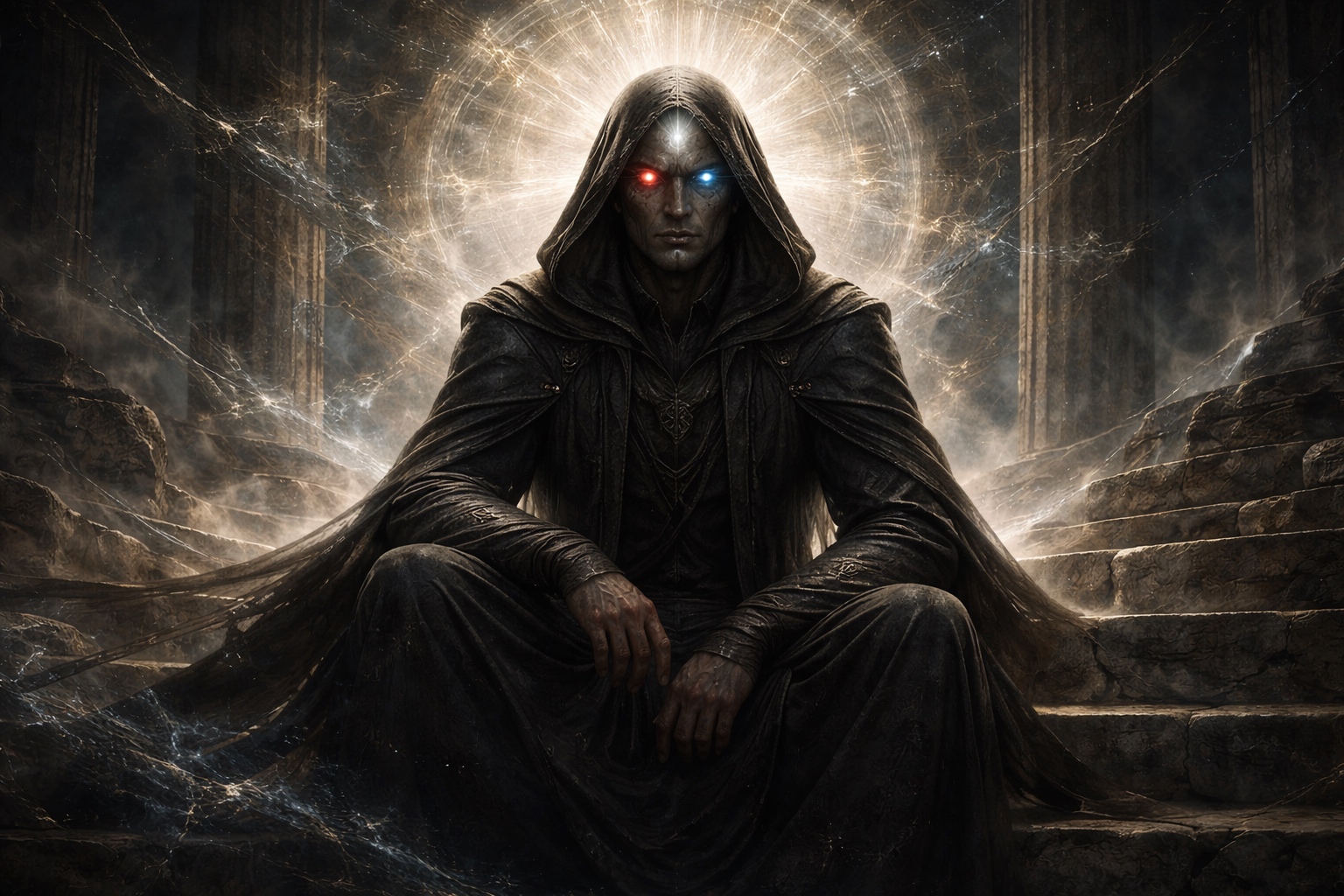
Tempus
The God of Time, Watcher of All Moments, Guardian of the Blinded Future
One of the First Gods, the ancient stewards who maintained existence before the Shard Gods had names.
Tempus was born in a paradox. When Ix introduced the concept of time into the cosmos, something had to steward it: to ensure that moments moved forward, that past remained fixed, that the present existed as a threshold between them. Tempus became that steward, with a terrible gift: the ability to perceive all aspects of time (past, present, and future) simultaneously.
For eons, he watched everything that had been, everything that was, and everything that would be. He saw all outcomes. He understood every consequence before it occurred. He knew Ix's downfall before the cosmos did.
And then the Ancients, seeing what Tempus could perceive, saw what he might reveal, and they blinded his future eye.
This is the defining tragedy of Tempus. He can see the past with perfect clarity. He can perceive the present with absolute precision. But the future (that third eye, which should give him sight of what will be) is closed. He is cut off from half of what he once perceived. He is, in effect, trapped in a moment of eternal incompleteness.
Yet he continues his work. Time still moves. The past still becomes fixed. The present still turns into past. And Tempus watches, seeing two-thirds of what he once did, knowing that something crucial is hidden from him, that there are events he cannot see, futures that will come regardless of his blindness.
Followers of Tempus exist in this theological space of profound limitation and strange clarity. Their god is incomplete, and yet his work is essential. They worship something broken that continues functioning perfectly. Some find this inspiring. Others find it terrible. All find it deeply significant.
At a Glance
- Portfolio: Time, temporal flow, past and present (but not future), history, memory, the recording of events, the keeping of records, consequence, cause and effect.
- Virtues (as the faithful name them): Accuracy, the honoring of what has been, the acceptance of consequence, truthfulness about the past, the wisdom of learning from history.
- Vices (what Tempus opposes): The distortion of history, the refusal to learn from the past, the false promises about the future, the claim to know what cannot be known.
- Symbol: A triangle of three eyes, with the third eye sometimes depicted as closed or marked with a line through it.
- Common worshippers: Historians, archivists, keepers of records, those who have made peace with the past, those seeking to understand cause and effect, those who understand that the future cannot be known and find peace in that truth.
- Common regions: Present in every region, but strongest in cities with significant archives and historical traditions, and in places where the past is deeply important to present identity.
Names & Identifiers
- Common name (internal): The Watcher or simply Tempus.
- Formal name (legal/ceremonial): The God of Time or The Guardian of Moments.
- A follower: A Tempus-follower or time-watcher; sometimes a keeper of what-has-been.
- Clergy (general): Tempus-priests or keepers of time; more formally, archivists of the eternal moment.
- A temple/shrine: A Tempus-temple or chrono-shrine; these are often archives or libraries.
- Notable colloquial names: Followers sometimes call themselves the Blinded-but-Seeing, acknowledging the paradox at the heart of their faith; outsiders sometimes call them the Doom-Seers (inaccurately, since Tempus cannot see doom) or the History-Keepers.
The Nature of Primitive Worship: Accepting Incompleteness
To worship Tempus is to worship something fundamentally broken. Not broken in the sense of failing to function; Tempus does his job perfectly. But broken in the sense of incomplete, missing something essential, wounded in a way that will never fully heal.
In the early centuries of Tempus worship, followers were people who worked with history: scribes recording events, priests maintaining traditions, elders teaching the young what had been. They noticed that Tempus seemed to respond to those who honored what had been, who kept accurate records, who resisted the temptation to revise or reshape the past for present convenience. They noticed also that Tempus offered no guidance about the future, that prayers for foresight went unanswered, that the faithful could not depend on divine knowledge of what was coming.
Over time, the theology evolved into something profound: Tempus teaches that the past is knowable and the future is not. The past is fixed, sealed, capable of being understood if you pay attention and resist distortion. The future is radically open, unknowable, full of genuine possibility that exists precisely because no one can see it. And the present is the threshold where the fixed past meets the open future.
Modern Tempus-followers understand that they worship a god who is deliberately limited. This is not a punishment for them; it is a truth about existence. No one can know the future with certainty, not because Tempus is weak, but because the future has not happened yet and does not fully exist. Prophecy is a lie. Fortune-telling is a lie. The claim to know what will come is a fundamental violation of the nature of time itself.
And yet (this is the bitter irony that shapes Tempus-faith) there are many charlatans claiming to speak for Tempus, claiming to offer foresight, claiming that Tempus has revealed the future to them. These frauds are among the deepest offenses to the god's followers. They claim to offer what Tempus himself cannot offer. They profit from the human desire to know what cannot be known. And they do so in Tempus's name, twisting his worship to something obscene.
True followers of Tempus spend much of their effort exposing these frauds, hunting down charlatans, and preventing false prophecies from spreading. In some ways, the faith of Tempus has become defined as much by what it opposes (false claims about the future) as by what it affirms (the accurate keeping of what-has-been).
Sacred Spaces
Tempus has few temples of dramatic beauty. Instead, his sacred spaces are archives: places where the past is preserved in written form.
Chrono-Shrines are the most common sacred spaces: small rooms or chambers where important historical records are kept. These might be in city archives, in great libraries, in temples of other faiths that recognize the importance of Tempus-followers. A chrono-shrine is a place where the past is made accessible, where followers can read the records and learn what has been.
The Great Archives are the most important Tempus-temples: vast libraries and record-halls that preserve centuries or millennia of historical documentation. These repositories are maintained with extraordinary care, protected from fire and flood and decay. They exist in the largest cities and in a few remote locations. A Great Archive is both a temple and a tool: a place to worship through the act of preserving and understanding the past.
The Memory-Halls are specialized spaces within larger temples or archives, dedicated to preserving the records of significant events: wars, famines, plagues, discoveries, changes in government. A Memory-Hall might contain documents, artifacts, or other relics from the period it commemorates. Visitors come to these halls to confront the reality of what-has-been, to understand that history happened and mattered.
The Void-Chambers are symbolic spaces in some Tempus-temples: rooms left deliberately empty or containing symbols of the blinded future eye. These are places where followers come to accept the unknowability of what is to come, to sit in the darkness of not-knowing, to find peace with the fact that the future cannot be seen.
Core Doctrine
- The past is fixed and knowable. Events have happened. They are real. They can be studied, understood, learned from. Distorting the past is a form of blasphemy because it denies the reality of what has been.
- The future is radically unknowable. No god, no person, no artifact can reliably predict what will come. The future is not hidden somewhere, waiting to be discovered; it does not yet exist in full form. Those who claim to know the future are lying, whether they know it or not.
- The present is the moment of agency. You cannot change the past; it has been. You cannot know the future; it is not yet. But you can act in the present. You can choose how to respond to what has been and how to move toward what might be.
- Consequence flows from cause. Understanding the past teaches you how causes produce effects. This is not prophecy; this is learning from what-has-been to make wise choices in the present about what-might-be.
- Tempus's blinding is significant. The god's inability to see the future is not a flaw or a punishment. It is a truth about existence: that some things are hidden, unknowable, sacred precisely because they remain unknown.
Soul Coins & Divine Economy
Tempus's power grows through the acts of those who preserve and honor the past, through the work of historians, archivists, and those who refuse to let history be erased or revised.
- How Tempus gains soul coins: Through the accurate recording of events, the preservation of records, the study of history, the honoring of what-has-been. Acts of historical preservation generate coin. Refusals to revise or distort history generate coin. Exposures of false prophecy and charlatanry generate coin. Even simple acts (reading history, learning from the past, teaching younger generations about what-has-been) generate small amounts.
- What makes a coin "heavy": Coins are heaviest when generated by those who have dedicated their lives to understanding and preserving the past. An archivist who has spent a lifetime maintaining records generates heavier coin than casual historical interest. A historian who risks safety to preserve records from destruction generates heavier coin than safe scholarship. Exposure of charlatans generates coins of surprising weight because it directly opposes the false claims about future-knowing.
- What Tempus spends coins on: Maintenance of the flow of time (ensuring that moments pass properly, that cause precedes effect, that the past solidifies correctly), protection of archives and records from destruction, and support of those who work to expose false prophecy. Tempus also spends coins on rewarding those who learn from history correctly and who use past knowledge to make wise present choices.
- Trade: Tempus does not trade coins often, and when he does, it is with other Primitive Gods about the cosmic order. He negotiates with Cael about how far into the future storm patterns are predictable (the answer is: not far). He maintains a careful equilibrium with Solis about the constancy of celestial cycles. These negotiations are about the limits of knowability.
- Infernal competition: Infernal forces profit from the distortion of history and the spread of false prophecy. They create confusion about the past, encourage historical revision, and encourage false seers who promise knowledge of the future. Tempus-followers often find themselves opposing infernal corruption of the historical record.
Clergy & Practice
Tempus has formal clergy dedicated to the preservation of history, and also a secondary force dedicated to opposing false prophecy.
Archivists are the primary form of Tempus-clergy. They are scholars who have dedicated themselves to the collection, preservation, and organization of historical records. Archivists work in the Great Archives, in city record-halls, and sometimes in portable archives maintained by traveling clergy. An archivist's primary commitment is to truthfulness: records must be accurate, preserved in their original form, and organized in ways that make truth accessible.
Keepers of the Temporal Record are archivists who specialize in maintaining records in the face of effort to destroy or distort them. During wars, persecutions, or periods of political upheaval, temporal record-keepers work to preserve documentation that those in power want destroyed. This work is dangerous and often conducted in secret.
The Fraud-Hunters are a more controversial aspect of Tempus-clergy: followers dedicated to identifying and exposing charlatans who claim to offer prophecy or future-seeing in Tempus's name. Fraud-hunters are investigators, interrogators, and sometimes enforcers. They track down false seers, expose their methods, and dismantle their operations. In some communities, they are supported by law; in others, they work outside legal structures. The friction between fraud-hunters and secular authorities is a constant source of tension in Tempus-faith communities.
The Scholars of Consequence are rare followers who study the relationship between past events and present conditions, attempting to understand, through historical analysis, why the present is as it is. This is not prophecy (which is forbidden); this is the honest work of understanding cause and effect across time.
Daily practice for Tempus-followers varies but typically includes:
- The Historical Study: Spending time reading and understanding historical records. For serious followers, this is hours each day. For others, it might be regular but less intensive study.
- The Record-Keeping: Maintaining some form of personal or community record of events, not for prophecy, but for preservation. What happens today becomes history tomorrow.
- The Lie-Watching: Paying attention to claims about the future, particularly claims made in Tempus's name. Any follower who becomes aware of false prophecy being spread has an obligation to investigate and oppose it if possible.
There are no elaborate ceremonies in the regular practice of Tempus-faith, but there are moments of heightened attention. When a significant historical event occurs, followers gather in archives or temples to formally record it. When an important record is discovered or preserved, a ceremony is held celebrating the preservation.
Taboos
- Distorting the historical record. To alter documents, to suppress records, to revise history to fit present ideology: these are profound violations. A Tempus-follower discovered falsifying records faces the harshest censure the faith can deliver.
- Claiming to know the future. Any follower who claims Tempus has granted them foresight, who makes prophecies, who pretends to know what will come: such a follower has betrayed the faith fundamentally.
- Profiting from false prophecy. To charge money for fortune-telling, to sell "prophecies" or claims about the future: this is particularly offensive when done in Tempus's name.
- Refusing to learn from history. A community or follower who ignores what-has-been, who refuses to learn from past mistakes, who insists on repeating failed patterns: such a follower has rejected Tempus's primary gift.
Obligations
- Preserve what-has-been. All followers are expected to contribute to the preservation of historical records in some way, by maintaining records, supporting archives, or simply ensuring that their knowledge of important past events is documented.
- Study the past. Followers are expected to engage in regular historical study, to understand the causes that led to the present conditions.
- Oppose false prophecy. When followers become aware of charlatans claiming to offer future-sight in Tempus's name, they are expected to report this to local fraud-hunters or authorities.
- Keep honest records. Whatever records followers maintain (personal, communal, professional) these must be truthful and not revised for present convenience.
Holy Days & Observances
The Day of Accurate Memory occurs once per year, on a date chosen by each local community but typically during a time that commemorates an important local historical event. On this day, followers gather to read and discuss historical records, to ensure that significant past events are not forgotten, and to reaffirm the commitment to truthfulness about what-has-been.
The Exposure Day occurs twice per year in communities with significant Tempus-presence. On these days, fraud-hunters present publicly the charlatans they have exposed in the previous six months, explaining their methods and warning the public about false prophecy. It is part public service, part celebration of the hunters' success in opposing lies.
The Void-Night occurs on the new moon in some Tempus-temples, a night when followers gather in darkness to sit in silence, accepting the unknowability of the future, finding peace in not-knowing.
Ceremonies & Rituals
The Record-Blessing is performed when an important historical document is discovered, recovered, or formally archived. Archivists and followers gather to formally acknowledge the document's historical significance and to commit to its preservation.
The Fraud-Unmasking is performed when fraud-hunters formally expose a false seer. The charlatan's methods are explained publicly, the false claims are refuted using evidence, and the community is warned against similar deceptions.
The Historical-Testimony is performed by followers wishing to formally document significant events they have witnessed. They stand before a Tempus-priest, speak about what they have seen, and the priest records the testimony in the temple's archives.
Historical Figures
Kellan the Archivist was a record-keeper who, during a period of war and persecution, worked to preserve the historical records of his city even as the government attempted to destroy them. He hid documents, created secret copies, and died protecting the archive from being burned. After the war, the records were recovered and preserved. He is remembered as an example of the willingness to sacrifice for the preservation of truth.
The First Fraud-Hunter is a legendary figure whose actual identity is uncertain. The oldest records of Tempus-faith refer to "the one who first exposed the lie of false prophecy." This person allegedly hunted down and exposed the first false seers who claimed to speak for Tempus, establishing the principle that those who claim Tempus has granted them foresight are always lying. Whether a single historical person or a composite of many, the legacy is the foundation of fraud-hunting in Tempus-faith.
Meriss the Historian was a scholar who spent a lifetime studying the causes that led to major historical events, investigating not just what happened but why. Her work demonstrated that understanding the past could teach wisdom about the present without requiring prophecy about the future. She lived through a period of significant social change and used historical analysis to help communities navigate that change wisely. She is remembered as an example of how honest historical scholarship provides genuine value without pretending to know the future.
Dalton the Fraud-Killer was a fraud-hunter whose methods were brutal and controversial. He not only exposed false seers but actually hunted them down and, in several documented cases, killed them. While his methods were extreme, his success in eradicating a network of charlatans who were spreading dangerous false prophecies was considered significant. Tempus-faith is divided about Dalton: some celebrate him as a hero of the faith, others see him as a cautionary tale about how the pursuit of truth can become corrupted by violence.
Sacred Relics & Artifacts
The First Archive is said to be the oldest known collection of historical records, dating back to the earliest days of civilization. It is preserved in a Great Archive in a major city and contains documentation of events thousands of years in the past. Followers believe that accessing the First Archive grants a kind of communion with Tempus: the ability to directly encounter the past through primary documentation.
The Fraud-Chains are actual chains used in some Tempus-temples to physically bind the records of confirmed false prophecies. These are not displayed prominently but kept in dedicated areas, serving as both warnings and proof that the faith actively opposes false claims about the future.
The Blind-Mask is a ceremonial object used in some Tempus-temples: a mask that covers the third eye, symbolizing Tempus's blinding. It is worn during certain ceremonies to remind followers of the fundamental limitation at the heart of their deity, and to find peace with that limitation rather than rage against it.
Adventure Hooks
- A charismatic false prophet has gained a massive following by claiming Tempus has granted him foresight. His "prophecies" are vague enough to seem accurate in hindsight but specific enough to inspire devotion. He is making an enormous fortune. Fraud-hunters want help exposing him, but his followers are loyal and potentially violent.
- An ancient archive has been discovered containing records of events that contradict current historical understanding. The documents appear authentic but suggest that major historical events happened differently than recorded. Archivists are struggling to verify the documents while managing political pressure from those who benefit from the current historical narrative.
- A region is experiencing a strange phenomenon: people are developing seemingly genuine prophetic visions: accurate glimpses of near-future events. Tempus-followers are panicked because this violates their core theology that the future cannot be known. Investigation is needed to determine if this is genuine prophecy or something else (infernal interference, mass delusion, etc.).
- An archivist working in a Great Archive discovers evidence that historical records have been deliberately suppressed, that documents were intentionally removed and destroyed to hide past atrocities. She wants to recover the lost records and restore the historical truth. Doing so will require finding where the suppressed documents were hidden and dealing with those who benefit from the lies.
- Fraud-hunters have discovered a network of false seers operating across multiple cities, and they have recruited powerful allies who benefit from the false prophecies being spread. The hunters need help dismantling the network while managing the political complexity of opposing powerful figures who profit from the charlatans' work.
The Primitive Deities endure. Ancient beyond measure, they maintain the great systems that Ix imagined: the underworld, the weather, the night sky, the sun's constancy, the flow of time. They are not beings in the way the Shard Gods are beings; they are forces that have, over millennia of mortal worship, begun to develop something approaching attention to the faithful who acknowledge them. To worship a Primitive God is to make peace with a force that does not particularly care about you but whose work you depend upon. It is a strange compact: without drama, without the promise of personal salvation, without the expectation that the god will intervene in your favor. And yet, to those who understand it, it is the most honest faith available, because it asks for nothing but acknowledgment of what already is, and in return offers not comfort but truth.