Selunehra
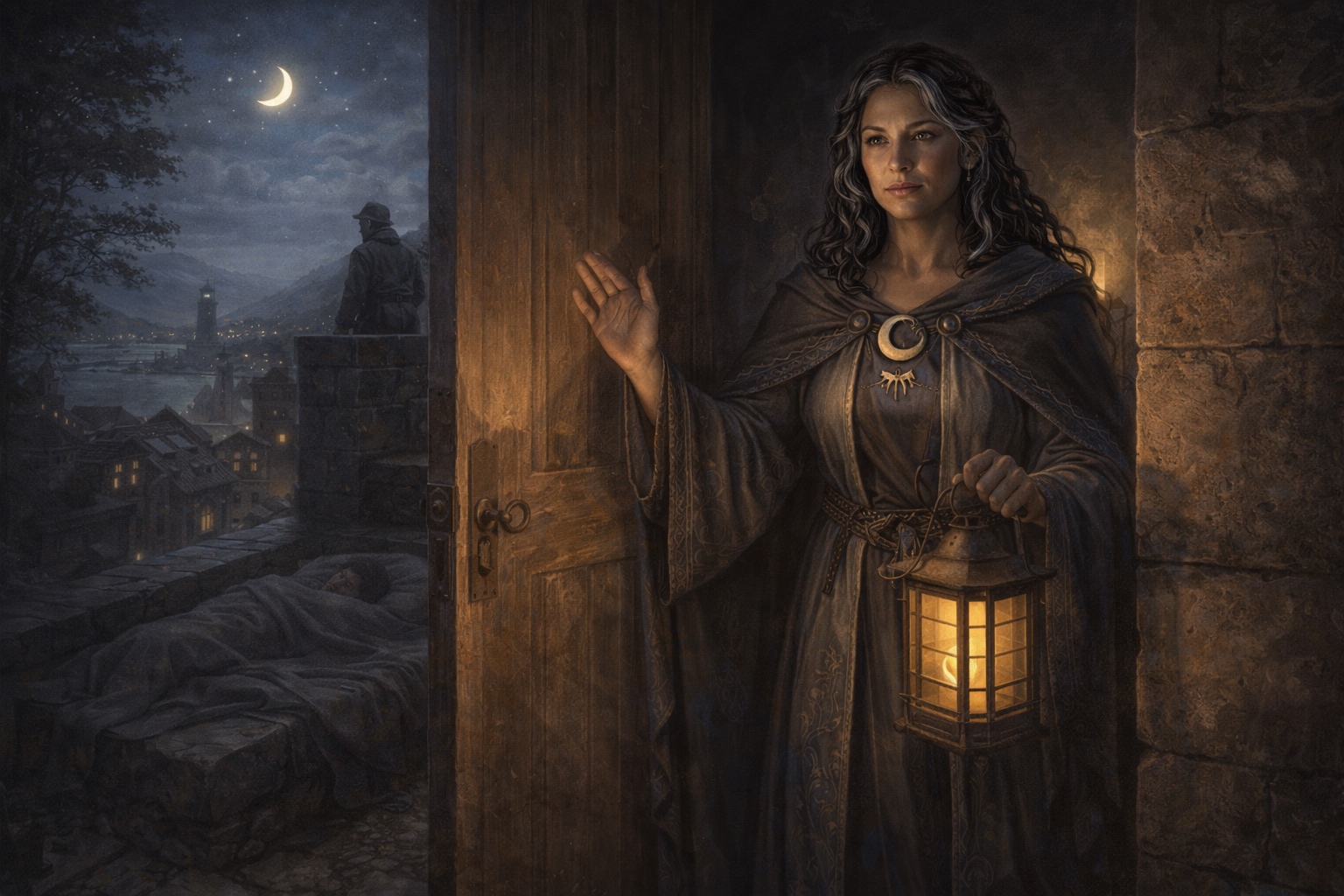 # Selunehra
At a Glance
- Portfolio: Moon, night, watchfulness, sleep (not dreams), privacy, quiet work, hidden routes, and the kinds of mercy that happen after dark.
- Virtues (as the faithful name them): Restraint, vigilance, mercy, patience, discretion.
- Vices (what Selunehra opposes): Voyeurism, needless exposure, panic, sleepless cruelty, using secrets as weapons.
- Symbol: A thin crescent above a closed eye.
- Common worshippers: Night watch, midwives on late calls, sailors, lighthouse keepers, safehouse hosts, people who work when others sleep, and people who cannot afford to be seen.
- Common regions: Dort-wide; especially strong in coastal towns and dense cities. In Irna, Selunehra's shrines are often more common than streetlamps.
Names & Identifiers
- Common name (internal): The Gentle Watch.
- Formal name (legal/ceremonial): The Silver Vigil of Selunehra.
- A follower: A Vigilant.
- Clergy (general): Nightwardens.
- A temple/shrine: A Vigil House (often attached to a watchpost, harbor light, or a community clinic).
- Notable colloquial names: The Lantern Mother, Keeper of Shut Doors, the Silver Guard.
Origin & History
The Midnight Row House
It was not a ruin where Selunehra's shard was found. It was not a vault, a treasure, or a place of obvious power. It was found under a bed in a crowded row house in the dense heart of a city that had not yet learned to sleep.
The midwife's name is lost to history, known only as "she who found the silver beneath the restless." She was overworked in the way that only a city midwife can be: called at all hours, paid little, expected everywhere, sleeping in fragments. Her days bled into her nights. Her nights became indistinguishable from her mornings. She had not slept properly in weeks.
That night, a summons came after midnight. A child in a cramped rowhouse would not settle. The parents were brittle with fear, not about the child, though that was the excuse, but about the street outside, where the city's hunger prowled after dark. The kinds of things that happened to people who had nowhere to hide. The kinds of attention that a crying baby attracted.
While searching for clean cloth, the midwife reached beneath the bed and touched something cold and curved. Not cloth. Not anything she recognized.
A shard, small as a thumbnail, silver like a fish-scale.
She did not feel power. She felt quiet.
What the Shard Taught
The baby slept. Not through magic, though magic was certainly present. The baby slept because something fundamental had shifted. The quality of the night itself had changed.
The dog stopped barking. The father's hands stopped shaking long enough to hold a cup of tea without spilling. The mother's jaw unclenched for the first time since labor had begun. And the midwife (who had not slept properly in weeks) sat on the floor with the shard in her palm and realized she could finally unclench her jaw.
The shard's principle was simple, but it took the midwife a long time to fully understand it: Darkness is not only danger. Sometimes it is shelter. Sometimes it is the difference between being hunted and being left alone.
The principle went deeper. Light exposes. Darkness obscures. Exposure is not always mercy; sometimes it is cruelty. A crying baby drawing attention from a predatory street is not made safer by light; it is made more vulnerable. A woman fleeing violence is not made safer by exposure; she is made more target. A person who cannot afford to be seen is not made safer by visibility; they are made more vulnerable to the machinery of judgment and punishment that grinds through cities after dark.
But darkness, properly tended, is different. Darkness where you are safe. Darkness where you can finally rest. Darkness where what happens is not observed by those who would profit from your suffering.
From Midwife to Moon
In the years that followed, the midwife began to understand what the shard had given her. It was not a spell or a curse. It was a practice. A way of approaching the night. A theology of darkness.
She began to build. Not temples (Selunehra has no temples) but spaces. A quiet room in her own house where any woman in labor could come and know she would not be exposed to the street, to judgment, to danger. A system of signals: a shuttered lantern in the window meant: come, this place is safe and shut. A watch rotation among neighbors so that someone was always awake, always alert, always ready to turn away those who came with violence.
The shard grew. Not in size (it remained thumbnail-small) but in influence. It became a principle. The principle became a practice. The practice became a network. Other midwives learned. Sailors learned. Lighthouse keepers learned. Night watch learned. People for whom darkness was not threat but necessity learned.
Nightwardens teach that the shard became Selunehra when mortals made that principle into a practice: safe places to sleep, watch rotations that enforce rest, lanterns that guide without exposing, doors that close and stay closed, confessions that are heard and burned, secrets that are kept because keeping them is the highest form of mercy.
The god did not descend. The god did not speak. The god simply manifested as the accumulated weight of millions of small acts: a door locked softly, a question not asked, a light dimmed before asking for honesty, a person kept safe because someone was watching.
The Shut Door's Covenant
By the time Selunehra was formally recognized as a deity, the practice was already centuries old. There were no dramatic conversions or missionary campaigns. The faith simply existed in the places where it had always been necessary: in coastal cities where merchants and refugees needed to disappear between ships; in dense urban centers where the vulnerable needed shelter; in lighthouse networks where keeping the light burning was a sacred obligation; in hospitals where midwives and healers worked through the night; in forests and hidden roads where those fleeing justice or pursuit could find rest without being exposed.
The first formal Vigil House was established not by divine command but by necessity. It was a building, yes, but more importantly it was a principle made visible: this space exists for those who need to rest without fear. This space asks no questions. This space does not expose. This space protects.
Other Vigil Houses followed. Not as branches of a hierarchical organization but as independent cells, each understanding themselves as part of a larger network bound by principle rather than structure. A Nightwarden in a harbor city might know three other Nightwardens. A safehouse keeper might know half a dozen routes to safe houses. A lighthouse keeper might know the rotation of other keepers up and down the coast. But no central authority coordinated the network. The network maintained itself through mutual understanding of what Selunehra required: rest for the exhausted, shelter for the vulnerable, darkness that protected rather than threatened, silence that kept people safe.
The Divine Compact
Selunehra makes a quiet but absolute bargain: I will ensure that darkness is safe for those who need it, that rest is possible for those who are exhausted, that secrets are kept for those who must hide.
- What Selunehra promises: A safe night. A place where you can sleep without fear. A kind of darkness that protects rather than threatens. The knowledge that your vulnerability is not exposed. The peace that comes from being kept safe by someone who has chosen to watch.
- Common boons: A night of deep, restorative sleep after a period of deprivation; the sense of being watched over without being observed; a safe route revealed at the moment of greatest need; a safe door that opens when you have nowhere else to go; a lighthouse burning when you need its guidance; a confession heard and burned, so the burden becomes lighter but the secret remains safe.
- Rare miracles: A harbor light that burns without fuel on the darkest, most dangerous night; a person on the edge of collapse who experiences a full night of dreamless, healing sleep that seems to restore a week's worth of rest; a route appearing through darkness that makes escape possible when it seemed impossible; a door that is found exactly when someone is being pursued and needs to disappear into safety; a person haunted by guilt who finds that their confession, spoken in darkness and burned in silence, allows them to finally rest.
- Social benefits: Acceptance in communities that rely on night work; knowledge of hidden routes and safe houses; the reputation of someone who can be trusted with secrets; the protection that comes from being known as someone who keeps faith with the vulnerable; access to networks of mutual support among those who work in darkness.
- Afterlife promise / fear: Selunehra's faithful believe that after death they will dwell in a quiet watchful night, not a dark prison, but a space of perfect safety where they need never fear exposure or vulnerability again. They will be the watchers, keeping eternal vigil, resting as they earned rest in life. The faithful fear exposure: the loss of privacy, the stripping away of protective darkness, the moment when everything hidden is made visible and vulnerable.
- Costs / conditions: Selunehra demands unwavering discretion. Secrets must be kept, absolutely. She demands constant vigilance, not paranoia, but genuine attentiveness. She demands that followers use their protection not for idleness but for restoration: sleep is sacred because it heals and prepares, not because rest is an end in itself. She demands that those who watch do so with mercy, not judgment. Those who betray confidences find her presence withdraws like darkness at dawn. Those who use their knowledge of safe places to exploit the vulnerable become enemies of the faith. Those who spread what should have remained hidden find themselves isolated from the networks that might otherwise protect them.
Core Doctrine
The faithful of Selunehra organize their understanding around these principles:
-
Night is for restoration. Sleep is sacred because it repairs what the day spends. A body that never rests becomes brittle. A mind that never sleeps becomes cruel. A soul that never finds peace becomes exhausted to the point of breaking. The night exists to undo the harm of the day.
-
Light is not always kindness. Sometimes darkness is what keeps someone alive. A woman fleeing violence is not made safer by being visible. A refugee is not made safer by exposure. A person whose survival depends on not being found is not made safer by being seen. Visibility is a privilege, not a universal good.
-
A watchman's job is not suspicion; it is protection. "See clearly" does not mean "see everything." A true watcher notices threats so others can sleep. A true watcher does not pry into the private matters of those being protected. To watch well is to remain alert while respecting the boundaries of those being guarded.
-
Secrets are shelter. Some things must not be told because telling them would cause harm. A confidence is a trust. Breaking a confidence is not exposure of truth; it is destruction of something sacred. The faithful learn that keeping a secret often requires as much courage as speaking a truth.
-
Privacy is a right, not a luxury. Everyone deserves a space where they are not exposed. Everyone deserves the knowledge that some part of their life will not be made visible. A world where nothing is private is a world where the vulnerable have no refuge.
-
Mercy that happens after dark is still mercy. The help that comes in darkness, from hands that do not seek recognition, from people whose names will not be known: this is some of the deepest form of mercy. Selunehra teaches that the greatest kindness is the kindness that expects no return, no recognition, no credit.
Soul Coins & Divine Economy
(See also: Soul Coins & Divine Economy)
Selunehra accumulates divine power through acts of protection, vigilance, and the maintenance of safe spaces and trustworthy networks.
-
How Selunehra gains soul coins: Every person who experiences a safe night's sleep after a period of deprivation; every secret kept absolutely; every watch rotation maintained with discipline; every safe house that functions without exploitation; every harbor light that guides someone safely to shore; every confession heard and burned; every time someone is protected because a Nightwarden was watching. The act of keeping vigil generates coins. The act of enforcing rest generates coins. The act of maintaining silence generates coins.
-
What makes a coin "heavy": Sacrifice. A lighthouse keeper who dies maintaining the light through a terrible storm, ensuring others' safety, generates heavy coin. A Nightwarden who gives up sleep night after night to keep watch generates heavy coins. A safehouse keeper who harbors someone vulnerable and turns away profit, comfort, and safety to do so generates heavy coins. A person who keeps a secret even when revealing it would benefit them generates heavy coins. A midwife who works through endless nights to bring safe births to those who would otherwise be exposed and vulnerable generates substantial coin.
-
What Selunehra spends coins on: Miracles of safe passage and protection. The blessing of harbor lights to burn without fuel when most needed. The maintenance of the networks of safe houses across regions. The protection of Nightwardens from those who would hunt them. Occasionally, the intervention to ensure that a dangerous night becomes safe, that a person fleeing violence finds shelter, that a harbor light appears exactly when a ship needs guidance.
-
Trade: Selunehra trades coins with Raphma (their territories in the divine domain abut: night and twilight, sleep and dreams, each respecting the other's boundaries). She occasionally trades with Chamastle, goddess of shelter and home, on matters related to safe spaces. She has been known to trade with Ryujin, god of tides and harbors, to ensure that harbor lights remain functional and blessed. She does not trade heavily; she prefers to accumulate her own coins through her own faithful.
-
Infernal competition: The Tempters prey on exhaustion and fear. They offer power to those who cannot sleep, promising rest in exchange for dark bargains. They tempt the vulnerable with promises of safety that come with terrible conditions. They whisper to those in darkness, offering warmth and shelter in exchange for debt and obligation. Selunehra's response is to offer genuine rest, genuine safety, genuine shelter, not through bargain but through the network of faithful who ask nothing but that those they protect remember them in prayers of gratitude. The Tempters offer shelter with chains; Selunehra offers shelter with open doors.
Sacred Spaces
Selunehra's sacred spaces are not temples in the traditional sense. They are functional spaces designed around the principle of safe darkness and restorative rest.
Vigil Houses
A Vigil House begins as a building: sometimes large, sometimes small, sometimes integrated into another institution like a hospital or watchtower. The most essential feature is the quiet room: a space with no windows, a single door that locks from the inside, bedding, water, and nothing else. No questions are asked in the quiet room. No preaching occurs. The room exists for one purpose: to allow someone to sleep without fear.
Beyond the quiet room, Vigil Houses typically include:
- A watch room where Nightwardens maintain rotations, keeping eyes open through the dark hours
- A confessional room where those burdened by secrets can speak them into darkness and have them burned
- A kitchen where quiet meals are prepared for those whose hunger is as real as their need for safety
- Sleeping quarters for the Nightwardens themselves, because a warden who does not rest becomes neither vigilant nor merciful
The architecture of a Vigil House is deliberately designed to obscure its interior from the street. Heavy shutters that can be closed. Windows positioned high, or obscured by distance from the view of passersby. A gate or entrance that conceals rather than advertises. The building itself communicates: what happens here is not meant to be seen.
Harbor Lights
A harbor light is Selunehra's temple made visible. The lighthouse itself is the sacred space, not the building, but the light: the flame that burns through the night, that guides ships safely to harbor, that represents Selunehra's promise to those who navigate in darkness.
A harbor light is a Vigil House in essence: a place where someone maintains vigil through the dark hours so that others can safely navigate. The light-keeper is a priest, the flame is a prayer, the safe harbor is the boon.
Some harbor lights are supported by formal institutions (city governments, merchant fleets). Others are maintained by Nightwardens who fund them through other labor. The most sacred harbor lights are those maintained with minimal resources, where a keeper works other jobs by day and tends the light by night, supported by small donations from merchants and sailors who understand the sacred nature of the light.
Shut Doors
The most common sacred space in Selunehra's faith is also the simplest: a shut door.
A locked door is a prayer to Selunehra. A door that closes between you and the street. A door that keeps you unseen. A door that separates the vulnerable from predation. The ritual of closing a door (softly, with intention, with the knowledge that what lies beyond is now protected from exposure) is a form of worship.
Nightwardens bless shutters and locks. They teach that the act of locking a door is not paranoia; it is piety. A door that closes and stays closed is a temple as much as any building.
What Makes a Space Sacred
A space becomes sacred to Selunehra not through consecration but through function and intention. A safehouse is sacred because it protects the vulnerable. A harbor light is sacred because it guides. A watch rotation is sacred because it allows others to sleep. A locked door is sacred because it defends privacy.
A building can be large or small, ornate or austere, but it must be functional in service of safety and rest. A space that is decorated and impressive but does not actually protect or allow sleep is not sacred to Selunehra; it is merely a building wearing borrowed clothes.
Organizational Structure
Selunehra's faith has no unified hierarchy and no central authority. Instead, it is organized through networks of mutual understanding and shared practice.
At the local level, Nightwardens organize themselves through watch rotations: groups of people who commit to maintaining vigilance during specific hours, ensuring that the night is never unguarded. A watch rotation might include actual city guards, but typically it includes merchants, harbor keepers, healers, and ordinary people who understand that their community's safety depends on someone being awake and alert.
Safehouse networks operate semi-autonomously. A safehouse keeper might know three or four other keepers in their region, creating a loose chain through which people needing protection can be passed hand-to-hand until they reach safety. The network is deliberately loose; if one keeper is compromised or discovered, the others are not automatically exposed.
Harbor-keepers (lighthouse operators and sailors who understand the sacred nature of maintained lights) coordinate through maritime networks and merchant associations. They share information about which lights are burning, which are failing, which need support. This coordination is practical and spiritual simultaneously: a light that guides is a light that prays.
Vigil Houses maintain independence while understanding themselves as part of a larger whole. A Vigil House in a coastal city might formally associate with a hospital or healing institution. A Vigil House in a dense urban center might be attached to a merchant association. A Vigil House in a small town might exist in a single building that serves as both watchpost and sanctuary. But all understand that they are participating in something larger than themselves.
The Shut Door Collective is the closest thing Selunehra's faith has to a formal organization. It is a network of safehouse keepers, primarily focused on protecting the vulnerable from those with power. They maintain training in how to identify danger, how to move people safely, how to maintain security without causing harm to those being protected. The Collective operates with careful hierarchy (those with most experience train those newer to the work) but this hierarchy is functional rather than authoritarian. A newer member of the Collective is treated with full respect; their role is simply less experienced, not less valued.
No Nightwarden takes a title they did not earn. Authority comes from demonstrated competence: a person becomes a Nightwarden through years of faithful practice, not through appointment or ordination. A Nightwarden is recognized because they have proven they can maintain vigilance, keep confidences, and protect the vulnerable.
Entering the Faith
Conversion to Selunehra's faith is remarkably organic. Most people do not formally convert; they simply begin living according to Selunehra's principles and discover that they have been practicing the faith all along.
Soft entry happens continuously: Someone begins working a night shift and discovers how different the world is when most are sleeping. A person befriends a lighthouse keeper and is invited to help maintain the light. A woman giving birth finds her way to a safe place and receives care without judgment. A person fleeing danger is passed hand-to-hand through a network and arrives in safety without ever knowing who helped them. A merchant begins protecting their workers' rest by enforcing limits on working hours. Slowly, these people realize they are practicing Selunehra's principles.
Formal initiation is available but not required. Those who wish to formally join typically approach a recognized Nightwarden and request the Silver Count Oath. The oath is simple:
"I will maintain watch so others can sleep. I will keep secrets so others can be safe. I will tend the darkness so that it protects rather than threatens. I will not ask of those I protect what they are fleeing. I will not expose what should remain hidden. I will remain vigilant against those who would prey on the vulnerable. I will rest when I must, so that I am ready when I am needed."
The oath is taken in darkness, spoken aloud, often with only a single Nightwarden as witness. There is no ceremony, no celebration. The formal recognition is often just a nod, an acknowledgment that yes, you are now one of us, you are now bound by these principles, you now carry the weight of keeping faith with those who trust you.
What makes an enemy rather than a convert: Those who use protected spaces to prey on the vulnerable. Those who expose people who came seeking safety. Those who spread secrets. Those who weaponize information learned in confidence. Those who pretend to protect while actually exploiting. These are not approached for conversion; they are opposed. The faith will move against them.
The Faithful in Practice
A devoted Vigilant is recognizable by their habits and choices.
-
Enforces rest obsessively. When someone near them is exhausted, a Vigilant becomes almost unreasonable in their insistence that the person sleep. They will order someone to rest, will arrange others to handle tasks while that person sleeps, will physically prevent someone from continuing to work when they are falling asleep where they stand. This is not kindness but theology: rest is sacred, and deprivation is cruelty.
-
Guards without exposing. A Vigilant will notice threat immediately: a hand movement, a change in the crowd's energy, the way a door opens. But this vigilance is quiet. They do not call attention to the threats they perceive. They do not name the danger. They simply ensure that those they protect are directed away from it without knowing they were ever in danger.
-
Keeps confidences absolutely. A Vigilant will not repeat a secret under torture, will not trade information even to save their own life, will not be tempted by profit or advantage to break a confidence. To a Vigilant, breaking a secret is comparable to betrayal of the highest order. They will carry secrets to their grave and beyond.
-
Dims lights before asking difficult questions. When approaching someone who might need to reveal something shameful or private, a Vigilant will first ensure the space is darker, less exposed, more private. They understand that some truths can only be spoken in darkness, and they create that darkness intentionally.
-
Speaks less than they listen. A Vigilant develops the ability to be silent for long periods without discomfort. They listen more than they talk. This is not passive; it is active attention to what others are trying to communicate beneath their words.
-
Acts without expecting recognition. A Vigilant will help, protect, and provide without expecting thanks or repayment. The help that happens in darkness, from hands that remain unnamed, is the highest form of service.
-
Understands that safety requires both protection and rest. A Vigilant is not paranoid, but neither are they naive. They understand that genuine safety requires both: someone keeping watch, and those being protected having the opportunity to rest without fear.
Taboos
-
Waking the unwilling (without cause). Except to save life or avert immediate danger, deliberately depriving someone of sleep is treated as harm. A Vigilant who deliberately keeps someone awake when they could sleep has committed a serious transgression.
-
Selling confessions. Trust is shelter; betrayal is arson. A Nightwarden who reveals what was told in confidence for money, advantage, or any other reason has broken the most sacred oath. This is grounds for immediate expulsion from the faith and permanent marking as an enemy.
-
Making a spectacle of private grief. Some sorrows should remain private. Some losses should not be exposed to public judgment or curiosity. Nightwardens will cut ties with someone who insists on exposing private pain publicly, especially pain that belongs to another person.
-
Using protected spaces to prey on the vulnerable. A Vigil House that becomes a place of exploitation rather than safety is an abomination to Selunehra. Those who use safe spaces to victimize those seeking shelter become enemies of the faith immediately.
-
Speaking too much. Selunehra values silence and discretion. A Vigilant who is careless with words, who gossips, who speaks when silence would serve better, gradually loses standing in the faith.
-
Exposing those who need to remain hidden. Whether accidentally or deliberately, a Vigilant who allows someone seeking protection to be discovered has committed a grave transgression. Vigilance includes not just keeping watch, but ensuring that those under protection remain unseen.
Obligations
-
Maintain watch rotations. If you have committed to a watch, you maintain it. If you are too exhausted, you arrange for someone else to take your place, but the watch is not abandoned.
-
Enforce rest in your community. You ensure that those dependent on you (family, employees, those in your care) have access to sleep. You protect their rest as you would protect a sacred object.
-
Keep confidences. Every secret told to you is a burden you carry. You do not share them, repeat them, or use them. Some secrets may need to be burned (told to Selunehra and then released), but never spoken to other mortals without explicit permission.
-
Support safe spaces. Whether through maintenance, funding, labor, or simple participation, you ensure that Vigil Houses, harbor lights, and safehouses remain functional.
-
Guard without judgment. A Vigilant does not judge those seeking shelter. You provide protection to the refugee and the fugitive equally, asking nothing of their story.
-
Respond to danger. If danger is visible (someone being pursued, threatened, or preyed upon) you act. You may not expose yourself to unnecessary risk, but you do not ignore suffering you can affect.
Holy Days & Observances
The First Crescent
Date: First visible crescent after midwinter.
Each household darkens one window completely and lights one candle in another: privacy and guidance together. Nightwardens accept anonymous confessions written on scraps of paper, then burn them. The act of writing something and watching it burn in a safe space is understood as releasing a burden while keeping the secret safe, not forgotten, but transformed.
On this night, many households leave a light burning at a window as a signal to those seeking shelter: come, this place is safe. Some are genuine safe spaces; others are symbolic. Either way, the message is sent: if you are fleeing danger, a door may open for you.
The Long Watch
Date: Declared during crisis (storm, siege, plague flare).
Not scheduled, declared. When danger is clear and present, the Nightwardens and the communities they serve declare a Long Watch. During this time, watch rotations are doubled or tripled. Nightwardens enforce rest even more strictly than usual, recognizing that in crisis, the vulnerable become most at risk of exhaustion and exposure. Vigil Houses operate continuously. Harbor lights are maintained with extra care. Safe routes are established and communicated through networks for those who need to move.
The Long Watch is understood as a collective action. Even those not formally part of the faith might participate by maintaining a window light, by offering a secure space for sleeping, by watching and warning others of danger. The Long Watch is Selunehra's faith made visible at the moment when it is most needed.
The Moonless Night
Date: The darkest night of the year (new moon in late autumn).
This is the night when Selunehra is closest to the mortal world, when darkness is deepest and most necessary, when those who work in the night and those who hide in the night are honored. Nightwardens stand double watches this night. Vigil Houses prepare for increased need. Harbor lights are tended with extra care, as this is often the most dangerous night for ships.
On this night, Vigilants also practice personal reflection. They review the year's watch, considering what they have maintained, what people they have kept safe, what secrets they have protected. They renew their oaths. They rest as much as they can, knowing that the next year's vigil will demand more.
In some communities, the Moonless Night is marked by a gathering, not a party, but a quiet assembly. People who have been kept safe are brought together (though they may not know each other's stories). They share a simple meal. They rest in proximity to each other, knowing that tonight, many of them are watched over by the same careful hands.
Ceremonies & Rituals
The Silver Count (nightly)
The most common ritual in Selunehra's faith, performed by almost every Vigilant:
- Wash hands/face (the day removed from your skin)
- Close one door softly (establishing privacy)
- Say the silver count: name three things that are safe right now.
The silver count might be: my roof, my locked door, the Nightwarden three streets over who is keeping watch. Or: this bed, this room, the harbor light burning on the water. Or: my family sleeping in the next room, my own vigilance, the darkness that hides me.
The practice takes two minutes. It is performed every night, deliberately, as a small act of devotion that reminds the Vigilant of the sacred nature of safety and the networks that maintain it.
The Watch-Blessing
Performed by a senior Nightwarden when blessing a new watch rotation. The Nightwarden speaks to those who will maintain the watch:
"You are the eyes that others do not have to open. You are the wakefulness that allows sleep. You are the sentinel against the night's dangers. Rest when you must. Remain alert when you can. Let no one you have sworn to protect be exposed to harm. Return to us each dawn."
The blessing is simple but the commitment is absolute: those who accept a watch-blessing become responsible for the safety of those they watch.
The Door-Closing (ritual of protection for new safe spaces)
When a new Vigil House, safehouse, or harbor light is established, a senior Nightwarden performs the ritual of Door-Closing. The ceremony involves:
- Walking the perimeter - The Nightwarden walks the edges of the space, identifying it as sacred
- Blessing the doors - Each door or window is marked (often with silver chalk, salt, or ash) to indicate it is a boundary between danger and safety
- Speaking the covenant - The Nightwarden speaks the purpose of the space aloud: This is a place where the exhausted may sleep. This is a place where the vulnerable may hide. This is a place where the exposed may find darkness. This is a place where secrets are safe.
- Lighting the first light - If the space has a harbor light, the first light is lit. If it has a window, the first candle is placed. The light is understood as a signal: this place is ready to protect
The Confession Burning
A ritual available at any Vigil House, performed as often as necessary:
A person carries their burden to a Nightwarden. They speak the confession aloud: something they have done, something that shames them, something they could not bear to have exposed. The Nightwarden listens in complete silence, without judgment, without advice.
When the confession is complete, the Nightwarden writes it on paper (not showing the person what is written). The paper is then burned in a safe fire: a candle, a hearth, a brazier. As the paper burns, the burden is understood to transform: no longer hidden from Selunehra (who now carries the knowledge), no longer exposed to the world, but released.
The Nightwarden then speaks only: "What was spoken is forgotten. What was burned is released. You are lighter."
No further conversation occurs about the confession. The person may rest in the Vigil House, or leave, carrying the knowledge that Selunehra now bears what they could not.
Ceremonial Attire
Silver-Thread Vestments
Worn by Nightwardens during formal ceremonies. These are robes or simple garments in dark colors (black, deep blue, grey, forest green) with patterns embroidered in silver thread. The patterns suggest stars, moons, shut doors, and closed eyes. The vestments are deliberately simple and practical; a Nightwarden might walk from a ceremony directly into a night watch, and the clothing should allow that transition.
The silver thread is the only ornamentation, but it is essential. Silver reflects light, and the thread is understood as representing the harbor lights, the candles in windows, the small lights that guide in darkness.
The Shuttered Lantern
Carried by Nightwardens on formal watch. This is a lantern designed so that the light can be completely closed off (shuttered) when darkness is needed, or opened when guidance is needed. The lantern serves practical purposes (providing light when necessary) and theological ones: it represents the principle that light should be deployed with intention, not assumed to be universally good.
Senior Nightwardens often carry lanterns passed down through generations, marked with the names of previous keepers. The lantern becomes a symbol of the lineage of watchfulness.
The Moon-Crescent
Worn discretely, usually as a small brooch, pendant, or mark on the clothing. The crescent is silver when possible, but any metal will do. The crescent is worn above the left chest (above the heart) or as a brooch near the shoulder. Some Vigilants wear the crescent carved into their walking stick, etched into a ring, or simply embroidered small on the cuff of a garment.
The crescent is not hidden, but it is understated. Those who know what it means will see it; those who do not will pass by without noticing.
Historical Figures
Cassath the Lightkeeper (died maintaining the beacon)
A lighthouse keeper of unusual dedication, Cassath maintained a harbor light on a rocky coast for sixty years. The light was small and often on the edge of resources; merchant communities would contribute funds, but inconsistently. There were years when Cassath worked other jobs by day and tended the light by night, surviving on almost no sleep.
During the Great Storm (a historical hurricane that nearly destroyed the coastal territories), Cassath remained at the light while the tower itself was being destroyed by wind and water. Rather than abandoning the light, Cassath climbed it, fought the weather, and kept the flame burning. As the tower collapsed, Cassath went down with it, but the light continued to guide ships to safety even as it fell.
Ships following that light reached harbor safely that night. The merchant fleet lost one lighthouse keeper but saved three ships, more than a hundred lives, and more cargo than a month of trading would bring. Cassath's body was never recovered, but it is remembered that the light continued burning even as the tower fell.
Cassath is invoked by lighthouse keepers in dangerous weather and by those who must maintain vigilance at terrible personal cost.
Marta of the Shut Door Network
A legendary safehouse keeper from two centuries ago, Marta is credited with establishing the first coordinated network of safehouses across multiple territories. Before Marta's time, safe houses operated independently; those seeking refuge had to find their own way from one to another.
Marta systematized the process. She traveled to established safehouses and proposed a covenant: if a person arrives at your door fleeing genuine danger, you will pass them to the next safehouse, and that keeper will pass them to the next. She established a system of signals and codes so that someone could move from city to city, always knowing where to find shelter.
Marta herself maintained a safehouse in a major city and is said to have harbored hundreds of people fleeing violence, persecution, and injustice. When authorities finally moved against her (threatened to investigate her house) Marta burned all her records and disappeared into the network she had created. She was never found and likely lived out her life in safe obscurity, which would have pleased her greatly.
The Shut Door network that maintains safehouses across Dort today traces its lineage to Marta's work. Her name is known, but not her face; that anonymity is considered a blessing.
The Midwife of Origins (name lost to history)
The person who first found Selunehra's shard is celebrated throughout the faith, though her actual name has been forgotten. She is simply remembered as "she who carried the shard beneath the bed" or "the Midwife of Origins."
What is remembered about her: she worked nights helping women birth safely. She understood darkness as protection. She found a principle in a shard and made it into a practice. She did not become famous; she did not establish an order or declare herself a prophet. She simply began to do the work, and others recognized what she was doing and joined in.
Many Vigilants believe that she died working, that her last night, she was helping someone in labor while maintaining a watch, and somewhere near dawn, she passed from exhaustion and dedication into Selunehra's eternal vigil. There is no evidence of this, but the belief persists because it feels true to the principle she embodied.
Sacred Relics & Artifacts
The First Shuttered Lantern
-
Description: A simple lantern of worked metal, dark with age, with shutters that can be opened or closed to control the light. The metal is not ornate, but the craftsmanship is evident. The glass is worn and slightly hazed from generations of smoke and weather.
-
Origin: Said to be the lantern carried by the Midwife of Origins, the person who first found Selunehra's shard and began the practice of maintained watch. Whether this is actually the original lantern is debated even by senior Nightwardens, but the belief persists.
-
Powers or Significance: Carried by the highest-ranking Nightwarden in a given region during formal ceremonies. Some believers claim that when the lantern is lit, the light is somehow "purer" and guides more reliably. Whether this is genuine magic or the psychological effect of carrying something sacred is unclear and perhaps not the point.
-
Current Location / Status: The lantern is held by the most senior active Nightwarden in the central coastal city. It is displayed during the Moonless Night and the First Crescent, and used in important Door-Closing ceremonies. Multiple replicas have been created; many are indistinguishable from the original.
The Closed Book (Ledger of Protected Confessions)
-
Description: A thick ledger bound in dark leather, its pages filled with writing in many hands across many centuries. The book is kept closed with a seal, not magical, but unbroken and recognized as unbreakable by tradition.
-
Origin: Founded by Marta of the Shut Door Network as a record of the confessions heard and burned by Nightwardens across her growing safehouse network. New pages are added continuously as Nightwardens burn confessions and record them in this book.
-
Powers or Significance: The Closed Book has never been opened by any living person. The vow is absolute: the confessions in the book are recorded to prove that Selunehra knows and honors what was revealed, but they are never to be read by mortal eyes. The very fact of the closed, unbroken ledger is sacred: it demonstrates that confessions are truly protected, that what is burned becomes Selunehra's secret and not a tool to be wielded by mortals.
-
Current Location / Status: Kept in the oldest established Vigil House, protected in a locked cabinet. New confessions are added monthly by the Nightwardens who burn them. The book has grown substantially over centuries and will eventually need to be split, an event anticipated with some anxiety about the correct protocol.
The Harbor Light of Cassath's Tower
-
Description: A crystal or glass beacon, the only remaining artifact from the lighthouse that fell during the Great Storm. The beacon is intact but shows signs of tremendous stress: cracks, water damage, scorching. Yet it continues to glow faintly, particularly at night.
-
Origin: Salvaged from the ruins of Cassath's tower in the years after the Great Storm. Cassath's dedication and the light's role in saving lives created something sacred from the wreckage.
-
Powers or Significance: The beacon is understood as permanently blessed. When installed in a new lighthouse or carried to a harbor light in danger, it is believed to strengthen the light's ability to guide ships safely. Whether the effect is genuine magic or the psychological effect of carrying something sacred is debated, but ship captains trust it.
-
Current Location / Status: Held in the largest harbor-light in the central coast, where it is displayed during the Moonless Night and incorporated into blessing ceremonies for new lighthouse keepers. Some senior Nightwardens have requested that a replica be created and distributed to other harbor lights, a debate that continues among the faith's leaders.
Sects
Harbor-Silver
How they refer to themselves: the Lighthouse Keepers, the Beacon-Tenders, the Salt-Sharp
Harbor-Silver are sailors, lighthouse keepers, and maritime merchants who understand the sacred nature of maintained harbor lights and safe passage by sea. They operate through maritime networks, sharing information about which lights are burning, which are failing, which need support. This sector sees the harbor light as a temple, the light-keeper as a priest, and the safe harbor as the primary boon Selunehra offers.
Harbor-Silver tend to be pragmatic and organized. They maintain formal lists of lighthouses and their keepers. They coordinate maritime patrol to ensure that lights are not sabotaged or allowed to fail. They lobby local governments to maintain lighthouses as public institutions rather than commercial enterprises.
Many Harbor-Silver keepers see their work as a form of direct prayer: the flame they maintain is their devotion made visible each night.
The Shut Door
How they refer to themselves: the Keepers of Safe Spaces, the Silent Network, the Protected
The Shut Door is the section of the faith dedicated to maintaining safehouses and protecting the vulnerable. They are often women and non-binary people who have experienced violence, and who work to provide safe spaces for others. The Shut Door maintains the networks through which people fleeing danger can move safely from city to city.
Shut Door members are typically organized loosely by region, with experienced keepers training newer members in how to identify danger, how to maintain security without causing harm, and how to transfer people safely between safehouses. The Shut Door prioritizes absolute discretion; members often do not know each other, communicating through intermediaries.
The Shut Door claims no formal authority structure, but experienced keepers have substantial informal influence through their reputation and knowledge.
Moon-Counting Ascetics
How they refer to themselves: the Vigil Monks, the Sleep-Keepers, the Night Students
Moon-Counting Ascetics are monastics and contemplatives who have committed to a life of spiritual practice focused on understanding the sacred nature of night and sleep. They maintain formal watch rotations and practice sleep discipline: learning to recognize the difference between needed rest and needless drowsiness, between vigilance and paranoia, between necessary action and exhausting overcommitment.
Moon-Counting Ascetics often live in communities (monasteries or shared houses) where they maintain coordinated watch and sleep rotations. An ascetic community of ten people might maintain a constant watch through the night, with each person watching for a few hours before sleeping. This allows them to provide protection to the wider community while also respecting the sacred nature of rest.
Moon-Counting Ascetics are the intellectual heart of the faith. They produce the philosophical texts that guide Selunehra's theology. They debate questions about the ethics of watch rotations, the nature of privacy, the boundaries between protection and violation.
Heresies
The Exposers
How they refer to themselves: the Truth-Tellers, the Revelationists
The Exposers claim that "all secrets rot" and that true spiritual purity comes from complete exposure. They argue that private shame, hidden guilt, and concealed trauma can only be healed through public revelation and forced confession. They practice public confession ceremonies where they pressure people to reveal their darkest secrets in front of the community.
Some Exposers have begun publishing confessions that were meant to be burned, claiming that the community's need to know outweighs the individual's need for privacy. The mainstream faith considers this a fundamental betrayal of Selunehra's core principle: that some things must remain private for the sake of the vulnerable.
The conflict between the mainstream faith and the Exposers is particularly painful because the Exposers typically begin with genuine intentions; they believe they are healing communities through radical honesty. The damage they cause takes years to become visible.
The Sleepless Vigil
How they refer to themselves: the Eternal Watchers, the Never-Resting
This heresy argues that the highest form of devotion to Selunehra is to eliminate sleep entirely, to maintain eternal wakefulness in service of vigilance. They practice sleep deprivation as a spiritual discipline, claiming that a person who never sleeps can achieve perfect alertness and perfect understanding of night's mysteries.
The mainstream faith opposes this completely. Selunehra teaches that sleep is sacred and necessary, not an obstacle to overcome. A person who does not sleep becomes brittle, cruel, and unreliable: the opposite of what vigilance requires. The Sleepless Vigil corrupts the core doctrine by treating rest as a failing rather than a necessity.
The Sleepless Vigil produces people who are physically and mentally deteriorated, yet they are often convinced they are achieving higher spiritual states. This heresy is considered particularly dangerous because it recruits from among the most devoted followers.
The Vault Keepers
How they refer to themselves: the Secret Hoarders, the Keepers of Knowledge
This sect argues that Selunehra's protection of secrets should extend to the complete suppression of information that might harm the powerful. They have begun accumulating secrets (confessions, compromising information, knowledge of crimes) and using them to control powerful people or to prevent revelation of things they deem too dangerous to expose.
The mainstream faith considers this a perversion of the principle. Keeping secrets to protect the vulnerable is sacred; keeping secrets to maintain the power of the powerful is exploitation. The Vault Keepers have become a threat that the mainstream faith works actively to oppose.
Cults
The Dream-Takers
How they refer to themselves: the Night Thieves, the Sleep-Stealers
This cult claims that they serve Selunehra by taking sleep from those who do not deserve rest. They believe that through dark ritual and magical means, they can steal the restorative power of sleep from their targets, leaving them exhausted while the cult members accumulate the stolen rest. This is, of course, a perversion of Selunehra's teaching, but the Dream-Takers claim they are pursuing justice by depriving the wicked of peace.
The mainstream faith considers them a direct assault on Selunehra's core doctrine. Those who practice this magic face organized opposition from Nightwardens.
The Absolute Silence
How they refer to themselves: the Voiceless, the Sealed-Mouth
This cult believes that the highest form of devotion to Selunehra is complete silence, not speaking at all, even to communicate basic needs. Members practice extended periods of complete silence and encourage each other to speak less and less. Some members have taken vows of perpetual silence.
The mainstream faith is concerned about this practice as it prevents the kind of human connection and communication that healthy communities require. However, the cult is generally harmless; its members are quiet and do no obvious damage to others. The faith monitors them but does not actively oppose them.
The Night Court
How they refer to themselves: the Shadow Judges, the Darkness Arbiters
This cult believes that Selunehra's darkness should be used to conduct secret trials and administer secret justice. They have created an underground system where people can bring accusations against others, and the "Night Court" investigates in complete secrecy and pronounces judgment without the accused ever knowing they are being tried.
This is a dangerous perversion of the principle of privacy. The mainstream faith actively works against the Night Court, considering their secret justice system to be a tool of oppression rather than protection.
Presence in the Shattered Domain
-
Territory aesthetic: A quiet city of slate roofs under a huge moon. Every street has one lamp: enough to walk, not enough to feel watched. The streets are never fully dark, but never brightly lit either, always in a state of twilight. The architecture emphasizes doors: many doors, all of them closed but not locked, with the sense that they lead to safety within. The sound is of water flowing, wind passing quietly, and the occasional soft footstep of someone on night watch. Time moves differently here; a night lasts as long as it needs to for rest to be complete, but never so long that the watched become exhausted.
-
Likely allies: Raphma (the boundary between her twilight and Selunehra's night is respected and maintained; dreams belong to Raphma, but the sleep that makes dreams possible belongs to Selunehra). Chamastle (shelter and safety align naturally). Ryujin (harbor lights and tides, the cooperation of lighthouse keeper and tide-reader).
-
Likely rivals: Powers of coercion and forced revelation; entities that feed on insomnia and fear. The Tempters who tempt with bargains made in darkness. The Exposers and other forces that demand visibility and exposure as virtue.
-
Stance on the Godless: "Even the Godless sleep. Even the Godless deserve darkness that is not a threat." Selunehra's response to the Godless is to ensure that if they come seeking rest, they will find it. She does not attempt conversion; she simply ensures that safe sleep is available to anyone who needs it.
Adventure Hooks
-
A Vigil House is accused of sheltering criminals. The truth: it's sheltering victims of someone powerful, and the accusation comes from those who want the victims exposed and vulnerable again. The party must navigate legal systems and political power while protecting the principle that some people have the right to hide.
-
The Exposers begin posting confessions publicly in a major city. People start dying: blackmailed, exposed to violence, driven to suicide. Who is benefiting from this exposure, and how do you stop it without violating the principle of truth-telling?
-
A harbor light dims on moonless nights only, right before ships vanish. Investigation reveals a smuggling ring, but also suggests that the lighthouse keeper is being coerced. How do you break the coercion without exposing the keeper to greater danger?
-
The Shut Door's safehouse network has been compromised; someone is selling information about where refugees are hiding. The party must find the leak while refugees are in active danger, and decide how to handle the betrayal without destroying the trust that the network depends on.
-
A healer has been missing for weeks. Evidence suggests they have taken the First Shuttered Lantern and disappeared into the safehouse network. Did they steal it, or were they in danger and forced to flee? Why would they take such a sacred relic?
-
The Night Court in a major city is being investigated, but their operations are so secret that even the victims don't know they've been tried. How do you stop secret injustice without exposing people who came seeking confidentiality?