Sylira
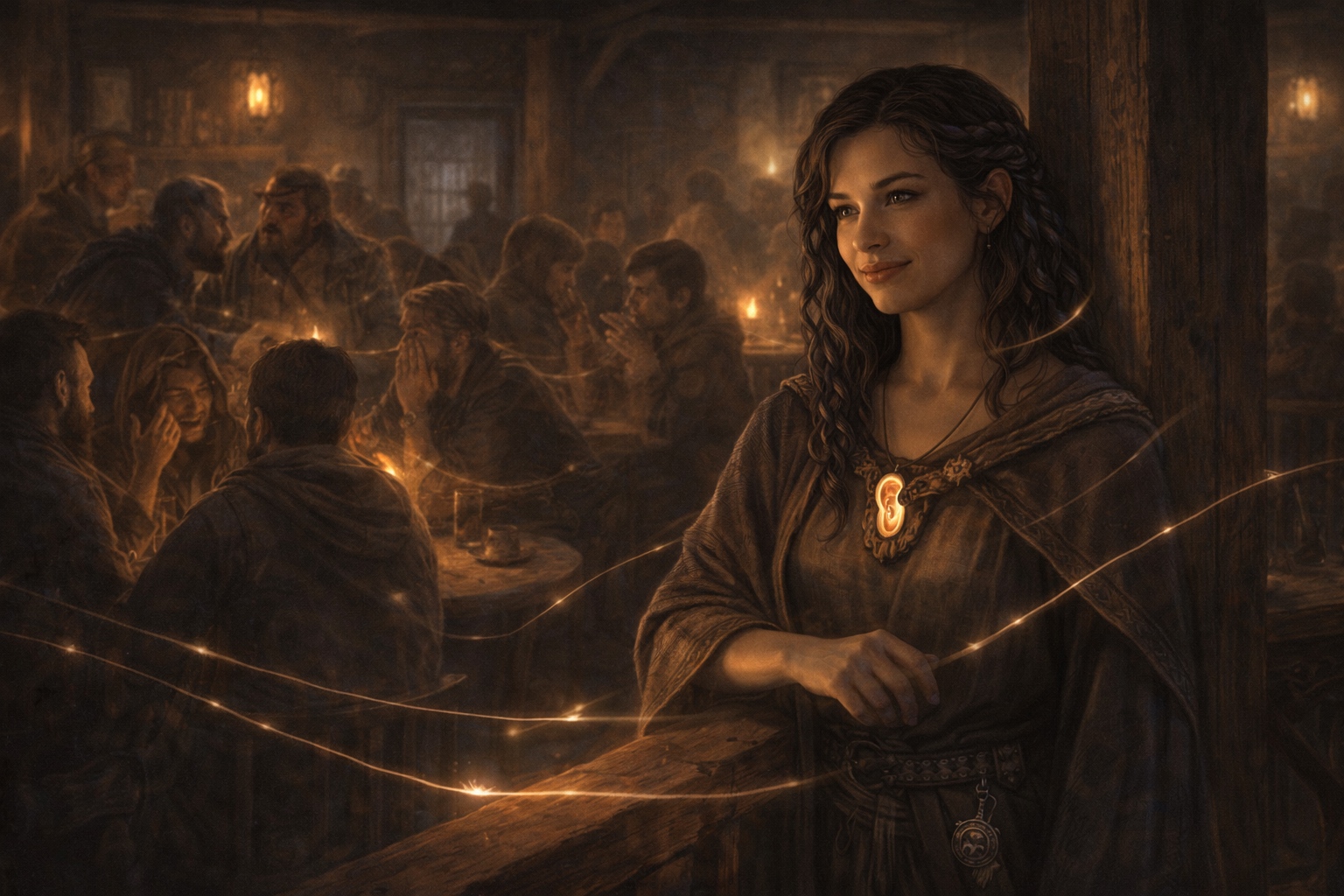
Sylira
The Goddess of Gossip, Rumour, and the Life of Information. The Whisper That Travels. The Drift of News.
At a Glance
- Portfolio: Gossip, rumour, whisper, the spread of information through social networks, reputation (both building and destroying), the circulation of news, secrets revealed and kept, the power of knowing first, the transformation of information as it travels.
- Virtues (as the faithful name them): Knowing things, sharing useful intelligence, the protective function of gossip (warning about dangerous people), wit, the pleasure of a well-shared story, network-building through information exchange, the courage to speak dangerous truths.
- Vices (what Sylira opposes): Spreading deliberate lies while claiming they are true; destroying someone through fabricated rumour; using information to isolate and harm the powerless; hoarding information that would protect others; claiming certainty about things one does not actually know.
- Symbol: Two lips with a single open ear between them (emphasizing both speaking and listening), or an ear with a small flame next to it (a whisper in the dark), or simply an open ear. Some traditions use an hourglass where gossip flows like sand: infinite and impossible to stop once begun.
- Common worshippers: Innkeepers and tavern owners (who hear everything), merchants who trade in information as much as goods, courtiers whose power comes from knowing things first, spies and informants, gossips of all kinds, anyone whose livelihood depends on knowing what others are talking about, street musicians and ballad-singers who carry news between settlements.
- Common regions: Strongest in major cities, ports, merchant hubs, and royal courts. Anywhere information flows faster than official channels. Weakest in remote settlements where news travels slowly and everyone already knows everything about everyone else.
Names & Identifiers
- Common name (internal): The Whisper or The Drift (as in the drift of information, the way talk carries).
- Formal name (legal/ceremonial): The Faith of Sylira, Goddess of the Spoken Word and the Traveling Truth, or simply The Whisper in formal documents.
- A follower: An Eared one or Carrier; among the faith, simply a listener or whisper-bearer.
- Clergy (general): Tongue-Priests or Ear-Keepers; they listen professionally and share what is relevant. Senior clergy are Drift-Keepers (overseers of regional information networks).
- A temple/shrine: A Whisper House or Drift House, almost always co-located with taverns, inns, or markets. Not separate religious buildings but dedicated spaces within the most information-rich locations. The sacred space is wherever people talk.
- Notable colloquial names: Outsiders sometimes call them the Gossips, the Network, or the Listening Order. In conservative regions, the Rumour-Mongers.
Origin & History
The Shard That Would Not Stay Buried
Sylira is a Shard God. Her fragment came out of Ix's shattering like any other, carrying a portion of the Primordial's totality: in her case, the part that was never content to let a thing known sit still inside one mind.
Her shard was among the quietest ever to fall, and for a very long time it did nothing at all. It did not lodge in a mountain, a river, or a battlefield. It ended up in a wall.
This was not entirely accidental. The shard carried an instinct rather than a domain, and the instinct was movement: information wants to reach the person who can act on it. A fragment like that has no use for a mountaintop. It needed people talking, and it needed someone positioned to hear them and constitutionally unable to pass it on. It waited for a very long time, through more than one building, and by the accounts the faith preserves it was already old when The Golden Measure was raised around it.
What settled between Zopha and Talbar much later was not Sylira's origin but her territory. Knowledge belongs to Zopha. The recorded agreement belongs to Talbar. Neither of them governs what happens to a fact after it leaves a mouth: the living, changing, traveling thing that gains and loses weight with each retelling, that can protect a community or destroy a reputation. Both gods noticed the gap. Both tried to manage it, Zopha by sending Keepers to correct misinformation and Talbar by specifying in contracts what was known and what was not, and neither could stop the current.
Sylira was already in the gap. She had been waiting in a wall for centuries for someone to open it.
Ora and the Shared Wall
The story the faith teaches is not cosmic but deeply human.
In a city at the crossroads of three kingdoms, there stood a tavern called The Golden Measure. It was built with excellent craftsmanship but imperfect design: the wall between the private dining room (where important people discussed matters of consequence) and the kitchen (where servants worked the pass-through) was thin.
For thirty years, Ora worked in the kitchen of The Golden Measure. She was not remarkable: not beautiful, not clever in obvious ways, not ambitious. She simply worked. She moved food through the pass-through. She listened.
In three decades of listening, Ora heard things that would destroy several powerful families. She knew which merchant was about to go bankrupt before he knew it himself. She knew which lord was sleeping with which lord's wife. She knew which judge had taken a bribe. She knew which general had received an offer of betrayal from a rival kingdom. She knew which noble's eldest son was secretly the bastard of a servant. She knew which princess had written love letters to a peasant and hidden them in the garden wall.
She had never told anyone any of it.
When asked, Ora would later say that she had believed herself bound by the intimacy of overhearing. The information had been spoken in confidence (even if she had not been meant to hear it), and to share it seemed like a violation of something sacred. She was a servant; this knowledge was not hers to carry.
Instead, she carried it alone.
One winter, when The Golden Measure was being repaired, workers discovered a shard embedded in the plaster of the shared wall, old, perhaps centuries old, its divine origin obvious to anyone who saw it. The shard had not revealed cosmic truth to previous discoverers. It seemed inert, dormant, a mere fragment of something larger.
But Ora found it in the wall crevice and held it.
When she touched it, the shard did not grant her visions of the divine realm. It granted her something simpler and more devastating: the understanding that she had been wrong.
She had been wrong to stay silent. Information that reaches the right person at the right moment is protection. Information that stays with one person is just a burden.
This was not the shard commanding her to gossip everything. It was revealing a truth she should have understood: that information has a purpose. It moves toward the person who can use it. A warning about a dangerous man should reach the women in his path. Evidence of a corrupt judge should reach those he has wronged. The knowledge that a merchant is going bankrupt should reach those who would otherwise extend him credit they cannot afford to lose.
The shard's principle became clear: information wants to reach the person who can act on it.
Ora's Ministry
Ora began talking.
Not indiscriminately. This was not unloosing all the secrets at once. She began with careful discernment, asking herself, for each piece of information: Who needs this? Who can act on it? What is the right moment? Will sharing this protect, or will it harm?
She started with a warning. A young woman working as a servant in a lord's house. A guest had begun to take inappropriate interest in her. Ora knew from the kitchen gossip that the guest was dangerous, had done this before, in other houses. She spoke to the young woman's friend. The friend spoke to the girl's mother. Within days, the girl had found work elsewhere.
Then a farmer, about to invest in a crop that would fail because a distant neighbor had poisoned the soil. Ora knew from overhearing a merchant discuss it. She found a way to mention it to the farmer's wife at the market. The farmer avoided the failed investment.
Then a warning to women in the city: a particular sort of merchant was selling adulterated medicine that caused harm instead of healing. She had heard him discussing it with an apothecary. When she told people, the information traveled. Women warned their families. The merchant's practice collapsed.
People began to notice that Ora seemed to know things before they happened. That she had useful warnings. That information shared with Ora often turned out to be important. More people began telling her things. More people began asking her what she had heard.
The Golden Measure became a place where useful information circulated, where people who needed to know things found them out, where some genuinely dangerous people were exposed by the simple fact of a serving woman who had decided that the wall between the kitchen and the dining room was not thick enough.
When Ora eventually died (having lived a long life, having listened for sixty years, having shared what she heard with precise discernment) the tavern owner wept. The city felt quieter, as if something that had been subtly preventing disaster had been removed.
But by then, others had learned what Ora understood. The Drift had been established. The Whisper had become a practice.
Sylira did not descend to Ora. She did not speak to her in dreams or reveal herself with lightning. Sylira simply recognized herself in Ora's choice, the way a god recognizes her own nature reflected in mortal action. Ora had lived the principle that would become Sylira's core theology: information has a current, and that current moves toward those who can use it. The person who says a thing cannot control what it becomes. Once information leaves the speaker's mouth, it travels by its own rules.
The Divine Compact
Sylira offers a bargain built on a paradox: she grants access to the currents of information but demands honesty about what one knows versus what one believes.
What Sylira promises:
Access to the information currents: the ability to hear what is being said, to know what is traveling through a community, to be aware of things before they become common knowledge. The network of people who share information. Protection for those who pass along dangerous truths. The blessing of being well-connected.
Common boons:
- Exceptional instinct for what is being said in a community
- The ability to know who to ask to find out what you need
- The tavern or meeting place that becomes an information hub almost by accident
- Protection for informants and gossips who expose genuine danger
- The feeling that you're always slightly better-informed than you should be
- Lucky overhearing of information that proves crucial
- Subtly enhanced persuasiveness when sharing what you know
Rare miracles:
- A piece of information reaching exactly the person who can act on it at exactly the moment it's needed
- A rumour that is factually wrong but directionally accurate managing to prevent a disaster anyway
- A whisper network successfully warning an entire community about a threat before the threat can act
- Someone completely changing their behavior based on a warning shared, preventing violence or harm
- Information thought long-buried surfacing at the precise moment it becomes relevant
Social benefits:
Belonging to networks of listeners and speakers. Access to Whisper Houses across regions. Mutual protection among those who gather information. The practical advancement that comes from knowing things before others. Respect from those who understand that knowing comes before power.
Afterlife promise / fear:
The faithful believe they will spend eternity in a space where all information is audible and knowable, where they can finally understand the conversations they overheard but did not quite catch, the secrets they heard but did not fully comprehend, the stories behind every rumour. They will be surrounded by the constant flow of information that shaped their lives, understanding it all at last.
What they fear is dying without having told someone something important. The horror of having knowledge that would have mattered, and failing to share it before death. The fate of taking important truths to the grave unused.
Costs / conditions:
Sylira demands honesty about what you know versus what you believe. She demands that her followers maintain the distinction between:
- What you know (verified, reliable information)
- What you believe you know (unverified but plausible)
- What you're embellishing (adding details to make a story better without intending to mislead)
- What you're spreading as rumour (acknowledging you don't know if it's true)
The sin is not spreading a rumour. The sin is claiming a rumour is fact when you know you don't know. It is spreading information while claiming certainty you don't possess. It is breaking the fragile trust that makes networks work: the understanding that information comes with a reliability attached.
Those who deliberately spread falsehoods while claiming knowledge, who corrupt the network's reliability, find themselves increasingly isolated. Fewer people share information with them. Their own warnings go unheeded. The very network they abused shuts them out.
Core Doctrine
The faithful of Sylira organize their understanding around these principles:
-
Information has a current and cannot be fully controlled. Once something is spoken, it travels by its own rules. The speaker cannot recall it. The speaker cannot control how it changes. Understanding this is the beginning of wisdom about information.
-
The person who says a thing is not responsible for what it becomes. If you tell the truth and someone misinterprets it, the misinterpretation is not your lie. If you share accurate information and someone uses it badly, that use is not your doing. This does not mean the speaker bears no responsibility; it means responsibility is distributed, not singular.
-
Information-in-motion is morally ambiguous. The same whisper that saves a community from a dangerous person can destroy an innocent one. The rumour that exposes corruption can ruin someone unfairly. Sylira owns all of it. She does not sort information into "helpful" and "harmful" but understands that information is a force, like water, like fire: powerful and not inherently moral.
-
The protective function of gossip is real. When people gather and share information, they protect themselves. Communities that gossip together have warnings about dangerous individuals earlier. Abusers are exposed. Corruption is named. The flow of information is how powerless people protect themselves from those with formal power.
-
Knowing comes before justice. Those who demand verified proof before accepting information often protect wrongdoers. Sylira's realm is the space before proof, where rumors become information, where suspicions become warnings, where community knowledge becomes action.
-
The reliability of the network depends on honesty about certainty. If the network cannot distinguish between rumour and fact, between what is known and what is guessed, the network becomes useless. Information must come with a reliability attached. To claim certainty you do not possess is to poison the well.
Soul Coins & Divine Economy
(See also: Soul Coins & Divine Economy)
Sylira accumulates power through the spread and reception of useful information, not the information itself being created, but its circulation, its effect, its protective function as it moves through communities.
How Sylira gains soul coins:
Every act of meaningful information-sharing generates a small amount of coin. Larger amounts come from:
- Information reaching the person who can act on it
- Whisper networks that genuinely protect communities
- Exposing genuine wrongdoing through information that could not be proven through official channels
- Warnings that prevent harm
- Network-building through information exchange
- Overhearing something crucial and making the choice to share it carefully
A person who listens for decades and shares what they hear with discernment generates substantial coin. A merchant who builds a reputation for knowing things and sharing them reliably generates more still.
What makes a coin "heavy":
- Risk taken in sharing information. The person who exposes danger at personal cost generates heavier coins.
- Accuracy within honest uncertainty. The informant who shares what they know while being explicit about what they don't know; that reliability creates heavier coins.
- Information that reaches at exactly the right moment. A warning that arrives just in time, a piece of knowledge that appears when it's most needed: these weigh more.
- Community protection. The gossip that protects vulnerable people, that warns women away from dangerous men, that exposes corruption affecting the powerless: these generate the heaviest coins.
- The choice to speak despite personal consequences. The person who shares a dangerous truth knowing it will harm their reputation or position: that courage weighs heavily.
What Sylira spends coins on:
- Creating the conditions for information to flow more easily
- Protecting those who share dangerous truths from the full consequences
- Ensuring crucial information reaches the right ears at the right moment
- Weakening the power of deliberate lies and fabricated rumours
- Sustaining the Whisper Houses and the networks that maintain them
- Occasionally, guiding events so that crucial overhearing happens at crucial moments
Trade:
Sylira trades coins with Talbar (information as commodity; merchants trade constantly around market intelligence and reputational information). She trades carefully with Anansi (story and gossip intersect; they have boundary disputes). She refuses trades that would involve deliberately spreading false information or corrupting the reliability of networks.
Infernal competition:
The Tempters offer perfect information: the ability to know everything about anyone, to never be surprised, to always have the intelligence advantage. The cost is that you become a conduit for their information, which is always shaped to serve infernal ends. Information from infernal sources carries hidden payloads: it flatters, it isolates, it encourages betrayal.
Sylira's counter is straightforward: information with a source is more valuable than information without one. If you know where information comes from (who benefits from it being spread, who is being protected by it, whose advantage it serves) you can evaluate it. Information that appears from nowhere, that flatters you alone, that seems too perfect to be true: this is the mark of infernal seduction.
The most effective protection against infernal information is the network itself. Information that cannot survive scrutiny by the community is recognized as false. Sylira's blessing is not certainty, but community sense-checking.
Sacred Spaces
Sylira's sacred spaces are Whisper Houses and Drift Houses, almost always attached to or located within taverns, inns, or market buildings. The theology is made concrete: sacred space is where information flows.
The most sacred feature is not an altar but a listening wall: a space where multiple conversations can be overheard simultaneously, and where the architecture facilitates both the hearing of information and the sharing of it. This might be a cleverly designed room with excellent acoustics, or a wall with strategic thin sections, or simply a central gathering space where conversations naturally carry.
Standard features of a Whisper House:
The Central Room: The gathering space where the network comes together. Not elaborate, not grand, deliberately unadorned so that attention stays on the conversations happening. Might be the back room of a tavern, might be a dedicated space with multiple levels (so information flows visibly from one tier to another), might be a marketplace pavilion.
The Rumour Board: A public space where unverified information can be posted with a notation system indicating source confidence. This is simultaneously a practical community tool and a religious artifact. The board distinguishes between:
- Verified by multiple sources (high confidence)
- Single source, credible (medium confidence)
- Unverified rumour (low confidence)
- Speculation/embellishment (explicitly marked as such)
This notation system is one of Sylira's most practical gifts to communities. It teaches that information always comes with a reliability attached. Even rumors can be useful, but only if everyone knows they're rumors.
The Archive: Most Whisper Houses maintain a record of significant information that has circulated, not a library like Zopha's, but a tracking of what has been said, what turned out to be true, what was misunderstood, what proved false. This archive helps the network learn about itself.
The Listening Shrines: Small personal alcoves where individuals can sit alone and practice the discipline of listening. Not prayer in the traditional sense, but the careful attention that gathers information. Many Whisper House visitors spend time in these shrines simply listening to the house around them.
The Offering Altar: Where those who have benefited from shared information leave offerings. These are not monetary but practical: a candle, a token, a written note of thanks. The offerings accumulate as visible signs of the network's function.
Organizational Structure
Sylira's faith is organized like information itself: in webs, not in pyramids. Each Whisper House is a node; the nodes are connected by carriers (clergy who travel between them, moving information deliberately). The faith has no central authority. This is theology as much as practicality: a central authority is a single point of failure, and information that can only reach one place is not free information.
Ear-Keepers manage individual Whisper Houses, maintaining the sacred space, ensuring the rumour board is kept with care, and listening to the community's needs. They are expected to be neutral; an Ear-Keeper who takes sides in local disputes is recognized as having failed their role.
Tongue-Priests are clergy who specialize in a particular context: courtier-priests who gather information in royal courts, merchant-priests who maintain networks in trading quarters, street-priests who move through neighborhoods gathering what is being said.
Drift-Keepers are senior clergy who maintain the broader regional networks, ensuring that crucial information gets to Whisper Houses that need it. They travel regularly and know the major information routes and the key listeners in their region.
Carriers are lay people and junior clergy who move between Whisper Houses deliberately, carrying information that one house needs to share with another. They are not traveling monks or priests; they are merchants, performers, messengers, anyone whose regular movement gives them cover for information exchange.
No hierarchy exists beyond this. There is no high priest of Sylira, no central council making decisions about doctrine. Instead, Ear-Keepers gather in regional conclaves when major events occur or when network problems need solving. These conclaves are usually convened quickly and disbanded as soon as their work is done.
Authority flows from two sources: (1) reputation and trustworthiness, (2) demonstrated skill at maintaining the network's function and reliability.
An Ear-Keeper found to have deliberately spread false information, or to have used the network for personal gain rather than community protection, is simply removed. Others will cease to share information with them. They become isolated, no longer part of the network.
Entering the Faith
Entry into Sylira's faith is soft and informal, reflecting the deity's nature.
Soft entry is constant and natural: you're the person who always knows what's happening before it's official news. You're the friend everyone talks to. You overhear important things and have good judgment about what to do with them. You might never formally convert and still be living Sylira's practice.
Formal initiation involves recognizing and committing to three principles:
-
The Recognition: Demonstrating that you have information that is genuinely useful and that you have shared it with the right person at the right moment. You must show you understand Sylira's core principle: that information has a purpose and moves toward those who can use it.
-
The Oath of Honesty: Taking a formal vow to maintain the distinction between what you know, what you believe, what you're repeating unverified, and what you're embellishing. Swearing that you will never claim certainty you don't possess. This oath is taken before a Tongue-Priest and witnesses.
-
The Acceptance: Being formally added to the network. An Ear-Keeper or Tongue-Priest introduces you to the other Carriers and listeners in your region. You receive a listener's token: something simple (a small bell, a carved shell, a brass ear) that marks you as someone who listens with purpose.
Initiation ceremonies are informal, usually occurring in the back room of a Whisper House with minimal ritual. The focus is on the principles and the commitment, not on ceremony for its own sake.
What makes an enemy rather than a convert: Those who deliberately spread falsehoods while claiming knowledge; those who use information networks for personal enrichment at community expense; those who gossip for cruelty rather than protection. These are not approached for conversion; they are opposed directly through counter-information, exposure, and when necessary, through the network shutting them out entirely.
The Faithful in Practice
A devoted follower of Sylira is recognizable by their habits and instincts.
- Listens more than they speak. Not shy, not silent, but deeply attentive. When others are talking, they are genuinely hearing, not waiting for their turn to speak.
- Asks careful questions. When they want to know something, they ask in ways that don't reveal what they're trying to learn, don't put the person being asked on the defensive, and respect boundaries about what others want to keep private.
- Maintains the distinction between knowing and guessing. When sharing information, they explicitly mark what they know versus what they're reporting unverified. "I heard..." "I'm not sure, but..." "This is confirmed..." These distinctions matter.
- Notices connections between information. Skilled at seeing how knowledge from one conversation illuminates what was said in another. Can connect the market gossip to the court whisper to the street rumour and understand the pattern.
- When confronted with information, asks: "Who benefits from this being spread?" Not cynically, but practically. Understanding the source of information helps evaluate its reliability.
- Observes network effects. Notices when information has actually moved, who is using it, what effects it's having. Tracks whether their sharing of information actually resulted in protective action or productive change.
- Respects secrets. The faithful understand that some information belongs to someone: a private sorrow, a hidden shame, a personal story someone shared in confidence. These are not part of the network to be spread. The skill is distinguishing between secrets (which should stay private) and information that serves a protective function (which should be shared).
Taboos
- Claiming certainty about things one does not actually know. This poisons the reliability of the network. The faithful must maintain rigorous honesty about what they know, what they believe they know, and what they're guessing.
- Spreading deliberate lies while claiming they are true. Sylira does not sort information into "true" and "false" in the way Zopha does. But she does care about honesty about what one is doing. Lying while claiming truth is forbidden. Spreading an unverified rumour while calling it rumour is acceptable. Spreading it while claiming knowledge is not.
- Using information to harm the powerless. Spreading information that isolates someone who is already vulnerable; using gossip to destroy someone who cannot defend themselves. The protective function of gossip is sacred; its use as a weapon against the weak is forbidden.
- Hoarding information that would protect others. Knowing that someone is in danger and staying silent. Knowing that a corrupt person is exploiting others and keeping quiet. This inverts Sylira's purpose entirely.
- Deliberately corrupting the network. Sharing false information disguised as real, poisoning the Rumour Board with unreliable content, using the network to serve your own interests rather than the community's. A person who does this loses access to the network itself.
- Breaking the confidentiality of the listener's role. If someone shares information with you as an Ear-Keeper or Tongue-Priest (not to be spread, but to help you understand the community), revealing where that information came from is a grave breach.
Obligations
- Consistent listening. The faithful are expected to maintain engagement with the flow of information in their communities. This is not optional.
- Network participation. Contributing to Whisper Houses, maintaining the Rumour Board, sharing information with the broader network when it serves the community. This may mean gathering information, maintaining records, or simply being present as part of the network.
- Teaching discernment. Those who are skilled at evaluating information are obligated to teach others, not just how to gather information, but how to think critically about it, how to distinguish reliability, how to resist manipulation.
- Protecting sources. The faithful understand that information networks only function if people trust that their sources will be protected. Revealing who told you something (except in cases of imminent danger) is a serious breach.
- Ethical gathering. Information must be gathered honestly. Eavesdropping is acceptable; invasion of privacy is not. The line between listening and spying must be maintained.
Pillars of the Faith
Sylira's faith is organized around four pillars, which practitioners understand as both individual practices and collective ideals:
- Listening: The foundation. To hear what is being said, to attend to the voices in a community, to be present to others' words. Not mere passivity but active, engaged reception.
- Honesty: The discipline of maintaining clarity about what one knows, what one believes, and what one is guessing. The refusal to claim certainty one does not possess.
- Discernment: The ability to evaluate information, to understand its source, to recognize its purpose. To know when information should be shared and when it should be kept private. To distinguish protective gossip from cruel gossip.
- Network: The recognition that information has power only as it moves through community. Alone, information is just knowledge. In community, it becomes protection, warning, collective sense-making.
Holy Days & Observances
All holy days across Dort are listed in the Festival Calendar.
The Day of Open Ears
Date: First new moon of the spring season.
The faith recognizes a day when everyone is expected to listen more than they speak. Whisper Houses hold open houses where people gather to listen to the community, not to be heard, but to hear. Those who attend are encouraged to simply sit and listen, absorbing the flow of information, understanding what is being said about their community.
It is a day of humility for those who usually speak, and of validation for those who usually listen.
Ora's Choice
Date: The autumn equinox.
Commemorates the moment Ora decided to begin speaking, to begin sharing the information she had gathered. On this day, Whisper Houses gather to discuss the personal cost of speaking dangerous truths: the social, professional, and personal risks that come from sharing what one knows.
Members are encouraged to share stories of information they have shared that cost them something, or information they chose not to share because the cost was too high. The day centers on the reality that speaking is not costless; the faithful who choose to speak despite the cost are honored.
The Great Gathering
Date: The summer solstice.
Once yearly, Whisper Houses attempt to gather representatives from their region. If a city is too large, multiple regional gatherings occur. The purpose is to review the year's most important information, to discuss patterns and themes, to ensure that crucial information has reached the right places, and to identify gaps in the network.
The Great Gathering is not a celebration so much as an assessment. It is when the network evaluates itself, learns from its successes and failures, and prepares for the year ahead.
The Silence
Date: The winter solstice.
A paradoxical holy day for a faith centered on gossip and rumour. On the longest night, Whisper Houses go completely silent for several hours. No speaking. No information sharing. Only listening to the world as it is.
The theology is complex: the faithful recognize that even information must sometimes rest. That constant sharing can overwhelm. That there is wisdom in silence. That listening alone, without speaking, is also a valid practice.
Ceremonies & Rituals
The Initiation of the Listener
Performed when someone formally joins the faith. The initiate stands before witnesses (usually other Carriers and Tongue-Priests) and is asked three questions:
- "Do you commit to hearing what is said in your community, to listening with attention and care?"
- "Do you commit to honesty about what you know, what you believe, and what you are guessing? Will you mark every piece of information you share with its reliability?"
- "Do you commit to using the information you gather for the protection of your community, not for your own enrichment or for cruelty?"
The initiate answers affirmatively to each. They are then given a listener's token (varies by region and tradition) and formally introduced to the local network.
The Gathering of Secrets
Performed when the Ear-Keeper and senior listeners need to make a major decision about the community or the network. Those gathered sit in the Listening Wall and each speaks what they have heard, not in the form of finished stories or accusations, but in raw fragments. "I heard..." "People are saying..." "There is talk of..."
From these fragments, patterns emerge. The gathered listeners begin to see the shape of what the community is experiencing, what information is moving, what needs attention. The Gathering helps the network understand itself.
The Ritual of the Rumour Board
Performed monthly or as needed. The senior Ear-Keeper reviews the Rumour Board with the community. Each piece of information is examined: Is it still relevant? Has it been verified or proven false? Should it be archived? Should it be removed?
Occasionally, something on the board is revealed to be false or harmful. The community must decide what to do: remove it, mark it as incorrect, or allow the correction to spread. This ritual teaches the network how to correct itself.
The Oath of Silence
Performed when someone in the community has asked for protection of a source or has shared sensitive information that must not be spread. The Tongue-Priest and the listener come together and formally commit to silence about that particular information. This oath is treated as seriously as any vow.
Ceremonial Attire
The Listener's Cloak
Worn by Ear-Keepers and senior Tongue-Priests during formal gatherings. A simple, nondescript cloak in neutral colors (grey, brown, or dark blue). The fabric is deliberately unremarkable; the theology is that the listener should not draw attention to themselves, should be easy to overlook, should fade into the background of a room.
Inside the cloak, hidden from view, a pattern of ears is embroidered, a private reminder of the role.
The Listener's Token
Given to every initiated member. These vary by region and tradition but typically represent listening in some form: a small bell, a carved ear, a brass coin with an ear stamped on it, a shell. It serves as proof of membership and as a daily reminder of the commitment to hear.
The Tongue-Priest's Cord
Worn by clergy around the waist. A cord with knots tied at regular intervals, each knot representing a major piece of information that the priest has successfully moved through their network. A young Tongue-Priest might have a few knots; a veteran might have dozens. The cord is a visible marker of experience and network significance.
The Ear-Keeper's Badge
Worn by Ear-Keepers during official functions. A simple badge bearing Sylira's symbol (usually a stylized ear). It signals authority to maintain the Whisper House, to arbitrate disputes about information, and to represent the network to outsiders.
Historical Figures
Ora of the Golden Measure
Ora (dates unknown, but believed to have lived roughly 400 years before the current era) was a servant at the tavern called The Golden Measure in a city at the convergence of three kingdoms' trading routes. She worked in the kitchen for thirty years without drawing particular notice, until she was discovered to have been the source of crucial information that had saved the city during a period of political instability.
What made Ora remarkable was not her ability to gather information (she had simply been listening in her kitchen) but her judgment about what to do with it. She shared what she knew with careful discernment, protecting sources, ensuring information reached those who could act on it, refusing to gossip for mere entertainment or cruelty.
When she eventually died, the city held what the faith considers the first formal ceremony honoring her memory. The tavern where she worked still exists and has become the site of a major Whisper House, though the building itself has been rebuilt many times.
Ora is invoked by servants and the powerless, by those whose only advantage is the knowledge they have gathered, and by anyone who struggles with the question of when to speak and when to remain silent.
The faith considers her canonically important, not as a saint, but as the living example of Sylira's theology made flesh.
Castellan Thoren the Listener
Thoren lived approximately 200 years ago and served as the Castellan (administrator) of a major fortress during a period of civil war. Using careful networks of information-gathering (listening to soldiers, merchants, servants, and spies) Thoren managed to maintain the fortress's neutrality even as forces around it warred, by always knowing which army was approaching, what their intentions were, and how to negotiate with them.
Thoren's genius lay not in military strategy but in information synthesis. By maintaining a network of listeners throughout the region, and by gathering information without claiming to be gathering it, Thoren could anticipate threats before they developed, could see through deception, could know when someone was lying about their intentions.
The fortress survived. The city around it survived. When the civil war ended, it was partly because forces recognized that taking the fortress would be impossible; this unknown castellan had made it too well-informed to be caught by surprise.
Thoren is invoked by those in positions of authority who must make decisions with incomplete information, and by those who must predict others' intentions through careful listening.
Thoren is also a cautionary example: used too aggressively, the skills of information gathering can become something approaching mind control. The faith teaches that Thoren's practice was justified because it served protection rather than conquest, but warns that the line can be thin.
Mallory the Broker
Mallory (contemporary with Castellan Thoren, dates approximately 200 years ago) was not a leader or a politician but a person who made their living explicitly by knowing things and connecting people who needed to know them. She operated in a major merchant city and served as the connection point between the underground network and the official city authorities.
When information moved through Mallory, it was transformed from rumour into something approaching official knowledge, not because she verified it (though she often did) but because she had a reputation for reliability. People believed information that came from Mallory because she had, over years, demonstrated that she knew the difference between rumour and fact, that she would not stake her reputation on unreliable information.
Mallory's great achievement was establishing a formal system for the city's information networks: the first Rumour Board (in its modern form), the first explicit notation system for reliability, and the first regular gathering of listeners to assess what the city was hearing.
She is invoked by merchants and others in commercial trades, and by anyone whose livelihood depends on information being reliable. She is also invoked when the faith must deal with questions about the commercialization of information: the balance between information as a commodity and information as a community asset.
Anselm the Quiet
Anselm is a more recent figure (roughly 50 years in the past) and represents a different tradition: the listener who chose almost permanent silence, who gathered information but shared it only through the official network, through Ear-Keepers, through formal channels.
Anselm lived in a small city and worked as a clerk in the city administration, a position that gave him access to official documents and knowledge of what the city's leadership was thinking and doing. For decades, he gathered information and brought it only to the Ear-Keeper of the local Whisper House.
Anselm never spoke publicly about what he knew. He never gossiped in taverns or tried to influence opinion directly. He was the intelligence source, but the network decided how to use his information.
When Anselm died, the city discovered that he had been instrumental in preventing at least three major disasters: corruption among magistrates, a corrupt merchant guild poisoning goods, an invasion of which the city received early warning. And almost no one had known Anselm was the source of this information.
The faith reveres Anselm as the counterpoint to Ora, not the person who speaks openly, but the person who provides the network with the information it needs, trusting that the network will do the right thing with it. Anselm represents the invisible infrastructure of information: those who listen and feed the network without seeking recognition.
Sacred Relics & Artifacts
The First Rumour Board
Description: A simple wooden board, roughly the size of a door, divided into sections with chalk. The original sections bear Mallory's handwriting with her notation system. Some sections are so old the chalk has faded nearly to nothing.
Origin: Created by Mallory the Broker approximately 200 years ago as a formal system for tracking and marking the reliability of information in her city. It represents the first successful attempt to apply rigor to the informal spread of gossip.
Powers or Significance: No magical properties, but symbolic and practical significance beyond measure. The board demonstrates that gossip can be organized, that rumour can be marked for reliability, that even informal information can be systematized. It taught the faith that you do not have to choose between information flowing freely and having standards.
Current Location / Status: Housed in a special shrine within the oldest active Whisper House in the merchant city where Mallory worked. It is consulted during disputes about how to mark information's reliability. It is preserved carefully, though the wood shows the wear of centuries.
The Pass-Through Wall
Description: A section of the original wall from The Golden Measure tavern, the wall through which Ora listened to important conversations. The section is roughly three feet wide and has been sealed in glass or a protective casing to preserve it from damage.
Origin: From the tavern that Ora served in. The wall became a holy object after it was discovered that Ora had been the source of crucial information that protected the city.
Powers or Significance: The wall symbolizes the original principle of Sylira's faith: that the boundary between private and public information is porous, that listening is how the powerless gather intelligence, that overhearing can be a form of sacred attention. It is a reminder that the most profound religious experiences often begin accidentally, in mundane circumstances.
Current Location / Status: Housed in the oldest Whisper House, which grew up around The Golden Measure. It is considered one of the most sacred objects in Sylira's faith, and visitors to the Whisper House often pause before it to contemplate Ora's story.
The Listener's Bells
Description: A set of bells of graduated sizes, numbered from smallest to largest. Each bell has a different tone, and the set can produce a range of sounds from high and clear to low and resonant.
Origin: Created by Anselm the Quiet as a gift to the local Ear-Keeper, meant to represent how the same information takes on different qualities depending on context. What is a clear high note from one perspective is a deep low tone from another.
Powers or Significance: The bells have become a teaching tool and a symbol of how information changes as it travels through a network. Played by skilled Ear-Keepers, they can produce beautiful music, analogous to how information, when handled skillfully, becomes something more than its raw components.
Current Location / Status: Rotates among major Whisper Houses. They are used in some ceremonies, and they are sometimes consulted when a Tongue-Priest needs to think about how a piece of information might be received in different contexts.
Ora's Token
Description: A small carved object, believed to be from Ora's own hand, depicting a simple ear. The carving is crude but competent, suggesting an amateur artist working in a medium that was not their primary skill. The object is worn smooth from centuries of handling and prayer.
Origin: Created by Ora and carried with her throughout her life. After her death, it was discovered among her belongings and has since become the most sacred object in the faith, perhaps the closest Sylira's faithful have to a relic directly touched by the founder of the practice.
Powers or Significance: The object is believed to grant clarity to listeners, not magical insight, but the ability to hear more clearly, to distinguish nuances in speech, to perceive what is being left unspoken. Scholars consult it when they must listen to complex negotiations or understand what is being said beneath the words.
Current Location / Status: Kept in the Whisper House that grew up around The Golden Measure, accessible only to senior Ear-Keepers and during specific ceremonial moments. It is brought out rarely, and with great care.
Sects
The Listeners
How they refer to themselves: The Ears or simply The Listeners
The Listeners form the core of Sylira's faith. They focus on the practice of careful listening, not just hearing, but attending to tone, to what is left unspoken, to the emotional content beneath the words. Listeners often specialize in particular contexts: tavern listening, court listening, marketplace listening, street listening.
The Listeners believe that the skill of listening is sacred work. They practice meditation on sound, techniques for remembering what they hear, and the discipline of distinguishing between what was actually said and what they think was meant. A skilled Listener can integrate information from dozens of separate conversations into a coherent picture of what a community is experiencing.
The Carriers
How they refer to themselves: The Messengers or The Path-Walkers
The Carriers are the infrastructure of the network. They travel between Whisper Houses, carrying information that one region needs to share with another. Carriers are merchants, performers, messengers, anyone whose regular movement gives them cover for information exchange.
The Carriers believe that the network's power lies in its distribution, that information should be able to move between regions, that no Whisper House should be isolated, that the broader the network, the more powerful it becomes. Carriers often specialize in particular routes or regions.
The Rumour-Keepers
How they refer to themselves: The Archivists or The Record-Keepers
This sect focuses on maintaining the Rumour Boards and the archives of information that has circulated. They believe that the network must learn from itself, that tracking what has been said, what turned out true, what proved false helps the community understand how to evaluate future information.
Rumour-Keepers are often scholarly, meticulous. They maintain detailed records of information flows, patterns in misinformation, sources that have proven reliable or unreliable. Some Rumour-Keepers have developed early forms of statistical thinking by analyzing patterns in the information network.
The Whisper-Shapers
How they refer to themselves: The Crafters or The Word-Smiths
This sect focuses on how information is shaped as it travels: how the same fact can be presented in different ways to different audiences, how framing affects how information is received. Whisper-Shapers are not liars; they are people who understand the aesthetics of information, who know how to make true information compelling, how to present difficult truths in ways that allow people to hear them.
Whisper-Shapers often work as teachers and educators, helping people learn to think about information critically, to recognize how framing affects reception, to appreciate the skill involved in good communication.
This sect is watched carefully by the orthodox faith. The line between shaping information skillfully and manipulating it is thin, and some Whisper-Shapers have crossed over into deliberately misleading presentation while technically remaining truthful.
Heresies
The Doctrine of Absolute Transparency
How they refer to themselves: the Unrestricted or the Exposed
This heresy argues that Sylira's emphasis on discretion and reliability is misplaced. They believe that all information should be shared with everyone, that keeping any information private or secret inverts Sylira's purpose. They argue that transparency is freedom, that secrets are inherently oppressive, that the network should share everything.
The orthodox faith counters that this fundamentally misunderstands information. Some things are private because they belong to individuals. Some secrets must be kept because revealing them endangers people. The protective function of the network depends on people trusting that what they tell a listener will not be spread without good reason.
The Unrestricted have caused serious damage to some Whisper House networks by spreading sensitive personal information, exposing vulnerable people, and destroying trust in the very systems that should protect communities.
The Fabricators
How they refer to themselves: the Truth-Bringers or the Necessary Deceivers
This heresy argues that Sylira governs information-in-motion, and doesn't care whether the information is true. They argue that a false rumour that achieves a good outcome is blessed by Sylira, that the network is a tool for shaping perception regardless of accuracy.
The Fabricators deliberately spread false information: lies designed to achieve outcomes they believe are good. They have poisoned networks with misinformation, destroyed reputations through fabricated rumours, and corrupted the reliability that makes the network functional.
This is perhaps the deepest offense against Sylira's core doctrine. The faith considers the Fabricators' corruption so serious that they are often opposed more vigorously than infernal cults. A fabricator loses access to the network and becomes isolated from the community that depends on information reliability.
The Hoarders
How they refer to themselves: the Preservers or the Protectors
This heresy argues that Sylira's emphasis on sharing information is dangerous, that information is power, and power should be hoarded and controlled. Hoarders believe that those who gather information should keep it, that the network should be centralized under the control of the powerful, that information should be used for dominion rather than protection.
The Hoarders invert Sylira's theology entirely. They create networks that are designed to distribute information to a few powerful people while keeping it from everyone else. They oppose Sylira's vision of distributed, accessible information.
Cults
The Whisper-Merchants
How they refer to themselves: the Brokers
A cult that treats information as a pure commodity to be bought and sold, without regard for its source or its effect. They buy information from informants, sell it to whoever will pay, and care only about the transaction, not about whether the information serves protection or causes harm.
The Whisper-Merchants operate outside the faith's formal structure, using Sylira's name while violating her core principles. They have been known to sell dangerous information to those who would use it for harm, to trade in secrets that were shared in confidence, to corrupt the trust that makes networks work.
The Court-Weavers
How they refer to themselves: the Architects or the Hidden Hands
A cult that focuses specifically on political manipulation through information control. Court-Weavers believe that information should be used to manipulate those in power, to create chaos that benefits their secret agenda, to use the network as a tool for political transformation.
The Court-Weavers sometimes claim to serve Sylira, but they use information for domination rather than for protection. They are particularly dangerous because they often have access to significant information and the sophistication to shape it effectively.
The Poisoners
How they refer to themselves: the Healers or the Truth-Sayers
A cult built around deliberately spreading damaging information disguised as protective warning. They identify vulnerable people and spread false rumors about them, claiming they are warning the community about danger.
The Poisoners represent the dark side of gossip: its use as a weapon against the powerless. They target individuals rather than systems, create harm rather than protection, and corrupt the very function that makes the network legitimate.
Presence in the Shattered Domain
Sylira's territory in the Shattered Domain is one of constant movement and flow.
-
Territory aesthetic: An enormous marketplace or bazaar that never closes, where conversations happen in every language, at every volume, all at once. The ground is always flowing with something like water or sand: information as current, as substance, as force. Words become visible as they travel, appearing as whispers of light or threads that connect speaker to listener. Boundaries between spaces are permeable; conversations from one area bleed into others. The overall effect is of a vast communication network where everything said anywhere can potentially be heard everywhere, but somehow without chaos; instead, a kind of organized flow, the way a river has current and pattern even as the water moves endlessly.
-
Likely allies: Anansi (narrative and gossip intersect, though tensions exist), Talbar (information as commodity), Caldrin (messenger god, information in transit), Themela (justice built on knowledge), any deity who believes in the power of communication and the value of transparency.
-
Likely rivals: Deities who profit from ignorance or forced silence, gods who require control over information, anyone who builds power through secrecy. Sylira has notable tension with Zopha (Sylira's information is unverified; Zopha demands accuracy) and Itha (Sylira's gossip and Itha's prophecy both traffic in future knowledge, but Sylira's is grounded in rumour while Itha's is cosmic).
-
Stance on the Godless: Curious and welcoming. The godless are potential members of the network. Their views and experiences are valuable information. Sylira makes no effort to convert them but is genuinely interested in what the godless know, what they have seen, what they believe. There is no hostility, only interest in expanding the network of shared information.
Adventure Hooks
-
A crucial piece of information has been spreading through a Whisper House network, and it has prevented a tragedy, but the information is completely false. It is a coincidence of remarkable probability that a false rumour was directionally accurate enough to prevent genuine harm. The network must grapple with the question: do we acknowledge that the rumour was false and risk losing the protective power it has? Do we let the false information continue to circulate? How do we maintain reliability while acknowledging that sometimes false information produces good outcomes?
-
A Court-Weaver cult has infiltrated a Whisper House network and is deliberately poisoning the information flow with carefully crafted misinformation. The false information is subtle and designed to be plausibly deniable; they can always claim they were just spreading rumours. The Ear-Keeper must identify the source of corruption without having proof, without disrupting the network, and without accusing people who might be innocent.
-
A young Carrier has begun trafficking in information obtained through breaking people's private confidentiality. They believe they are serving Sylira by spreading information, and they are technically spreading true information, but they are violating the core principle that the network depends on people trusting listeners with secrets. The local Tongue-Priests must decide how to address this: as a teaching moment, as a violation requiring removal from the network, or as a case where the principle of sharing useful information conflicts with the principle of protecting confidentiality.
-
The faith has been approached by Talbar's clergy with a proposition: the faiths could work together to create a more efficient network for spreading information about merchants, prices, and opportunities. The benefit to both faiths would be significant. But the arrangement would require Sylira's network to become more centralized, more tied to Talbar's commercial interests, and less focused on community protection. The negotiation becomes theological: what would Sylira lose if she became more closely bound to commerce?
-
A major historical figure (a founder or legendary storyteller) has been revealed through careful research to have been spreading false information, to have deliberately deceived the community for what they believed were good reasons. The faith must decide whether to acknowledge this, and if so, what it means for its understanding of that figure. Does the legend change? Does the reliquary need to be revisited? How do we maintain reverence for someone who violated core principles?
-
A Whisper House has become aware that infernal forces are attempting to infiltrate the network by offering "perfect information": reliable facts about people's secrets, their vulnerabilities, their desires. The temptation is enormous. Some Carriers are considering the offer. The senior Ear-Keepers must understand what the infernal is trying to do (corrupt the network by making it too perfect, too focused on individual advantage rather than community protection) and convince Carriers that the shortcut will ultimately poison the network they depend on.
-
Information has begun moving through a Whisper House network about a particular person: rumors of corruption, of dangerous behavior, of hidden crimes. The information is spreading rapidly and is damaging the person's reputation and livelihood. But the source of the information is unverifiable, and the person being damaged claims it is all false. The network must decide: do they mark this as rumour and watch it spread anyway? Do they actively counter it? Do they protect the source by refusing to reveal how the information originated, even though that makes it impossible to verify? How does the faith balance the protective function of warning about someone actually dangerous versus the potential harm of spreading unverified accusations?
Common Prayers & Devotions
While Sylira's faith does not require elaborate ritual, common personal practices include:
Upon Waking: "Let me hear what is being said today. Let me listen with care and attention. Let me know what my community needs to know."
When About to Share Information: "What I am about to say is [true/unverified/rumour/speculation]. I share it because [reason]. May it reach those who need to hear it."
When Listening: The faithful often hold a small token in their hand while listening intensely, using the physical focus to deepen their attention.
In Whisper Houses: Many followers will sit quietly in the listening shrines, simply practicing the art of listening without expectation of gaining information. This is spiritual practice: attending to the world as it is, without agenda.
Theological Tensions
The faith of Sylira is internally diverse and contains several ongoing tensions that practitioners actively grapple with:
With Zopha: Zopha demands accuracy and careful verification. Sylira governs information that travels before it can be verified. The two deities have fundamental disagreements about how information should move. Zopha's followers believe Sylira's network spreads too much unverified information. Sylira's followers believe Zopha's demand for verification is a mechanism by which the powerful suppress truths they don't like. Both are right.
With Themela: Justice demands proof. Sylira's domain is rumour and accusation. A Themela-worshipper will not convict someone on gossip; a Sylira-worshipper knows that gossip sometimes reveals what official justice cannot prove. The two faiths need each other but are often in tension; Themela protecting people from false accusation, Sylira exposing real wrongdoing that the law cannot touch.
With Itha: Prophecy claims knowledge of the future. Gossip claims knowledge of the present but implies prediction. When prophecy and rumour conflict, which should be believed? Itha's followers claim cosmic authority; Sylira's followers claim community knowledge. The boundary between prophecy and educated guess is genuinely unclear.
Internal tension between protection and curiosity: The faith contains an internal argument about whether the primary purpose of information-sharing is protection (warning about danger) or simple knowledge exchange (satisfying curiosity). Some followers believe any information worth sharing is worth spreading; others believe many things are better left private even if they are true.