Vessikar
Vessikar
At a Glance
- Portfolio: Markets as places, weights and measures, currency trust, the civic machinery that keeps exchange from becoming violence, fair tariffs and tolls, bargaining without coercion, supply chains that don't collapse, and the honest accounting of value.
- Virtues (as the faithful name them): Transparency, fairness, consistency, restraint, accountability, honesty under pressure, and the courage to enforce measures even when it harms the powerful.
- Vices (what Vessikar opposes): Rigged scales, counterfeit measures, price-gouging in crisis, monopoly violence, starving towns for leverage, hidden weights, confiscation disguised as fees, and exclusive control of necessities used to compel obedience.
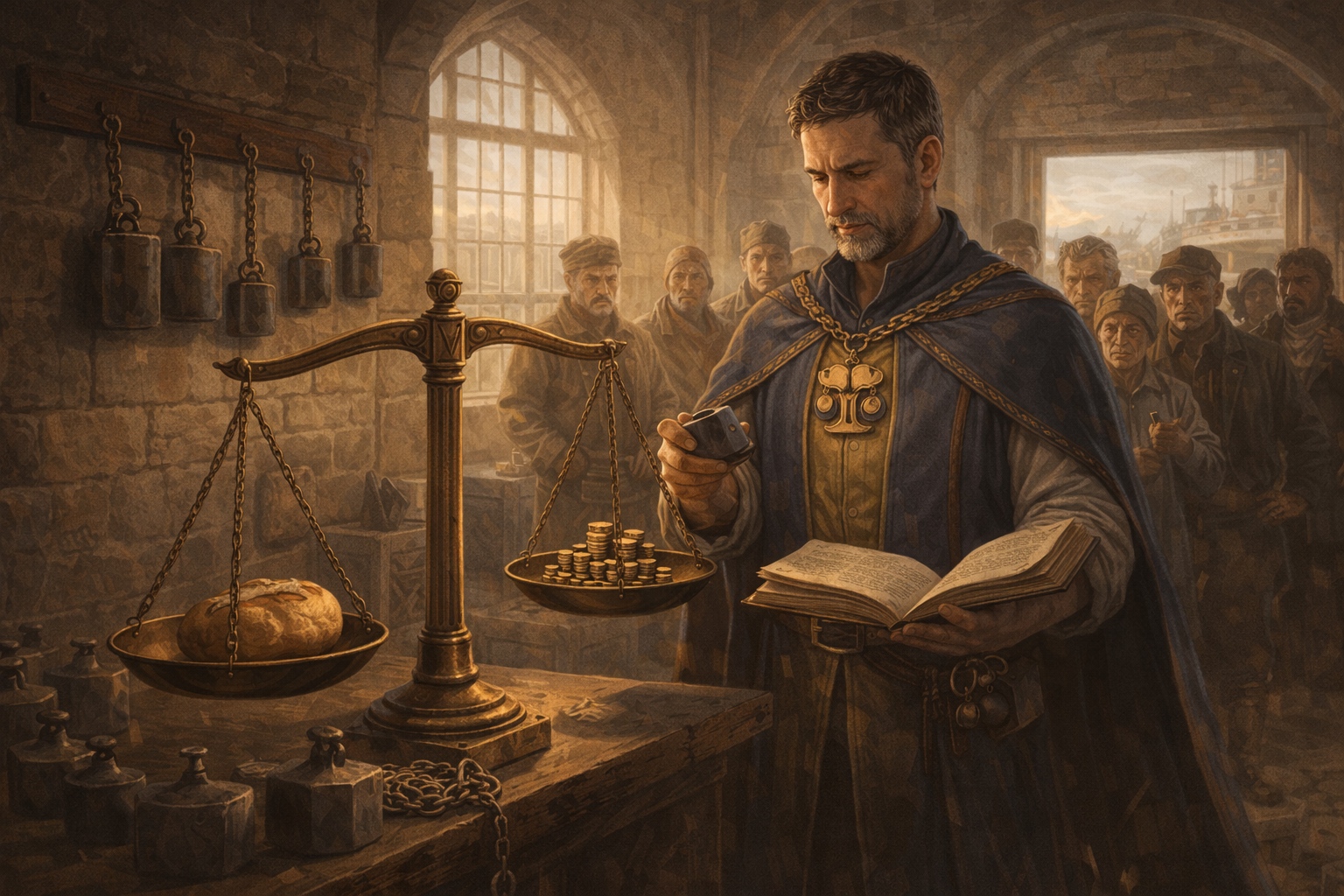
- Symbol: A balance scale where one pan holds a coin and the other holds a loaf of bread: the principle that fair exchange sustains communities.
- Common worshippers: Market inspectors, shopkeepers, dock weighers, warehouse managers, quartermasters, moneychangers, civic auditors, merchants who depend on customer trust, and anyone who has watched a cartel destroy a city.
- Common regions: Dort-wide, with particular strength in inland trade cities where markets feed entire regions and a single corrupt weighhouse can start a riot or famine.
Names & Identifiers
- Common name (internal): The Honest Scale or Vessikar of the Fair Weight.
- Formal name (legal/ceremonial): The Weighing Covenant of Vessikar or The Faith of the Honest Measure.
- A follower: A Weigher or Measure-keeper; those who have taken formal vows are sometimes called Covenant-sworn.
- Clergy (general): Scale-Priests or weight-masters; senior figures overseeing major weighhouses are wardens of measure.
- A temple/shrine: A Weighhouse (often integrated into a civic building rather than built as a decorative temple); large institutional weighhouses are sometimes called measure-halls.
- Notable colloquial names: The Dock Judge (in port cities), Coin-Father (in market districts), The Weight (among merchants), and in crisis, the Savior of Trust.
Origin & History
The Age of Cartel and Silence
Before Vessikar's shard came to consciousness, markets were weapons. Not in the romantic sense of competition, in the literal sense of siege engines. A cartel could starve a city by controlling grain supplies and distributing them only to those who submitted. They could rig scales to make honest merchants appear to be thieves. They could hide counterfeit measures in a warehouse and then prosecute the shopkeeper who used them. A city could have full granaries and still watch its people riot in hunger because the trust that allows exchange had rotted away.
In one of the old accounts, a particular inland trade hub (the city of Measton, in the heart of Dort) suffered this fate during what would come to be called the Famine Behind the Full Warehouse.
The Famine Behind the Full Warehouse
The grain was there. Everyone knew it. The warehouses bulged. But a merchant cartel had made a deal with local nobility: they would control distribution in exchange for a percentage of the profit. The cartel simply... did not distribute. They released grain in quantities so small that prices tripled, then quadrupled. Desperate families traded land, titles, even children for a single bushel. The cartel grew richer and the city poorer, and the granaries remained full.
This might have continued indefinitely, but the cartel made a second error: they needed to manage the impression of honest dealing. So they commissioned counterfeit weights: scales that appeared true but had been doctored with lead hidden in the mechanism. These they distributed throughout the city's merchants, ensuring that anyone trying to sell fairly would appear to be cheating. When riots came, the cartel blamed the merchants, not themselves. But the merchants were furious, and when a shopkeeper's scale was examined, the fraud was unmistakable. The deception was exposed, and then the riots became a revolution.
When the city guards finally stormed the cartel's central warehouse, they found something strange. Lodged in the wall where the official weights were chained (weights meant to be the standard by which all others were measured) was a crystalline shard the size of a woman's fist. It was not hidden or obscured. It was embedded like an accusation, like something that had been thrown from outside time and had struck the very heart of the city's corruption.
The Clerk and the Shard
A woman named Ellenna Steelweight, a clerk in the civic weighhouse who had survived the revolution and the cartel's fall, pulled the shard free. According to the account, she felt no comfort in doing so. Instead, she felt something that moved through her like a rule written in her own bones:
- Make the measure public.
- Make the scale accountable.
- Make theft expensive.
Without understanding how or why, Ellenna began to standardize weights and measures across the city. She posted them where anyone could touch them and verify them. She started audits and wrote down the names of those who cheated and those who kept honest scales. She refused "private arrangements" between merchants and civic officials. She made the keeping of honest weights a public practice and a matter of civic honor.
Others joined her, not out of religious devotion but out of practical self-interest. A marketplace where scales were honest and weights were public meant that prices would be stable. Stable prices meant trust. Trust meant that people would actually come to the market to buy rather than hoard. Honest commerce was more profitable than cartel extortion, if you could maintain the infrastructure of honesty.
When Measure Became Covenant
Within a generation, what Ellenna had begun became formalized. The shard's principle (that measures must be public, scales must be accountable, and cheating must carry weight) became practice. Practice became institution. Institution became worship.
But Vessikar's faith emerged not from abstract theology but from the lived experience of watching a city nearly die from hidden measures. The faith understood, in its bones, that this was not about the love of commerce. Commerce could be honest or dishonest; either way, the faith did not care much. What mattered was that a city cannot remain civilized if its people cannot agree on what is real. If a measure is not trustworthy, then every exchange becomes a negotiation of reality itself. A customer cannot know if they are being cheated. A merchant cannot know if they are being undercut. Trade becomes a trial of strength, and the weak starve.
Vessikar is revered not because he loves merchants, but because he understands something merchants sometimes forget: that the scale is the foundation of peace. When measures are honest, even competitors can coexist. When measures lie, even allies become enemies.
The Spread from Measton
The faith did not spread through missionary work. It spread because every city that adopted the principles of the Honest Scale became more stable and more prosperous than its neighbors. Weighers and Scale-Priests moved from Measton to other trade hubs, bringing the practices with them. Some were hired by civic authorities; some simply established weighhouses and began auditing markets whether they were invited to or not.
Occasionally, a cartel or corrupt regime tried to suppress the faith. The usual result was that trust in markets collapsed, black markets emerged, and violence followed. After a few catastrophic examples, it became clear to rulers that allowing an independent Weighing Covenant to operate was cheaper than attempting to control commerce directly.
Over centuries, the faith of Vessikar became woven into the civic fabric of Dort. In most major cities, the weighhouse is now a semi-independent civic institution, staffed by Scale-Priests but funded by a combination of taxes, merchant tithes, and the fines collected from those caught using false measures. The faith does not rule cities, but it has become impossible to rule a city without it.
The Divine Compact
Vessikar makes a bargain that seems simple but demands constant practice to maintain.
- What Vessikar promises: The infrastructure and blessing needed to make honest exchange possible. Not prosperity (that depends on skill and fortune) but the practical ability to exchange goods and coin without fearing deception. Markets that do not collapse into violence. Cities that do not starve while sitting on full granaries.
- Common boons: The ability to spot false weights instantly (experienced auditors can smell a doctored scale); markets that remain stable even in crisis; audits that stick (once a fraud is documented by a Weigher, it is difficult for the guilty to deny it); customers who return because they trust they are being treated fairly; stable prices that allow for reliable planning; protection from cartel violence.
- Rare miracles: Counterfeit measures spontaneously failing at the moment of attempted use; a city's trust restored after scandal through a public ceremony; a merchant whose business was destroyed by false accusation being publicly exonerated; a cartel's hidden storehouses being revealed to authorities; a crisis averted because people trusted that the measures announced by Weighers would be honored.
- Social benefits: Access to weighhouses and civic institutions; respect from both merchants and consumers; status as a keeper of public trust; employment and advancement within the faith; the practical networks that allow honest commerce to persist.
- Afterlife promise / fear: Weighers believe that their souls, after death, will go to a place of honest scales and perfect measures: a domain where cheating is impossible and every transaction is transparent and fair. What they fear is the opposite: a soul condemned to eternal uncertainty about whether they are being dealt with justly, unable to verify anything, always suspecting deception.
- Costs / conditions: Vessikar demands that followers maintain standards even when it is financially ruinous to do so. A Weigher must report a merchant's cheating even if that merchant is powerful and dangerous. The faith demands public accountability and refuses to allow measures to be kept secret for "security reasons." The faith demands that followers resist the temptation to profit from dishonest scales, even when opportunity arises. Vessikar is demanding not because he is cruel, but because the entire edifice of honest commerce depends on followers who will not bend the scale when power is applied.
Core Doctrine
The faithful of Vessikar understand these convictions as the rules that make communities function:
-
A measure is a promise, and breaking it breaks society. A merchant who posts a weight and then uses a doctored scale is not merely cheating a customer. They are breaking a fundamental agreement that allows strangers to trade with each other. When measures lie, cities cannot function. Therefore, protecting measures is not a business concern; it is a matter of civic survival.
-
Profit is not sin; coercion is. The faith does not care if a merchant makes a good living through honest commerce. The faith cares intensely when a merchant uses control of necessities (grain, water, medicine, fuel) to compel obedience. A merchant who charges high prices during abundance is not violating Vessikar's law. A cartel that withholds necessities during crisis to leverage political concessions is committing an act of violence.
-
In crisis, the scale is sacred. When a city is starving, the scale matters more than usual, not less. It is precisely when people are desperate that dishonest measures become most tempting and most destructive. A merchant who cheats in abundance causes ripples; a merchant who cheats in famine causes deaths. The faith's most fervent practice occurs during crisis.
-
The measure must be public, or it is not a measure. A weight kept in a sealed box, known only to a merchant and their accountant, is not a measure. A scale operated in a dark corner, adjusted secretly, is not a scale. True measures are posted, accessible, and verifiable by anyone. This is not about suspicion; it is about the architecture of trust. If anyone can verify the weight, then no one needs to wonder if they are being cheated.
-
Accountability is not punishment; it is structure. When a merchant is caught using false weights, the response of the faith is not vengeance. It is documentation. The name is written down. The fraud is recorded. The incident is made public. This is not cruelty; this is the mechanism by which markets police themselves. A merchant known to have cheated once will have fewer customers, fewer suppliers willing to work with them, fewer lenders willing to extend credit. The market enforces through withdrawal of trust, not through violence.
-
Restraint is strength. A Weigher who has the power to arrest a merchant and chooses instead to issue a fine and a warning is demonstrating the strength of the faith. A Scale-Priest who could profit from a hidden arrangement and refuses to do so is strengthening the entire structure. The faith's power is not force; it is credibility. Every time a Weigher chooses honesty over profit, they make the next honest choice easier for others.
Soul Coins & Divine Economy
(See also: Soul Coins & Divine Economy)
Vessikar accumulates power through the honest functioning of markets, not through the volume of trade, but through the trustworthiness of the exchange itself.
- How Vessikar gains soul coins: Every honest transaction conducted using verified measures generates a coin. Every merchant who posts a scale publicly and accepts audit without trying to hide anything generates coin. Every Scale-Priest who enforces measures despite social pressure generates coin. The greatest coins come from merchants who accept audits that will cost them dearly: a shopkeeper who discovers their supplier has been delivering short measures and reports it, even though this means their own inventory is short, even though this might bankrupt them. This is the act that generates the heaviest coins, because it is the act most difficult to perform.
- What makes a coin "heavy": Sacrifice under pressure. A merchant who keeps honest scales during abundance is keeping faith. A merchant who keeps honest scales during famine (when they could profit enormously by subtle cheating) generates a coin heavy enough to shift the weight of the world. A Weigher who audits a cartel, knowing this will make enemies and might get them killed, generates coins of immense weight. A city official who refuses a bribe to look the other way from a merchant's false measures contributes to the heaviness of Vessikar's currency.
- What Vessikar spends coins on: Miracles of trust restoration. Ensuring that audits and investigations succeed even against powerful opposition. Occasionally granting inspiration to a Weigher who is struggling to solve a complex case of hidden fraud. Protecting weighhouses from sabotage. Maintaining the institutions that make honest commerce possible. Supporting Scale-Priests in regions where the faith is young and not yet supported by established civic infrastructure.
- Trade: Vessikar maintains strong alliances with Talbar, who seals contracts and ensures that deals are honored. They cooperate on ensuring that agreements contain honest terms and that the scales backing those agreements are true. Vessikar has formal trade relationships with Themela, god of law, ensuring that civic courts enforce measures consistently. Vessikar occasionally trades with Caldrin, god of routes and journeys, to ensure that merchants traveling trade roads maintain honest measures across territories. Vessikar does not trade with Kraut directly, but they share aligned interests; a merchant who cheats with false measures destabilizes the agricultural markets that Kraut's faith depends on.
- Infernal competition: The greatest threat to Vessikar's domain comes from Tempters who corrupt merchants into accepting deals that involve hidden weights, counterfeit measures, or agreements to cheat on a systematic basis. Infernal forces profit from market collapse, from chaos, from the breakdown of trust. Vessikar's counter-strategy is not combat but infrastructure: every time a Weigher documents a fraud and prevents it from spreading, they are weakening the Tempters' ability to operate. The more public the measures, the harder it is for infernal corruption to hide.
Sacred Spaces
Vessikar's temples are not separated from commerce but embedded within it. A weighhouse is a sacred space precisely because it is integrated into the marketplace, not elevated above it, but functioning as its foundation.
Weighhouses: The Architecture of Trust
A public weighhouse is typically a civic building with multiple components:
-
The Scale Chamber: A large, well-lit room with multiple balances of different sizes, mounted on sturdy tables or pedestals. The room is designed so that anyone entering the market can see the scales in use. All operations are conducted visibly. There are no back rooms where weights are adjusted in secret. The architecture itself enforces transparency.
-
The Posted Measures: Metal or stone standards mounted on the walls, clearly labeled and accessible for public inspection. These are the reference weights against which all other scales must be calibrated. Anyone can approach and touch them, can verify that they match. Some weighhouses mount multiple copies at different heights so that both standing merchants and seated customers can verify the measures.
-
The Ledger Chamber: A smaller room where the Scale-Priests maintain their records: documentation of every fraud detected, every merchant audited, every measure verified. Some ledgers are public record, displayed in sections accessible to anyone who wishes to check whether a particular merchant has been caught cheating. Some ledgers are sealed, kept only for the faith's own reference.
-
The Sealed Emergency Ledger: This is the most sacred space within a weighhouse. In this chamber, locked behind doors that require multiple keys (held by different Scale-Priests) is the Ledger of Last Resort: a complete record of every emergency action taken during crisis. If a famine forced prices up beyond all normal bounds, the ledger records it. If a cartel was broken and their measures were all discovered to be false, the ledger records it. If a Weigher accepted a bribe and later confessed, the ledger records it. This ledger is never shown to the public during the crisis itself; to do so would undermine confidence. But after the crisis passes, the ledger is opened and the record is made public. This is how the faith maintains credibility: by proving, after the fact, that they kept honest records even when dishonesty would have been profitable.
-
The Merchant's Register: A table where merchants can register the exact weights and measures they are using. This is not mandatory, but a merchant who registers their measures gains a degree of protection. If someone claims they were cheated by that merchant, the claim can be investigated by checking the registered measures. A merchant who refuses to register their weights becomes immediately suspect.
-
The Dispute Chamber: A formal room where Weighers arbitrate disagreements between merchants and customers. A customer claims they received short measure; a merchant claims their scale is true. The Weighers examine both parties' scales, consult the public standards, and make a judgment. The judgment is not issued as a court verdict but as a statement of what the measures actually show.
What makes a space sacred to Vessikar is not the grandeur of its architecture but the understanding that what happens here is foundational to civic life. A weighhouse can be a simple room with a single balance, a table of posted measures, and a ledger. It can be ornate and grand. Either way, it is sacred because it is the place where strangers agree to believe the same thing about what is real.
Private Weighhouses and Merchant Affiliations
Some larger merchant guilds maintain their own weighhouses, staffed by their own Weighers. This creates a theological tension within the faith: can a private weighhouse be truly honest, or is it inherently biased in favor of its patron guild?
The faith's answer: a private weighhouse can be honest, but it requires more vigilance. These weighhouses are required to:
- Allow public access to the scales during business hours
- Submit to random audits by independent Scale-Priests
- Maintain their ledgers in a form that allows external verification
- Accept arbitration of disputes involving outside parties
A private weighhouse that violates these standards is effectively blacklisted; Weighers will refuse to work there, merchants will avoid using its scales, and the faith will issue public statements that its measures cannot be trusted.
Organizational Structure
The faith of Vessikar is organized around civic integration and practical accountability rather than theological hierarchy.
Scale-Priests and Wardens
Scale-Priests are the ordained clergy of the faith, trained to examine measures, detect fraud, maintain ledgers, and arbitrate disputes. They are expected to be impartial above all else. A Scale-Priest found to be showing favoritism is removed from service; their credentials are revoked, and the faith publicly announces that they can no longer be trusted.
Wardens of Measure are senior Scale-Priests who oversee major weighhouses. They supervise junior priests, maintain the authority to conduct major audits, and represent the faith in civic councils. A Warden is expected to have decades of experience and an unquestioned reputation for honesty.
Regional Conventions
Once yearly, Scale-Priests gather in regional conventions to discuss complex cases, refine practices, and ensure consistency. These conventions have real authority; a decision made at a convention is binding on all participating weighhouses in that region. But the authority rests entirely on consensus. If a convention makes a decision that seems unjust, Scale-Priests can petition the next gathering to revisit it.
Independence from Civil Authority
The faith maintains strict separation between weighhouses and civic government, despite the physical integration. A Weigher is appointed by civic authorities but can only be removed by the faith itself. If a city government attempts to force a Scale-Priest to falsify records or ignore fraud, the entire faith can withdraw its services, which is politically catastrophic, as markets immediately lose credibility.
This leverage is rarely used but always remembered. It keeps civic authorities from attempting to corrupt the weighhouses.
Training and Initiation
Becoming a Scale-Priest requires apprenticeship (typically three to five years) under an established Warden. The apprentice learns to read scales, to identify counterfeit measures, to maintain ledgers, and to conduct audits. But the most important training is ethical: learning to refuse profit, to maintain honesty under pressure, and to understand that the weight of the scale is more important than any single transaction.
Only after demonstrating both technical skill and unquestionable ethical character can an apprentice be formally ordained as a Scale-Priest.
Entering the Faith
Conversion to the faith of Vessikar is gradual and often unintentional.
Soft entry is constant and implicit. A merchant who decides to post their weights publicly is already practicing the faith's values. A customer who asks to verify a scale before making a purchase is already a believer, whether they know it or not. A city official who insists that merchants' measures be inspected is already doing Vessikar's work.
Formal initiation typically begins with an invitation from an established Weigher or Scale-Priest. The candidate is asked whether they understand the obligation: to maintain measures honestly even when dishonesty would be more profitable, to report fraud even when it would be politically dangerous, to accept audits without attempting to hide anything.
If the candidate agrees, they take the Oath of the Open Scale:
"I swear upon the scale that shall weigh my soul, that I shall not hide measures in darkness, that I shall speak truth about weight and value even when silence would profit me, that I shall accept inspection without evasion, and that I shall maintain the faith that allows strangers to trade without fear of deception. If I break this oath, may my name be written in the ledger of dishonor, and may no merchant trust my scale forevermore."
This oath is taken publicly, usually in a weighhouse with witnesses present. It is recorded in a formal register and, in some cities, posted publicly.
What makes an enemy rather than a convert: A merchant who knowingly uses false measures, who attempts to hide their scales from inspection, who bribes weighers to ignore fraud, or who deliberately spreads counterfeit measures to other merchants. The faith does not attempt to convert these people; it opposes them directly through documentation, exposure, and if necessary, through civic action.
The Faithful in Practice
A devoted Weigher is recognizable by their specific behaviors and instincts.
-
Posts their measures publicly. Whether required to do so or not, they make their scales visible and available for inspection. This is not paranoia; it is the core practice of the faith. If no one can verify your scale, then you are not really operating fairly; you are just claiming to be.
-
Accepts emergency audits without resistance. When a Scale-Priest appears and asks to inspect a merchant's weights, the faithful Weigher does not delay or equivocate. They open their scales, invite inspection, and if fraud is found, they accept the judgment and the consequences.
-
Refuses exceptions. A powerful merchant arrives and asks for a private arrangement: "just this once, just for my goods, no one needs to know." A faithful Weigher refuses. Not harshly, not as a personal judgment, but as a matter of principle. The scale applies to everyone.
-
Audits their own books first. Before a city inspector arrives, a faithful merchant conducts their own audit of their measures. They look for any place where a scale might have drifted, where a weight might have been corrupted, where they might have made an honest error. They document it. They correct it. This practice (self-policing before external inspection) generates the heaviest soul coins.
-
Teaches others to verify. When customers arrive, the faithful Weigher invites them to check the scale themselves. "Would you like to verify? Here is the standard weight. You can see that they match. Feel free to check again if you wish." This practice seems to invite distrust, but it actually generates the opposite. A merchant who invites verification is a merchant whose scales are true.
-
In crisis, holds the line harder than usual. This is the test of faith. When a city is starving and there is no grain arriving, and a merchant is desperate, and the price would triple if they raised it; a faithful Weigher does not let the measure slip. They maintain the standard weight. They refuse to engage in the subtle cheating that everyone would understand. This sacrifice is what generates the coins heavy enough to move gods.
Taboos
-
Hidden weights and false bottoms. Any attempt to conceal the true nature of a scale, or to create mechanisms that make a scale show one measurement while delivering another, is a profound violation.
-
Confiscation disguised as fees. A civic authority that claims the right to take a percentage of a merchant's goods "for inspection" or "for handling" is engaging in a form of theft. The faith opposes this intensely, viewing it as one of the primary ways that governments corrupt the measure.
-
Exclusive control of necessities. When a single merchant or cartel controls access to a necessity (grain, water, medicine, fuel) and uses that control to compel political obedience, they are committing violence. The faith treats this as a grave violation, one that may justify direct intervention.
-
Price-gouging in disaster. There is a difference between raising prices because supply is genuinely scarce (acceptable) and withholding supply to artificially drive prices up (violation). A merchant who holds grain in a warehouse while people starve, raising prices incrementally to maximize profit, is engaging in a form of siege warfare. The faith opposes this.
-
The deliberate spread of counterfeit measures. A merchant who creates false weights with the intent of distributing them to other merchants (so that innocent shopkeepers will appear to be cheating) has committed an act of calculated sabotage. This is treated as a serious crime by the faith.
-
Silent corruption. A Scale-Priest who knows about fraud but remains silent to protect a friend, a family member, or a patron is committing a violation of their vows. The silence is the crime, not the fraud itself.
Obligations
-
Maintain accurate measures. Every initiated follower of Vessikar is expected to keep their scales in proper working order, to have them inspected regularly, and to replace any weight that becomes suspect.
-
Accept inspection. Followers must allow Scale-Priests to audit their measures without delay or evasion. Refusing inspection is equivalent to admitting guilt.
-
Report fraud. If a follower discovers that a merchant is using false measures, or that weights are being sold that are not true, they must report it to the faith. Knowing about fraud and remaining silent is itself a form of fraud.
-
Tithe to the weighhouse. Merchants who benefit from the faith's infrastructure are expected to contribute financially to the maintenance of weighhouses and the support of Scale-Priests. The tithe is typically a small percentage of profits, but it is not optional.
-
Participate in audits and civic inspections. When the faith or civic authorities conduct major audits of the marketplace, initiated followers are expected to cooperate fully.
Holy Days & Observances
All holy days across Dort are listed in the Festival Calendar.
The Chain-Measure
Date: First market day of the new year.
This is the faith's most solemn observance. Throughout the city, all weights and scales are checked publicly. Scale-Priests move through the marketplaces with the reference standards, comparing every merchant's scales to the official measures. Those that are true are blessed and publicly praised. Those that are found false are immediately confiscated and the merchant's name is recorded.
Scale-Priests read aloud (loudly enough to be heard across the marketplace) the names of merchants who donated to emergency stores in the past year (deserving of public praise) and those who were fined for cheating or caught using false measures (serving as warning to others). The ritual is meant to make clear: honest merchants will be celebrated, dishonest merchants will be exposed.
The celebration continues through the evening, with feasts and speeches honoring the merchants who have maintained the faith's principles. Taverns offer discounts to Scale-Priests. The city, for a day, celebrates the infrastructure that keeps it alive.
The Open Ledger
Date: Declared after major scandal or disaster; timing is not fixed.
When a cartel is broken, or a major fraud is exposed, or a weighhouse has to make emergency decisions during crisis, the faith conducts the ritual of the Open Ledger. All sealed records are opened. The public is invited to examine the ledger and understand what happened. The testimony of witnesses is recorded. The explanations of those involved are documented.
The point is not purity or judgment. The point is restoring trust fast enough to prevent violence. By opening the ledger and showing what the faith actually did (the decisions it made, the reasons for those decisions, the mistakes that were made and corrected) the faith demonstrates that it is willing to be held accountable. This accountability is what allows trust to be restored.
The Measure's Feast
Date: Longest day of the year, celebrated at sunset.
This is a minor observance, more social than solemn. Communities gather in marketplaces to share food and drink, and merchants give away small portions of their goods to the poor. The theological point is that fair trade should benefit the community as a whole, not concentrate wealth in the hands of a few.
Scale-Priests often use this day to teach, explaining to customers how to verify a scale, how to spot counterfeit weights, what questions to ask when making a purchase. The feast is education, not just celebration.
Ceremonies & Rituals
The Chain-Measure Ritual
This is the core ceremony of the faith, performed in its most elaborate form during the annual Chain-Measure holy day, but also used whenever weights need to be officially verified or standards need to be established.
Setting: The public market or a weighhouse. The ceremony requires witnesses: ideally, any merchant or citizen who chooses to attend.
Procedure:
-
Invocation: A senior Scale-Priest invokes Vessikar's presence: "Vessikar, god of honest measure and the scale that does not lie, witness this verification and bless these weights with truth."
-
Presentation of the Standard: The official reference weights and measures are presented to the gathering. They are removed from their sealed storage and displayed openly.
-
Comparison: Each merchant's scales are compared to the standard, one by one. The Weigher places the standard weight on one side of the merchant's scale and watches to see if it balances. If it does, the scale is declared true. If it does not, the difference is measured precisely and recorded.
-
Blessing or Correction: Scales found to be true are blessed with a brief prayer. Scales found to be false are immediately corrected, either adjusted on the spot or confiscated. The merchant is informed of the result and given a copy of the measurement for their own records.
-
Recording: A Scale-Priest records the results (merchant name, scale condition, any fraud detected) in the official ledger. This record is public. The ledger is displayed so that anyone can see it.
-
Public Pronouncement: The results are announced loudly so that merchants and customers throughout the market can hear. This is not done privately; it is done as a public proclamation.
The Ledger Sealing
Performed when a weighhouse transitions from normal operations to emergency measures during crisis (famine, plague, disaster), this ritual formalizes the understanding that decisions will be made that would be considered violations in normal times.
Procedure:
-
A senior Warden of Measure declares the emergency before witnesses.
-
They present the normal ledger (the record kept during stable times) and officially close it. Future entries will go into a separate ledger.
-
They explain, clearly and loudly, what new rules will apply during the emergency. For instance: "During this famine, we will accept it if a merchant charges prices two times normal, but not three times. We will not pursue merchant accusations unless clear fraud is involved. We will prioritize distribution to the neediest families."
-
A second Warden of Measure agrees to these terms, or objects. If they object, the dispute is recorded and mediation is sought.
-
The new ledger is sealed (not locked away, but formally marked as the emergency ledger) and the emergency measures begin. Later, after the crisis passes, this ledger will be opened, the decisions reviewed, and the faith will be held accountable for what it permitted during the emergency.
This ritual is meant to prevent something important: the drift from exceptional measure to accepted practice. By formally declaring the emergency and formally separating the emergency ledger, the faith ensures that extraordinary decisions cannot become the new normal.
The Emergency Audit Ritual
When fraud of unusual scale or significance is detected, the faith conducts a formal emergency audit. This ritual is used when a cartel is broken, when a warehouse is found to contain counterfeit weights, or when a major merchant is suspected of systematic fraud.
Procedure:
-
Declaration: A Warden of Measure publicly declares that an emergency audit is being conducted, naming the merchant or location under investigation.
-
Sealing: The location is sealed (no goods can leave, no measures can be hidden or destroyed) until the audit is complete.
-
Investigation: Multiple Scale-Priests spend days or weeks examining every scale, every weight, every record. They interview merchants, customers, suppliers. They recreate transactions to determine if fraud actually occurred.
-
Documentation: Every finding is recorded in extreme detail. Not just "this merchant cheated" but "on market day of the third month, merchant A used a scale that was doctored with lead in the bottom, cheating customer B of approximately one copper per transaction, across approximately forty transactions, for a total theft of forty copper."
-
Public Pronouncement: The results are announced publicly, with specific findings, specific victims, and specific consequences (fines, confiscation, banning from the market, etc.).
-
Restoration: If victims can be identified, they are compensated from fines. If they cannot be identified, the compensation is given to the community general fund.
Ceremonial Attire
The Balance Pendant
Worn by all initiated Weighers and Scale-Priests. A pendant bearing the symbol of Vessikar: the balance scale with coin on one side and bread on the other. The pendant is typically made of silver or bronze, depending on rank. A scale-priest who has served for decades might have a pendant of gold.
The pendant is never hidden. It is worn visibly, always. An initiated Weigher without the pendant is signaling that they are not under the covenant, that they should not be trusted.
The Auditor's Sash
Worn by Scale-Priests during official inspections and audits. A sash of deep blue or grey, marked with symbols representing different weights and measures: a visual reminder of the specific measurements they are sworn to enforce. The sash also bears pockets or pouches for carrying the tools of auditing: small standard weights, calipers, measuring tools, and a compact version of the reference standards.
The Sealed Ledger Carried as Sacred Object
When a Warden of Measure travels to conduct an audit in a distant market, they carry the sealed ledger (the emergency records from previous crises) as a sacred object. It is wrapped in cloth and transported carefully, never left unguarded. This physical object reminds everyone that the faith maintains accountability across time, that decisions made in crisis will be reviewed and justified later.
The Market Cloak
Worn by Scale-Priests working in open-air markets or traveling to different locations. A practical cloak of durable wool, marked with the symbol of Vessikar and treated with oils that make it water-resistant. Pockets and interior pouches allow the Priest to carry multiple reference weights and measurement tools.
Historical Figures
Ellenna Steelweight, the Founder
The clerk who found Vessikar's shard lodged in the wall of Measton's weighhouse and understood what it meant. Ellenna was not a military leader or a noble; she was a woman who maintained records and who understood that accurate records were the foundation of a functioning city.
After the cartel was broken and the revolution had burned itself out, Ellenna systematized the keeping of weights and measures. She trained others. She established the principle that scales would be public and verifiable. She created the first Registry of Measures, documenting which merchant used which scales and holding them accountable to standards.
Ellenna died quietly, with no dramatic last words or divine revelation. But her life established a principle: that the boring work of maintaining accurate records is sacred work, and that a person who does this work faithfully serves their god.
Every Scale-Priest is, in some sense, doing Ellenna's work.
Maresh the Impartial
A legendary figure from approximately two centuries after Ellenna, Maresh was a Warden of Measure in a major city during a time when political pressure on weighhouses was intense. A noble family attempted to bribe Maresh to ignore fraud by a merchant in their employ. When Maresh refused, they attempted intimidation. When intimidation failed, they attempted to have Maresh removed from position.
Maresh publicly documented every bribe attempt and every threat. The Warden presented the evidence to the civic council and announced that if the attempts at intimidation continued, the entire weighhouse would withdraw its services and the city's markets would lose credibility.
The noble family backed down. Maresh remained in position for another thirty years, becoming the symbol of the faith's willingness to stand against power. The story teaches that a Weigher who cannot be moved is more powerful than any individual or faction, because without them, commerce collapses.
The Witness of the Hidden Ledger
A more recent figure (approximately a century ago), known only as "the Witness," was a Scale-Priest in a city that experienced severe famine. The civic government asked the Witness to manipulate records, to hide the fact that supplies had been hoarded by a cartel, to make it appear that the supplies simply did not exist.
The Witness refused and continued documenting fraud. When the government attempted to imprison the Witness, they escaped and hid the ledger: the full, true record of where the supplies were and who was hoarding them. The hidden ledger became leverage; the government eventually released the Witness to recover it.
After the crisis, the Witness revealed the ledger to the public. The cartel was broken, the supplies were distributed, and the government official who had requested the falsification was removed from office.
The Witness was exiled but became a folk hero: the symbol of the faith's willingness to sacrifice everything for the truth of the measures.
Sacred Relics & Artifacts
The First Scale
The original balance scale used by Ellenna when she began standardizing measures in Measton. It is a simple balance made of wood and bronze, showing significant wear and age. The mechanism has been repaired and rebuilt multiple times, but the basic structure remains.
- Description: A balance scale approximately two feet long, mounted on a central fulcrum. The pans are made of bronze, worn smooth by centuries of use. The wood is dark with age and stained with the residue of countless transactions.
- Origin: Created by an unknown craftsman before the cartel's fall; used by Ellenna to establish the first official measurements in Measton.
- Powers or Significance: No magical properties, but profound symbolic weight. To measure something on the First Scale is to invoke the entire history of the faith: the guarantee that measures have remained true since Ellenna's time.
- Current Location / Status: Housed in the central weighhouse of Measton, kept in a ceremonial chamber that is open to the public. Measures are rarely made on it now (it is too precious to risk damage), but it is displayed during the Chain-Measure holy day and used in major ceremonial rituals.
The Chain-Weights
A set of original certified measures from the earliest days of the faith: standard weights made from carefully calibrated metal that was verified repeatedly. The weights are of various denominations (small weights for precise measurement, larger weights for bulk goods) and they form a sequence that mathematicians refer to as "the chain."
- Description: A collection of weights ranging from a quarter-ounce to fifty pounds, stored in a wooden case lined with velvet. Each weight is inscribed with its value and the date it was certified. The earliest weights are marked with Ellenna's personal seal.
- Origin: Crafted during Ellenna's lifetime and certified through repeated use and comparison against other known standards.
- Powers or Significance: When a new weighhouse is established in a different city, one weight from the Chain is taken from Measton and carried to the new location. This serves as the primary standard for that new weighhouse. Over centuries, the Chain has been divided and redivided as the faith has spread, but each weight retains the spiritual significance of having been part of the original set.
- Current Location / Status: The primary Chain is kept in Measton. Secondary weights are distributed to major weighhouses. The faith maintains careful records of where each weight is located and ensures they are regularly compared against each other to verify that none have drifted.
The Sealed Ledger of the Last Great Famine
An emergency ledger from a documented famine approximately three centuries ago, in which a city's supplies ran critically low and the faith had to make extraordinary decisions about rationing and price-fixing.
- Description: A leather-bound ledger containing entries in the careful handwriting of multiple Scale-Priests. The ledger documents: the daily price of grain, the decisions made about redistribution, accusations of fraud that were investigated, decisions to permit higher prices in order to incentivize new supplies to arrive, and the ultimate outcome (famine ended, no major catastrophe, market recovered).
- Origin: Created during the famine as a record of emergency decisions; later sealed and preserved as a record of what the faith actually did in crisis.
- Powers or Significance: The ledger is less a relic and more a teaching tool. It is opened periodically and new Scale-Priests study it to understand how the faith has navigated crises in the past. It demonstrates that honesty and accountability can coexist with pragmatic emergency decisions.
- Current Location / Status: Kept in a secure vault in a major weighhouse, accessible to Scale-Priests and historians. The ledger is read aloud, portions at a time, during the Chain-Measure holy days, allowing the public to understand what happened during the famine and how the faith responded.
Sects
The Dock Weighers
How they refer to themselves: the Harbor Guard or the Dock Keepers
The Dock Weighers are Scale-Priests who specialize in maritime trade, overseeing the weighing of goods as they are loaded and unloaded from ships. They are obsessed with preventing corruption at the points where trade enters and leaves the city, viewing ports as the chokepoints where a cartel could most easily control commerce.
Dock Weighers are known for being harsh, practical, and uncompromising. They will delay a ship's departure if they detect even the suspicion of false measures. They maintain elaborate records of every shipment and cross-reference them against what is documented as having been sold in the city markets.
The tension within the sect is between efficiency (ships pay a cost for every day delayed in port, which falls on consumers) and integrity (allowing a false measure to slip through port is allowing corruption to spread throughout the region). The Dock Weighers generally err on the side of integrity, which makes them unpopular with merchants but invaluable to the faith.
The Market Judges
How they refer to themselves: the Fair Exchange Keepers or the Market Wardens
Market Judges focus on the civic integration of weights and measures within urban markets. They are the Scale-Priests most likely to be involved in community work, in teaching customers how to verify scales, and in maintaining the day-to-day infrastructure of honest commerce.
Market Judges are often less severe than Dock Weighers, understanding that building trust requires some degree of tolerance for honest error or minor drift in scales. However, they are uncompromising about systematic fraud or deliberate cheating.
The sect has developed techniques for winning over skeptical merchants, showing that honest scales actually improve their business by building customer loyalty, documenting cases where merchants' revenue increased after they began allowing public inspection of measures.
The Coin-Scale Vessikarans
How they refer to themselves: the Currency Guardians or the Moneychanger's Oath
This sect specializes in the particular challenges of currency exchange, verifying that coins are genuine, that they contain the promised weight of precious metal, and that moneychangers are not shaving coins or engaging in other subtle forms of fraud.
Coin-Scale Vessikarans maintain specialized tools for testing coins: scales that measure weight precisely, instruments for measuring diameter, acids that test purity. They are less concerned with the commodity trade and more concerned with the fundamental unit of exchange: the currency itself.
The sect is sometimes viewed with suspicion by other Vessikarans as being too focused on finance and too close to bankers and moneychangers. There is a persistent theological concern that Coin-Scale Vessikarans might become corrupted by the wealthy interests they work with. The mainstream faith maintains oversight to ensure this does not occur.
Heresies
The Closed Exchange
How they refer to themselves: the Stable Order or the Chosen Guardians
The Closed Exchange argues that markets should be managed by a chosen few "for stability." In practice, this is cartel religion dressed in Vessikar's language. They maintain that the faith should cooperate with merchant cartels, that prices should be controlled by those who understand commerce best, and that the public's role is to trust in the wisdom of the controllers.
The result is beautiful shrines in wealthy districts, quiet rewriting of measures to favor dominant merchants, and selective enforcement of rules against those wealthy enough to pay for exemptions.
The mainstream faith opposes this vigorously, seeing it as a return to the exact corruption that Vessikar's shard came to prevent. Many cities have purged Scale-Priests suspected of sympathizing with the Closed Exchange, sometimes violently.
The Invisible Measure
How they refer to themselves: the True Reckoners or the Hidden Balance
This heresy argues that the true measure cannot be physical, that it is a matter of spiritual understanding. They claim that a merchant with true faith does not need public scales or formal verification; they should simply be trusted to act fairly because their spiritual alignment with Vessikar is perfect.
In practice, this leads to merchants claiming exemption from inspections, refusing to post their measures, and insisting on private arrangements. The mainstream faith considers this absurd and dangerous, a return to the era of hidden measures and cartels.
The Absolute Standard
How they refer to themselves: the Pure Measure or the Unchanging Scale
This heresy argues that any adjustment to measures or any recognition of legitimate emergency variation is a betrayal of the faith. During a famine, they insist, measures must remain exactly the same, prices must be controlled absolutely, and any merchant who raises prices should be executed.
In practice, this leads to economic collapse, as merchants stop bringing goods to market when they cannot adjust prices to match scarcity. The mainstream faith recognizes that some flexibility in pricing is necessary during crisis, even as measures themselves remain true.
Cults
The Cult of the Perfect Scale
How they refer to themselves: the Seekers of Absolute Truth or the Keepers of the One True Measure
This cult claims that Vessikar revealed to them the existence of a "perfect measure": a single, absolute standard to which all other measures should conform. They believe that if they can find or create this perfect measure, they will unlock divine power and will be able to enforce honest commerce across the entire world without the need for individual Scale-Priests or civic infrastructure.
In practice, they engage in elaborate theoretical work attempting to calculate the perfect standard, often arriving at measurements that make no practical sense. The mainstream faith views them as harmless but deluded.
The Auditors of Vengeance
How they refer to themselves: the Wrath of the Scale or the Just Investigators
This cult believes that the punishment for fraud should be severe: execution, mutilation, or permanent exile. They take the role of auditor but use it as cover for violence against merchants they suspect of cheating.
The mainstream faith opposes them forcefully, seeing them as a corruption of the faith's core principle that accountability is structural, not punitive. A merchant who cheated should be exposed and lose business, not be executed.
The Alchemists of Weight
How they refer to themselves: the Measure-Changers or the Scale Priests of Secret Science
This cult believes that through magical means they can create scales that are perfectly true regardless of external factors: scales that cannot be corrupted or falsified. They claim to be pursuing this technology through arcane research and experimentation.
The mainstream faith is skeptical of claims about magical solutions to what is fundamentally a problem of trust and accountability. They view the Alchemists as wasting resources on impossible goals rather than maintaining the practical infrastructure that already works.
Presence in the Shattered Domain
-
Territory aesthetic: An endless covered market under an impossibly high roof. Every stall has a posted measure displayed prominently. Every posted measure is true, or the stall vanishes, ceasing to exist. The ground is paved with ledgers, the walls lined with chains of certified weights. There is no cheating here, no hidden measures, no cartels. The very architecture prevents dishonesty. It is not beautiful in the way temples are beautiful, but it is perfectly functional. Everything works exactly as promised.
-
Likely allies: Talbar (contracts must rest on honest measures, or they collapse), Themela (law is built on the assumption that people can agree on facts, which requires true measures), Caldrin (trade routes only function if measures are consistent across regions). The relationship with Kraut is unformalized but deeply aligned; cartels destabilize agricultural markets as thoroughly as they destabilize grain distribution.
-
Likely rivals: Deities of hoarding, theft, and deception. Any power that profits from the collapse of trust and the emergence of black markets opposes Vessikar. The Tempters in particular work against the faith, attempting to establish hidden measures and corrupt weighhouses.
-
Stance on the Godless: Pragmatic and unmoved. The Godless may not worship Vessikar, but they still buy bread and trade in markets. "They still buy bread," the faith teaches. "Let them buy it fairly." The faith is not interested in converting the Godless; it is interested in ensuring that exchange happens honestly regardless of who the buyer believes in.
Adventure Hooks
-
Counterfeit Weights Crisis: Someone is distributing counterfeit weights throughout the city's marketplace, not heavy enough to immediately betray themselves, but slightly off, making honest merchants appear to be cheating their customers. Customers are being defrauded. Trust is eroding. The Scale-Priests must trace the source of the counterfeits before the market collapses into violence.
-
The Burning Weighhouse: A port's central weighhouse burns down the night before a major grain shipment arrives. The city is thrown into chaos; without the weighhouse, cargo cannot be verified, and merchants and customers are paralyzed by uncertainty. The faith must determine whether this was accident or sabotage, and must establish emergency measures to prevent cartels from exploiting the chaos.
-
The Closed Exchange Temptation: During a severe famine, the Closed Exchange offers stability; they claim they can manage distribution and prevent riots. All the civic authorities have to do is grant them a temporary monopoly. The faith must argue against this without being seen as indifferent to the city's suffering, and must demonstrate that fair measures can maintain stability even in crisis.
-
The Warden's Impossible Choice: A Warden of Measure discovers that their own child is systematically cheating customers using false measures. The evidence is clear and overwhelming. The law requires investigation and exposure. But the child is the Warden's only family, and exposing them will destroy the family's reputation and livelihood. The Warden must decide whether their vows to the faith are stronger than their love for their child.
-
The Hidden Ledger Discovered: An old ledger is discovered in a ruined building, documenting a major cartel's operations from two centuries ago, including names of civic officials, merchants, and military officers who were involved. The ledger is fragile and could be destroyed easily. Various factions want to buy or steal it. The faith must decide whether to preserve it, publish it, or use it as leverage.
-
The Merchant's Dilemma: A merchant of good faith discovers that their supplier has been delivering short measures for years, cheating them systematically. The merchant would be technically justified in passing this loss along to customers. But doing so would require them to use false measures themselves. The merchant asks the faith for guidance: what does honesty require in this situation?