Niazi Tribe
Bafao's story is woven into the very fabric of Funta itself, a fishing village that grew into something far more substantial through the vision and dedication of those who understood that a community's strength lies not merely in commerce or industry, but in the preservation of what makes it home. The Niazi family stands at the heart of this story, their roots reaching back to the original settlers who first cast nets into the waters and saw in these lands a place to build something lasting. Generations of stewardship have transformed Bafao into a thriving port town where tradition and progress dance together, where the old ways are honored even as new possibilities unfold. The Niazi name has become synonymous with this delicate balance, with leadership that knows when to hold steady and when to reach forward.
Jabari Niazi: The Chieftain of Bafao
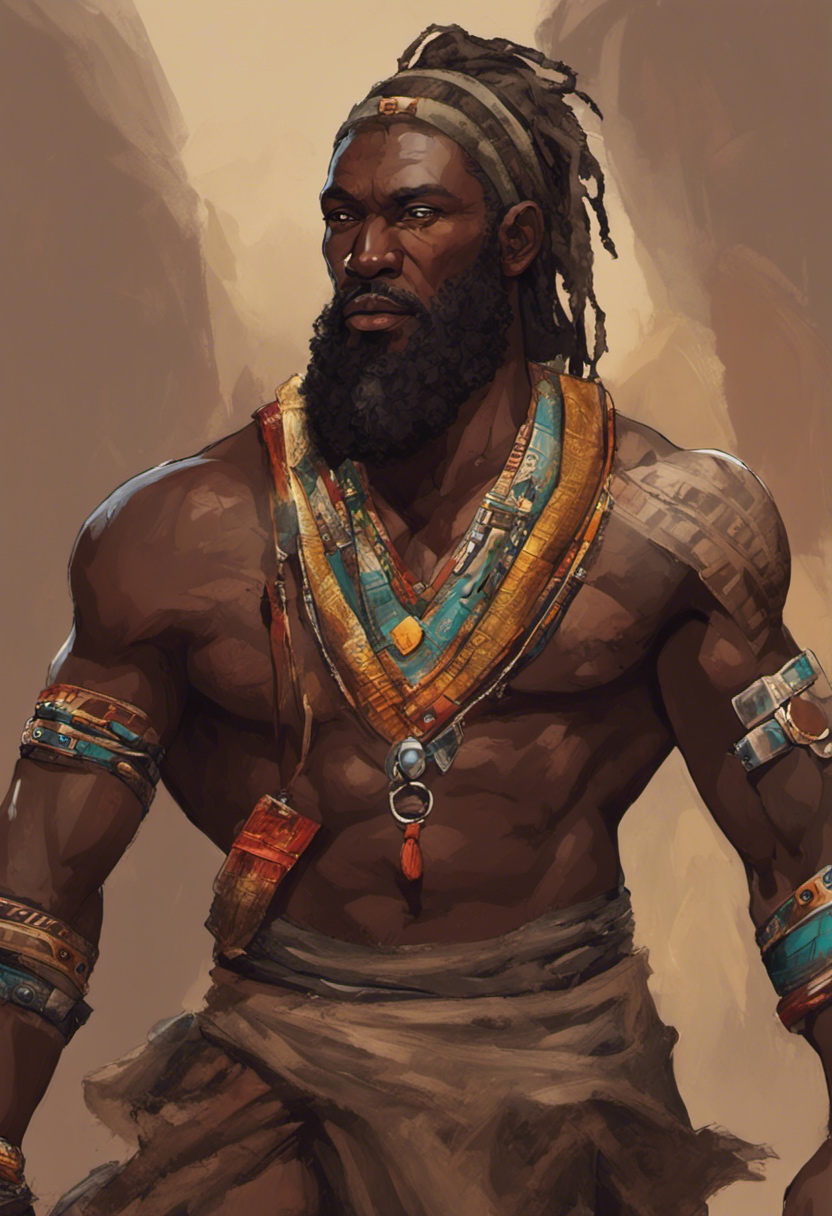
Jabari Niazi is a man whose physical presence announces him before he speaks: standing six feet four inches tall with a broad, muscular build earned through decades of work alongside the people in Bafao's shipyards, fishing boats, and fields. His rich dark brown skin bears the weathering of countless years beneath the Funta sun, each line a record of his life lived alongside those he serves. His most striking feature is perhaps his hazel eyes, which often twinkle with a wisdom tempered by hidden humor, a reminder that he never takes his position so seriously that he forgets the simple joys of human connection. A thick beard, generously peppered with gray, frames a strong square jaw, and he carries himself with the natural authority of someone born to leadership yet never corrupted by it.
When Jabari dresses in the traditional Funta garments that are his custom, he does so deliberately. The fabrics are richly embroidered in vibrant colors: patterns that speak of his status and his deep cultural pride, a visual language announcing that in Bafao, the old ways remain sacred. His family's roots run deep into the soil of this village, his ancestors among those original settlers who saw possibility in these waters and built something that would outlast them. From his earliest days, Jabari was groomed for leadership, educated in the traditions and customs that bind Funta together and in the practical arts of trade and governance. When his father passed and the mantle of Chieftain fell to him, few questioned whether he was ready; his preparation had been thorough, his character already well established.
As Chieftain, Jabari has proven instrumental in maintaining Bafao's growth while fiercely protecting its cultural integrity. He has expanded trade relations with a shrewd but fair hand, fostered industrial development that creates prosperity without erasing identity, and championed the preservation of the customs and arts that define Funta life. What distinguishes his leadership, however, is not merely what he has accomplished but how he accomplishes it. He is fundamentally a man of the people, benevolent and fair, who approaches governance through consultation rather than decree. He seeks advice freely from the elders who carry historical memory, from the experts whose knowledge runs deep in their fields, and remarkably, from the common folk whose lived experience often proves more valuable than any theory. This consultative approach might seem to diminish a leader's authority, yet in Jabari's hands it has strengthened it, creating a genuine bond between chieftain and community.
Those who encounter him in public forums or in the casual settings where he moves among his constituents remark on his down-to-earth nature, how easily he sets aside the formal trappings of office to speak as one person to another. Yet this accessibility never slides into laxity. Jabari possesses a strong moral compass, unwavering in his commitment to law and order. When someone challenges or insults the leadership of Bafao, he does not hesitate to act, believing firmly that the social contract requires its enforcement. Yet even his justice is considered. Punishments are never cruel or excessive; instead they serve as reminders to the community of what is expected, reinforcing the bonds that hold everyone together. He is deeply committed both to the welfare of his people and to the preservation of the culture that gives their lives meaning and continuity.
Amina Niazi: The Heart and Soul of Bafao

Where Jabari embodies the steady authority of Bafao's leadership, Amina Niazi represents its emotional and cultural pulse. Standing five feet eight inches tall with a graceful yet sturdy build, she moves through the world with a presence that draws people toward her. Her beautiful deep caramel skin seems to hold light, and her warm inviting brown eyes communicate a genuine interest in whoever stands before them. Her hair, usually arranged in intricate braids adorned with small beads, frames a face that is remarkable for being simultaneously kind and strong, the face of someone who understands that compassion requires backbone. Like her husband, she dresses deliberately in the traditional Funta garments richly embroidered and vibrant in color, complementing his attire in a way that speaks of unity while maintaining her own presence. These clothes signal her own high status, a visual reminder that her power in Bafao is not borrowed from her husband's position but exists in its own right.
Amina comes from a lineage of skilled artisans renowned throughout the region for their exquisite textile craftsmanship, a heritage that provided her not merely with an appreciation for beauty but with an understanding of how to create it. Her education was thorough, encompassing both the arts and sciences as well as the traditional roles expected of a future chieftain's wife. When she married Jabari, she brought to their partnership not just the wealth of family connections but a keen business acumen that proved itself invaluable. She has been instrumental in promoting Bafao's local arts and crafts, creating platforms and opportunities for artisans to showcase their work, and in doing so has contributed significantly to both the cultural and economic growth of the city.
Her personality reveals itself in the quality of her relationships. She is a nurturing soul, the emotional pillar that supports her husband's more authoritative role, providing a balance that makes their leadership truly complete. Those who know her recognize her deep empathy and compassion; she is approachable and beloved, someone who makes space in her heart for the struggles and joys of others. Yet her intelligence is equally evident, and she is not someone to hold her thoughts merely for propriety's sake. She speaks her mind freely, particularly when she perceives that community welfare is at stake. She has become a passionate advocate for education and women's rights, organizing community programs designed to empower those whose voices might otherwise go unheard. Like her husband, she shares a firm belief in justice and the rule of law, and though her methods are gentler, her convictions are no less steadfast. When difficult decisions must be made, when a strict hand is required to maintain social order, she stands beside Jabari, supporting him with the full weight of her moral authority.
Together, Jabari and Amina form a leadership team that is both balanced and remarkably effective. They are deeply committed not only to the material prosperity of Bafao but to the preservation of the cultural integrity that makes their city home. In their partnership, one can see the best of what governance can be when built on genuine love for the people being served.