Tamrat Clan
Tontou is a city built upon water and possibility, a place where the lagoon's tricky currents and abundant resources have drawn traders, dreamers, and ambitious spirits for generations. Before the Tamrat Clan rose to prominence, Tontou was a patchwork of minor chieftains and competing interests, a collection of communities more inclined to work against each other than toward any shared vision. The Tamrat Clan transformed this fragmented landscape through a combination of strategic thinking, practical acumen, and an understanding that true power comes not from conquest but from showing people a future worth building together. What they have created, a blend of hierarchical structure rooted in Irna nobility with the enduring values of Funtan tribal community, stands as a unique model of governance. The story of Tontou is, in many ways, the story of how one family learned to dream large while never losing touch with the people who make those dreams possible.
Sefu Tamrat
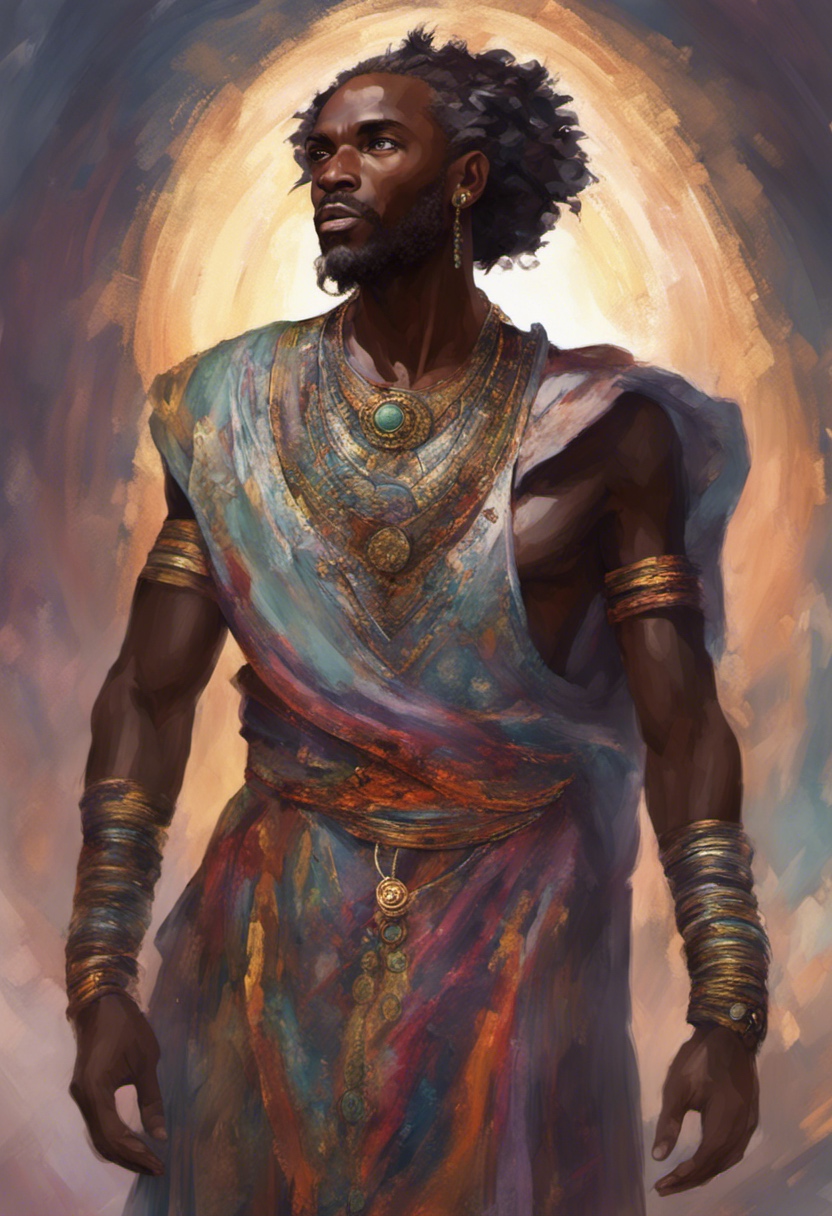
Sefu Tamrat is a man whose physical bearing commands immediate respect: six feet three inches tall with broad shoulders that speak of a lifetime of practical labor, his rich dark brown skin weathered by sun and sea air in equal measure. His most arresting feature is perhaps his eyes, a deep contemplative black that seems always to be assessing, analyzing, reading the currents of both water and human nature with the same careful attention. His hair, cropped short and streaked with gray, hints at the years of experience that have accumulated behind those observant eyes. When he dresses, and he does so deliberately, he chooses vibrant traditional Funtan attire of the highest quality fabrics, a choice that announces his commitment to his roots even as his position in Tontou's hierarchy grows ever more elevated.
Sefu was born into a family of fishermen, and by all conventional expectations, his life should have remained bound to the rhythms of the sea: casting nets, reading weather, pulling a living from waters that could be generous or cruel depending on the season. Yet Sefu's ambitions were always larger than the lagoon surrounding Tontou suggested they could be. It was his intimate knowledge of those tricky waters, the dangerous currents and hidden passages that most navigators avoided, that became his first path to power. He began guiding merchant ships safely to port, developing a reputation for reliability that eventually transformed into opportunity. His business acumen became apparent as he diversified his ventures, moving from navigation into trade itself, then into agriculture and the textile industries. Each expansion was calculated, each partnership strategic, and gradually Sefu accumulated not merely wealth but influence.
His rise to the position of Chieftain was not handed to him through family connection alone. Rather, it was earned through a combination of strategic alliances and decisive shows of force, moments when he demonstrated to the various competing interests in Tontou that unity under his leadership would prove far more profitable than continued fragmentation. What distinguishes his governance, however, is that he never forgot his origins. Though his rule was heavily influenced by Irna nobility and its hierarchical structures, he retained his connection to Funtan roots, creating a unique blend of governance that honors both traditions. This is a man who understands that power comes not from distant proclamation but from the ability to negotiate, to persuade, and when necessary, to act with decisive firmness.
Sefu is fundamentally a man of few words but immense action. His pragmatism borders on the shrewd, and he possesses a keen ability to read people and situations with almost preternatural accuracy. When circumstances demand it, he can be stern and uncompromising, yet this hardness is tempered by a deep sense of responsibility toward his people. His vision of Tontou's potential is grand; he sees not merely a trading post but a thriving center of commerce, culture, and innovation. He works tirelessly to realize this vision, whether he is negotiating complex trade deals with merchants from distant lands or personally overseeing the dredging of the lagoon to accommodate larger vessels. Those who work for him quickly learn that he values loyalty above almost all other qualities, and he rewards competence generously. He has no patience whatsoever for sycophants or inefficiency, and those who mistake his quiet demeanor for weakness discover their error swiftly.
Yet there is a softer side to Sefu Tamrat, one that appears most clearly in his family relationships. His wife and children are his grounding force, the people for whom all his ambition ultimately exists. In their presence, the calculating strategist gives way to a man capable of genuine warmth and deep affection. His family is his greatest source of pride, and those who have observed him in these intimate moments understand that whatever else Sefu Tamrat may be, he is fundamentally human, driven by the same desires for connection and legacy that move everyone.
Amina Tamrat: The Heart and Soul of Tontou
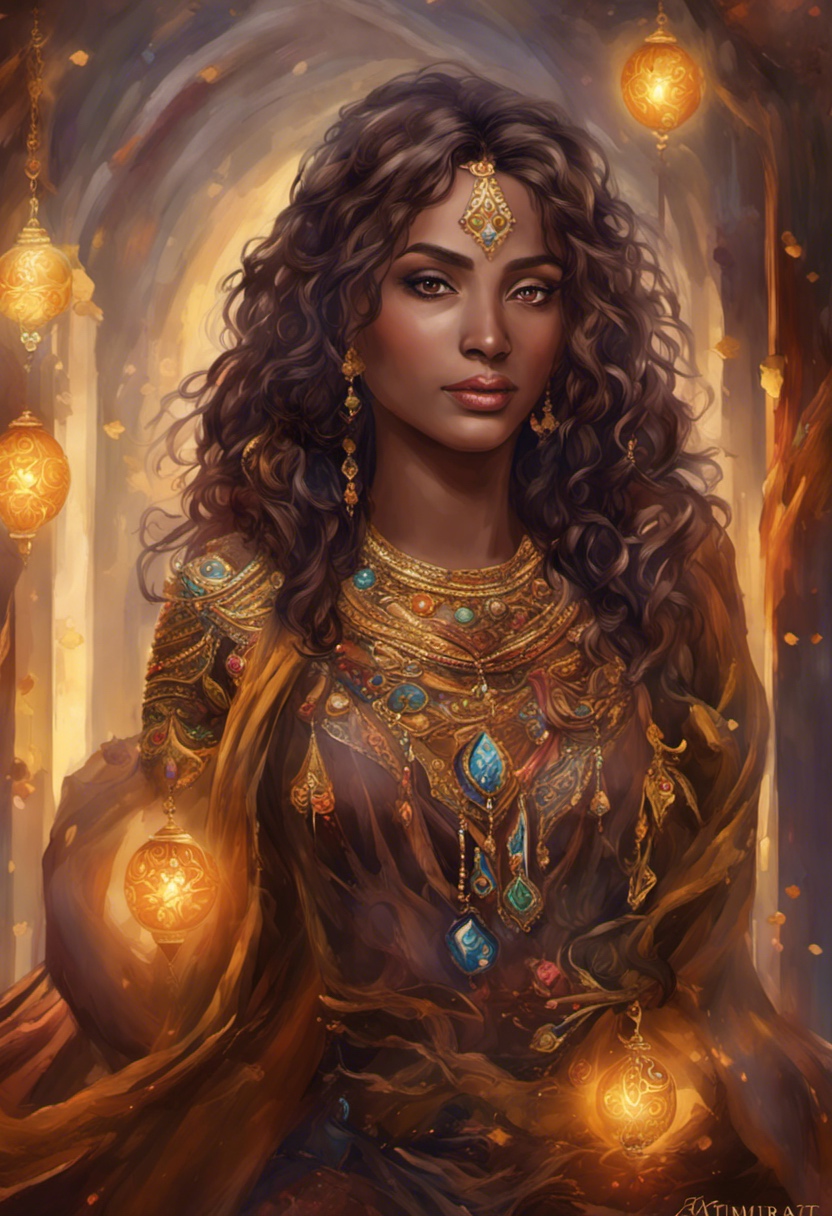
If Sefu Tamrat represents the pragmatic vision that drives Tontou's expansion, Amina Tamrat is the force that ensures this expansion remains rooted in humanity and culture. Of medium height with a graceful build that carries an air of quiet authority, she moves through her world with the assurance of someone who knows her own worth and needs no external validation for it. Her warm golden brown skin seems to glow with an inner vitality, and her captivating hazel eyes are remarkable for their apparent ability to see right through to a person's essence, a quality that makes her simultaneously comforting and slightly intimidating to those who meet her. Her dark coiled locks are often adorned with colorful beads and fabrics that reflect her vibrant personality, a deliberate choice that announces her refusal to be merely ornamental in her role.
Her garments reflect a philosophy of blending rather than choosing, intricately embroidered pieces that thoughtfully combine Funtan and Irna styles in ways that honor both traditions without being entirely beholden to either. She dresses impeccably but never ostentatiously, understanding that true status requires no overwrought display. Amina comes from a lineage of skilled textile artisans, a family connection that provided her with not merely technical skills but an understanding of beauty's power to communicate and to transform. The story of how she came to marry Sefu is itself remarkable; the two met at a trade fair where her family's textiles were on display. The attraction between them was immediate and mutual, a meeting of not merely hearts but of minds. She recognized in Sefu an ambition that matched her own, and he recognized in her someone whose artistic vision and business sense could elevate his endeavors beyond mere accumulation of power and wealth.
When Amina joined her life to Sefu's, she brought to their partnership not only artistic skills forged through generations of craftsmanship but a keen business sense that has proven invaluable to Tontou's development. She has been instrumental in promoting the city's textile industry, elevating it from a local craft into one of the region's major exports. Her influence extends far beyond commercial success, however. She has become a patron of the arts, actively supporting Tontou's burgeoning theater scene, recognizing intuitively that a city's cultural life is as important to its people as its economic prosperity.
Her personality is marked by emotional depth and genuine insight into human nature. She serves as the emotional and cultural anchor in her husband's life, providing a counterbalance to his pragmatism. Those who know her recognize her profound compassion and her remarkable ability to connect with people across the various divides that typically separate communities. She is deeply involved in community affairs, volunteering her time and resources generously. Yet she is far more than merely supportive; she is a woman of her own ambitions and dreams, strong and independent in her own right. Her relationship with Sefu, though built on deep love and mutual respect, is fundamentally one of equals. She is his confidante and his most trusted advisor, the person he turns to not merely for emotional support but for counsel that provides ethical and emotional dimensions to his more pragmatic approach. She does not hesitate to speak her mind, and when she believes a course of action may cause harm to the community or compromise their shared values, she says so plainly.
Together, Sefu and Amina Tamrat form a leadership partnership that has transformed Tontou from a fractured collection of competing interests into a coherent whole moving toward shared prosperity. What they have accomplished is remarkable not merely for its material success but for the way it honors both tradition and innovation, both individual ambition and community welfare.