Chigobo
Chigobo: Where the River Feeds the Forge
"You want to hire a hauler? Go to Chigobo. Want the best axe in the eastern range? Go to Chigobo. Want a centaur to look you in the eye and tell you exactly what they think of you? Definitely go to Chigobo."
Barman at The Manda Road Rest Stop
At a Glance
| Continent | Funta |
| Region / Province | Eastern Funta, Lesser Karoo foothills |
| Settlement Type | Town |
| Population | ~1,400 |
| Dominant Races | Centaur (majority), Human, Dwarf |
| Ruler / Leader | Chieftain Thabisa, Induna of Chigobo |
| Ruling Body | Chieftain, advised by two Indunas |
| Primary Deity | Caminus, Gramil, Nesara |
| Economy | Lumber, Mining, Smithing, Agriculture |
| Known For | The finest mining equipment in eastern Funta, and a honey so sweet healers in Lahale pay three times the market price for it |
First Impressions
The road from Manda follows the Tugela River east, and for most of the journey there is nothing but red-earthed open country and the distant grey line of the Lesser Karoo range. Then the forest begins: dense hardwood stands that press close to the river's banks, alive with birdsong and the crash of something large moving through the undergrowth. It takes a moment to realize the crashing is the sound of workers.
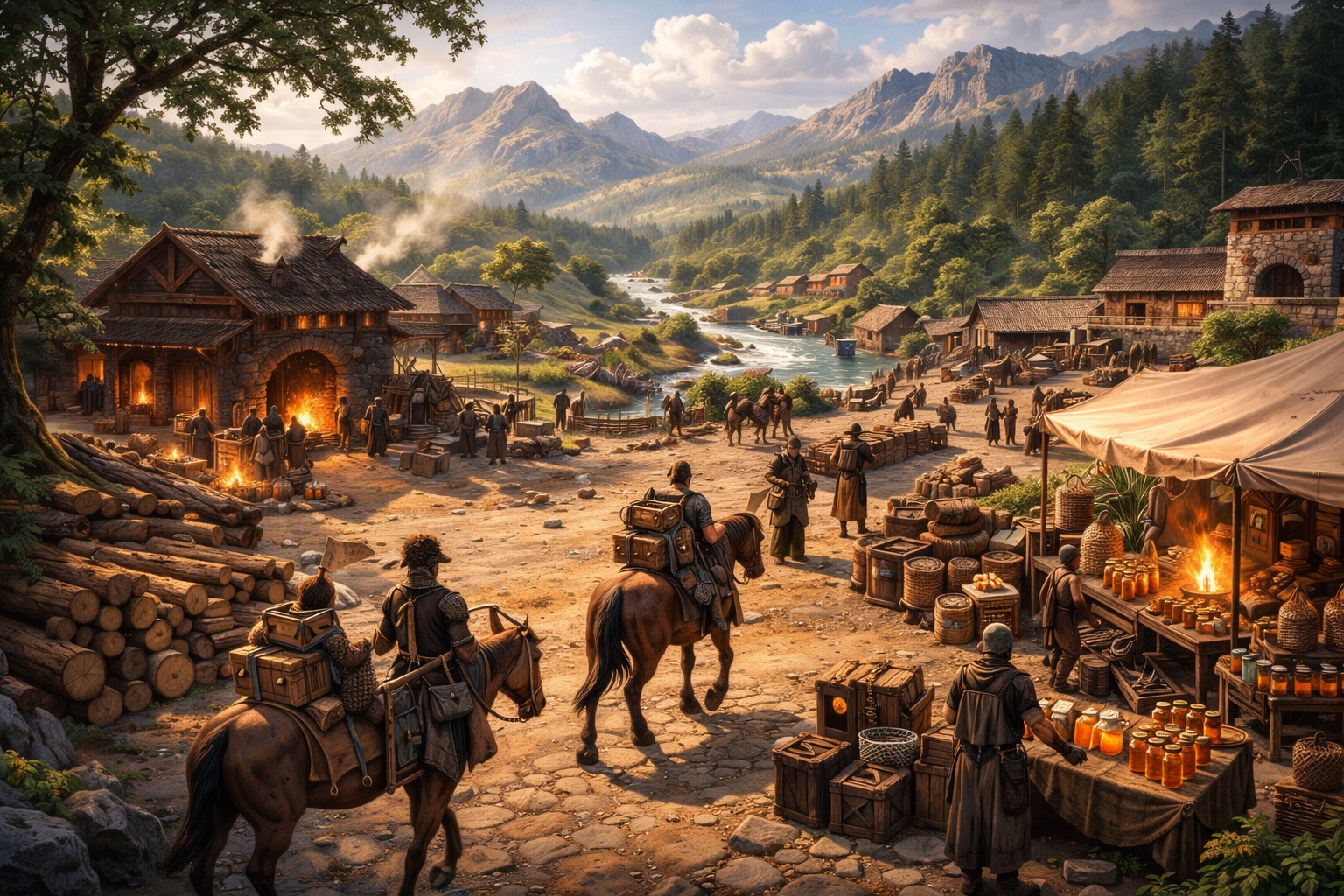
Chigobo announces itself through sound before it becomes visible: the deep rhythmic bite of axes, the ringing clang of a forge, the low rumble of centaur voices carrying across the water. When the treeline breaks and the settlement comes into view, the first thing most visitors remark on is the scale of it. Everything in Chigobo is built for centaurs. The doorways are wide and low-beamed, the market lanes broad enough for a laden centaur to pass without turning sideways, the central fire pits surrounded by platforms at varying heights so that speakers can address a crowd that ranges from four feet to seven. Structures are stout, built from the same hardwood being harvested in the surrounding hills, with iron fittings from Jengo's Forge keeping the joints tight against the mountain winds.
The smell is wood smoke and pine resin and the sweet-dark scent of fermenting sorghum from the brewing shed near the river's edge. And beneath all of it, faintly, something floral; the apiary runs downwind of the town, and on warm days the air carries its product everywhere.
Geography & Setting
Chigobo sits at the confluence of the Tugela River and the Karoo Trace, a fast-running tributary that descends from the mineral-rich heights of the Lesser Karoo Mountains. The river provides fresh water, fish, and a natural border to the east. The mountains loom to the north and west, their slopes covered in dense hardwood forest in the lower elevations and open scrubland above the treeline, where the ore seams run.
The terrain immediately around the settlement is a narrow fertile strip, good soil between the river and the foothills that the centaurs have cultivated into fields of sorghum, millet, and garden vegetables. The forest begins a short walk from the outermost buildings and runs unbroken up into the mountain heights.
The elevation puts Chigobo in the cooler band of eastern Funta's climate. Summers are warm and wet, driving the hardwoods into fast growth. Winters are mild by mountain standards but cool enough at night that the forge never fully goes cold.
The People
Demographics
Chigobo is centaur country. Roughly three out of every four residents are centaur, and the town's layout, customs, and pace of life reflect that without apology. Humans came first as traders, then as workers willing to handle jobs centaurs found awkward: cramped mine shafts, detailed carpentry, bookkeeping. A small community of dwarves arrived two generations ago, drawn by the mining work and the quality of Jengo's forge, and they have stayed. Smalings pass through but rarely settle. Elves are rare and treated with polite reserve.
Outsiders who arrive with a skill and a willingness to work find Chigobo welcoming enough. Those who arrive with assumptions about who is in charge, or who show discomfort around the centaur majority, find the welcome wears thin quickly.
Economy
Chigobo runs on three pillars: what it cuts from the forest, what it pulls from the mountain, and what it shapes at the forge. Thabisa's Timber Co. is the largest employer in the settlement, supplying hardwood lumber across eastern Funta and as far as the coastal towns. Jengo's Forge turns the mountain ore into tools, weapons, and armor, with a particular reputation for mining equipment so well-made that it finds its way to buyers in Lahale and beyond. Karoo Harvest handles the agricultural side, running the fields, the kitchen gardens, and the apiary that produces Chigobo's most surprising export.
The settlement is not wealthy by the standards of the coastal cities, but it is stable. Almost everyone who wants work has it. The chieftain takes a modest tribute from the major enterprises and uses it to maintain the roads, the market, and the guard.
Primary Exports
- Hardwood lumber: Karoo hardwood is dense and slow-burning, prized for construction and shipbuilding
- Forged tools & mining equipment: Jengo's Forge reputation extends well beyond the region
- Karoo honey: Small-batch, expensive, and sought after by healers for its mild restorative properties
- Rough ore: What the mines pull out that doesn't go straight to the forge
Primary Imports
- Grain and dried goods: The fields supply most staples but not all
- Spices and oil: From the coastal towns and Manda market
- Glass and fine cloth: Nothing in Chigobo produces these
Key Industries
- Thabisa's Timber Co.: Logging, milling, and transport of hardwood lumber; run by Chieftain Thabisa directly
- Jengo's Forge: Tools, weapons, armor, and specialized mining equipment; the finest smithing in the region
- Karoo Harvest: Sorghum, millet, herbs, vegetables, and the apiary; run by Mosi
- The Karoo Mines: Two active shafts in the mountain, run by a dwarven foreman named Brek Ashvein
Food & Drink
Chigobo eats like eastern Funta: sorghum porridge in the morning with goat milk and dried fruit, hearty stews at midday with whatever the river and the fields provide, and grilled meat over the fire pits in the evening when the work is done. Goat and guinea fowl are common. River fish are smoked and dried and eaten as a working snack throughout the day. The local flatbread, a heavy teff loaf baked in the forge's cooling chambers, is dense enough that one piece will keep a human satisfied for half a day.
The one luxury the settlement produces is its honey. Most of it gets sold, but what stays in Chigobo ends up stirred into fermented milk drinks, drizzled over fruit, or used to sweeten the dark sorghum ale that the brewing shed near the river turns out in reliable quantities. The ale is called Tugela Black. It is strong, slightly bitter, and exactly what a centaur wants after hauling logs for eight hours.
Culture & Social Life
Centaur society in Chigobo is built on demonstrated competence. A leader who cannot outwork their people, or cannot at least outthink them, does not keep their position long. Thabisa has both qualities, which is why no one has seriously challenged her in twelve years. Respect is given readily to those who earn it and withheld from those who haven't, regardless of race or background.
Greetings between centaurs involve a brief lowering of the head, not a bow, more like an acknowledgment. Handshakes are adopted from human custom and used with outsiders. Hospitality is real but not effusive. A guest offered a seat by the fire has been welcomed; a guest offered food has been truly welcomed. Refusing food is considered a mild insult.
The town has a communal culture around the fire pits in the central clearing. Evenings, when the work shifts end, people gather (centaur, human, and dwarf alike) to eat, argue, play dice, and listen to whoever is in a mood to tell a story. Arguments are loud and common and rarely become violent; the understanding is that you say what you think, directly, and then let it go.
Festivals & Traditions
The Logging Song
Not a festival so much as a tradition: on the morning of the first major lumber harvest of the season, the entire Thabisa's Timber Co. crew gathers at the forest edge and the eldest worker present leads the camp in a call-and-response song asking the forest's permission to take what they need. The song is in the old tribal language and few of the younger workers know all the words, but everyone knows the refrain. It lasts about twenty minutes and then the axes come out. Outsiders who've witnessed it tend to describe it as one of the stranger and more moving things they've seen in Funta.
Forge Day
Once a year, on the spring equinox, Jengo opens the forge to anyone in the settlement who wants to try their hand at shaping metal. Children line up first. The products are rarely useful. The point is the fire and the participation and the reminder that making things is something any person can do. Jengo judges the best piece made by a first-timer and the winner gets a small blade shaped by Jengo himself.
Music & Arts
Music in Chigobo runs to percussion: hide drums and the hollow-log instruments common across Funta, played fast and layered in ways that can build into something almost overwhelming at full volume. There are also string players, usually human, who learned their craft on the coast and brought it inland. The combination has produced a local style: heavy drum foundations with melodic strings weaving over the top. It sounds unlike anything you'd hear in the coastal towns or in Lahale.
Carving is the visual art tradition here. Centaurs carve in the hardwood offcuts from the mill, not furniture or tools, but figures. Animals, mostly. Ancestors, sometimes. The style is stylized rather than realistic, built from bold shapes and deep cuts. Good pieces turn up in the market and fetch real coin from traveling merchants who know what they're looking at.
Religion
Primary Faith
Chigobo's dominant practice is older Funta animism: forest, river, and mountain approached as living presences that must be asked, thanked, and occasionally apologized to. The Logging Song is the best-known expression of it.
Where Chigobo's animism overlaps the wider pantheon most cleanly is Gramil: not an "anomaly fixer," but a god of ancient trees and the dignity of old growth. The shrine at the forest edge is understood by locals as a Gramil place even when the prayers spoken there sound like older forest-spirit rites.
Caminus is the other primary devotion, centered on Jengo's forge and the town's identity as makers. His hammer mark above the forge door is treated as both blessing and standard: you don't work badly under Caminus's eye.
Nesara has moved into primary standing alongside Gramil and Caminus because the Tugela River is not simply the town's water supply; it is the engine of the entire settlement. The mill wheels turn on its current, the lumber rides its flow to the coastal markets, and the flood of 5311 ME, which nearly destroyed the lower quarter, embedded a deep communal respect for the river's power and mercy. The ceremonial acknowledgment at the Tugela's bank before the spring timber runs is understood by those who know Nesara as a water-deity observance even when the prayers use older language. The river asked something of Chigobo during the flood, and the town rebuilt on raised platforms as an act of reverence, not just practicality.
Secondary / Minority Faiths
The dwarven community maintains private devotions to ancestors and to Thulgard, especially through long mountain winters and after mine accidents. They don't proselytize and the centaurs respect the privacy of it.
Anansi weaves through the evening fire pits where the settlement's real social life happens. Chigobo's communal culture (the hours of argument, storytelling, dice, and the telling of tales around the central fire) is exactly the space Anansi inhabits. The Logging Song, with its call-and-response structure and the way younger workers learn the refrain before they know the words, is an Anansi tradition in everything but name: communal memory passed mouth to mouth, shaped a little differently by each telling.
Oruka is acknowledged quietly by the hunters among the Chigobo community and by the forestry workers who follow the Bugoye's edge. The large figure that three separate logging crews have now reported watching them from the treeline belongs to Oruka's domain whether or not it is the deity's emissary; the highland forest is predator country, and the centaurs who work in it carry a respect for what hunts alongside them that has nowhere else to go.
Damballa does not have a formal shrine in Chigobo, but the mine has had two dangerous cave-ins, and underground work produces a specific kind of death-awareness that the Damballa tradition addresses honestly. Brek's crew has been known to leave offerings at the tunnel entrance that are neither Thulgard's protective wards nor Gramil's forest acknowledgments: something older, something that speaks to the earth taking back what it lent.
Secret or Forbidden Worship
A pair of human traders who pass through regularly are suspected by Nia of carrying devotional items tied to Oshala. Nothing has been confirmed. Thabisa has asked Nia to watch and wait rather than act without proof.
History
Founding
Chigobo is not a new settlement; centaur communities have lived along the Tugela River for at least four hundred years, long before Irna explorers made contact with Funta. The original settlement was a seasonal hunting camp that became permanent when the first centaur families recognized the forest's lumber potential and the mountains' ore. For most of its history, Chigobo was a modest community that traded with neighboring tribes and kept largely to itself.
Key Events
The Forge Compact (approx. 180 years ago)
A dwarven prospector named Halsin Graystone arrived in Chigobo after being driven out of a failed mine operation to the south. He struck a deal with the chieftain of the time: Halsin would teach the settlement's strongest smiths advanced metalworking techniques in exchange for a share of the ore and a place to live. The Forge Compact, as it became known, transformed Chigobo from a lumber town into a smithing center. Jengo's lineage descends directly from Halsin's first Chigobo-born students.
The Karoo Honey Discovery (approx. 60 years ago)
Mosi's grandmother, establishing the first intentional apiary on the mountain scrubland above town, discovered that bees foraging on the high-altitude Karoo flowers produced honey with unusual properties: mildly restorative when taken as part of a medicinal preparation, notably effective for treating wound infections. A healer from Lahale happened through Chigobo, tasted the honey, and within a year was sending buyers. The apiary has been Chigobo's most profitable operation per unit of output ever since.
The Flood Season of 5311 ME
An unusually wet winter broke the Karoo Trace banks and sent floodwater through the lower quarter of Chigobo. Significant buildings were lost and two people drowned. Thabisa, who had been chieftain for only three years at the time, organized the entire settlement in rebuilding. The rebuilt lower quarter sits on raised platforms now, and Thabisa's response to the flood is still pointed to as the moment she proved herself. The community vote to confirm her leadership, held afterward, was nearly unanimous.
Current State
Chigobo is prosperous and stable, though not without tensions. The mines are beginning to show signs of thinning ore in the primary shaft, and Brek Ashvein has been pushing Thabisa to authorize a deeper exploratory dig that would be expensive and disruptive. The logging operation is also running up against the sustainable limits of the nearby forest; Thabisa is aware that they are taking more than the forest replaces and has begun requiring replanting, which slows production and annoys the timber buyers who want more, faster. Neither problem is a crisis yet. Both will need a decision in the next few years.
Leadership & Governance
Chieftain's Lodge: Overview
Chigobo operates under the authority of an Induna, a chieftain who rules the settlement and the farmlands surrounding it by the customs of Funta. The chieftain is not elected but earns and holds the position through demonstrated leadership. Challenges to a chieftain can be made formally, but Thabisa has not faced a serious one. She holds authority over law, tribute, and major decisions for the settlement. The nearest major Kgosi is three days' travel west, and Chigobo's distance from that power means Thabisa has significant practical autonomy.
Induna Thabisa
Centaur, Female; mid-fifties
Thabisa is a large centaur, heavy-shouldered even by centaur standards, with a dark chestnut coat and a silver-streaked mane she keeps braided back while working, which is most of the time. Her face is broad and carries the weathered look of someone who has spent decades outdoors in the mountain wind. She does not look like what someone raised on stories of elegant rulers might expect. She looks like a chief forester who happens to run a town.
She is direct to the point of bluntness, dislikes flattery, and has no patience for people who talk around a problem instead of naming it. She is also a careful thinker; she tends to ask more questions than she answers in a first conversation, listening with an attention that some visitors mistake for disinterest. It is not. When she finally offers a judgment, it is usually worth waiting for.
She is respected by virtually everyone in Chigobo. The human workers trust her because she has never shown favoritism toward centaurs in disputes. The dwarves trust her because she kept Brek Ashvein's mine crew whole through two dangerous cave-ins and paid for the injured workers' recovery herself. She is not beloved in the warm, story-song sense. She is trusted, which in Chigobo is worth more.
Jengo: Master Smith, Husband to the Chieftain
Centaur, Male; late fifties
Jengo is lean where Thabisa is broad, with a copper-brown coat and hands, all four of them, marked by decades of forge work. He is quieter than his wife, more comfortable in the forge than at council, and famously uninterested in politics. He does not advise Thabisa on governance and she does not tell him how to run the forge. Their arrangement works.
His skill at smithing is genuine and beyond dispute. He could charge three times his current rates and buyers would pay. He doesn't, partly because he doesn't care about wealth and partly because he believes overcharging creates resentment. He is as close to a philosopher as Chigobo produces.
The Foals: Lindiwe, Jabulani, and Sizwe
Centaur; young adults / adolescents
Thabisa and Jengo's three children are at various stages of figuring out who they are in a town where their mother is the most important person and their father is the second most respected. Lindiwe, the eldest, works alongside Thabisa and is being groomed for leadership whether she fully wants it or not. Jabulani apprentices at the forge with his father and shows the most natural talent of the three at smithing. Sizwe, the youngest, is still in the years of testing limits, and Nia spends more time managing the trouble Sizwe gets into than she would prefer.
The Guard
The Chigobo guard is a militia of twelve, centaur and human mixed, under the command of Kwame. They are not soldiers; they are trained for dealing with banditry on the roads, disputes in the market, and the occasional creature that wanders down from the mountain heights. Kwame runs them hard and they are competent at what they do, though they would be overmatched by a determined organized force. There has not been one.
Kwame himself is a large, scarred centaur who fought as a mercenary in the west before returning to Chigobo a decade ago. He says little about those years. He and Thabisa have known each other since childhood and his loyalty to her is not transactional.
Law & Order
Chigobo follows the general customs of tribal Funta: the chieftain's word is law, disputes are settled in public hearing, and punishments favor labor and restitution over confinement. There is no jail as such; a wrongdoer who can't pay restitution works it off in the lumber operation or the mines. Serious offenses (violence against a community member, theft from the forge) result in exile. It has happened twice in Thabisa's time.
Notable Figures
Nia: Induna of Trade & Diplomacy
Centaur, Female; early fifties; usually found at the market or the Chieftain's Lodge
Nia is Thabisa's oldest friend and her most important advisor. She is lighter-framed than most centaurs in Chigobo, with a grey dappled coat and a habit of watching a room rather than participating in it. She handles all trade negotiations with outside buyers, manages the tax ledgers, and keeps the peace with the merchants who pass through. She is the most politically shrewd person in Chigobo and quietly the one most outside powers try to cultivate. She has not been cultivated successfully yet.
Mosi: Head of Karoo Harvest
Centaur, Female; late forties; at the fields or the apiary most mornings
Mosi is small for a centaur and seems perpetually covered in something: soil, pollen, or whatever the bees have been into. She is the settlement's foremost expert on the medicinal properties of the Karoo honey and has an ongoing correspondence with healers in Lahale who want more product than she can produce. She is good-natured, extremely knowledgeable about plants and creatures, and fiercely protective of the apiary against anyone who wants to expand it faster than she thinks is safe.
Brek Ashvein: Dwarven Mine Foreman
Dwarf, Male; age uncertain, probably sixties; lives near the mine entrance
Brek has been in Chigobo for thirty years. He came for the ore and never found a reason to leave. He is stocky even by dwarf standards, with an ash-grey beard he keeps braided out of the way and a voice that carries through solid rock. He believes the thinning ore in the main shaft is not the end of the vein but the beginning of a richer one deeper in, and he has been trying to convince Thabisa to fund the deeper dig for two years. He is probably right about the ore. Thabisa is worried about what else might be down there.
Dela: the Brewer
Human, Female; mid-thirties; the brewing shed by the river
Dela arrived in Chigobo six years ago from the coast and stayed because Thabisa offered her the use of the brewing shed and asked no tribute for the first three years. She makes Tugela Black and two other varieties that she hasn't named yet. She is sociable, knows everyone's business, and is the informal clearinghouse for settlement gossip. She is also quietly saving everything she earns and no one knows why or for what.
Key Locations
Seat of Power
- The Chieftain's Lodge: A long, open-sided hall at the center of town, half-indoors and half-open to a wide covered yard. Council hearings happen here, public disputes are settled here, and on feast nights the whole settlement gathers here. The building is the largest single structure in Chigobo and the most well-maintained. A carved relief of a centaur with raised arms runs the length of the main beam: old work, possibly older than the settlement's recorded history.
Houses of Worship
- Gramil's Clearing: Not a building but a managed space at the forest's edge where the oldest trees have been left untouched. A carved stone marker at the center is worn smooth from years of hands. Oil lamps hang from the branches. Offerings of fresh-cut wood and first-harvest grain are left here before major operations begin.
- The Forge Door: The hammer symbol above Jengo's Forge serves as the informal shrine to Caminus. Workers touch it on the way in. Jengo holds his monthly observance here at dawn, before the fire is lit for the day.
Inns & Taverns
- The Karoo Rest: The only lodging in Chigobo that accommodates human-scale travelers. Run by a human couple, Petra and Orin, who came with a trade caravan and built the place themselves. The beds are clean, the food is standard Funta fare, and Petra makes a version of the local flatbread that most travelers agree is better than what they get anywhere else. The room with the view of the forge fire is the one to ask for.
- Dela's Shed: Not technically an inn, but Dela keeps two pallets in the back room for travelers who need to sleep off the Tugela Black. It is understood that staying there involves contributing to the conversation.
Shops & Services
- Thabisa's Timber Co. Mill Office: Where lumber orders are placed, prices set, and transport arranged. Managed by a human clerk named Oswald who has been with the company for fifteen years and knows every buyer by name, preference, and credit standing.
- Jengo's Forge: Open six days of seven. Custom orders take longer than buyers expect and are always worth the wait. A secondhand rack near the entrance holds completed pieces available for immediate purchase: mostly tools, some blades.
- Karoo Harvest Market Stand: Mosi's produce, herbs, and honey for sale on the three-day market. The honey is limited; she sets a maximum per buyer.
The Market
- The Tugela Market: Held every third day in the broad lane running beside the river. Centaur-wide lanes, canvas awnings, and a designated area for traveling merchants. Local produce, forge goods, carved wood, dried fish, and the occasional item that has traveled far to end up here. Noisy, crowded by Chigobo standards, and the best place in the settlement to find something you weren't looking for.
Other Points of Interest
- The Karoo Apiary: Half a mile uphill from the main settlement, in the scrubland where the Karoo flowers grow. A cluster of carved-wood hive boxes tended by Mosi and two assistants. Not open to casual visitors; Mosi keeps the approach netted and asks travelers to wait at the marked stone if they want to purchase honey.
- The Primary Mine Shaft: The main entrance to the Karoo Mines, a reinforced cut in the mountain face about a mile north of town. Human-wide tunnels, which is why dwarves do most of the underground work. A pulley-and-rope system handles ore transport. The second exploratory shaft Brek wants to dig would be just east of this one.
Secrets, Rumors & Hooks
- The Karoo honey's restorative properties are becoming more pronounced in recent harvests. Mosi suspects it has something to do with a new flowering plant that has appeared in the scrubland above the apiary, a plant she doesn't recognize and can't find in any reference she has. She hasn't told Thabisa yet.
- Brek Ashvein has been down in the mine every evening for the last two months, alone, after the crew leaves. He says he's surveying. His crew says he's listening.
- Dela is saving her coin to buy passage back to the coast, but not for herself. She is trying to free a family member from a debt situation she doesn't talk about. She would pay very well for a discreet service.
- A carved marker found in the oldest part of Gramil's Clearing predates the settlement by at least two centuries and depicts not a centaur but something else; scholars who've passed through have given three different opinions on what it represents. Thabisa has stopped asking scholars.
- The two human traders suspected of Oshala devotion are also suspected, by Nia alone, of carrying messages between parties in Lahale and parties further east. She does not know what the messages contain. She has not yet decided who to tell.
- Three logging crews have reported the same thing independently over the past two seasons: a large figure watching them from the treeline, uphill, that does not match any creature in the mountain. No one has gone looking for it. Kwame has been told. He is quietly preparing.