D'Kar
D'Kar: Where the River Begins
"Every town downstream of D'Kar owes it something. The Mbashe starts here. The timber starts here. The stone starts here. Azibo is too gracious to say this to anyone's face, but he knows it, and you can tell."
A river captain, describing the town to a first-time passenger
At a Glance
| Continent | Funta |
| Region / Province | Northern Funta, Bugoye Forest and Greater Karoo Mountain margin |
| Settlement Type | Town |
| Population | ~5,100 |
| Dominant Races | Human (majority), Dwarf, Drakin (ruling family and community), Gnome |
| Ruler / Leader | Chieftain Azibo Zuberi |
| Ruling Body | Zuberi family, chieftaincy governance |
| Primary Deity | Nesara, Bronthe (among others; Funta animist traditions remain primary framework) |
| Economy | Sustainable timber, mountain stonecraft, river trade origination point |
| Known For | Being the headwaters of the Mbashe River (the same river that reaches Tontou's lagoon) and for timber and stone that are the raw materials for half of northern Funta's construction industry |
First Impressions
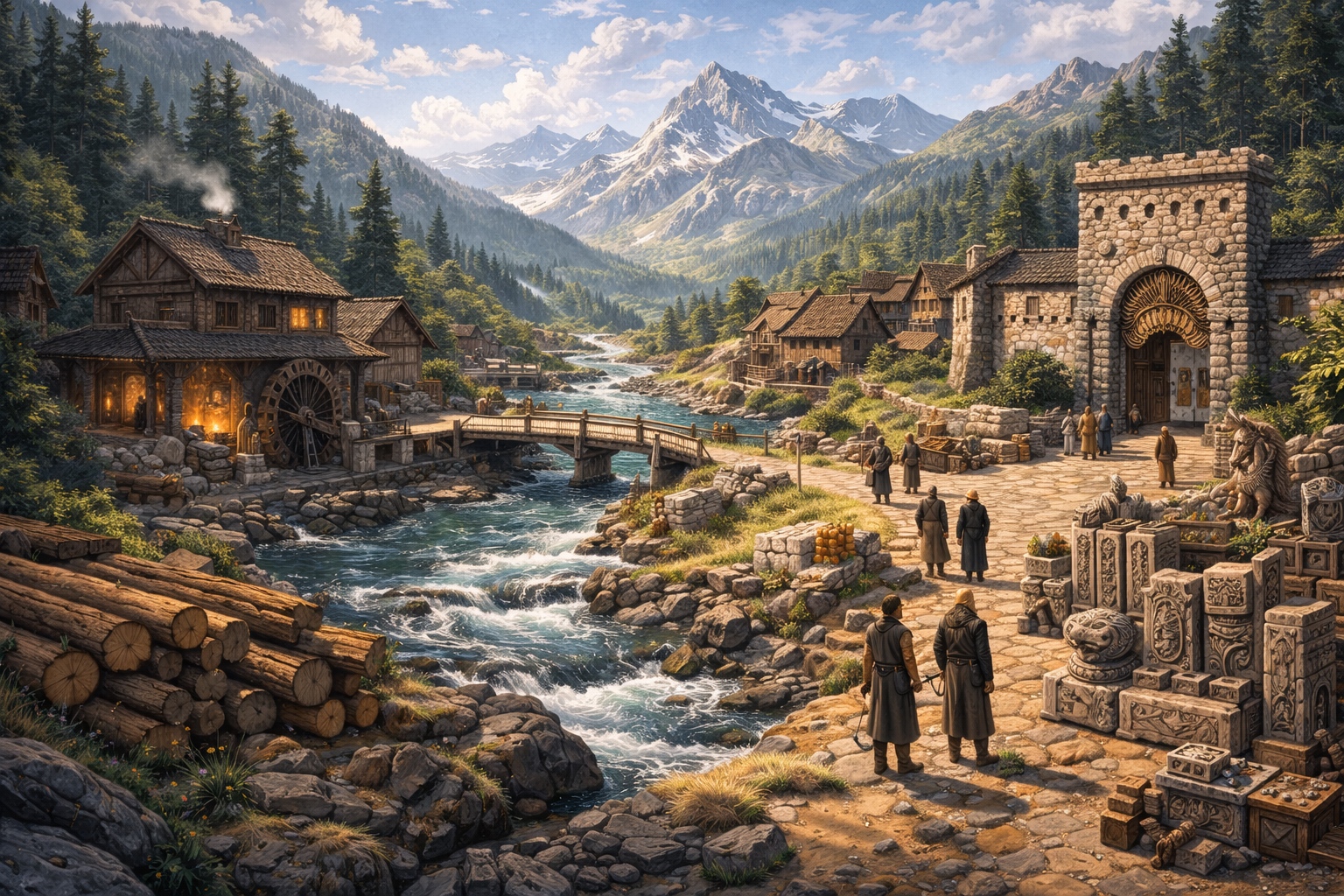
D'Kar sits where two things end and one thing begins: the Bugoye Forest thins out to the west, the Greater Karoo Mountains rise to the east, and the Mbashe River collects itself from the runoff between the two and starts the long journey south toward the Kelta Lagoon and Tontou. The town occupies the narrow valley floor between these features.
The smell is pine from the forest, dust from the stone quarry operations above, and the clean cold water of the river's upper reach, nothing like the brackish, warmer river that arrives at Tontou five days downstream. The mill wheels on the river's upper section are always turning. The sound of them is the town's ambient note.
The architecture is the direct product of what the town produces: buildings in D'Kar are stone-faced with timber framing, the stone coming from the Karoo operations above and the timber from the Bugoye below. The construction quality is good because the people who make the materials live here and are not going to accept inferior work in their own walls.
Chieftain Azibo Zuberi's compound is the largest structure and the most immediately distinctive, not because of its size but because the Drakin architectural tradition imported into the design makes it identifiable from the river approach. The bronze-scaled carvings at the entrance gate are the most frequently remarked-upon feature by first-time visitors.
Geography & Setting
D'Kar's valley floor sits at the northern end of the Bugoye Forest's range, where the forest thins and the mountain foothills begin. The Mbashe River gathers from several streams in the mountain runoff and consolidates in the valley before flowing south. This is the cleanest, fastest section of the Mbashe (cold, clear, powerful enough to drive the mill operations) and bears no resemblance to the wide, slow estuary it becomes before reaching Tontou.
The forest to the west is managed under an agreement negotiated by Azibo's father with the families who work the Bugoye. The mountain quarrying operations to the east occupy a series of designated sites in the lower Karoo foothills. The town manages both extractive industries from the valley floor, using the river as the transport mechanism for output.
The People
Demographics
D'Kar is predominantly human but has an unusually diverse non-human population for a northern Funta town. The Zuberi family's Drakin heritage and the family's reputation for fair governance have made the town a destination for Drakin from elsewhere in Funta who prefer living under a leadership that does not regard them as exotic. The Dwarf community runs the Woolworks equivalents here (the stonecraft operations) and has been integrated for three generations. Gnomes occupy the specialist manufacturing niches as they tend to do.
The river workers form a transient population that turns over seasonally. The skilled trades (forestry, quarrying, river piloting) are more stable.
Economy
D'Kar's economy is extractive in the most sustainable sense the term allows: the timber and stone are genuinely renewable and are managed accordingly, and the river provides the transport mechanism that makes both viable at scale. The town does not process finished goods to any significant degree; the raw materials move downstream and come back as finished products, which D'Kar buys from Tontou and other cities. The trading post is the commercial hub that manages both directions of this flow.
The river trade origination is economically significant beyond the direct commerce: D'Kar's position at the Mbashe headwaters means that everything moving on the river below them passes through infrastructure that D'Kar's maintenance ensures. The town collects tolls on the river passage through its territory that are modest individually and substantial in aggregate.
Primary Exports
- Bugoye timber: Sustainable-harvested; the specific species available here (old Bugoye hardwoods) are not available from southern sources
- Karoo stone: Mountain-quarried; the specific composition makes it resistant to moisture in ways that lowland stone is not; premium construction material
- River-transport services: Not an export exactly, but the piloting knowledge for the Mbashe's upper reaches is a service that D'Kar controls
Primary Imports
- Processed goods: Finished textiles, tools, metalwork; things the extractive economy doesn't produce
- Food variety: Northern Funta's agricultural yield is less diverse than the south; trade brings what the local farms don't grow
Key Industries
- Mwamba Lumber Co.: Jengo's operation; sustainable timber harvest and initial milling
- Karoo Stonecraft: Thalia's enterprise; quarrying and the specialty carved stone products that command premium prices
- Riverway Trading Post: Lysandra's operation; the commercial hub managing both export and import on the Mbashe
Food & Drink
D'Kar eats what the northern forest and mountain edge produce: game from the Bugoye, river fish from the Mbashe's upper clean waters, the cold-climate vegetables from the valley farms. The elevation and climate make some crops impractical that grow easily further south; grain comes in by river. The mountain herb trade is a specific local product; Nia Zuberi's herbal knowledge has institutionalized a trade in dried medicinal and culinary plants that reaches as far as Tontou.
Beer is the primary fermented drink, brewed from grain that comes upriver. The specific mountain water gives the local variety a characteristic that the brewers downstream have not replicated despite attempting it.
Culture & Social Life
D'Kar's culture reflects the dual character of its industries; the forestry workers and the quarrying workers have distinct traditions and distinct social rhythms, and the town functions partly as the meeting point of two occupational cultures. The forestry community tends toward the patient, observational character of people who work in environments where inattention has immediate consequences. The quarrying community is louder and more immediately physical.
The Drakin population has introduced an element that the human majority finds simultaneously familiar (most Drakin in D'Kar have been there for decades) and occasionally disorienting (the Drakin ceremonial traditions are unlike anything in Funta's broader culture). The accommodation has been primarily achieved through Azibo's deliberate practice of participating in both traditions.
Festivals & Traditions
The River Opening
When the spring melt increases the Mbashe's flow enough for the first timber rafts to run safely, D'Kar marks it with a morning that involves the river workers, the Chieftain's blessing, and a first-run pilot who takes the inaugural raft through the upper rapids. The pilot who does it successfully earns a title ("River Opener") that confers specific respect in the river-working community for that season. The Drakin community has added a breath of flame over the water to the ceremony, which the human majority has adopted with enthusiasm.
The Stone Day
When the quarrying season opens, the Karoo Stonecraft operation marks it with a ceremony that involves Thalia's workers and the Chieftain. The first cut of the season is made ceremonially, the stone presented to the Chieftain, and the season's production goals discussed publicly. This last element is unusual (the public discussion of commercial targets) and was introduced by Azibo as a way of aligning community expectations with what the extraction will actually produce.
Music & Arts
D'Kar's music tradition is work-song based, like most of Funta's northern settlements. The forestry community has specific songs for the felling, dragging, and river-running phases; the quarry community has its own tradition that runs more rhythmic and percussive, using stone-on-stone as accompaniment. The integration of these two forms, which the Bardic tradition from Irna has not reached this far north, has produced a D'Kar sound that people who have heard it find difficult to describe accurately to people who haven't.
The Drakin community maintains a ceremonial storytelling tradition that uses flame, controlled breath-fire, as visual accompaniment to narrative. The human majority attends the major performances of this tradition and has begun including fire-lit storytelling in their own ceremonies.
Religion
Primary Faith
D'Kar practices an animist tradition common to northern Funta; the forest and the mountain are both regarded as presences requiring respect and acknowledgment, which is practical as well as spiritual given that both are the source of the town's livelihood. Ceremonies mark the extraction seasons, the river's behavior, and the mountain's quiet periods.
The Zuberi family has integrated their Drakin ancestral practices into this framework, and the combination has produced a civic religion that is genuinely shared rather than imposed on either community.
Nesara has achieved something close to primary standing in D'Kar because the Mbashe River is not simply D'Kar's geography; it is the reason the town exists and the mechanism by which everything D'Kar produces reaches the world. The River Opening ceremony, with its community gathering and the Chieftain's blessing of the first timber run, is a Nesara observance in practical terms even when the prayers draw on older animist language. The clean, cold headwaters water is treated with a reverence distinct from what communities downstream show the same river; D'Kar knows the Mbashe in its truest form, and that knowledge carries spiritual weight.
Secondary / Minority Faiths
Caminus has a presence in the stonecraft community. Bethsia has a small following among the forestry workers who document the Bugoye's unusual phenomena; the forest has specific locations that behave in ways that the workers have been noting for generations without explaining.
Bronthe is the patron of the Karoo Stonecraft operation and of the quarry workers who go into the mountain face each season. Where the stone comes out, Bronthe's mark goes in: into the foundation-stones of buildings, into the shaped lintels of tunnel mouths where cave-in would be fatal. The stone that D'Kar produces is known for its quality partly because the people who quarry it take its extraction seriously as a matter between themselves and the mountain, not just a commercial operation.
Caldrin is the faith of the river pilots, the trading post, and the caravan yards where D'Kar's goods change hands. The Upper Mbashe's piloting knowledge is the most specialized wayfinding expertise in northern Funta, and the pilots who hold it are Caldrin's people in the practical sense: they know the routes, they uphold the guest-right that makes river trade function, and they are the reason goods and people arrive intact rather than wrecked on the upper rapids.
Anansi enters D'Kar through the fire-lit storytelling that has become the town's distinctive cultural expression. The Drakin flame-breath accompaniment to the ceremonial storytelling tradition, which the human majority has enthusiastically adopted, is pure Anansi in form: communal memory transmitted through performance, each retelling shaped a little differently by the teller, the story adapting and surviving. The work-songs of the forestry and quarry crews carry the same quality, the knowledge of how and where to cut held in rhythm and refrain as much as in written instruction.
History
Bronthe is honored by masons and miners; offerings go into foundation-stones and tunnel mouths where failure would be fatal. Nesara is honored at wells and river shrines, and in irrigation councils: water held in trust for everyone downstream. Caldrin is honored at gates, bridges, and caravan yards for safe passage, true directions, and upheld guest-right. Vessikar has shrines near weighhouses and market courts; honest measures are treated as civic peacekeeping.
Founding
The valley was inhabited before it was governed; hunters and temporary camps existed at the river headwaters for as long as the hunting was good. Permanent settlement followed when the timber and stone value became recognized. The Zuberi family arrived from further north several generations ago as traveling Drakin craftspeople and recognized the valley's resource potential before anyone had organized to exploit it.
Key Events
The Zuberi Consolidation (approx. 80 years ago)
Azibo's grandfather arrived, assessed the valley's resources and the complete absence of organized governance, and spent twenty years building the relationships with the local families that culminated in his recognition as Chieftain. The process was not violent and is remembered by the founding families' descendants as being managed with fair dealing rather than political force.
The Sustainable Harvest Agreement (approx. 50 years ago)
When the first signs of Bugoye over-harvesting appeared (a smaller, less-diverse stand on the most accessible western edge), Azibo's father negotiated the harvest zone rotation agreement that has held since. The agreement involves the forestry workers' families, the Mwamba Lumber operation, and the Chieftain's office as the third party. The Bugoye's currently visible condition (healthy, productive, and recovering in the rested zones) is the agreement's validation.
The River Compact with Tontou (approx. 20 years ago)
When Tontou's Chieftain Sefu Tamrat's father commissioned the lagoon dredging, the downstream implications for D'Kar's river tolls required renegotiation. Azibo managed the negotiation directly and arrived at an arrangement that has worked for both parties since; D'Kar's tolls are calibrated to the volume Tontou's dredging makes possible, and Tontou's commercial growth has benefited D'Kar proportionally.
Current State
D'Kar is stable and functioning well. The timber and stone industries are healthy, the river toll income is steady, and the relationship with Tontou is productive. Azibo's principal concern for the future is the succession question; Ekon has the temperament for governance but his interest is masonry, and the combination of craft identity and leadership responsibility is not a comfortable fit for everyone. Sora is more naturally oriented toward the governance side but is still developing. Azibo has time, and he knows it.
Leadership & Governance
The Zuberi Family: Overview
The Zuberi family governs through the chieftaincy tradition, which in D'Kar means a combination of formal authority over extraction permits, river access, and dispute resolution, and the practical authority that comes from being commercially central to every major industry in the valley. The governance is direct and personal; Azibo is present in the town's daily life in ways that larger-city nobles are not.
Chieftain Azibo Zuberi
Drakin, Male; bronze scales; fifties
Azibo is physically imposing (the bronze scales catch light in ways that draw the eye before his personality does) and has spent his career working against the assumption that physical presence implies governance by force. He is, in practice, a deliberate and patient man who values the long view and who has made the sustainable resource model D'Kar's identity rather than just its policy. The economic case for sustainability is sound, and he can make it; the genuine care for the Bugoye and the Karoo that underlies the policy is harder to communicate and he doesn't try very hard.
His wife Nia's herbal expertise has made her the town's practical medical authority, which gives the Zuberi household a different kind of connection to the community than administrative governance provides. He regards this as one of the better outcomes of their partnership.
Nia Zuberi
Human, Female; fifties
Nia is not a healer in the formal temple sense; she has no religious affiliation with her practice. She is an herbalist whose forty years in the D'Kar valley have given her a knowledge of the Bugoye's medicinal plants that exceeds what any written source documents. She trains apprentices, maintains a dispensary from the family compound, and is, by common community consensus, the person you bring difficult cases to when you need someone who will actually solve the problem rather than give it a dignified name.
Fenrik Ironshackle: Advisor
Elf, Male; age indeterminate; the Chieftain's council chamber
Fenrik has been with the Zuberi family since Azibo's father's governance and provides the institutional continuity that comes from having been present for every major decision the family has made. He is diplomatic in the practical sense (he finds language for things that need to be said and manages the delivery), and he holds the relationship with the downstream river communities with a care that the Chieftain could handle himself but doesn't need to.
Kaelum Frosthold: Captain of the Guard
Half-Orc, Female; thirties; the town watch and Chieftain's security
Kaelum runs the watch with a directness that the community respects and occasional strangers find startling. D'Kar doesn't have significant crime problems; her management keeps it that way. She also trains the town's militia to a standard that reflects the fact that the northern mountain edge is not entirely predictable.
Notable Figures
Jengo: Owner, Mwamba Lumber Co.
Dwarf, Male; age uncertain; the lumber mill, river edge
Jengo has run the lumber operation for twenty years with a rigidity about the sustainable harvest zones that occasionally frustrates the river traders who want more volume than the rotation allows. He is correct about the rotation and knows it, which is what makes the frustration manageable. His relationship with the Zuberi family is collaborative; he participates in the harvest zone reviews and provides data that the Chieftain's office uses for enforcement.
Thalia: Owner, Karoo Stonecraft
Gnome, Female; age uncertain, appears young; the quarry site and town workshop
Thalia produces two things: functional quarried stone for construction markets and carved stone pieces that function as art objects and command prices that the construction stone's buyers find inexplicable. The carved work is Thalia's own; she employs fifteen people for the quarry operation and works the artistic side alone. The Chieftain has one of her pieces in the compound's entrance hall.
Lysandra: Owner, Riverway Trading Post
Zerren, Female; thirties; the trading post, river dock
Lysandra arrived in D'Kar eight years ago from further north and has built the trading post from a small operation into the town's primary commercial interface. She is shrewd in the commercial sense and has managed the social dynamics of being the only Zerren in a predominantly human and Drakin town with a practicality that does not disguise the effort it requires.
Key Locations
Seat of Power
- The Zuberi Compound: The family's residence and administrative center; identifiable by the bronze-scale carvings at the entrance; the council room where formal decisions are made is separate from the family residence and is open to community members with legitimate business
Houses of Worship
- The River Offerings Point: The specific bank location where the river's headwaters are acknowledged at season turns; not a building
- The Caminus Shrine: At the stonecraft operation; maintained by the quarry workers
Inns & Taverns
- The Upper Mbashe Inn: The principal accommodation; on the river, positioned where the water is still fast and clear; used by merchants, river pilots, and visitors; the beer is the reason to go
- The Quarry House: A working tavern nearer the mountain operations; rougher than the Upper Mbashe, better for overhearing things
Shops & Services
- Mwamba Lumber Co.: The river-edge mill; timber in various stages of processing; not retail
- Karoo Stonecraft Workshop: In town, separate from the quarry; where the finished and carved stone is sold; Thalia's gallery of carved work is in the back room
- The Riverway Trading Post: Lysandra's operation; general goods import and export; the most reliable source of things that don't come from D'Kar's own production
- The Zuberi Dispensary: Nia's herbal operation; open specific hours; not free, but priced fairly
The Market
- The Valley Market: Open on designated trade days; primarily timber, stone, and processed goods. River workers sell their catch from the upper Mbashe on market mornings; the fish are better here than anywhere downstream because they haven't spent days in the river.
Other Points of Interest
- The Upper Mbashe Rapids: The section of river immediately above the town where the water is fastest; pilot training occurs here; the River Opening ceremony is held at the top of the rapids
- The Bugoye Edge: The accessible margin of the Bugoye Forest to the west; the managed harvest zones are visible, and the contrast between the harvested-and-recovering sections and the untouched old growth is instructive
Secrets, Rumors & Hooks
- Sora Zuberi, in her forestry work at the Bugoye's edge, has found a section of the forest that does not match the harvest records: old growth of a species that should not be present this far north, in a pattern that suggests deliberate planting rather than natural growth. She has not told her father. She has not told Jengo. She has been going back and looking at it for three months.
- The sustainable harvest agreement includes a provision about a specific zone in the deep Bugoye that no one is permitted to enter, not even for inspection. The provision was in the original agreement when Azibo's grandfather negotiated it and has been renewed twice without discussion of what it pertains to. Fenrik Ironshackle was present at the original negotiation and will not discuss this provision.
- Lysandra's trading post records show a cargo category she marks as "mountain returns", goods that have come back down from a destination she marks only as coordinates rather than a named settlement. She has been receiving these returns for two years. The goods are processed mountain herbs of a variety that Nia Zuberi has never seen and has been asking Lysandra about.
- The bronze-scale carvings on the Zuberi compound's entrance gate were not made by a Drakin craftsperson. Azibo's grandfather commissioned them from something else; there is a record in the family archive that describes the commission but uses a term that Azibo cannot translate from the older Drakin dialect. Azibo has been meaning to find someone who can translate it.