Dargol
Dargol: The Gateway That Mostly Opens
"Dargol could be something. It's at the mouth of the Rhodian crossing, the Junaloia trade passes through it, the fish practically leap onto the docks. And yet. You've been there. You know what I mean."
A merchant from Tontou, in conversation
At a Glance
| Continent | Funta |
| Region / Province | Southern Funta, Rhodian Ocean coast |
| Settlement Type | Town |
| Population | ~2,800 permanent; variable transient population from Junaloia trade |
| Dominant Races | Human (majority), Dwarf, scattered others |
| Ruler / Leader | Chieftain Tendai Chijioke, nominally; Zora Chijioke in practice |
| Ruling Body | Chieftaincy; single household governance |
| Primary Deity | Ryujin, Martus |
| Economy | Fishing, Junaloia trade intermediary, coastal livestock |
| Known For | Being the primary port of departure for Junaloia; for producing excellent smoked fish that most people on the mainland have not heard of; and for being a town that functions in spite of, rather than because of, its official governance |
First Impressions
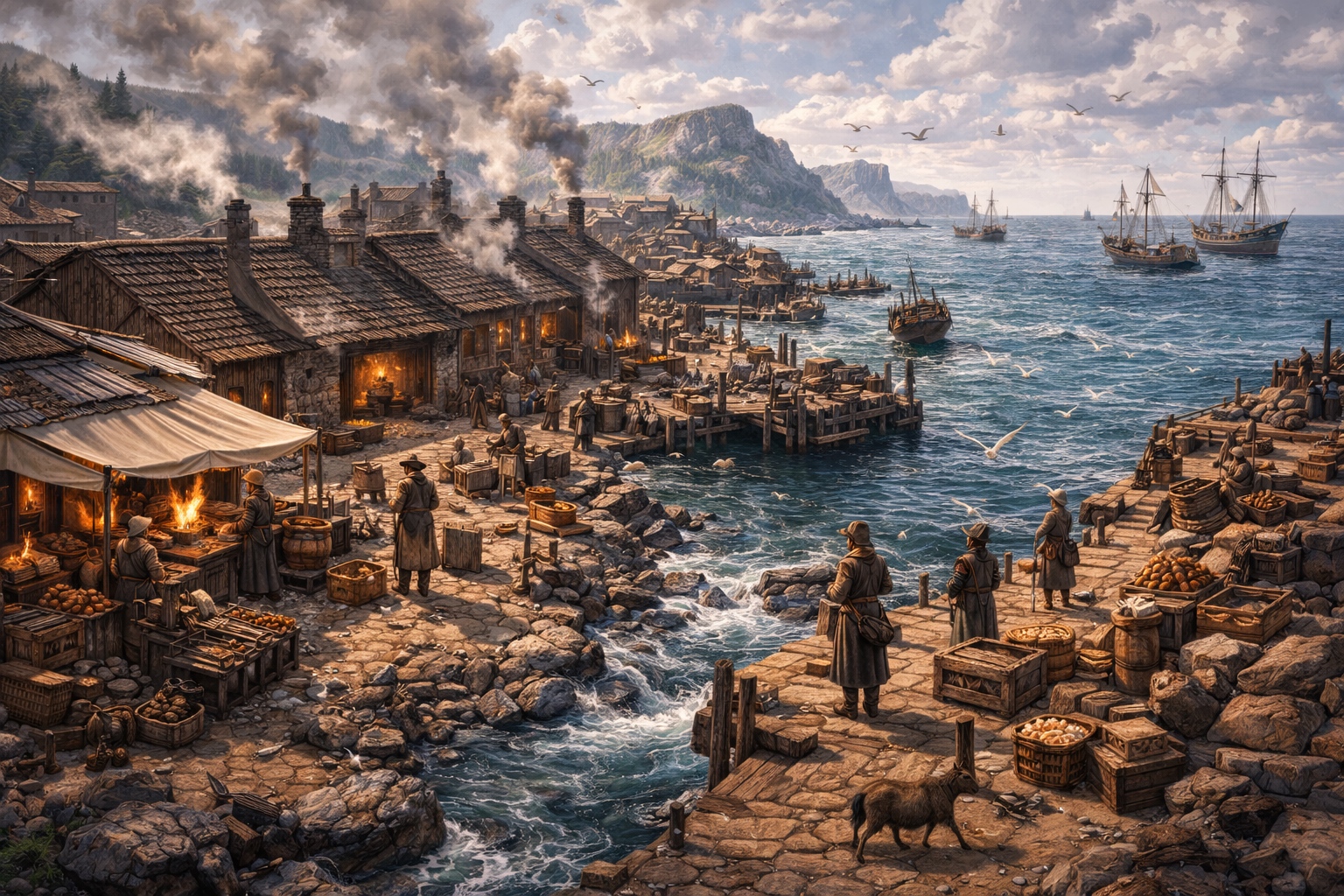
Dargol exists in a state of productive disorder. The docks are functional but patched, the market stalls lean against each other at angles that suggest accumulated improvisation rather than planning, and the goats that wander the back lanes do so with the confidence of creatures who have learned that no one in authority is going to tell them otherwise.
The harbor is the town's good news: the Rhodian Ocean here is calm in most seasons, the anchorage is deep, and the Junaloia routes, the oceanic archipelago three days out, pass through Dargol as a matter of practical geography. The trade that moves through the town's docks is real and ongoing even if the town has not organized itself to profit from it as much as it could.
The smell is salt, fish, charcoal from the smoking operations, and the specific smell of a working port that has not recently invested in drainage. First-time visitors from Tontou tend to arrive with expectations shaped by Tontou's lagoon and leave wondering what the difference is between Dargol and the same distance of empty coastline.
The permanent residents would have opinions about this comparison if they had not heard a version of it before.
Geography & Setting
Dargol occupies a natural harbor indent on Funta's southern Rhodian coast, one of the few points along this stretch where a loaded trading vessel can anchor without requiring significant navigational experience. This is not an accident of history; the harbor was the reason people settled here before there was a settlement worth naming.
The coastline to either side is rocky and unpredictable. Dargol's harbor is the exception. This gives the town a functional monopoly on the Junaloia crossing in this part of Funta, and the monopoly has been the foundation of whatever economic life the town manages to sustain.
Inland, the terrain is low scrub and dry pasture. The livestock that Gryta Pip runs are better suited to this environment than any other agricultural activity would be. The fishing grounds extend well beyond the harbor and are the most productive resource the town controls, productive enough that Gavric Thundervein's operation has been sustaining the town's basic economy for two decades without requiring anything more organized than Gavric's personal determination.
The People
Demographics
Dargol's permanent population is mostly human, with the Dwarf community centered on the fishery operation and a rotating cast of traders, sailors, and Junaloia-connected merchants who constitute the transient population. The town is not unwelcoming to outsiders (the economic logic runs the other direction, since every person passing through is a potential customer), but the permanent residents have a collective fatalism about Dargol's situation that can read as indifference to outsiders not yet calibrated to it.
The Junaloia connection brings a specific demographic element: the archipelago's traders and the Funta-side families who have inter-island relationships. These connections are one of the more interesting things about Dargol and are consistently the most underutilized by its governance.
Economy
Dargol's economic life runs on three things and would benefit from running on four. The three are Gavric's fishery, the Junaloia transit trade, and Gryta's livestock operation. The fourth, a properly organized trading house that could act as a real intermediary for the Junaloia commerce, does not exist, though Zora Chijioke has been describing what it would look like for approximately five years.
The fish are excellent. The smoked product from Gavric's operation is the equal of anything Tontou's market stocks, and Dargol's pricing is better because no one has realized yet that they could charge more. This situation will not last indefinitely.
Primary Exports
- Smoked and dried fish: Rhodian Ocean catch; the smoking tradition here predates Gavric's operation and the product quality reflects it
- Junaloia trade transit: Import/export intermediary for the archipelago; the value-add is mostly in the docking and logistics, not in any processing
Primary Imports
- Manufactured goods: Tools, textiles, the full range of things a fishing port needs that it cannot produce
- Junaloia goods: Archipelago-specific products (spices, specific materials, craft goods) that move through Dargol on their way north
Key Industries
- Rhodian Fishery: Gavric's operation; the economic foundation of the town
- Junaloia Imports and Exports: Seun Adara's trading operation; the interface between mainland and archipelago commerce
- Dargol Livestock: Gryta Pip's operation; coastal pasture farming; the cheese and dried meat provide basic provisions for departing vessels
Food & Drink
The fish is the honest answer to any question about Dargol's cuisine. The smoked varieties are available in half the forms that smoke and patience allow: whole, filleted, shredded into the stewed grain dishes that constitute most of the town's daily eating, pressed into the drying slabs that sailors provision from. The fresh catch from Gavric's morning boats is the best food available anywhere in this stretch of coast and is available at the market for prices that have not moved in a decade.
The goat cheese from Gryta's operation is an acquired taste that most permanent residents have acquired and most transit visitors have not gotten around to.
Dargol has two taverns with functioning kitchens. The food at both is adequate and honest about being so.
Culture & Social Life
The permanent residents of Dargol have developed the particular social equanimity of people who have made peace with the gap between what their town could be and what it is. This is not resignation exactly (Zora Chijioke's ongoing project of organizing the Junaloia trade more effectively has real community support), but it is the practical acceptance that the organizational improvements require leadership capacity that Tendai does not provide.
The Junaloia traders who pass through have a different relationship with the town: for them, Dargol is a staging point, a provisioning stop, a place to wait out weather. The regulars know the fishing families and have relationships with Gavric's dock staff that are more genuine than the transit-visitor dynamic would suggest. The archipelago connection has made Dargol, at the level of individual relationships, more cosmopolitan than its appearance implies.
Festivals & Traditions
The Junaloia Departure
When the main trading season opens and the first convoy of vessels prepares for the archipelago crossing, Dargol marks it with a harbor-side send-off that is equal parts commercial event and genuine communal wish for safe passage. Martus is invoked for luck and favorable turns of tide. Gavric provides smoked provisions at cost. Zora manages the logistics that ensure the convoy is actually ready to depart on the day announced.
The Smoke Season
The autumn fish run brings the best catches of the year, and the weeks of intensive smoking that follow are Dargol's closest equivalent to a harvest festival: long days, the whole harbor district smelling of woodsmoke and fish, and the specific communal satisfaction of work that will sustain the town through the slower months. The first smoke-day is marked with a meal that involves the whole permanent population and a frankly impractical amount of fresh fish.
Music & Arts
Dargol's cultural life is the music of the harbor: work songs, the specific rhythms of the Junaloia sailor tradition, and the informal playing that happens in the two taverns after the day's work. Nothing has been written down; everything is in the heads of the people who grew up hearing it. The tradition is genuine even if it has not been organized.
Religion
Primary Faith
Dargol's working religion is split the way most ports' are:
Ryujin's presence is strongest at the end of the main dock: small water-offerings, sailors pausing before departure, Junaloia traders maintaining their own rites.
Martus has the oldest established temple in town. His observances are practical and superstitious rather than doctrinal: coin-offerings before sail, charms tied to nets, dice games played "in his name" before a risky season. The priest's chief role is less moral instruction and more keeping the town's luck rituals coherent enough that nobody feels cursed.
Secondary / Minority Faiths
Talbar shows up where Junaloia commerce meets mainland bargaining, not as a grand temple, but as mediators and contract-witnesses who keep deals from collapsing into blood feuds.
Caldrin is the faith of the Junaloia crossing itself, the most dangerous regular passage in Dargol's world. The specific dock finger where the Junaloia convoys stage before departure has accumulated offerings and small wayfinding tokens in a pattern that is recognizable as Caldrin's domain: requests for true directions, for upheld passage rights, for the hospitality-to-strangers that means arriving safely at the other side. Seun Adara's trading post keeps a small Caldrin marker at the door, a practice brought from wherever he came from that Dargol's traders have adopted as practical.
Anansi is present in the informal register: the harbor music that has never been written down, the work songs passed between fishery crews, the tavern storytelling that constitutes Dargol's actual cultural life in the absence of any formal arts institution. The fact that no one has organized any of this is itself characteristic of Dargol; Anansi's tradition thrives in exactly this kind of organic, unarchived, communal transmission. The Junaloia sailors bring their own narrative traditions to the Net House and the Rhodian Rest, and the cross-pollination with Funta harbor music is the kind of adaptive identity that Anansi embodies.
Dolen is felt most sharply at the Departure Point, where families stand until the Junaloia vessels clear the harbor mouth. The archipelago crossing is real risk; the permanent residents know which seasons produce which weather, and they know the names of those who didn't come back. Dolen's domain of longing and separation is present in the quiet of the Departure Point vigils, in the particular domestic rituals (nets mended, provisions packed, the specific acts that keep hands busy while hearts wait) that the fishing families maintain.
Secret / Underground
No organized secret faith, but there are specific fishing families in Dargol who maintain older coastal traditions that do not involve the Martus temple and that they do not invite outsiders to observe. The traditions appear to concern the Rhodian Ocean specifically and to predate the harbor settlement.
Damballa is the most likely name for what the older fishing families' coastal traditions actually address: the Rhodian Ocean's cycles of death and return, the understanding of the Quiet Anchorage two days south as a place where the boundary between living and dead is thin, and the practical reckoning with mortality that fishing communities maintain even when they don't speak it openly. These traditions are not acknowledged in public and are specifically kept out of the Martus temple's orbit. The death-cycle faith that the Rhodian fishing families maintain is older than the harbor settlement, and they intend to keep it that way.
History
Founding
The harbor was used as an anchorage before there was anything to anchor at. The permanent settlement grew up around the provisioning need: people who could sell water, food, and rope to vessels preparing for the Junaloia crossing. The fishing industry developed alongside the provisioning trade and has outlasted several cycles of the Junaloia commerce's ups and downs.
Key Events
The Junaloia Trade Formalization (approx. 60 years ago)
When the Junaloia archipelago's internal governance organized enough to produce a consistent export trade, Dargol's position as the nearest mainland port made it the default intermediary. The town's infrastructure, such as it was, received investment from the Junaloia-side merchants who needed reliable mainland provisioning. The docks were rebuilt. The town grew. The governance apparatus did not grow at the same pace and has not caught up since.
The Fishery Establishment (approx. 20 years ago)
Gavric Thundervein arrived in Dargol with a specific plan for industrializing the fish processing that the town's independent fishermen had been doing informally. He negotiated with Tendai's predecessor for harbor access rights and built the smoking and drying operation that has been running since. The quality improvement in Dargol's smoked fish product was immediate and attributable entirely to Gavric's methods, which he protects with the specific intensity of a person who knows they are the main thing holding a situation together.
The Chijioke Succession (approx. 8 years ago)
Tendai Chijioke came to the chieftaincy not by ambition but by elimination: the predecessor died, the obvious successors declined or were unavailable, and Tendai was present and willing to accept the title if no one else wanted it. No one else did. Zora's involvement in the actual work of governance began immediately and has not diminished.
Current State
Dargol is stable in the sense that it is not getting worse. The fishery provides economic floor, the Junaloia trade provides ceiling, and Zora's management of the gap between the two keeps the town from losing either. The organizing question, whether the Junaloia trade can be consolidated into something more structured, has been circling for years. Zora believes she now has Seun Adara's cooperation, which was the missing piece. Tendai has been told and is supportive in his way.
Leadership & Governance
The Chijioke Household: Overview
Governance in Dargol is single-household in structure and divided in practice. The Chieftain holds formal authority: dispute resolution, harbor rights, trade agreements, the functions that require a recognized authority to execute. Zora holds the organizational competence that makes those functions operate. The arrangement works because both parties understand it and because Tendai, whatever his limitations, does not interfere with Zora's work.
Chieftain Tendai Chijioke
Human, Male; forties
Tendai is not a bad man. He is a man who did not seek his position, does not have the particular drive that positions like his typically require, and has organized his life around doing what the role needs without burning himself out on what it could require. His decisions are generally sound when the options are clearly presented to him. The problem is that he does not seek the options out on his own, which means the decisions that require initiative tend not to get made until Zora has made them for him.
He is liked by the town's fishermen and by the sailors who pass through, both of whom read his lack of aggression as approachability. He is liked less by the Junaloia merchants, who want someone who takes the commercial situation seriously and who find his relaxed manner difficult to distinguish from indifference.
Zora Chijioke
Human, Female; forties
Zora would not have chosen Dargol as the place to build a life. She arrived as a trader's daughter, married Tendai for reasons that seemed clearer at the time, and has spent the last fifteen years deciding that if the town is going to be what it could be, she is the one who has to make it happen. This has not made her bitter; it has made her highly competent and occasionally impatient with people who are neither.
She manages the harbor logistics, the Junaloia trader relationships, and the annual provisioning agreements with a thoroughness that would have distinguished her in any commercial city in Funta. In Dargol, she is largely invisible to the broader world because the town itself is. This situation is one she is actively working to change.
Mosi: Senior Advisor
Human, Male; sixties; the Chieftain's hall and the harbor office
Mosi has been in Dargol longer than anyone except Gavric and has served in an advisory function under two chieftains. His value is institutional knowledge: he knows every significant agreement the town has made, every debt that has been forgiven, every trader who was banned and then quietly allowed back. He is not energetic in the way that the situation sometimes requires, but he is accurate in a way that prevents specific categories of error. Zora consults him before committing to anything that has historical dimensions.
Rudo: Captain of the Watch
Half-Orc, Female; thirties; the harbor and market areas
Rudo manages Dargol's watch with a minimum of ceremony and a maximum of effect. The town's crime level is low, partly because there is not enough concentrated wealth to make organized theft worthwhile, and partly because Rudo has made clear through several early demonstrations that the consequences of testing this are not proportionate to the opportunity. She works well with Gavric, whose fishery docks require the most consistent attention, and has a professional respect for Zora that involves following instructions from her without requiring Tendai's formal sign-off.
Notable Figures
Gavric Thundervein: Owner, Rhodian Fishery
Dwarf, Male; age uncertain; the fishery dock and smoking sheds
Gavric built what he built because no one else was building it and the materials were there. He has the particular single-mindedness of a person who identified a thing that needed doing twenty years ago and has been doing it without distraction since. His smoked fish is the best on the Rhodian coast. He is aware of this and prices accordingly in the export market, which is the one area where Dargol demonstrably punches above its weight.
His relationship with Zora is collaborative; with Tendai, it is politely minimal. He employs twelve people at the fishery, most of whom have been there long enough that the operation would not function smoothly without them.
Seun Adara: Junaloia Imports and Exports
Zerren, Male; thirties; the trading post near the dock
Seun arrived in Dargol four years ago with existing Junaloia connections that he built into a trading post operation that now handles the majority of the formal commerce moving between the archipelago and the mainland through this port. He is commercially shrewd and has been cautious about the relationship with Zora, not because he distrusts her but because consolidating the Junaloia trade involves stakes large enough that he wanted to understand the town's actual power structure before committing to it. He has now understood it and has committed.
Gryta Pip: Dargol Livestock
Gnome, Female; age uncertain; the inland pasture and the market
Gryta manages the coastal goat and chicken operation that provides Dargol's vessels with basic provisions. She is not in a particularly dramatic situation: the livestock business works, the cheese is unusual enough to have a small dedicated market among the Junaloia sailors, and she has expanded the operation twice in the last ten years without fanfare. Her interest is in the animals. The rest of it is administration, which she handles because it is attached to the part she cares about.
Key Locations
Seat of Power
- The Chijioke Hall: The chieftain's official residence and the town's administrative center; a functional building without pretension; the back office where Zora's actual records are kept is better organized than the formal meeting room
Houses of Worship
- The Martus Temple: On the harbor front; small, maintained with genuine care by the priest and the fishing families who fund it; the internal space is simple and honest in the same way the fishery work is
- The Ryujin Dock Shrine: At the end of the main dock; maintained by the Junaloia trading community; flowers and small objects left by sailors before departure
Inns & Taverns
- The Rhodian Rest: The larger of the two inns; used by the archipelago traders and the regular provisioning merchants; adequate food, reliable beer, and Gavric's smoked fish as the permanent menu item that distinguishes it
- The Net House: The working tavern; used primarily by the fishery workers and the dock crews; the conversation is better here and the fish is equally good
Shops & Services
- Rhodian Fishery: Gavric's operation; the dock-side smoking and drying sheds that process the catch; wholesale only, not a retail establishment, but the harbor market sells the output
- Junaloia Imports and Exports: Seun's trading post; the interface between the archipelago commerce and the mainland; the most cosmopolitan square footage in Dargol
- Dargol Livestock: Gryta's operation; primarily a wholesale provisions supplier for departing vessels; the market stall on trade days is where the retail side happens
The Market
- The Harbor Market: Daily market oriented toward the provisioning trade; fish, livestock products, and the Junaloia goods that Seun makes available on market days. The permanent residents and the transit traders occupy it at different rhythms that have never been formally organized but have achieved a working equilibrium.
Other Points of Interest
- The Smoking Sheds: The row of low buildings behind Gavric's dock where the fish processing happens; not a tourist attraction, but the smell on a smoking day reaches the whole harbor district and is either appealing or not
- The Departure Point: The specific dock finger where the Junaloia vessels tie up before crossing; by unofficial tradition, the families of those making the crossing stand here until the vessel clears the harbor mouth
Secrets, Rumors & Hooks
- Seun Adara's Junaloia connections include a family on one of the inner islands that has been sending him materials that are not in the formal trade manifests. The materials are not contraband in any obvious sense; they are simply not declared. He has been sitting on them for three months trying to decide what they are worth and to whom.
- The older fishing families' private coastal traditions include a specific understanding of a location two days south along the Rhodian shore that they call the Quiet Anchorage. They do not use it. They do not explain why. The occasional vessel that has anchored there has left quickly, and the crews have not wanted to discuss it afterward.
- Mosi's institutional records include documentation of an agreement made during the previous chieftain's tenure that granted specific Junaloia trading rights to a merchant house that has since been dissolved. The dissolution was never formally registered with Dargol's harbor records, which means the rights may still technically be active and may now belong to a successor entity that no one in Dargol has dealt with.
- Zora has been in correspondence with a Tontou merchant about establishing a formal trading house in Dargol with outside investment. She has not told Tendai because his initial reaction to proposals of this scale tends to be negative before he has thought about them, and she wants to be further along before that conversation happens.