Djado
Djado: Where the Fire Never Goes Out
"Every traveler who passes through Djado remembers the heat twice. Once from the desert. Once from what they saw at the cliff."
Unnamed caravan master, quoted in a LaHale geography collection
At a Glance
| Continent | Funta |
| Region / Province | Central Funta, south-central Great Ennedi Desert edge |
| Settlement Type | Town |
| Population | ~1,100 permanent; fluctuating population of nomadic residents |
| Dominant Races | Human (majority), Elf, Felair, Drakin; mixed nomadic population |
| Ruler / Leader | Supreme Fire Sister Elara Sunfire (de facto civic authority); the Fire Swingers govern by influence rather than formal title |
| Ruling Body | The Fire Swingers, autonomous order; civic matters are handled by community consensus with deference to the order |
| Primary Deity | Zopha (in relation to the Fire Swingers' knowledge-adjacent traditions); Nesara (water as sacred survival); animist fire spirits honored by the nomadic community |
| Economy | Water trade, desert hunting and gathering, livestock herding, the Fire Swingers' logistical needs |
| Known For | The Flamehold: the Fire Swingers' fortress carved into the valley cliffs; the Trial By Fire; and being the closest thing to an inviolable sanctuary in the entire Great Ennedi interior |
First Impressions
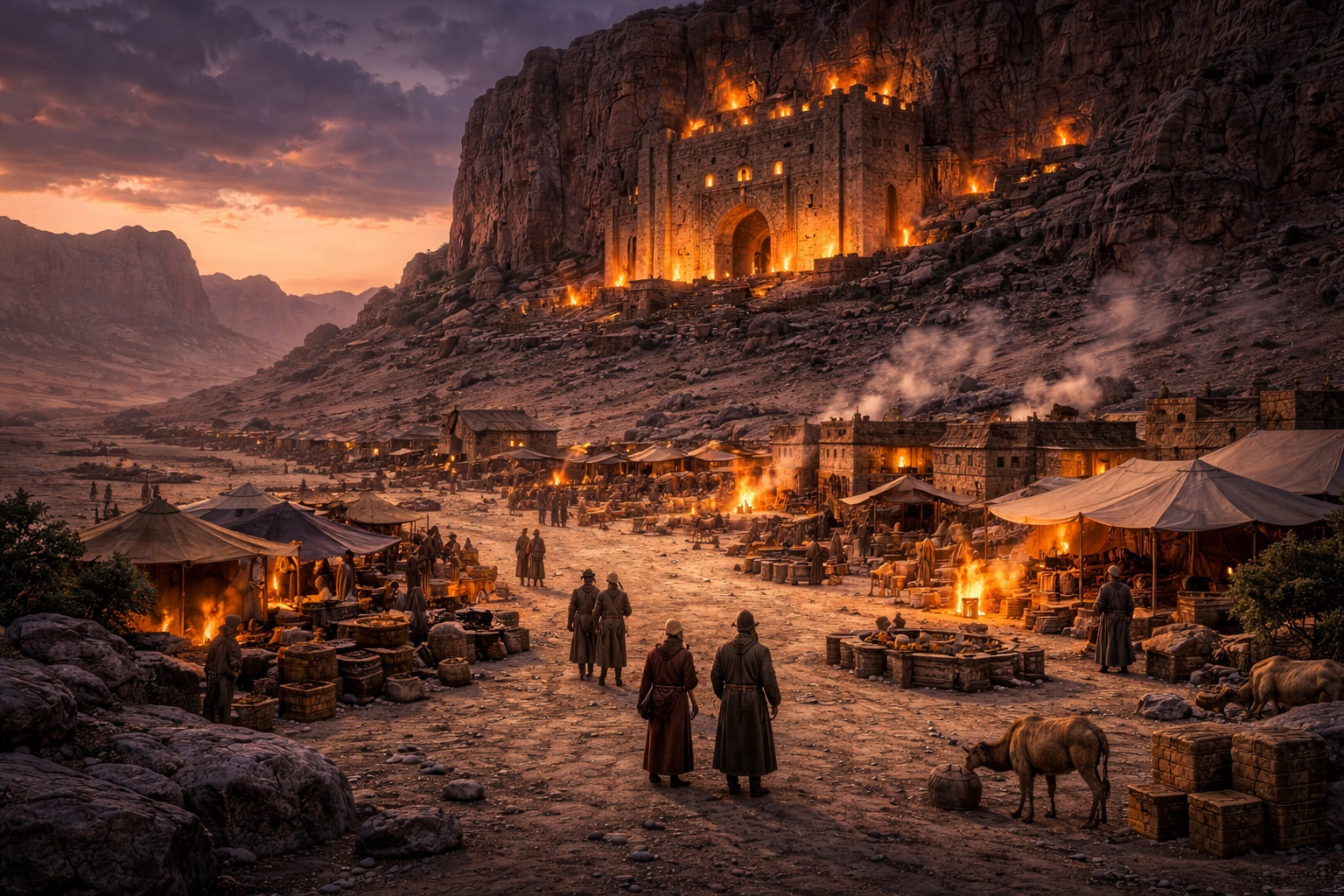
The desert gives you nothing for the last two days before Djado: flat rock, heat shimmer, the occasional dead acacia that offers no shade worth having. Then the valley opens below: a long, sheltered cut in the plateau where the rock holds moisture that the surface cannot, where goats pick at sparse vegetation on the lower slopes, and where the town has settled into the valley floor with the practical arrangement of people who have learned exactly which parts of the available space are worth occupying.
The Flamehold is what you see before you see any of that. The cliff face on the valley's eastern side has been inhabited: built into, carved out, made continuous with the rock in a way that takes repeated looking to parse. From the valley floor, the glowing apertures in the cliff face look like embers in stone. The statues at the grand entrance are visible as silhouettes even at distance. No banners. No flags. The Fire Swingers do not advertise.
The town below the cliff has the comfortable disorganization of a settlement that serves a population that does not stay in one place for long. Temporary structures stand next to permanent ones. The wells, marked by Sunfire Wells' simple carved stones, are the town's actual center, the points around which everything else has oriented. The smell is dust, goat, and smoke. The smoke is always there.
Geography & Setting
Djado sits in a valley cut into the desert plateau, a sheltered depression that provides some protection from the surface winds and enough subsurface moisture to support the wells that make permanent settlement possible. The valley runs roughly north-south. The western slope is occupied by the town; the eastern cliff face houses the Flamehold.
The Great Ennedi Desert surrounds the valley in every direction. Travel out of Djado is done with guides, water discipline, and an understanding of which routes are passable and which are passable only if Johanna, the ancient dragon of the Ennedi, is not in a mood to notice you. Most desert travelers treat the great dragon as an environmental variable rather than a personal threat, which is probably accurate and possibly unwise.
The climate is exactly what a desert plateau valley should be: extreme daytime heat, surprisingly cold nights, and a dry wind that carries fine sand into everything. The valley's sheltered position moderates the wind but not the temperature. There is no river access; all water comes from the wells, which tap underground sources that the town's survival depends on.
The People
Demographics
Djado's permanent population is roughly half settled and half the nomadic hunters and gatherers who use the town as a seasonal base. The settled population runs the town's essential services: the wells, the livestock operation, the supply trading. The nomadic population passes through in patterns that the settled residents have learned to anticipate, and the town's commercial rhythm adjusts accordingly.
The Fire Swingers are a population unto themselves: present, visible on patrol, and utterly separate from the civic life of the town below the cliff. They use the town's wells, acquire food from the town's suppliers, and take on recruits from the surrounding region, but they do not govern the town in any formal sense. The town governs itself by community consensus and defers to the order's authority in matters that affect the order's interests.
Outsiders are tolerated rather than welcomed. Djado is not hostile to visitors, but it is indifferent in a way that communicates clearly that the Flamehold's presence makes this a place with its own rules, and learning those rules is the visitor's responsibility.
Economy
Water is the foundation of everything in Djado. Sunfire Wells manages the public wells and the sale of water to travelers passing through; this is the town's most critical economic function, and the fee structure for water access is the most consistently enforced law in the settlement. A traveler who tries to draw water without paying will find that this is the one matter on which Djado's community, the Fire Swingers, and the well operators act in complete alignment.
Desert hunting and gathering sustain the nomadic population and provide traded goods (dried meat, preserved plants, desert materials used in the Flamehold's ritual practices) that flow through the town's modest market. The Fire Swingers' logistical needs generate significant local economic activity: food, materials, repair services, and the miscellaneous supply requirements of a fortress that houses hundreds of warrior monks.
Primary Exports
- Desert goods: Dried and preserved meats, desert plants with medicinal or ritual properties; traded to LaHale and along the interior caravan routes
- Water access: Not an export, but the economic fact that makes the town's existence possible for travelers crossing the Ennedi
Primary Imports
- Grain and staple foods: The valley does not support significant agriculture; most food comes in from Lahale and Nukwai via the Volta corridor
- Metal goods and equipment: Tools, weapons components, and materials for the Flamehold's forge; brought in by supply caravans
Key Industries
- Sunfire Wells: Water management and distribution; the town's most critical operation
- Valley Livestock: Goat herding adapted to the valley's conditions; primary protein source and hide supplier
- Desert Bounty: The organized hunting and gathering operation that supplies both the town and the Flamehold with desert resources
Food & Drink
Djado eats practically. The constraints of desert provisioning produce a cuisine that is efficient, preserved, and spiced heavily to make the preserved foods palatable, a pattern that has produced genuine local specialties in its own right. Smoked and dried goat is the base protein. Desert plants and the occasional hunting catch supplement it. Grain comes in from the trade routes and is used carefully. There is a goat milk preparation (soured, thickened, spiced with desert herbs) that is specifically associated with Djado and that travelers from other parts of Funta find surprising.
Water is treated with a respect that is genuinely religious in character and practically enforced. Wasting water in Djado is a social offense of the first order.
Culture & Social Life
Djado's culture is shaped by the desert and by the Flamehold's proximity in approximately equal measure. The desert instills practical values: conserve everything, plan for worse conditions than the current ones, trust the people who have proven they know the terrain, and do not underestimate the terrain. The Flamehold's proximity adds an awareness of controlled power and discipline that has permeated the community's self-conception even for people who have no connection to the order.
The community's relationship with the Fire Swingers is pride mixed with a careful awareness of the order's absolute autonomy. Djado claims the Fire Swingers as its own in the way that any town claims the remarkable thing that exists within its territory, but the town also knows better than to test the limits of what that claim means. The order does not need the town's approval for anything it does, and the town knows it.
Festivals & Traditions
The Well Blessing
At the beginning of the dry season, the community gathers at each of the town's wells in sequence for a ceremony that is part practical inspection (checking the well's status, the water level, the integrity of the equipment) and part communal acknowledgment that the wells are the reason the town exists. The Sunfire Wells family leads the practical portion; an elder from the nomadic community leads the spiritual acknowledgment.
The Remembrance of Binara
On the anniversary of the Battle of Bafao, Djado marks the founding of the Fire Swingers' most celebrated moment with a day of quiet. No music. No celebration. No market. The town sits with the understanding that Binara died for something, and that something continues above in the Flamehold.
Music & Arts
Djado's artistic life is limited by its population size and practical orientation. There is music (the nomadic community brings musical traditions that vary by season and by which groups are passing through), but it is not performed; it is played around fires in the evenings as a social activity. The Fire Swingers have their own ritual musical tradition that is not shared with the town, but on certain ceremonial occasions, the sounds from the Flamehold carry down into the valley and the town stops to listen.
Religion
Primary Faith
The fire spirits that the nomadic community acknowledges (not formally organized, not administered by clergy) are the closest thing Djado has to a primary faith. Fire is not purely metaphorical in the Ennedi's spiritual life. The Fire Swingers' very existence is a theological statement that fire is power, discipline, and protection, which aligns with the animist tradition in ways that have made the order and the community's faith mutually reinforcing without being identical.
The Zopha connection that exists in the Fire Swingers' intellectual tradition, particularly in the Ember Archives, is not really accessible to the town population. It is a scholarly dimension of the order's practice that the community observes from outside.
Nesara holds a place in Djado that is more intimate and more urgent than deity worship usually is. In a desert valley where every drop of water comes from wells tapping underground sources that are slowly declining, water is not a resource; it is existence itself. The Well Blessing ceremony, conducted at each well in sequence at the start of the dry season, combines practical inspection with a spiritual acknowledgment that the underground water is held in trust, that it must be asked rather than taken. The fee structure for water access is the most consistently enforced rule in the settlement, and that enforcement is understood as religious as much as practical.
Secondary / Minority Faiths
Travelers through Djado bring their own faith practices. The town's approach is the desert approach: as long as your gods don't require more water than you've paid for, your business is your business.
Anansi moves through the nomadic population's evening fires with a freedom that no permanent institution could achieve. The nomads who pass through Djado bring their own story traditions from across the Ennedi, and the valley's fire-lit evenings are where these traditions intersect: hunters' tales, caravan news, the oral history of peoples who keep no written records. The Remembrance of Binara, which the town observes with a day of quiet rather than celebration, is the permanent population's own version of this same impulse: holding communal memory against forgetting, making sure the story survives the people who first told it.
Cameth is the quiet faith of the permanent settlement: the households that stay, tend the wells, manage the livestock, and maintain the infrastructure that makes Djado a habitable place rather than another stretch of desert. The desert instills practical values, and Cameth's protection of ordinary people in ordinary crisis is exactly the faith that emerges from a community that manages extreme conditions as a daily fact of life. Offerings to Cameth appear most often around the wells themselves, not the grand religious expression of Nesara's water-reverence, but the small household acknowledgment that disaster can come from any direction and that protection must be asked for continuously.
Secret or Forbidden Worship
The Prophesied Chamber deep within the Flamehold is a theological category of its own, not secret in the sense of hidden from the order, but sealed until the conditions of an ancient prophecy are met. The town knows this chamber exists. The town has no more information about it than that.
Damballa is present in Djado in the way the death-cycle faith is always present in communities where death is a regular practical companion. The three disappearances in the past decade, hunters who strayed too close to Johanna's territory, are managed publicly as "desert conditions" and privately as something requiring acknowledgment to a deity who governs the return of flesh to the earth. The desert takes people and does not give them back. Faelar at Desert Bounty keeps a private offering space that those who know what to look for recognize as Damballa's, and the nomadic communities who return each season have their own versions of this same acknowledgment to the cycle of death that the Ennedi enforces.
History
Founding
Djado was not founded so much as it accumulated around the wells. The underground water source was identified by nomadic hunters who began camping there reliably each dry season. The camp became semi-permanent when the first well was properly developed. The Fire Swingers arrived later; the Flamehold was established after the order's founding, when the order was looking for a headquarters that was defensible, isolated, and appropriate to their discipline. The valley cliff was ideal. The town below was already there, which the order viewed as a logistical convenience.
Key Events
The Flamehold's Construction (historical period, exact date unrecorded)
The construction of the Flamehold into the cliff face is the event that defined Djado's place in Funta's geography. The work took years and involved techniques that the town's residents observed without understanding. The result is a fortress that is effectively unassailable by conventional means and that has never been seriously tested, because the reputation of the Fire Swingers is its own deterrent.
The Battle of Bafao (year 1211 ME)
The Fire Swingers' decisive action at Bafao, destroying Lord Valgrant's invasion fleet and routing his army, did not happen at Djado, but its impact was felt here. The order's reputation was established at Bafao in terms that the world understood. Djado's connection to the order made it, by extension, inviolable. No raiding party, no warlord, no chieftain has tested the proposition. The captured artifacts from Bafao (Lord Valgrant's family sword, crest, and helmet) are displayed in the Flamehold's training grounds as the order's lesson about fierçeness and mercy.
Current State
Djado is stable in the particular way of a settlement that has an incontrovertible deterrent at its back. The Fire Swingers' presence makes conventional threats irrelevant. The town's economy is constrained by its desert location and its dependence on outside food supply, but those constraints are managed rather than crisis conditions. The current tension is the well system's long-term sustainability: Sunfire Wells has been monitoring the underground water levels for two generations and the numbers are moving in a direction that requires attention that the town is not yet prepared to discuss publicly.
Leadership & Governance
Community Consensus: Overview
Djado has no formal governance structure. The permanent settlement manages itself through community consensus on the matters that affect everyone (well access, market space, the reception of visitors) and defers to Sunfire Wells on water-related questions and to the Fire Swingers on questions that touch on the order's interests. This works because Djado is small enough that everyone who matters knows everyone else, and because the Flamehold's proximity means that actual enforcement of anything requiring physical force is not a question anyone raises.
Supreme Fire Sister Elara Sunfire
Elf, Female; elderly; precise age unknown
Elara Sunfire is a figure of such established authority within the order and, by extension, the region that the town relates to her less as a leader than as an institution. She is elderly in the Elf sense (centuries old, composed in the manner of someone who has survived everything that could be presented to her and intends to survive more) with skin the deep dark of midnight and eyes like molten gold that the town's residents describe in specific terms when they tell stories about her.
She is unmarried by choice, leads the Fire Swingers with an absolute authority that does not require demonstration, and appears in public when she chooses to, which is not often. Her visits to the town below the cliff are noted and remembered. When she speaks to the town population, it is briefly and specifically, and the town takes her words seriously in the way of people who know they are not receiving many.
Flame Mother Variana Wyrmbane
Drakin, Female; second in command to Elara Sunfire
Variana is the operational authority for the Flamehold's day-to-day function: training schedules, mission assignments, logistical management, and the management of the order's relationship with the town below the cliff. She communicates the order's needs to the town's suppliers and handles disputes that arise at the interface between the Flamehold and the community. She is respected in the town; more than Elara, she is visible there.
Blazing Star Zola
Felair, Female; personal advisor and confidante to Elara Sunfire
Zola is unusual within the order in being primarily an advisor rather than a combat operative. She is a master of the order's history and doctrine, and her counsel shapes decisions that Variana later implements. She is more often seen in the Flamehold than in the town, but when she does come down into the valley, which happens during certain seasonal transitions, she is notable enough in appearance that the town's children follow her at a distance.
Guard & Militia
The Fire Swingers' Cinder Wardens patrol the valley perimeter and maintain watch over the approaches to both the Flamehold and the town. They do not formally guard the town (their mandate is the order's security), but the practical effect is that the town is watched.
Law & Order
Djado's law is community consensus enforced by community memory and the proximity of the Fire Swingers. There is no formal code. Violations of water-sharing agreements are the most reliably enforced rules. Everything else is managed by the community's own judgment.
Notable Figures
Thalindra: Manager, Sunfire Wells
Elf, Female; middle-aged; the wells
Thalindra is the practical authority on Djado's water supply. She manages the daily operation of the public wells, the fee collection, the maintenance, and the long-term monitoring of the underground source levels. She is not alarmed by what the monitoring shows, in the sense that she has decided that appearing alarmed would not help. She is very much tracking it.
Faelar: Owner, Desert Bounty
Gnome, Male; age indeterminate; the market and the desert
Faelar runs the hunting and gathering operation that supplies the town and the Flamehold with desert resources. He employs a rotating group of nomadic hunters who bring him materials he cannot gather himself, and he has a comprehensive knowledge of what the Ennedi's desert ecology can produce and where to find it. He is the person to speak to about what lies in the desert beyond the valley's edge.
Gavric: Owner, Valley Livestock
Dwarf, Male; middle-aged; the livestock pens on the valley's western slope
Gavric manages the goat herd that provides the town's primary protein source. He arrived in Djado three decades ago following a route that he does not discuss in detail, and he has stayed because the goat-herding conditions in the valley suit him and because the alternative of leaving requires crossing the desert, which he did once and considers sufficient. He is reliable, specific about his goats' genealogy, and largely uninterested in anything that is not a goat.
Key Locations
Seat of Power
- The Flamehold: The Fire Swingers' cliff fortress; the Ashen Council Chamber within is where the order's strategic decisions are made; this is the effective seat of authority for the region, though the order does not frame it in civic terms
Houses of Worship
- The Pyre Sanctum: Within the Flamehold; the spiritual center where rituals are conducted and initiates undergo the Trial By Fire; not accessible to the public
- The Valley Fire Circle: An outdoor gathering space at the valley's south end where the community conducts the seasonal fire ceremonies; maintained collectively
Inns & Taverns
- Nomad's Rest: The town's single inn, operated by a Human named Elara (not the Fire Swinger Elara; the shared name is a source of confusion that the innkeeper has learned to address immediately); provides adequate shelter for travelers; the meals are serviceable
Shops & Services
- Sunfire Wells: Water service; the most critical commercial operation in the town
- Desert Bounty: Desert goods and supplies; also acts as the information source for conditions in the surrounding desert
- Valley Livestock: Meat, dairy, and hides; also supplies the Flamehold under a standing contract
The Market
- The Valley Floor Market: An informal market that expands significantly when nomadic groups are in residence; desert goods, crafts, traded items from the caravan routes; schedule varies with population
Other Points of Interest
- The Flamehold Exterior: Visible from the valley floor; the glowing apertures in the cliff face, the carved entrance with the statues of legendary Fire Swingers, the battlements integrated into the rock face. Not accessible except to the order and those they admit.
- The Training Grounds (exterior): The outdoor sparring area below the Flamehold, visible but not open; on mornings when training is conducted outside, the town stops what it is doing to watch
Secrets, Rumors & Hooks
- Thalindra's monitoring of the underground water levels shows a decline that she estimates will require a decision within twenty years. She has told Variana Wyrmbane. Variana has told Elara Sunfire. Nothing has been communicated to the town.
- The Prophesied Chamber in the Flamehold's depths has shown unusual activity recently, not opening, but the seals around it have been observed to flicker in ways they have not done in living memory. Blazing Star Zola has been spending significant time near the chamber. She has told no one what she has observed.
- The nomadic hunting routes in the Ennedi occasionally bring hunters close to areas that Johanna, the golden dragon, claims as her own. There have been three disappearances in the past decade that the community attributes to "desert conditions." Faelar knows that the routes were too close to the dragon's territory and has adjusted the patterns. He has not explained to the families why the routes changed.
- The artifacts from Bafao displayed in the Flamehold's training grounds (Lord Valgrant's sword, crest, and helmet) have a piece missing that no historical account documents. The sword has a space in its hilt where a gemstone should be. The Fire Swingers' records do not explain the absence. Elara Sunfire, when asked, changes the subject.
- Faelar at Desert Bounty occasionally receives items through the caravan trade that are not desert goods, materials from inside the Great Ennedi that no expedition should have been able to retrieve. He sells them without documentation and does not ask where they came from.