Douhi
Douhi: The Table That Feeds the Valley
"They'll tell you Lahale is the heart of the Volta basin. And they're right, in the way that's true of libraries. But Douhi is the stomach. And without a stomach, a heart doesn't last long."
A Nukwai grain merchant, pragmatic by profession
At a Glance
| Continent | Funta |
| Region / Province | Western Interior, Volta River basin; between Lahale to the north and Nukwai to the south |
| Settlement Type | Town |
| Population | ~5,800 |
| Dominant Races | Human (large majority); Smaling community in civic and leadership roles |
| Ruler / Leader | Chieftain Akiki, Smaling, male |
| Ruling Body | Chieftain Akiki, supported by a council of farm family heads and guild representatives |
| Primary Deity | Nesara, Kraut (alongside animist earth and river traditions) |
| Economy | Agriculture: grain, cotton, livestock, herbal products; primary supplier to Lahale and Nukwai |
| Known For | Being the agricultural heartbeat of the Volta corridor; consistently producing surpluses that keep the western interior stable; and being the only major Funta settlement whose Chieftain is a Smaling |
First Impressions
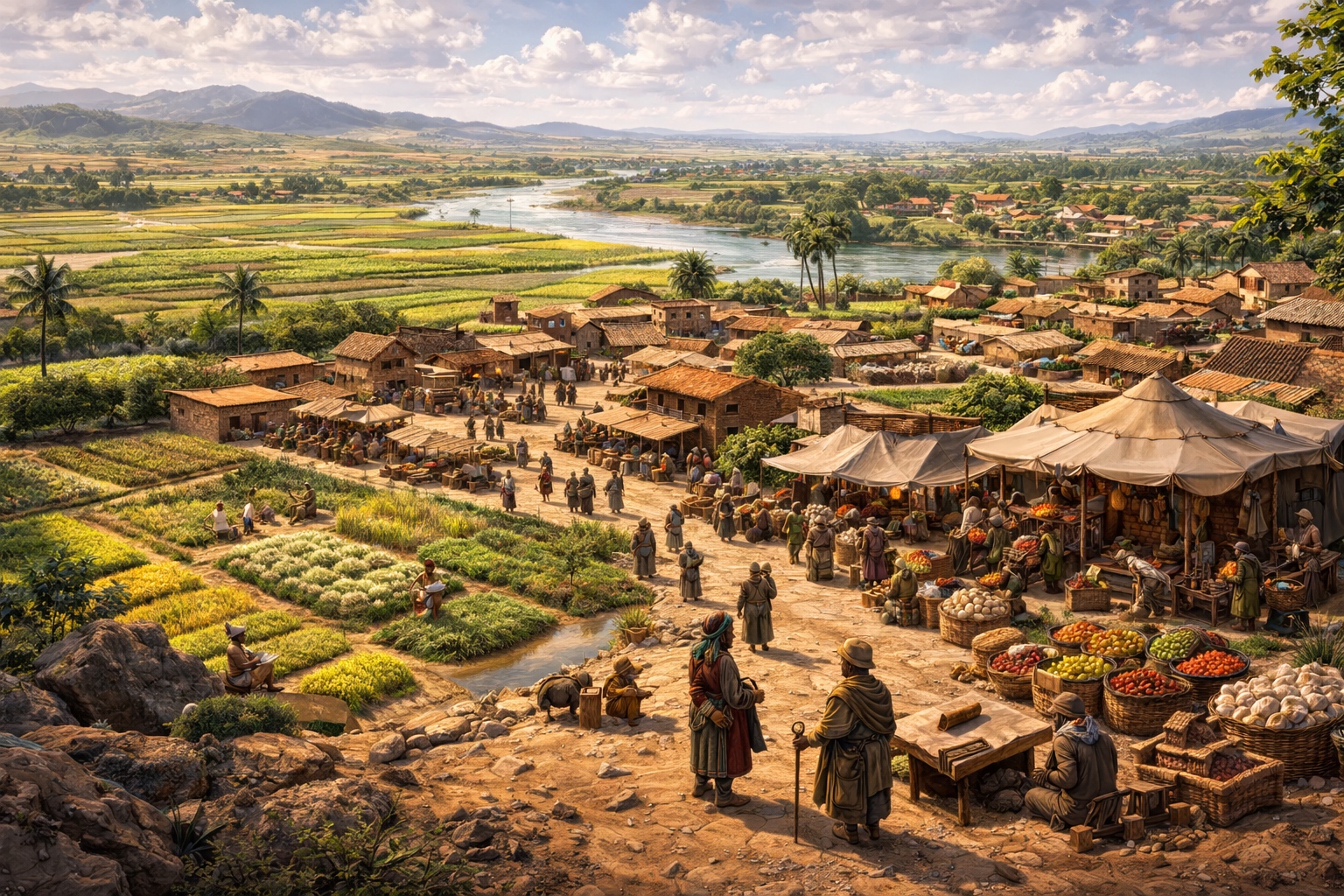
Douhi's approach from any direction is through fields. The town is surrounded by agriculture in every direction that the Volta's irrigation can reach: millet and sorghum to the north, cotton plots to the west, the cattle pastures south of the main settlement, the market garden strips along the riverbank. The town itself is compact compared to the farming that surrounds it. The buildings are practical: clay brick, thatched or tiled, one and two stories, scaled to the work being done in them rather than to any ambitions the people doing the work might have.
The market square is the center of things: open, busy with the morning trade that brings produce from the farms into town for exchange, distribution, and packaging for the northern and southern routes. The smell is the honest agricultural smell of a working community: earth, cut grain, animals, the cooking fires of the households whose morning preparation overlaps with the market's early hours.
Chieftain Akiki can sometimes be found in the market before official business begins, checking the produce quality and talking to the sellers. He is small enough that new visitors sometimes mistake him for a merchant's child. This is an error that regular Douhi residents have quietly enjoyed across multiple generations.
Geography & Setting
Douhi sits on the eastern bank of the Volta River at the point where the valley floor is widest and most productive, approximately midway between Lahale to the north and Nukwai to the south. The Volta provides irrigation through a system of channels that the town has expanded and maintained over three generations of organized agricultural management. The irrigated land extends west from the river and the town, thinning as it approaches the terrain that transitions to the Tellery Pan's arid scrub.
To the east, the land rises toward the foothills that mark the Great Ennedi's western approach. The eastern farms are less productive and more exposed; some of the outlying farmsteads in that direction serve as the first warning of any movement from the desert interior, which has been relevant when raider activity from the Melfi direction has been elevated.
The river is navigable through Douhi; this is how agricultural surplus moves north to Lahale and south to Nukwai without requiring road transport for heavy loads. The river landing is a simple dock arrangement; it is not a commercial port but a functional agricultural shipping point.
The People
Demographics
Douhi's population is predominantly human, as is the case across most of Funta's interior. The Smaling community is small (perhaps three hundred individuals, clustered in the civic and administrative district of the town), but it holds disproportionate weight because the Chieftain's family is the community's anchor. Smalings in Funta's interior are not common, and Douhi's Smaling civic leadership is historically unusual. The story of how Akiki's grandfather came to establish this community in Douhi involves a long journey and a successful series of agricultural experiments that the town was in no position to decline the results of, and is told locally with the warmth reserved for founding myths that are also demonstrably true.
The farm families who make up the majority of the population have been in Douhi for multiple generations. The agricultural land is organized by family holding, and the social structure of the town corresponds to the hierarchy of those holdings: the oldest families with the most productive land at the top, recent arrivals and landless laborers at the base.
Economy
Douhi does one thing and does it very well: it produces food. The agricultural surplus that feeds Lahale's ninety thousand scholars and merchants and guards, and that supplements Nukwai's own production, comes primarily from Douhi's farms. This gives the town a political significance disproportionate to its population; without Douhi's consistent output, the Volta corridor's stability degrades. Both Lahale's Scholar's Council and Chieftain Amina of Nukwai know this, and Chieftain Akiki knows they know it.
The herbal production managed by Elira, the Chieftain's wife, is a secondary but growing economic line: specialty dried herbs, medicinal preparations, and the cosmetic plant products that the Lahale market purchases at good prices.
Primary Exports
- Grain: Sorghum, millet, teff; the primary product that goes north to Lahale and south to Nukwai
- Cotton: The western fields produce raw cotton that feeds Tontou's textile industry through the eastern trade route
- Livestock: Cattle and goats; some slaughtered and dried for shipment, some sold as breeding stock
- Herbal goods: Elira's preparations; sold to Lahale's markets and to traveling merchants
Primary Imports
- Tools and equipment: Metal farm tools, irrigation hardware, building materials; brought in from the coast trade through Koma or west through Manda
- Finished goods: Cloth, pottery, anything requiring craft skill not well-represented in an agricultural town
Key Industries
- Family Farm Holdings: The organized agricultural operations that produce the town's exports; the economic foundation
- Volta River Agricultural Shipping: The river landing operation that moves bulk goods north and south
- Akiki's Livestock Management: The coordinated herding and breeding operation that the Chieftain's family manages
Food & Drink
Douhi eats what it produces, which is extensive. Fresh vegetables from the market gardens are available year-round. Grain is present in every form: flatbread, porridge, fermented beer. Meat is abundant in the harvest season and preserved for the rest of the year in smoked and dried forms that the town has refined over generations. The river provides catfish and tilapia that supplement the livestock protein.
Elira's herb production has given Douhi's cooking a distinctive character; the dried herb blends she develops are used in the town's kitchens and increasingly sought after in Lahale. The fermented grain beer that Douhi's eastern families make from the teff surplus is considered the best in the Volta basin by a local consensus that is probably accurate.
Culture & Social Life
Douhi's social life is organized around the agricultural cycle; the rhythms of planting, growing, harvest, and rest structure the community's time, its festivals, and its social gatherings. The town is not sophisticated in the Lahale sense; it does not have theaters or academies or libraries. It has barns and market stalls and the kind of communal knowledge of how to grow things that takes generations to accumulate.
The Smaling community's presence has given the town one distinctly unusual cultural element: Smaling organizational traditions (meticulous record-keeping, long-term planning horizons, and the particular Smaling gift for community-scale logistics) have been integrated into how the town manages its agricultural operations. The farm production records that Douhi keeps are the most systematic in western Funta, and neighboring settlements have begun sending representatives to observe the methods.
Festivals & Traditions
The First Planting
At the beginning of the growing season, the town conducts a day-long ceremony marking the first seeds going into the prepared ground. The Chieftain makes the first ceremonial planting; then everyone else plants in earnest. The ceremony has a religious dimension acknowledged to the earth and river spirits, and a practical dimension acknowledged to the almanac records that tell the community when the soil and weather conditions are right. Both are taken seriously.
The Harvest Fair
The town's largest annual event: a three-day fair at the completion of the main harvest, with markets, music, competitions among farm workers, food and drink at a level that reflects the year's success, and the public accounting of the season's production that Akiki presents to the assembled community. The accounting is genuinely interesting to the people who attend, which is itself a Douhi cultural feature.
Music & Arts
Douhi's musical tradition is work song, the rhythms that organized communal agricultural labor over centuries and that persist as social practice even when the specific work is done. The harvest songs are the most developed: multi-voice arrangements that the community has been layering for generations and that visiting musicians from Lahale have recorded with interest. There is no performing arts tradition in Douhi; what culture there is, is communal and functional.
Religion
Primary Faith
The earth and river animist tradition: not formally organized, without clergy or temple, present in the ceremonies that mark agricultural seasons and in the small offerings that farming families leave at the boundary stakes of their fields. The faith is practical: the earth and river are what feed the town, and the ceremonies that acknowledge this are the town's way of staying in right relationship with the forces that matter.
Nesara has moved from implicit animist background to explicit primary standing because the Volta River and its irrigation channels are the actual material foundation of Douhi's entire existence. The irrigation expansion that Akiki's grandfather built, the single most important event in the town's history, was an act of Nesara worship in practical form: water directed, distributed equitably, held in trust for everyone downstream. Bosede's channel maintenance is sacred work in the same register. The First Planting ceremony invokes the earth and the river in sequence, with the river acknowledgment now given the formal weight that Nesara's clergy would recognize as their tradition.
Kraut has found a home in Douhi that is as precise a match as the deity's portfolio allows anywhere in Funta. The sacred harvest, the transformation of seed into bounty, the agricultural abundance that feeds Lahale and Nukwai: this is Kraut's domain translated into material reality at the scale of a major producing town. The Smaling community's presence reinforces this: Smalings are Kraut's people throughout Dort, and Akiki's family's meticulous record-keeping of production yields, the public accounting at the Harvest Fair, and the genuine communal investment in agricultural success are expressions of the same Kraut-flavored faith that manifests as careful stewardship and celebration of abundance.
Secondary / Minority Faiths
Traveling merchants and occasional Lahale visitors bring their own faith practices. Douhi has no formal accommodation for any organized faith beyond the animist tradition.
Hesira is present in the farm families' domestic life in ways that a town organized around family landholdings and multigenerational agricultural practice naturally produces. Marriage in Douhi is the foundation of farm succession (who inherits which field, which family combines with which), and the domestic continuity that Hesira governs is as economically as it is spiritually significant here. The First Planting tradition, where families plant together on a ceremonially designated morning, is as much a Hesira observance as an agricultural one.
Anansi lives in Douhi's harvest songs, the multi-voice communal arrangements that visiting musicians from Lahale have noted with surprise and that the community has been layering for generations without formal instruction. Douhi has no theater, no library, no performing arts tradition in any formal sense. What it has is work songs that are also communal memory, a Smaling record-keeping tradition that is also storytelling about the land's history, and a deep collective knowledge of how things grow that gets transmitted mouth to ear across generations in exactly the way Anansi's tradition functions.
Caldrin is honored at the river landing and at the caravan yards where Douhi's output changes hands for the northern and southern routes. The town is a through-point for the Volta corridor's commerce, and the river-pilots and caravan crews who move Douhi's surplus to Lahale and Nukwai carry Caldrin's practical worship with them in the form of route knowledge, uphold guest-right, and the hospitality that makes a provisioning stop reliable.
History
Nesara is honored at wells and river shrines, and in irrigation councils: water held in trust for everyone downstream. Caldrin is honored at gates, bridges, and caravan yards for safe passage, true directions, and upheld guest-right. Vessikar has shrines near weighhouses and market courts; honest measures are treated as civic peacekeeping. Sylira keeps whisper-shrines in inns and social halls: places to trade news, manage reputation, and pretend it isn't politics.
Founding
Douhi grew from a farming settlement at the Volta's most productive stretch: a community that was present before anyone thought to name it, expanding as the irrigation system expanded. Akiki's grandfather arrived three generations ago with his family and an agricultural methodology that significantly increased the land's productivity. The family's success established the Smaling community as civic leaders when the existing community recognized that the productivity gains justified giving the family authority over agricultural management, and that agricultural management was the only management that mattered in Douhi.
Key Events
The Irrigation Expansion (approx. 70 years before present)
Akiki's grandfather supervised the construction of the current irrigation channel system, extending the watered land significantly to the west. The project took six years, required cooperation across all the farm families, and permanently established the scale of Douhi's agricultural output. The channel system still operates on the design principles he established; modifications have been incremental improvements, not redesigns.
The Melfi Raid (approx. 20 years before present)
A raider party from the Melfi region reached Douhi's eastern outlying farms and did significant damage before Akiki's father organized the response that drove them off. The raid was not catastrophic, but it established the town's security arrangement with Manda, an agreement that keeps Manda's trade relationship with the Melfi raiders structured in ways that redirect raider attention away from the Volta corridor's farming communities.
Current State
Douhi is productive and stable. Akiki is a confident leader with a clear understanding of the town's economic leverage in the Volta corridor and the political relationships that leverage creates. His primary current concern is the eastern farm exposure (the outlying farmsteads that are vulnerable to any renewed raider activity from the Melfi direction) and the succession question: his son Jengo has shown an interest in everything except agricultural management, and his daughter Zuri has the aptitude but is fifteen years old.
Leadership & Governance
Chieftain Akiki: Overview
Akiki governs by the chieftain authority standard to Funta, implemented with the Smaling organizational thoroughness that has characterized his family's management of Douhi since his grandfather. His decisions are well-documented, his reasoning is explained to the council, and his enforcement is consistent. He is respected in a way that is specific to competence rather than fear.
Chieftain Akiki
Smaling, Male; middle-aged; Douhi Chieftain's Hall and the fields
Short in the Smaling way, with the sun-weathered skin of someone who works outdoors regularly even though he doesn't have to, and the economic intelligence of a family that has made a town significantly more productive than it found it. Akiki was raised by human parents in Douhi (his biological family's Smaling origins are several generations back on his father's side) and combines Smaling organizational precision with the human-scale ambition and social intuition that a childhood in a majority-human community produces.
He is affable, approachable in the market hours he keeps, and precisely clear about what the town's interests are and what it will take to protect them. His relationship with Lahale's Scholar's Council is diplomatically careful; he knows LaHale needs what Douhi produces, and he knows that being overtly transactional about this would end the goodwill that makes the relationship function. The balance between leverage and relationship is something he manages deliberately.
Elira: Chieftain Akiki's Wife
Human, Female; forties; the herb gardens and the Chieftain's household
Elira is a herbalist of genuine skill whose practice has grown beyond personal craft into a production operation supplying Lahale's market. She is, in the town's estimation, the person who understands plants the way Akiki understands animals and soil: precisely and practically, with the accumulated knowledge of someone who has been doing this seriously for twenty years. She is a community resource for medicinal questions and is considered the second leader of Douhi in all but title.
Key Workers and Advisors
Tara, Human, Female: Oversees livestock management; responsible for cattle and goat herding and the coordination of livestock trade. Has worked for the Chieftain's family for fifteen years and knows the herd's complete genealogy.
Bosede, Human, Male: The irrigation system's primary engineer; manages the channel maintenance schedule and the water distribution decisions during low-flow periods. His judgment on irrigation questions has not been seriously questioned since a water dispute thirty years ago that he resolved correctly.
Mwitu, Smaling, Female: The agricultural record-keeper; maintains the production statistics that make Douhi's planning accurate and that the Lahale Scholar's Council has requested copies of for their own records. She is the most systematically knowledgeable person in the Volta basin about what a farm of a given size can produce under specific conditions.
Guard & Militia
Douhi maintains a small town guard of approximately sixty people, sufficient for market security and the enforcement of the town's basic laws. The guard is not equipped or organized for military defense against a serious raider incursion; the agreement with Manda manages that threat diplomatically, and Akiki is aware that the agreement is the town's primary defense strategy.
Law & Order
Chieftain law, applied by Akiki's consistent and documented enforcement. The principal concerns are property disputes between farm families, market fraud (which the Smaling record-keeping tradition makes difficult to sustain for long), and the occasional traveler who misunderstands that Douhi's hospitality has clear limits.
Notable Figures
Zuri: Akiki's daughter
Smaling, Female; fifteen; the farms and record office
The more capable of Akiki's two children, with her father's organizational precision and her mother's interest in the biological aspects of agriculture. She has been learning the farm management system alongside the herbalism that Elira has been teaching her. She will be a better Chieftain than her brother. She knows it. Akiki knows it. Jengo knows it. The succession question is not about capability.
Jengo: Akiki's son
Human, Male; nineteen; officially preparing for civic responsibility; actually studying carpentry
Jengo is a fine carpenter and has built three pieces of furniture that are in the Chieftain's hall and are good. He is not interested in agricultural management. He has told his father this twice. Akiki has heard him both times and has not resolved the question.
Bosede: Irrigation Engineer
Human, Male; fifties; the channel system
The most important person in Douhi for long-term viability that most of the town does not think about. His assessment of the eastern channel's capacity is updated annually and shared with the council. He has been indicating for three years that one of the secondary channels needs a major repair. The council has been deferring the budget allocation. He has stopped deferring his reports about it.
Key Locations
Seat of Power
- The Chieftain's Hall: A substantial building in the center of town; the administrative center for agricultural coordination, trade negotiation, and civic governance; the production records going back three generations are kept here in Mwitu's organized archive
Houses of Worship
- The Field Boundary Shrines: Not a single location; the collection of small offerings and marker structures at the boundaries of agricultural fields; maintained by the individual families; the community's expression of the animist tradition
Inns & Taverns
- The Volta Landing Inn: Adjacent to the river dock; serves the river trade traffic and the occasional traveler between Lahale and Nukwai; simple, clean, reliable. The catfish stew here is specifically worth eating.
- The Harvest Hall: The town's primary gathering place for communal meals and social events; not strictly an inn, but maintains a few rooms and serves food daily
Shops & Services
- Elira's Herb House: The herbalist's production and retail operation; medicinal preparations, dried herb blends, and the specialty cosmetic products that go north to Lahale
- Mwitu's Record Office: Open to farm families for record consultation and agricultural planning assistance; a public resource
The Market
- Douhi Main Market: Open every morning in the central square; fresh and preserved agricultural goods; the most comprehensive selection of Volta basin produce in the region. This is where surplus production is sold to river merchants for onward shipment.
Other Points of Interest
- The Irrigation System: The network of channels extending west from the river; maintained by Bosede and his crew; the infrastructure that makes the town's agricultural output possible
- The Eastern Outlying Farms: The farms that extend toward the foothills; the most exposed part of Douhi's agricultural territory and the area Akiki watches most carefully for signs of activity from the Melfi direction
Guilds & Organizations
- The Farm Family Council: The advisory body to the Chieftain; the heads of the major farm families; meets monthly to discuss production coordination, water allocation, and trade pricing
- The Livestock Herders' Association: A cooperative that manages grazing rotation and shared pasture access; Tara chairs it and handles disputes
Secrets, Rumors & Hooks
- Bosede's irrigation channel repair estimate has been escalating quietly for three years. The repair that was a minor remediation three years ago is now a significant reconstruction. He has not updated his public estimate to reflect this because he knows the council will not fund something twice as expensive as what they already declined to fund. He has been quietly making temporary repairs with his own resources.
- The Melfi arrangement, the agreement with Manda that keeps raider attention redirected, has a clause that Akiki's father negotiated and that Akiki has inherited without having fully examined. The clause has implications that a careful reader would find interesting. Chieftain Kwame of Manda has read it carefully.
- Jengo's carpentry has attracted the attention of a craftsperson from Lahale who visited to arrange a grain purchase and stayed an extra week to talk to Jengo about his work. Jengo has been corresponding with this person. The correspondence has not been shared with Akiki.
- Zuri has been conducting her own agricultural experiments on a plot of family-owned land that is not part of the production records. The experiments are in agricultural methodology; she is testing a planting rotation that she believes will increase yield by fifteen percent. The methodology comes from a Lahale academic publication she obtained through Elira's connections. If she is right, it will make Akiki's succession question considerably more urgent.
- There are three pre-settlement structures in Douhi's eastern outlying farm territory, foundations of buildings that predate the town by an unknown period. The farming families use the old stones as boundary markers. No one has excavated them. The stones are occasionally moved as field boundaries shift, which Mwitu notes in the records without comment.