Irbi
Irbi: The Nomad's Anchor
"In Irbi, everyone passes through, but few ever truly leave."
Elara, proprietor of Nomad's Rest
At a Glance
| Continent | Funta |
| Region / Province | Northern Tellery Pan |
| Settlement Type | Nomadic oasis hub with permanent governance |
| Population | ~600-900 (highly fluctuating: ~400 permanent, 200-500 nomadic) |
| Dominant Races | Human, Zerren, Lizardfolk, Gnome, Smaling |
| Ruler / Leader | Chieftain Kwame Nia |
| Ruling Body | Chieftain (sole leadership) with trusted advisors |
| Primary Deity | Nesara, Caldrin (alongside animist traditions of water spirits, seasonal cycles, ancestors) |
| Economy | Water trade, seasonal commerce, caravansary services |
| Known For | An oasis where nomadic peoples gather seasonally; ruled by a mysterious retired adventurer |
First Impressions
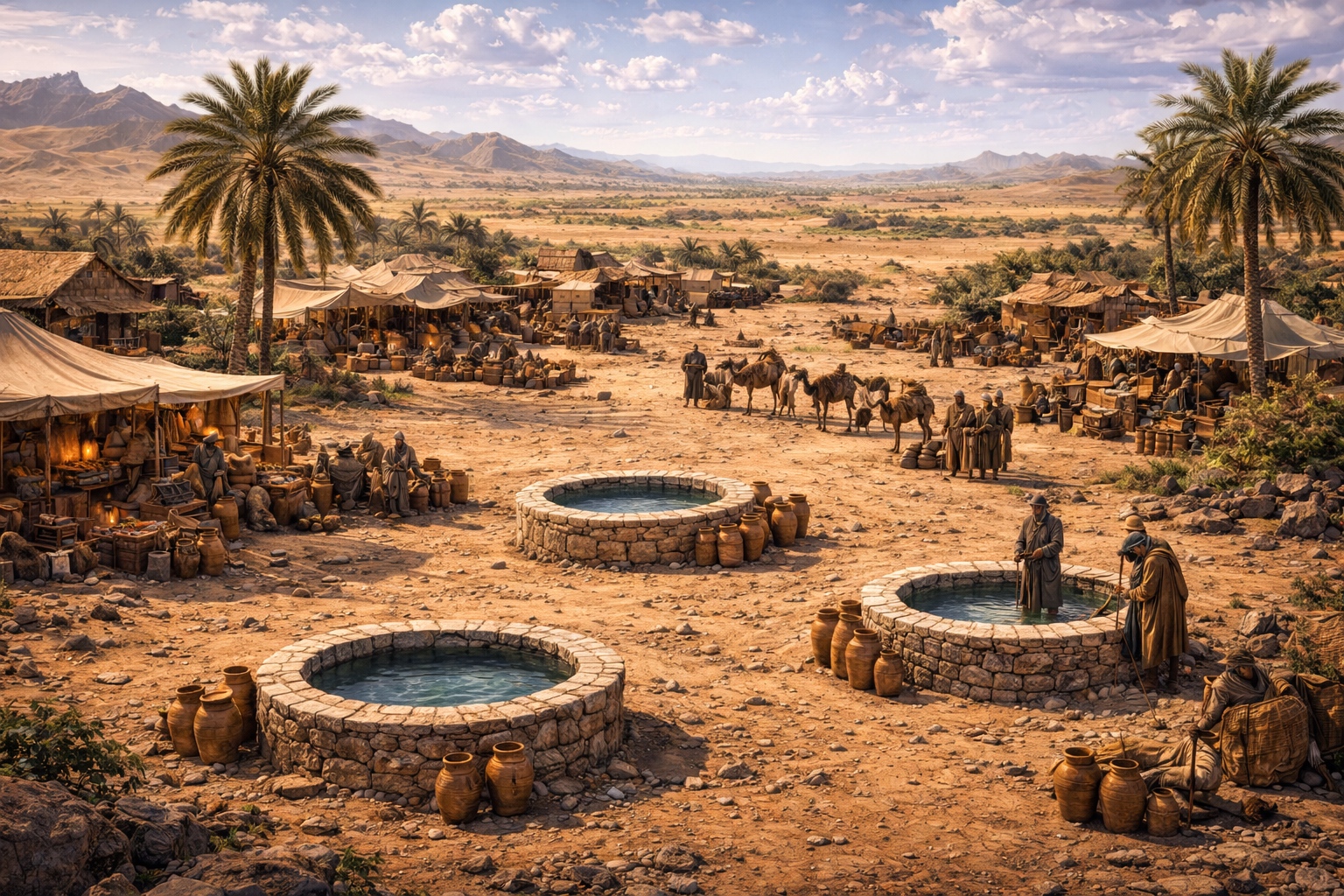
Irbi appears from the scrubland like a mirage, not because it isn't real, but because the transition from arid emptiness to habitation is so sudden. The landscape surrounding the settlement is dry mountain foothill: sparse vegetation, rocky outcroppings, and a relentless sun that seems to drain color from everything it touches. Then, abruptly, green appears. The three public wells radiate outward from a central area, each surrounded by carefully maintained plantings: date palms, acacia trees, and hardy shrubs that shelter the water sources from the worst of the sun.
The architecture is deliberately temporary. Structures are made from canvas, woven reed, and lashed wood, materials that can be quickly erected or dismantled. Permanent buildings are few: Kwame Nia's residence (a sturdy stone structure overlooking the primary well), the administrative center, and a handful of businesses that have earned enough stability to warrant more permanent construction. The overall effect is a settlement that respects the nomadic nature of its population, a place that says: you are welcome to stay, but we do not presume you will remain.
The air carries the sound of water. The wells are maintained with evident care; the sound of drawbuckets, filling vessels, and the lapping of water are constant background to Irbi's rhythm. Unlike Melfi, where water is a weapon and symbol of power, Irbi's water is shared with an equity that speaks to Kwame Nia's character and philosophy. There is tension here too (the tension of limited resources and the constant negotiation between transient populations), but it is tension that has been ritualized and made manageable through leadership and careful tradition.
The town is ruled by a single figure whose very presence seems to guarantee peace. Chieftain Kwame Nia is visible in the settlement: on the paths between wells, in the marketplace, making decisions that favor neither the permanent residents nor the nomadic arrivals but some careful balance between the two. To arrive in Irbi is to step under an umbrella of governance that is, paradoxically, both iron-fisted and surprisingly just.
Geography & Setting
Irbi sits in the Northern Tellery Pan highlands, at moderate-high elevation in an arid scrubland region characterized by dry mountain foothills. The landscape is rocky, with scattered low vegetation adapted to extreme aridity. The terrain is defensible but not isolated; caravan routes pass nearby, and the settlement has become a natural stopping point for traders moving between distant settlements.
Three wells provide the town's water. The primary well, controlled and managed directly by Chieftain Kwame, is the deepest and most reliable. Two secondary wells serve the broader population. Wealthier permanent residents have dug private wells on their property, though these are generally less reliable than the public sources.
The settlement's layout reflects Kwame's understanding of nomadic culture. The central area is open and communal, suitable for temporary encampments. The three wells are positioned at roughly equal distances from the center, encouraging distribution of population and preventing bottlenecking around a single water source. Permanent structures are at the periphery, creating a buffer between the nomadic center and more stable infrastructure.
The surrounding terrain offers some shelter from the worst weather, though the scrubland provides limited protection during dust storms. Several elevated positions allow watchers to spot approaching caravans or threats from significant distance. Unlike Melfi's defensible canyon positions, Irbi is relatively open; its security depends more on diplomatic goodwill than on terrain advantages.
The People
Demographics
Irbi's population is divided into three categories: the permanent residents (~400 people), the seasonal nomads (200-500, fluctuating with season), and occasional travelers (caravans, individual wanderers, refugees).
Permanent residents tend to be those who have settled for practical reasons: traders who found profit in serving nomadic populations, craftspeople offering specialized services, families who simply decided to stay. Many permanent residents were originally nomadic themselves and gradually transitioned to settled life.
The nomadic population includes herding families following seasonal grazing patterns, hunter-gatherer bands pursuing game and wild food, trading caravans moving between settlements, and spiritual seekers following pilgrimage routes. The population is extraordinarily diverse: Humans, Smalings, Gnomes, Zerrens, and Lizardfolk are all well-represented. Felair caravans pass through seasonally. Drakin are rare but not unknown.
Humans form the numerical majority of permanent residents. Zerrens and Lizardfolk are overrepresented in the nomadic population, drawn to the freedom and lack of prejudice that Kwame Nia's governance maintains. Gnomes and Smalings tend to be traders and merchants, finding profit in the constant flow of temporary populations.
The age structure is weighted toward adults and the elderly. Young children are present but in lower numbers than in more stable settlements. Youth who reach adolescence often choose to leave Irbi, seeking opportunities in more developed settlements or adopting full nomadic life.
Economy
Irbi's economy is based on three interlocking systems: water trade, seasonal commerce, and caravansary services.
Water Trade is the foundation. The three public wells produce enough water to support the permanent population and provide excess for sale to nomadic peoples and traveling caravans. Kwame Nia personally oversees the primary well, setting water prices (kept deliberately low to prevent wealth concentration), managing maintenance, and ensuring fair distribution. The secondary wells are managed by appointed assistants under his ultimate authority.
Seasonal Commerce occurs in waves aligned with nomadic migration patterns. When herding populations arrive (spring and early summer), demand for supplies (salt, specialized tools, medicine) increases, creating opportunity for traders. Hunters arriving during hunting season (late summer and fall) bring game and hides to trade for preserved foods and tools. Caravans pass regularly, creating moments of intense commercial activity and higher prices.
Caravansary Services provide income to permanent residents who offer lodging, food, animal care, and security services to traveling populations. Elara's Nomad's Rest is the primary establishment, but numerous families offer temporary shelter and services on a smaller scale.
The economy is not particularly wealthy, but it is stable. Money is less common than barter; most transactions involve direct exchange of goods or services. Water, when sold, commands premium prices that increase significantly during dry seasons.
Primary Exports
- Water: bottled or in containers for traveling caravans; the primary export and most valuable commodity
- Preserved foods: dried meats, rendered fat, plant-based provisions prepared by permanent residents
- Information: intelligence about routes, distant settlements, security threats, and caravan movements
- Labor: services including animal care, equipment repair, guide services for nomadic populations
Primary Imports
- Specialty goods: tools, textiles, medicines, preserved foods from distant settlements via caravans
- Livestock: young animals purchased or traded to replenish herds
- Craft materials: metals, dyes, specialized materials used by resident craftspeople
Key Industries
- Water management and distribution: the fundamental economic basis
- Caravansary services: lodging, food, animal care, security for nomadic and traveling populations
- Marketplace and merchant services: acting as a commerce hub for trading populations
- Craft and repair services: blacksmithing, leather working, textile maintenance
- Hunting and gathering support: purchase and resale of game, wild plant products, and foraged materials
Food & Drink
Food in Irbi reflects the nomadic-influenced culture: portable, preserved, and adapted to water scarcity.
The permanent population grows limited crops in irrigated gardens near the wells (millet, sorghum, dates, a few vegetables). These are supplemented by game brought in by hunters and preserved foods from caravans. Meals are simple: grain-based porridges, dried meat, bread, dates, nuts, and foraged herbs. Fresh meat is occasional and celebrated.
Nomadic populations arrive with their own food supplies (dried milk products, preserved meats, grain) and trade or barter for local goods. Hunting populations depend on locally killed game. There is a thriving market in preserved and prepared foods: smoked meat, rendered fat, grain cakes, and herbal preparations.
Water is available to all, both from the public wells and in purchased containers. Alcohol is rare and typically only available to wealthier travelers; the local culture emphasizes sobriety and water conservation. Hot tea made from foraged herbs is common, particularly in cooler months.
No one in Irbi goes hungry, but no one eats richly either. Sustenance is the goal; luxury is rare.
Culture & Social Life
Irbi's culture is defined by hospitality, transience, and the paradoxical stability provided by Kwame Nia's leadership. The town respects nomadic culture while maintaining enough permanent infrastructure to provide coherent governance.
Social life is less cohesive than in settled towns. Permanent residents socialize with each other; nomadic populations form temporary clusters based on ethnicity, profession, or travel direction; and the two groups interact at markets and shared wells without forming deeper bonds.
Status in Irbi is less visible than in Melfi. There are no military hierarchies, no tribal colors. Instead, status derives from skill, wealth, and time spent in the settlement. Long-term residents who have proven reliable earn respect. Skilled crafters command status. Successful traders are respected. Kwame Nia himself is the ultimate status marker; proximity to him or favor from him carries weight.
There is a culture of storytelling around the wells in evening hours, particularly during high-population seasons. Nomadic peoples share news from distant places, traders tell tales of unusual encounters, and permanent residents recount the history of the settlement. Kwame Nia sometimes joins these gatherings, listening more than speaking.
Personal autonomy is respected. Irbi's culture does not enforce the kind of tribal loyalty that defines Melfi. A person can criticize the leadership, question decisions, or simply choose to leave without significant consequence (though departure in bad standing may mean refusal of future entry).
Festivals & Traditions
The Gathering of Waters
Once per year, during the transition from dry season to wet season (or as close as Funta's climate allows), a formal celebration occurs where all permanent residents and any nomadic populations currently in Irbi gather at the central well area. Offerings are made to water spirits. Kwame Nia formally reaffirms the town's commitment to equitable water distribution and fair treatment of all peoples. New permanent residents are formally recognized. Disputes that have accumulated over the year are publicly addressed and resolved.
The Gathering is both festive and formal; it is the moment when Irbi's community explicitly reaffirms its values and covenants.
The Silent Night
On the new moon night closest to the winter solstice (or the darkest part of the year in Funta's complex seasonal cycle), all public activity ceases. The wells are tended, but no market, no commerce, no socializing occurs. It is a night for individual reflection, private prayer, and communion with the spirits of the land and ancestors. Even nomadic populations respect this tradition, settling into quiet camps.
The silence is profound and somewhat eerie. Those who have experienced it report feeling a deep connection to the settlement itself, as though the land itself is breathing.
The Caravan Festival
When the primary trading caravan from a major settlement (typically Manda or another distant hub) arrives, a spontaneous celebration erupts. The arrival of outside goods, news, and fresh faces breaks the monotony of nomadic life. There is increased activity in the marketplace, music and celebration in the evening, and a general excitement. Prices spike, but temporary residents seem not to mind, celebrating abundance.
Music & Arts
Music in Irbi is predominantly nomadic in character: portable instruments, pieces that can be sung and remembered without written notation, rhythms tied to travel, pastoral life, and water.
Percussion instruments are common: drums, shakers, and rhythm-makers made from gourds or wood. Wind instruments (flutes, pipes made from reed or bone) carry melodies. String instruments are rarer (they are less portable and require more maintenance), but some traders and permanent residents maintain them.
Visual arts are minimal in permanent form but rich in temporary expression. Nomadic peoples create patterns in sand, temporary sculptures from found materials, and elaborate body decoration (henna, paint) that is washed away after days or weeks. Some permanent residents practice textile weaving, creating decorative cloths and blankets sold to travelers.
Oral tradition is vibrant. Storytellers and singers maintain historical narratives, educational stories about survival in the desert, and entertainment tales. Some stories are specific to Irbi and are taught to new residents as part of cultural integration. Others are portable stories carried between settlements by nomadic populations.
Religion
Primary Faith
Irbi's dominant belief system is nomadic Animism, the veneration of spirits embodied in natural forces and the recognition of the sacred in everyday survival. Water spirits are paramount; each well is understood as a dwelling place for spirits requiring respect and propitiation. Seasonal cycles are sacred, tied to divine forces that must be honored.
Ancestors are venerated as guides and advisors. The dead are understood to continue existing in a different form, watching over their descendants and offering wisdom through dreams and intuition. This belief system is consistent across nomadic peoples and creates a shared spiritual foundation despite ethnic diversity.
Kwame Nia is not formally identified as a priest, but he is clearly understood to have spiritual authority as well as temporal authority. His connection to the primary well is not merely administrative but spiritual. Many believe he communicates directly with water spirits, which is why the wells under his management are so reliable.
Nesara names what the animist water-spirit tradition has always been in Irbi. The three wells are not just infrastructure; they are the settlement's reason for existence, the source of its economic power, and the center of its spiritual life. The Spirit Well Shrine and the Gathering of Waters ceremony are Nesara's domain in everything but name. When Kwame located new water sources during the drought, apparently through some knowledge or gift that no one fully understands, the community's interpretation was that he had asked the right deity the right question at the right moment. The Dry Well, left unrestored as a monument to fragility, is a Nesara teaching: the water is a gift that can be withdrawn.
Caldrin is the faith of Irbi's fundamental identity as a crossroads and waystation. The settlement exists because caravan routes pass through it; its economy is the economy of passage; its culture is built around the constant arrival and departure of peoples from every direction. Caldrin's domain (hospitality to strangers, safe passage, upheld guest-right) is not incidental to Irbi but definitional. Kwame's response to the Manda caravan ambush (personally pursuing the attackers and recovering the stolen goods) was a Caldrin enforcement action: the caravansary covenant had been violated, and the violation could not stand.
Secondary / Minority Faiths
A few permanent residents, particularly older individuals, maintain worship of Bethsia or Martus (as a luck/fortune patron) from their pre-Irbi lives. These practices are tolerated and respected, though not widely shared. Some wandering priests of Zopha (knowledge deity) occasionally pass through and find hospitality, though Funta's lack of formal temples to Zopha means these priests are always outsiders.
There is no organized church structure in Irbi, nor any priesthood beyond the informal spiritual authority that accrues to Kwame Nia and the community elders who maintain the Gathering of Waters ceremony.
Anansi is present in the evening storytelling culture at the Storyteller's Stone, the large natural rock near the central well where people gather when the nomadic populations bring the settlement to high season. The diversity of story traditions that converge in Irbi creates a natural Anansi space: Funta work song, Zerren narrative forms, Lizardfolk oral history, the traders' tales from distant markets, the survival lore of the Tellery Pan's nomadic peoples. No single tradition dominates; all of them deposit something in the communal memory. Kwame's occasional participation in these evenings, listening more than speaking, is one of the few places where his authority is set aside.
Jula is the faith of the Gathering of Waters covenant itself, the annual ceremony where Kwame publicly reaffirms the settlement's commitment to equitable water distribution and fair treatment of all peoples. Peace in Irbi is not an absence of conflict but a continuous active maintenance, and the Gathering is the moment when that maintenance is made explicit and ceremonial. Jula's clergy, where they pass through Irbi as travelers, find the settlement's fundamental compact already operating as their faith's practice.
Secret or Forbidden Worship
In the hidden corners of nomadic culture, there are whispered references to older deities or practices considered taboo by mainstream Animist beliefs. Some very old shepherds speak of gods of the deep desert that predate known Funta traditions. These practices, if they exist at all, are kept private and rarely discussed openly. Kwame Nia's authorities do not crack down on such beliefs, but they are not encouraged either.
History
Founding
Irbi's founding is poorly documented and lost to antiquity. The three wells were discovered by nomadic peoples centuries ago and became a natural stopping point for those traversing the scrubland. Over generations, a semi-permanent settlement developed around the most reliable well, creating a natural hub for nomadic populations who began returning seasonally.
The transition from natural stopping point to governed settlement occurred gradually. Approximately 80-100 years ago, a more formal structure emerged with elected or appointed leaders managing the wells and enforcing basic dispute resolution. The position of Chieftain became hereditary or at least stable in succession.
Chieftain Kwame Nia arrived approximately 25-30 years ago under mysterious circumstances. He was clearly an experienced adventurer: scarred, skilled in combat, and carrying himself with authority. The existing Chieftain either died or abdicated; Kwame stepped into the role. Under his leadership, the settlement has become more stable, more equitable, and more prosperous than previously recorded.
Key Events
The Drought (approximately 15 years ago)
An extended drought nearly destroyed Irbi. Two of the three wells dried up completely. Water levels in the primary well dropped to dangerous lows. The population faced existential threat. Kwame Nia made the decision to reduce the permanent population through voluntary relocation assistance and to ration water with absolute authority. Some permanent residents left; others died. Nomadic populations fled to other settlements. The town nearly collapsed entirely.
Kwame discovered (or somehow caused) the secondary wells to be re-dug and found new water sources, which saved Irbi from total collapse. This event cemented his reputation as a figure with unusual connection to the land and water spirits.
The Succession Question (approximately 8 years ago)
Kwame suffered a serious illness that brought him to the edge of death. For several weeks, his survival was uncertain. During this period, the permanent residents and visiting nomadic leaders began discussing succession, what would happen to Irbi if Kwame died? The question was not answered before he recovered, and he has not publicly addressed it since. The anxiety around his mortality remains a constant undercurrent in Irbi's culture.
The Ambush on the Manda Caravan (approximately 3 years ago)
A Manda caravan was attacked by raiders (possibly from Melfi, though never confirmed) en route to Irbi. Several guards and merchants were killed. The caravan was severely damaged. Kwame Nia personally led a response, tracking the raiders and recovering stolen goods. The message was delivered: attacks on caravans in transit to Irbi would be treated seriously.
This event demonstrated that Kwame has resources, allies, and reach beyond Irbi's visible structure. It also showed that he takes the security of the trade networks supporting Irbi very seriously.
Current State
Irbi currently exists in a strange equilibrium: more prosperous and stable than it has been in recorded history, but profoundly dependent on a single leader whose age and mysterious past suggest he cannot lead forever. The permanent population is content but anxious. The nomadic populations continue to arrive seasonally, treating Irbi as a reliable resource. Caravan routes have been formalized around Irbi's accessibility. The settlement is successful by almost every measure except for the unaddressed question: what happens when Kwame Nia dies?
Leadership & Governance
Chieftain Kwame Nia: The Anchor of Irbi
Chieftain Kwame Nia is the sole authoritative figure in Irbi's governance. He is not elected; his authority is accepted through a combination of proven competence, personal force of character, and (possibly) legitimacy inherited from a previous leadership structure. He makes final decisions on water distribution, dispute resolution, trade policy, and security matters.
His leadership style is consultative but ultimately unilateral. He listens to advisors and community members, asks questions, and considers perspectives. But he does not seek consensus; he makes decisions and enforces them. Remarkably, despite this autocratic structure, he is not despised. Instead, he is respected, perhaps because the alternatives (chaos, anarchy, or the kind of tribalism that defines Melfi) are understood to be worse.
He maintains no formal court, no bureaucracy, no written laws. Governance happens through conversation, presence, and the understanding that certain principles are inviolable: water is equitably distributed, all peoples are treated with basic dignity, disputes are resolved through discussion and mediation rather than violence.
Kwame Nia
Human male, approximately 60 years old (possibly older)
Kwame's physical appearance tells a story. Tall, lean, with muscle still evident beneath aging skin. Scarred across his arms, back, and one cheek. One eye is slightly milky, suggesting old trauma. His hair is gray, worn long and tied back. He moves with the efficiency of someone who has fought and survived; there are no wasted gestures.
His demeanor is calm and direct. He does not raise his voice; people listen because he speaks with the gravity of someone who has seen too much to waste words on triviality. He smiles rarely, and when he does, it seems to cost him effort.
Kwame's past is deliberately obscured. He does not discuss where he came from, who his family was, or what adventures led him to Irbi. There are rumors: he was a sellsword, a hunter, an adventurer, a warrior for hire, a soldier in a distant army, a criminal fleeing justice, a scholar seeking redemption. He responds to none of these rumors directly. When asked, he says, "That man died long ago. This is who I am now."
What is known: he is a skilled fighter, capable of wielding a sword or hand-to-hand combat with lethal efficiency. He understands military tactics and can coordinate armed response when necessary. He has some knowledge of water divination or well-sinking, which enabled him to locate new water sources during the drought. He has contacts outside Irbi, people in distant settlements who know and respect him.
Kwame is widowed. His wife (whose name he rarely speaks) died before he came to Irbi or early in his tenure. He has no children, or at least none in Irbi. He is solitary, living in a stone residence near the primary well, spending his evenings reading or contemplating the water in the darkness. He is not married to the settlement in a literal sense, but he is bound to it by something deeper than contract.
The deep question that hangs over Irbi is whether Kwame will name a successor or whether his death will create a vacuum of power.
Varook: Chieftain's Eyes and Ears
Lizardfolk male, age indeterminate (appears to be in mid-adulthood by human standards)
Varook is Kwame's closest associate and serves as the primary liaison to nomadic populations. He is a Lizardfolk: distinctive, competent, and inscrutable. Where Kwame is closed-off and reserved, Varook is somewhat more approachable, though he also maintains careful boundaries.
Varook moves through the nomadic communities with evident ease. He speaks multiple languages (including several non-human dialects), understands cultural nuances, and is trusted by nomadic leaders to transmit information and orders from Kwame. He is not subordinate in the way a secretary would be; rather, he is a trusted advisor whose opinion Kwame clearly values.
Varook's actual background is unclear. He is not native to Irbi; he arrived with or shortly after Kwame. He may have been a companion from Kwame's adventuring days. Their relationship suggests deep history and mutual trust.
Varook's role is partly diplomatic, partly intelligence gathering, and partly enforcement. When Kwame decides that someone needs to be spoken to, redirected, or warned, Varook often serves as the messenger. This gives him a certain fearsome reputation despite his generally calm demeanor.
Yara: Chieftain's Strong Arm
Zerren female, early 40s
Yara is Kwame's second trusted advisor and serves as the primary enforcer of his decisions. She is a warrior: skilled in combat, trained in tactics, and experienced in violence. Unlike Kwame, she is more openly present in Irbi's daily life.
Yara maintains order through presence and reputation. She is known to be capable of serious violence if required, but she is also known for restraint. She uses intimidation more than force, and when force becomes necessary, it is calibrated and devastating.
Yara maintains a small group of auxiliaries (roughly 8-12 individuals) who assist in security and enforcement. These are not a formal militia or guard force, but rather a loose collection of capable people who are paid or supported by the settlement in exchange for security services.
Yara herself is from outside Irbi (possibly from a distant settled area). She arrived approximately 15 years ago, around the time of the drought. Kwame hired her (or she negotiated to stay), and she has been with him since. She is respected by the nomadic populations, who seem to understand that she is dangerous but also fair.
Like Varook, her presence creates stability. When Yara is visible in the settlement, conflict is less likely.
Guard & Militia
Irbi does not maintain a formal military structure. Instead, Yara coordinates with the 8-12 paid auxiliaries plus volunteers from the permanent population to maintain security. In case of serious threat, able-bodied nomadic peoples can be called upon to assist.
This system is less impressive militarily than formal militia but has advantages: it does not create a permanent armed class that might dominate politics, and it maintains the settlement's emphasis on shared responsibility.
Law & Order
Law in Irbi is customary and personal rather than codified. Disputes are resolved through discussion, mediation by elders or Kwame himself, and the application of community pressure. Violence is discouraged through both social stigma and Yara's capacity for enforcement.
Serious crimes (theft, assault, sexual violence) are punished through temporary exile, permanent exile, or in extreme cases, physical punishment (rarely execution). The process is deliberative; Kwame listens to evidence, considers the accused's circumstances, and makes a decision. Appeals are possible through community intercession.
Non-residents (nomadic peoples and travelers) are held to the same standards but with understanding that they may leave the settlement at any time. A criminal from the nomadic population who is exiled simply leaves; preventing departure would require force that Kwame is reluctant to use.
Notable Figures
Elara: Proprietor of Nomad's Rest
Human female, mid-40s
Elara runs the largest caravansary in Irbi and serves as the primary interface between the permanent settlement and nomadic populations. She is resourceful, pragmatic, and hospitable, qualities that have made her business thrive.
Nomad's Rest is more than an inn; it is a meeting place where information is exchanged, rumors are heard, and connections are made. Elara knows the names, histories, and destinations of hundreds of nomadic peoples. She is a keeper of knowledge and a connector of communities.
Elara originally came to Irbi as a refugee approximately 20 years ago, fleeing a failed settlement. She arrived with nothing but skill and determination. Over time, she built her business from small temporary shelter operations into the substantial structure it is today. Kwame Nia gave her implicit trust early on, and she has honored that trust through competent, fair management.
She is rumored to have considerable savings and could leave Irbi if desired, but she chooses to stay. Her presence is stabilizing in ways she may not fully recognize; she is the human face of Irbi's hospitality to outsiders.
Faelar: Proprietor of Season's Bounty
Gnome male, early 50s
Faelar manages the marketplace and specializes in buying and selling seasonal produce from hunters, gatherers, and the limited agriculture the settlement supports. He is inventive and entrepreneurial, constantly seeking new products or ways to add value.
Faelar was originally a trader from a distant settlement who arrived in Irbi approximately 15 years ago and decided to stay. He negotiated with Kwame to establish a formal marketplace structure and has invested significantly in infrastructure (covered stalls, storage facilities, scales for fair measurement).
He is liked by the nomadic populations because he pays fair prices and maintains consistent standards. His marketplace serves not just Irbi but has become a regional hub where distant caravans know they can find reliable trade.
Faelar's wealth is visible but not ostentatious. He lives modestly and seems genuinely interested in the marketplace as a social institution as much as an economic engine.
Kahuna: The Healer
Smaling female, approximately 80 years old
Kahuna is the settlement's primary healer and herbalist. She maintains a small clinic near the central well where she treats injuries, illnesses, and provides midwifery services. Her knowledge of herbal medicine is extensive, acquired over decades of practice.
Kahuna came to Irbi as a young woman (approximately 50 years ago) and has lived here continuously. She has treated several generations of permanent residents and has delivered numerous babies born to both settled and nomadic families. She is deeply embedded in Irbi's community.
Kahuna is one of the few people who seems to have genuine friendship with Kwame Nia; they are seen together occasionally, and she is one of the rare individuals who appears to give him direct advice that he genuinely considers. She was present during his serious illness years ago and may know secrets of his health or past that she keeps confidential.
Key Locations
Seat of Power
Kwame Nia's residence is a substantial stone structure built near the primary well. It is fortified but not ostentatiously so, practical defensive construction rather than display. The building includes Kwame's living quarters, administrative space, and a small armory. It is not open to public visitation but is accessible to those summoned or granted audience.
The central well area functions as the de facto administrative center of the settlement; it is where Kwame often conducts business, meets with community members, and makes decisions visible to the public.
Houses of Worship
The Spirit Well Shrine is a simple stone structure surrounding the central gathering area near the primary well. It is maintained by volunteers and serves as the location for the Gathering of Waters ceremony and the Silent Night observance. There is no resident priest; the shrine is community property and responsibility.
Individual nomadic peoples often make small offerings at the wells themselves: cloth tied to structures, small carvings left as gifts to water spirits, and libations of precious water poured back into the wells as thanks.
Inns & Taverns
Nomad's Rest: The primary establishment (see Notable Figures section). A substantial structure with multiple rooms, a central common area, kitchen facilities, and livestock care. Prices are fair; the atmosphere is welcoming and distinctly multiethnic.
The Secondary Well House: A simpler establishment run by an elderly couple (Human, Sena and Kolam, both in their 70s). It offers basic rooms and simple meals. Less busy than Nomad's Rest but intimate and comfortable. Frequented by longer-term residents and repeating nomadic visitors.
The Wayfarer's Fire: A tavern/meeting space operated by Temira (Smaling female, 30s) that serves alcohol (rare and expensive), non-alcoholic drinks, and food. Primarily used by permanent residents in evenings; a social hub for the settled population.
Shops & Services
The Weaver's Stall: Textile production and sale, operated by a partnership of three permanent residents who produce cloth, blankets, and decorated textiles. Their work is of good quality and is purchased by both settled and nomadic populations.
Faelar's Marketplace: The primary commercial hub (see Notable Figures section). Central location, covered stalls, well-maintained infrastructure. This is where hunting families sell game, gatherers sell foraged goods, and merchants exchange goods.
The Healer's Clinic: Kahuna's establishment (see Notable Figures section). Simple, clean, welcoming. Provides medical care, herbal preparations, and midwifery.
The Water Station: A facility where travelers can purchase water in containers for transport. Rates are fixed and fair, set by Kwame's authority. The location serves hundreds of liters per day during high seasons.
Forge & Smithy: A blacksmith workshop operated by an older Human male (Barrick, 60s) who produces and repairs tools, weapons, and practical metal objects. Less elaborate than Kess's forge in Melfi, but competent and fair in pricing.
The Market
The marketplace is substantial and semi-permanent, with covered stalls and defined spaces for different categories of goods. During high seasons (when nomadic populations are present in large numbers), it expands into open ground. Prices are higher during high seasons, lower during periods of lower traffic. The marketplace is managed according to Faelar's leadership but with oversight by Kwame's representatives to ensure fairness.
Other Points of Interest
The Stone Circle: An ancient monument of unclear origin, located approximately one mile west of the settlement. It consists of standing stones arranged in a circular pattern. Local tradition suggests it was created by ancient peoples for spiritual purposes. It is visited occasionally by individuals seeking solitude or spiritual insight. Some nomadic peoples view it with reverence.
The Dry Well: One of the original two secondary wells, which dried up during the drought approximately 15 years ago. It remains visible, a reminder of Irbi's vulnerability. Kwame did not fully restore it, perhaps deliberately, as a monument to past crisis and resilience.
The Watchers' Heights: Elevated terrain overlooking the settlement from which guards maintain watch. Yara's auxiliaries rotate posts here, allowing warning of approaching threats. It is not a formal structure but rather a natural vantage point maintained as a practical security position.
The Storyteller's Stone: An informal gathering place near the central well where evening storytelling occurs, particularly during high population seasons. It is simply a large natural rock surface suitable for sitting, but it has become an iconic location in Irbi's culture.
The Criminal Element
Crime in Irbi is minimal, regulated more by social pressure than by formal law. Theft is rare because the community is small enough that perpetrators are quickly identified, and the social consequences are severe.
Organized crime does not exist in Irbi. There are no criminal syndicates, no theft rings, no organized predation. The settlement is too small and too integrated for such structures to develop. Kwame's leadership and Yara's enforcement prevent the kind of power vacuums that criminals exploit.
The greatest criminal threat is external: bandits and raiders from other settlements who might target Irbi or caravans in transit to it. Kwame takes this threat seriously and has arranged intelligence networks and defensive alliances to address it. The ambush on the Manda caravan 3 years ago was treated as a major incident and resulted in tracking and punishment of the perpetrators.
Internal crime is treated as a moral and social problem rather than a military one. A person who steals is confronted, shamed, made to recompense, and offered opportunity for redemption through labor or service. Repeated offenses result in exile.
Secrets, Rumors & Hooks
-
Kwame's Past Identity: Rumors persist that Kwame was someone significant in his previous life: a general, a legendary warrior, a criminal lord, a failed ruler. Someone in a distant settlement would recognize him if he were encountered. The truth is unknown, but the possibility that his past could catch up with him is a constant undercurrent. What would happen to Irbi if his identity were revealed and external powers came seeking him?
-
The Succession Mystery: Kwame has not named a successor, despite his age and the anxiety this creates. Is he planning something? Does he believe Irbi can survive without him? Is there a secret chosen successor who is being tested without their knowledge? The Gathering of Waters ceremony (scheduled in a few months) might be the occasion for an announcement, or might pass in continued silence.
-
Varook's Non-Human Origin: Varook is a Lizardfolk in a primarily humanoid settlement. While he is accepted and respected, there are whispers about his background. Some nomadic peoples seem to defer to him in ways that suggest he holds rank or authority in distant Lizardfolk communities. Is Irbi's stability partially dependent on alliances with non-human societies that are invisible to outsiders?
-
The Drought's True Cause: Was the drought natural, or was it caused or extended by external forces (drought magic, deliberate water-spirit offense, etc.)? How did Kwame discover the secondary wells so precisely during the crisis? Did he divine them, did someone tell him where to look, or does he have knowledge of Irbi's geography that he has not shared?
-
The Hidden Succession: What if Kwame has already chosen a successor, and it is someone unexpected (perhaps not even resident in Irbi)? What if Kwame's illness years ago was an assassination attempt that was covered up? What if the successor has already been identified but Kwame is waiting for a specific moment to reveal them?
-
The Manda Caravan Ambush: Who really attacked the Manda caravan, and why? Melfi's raiders are suspected, but what if it was an internal power play? What if someone in Irbi arranged the ambush to test Kwame's response or to eliminate a rival caravan family? Kwame's swift response closed the investigation, but questions remain.
Word Count: ~2,400 words. (This document significantly expands the original notes while preserving all named characters, businesses, and details.)