Manda
Manda: The Lifeline to the Lawless
"Manda keeps the peace not through strength but through understanding. It feeds the wolves so they don't eat the sheep. It's the most dangerous diplomacy in Funta, and it works."
Lindiwe, Trade Negotiator
At a Glance
| Continent | Funta |
| Region / Province | West-southwest Funta, Gulf of Duat coast |
| Settlement Type | Port Town |
| Population | ~1,900 |
| Dominant Races | Human, Elf, Half-Orc, Dwarf, Zerren |
| Ruler / Leader | Chieftain Kwame |
| Ruling Body | The Kwame Council (chieftain and key business/security leaders) |
| Primary Deity | Animist traditions, sea spirits, Ryujin, Nesara |
| Economy | Fishing, trade, mercenary services, food production |
| Known For | Strategic location, relationship with Melfi, diplomatic courage, Amina's healing reputation |
First Impressions
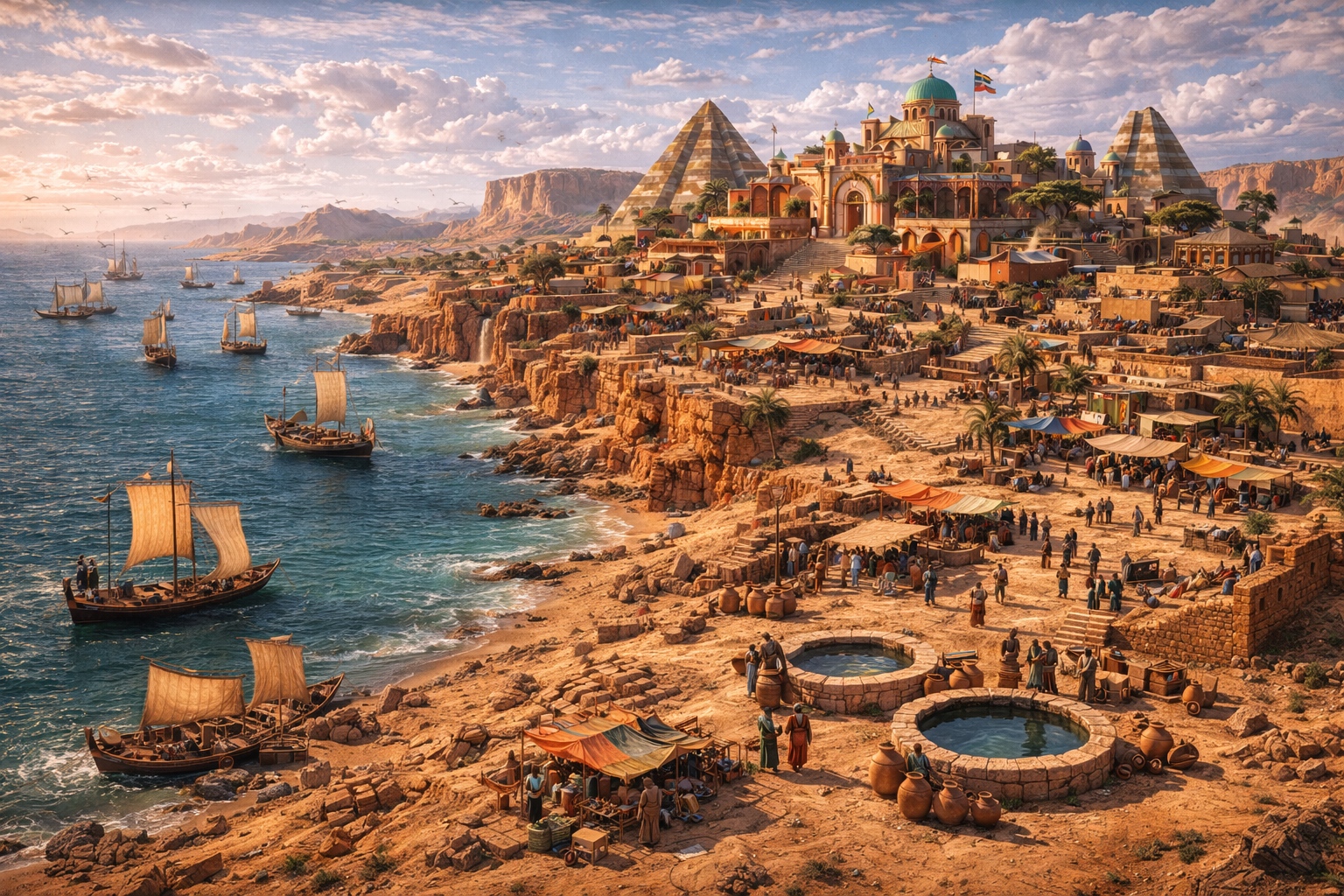
Manda announces itself in layers of salt and practicality. The Gulf of Duat's coastline here is rocky and less welcoming than the calm beaches to the south, and the settlement has the appearance of a place that accepts what the environment offers without complaint. Simple but sturdy architecture dominates: stone buildings designed to withstand harsh weather, with minimal ornamentation. The few structures that show care beyond mere function tend toward military or administrative use.
The harbor is working and unadorned. Fishing boats are present in numbers, along with a few larger merchant vessels, all in good repair. The docks show signs of constant use and maintenance. There is no pretense here; this is a settlement that knows what it is and does not apologize for it.
What strikes visitors most forcefully is the tension. Not violence, but a particular kind of watchfulness. Security is visible in ways it isn't in other settlements: armed personnel at the harbor, walls that are maintained and manned, a sense that the town is aware of threats beyond itself. Yet there is no sense of fear, more a sense of careful professionalism: a community that has accepted its circumstances and managed them effectively.
The islands visible from shore are scattering and less substantial than those around Pambuka. They serve as fishing grounds and minor settlements connected to Manda through regular trade.
Geography & Setting
Manda sits on the western coast of Funta, facing the Gulf of Duat and the open Rhodian Ocean beyond. The coastline here is rocky and the waters are rougher than in the more sheltered eastern settlements. The immediate hinterland is semi-arid scrubland with limited agricultural potential; Manda depends on fishing and trade rather than farming.
The location is strategic: Manda is positioned between the more stable settlements to the east and the lawless territories of Melfi to the west. This strategic positioning is the source of both Manda's economic importance and its primary source of tension.
Climate is temperate coastal, with colder waters than the eastern settlements and more frequent storms. The seasonal weather patterns are more dramatic; the winter storms can be severe.
The settlement sits on a coastal bluff, elevated above the harbor, which provides both defensive advantages and creates challenges for moving goods. A series of stairs and a switchback road connect the bluff-top settlement to the working docks below.
Why here? The harbor is defensible and the location provides control of movement along the western coast. Melfi is close enough to be strategic, far enough to not be immediately threatening. The fishing is good.
The People
Demographics
Manda's population is diverse by Funta standards, reflecting both the cosmopolitan nature of a port town and the deliberate policy of hiring capable people regardless of origin. Humans form a plurality but are not a majority. Elves are present, particularly in administrative and negotiation roles. Half-Orcs are represented, particularly in security and military functions. Dwarves are present in smaller numbers, working primarily in port management and boat repair. Zerrens are present in various roles, particularly as advisors and specialized tradespeople.
The constant movement of merchants, soldiers, and workers from Melfi means the settlement has exposure to darker cultures and morally ambiguous individuals. This has created a cultural acceptance of moral complexity that is unusual for Funta.
Economy
Manda's economy is deliberately designed as a supply and trade operation. The three components are fishing (local food production), essential goods trade (supplying Melfi), and military services (both defensive and mercenary).
Primary Exports
- Fish and preserved seafood: Caught locally, preserved, and exported both to Melfi and to legitimate ports
- Food staples: Grain and preserved goods from island suppliers and distant settlements, redistributed through Manda to Melfi
- Mercenary services: Batu's operation provides armed personnel for various contracts, though Kwame carefully controls which contracts are accepted
- Trade goods: As an intermediary between legitimate Funta settlements and Melfi
Primary Imports
- Grain and agricultural staples: Manda has minimal local agriculture and depends on imported goods
- Specialized goods for Melfi: Items that are difficult for Melfi to produce or obtain directly
- Metalwork and tools: For maintenance and equipment needs
- Luxury goods: For Manda's wealthier residents
Key Industries
-
Kwame's Fisheries: Run by Chieftain Kwame himself, this is the primary local food production operation. Eight fishing boats, locally managed, with catch preserved and distributed to both Manda and Melfi. Kwame personally oversees aspects of the operation, maintaining hands-on knowledge of this critical function. The business is profitable and reliable.
-
Amina's Healing Herbs: Managed by Amina (Kwame's wife), this operation supplies medicinal herbs, healing supplies, and medical services to Manda and regularly travels to Melfi. Amina's reputation as a skilled healer extends to Melfi, where even the raiders respect her knowledge. This operation generates significant income and creates a political advantage: both communities rely on her services, giving her unusual leverage.
-
Lindiwe's Trading Post: Overseen by Lindiwe (Elf female), this operation manages the complex logistics of trade between Manda and Melfi, ensuring that supplies flow consistently and that agreements are honored. Lindiwe negotiates directly with Melfi's leaders and has developed relationships of mutual respect. The trading post is larger and more sophisticated than typical Funta trade operations.
-
Sefu's Ship Repairs: Headed by Sefu (Dwarf male), this operation maintains Manda's fishing fleet and repairs vessels for trade merchants. It is a high-quality operation that has earned reputation throughout the western coast. Sefu is meticulous and maintains equipment to the highest standards.
-
Batu's Mercenary Services: Managed by Batu (Half-Orc male), this operation employs trained fighters for various contracts. Batu carefully screens which contracts are accepted; he will not work for causes that would harm Funta settlements or undermine the peace with Melfi. This discretion means the service has integrity that allows Manda to maintain both military capability and moral credibility.
Food & Drink
The diet is fish-forward, with fish as the primary protein source. Preserved foods (dried fish, salted meat, preserved vegetables) are staples because of the limited local agriculture. The cooking style is simple and functional, with little emphasis on elaborate preparation.
The communal well serves as the primary freshwater source, and water is carefully rationed during dry seasons. The well is considered sacred; damage to it would be considered a violation of community survival.
Fermented milk products are imported and rare, making them expensive treats. The local drink is a tea made from dried coastal plants.
Culture & Social Life
Manda's culture emphasizes pragmatism and discretion. There is no pretense about the settlement's role; everyone understands that Manda exists partly because of the Melfi relationship. There is cultural acceptance of moral ambiguity that would be shocking in more insulated settlements.
Despite this, there is also strong community solidarity. The shared understanding of external threat has created a culture of mutual support and loyalty. People look out for each other, partly from genuine affection, partly from practical necessity.
Music and storytelling follow Funta traditions but with darker themes. Stories about Melfi, about close calls with raiders, about the cleverness required to survive in Manda's circumstances, are told frequently.
Festivals & Traditions
The Stability Day
Celebrated annually on the day that marks Kwame's first agreement with Melfi, Stability Day is Manda's way of acknowledging the delicate peace. There is feasting, celebration, and public reminder of the mutual agreements that keep both settlements safe. It is partly political theater, partly genuine celebration, partly propitiation.
The Harvest Festival
Though Manda has minimal agriculture, the settlement marks the arrival of seasonal goods from island farms and inland settlements. It is an acknowledgment of trade relationships and the supplies that keep the community fed. The festival includes market activity and communal feasts.
Low-Water Remembrance
Held during the season of lowest water availability, this festival acknowledges the communal well's critical importance and ensures that maintenance and magical preservation (if available) are maintained. It includes offerings and community participation in well maintenance.
Music & Arts
The musical tradition emphasizes rhythm and percussion, with themes of strength and survival. The music tends toward complex and sometimes dissonant patterns that reflect the tension of Manda's circumstances.
Visual arts center on practical objects: decorated weaponry, carved ship elements, painted doors and shutters that show personal identity while maintaining functional simplicity. There is less emphasis on fine art and more on craft.
Religion
Primary Faith
Animism dominates Manda's spiritual life, with particular emphasis on protective spirits, spirits of the harbor, and spirits of the sea. The belief system treats spiritual protection as a resource that must be actively maintained through offerings and respect. Offerings to the sea are made regularly, and particular care is taken to propitiate the spirits before any major action.
The animist tradition in Manda has developed a particular aspect that emphasizes the spirits of place and boundary: the spirits of the gulf, the spirits that mark the boundary between Manda's territory and Melfi's. There is spiritual practice around these boundary lines, acknowledging both sides and requesting safe passage and continued peace.
Ryujin, lord of the saltwater seas and patron of fishermen and coastal traders, receives daily honor in Manda, a settlement whose survival depends on safe passage on the rocky and storm-prone Gulf of Duat waters. Before each fishing run, Kwame's Fisheries crews perform small water-offerings at the harbor; the Boundary Shrine extends its protection not only to land spirits but to the sea that shapes the coastline Manda depends upon. In a settlement where eight fishing boats represent the primary food supply, Ryujin's moods are not abstract theology.
Nesara, deity of freshwater and the sources that sustain life, is the spiritual focus of the community well, described by residents as sacred and treated with the kind of reverence that reflects genuine existential dependency. The Low-Water Remembrance festival, held when seasonal water availability drops lowest, is a de facto Nesara ceremony: the community acknowledges the well's critical importance, performs maintenance, and makes offerings against drought. The well is Manda's most strategically defended location; the fact that it is also spiritually defended is not coincidental.
Secondary Faiths
Themela (truth and justice under law) has followers among scribes, negotiators, and those who want Manda's agreements to remain enforceable rather than personal favors. There is a small Themela alcove maintained by a lay-legal clerk who advises on oaths, evidence, and the "cleanest" wording for agreements that need to survive a change of leadership.
Among the mercenary and security communities, devotion trends toward protective gods rather than conquest: Thulgard for holding the line and keeping civilians alive, and Echo for keeping the settlement from collapsing into factional violence. Before a dangerous mission, you're more likely to see a door-marked shield symbol than a war-banner prayer.
Caldrin, the deity of roads, crossroads, and hospitality-to-strangers, watches over the Melfi Road, the western route that Lindiwe and the supply caravans traverse regularly in one of the most diplomatically sensitive trade relationships in western Funta. Those who make this journey invoke Caldrin not only for physical safety but for the maintenance of the guest-right and diplomatic courtesy that keeps the arrangement functioning. The caravan infrastructure (guides, the careful management of passage agreements, the Melfi Trading House as neutral commercial ground) is effectively a Caldrin institution operating in a context where safe passage means the difference between stability and violence.
Hesira, deity of the hearth and domestic continuity, is honored in the households of Manda's tight-knit community, where the shared understanding of external threat has made domestic solidarity a survival strategy rather than a social comfort. The family bonds visible in the Kwame household (the partnership between Kwame and Amina, the careful preparation of each child for a specific community role) reflect Hesira's domestic theology, and Amina's healing practice is specifically an extension of the hearthfire's protective warmth into the community body. Among Manda's fishing families, Hesira is the patron of every household that waits for boats to return.
Anansi, the deity of story, trickery, and communal memory, is present in Manda's storytelling tradition: a culture that has developed its own particular genre of dark and clever tales about Melfi, about close calls with raiders, and about the cunning required to survive in circumstances that most of Funta would not choose. Kwame's diplomatic skill (his ability to negotiate with dangerous people, to turn their aggression into a supply arrangement) is itself a form of Anansi-adjacent trickery: not deception, but the adaptive intelligence that turns threat into relationship. The music of Manda "emphasizes rhythm and percussion, with themes of strength and survival" in ways that follow Anansi's tradition of turning hard truths into survivable narrative.
Dolen, deity of sorrow, longing, and the domestic crafts of the separated, is quietly present among the fishing wives, children waiting for boats, and those whose family members serve in Batu's mercenary operations that take them to dangerous assignments beyond Manda's walls. The decorated weaponry and painted door shutters that form Manda's visual arts tradition are the kind of craft Dolen oversees: personal expression under constraint, beauty maintained in difficult circumstances. Port towns that live in perpetual awareness that circumstances could change carry Dolen's weight.
Salvius, deity of healing, medicine, compassion, and the alleviation of suffering, has his most visible expression in Manda through Amina's Healing Herbs, an operation that "supplies medicinal herbs, healing supplies, and medical services to Manda and regularly travels to Melfi" and that "generates significant income and creates a political advantage." Amina's reputation as a skilled healer extends even to Melfi's raiders, who respect her knowledge, a reach of healing across political lines that Salvius's tradition of universal compassion specifically honors. Young Nia Kwame's apprenticeship under her mother creates a visible generational transmission of Salvius's practice that the community quietly acknowledges as one of Manda's most important inheritances.
Nyxollox, the gentle deity of death and peaceful transition, is present in Manda through the community's long-standing awareness that its circumstances carry genuine mortality: the decades of raiding before the diplomatic solution, the ongoing mercenary contracts that take Batu's personnel to dangerous assignments, and the fishing runs on the rough, rocky Gulf of Duat waters. The community's culture of "genuine affection" and mutual support carries Nyxollox's quiet acknowledgment that death is part of what they are protecting each other from. Among the fishing families who wait for boats and the households of mercenary workers, the gentle death deity is invoked in the practical hope that when danger comes to those they love, the passage is as peaceful as the circumstances allow.
Jusannia, deity of femininity, life, and the generative power of women's knowledge, is present in Manda through the notable women who hold the settlement's most critical roles. Amina Kwame's healing practice (the knowledge of herbs, of bodies, of how to sustain life in difficult circumstances) flows from mother to daughter in the partnership between Amina and young Nia Kwame, who is "learning healing" and showing "aptitude" in exactly the generational transmission that Jusannia oversees. The midwives and mothers of Manda's tight-knit community maintain Jusannia's quiet household tradition in the practical way of communities where survival depends on every person doing the work they are suited for.
Secret or Forbidden Worship
There is a hidden movement that worships at the boundary between Manda and Melfi, making offerings to spirits perceived as existing in that liminal space. The practice is technically not forbidden but is viewed with suspicion and concern by authorities. The group is very small and very discreet.
Amnyth, deity of death, vengeance, and the knowledge that comes from studying mortality, receives private offerings from those who lost family members to the decades of raiding and tension that preceded Kwame's great-grandfather's diplomatic solution, and from those who fear that Melfi's current stability faction could collapse, bringing that violence back. This is not organized worship but personal propitiation: the quietly maintained anger of those who have not entirely let go of what was lost, channeled into Amnyth's domain of vengeance and death-knowledge.
History
Founding
Manda was established approximately 200 years ago as a fishing settlement by traders who recognized the harbor's value and the strategic position relative to the western coast. For the first century, it was simply a fishing and trade town with no particular external threats.
Key Events
The Rise of Melfi
Approximately 100 years ago, a powerful warlord consolidated control of the territories west of Manda and established what became Melfi. Initial interactions were hostile, with raiding parties attacking Manda regularly. The settlement faced potential destruction.
The Diplomatic Genius of Kwame's Ancestor
Kwame's great-grandfather was the settlement's leader when the Melfi threat was greatest. Rather than attempting to defend against constant raids, he proposed a radical solution: consistent supply of essential goods in exchange for peace. The idea was accepted by Melfi's leadership, and the arrangement has held for approximately 75 years.
Kwame's Solidification of the System
When Kwame became chieftain 30 years ago, he inherited this delicate arrangement. He has strengthened it through his personal relationships with Melfi's leadership, through careful management of the supply chain, and through ensuring that any attempt to undermine the agreement is met with consequences. His leadership has transformed the arrangement from a temporary expedient into a stable system.
Current State
Manda is stable but aware of its precarious position. The system works because Kwame manages it well, because supply is consistent, and because Melfi's leadership values the arrangement. However, everyone understands that this depends on continued competent governance and continued willingness from Melfi to respect the agreement. The settlement lives with perpetual awareness that circumstances could change.
Leadership & Governance
The Kwame Council: Overview
Kwame holds absolute chieftain authority as is traditional for Funta, but his governance is informed by a council of his most important subordinates. The council includes Batu (security), Lindiwe (trade), Sefu (resources), Chijioke (administration and intelligence), and Amina (when matters of health or Melfi relations are under discussion).
This council is less formal than the councils in other settlements but is equally influential. Kwame consults them regularly and takes their advice seriously, particularly on matters outside his direct expertise.
Chieftain Kwame
Human, Male; mid-50s
Kwame is a striking figure: tall, physically capable, with the bearing of someone who has spent his life managing dangerous situations. His eyes are alert and constantly assessing. His manner is friendly but controlled; he is genuinely personable, but people sense that he is never fully relaxed.
Personality: Shrewd, calculating, with genuine diplomatic skill. Kwame is capable of charm but is not charming; he uses charm as a tool when needed but prefers directness. He is intelligent and well-informed. He makes decisions quickly once he has information, but he is patient about gathering that information.
Motivation: Kwame's primary motivation is keeping Manda safe and prosperous. Everything he does flows from this. The relationship with Melfi is the means to this end, not an end itself. He would abandon the arrangement in a moment if he believed a different approach would better serve Manda, but he has concluded that the current system is the most effective option available.
Known For: His diplomatic skill, his ability to negotiate with dangerous people without being intimidated, and his reputation for honoring agreements. He is trusted by both Funta settlements and Melfi's leadership because his word is reliable.
Amina Kwame
Human, Female; mid-50s
Kwame's wife and the manager of the healing herbs operation. Amina is a skilled healer with genuine compassion for people and a reputation that extends to Melfi. She is the most trusted person in Manda by the Melfi population, which gives her unusual political leverage.
Personality: Warm, observant, with the healer's natural empathy. She is strong-willed but does not seek direct power; she influences through relationship and wisdom rather than authority. She is deeply invested in Manda's welfare and in the survival of the Melfi relationship, but she maintains her own moral standards about what she will and will not do.
Her relationship with Kwame is genuine partnership. She advises him on matters of health, ethics, and Melfi relations, and he respects her judgment. When she expresses concern about a policy, Kwame listens carefully.
Batu: Head of Security
Half-Orc, Male; late 40s
Batu serves as Kwame's chief of security and commander of Manda's military forces. He is the manager of the mercenary operation and ensures that Manda is capable of defending itself while maintaining the necessary restraint to not provoke Melfi unnecessarily.
Personality: Professional, competent, with a dry sense of humor. Batu does not socialize broadly but is trusted by the people under his command. He is not interested in political games and respects Kwame's authority without question.
Motivation: Batu wants Manda to be secure and wants his people to be trained and prepared. He is quietly concerned that Manda's defensive capability may be insufficient if circumstances change, and he is constantly working to improve readiness without making Melfi nervous.
Lindiwe: Trade Negotiator
Elf, Female; age indeterminate (appears 40s-50s range)
Lindiwe manages the complex logistics of trade with Melfi and other settlements. She negotiates directly with Melfi's leaders and has developed relationships of mutual respect. She is the most exposed of Kwame's subordinates to Melfi's population and operates under constant scrutiny.
Personality: Sharp, patient, with genuine diplomatic skill. Lindiwe is not afraid of difficult conversations and will push back on proposals she believes are unfair or dangerous. She is respected by Melfi's leadership because she is honest and capable.
Motivation: Lindiwe wants the trade relationship to continue and wants it to be fair and sustainable. She believes that long-term stability requires that both Manda and Melfi benefit from the arrangement.
Sefu: Port Master
Dwarf, Male; late 50s
Sefu manages Manda's port operations and oversees the ship repair business. He is responsible for the physical infrastructure of the harbor and ensures that both Manda's ships and Melfi's vessels are maintained efficiently.
Personality: Meticulous, practical, with the Dwarven characteristic of taking work personally. Sefu is proud of his operation and will not tolerate shoddy work. He is less politically engaged than other members of the council but brings important perspective on resource management.
Chijioke: Advisor and Scribe
Zerren, Male; early 40s
Chijioke serves as Kwame's advisor on various matters and maintains records of agreements, trade flows, and other important information. He is literate and educated, which is unusual among Funta settlements, and brings analytical perspective to council discussions.
Personality: Thoughtful, detail-oriented, with a particular interest in understanding patterns and predicting future developments. Chijioke is less politically experienced than other council members but is developing influence through his growing understanding of the settlement's dynamics.
Motivation: Chijioke is interested in understanding how settlements function and how to improve governance. He views his position as an opportunity to learn and to contribute to making Manda more stable and prosperous.
Guard & Militia
Manda maintains a force of approximately 35 trained fighters organized into harbor defense, settlement patrol, and rapid response. They are semi-professional, with some full-time positions and some called up seasonally. They are trained to be capable but restrained, effective enough to defend against raids but not so overwhelming as to provoke Melfi unnecessarily.
Law & Order
Kwame's authority is absolute, but his justice is measured and considers both Manda's needs and the need to maintain the Melfi relationship. Serious crimes are punished harshly. Disputes are brought before Kwame or the council. There is an understanding that certain crimes (theft from the supply chain, violence toward Melfi traders) are more serious than others and will be punished more severely.
There is an informal justice system for Melfi-related crimes that considers both settlements' needs. If a Melfi raider commits a crime in Manda, the response must be careful: too harsh and Melfi could retaliate, too lenient and Manda's residents feel betrayed.
Notable Figures
Tendaji Kwame: Chieftain's Son, Military Training
Human, Male; late teens/early 20s
Location: Various, often at training or security locations
Kwame's older son is in training to potentially take over security and military operations. He is learning from Batu and is developing the skills needed to command Manda's forces. He is less politically sophisticated than his father but is learning.
What He Wants: To prove that he is capable of leading Manda's defense without overshadowing his younger brother or disappointing his father.
What He Knows: Military tactics, training methods, the names and capabilities of Manda's fighters, and increasingly the political dimensions of Manda's relationship with Melfi.
Jabari Kwame: Chieftain's Son, Trade Operations
Human, Male; mid-teens
Location: Harbor, trading post, or school
Kwame's younger son is being groomed for involvement in the trade operations. He is less committed to formal military training and shows more interest in commerce and negotiation. He is learning from Lindiwe and from his father.
What He Wants: To become a capable trader and eventually to manage the complex Melfi trade relationship.
What He Knows: The basics of trade negotiation, the personalities of Melfi's traders, and increasingly the political importance of consistent supply.
Nia Kwame: Chieftain's Daughter, Community Health
Human, Female; early teens
Location: Amina's healing practice, harbor, community spaces
Kwame's daughter is learning from her mother and showing aptitude for healing. She is less engaged in the political dimensions of governance and more interested in the practical work of caring for community members.
What She Wants: To become a healer like her mother and to serve the community's health needs.
What She Knows: Herbal remedies, healing techniques, and the physical conditions that affect people in Manda's climate and circumstances.
Lindiwe Trade Negotiator
Already covered as a council member, but her role deserves particular emphasis. Lindiwe is the most visible representative of Manda in Melfi and carries enormous responsibility. She knows the Melfi leaders personally, understands their motivations, and is trusted by them. Her assassination or capture would be devastating to Manda's security.
Key Locations
Seat of Power
- Kwame's Estate: A fortified compound on the bluff overlooking the harbor. It serves as Kwame's residence, the administrative center for the settlement, and a defensive strongpoint if the harbor is threatened. The estate includes living quarters for Kwame's family, council meeting rooms, and secure storage for valuables and supplies. The structure is practical rather than elegant, designed to be defensible while serving governance functions.
Houses of Worship
-
The Boundary Shrine: A small structure at the edge of settlement, maintained as a place to make offerings to the spirits of the gulf and the boundary between Manda and Melfi. It is regularly maintained and is the focal point for Manda's animist tradition.
-
The Themela Alcove: A small legal shrine dedicated to Themela (truth and justice in state law). Maintained by a lay clerk; used when witnesses swear statements or when agreements with Melfi must be documented cleanly.
Inns & Taverns
-
The Harbor's Rest: The primary tavern in Manda, located near the docks. It serves as a gathering place for fishermen, traders, and security personnel. The owner, a sharp-eyed Half-Elf named Kalista, maintains excellent security and keeps discussions confidential. The food is simple but adequate.
-
The Melfi Trading House: A semi-public space where Melfi traders stay during visits to Manda. It is managed by a Melfi expatriate and serves as neutral ground for negotiations and business. It is well-maintained and secure.
Shops & Services
-
Kwame's Fisheries, Processing Facility: Located near the harbor, where the daily catch is processed, salted, and prepared for distribution to both Manda and Melfi. It is a working facility with minimal decoration, focused entirely on function.
-
Amina's Healing Herbs, Workshop: Amina's personal operation, where medicinal herbs are grown, processed, and prepared. It serves as both a supply source and a healing practice where community members (and occasionally Melfi visitors) are treated. The workshop is organized and clean, with a strong smell of herbs and medicine.
-
Lindiwe's Trading Post: A substantial structure that serves as the center of trade operations. It has storage for goods in transit, living quarters for traders, and administrative space for managing the complex logistics of supply to Melfi. It is well-organized and secure.
-
Sefu's Ship Repairs: Located at the harbor, where Manda's fishing fleet and visiting vessels are maintained and repaired. It is a working facility with equipment for repairs and construction. Sefu is frequently present and maintains exacting standards.
The Market
- Harbor Road Market: The main commercial area runs along the switchback road between the bluff settlement and the harbor. Stalls and shops offer fish, preserved goods, imported items, and tools. The market is functional rather than festive.
Other Points of Interest
-
The Community Well: Located in the center of the settlement, this well is the primary source of fresh water and is treated as sacred. It is maintained communally and is protected by both security and spiritual practice. Water is distributed to residents, and access is free.
-
The Island Fishing Grounds: The scattering of islands visible from Manda's coast are fishing locations and minor settlements. They are connected to Manda through regular trade and fishing operations.
-
The Bluff Defensive Walls: The settlement on the bluff is defended by walls and strategic defensive positions that have been maintained for generations. They provide protection against raiders and are a visible reminder of Manda's preparedness.
-
The Melfi Road: The western route out of Manda toward Melfi's territories. It is maintained as a trade route and is traveled regularly by merchants and officials. It marks the boundary of Manda's direct control and is a place of particular diplomatic care.
Secrets, Rumors & Hooks
-
Kwame's health is beginning to decline, though he conceals this from all but Amina. He is experiencing pain in his joints and fatigue that he attributes to age, but there are concerns about whether he will be able to continue managing the delicate Melfi relationship if his physical or mental capacity diminishes. Succession is a concern that is not yet public.
-
There is a faction within Melfi that wants to terminate the supply agreement and take Manda by force. This faction believes that the settlement's resources are being wasted on trade rather than used for conquest. Lindiwe and Kwame are aware of this and are working to strengthen their relationship with the Melfi leadership that opposes this faction, but the political situation in Melfi is destabilizing.
-
Batu has quietly been training Manda's forces for a scenario in which Melfi breaks the agreement. He believes Manda should be prepared for war, even though Kwame does not want to admit that war is possible. The training is sophisticated and realistic, and the forces are becoming more capable, but Batu is careful to keep this from becoming public.
-
Amina is working with a Melfi healer on medical techniques and knowledge-sharing. This relationship is personal and professional, and it strengthens the human connections between the communities. However, if discovered by hardliners in either settlement, it could be misinterpreted as inappropriate fraternization or espionage.
-
Sefu has been contacted by shipwrights from other settlements about potentially relocating. They recognize his talent and want to hire him away from Manda. Kwame does not know this yet, but losing Sefu would significantly damage Manda's capacity to maintain vessels and would be a serious blow to the settlement's security posture.
-
The supply chain to Melfi is becoming strained because of internal conflicts within Melfi about how resources should be distributed. Different factions are making claims and demands, and Lindiwe is under pressure to navigate these conflicts without taking sides in Melfi's internal politics. The situation is becoming more complex and dangerous.
-
There is quiet discussion about whether Manda should use its position to exert more influence over Melfi, rather than simply responding to Melfi's demands. Some council members believe that consistent supply gives Manda leverage that Kwame is not using effectively. Others believe that attempting to exert more influence would be dangerous and could destabilize the entire arrangement.