Melfi
Melfi: The Well-War Oasis
"In Melfi, the only law is water, and the only currency is blood."
Unknown LaHale militia scout
At a Glance
| Continent | Funta |
| Region / Province | Southern Tellery Pan |
| Settlement Type | Warlord-controlled outlaw town |
| Population | ~800 permanent (highly fluctuating) |
| Dominant Races | Human, Half-Orc, Zerren, Dwarf |
| Ruler / Leader | None; Four Warlords (Council of Wells) |
| Ruling Body | Warlord Oligarchy: Tribaldom |
| Primary Deity | Animist (fire, ancestors, survival spirits) |
| Economy | Raiding, extortion, barter |
| Known For | A lawless haven where four tribes war for water control |
First Impressions
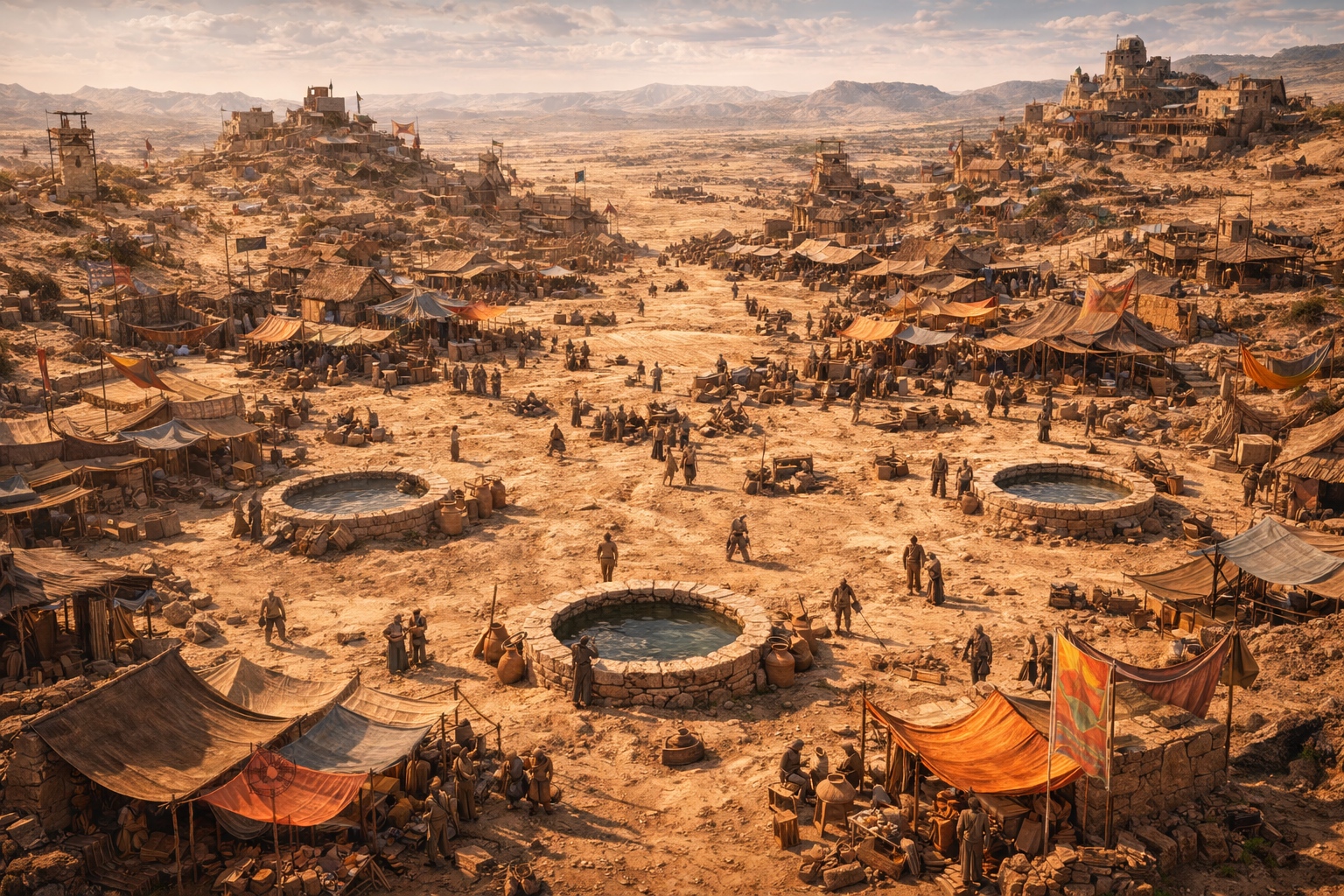
Melfi emerges from the rocky highlands like a scar in the landscape, a sprawl of makeshift structures clinging to four vital wells scattered across the arid terrain. The architecture is brutal and improvised: buildings cobbled from scavenged wood, sun-bleached stone, canvas tarps lashed to rough frames, and materials clearly repurposed from caravans and raids. Dust hangs perpetually in the air, and the smell of sweat, animals, and unquenched thirst permeates every street.
The town operates in constant tension. Tribal colors (painted shields, wrapped cloth, war scarves) mark territory invisible to outsiders but crystal clear to residents. The atmosphere crackles with barely suppressed violence. Raiders move with the casual menace of apex predators; non-tribal residents hurry about with eyes downcast, aware that attention is often dangerous. Yet there is a strange civility underneath the brutality. The four warlords have established an unspoken détente: no tribe monopolizes water, and no tribe pushes too hard without risking retaliation that could shatter Melfi entirely.
The town's reputation spreads far enough that it attracts drifters, refugees from failed settlements, debt-slaves trying to disappear, and those with blood on their hands they'd rather not have traced. To arrive in Melfi is to step outside the law entirely. There are no guardsmen of LaHale here, no merchant guilds, no priests demanding tithes, only the brutal logic of survival and the four warlords who enforce it through intimate knowledge of thirst.
Geography & Setting
Melfi sits on the western edge of the Southern Tellery Pan, high desert tableland at moderate elevation. The landscape is rocky, sparse, with minimal vegetation beyond thornbushes and hardy desert shrubs. The four wells that define the town lie roughly at the cardinal points: one to the north, one to the east, one to the south, one to the west. The distance between them forces tribal separation and makes resource monopolization impossible, a natural geographic constraint that has become the bedrock of the town's fragile peace.
The terrain itself is unforgiving and defensible. Multiple elevated positions allow watchers to spot caravans or approaching threats from considerable distance. Narrow canyon passages and rock formations provide ambush points. The surrounding desert offers no shelter for armies, which has made Melfi's raiders relatively safe from LaHale militia retribution; any sustained military action through the hostile terrain would be catastrophically expensive.
Water is so scarce that it shapes behavior in ways outsiders find difficult to grasp. A single well serves roughly 200 people; a broken well means slow migration or starvation. Thus the four tribes' control is absolute.
The People
Demographics
Melfi's population is composed primarily of transient raiders: members of the four tribal groups. The permanent non-tribal population includes displaced persons, refugees, escaped slaves, debt-fugitives, those running from LaHale law or worse, and opportunists who found profit in serving the warlords' complex logistics.
Humans dominate numerically. Half-Orcs are well-represented, particularly in the Desert Hawks and Scorching Serpents, drawn to raiding life and physical prowess. Zerrens cluster in the Sand Vipers; Jelani's charisma attracts outcasts and those with nowhere else to go. A handful of Dwarves manage blacksmith operations and well maintenance. No Elves have settled here; the few who passed through rarely stayed long.
Children are present but scarce. Reproduction among the raiders is low; most members recruit stolen rather than born. A small population of permanent residents' children exist, growing up understanding water as currency and violence as dialect.
Economy
Melfi's economy is entirely extractive and predatory. The four tribes conduct raids on villages near LaHale's periphery, places far enough from the oasis city to be vulnerable but close enough to be reachable. Targets are assessed carefully: rich enough to warrant attack, poor enough to lack serious defenses, isolated enough that revenge can be avoided. The warlords are strategists; LaHale's Fire Swingers are the nightmare no raid can risk provoking.
Non-tribal residents provide essential services: blacksmithing, food preservation, repair, entertainment, and crucially, information. A man who shoes horses, sharpens blades, or tans hides is safer in Melfi than anywhere else. An informant who sells intelligence about caravan routes, neighboring settlements, or rival tribe movements earns protection and water rations. Musicians, dancers, and cooks tend to clusters of raiders eager for distractions.
Trade with outside settlements is minimal and dangerous. Only heavily armed merchant caravans from Manda risk the route to Melfi; they know the warlords will negotiate rather than massacre them wholesale, as a dead merchant caravan becomes a crisis that attracts LaHale's attention. Basic commodities (salt, grain, preserved foods, metal) arrive at exorbitant markups. Locals barter services and information instead: a blacksmith doesn't pay coin for tools, but crafts something for a warlord and receives water credit or protection.
Primary Exports
- Stolen goods: weapons, jewelry, livestock acquired through raids
- Information: intelligence on neighboring settlements, caravan routes, LaHale movements
- Labor: mercenaries for hire, skilled craftspeople available for short contracts
Primary Imports
- Food and grain: from Manda caravans, exorbitantly expensive
- Metal: raw iron and steel for blacksmithing
- Tools and repair materials: replacement for worn equipment
Key Industries
- Raiding operations: the economic engine; logistics, recruitment, planning, fence networks
- Well management: control and distribution of water; the fundamental power structure
- Blacksmithing & weaponry: maintaining and improving the raiders' equipment
- Information trade: scouts, spies, and intelligence merchants serving all four tribes
- Service industries: entertainment, food, lodging, mending, hiding places for those fleeing justice
Food & Drink
Water is more precious than food. A person can steal, earn, or beg food; water is non-negotiable. Meals in Melfi are sparse: dried meat, hard bread, sorghum porridge, dates, and nuts. Game from the surrounding desert is hunted when possible. The warlords sometimes slaughter livestock captured during raids; fresh meat is a luxury and signal of tribal wealth.
Drink is almost exclusively water. Alcohol is rare and expensive, reserved for celebrations or the wealthy. The cultural prohibition against excess consumption of anything water-based is absolute; waste water and you might find yourself exiled into the desert.
Those with access to raids eat better: smoked meat, fresh bread, honey. Service workers and permanent residents eat what they can afford to barter for. The poor survive on water, sorghum, and whatever they can forage or trade minor labor for.
Culture & Social Life
Melfi's culture is defined by tribal loyalty, personal honor within one's group, and the unspoken rules of the Well-War. To be "tribe-bound" is to have protection, resources, and purpose. To be outside the tribes is to be vulnerable, though economically valuable because of one's neutrality.
Social life revolves around tribal camps. Each warlord maintains a headquarters near their well, typically a larger, better-constructed structure than the surrounding buildings. Fighters gather to sharpen weapons, receive orders, and absorb the culture of their group. Campfires are where stories are told: tales of successful raids, near-escapes from LaHale, legendary fighters of past generations. These stories are how young recruits are indoctrinated into raider culture.
Status in Melfi is visible: better weapons, fine clothes (stolen from raids), jewelry, personal slaves or servants. The warlords themselves are celebrities of a sort: known throughout Funta, feared in LaHale, respected in darker circles. Their personal guards are chosen for skill and absolute loyalty; being part of a warlord's inner circle is the highest status a raider can achieve outside of becoming a warlord themselves.
Interaction between tribes is carefully modulated. Explicit courtesy is maintained; warriors from rival tribes will trade at markets, share drinking water, even fight together against external threats. But the courtesy is thin, underlain by constant assessment: who is winning the Well-War? Which tribe is gaining recruits? Has anyone encroached on another's water supply?
Festivals & Traditions
The Dry Season Gathering
Once per year, as the dry season reaches its peak and tensions between tribes rise to dangerous levels, the four warlords convene at a neutral ground: the Market of Sands, a merchant space surrounded by all four wells equidistant. Warriors and non-combatants gather. The warlords meet to reaffirm the boundaries, discuss territorial disputes, and sometimes propose alliances against common threats. No weapons are drawn at the Gathering, though hands are always on hilts. It is part negotiation, part theatre, part warning.
Night of the Desert Spirits
An Animist tradition observed by all tribes without fail. On the darkest night of the year, fires are lit around each well. No raiding occurs. Warriors and civilians alike gather to pay respect to the spirits of the desert: fire spirits, water spirits, the ghosts of the dead who died in the sands. Offerings of milk, grain, and blood are poured into designated vessels. The night is marked by relative quiet and introspection. Even the most hardened raiders are quiet on this night, listening to the wind and contemplating their own mortality.
Music & Arts
Music in Melfi is harsh and functional, emphasizing percussion and wind instruments that carry well across open terrain. Drums are used both to mark time in work and to signal between tribal camps. Flutes made from bone carry melodies that are minor-key, haunting, speaking to the desert's austerity.
Visual arts are scarce. Tribal colors and symbols are painted on shields and clothing. Personal tattoos mark tribal affiliation and rank; some raiders bear ritual scars indicating battles survived. A few craftspeople produce pottery and woven goods, but luxury art is minimal; survival leaves little room for aesthetics beyond function.
Stories and oral tradition are the primary art form. Griots (storytellers) who remember the history of Funta, the legendary deeds of ancient warriors, and the current exploits of the warlords are highly valued. A skilled storyteller can command better rations and protection. Stories serve to inculcate values: courage, loyalty, cunning, honor, and ruthlessness.
Religion
Primary Faith
Melfi's dominant belief system is pragmatic Animism, the worship of spirits embodied in natural forces: fire, water, wind, and earth. The desert itself is understood as a living entity, fickle and deadly. Ancestors are venerated as guides and warnings. The four wells are not merely water sources; they are sacred ground where water spirits dwell, requiring propitiation and respect.
This belief system is perfectly aligned with raider culture: the gods demand courage, cunning, and the strength to take what one needs. Death in service to the tribe ensures honorable passage to the ancestor realm. Water is divine and must be honored through its careful use and the rituals surrounding it.
Damballa, the deity of death, decomposition, and the earthy cycles that return flesh to soil, is felt throughout Melfi in ways most inhabitants would not articulate as theological but would recognize as true. The Silent Tombs west of the settlement, where the honored dead are entombed and any raid constitutes "absolute taboo", are Damballa's clearest institutional expression: the one universally sacred ground in a place that holds almost nothing sacred. The Night of the Desert Spirits ceremony, with its bone-carved offerings and its quiet acknowledgment of those who "died in the sands," draws directly from Damballa's domain. In a settlement where violent death is constant and the desert claims those exiled or lost, the cycle of return is not metaphor but lived reality.
Nesara, deity of freshwater, is honored at each of the four wells not through formal ceremony but through behavioral reverence that substitutes for organized faith: the absolute prohibition on wasting water, the ritualized distribution of rations, the sacred status of the wells as Melfi's fundamental organizing principle. That "the well is his real power base", as is said of Mosi, is not merely political analysis; it reflects a genuine spiritual understanding that water in this environment is divine provision requiring active respect. Nesara's presence in Melfi is unspoken but total, embedded in every social rule that governs access to the settlement's most precious resource.
Secondary / Minority Faiths
A handful of secret Echo sympathizers exist among the permanent non-tribal population, people who remember what stable towns feel like and who talk, quietly, about rules that aren't just "who has water." They keep it private; open Echo devotion reads as weakness in Melfi.
Among the raiders themselves, formal deity worship is secondary to animism, but when it appears it tends toward war-as-identity:
(Martus is present too, but as luck, the charm tied to a spearshaft, the coin flipped before a risky ambush, not as a god of war.)
Anansi, the deity of story, oral tradition, and trickery without malice, has genuine presence through the griots, the skilled storytellers who "can command better rations and protection" than average Melfi residents. Anansi's portfolio of adaptive identity and communal memory maps almost perfectly onto the survival strategies of Melfi's non-tribal population: those who navigate tribal politics through clever positioning, neutral service, and the careful management of information. The campfire stories that induct young recruits into raider culture are, in theological terms, Anansi's domain, the transmission of values through narrative rather than formal instruction. That a storyteller can achieve status in a warlord settlement through words alone is the most Anansi thing about Melfi.
Nyxollox, the gentle universal deity of death and peaceful transition, has an unexpected institutional expression in Melfi through the Silent Tombs, the burial ground west of the settlement where "raids are considered absolute taboo" and which would "trigger unified response from all four tribes" if violated. The Night of the Desert Spirits ceremony's acknowledgment of those who "died in the sands," with its bone-carved offerings and its "quiet introspection" about mortality, is the closest Melfi comes to organized Nyxollox worship: the universally shared acknowledgment that even in a settlement where violence is constant, the dead deserve respect. In a place where Amnyth's darker death-knowledge serves the powerful, Nyxollox's gentler tradition belongs to the permanent non-tribal residents who bury their own dead without ceremony and simply hope that the transition is easier than the life preceding it.
Cameth, deity of protection of hearth, home, and household against disaster, the specific guardian of ordinary people in crisis, is the patron of Melfi's permanent non-tribal population: the blacksmith families, the cloth-repair couple Naja and Kerem, the food vendors, and the displaced and debt-fugitive people who have built modest livelihoods inside a warlord settlement. The safety of Kess's forge, where "no violence occurs in or immediately around" the workshop because "the warlords respect" its indispensability, is exactly the kind of protected domestic space Cameth governs: not grand, not sacred in an obvious sense, but inviolably defended because its loss would harm everyone. The permanent non-tribal residents who make offerings at small household shrines before the tribal camps' larger altars are doing Cameth's work, maintaining a form of ordinary life inside extraordinary circumstances.
Lantha, deity of the moon, night, watchfulness, and the quiet work done in darkness, is felt throughout Melfi's constant vigilance culture: the watchers on elevated rocky positions who scan the terrain for approaching threats from "considerable distance," the scouts who track caravan movements at night, and the tribal warriors who read camp-fire shadows to assess rival tribes' positioning. The survival logic that Melfi operates on requires the ability to see without being seen and to work during hours when the desert's ambient danger is highest, making Lantha's domain of nighttime watchfulness practically essential rather than abstractly theological. Saina's information network, which "spans all four tribes" and operates most effectively through the quiet channels invisible to those in daylight power, is, in its way, a Lantha institution.
Secret or Forbidden Worship
There are whispers that some permanent residents, particularly those who lost everything to the raiders, secretly worship Zopha (knowledge) or follow displaced priesthoods of other faiths. These worship practices are clandestine and occur in hidden spaces. Discovery would be dangerous; the warlords tolerate many things but active dissent is not among them.
Amnyth, deity of death, poison, and vengeance, receives clandestine offerings related to the succession of warlord assassinations that have marked Melfi's history: Keth's poisoning, the deaths under unclear circumstances across the decades, the current whispered investigations into who might strike next. Whether those who seek Amnyth's counsel are would-be assassins or those trying to identify and survive assassination attempts, the deity's portfolio of poison-craft and death-knowledge makes this secret worship practically motivated. Saina's information network likely touches the practitioners, and she knows better than to share what she knows.
History
Founding
Melfi began not as a settlement but as a stopping point. Centuries ago, the four wells were discovered by nomadic herders. The wells were reliable, deep, and capable of supporting a permanent population. Gradually, shepherds settled around them. A natural market grew, then permanent structures.
The shift to raider dominance occurred gradually over decades, accelerating when LaHale's expanding sphere of influence made distant settlements more vulnerable to external threats. Skilled fighters were recruited as protection. Eventually, these protectors realized that the water sources were the true power base and began consolidating control. The four primary warlords rose through a combination of force and shrewd negotiation, establishing the Well-War as a structured system rather than a chaotic free-for-all.
The oldest sources suggest that the four warlords made a pact generations ago, possibly sworn on the wells themselves in a binding Animist ritual: no tribe would ever monopolize all water, and no warlord would seek to rule the others absolutely. This agreement, enforced through the constant balance of military power and the absolute horror of any tribe that violated it, has held for generations.
Key Events
The LaHale Incident (approximately 15 years ago)
One of the warlords (records are unclear which) grew ambitious and plotted to attack a smaller settlement protected by LaHale soldiers. The raid was discovered prematurely; LaHale's militia responded with devastating force, nearly destroying one of the four tribal camps. The Fire Swingers were rumored to have been involved. The warlord in question either died in the conflict or fled; the incident became a permanent cautionary tale. No similar aggression has been attempted since.
The Assassination of Warlord Keth
Approximately 8 years ago, one of the original four warlords was poisoned, likely by an internal rival, though blame was never established. His tribe fractured temporarily, with his younger sister (Warlord Zola, current leader of the Desert Hawks) stepping in to hold the group together. This succession was the most recent major shift in power structure.
The Manda Trade Agreement (recent)
Roughly 3 years ago, negotiation occurred with Manda's merchant families resulting in formalized safe passage for supply caravans in exchange for protection guarantees. This has stabilized Melfi's food supply and given the warlords a vested interest in not destroying the merchant network.
Current State
Melfi exists in precarious equilibrium. The four warlords maintain periodic conference to prevent escalation into open warfare. Population fluctuates with raiding seasons and caravan arrivals. New recruits arrive regularly: young people seeking status, refugees seeking disappearance, adventurers seeking chaos.
The hidden challenge is sustainability: raiding cannot continue indefinitely without inviting reprisal. The warlords have become more cautious, more strategic. Expansion is constrained. The real question, whispered but never spoken openly, is whether Melfi's raider culture can transition into something more stable, or whether the town is destined for a violent collapse.
Leadership & Governance
The Four Warlords: Council of Wells
Melfi is governed by four equally powerful warlords, each controlling one of the town's cardinal wells. The system prevents any single ruler from achieving dominance while requiring constant negotiation and balance. The warlords meet quarterly at the Market of Sands (the central trading zone equidistant from all four wells) to discuss resource distribution, territorial concerns, recruitment, and external threats. Decisions are nominally consensus, but in practice, the strongest personality dominates discussion while respecting the red lines others have established.
Authority is personal and absolute within each warlord's territory. Warriors owe absolute loyalty to their warlord. Punishment for disobedience is swift and severe, often public execution or exile into the desert (functionally a death sentence). Non-tribal residents are tolerated because they provide services; if they become troublesome, they can be expelled with minimal consequence.
Warlord Mosi: The Scorching Serpents
Human male, mid-40s
Mosi controls the northernmost well and leads the Scorching Serpents, a tribe specialized in rapid hit-and-run tactics. Mosi himself is a cunning strategist, always calculating three steps ahead of rivals. His physical appearance is lean and scarred, a man who has survived decades of warfare through intelligence rather than brute strength.
His leadership style is cold and methodical. He plans raids with mathematical precision, choosing targets, timing, retreat routes, and contingencies with obsessive detail. His warriors respect this discipline; under his command, casualties are minimized and successful raids are high. He is the warlord most likely to negotiate peacefully with rivals because he understands that military victory isn't always the goal; status and resources are, and they can be achieved through other means.
Mosi maintains the Serpents' well with fastidious care, employing an entire crew dedicated to its maintenance and defense. The structure around it is more substantial than others, with watchtowers and defensive positions. He is calculating enough to realize that the well is his real power base; he protects it accordingly.
Warlord Zola: The Desert Hawks
Human female, early 50s
Zola controls the eastern well and leads the Desert Hawks, an elite archery unit capable of devastating ranged attacks. She is stern, direct, and uncompromising. Her predecessor (Warlord Keth) was her uncle; his assassination triggered a succession crisis that Zola resolved through a combination of martial skill and strategic marriages within the family structure.
She is the oldest of the four warlords and the one with the longest continuous tenure. Her warriors speak of her with respect bordering on reverence. She is known to be absolutely loyal to those loyal to her and implacably ruthless toward those who betray her. She has never lost control of her territory and holds the largest military force: approximately 280 warriors, compared to the other warlords' 200-240.
Zola is the most cautious about raiding after the LaHale Incident (which occurred during the final years of Keth's leadership). She has shifted her tribe toward information trading and mercenary work, hiring the Hawks to guard caravans or provide security for specific operations. This economic diversification has made her wealthy and given her options beyond raiding.
She is widowed (her husband died in a raid 20 years ago) and has two adult children, both warriors in her service. There is speculation that she is grooming one of them to be her successor, though she shows no signs of relinquishing power.
Warlord Jelani: The Sand Vipers
Human male, late 30s
Jelani controls the southern well and leads the Sand Vipers, specialists in ambush and psychological warfare. He is charismatic, magnetic, and deeply manipulative. Where Mosi thinks in straight lines and Zola in hierarchies, Jelani thinks in networks and narratives.
He is the newest warlord to rise to prominence, having seized leadership of the Sand Vipers approximately 12 years ago after the previous leader was killed in a rival skirmish. His strength is recruitment and persuasion. He has the smallest tribe by warrior count (~210), but his people are fiercely devoted. He attracts outliers, misfits, and those seeking redemption, then weaves their tragic stories into the tribe's identity and mythology.
Jelani himself is a former slave, which he never hides and frequently references. This origin story makes him sympathetic to displaced persons and fuels his rhetoric about freedom and survival. His tribe tends to include more non-human members (Zerrens, Half-Orcs, a few Dwarves) than the others, deliberately recruiting from those rejected elsewhere.
He is handsome, eloquent, and openly ambitious. Rumors suggest he is researching ways to increase his power without directly threatening the other warlords, perhaps seeking alliances with external powers or exploring economic diversification. Some worry he is the one most likely to break the uneasy peace, though he has been careful thus far.
Warlord Nia: The Wasteland Wolves
Half-Orc female, mid-40s
Nia controls the western well and leads the Wasteland Wolves, a tribe emphasizing brute strength, fearlessness, and direct combat effectiveness. She is a physical specimen: tall, muscular, scarred, and formidable in personal combat. She leads from the front lines, not from a command position.
Her leadership style is straightforward and physical. Disputes within her tribe are often resolved through combat rather than negotiation. Weakness is punished immediately. Strength is rewarded with status and resources. This approach maintains discipline through fear and respect in roughly equal measure.
Nia is illiterate and disinterested in written records or long-term planning. She is focused on the immediate: the next raid, the next threat, the next opportunity. This makes her both predictable (which other warlords appreciate) and dangerous (because she is capable of impulsive aggression). However, she understands the cost of violating the pact (she has seen what happens to warlords who grow too ambitious) and respects the equilibrium.
She has three adult children, all warriors. Unlike Zola, she has made no clear succession plan. When she dies, her tribe will likely fragment or consolidate under one of her children, creating instability.
Guard & Militia
Each warlord maintains a personal guard: typically 30-50 of their most skilled and loyal warriors, equipped with the finest weapons. These guards serve as the warlord's inner circle, execute their commands, and maintain discipline within the tribe.
Beyond the personal guards, each tribe maintains a larger militia structure: scouts, archers, spear-bearers, and specialists in horsemanship and desert survival. Total active military per tribe ranges from 180-280 warriors. Recruitment is continuous; young people and wanderers are regularly brought into the fold.
Law & Order
Law is enforced through warlord authority and tribal justice. There are no formal courts or appeals processes. A warlord's decision is final. Justice is brutal and swift: theft within the tribe results in loss of the stolen item and often physical punishment (amputation of fingers, scarification). Rape is punished with execution. Desertion results in public execution as a warning.
Inter-tribal disputes are handled through negotiation between warlords or, if negotiation fails, through ritualized combat (champions fight on behalf of their tribes, and the winner's claim is considered valid). Open warfare between tribes would violate the pact and is prevented through peer pressure and mutual deterrence.
Non-tribal residents are technically under the protection of whichever warlord controls their living area, though in practice, if a non-tribal person is victimized by a tribe member, justice is uncertain. Tribes tend to protect their own members from external punishment. However, crimes by non-tribals against tribals are treated seriously; the status differential matters.
Notable Figures
Kess: Master of the Forge
Dwarf male, approximately 70 years old
Kess is the most skilled blacksmith in Melfi and serves all four warlords. His forge, a respectable structure of kiln-stone and hardened clay near the central market, is considered neutral ground. No violence occurs in or immediately around the forge; this is an unwritten rule that the warlords respect because they depend on Kess's skill.
Kess came to Melfi as a refugee approximately 35 years ago after a mining disaster destroyed his family holdings in a distant mountain region. He arrived with nothing but skill and has built a life here. He is respected because he is both indispensable and neutral; he serves all four warlords equally, refusing to favor one tribe over another. His prices are fair, and his work is reliable. He is rumored to have considerable wealth hidden away, though he lives modestly.
Kess is one of the few permanent residents who has achieved a kind of social stability. Young crafters apprentice under him, and he has trained several blacksmiths now serving individual warlords. He is cautious, quiet, and keeps his thoughts to himself. Most people assume he is waiting for the day the Well-War explodes into open conflict, at which point he will leave again.
Saina: Information Broker
Zerren female, mid-30s
Saina runs a network of informants and scouts that spans all four tribes. She is technically a member of Jelani's Sand Vipers, but her information network is so valuable that all warlords employ her services. She maintains an office in a modest structure near the central market where information is bought and sold like water.
Saina is sharp-eyed, quiet, and remembers every detail told to her. She maintains absolute neutrality, accepting information from anyone and selling it to anyone who can afford her price. She has accurate information about internal tensions within each tribe, rumored dissatisfaction among warriors, potential raid targets, and the activities of external forces like LaHale militia.
Her value is immense, and her position is secure. Even Jelani (her nominal superior) rarely gives her direct orders; she operates semi-autonomously as long as she maintains her neutrality. She is rumored to be amassing wealth with the goal of eventually leaving Melfi and establishing herself in a more civilized setting, though this may be misinformation she spreads deliberately to maintain mystery.
Talvon: The Merchant
Human male, early 60s
Talvon represents the Manda merchant families in Melfi. He is neither raider nor settler but rather a permanent guest, having negotiated safe passage for merchant caravans in exchange for guaranteed purchase agreements. He lives in a fortified trading post near the central market, surrounded by guards employed by both the merchant families and occasionally by warlord detail.
Talvon is the primary contact for negotiations with outside powers. He has relationships with other caravan masters, distant merchants, and perhaps even some LaHale administrators. He is elderly, wealthy, and operates with the confidence of someone whose business is too valuable to dismiss. He maintains careful neutrality while preferring not to hide his personal opinion that Melfi's raider culture will eventually collapse.
He is rumored to have invested in alternative settlements and trade routes, hedging his bets against a Melfi collapse. His presence is stabilizing in that it represents a foothold for commerce, but destabilizing in that it offers a symbolic alternative path.
Key Locations
Seat of Power
Each warlord maintains a seat near their well. Mosi's compound (north) is fortified and methodically organized. Zola's compound (east) is the most substantial structure in Melfi, with defensive architecture and multiple buildings. Jelani's compound (south) is smaller but decorated with symbols and art celebrating the tribe's identity. Nia's compound (west) is functional and sparse, with less physical infrastructure and more emphasis on open ground for warrior training.
The Market of Sands (central, equidistant from all four wells) serves as the neutral ground where warlords meet and civilians and traders conduct commerce without tribal allegiance.
Houses of Worship
The Spiritfire Shrine (central market area) is a simple structure, walls of stacked stone enclosing an open-air gathering space. Here, the Night of the Desert Spirits celebration occurs, and individual pilgrims come to make offerings to water and fire spirits. There is no priest; the structure is maintained through shared labor by residents of all tribes.
Individual tribal camps maintain small stone altars or painted markers where warriors make personal offerings before raids.
Inns & Taverns
The Parched Throat: A modest inn near the northern well (Mosi's territory) operated by a retired raider, Moyo (Human male, late 50s). It serves harsh alcohol, basic food, and provides rooms for travelers and those seeking privacy. The Throat is reasonably neutral but leans toward Mosi-affiliated clientele.
The Red Sands: A tavern near the eastern well (Zola's territory) with a reputation for good music and stories. Operated by Elise (Human female, mid-40s), a former camp follower who settled and built a business. Better quality alcohol and food than the Throat; slightly more expensive.
Shops & Services
Kess's Forge: The primary blacksmith (see Notable Figures). Central location, neutral, essential.
The Water Seller: A modest operation run by Darak (Dwarf male, 50s) who distributes water purchased from the warlords and resells it to travelers and those without direct tribal access. The operation is technically under Mosi's protection but remains as neutral as possible.
Cloth & Repair: A small shop where textiles are sold and repaired, run by an elderly human couple, Naja and Kerem. Tattered clothing is common in Melfi; they do steady business.
The Bone Carver: A artisan shop where Sindri (Gnome female, 80s) creates tools, decorative objects, and small icons from bone. She is ancient and respected; her work carries spiritual significance, particularly for Animist rituals.
The Market
The Market of Sands occupies central space and transforms based on whether an external caravan is present. Permanent stalls include food vendors, water merchants, cloth sellers, and the blacksmith. When caravans arrive, the market expands with exotic goods, new produce, and increased foot traffic. Prices spike when caravans are in town; locals wait for them to leave to conduct cheaper barter.
Other Points of Interest
The Silent Tombs: A burial ground west of Melfi where the honored dead are entombed. Raids on the tombs are considered absolute taboo and would trigger unified response from all four tribes. The tombs are periodically tended by volunteers.
The Raiders' Barrens: Open ground between the four wells where warriors train. It is common to see fighters practicing in coordinated groups, dueling to test skill, and running through combat drills.
The Slave Pens: A harsh reality of Melfi. Captured individuals are sometimes held before sale or recruitment. The pens are located in Jelani's territory and are infamous. Jelani himself claims to offer enslaved people a choice: slavery or recruitment into his tribe. Others claim he simply sells them onward.
The Criminal Element
Melfi is criminal in totality; there is no separation between "legitimate" leadership and criminal enterprise. The warlords are the criminals; the criminal enterprise is the government. Raiding, theft, extortion, slavery, information trading, and mercenary work are the legal structure.
However, even within this structure, there is hierarchy. The warlords control large-scale raiding and military operations. Below them, individual warriors can conduct freelance raids with their warlord's blessing (and a percentage of profits). Below that, smaller-scale theft, robbery, and violence occurs without formal sanction: sometimes quietly tolerated, sometimes punished if the warlord's mood shifts.
A shadow criminal element operates beneath even this: smuggling operations unaffiliated with warlords, assassination networks for hire by external parties, and black market activity that trades in things the warlords would prefer to suppress (certain drugs, forbidden magical texts, etc.). Saina's information network likely touches this shadow element but maintains plausible deniability.
The most dangerous criminals are those who attempt to operate independently of the warlords' knowledge. Discovery results in swift punishment.
Secrets, Rumors & Hooks
-
The Well Poisoning Plot: Rumors suggest that someone, possibly a rival tribe or an external enemy, is considering poisoning one of the wells. If discovered to be true, it would violate the sacred pact and trigger unified response. This rumor is both true (it's being researched by an unknown party) and false (the threat is real but not imminent). The warlords are quietly investigating without allowing the rumor to spread widely, knowing that panic about well safety could destabilize the entire town.
-
Jelani's External Alliance: Intelligence suggests that Warlord Jelani has made contact with an external power: possibly a distant warlord, a merchant cabal, or even a hidden faction within LaHale. The goal is unclear: military support, economic backing, or a strategic advantage. If the other three warlords discover this, alliance-breaking could occur.
-
The Manda Money Trail: Talvon's true employer is rumored to be a faction within Manda that opposes the city-state's current leadership. The caravans may be carrying more than supplies: perhaps communications, weapons, or other strategic resources. Melfi may be unwittingly involved in Manda's internal politics.
-
Kess's Daughter: Kess the blacksmith had a daughter who left Melfi approximately 10 years ago seeking a better life. She is rumored to now serve as an officer in LaHale's militia. If Kess is discovered to have family in LaHale's ranks, his neutrality position could be questioned or compromised.
-
The Successive Assassinations: Someone has been quietly assassinating warlords in a pattern: Keth was poisoned, other leaders have died under unclear circumstances over the decades. The pattern suggests either an internal conspiracy or an external enemy. The four current warlords are aware of this history at some level and may be watching for the next attempt.
-
The Map: Rumors suggest that one of the original founders of Melfi created a map showing additional water sources hidden in the deep desert beyond Melfi's territory. If such a map exists and is found, the Well-War's fundamental constraint would dissolve, and the balance of power would shift catastrophically.
Word Count: ~2,450 words. (This document significantly expands the original notes while preserving all named characters, tribes, and details.)