Nukwai
Nukwai: A City of Two Minds
"You want to understand Nukwai, cross the bridge. From north to south. Then turn around and cross it back. Notice how different the guards look on each end. Notice how each side watches you come back. That's the whole story."
A Lahale trader, doing business in both halves
At a Glance
| Continent | Funta |
| Region / Province | Western Interior, western edge of Great Ennedi Desert; Volta River basin |
| Settlement Type | City |
| Population | ~18,000 (north side ~11,000; south side ~7,000) |
| Dominant Races | Human (majority), with Smaling, Elf, and Dwarf communities; south side more diverse |
| Ruler / Leader | Chieftain Amina of the Amina Tribe (north side); south side self-describes as autonomous |
| Ruling Body | The Amina Tribe governs the north by chieftain authority; the south side operates through a council of wealthy families who do not acknowledge Amina's jurisdiction |
| Primary Deity | Multiple; animist traditions in the north; Irna-origin faiths more common in the south |
| Economy | Agriculture, livestock, river trade, the supply corridor between Lahale and the eastern settlements |
| Known For | The Volta River divide that splits the city literally and politically; the north side's strict law enforcement; and the south side's wealthy autonomy that the Chieftain has not yet found a way to end |
First Impressions
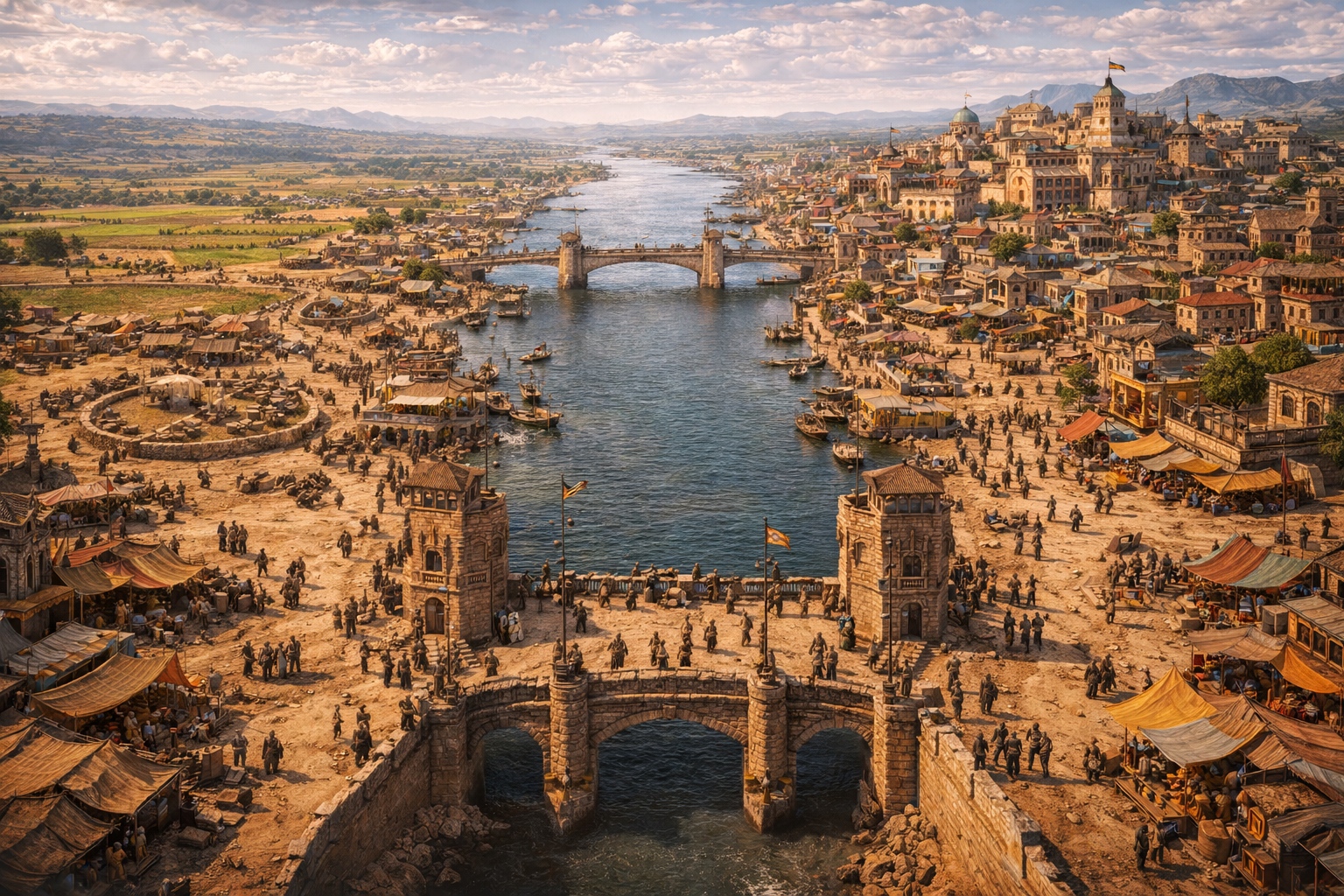
Nukwai is the only city in Funta where the river running through the middle is also the political border, and where neither side of that border pretends otherwise. Arriving from the west along the Volta trade corridor, you first reach the northern gate: solid, staffed, with Amina Tribe guards who check travel permissions and ask about your purpose with the unhurried thoroughness of people who have been told to be thorough. The north side behind them is agricultural Funta at its most organized: patchwork fields, livestock pens in the outer ring, workshops and houses in the inner district, and a market that smells of grain and fresh vegetables.
The bridges, there are three, are worth noting before you cross them. They are not particularly impressive structures, but they are heavily trafficked and watched from both ends. On the south side, the guards are private, better-equipped than the north side's civic militia, and dressed in house colors rather than tribal uniform. The south side's buildings are larger, newer-looking, and set on elevated ground with views across the river toward the north. The south considers itself a different kind of place. It is, at minimum, a differently governed one.
The Volta runs between the two halves with the indifference of a river. It does not take sides.
Geography & Setting
Nukwai sits in the Volta River basin at the edge of the Great Ennedi Desert's western reach, where the desert begins to give way to the semi-arid transitional land that the Volta's irrigation has made productive. The river is the city's primary geographic feature and, inevitably, its primary political metaphor. The north side occupies the original settlement ground: lower, flatter, agricultural. The south side developed later on elevated terrain across the river, attracting the wealthy who wanted the view and the autonomy that geographic separation made conceivable.
The desert is immediately east of the city. Trade routes cross through Nukwai in both directions: westward toward the coast and northward toward LaHale. The city's position on the Volta makes it a natural stop for river trade moving south from LaHale toward the coast.
The climate is arid, hot in summer, and subject to the desert wind that carries sand into everything not sheltered behind adequate walls. The river provides irrigation water for the agricultural land that feeds the city and supplies a meaningful surplus to LaHale and points south.
The People
Demographics
The north side's population is predominantly human, with the tribal composition of the original settlement: families who have been here for generations, organized around the Amina Tribe's authority structure and the agricultural economy. The north side is conservative, tight-knit, and organized in the way of communities whose survival depends on agricultural cooperation.
The south side is more diverse, attracting merchants, independent professionals, and wealthy individuals who have found that the south's quasi-autonomous status makes it more convenient for certain activities. The south has a higher proportion of Elves, Half-Elves, and races with Irna or Jazirah origin. It is cosmopolitan in the way that affluence tends to produce.
The bridges between the sides are the points of daily negotiation. Workers from the north commute to service jobs on the south. Merchants from the south buy agricultural goods from the north. Both sides understand that they need each other economically and resent the dependency.
Economy
The agricultural engine of the north feeds the city and generates the surplus that makes the trade corridor work. Crops (millet, sorghum, cowpeas) and livestock from the north's farms supply LaHale, Douhi, and points east. The river provides fish. The Volta trade corridor brings in goods from the coast and passes through goods headed inland.
The south side's economy is commercial rather than agricultural: trading, financial services, the accommodations and amenities that the wealthy merchant class requires. The south imports food from the north and exports money, which the north finds irritating on principle.
Primary Exports
- Agricultural goods: Grain, legumes, dried fish, livestock; the north's primary contribution to regional trade
- River trade facilitation: Nukwai's position on the Volta makes it a natural staging point for goods moving north-south along the river
Primary Imports
- Luxury goods: Irna cloth, Jazirah spices, skilled craftwork; primarily serving the south's wealthy population
- Finished goods and tools: Agricultural equipment, metal tools, building materials
Key Industries
- Amina Tribe Agricultural Holdings: The organized farming operations of the north; the city's food foundation
- The Volta River Trade: The logistics and commerce of goods moving through the city on the river route
- South Side Finance and Commerce: Merchant banking, trade brokering, and the service industry supporting the wealthy residential community
Food & Drink
Nukwai's food reflects its divided character. The north eats practically and well: fresh vegetables from the gardens, livestock meat, river fish, grain-based staples cooked with the regional spice combinations that the area's trade position has made available. The north's market food is honest and plentiful. The south eats ambitiously; the establishments serving the wealthy population source ingredients from across Funta and beyond, and the cooking reflects aspirations toward the Irna-influenced cuisine that the south's demographic associates with social advancement.
The two sides share one culinary tradition: the sorghum beer brewed on the north side is the best in the Volta basin and is consumed enthusiastically on both sides of the river, which is one of the few things both halves agree on.
Culture & Social Life
Nukwai's defining cultural fact is the division: acknowledged by both sides, explained differently by each, and structuring every aspect of social life. The north operates under chieftain authority and tribal social organization: clear hierarchies, collective obligations, and the expectation that individual welfare and community welfare are the same thing. The south operates under wealth-based social organization: status determined by economic position, individual property rights prioritized, and the expectation that personal success is its own justification.
Both sides claim to represent Funta's future. Both are partially right. The tension between them is creative in the way that genuine disagreements sometimes are.
Marriage between north and south exists and is complicated. The children of such unions navigate identity questions that both sides make more difficult than necessary. This community of bridge-crossers is the most interesting social development in Nukwai and the one that neither official side knows how to address.
Festivals & Traditions
The Volta Crossing
Once a year, in the dry season when the river is lowest, a traditional crossing is conducted on foot at the river's shallowest point, without the bridges. This is both a practical demonstration of the river's character and a symbolic acknowledgment that the two sides share a geography regardless of their political differences. Both sides participate. It is not friendly, exactly, but it is shared.
The Harvest Assembly
The north side's major annual celebration, marking the completion of the main harvest. The Chieftain presides. The south side is invited, attends at low levels, and leaves early. The north considers this typical. The south considers it an obligation they perform adequately.
Music & Arts
The north's musical tradition is Funtan and communal: drums, communal singing, music performed at gatherings and festivals as a collective practice. The south's musical preference runs to Irna-influenced performance traditions and the kind of skilled individual performance that wealthy audiences can hire for private events. The bridges occasionally host impromptu music that incorporates both traditions, which is where Nukwai's most interesting musical moments happen and which neither side officially sponsors.
Religion
Primary Faith
The north side's faith is largely animist, connected to the agricultural land and the river. The river itself is an object of reverence, not formally administered, but present in the seasonal ceremonies that mark planting, harvest, and flood. The Amina Tribe's faith includes a fire element that connects, at least aesthetically, to the Fire Swingers' practice, though the connection is cultural rather than institutional.
Hesira, deity of the hearth and domestic continuity, is the dominant private faith of the north side's agricultural families, the settled, generational households whose survival has always depended on the domestic cooperation that Hesira oversees. The north side's cultural emphasis on collective obligation and the understanding that "individual welfare and community welfare are the same thing" reflects Hesira's theology more than it reflects any other formal doctrine. In the older north-side neighborhoods, Hesira's household shrines outnumber all other religious observances combined.
Kraut, deity of abundance through cultivation and the sacred harvest, is honored at the Harvest Assembly (the north side's major annual celebration) and in the daily work of the farming families who have made the Volta basin's agricultural land productive. The north side's Amina Tribe Agricultural Holdings and its position as the food source for the entire divided city reflect Kraut's portfolio of fertility and earth-work. The south side's failure to attend the Harvest Assembly with genuine engagement is, in theological terms, a kind of impiety that the north side feels more than articulates.
Secondary / Minority Faiths
The south side's religious life is more heterogeneous. Irna-origin faiths have small temples or chapels in the wealthier residential areas. Zopha has a reading room and small shrine, partly because the south's wealthy population includes scholars and partly because Lahale's influence reaches here through the trade corridor.
Across both banks, Nesara is the obvious river-faith given formal shape: irrigation stewards, ferrymen, and those who remember floods by name. Caldrin is honored at the bridgeheads and in the caravan yards, where guest-right and safe passage are the town's real politics. On the south bank, Vessikar and Talbar both appear in merchant practice: honest measures when it is convenient, and a god's name invoked when it is not. Sylira thrives in the social competition between banks: rumor, reputation, and whose story becomes "true" first.
Anansi, deity of story and communal memory, is the patron of the bridge-crossing culture that has become Nukwai's most interesting social development, the growing community of mixed-heritage individuals who navigate both sides and who carry stories that neither official side knows how to address. The impromptu bridge music that combines north-side communal drumming with south-side Irna-influenced performance is Anansi's domain, as is the gossip and social negotiation that shapes the informal river economy neither side taxes or acknowledges. Where Sylira carries information for power, Anansi carries it for communal understanding.
Bridhel, deity of music, dance, and creative expression, watches over the bridge performances, described as "the most interesting musical moments" in Nukwai, where Funta communal tradition and Irna-influenced performance meet in improvised combination that neither the north nor the south officially sponsors. Bridhel's presence is felt most keenly in those moments between official cultures: the music that emerges when the bridges are full of people crossing in both directions and something unplanned happens. Bridhel's shrine, if one exists in Nukwai, would be at the central bridge.
Jula, deity of peace, measured reconciliation, and protection from violence, is invoked by those on both sides of the Volta who understand that the cold conflict between north and south cannot be sustained indefinitely without eventually producing genuine violence. Jula's followers among Nukwai's population (the bridge-crossers, intermarried families, and pragmatic merchants who profit from stability) pray for the cooperation that the Drought of the Volta demonstrated was possible and which peacetime politics cannot seem to sustain. The drought's water management agreement, still technically enforceable, is the closest thing Nukwai has to a Jula scripture.
Amaterasu, deity of light, life, renewal, and healing through illumination, appears in Nukwai through the north side's animist tradition, which "includes a fire element that connects, at least aesthetically, to the Fire Swingers' practice." Young Nia Amina's study "under the local Ash Priestess" names a clergy whose specific title references the ash of sacred fire, Amaterasu's domain of light and its ceremonial aftermath. For the north side's agricultural families, whose harvest depends on the seasonal return of warmth and whose Harvest Assembly marks the completion of the growing year, Amaterasu's cycle of renewal is embedded in the calendar they have maintained for generations.
Nyxollox, the gentle universal deity of death and peaceful transition, is present in Nukwai in the quiet, unorganized way of a divided city, with two sides that will not always cooperate, and the death rites of neither side fully recognized by the other. A city of eighteen thousand produces mortality that requires gentleness in its acknowledgment, and Nyxollox's practitioners move between the north's animist funeral traditions and the south's Irna-influenced observances without belonging entirely to either. The older north-side families whose ancestors are venerated in traditions that Chieftain Amina "officially discourages" maintain Nyxollox's gentle practice as the least contested dimension of ancestor connection: honoring the dead requires no political allegiance.
Thulgard, deity of community resilience, shared labor, and the collective strength of ordinary people, is the foundational spiritual influence behind the north side's agricultural culture, the organized cooperation that makes the Amina Tribe's "patchwork fields" and "livestock pens" function as the food system for the entire divided city. The understanding that "individual welfare and community welfare are the same thing," which defines the north side's social organization, is Thulgard's theology expressed as agricultural reality: the harvest that fails for one family threatens all of them, and so all of them work to prevent it. The Amina Tribe Guard's visible professionalism (loyal, consistent, designed to be "reliable rather than intimidating") applies Thulgard's protective covenant to civil law enforcement.
Lantha, deity of night, privacy, and the quiet work that happens in the dark, is the patron of Nukwai's most interesting informal institution: the unnamed Volta Broker, who "facilitates economic exchanges that neither side wants formally documented" and who is available "through intermediaries" but "never directly." The boat market operating "between the bridge pilings" persists because "neither side taxes it"; not publicly acknowledging it means it operates in the hours and channels invisible to official recognition, which is precisely Lantha's domain. The bridge-crossers who walk between sides at night and the caravan personnel sleeping between the two customs points are all practitioners of Lantha's tradition of essential work conducted in the privacy of darkness.
Secret or Forbidden Worship
There is a tradition of ancestor veneration in some of the north's older families that Chieftain Amina's tribal structure officially discourages as incompatible with proper law observance. It continues anyway. Amina knows about it and has decided that the political cost of suppressing it is higher than the practice warrants.
Amador, deity of love, desire, and the breaking of social boundaries through connection, is the patron saint of the bridge marriages that both sides make more difficult than necessary, the cross-bank romances that navigate identity questions about class, culture, and family loyalty simultaneously. The north's tribal values and the south's wealth-based hierarchy are precisely the kind of social prohibition that Amador dissolves through passion, and the community of bridge-crossers is quietly larger than either official side acknowledges. In a city where the political divide is also a cultural one, forbidden love is a minor political act, which is why it remains unspoken even among those who practice it.
History
Founding
Nukwai's founding community settled at the Volta crossing point for the obvious reasons: reliable water, agricultural land, and position on the trade route between the desert interior and the eastern coast. The original settlement on the north bank grew steadily. The south bank began as a seasonal camp for wealthy merchants who found the north bank's tribal regulations inconvenient, and the camp became permanent as the wealth concentrated there became sufficient to build on.
Key Events
The Great South Bank Claim (approx. 60 years before present)
The moment the south side formally declared itself autonomous (not through any political document, but through the construction of private guard posts at the south ends of the bridges and the installation of family crests on the major buildings) is when the current political arrangement crystallized. Chieftain Amina's predecessor challenged the declaration and was met with the argument that the south bank had never been formally claimed under tribal law and was therefore not subject to tribal governance. The legal dispute is technically unresolved. The practical situation is that the south side has its private guards and the north side has not yet found the moment to press the issue to a conclusion.
The Drought of the Volta (approx. 35 years before present)
A three-year period of low rainfall reduced the Volta's flow to a level that threatened the north side's agricultural irrigation and the south side's access to clean water simultaneously. The emergency required genuine cooperation: the north side's agricultural knowledge, the south side's financial resources, and joint management of the river's reduced output. The cooperation was effective. It did not produce lasting political goodwill, but it demonstrated that the two sides can work together when the alternative is both of them failing.
Current State
Nukwai is in a sustained low-level political tension that has been the city's defining condition for sixty years. Chieftain Amina governs the north effectively: her authority is unchallenged there, her enforcement is consistent, and the agricultural operation that sustains the region is well-managed. The south side continues its quasi-autonomous status, funding its private guard and maintaining its council of wealthy families who manage their affairs without reference to the Chieftain. The current flashpoint is an infrastructure project, a new bridge that the south wants to build at a location that would increase south side traffic without going through north-side customs. Amina has not approved the location. The south side has started preliminary work anyway.
Leadership & Governance
The Amina Tribe: Overview (North Side)
Chieftain Amina governs the north side under the tribal chieftain authority standard to Funta. Her word is law within her domain. She has zero tolerance for crime, consistent enforcement of her authority, and a clear vision for bridging the north-south divide, though her approach to that vision involves the south acknowledging her authority rather than working around it. She maintains a guard force sufficient to enforce the law in the north and to make the southern guards uncomfortable when they look across the bridge.
Chieftain Amina: Amina Tribe
Human, Female; forties
A striking woman who looks like what she is: a warrior-leader who has held authority through personal force and genuine competence for decades. Her skin is rich dark brown, marked with tribal scars that her family earned through generations. Her eyes are deep brown, almost black. She wears traditional Funta garments and battle-worn armor with equal confidence.
Amina is stern, fair, and clear-eyed about what Nukwai needs. She knows the south's autonomy is not legally grounded, but she also knows that legally ending it would require a confrontation that her current force cannot guarantee winning without Fire Swinger involvement, and the Fire Swingers are not in the business of settling internal Funta political disputes. Her strategy is patience and economic pressure: the north's agricultural production is the south's food source, and that dependency will eventually produce leverage.
Jengo: Chieftain Amina's Husband
Human, Male; forties
Jengo is the diplomatic dimension of Amina's leadership, the affable, strategically intelligent partner who manages the relationships that Amina's authority cannot. He comes from a trading family and understands the south side's commercial logic better than Amina does. He is also the parent who remains approachable to their three children while Amina provides the structure.
The South Side Council of Families
An informal governance body of the seven wealthiest families on the south bank. They make decisions collectively on the south side's infrastructure, guard funding, and external trade relationships. They do not have a formal leader; the family with the most at stake in any given decision tends to dominate it. They have been the effective government of the south side for sixty years and have no interest in changing this arrangement.
Guard & Militia
The Amina Tribe Guard (North Side): Approximately three hundred officers, organized by district and tribal affiliation. Professional by north side standards, loyal to the Chieftain, and specifically trained to be visible and reliable rather than intimidating. They wear tribal colors and carry standardized weapons.
South Side Private Guard: An amalgamation of the individual family guards, numbering approximately two hundred in total. Better equipment than the north, worse coordination. They operate by family contract rather than unified command. The arrangement works in the south's current political environment and would not work in an actual emergency.
Law & Order
The north side operates under Chieftain Amina's authority: the Laws of Funta in their chieftain-supremacy form, applied consistently and without exceptions for wealth. The south side operates under the informal code of wealthy community norms, enforced by family guards, with disputes handled by the Council of Families. Legal visitors from outside who misbehave on the south side are handled by the family whose property was affected; the outcome depends on which family that is.
Notable Figures
Tendaji: Amina's eldest child, future Chieftain
Human, Male; nineteen; north side administration
Tendaji is serious, strategic, and already demonstrating the leadership instincts his mother has been cultivating. He has a diplomatic touch that comes from his father and a warrior's directness from his mother. The south side's intelligence operation has been tracking his development with interest, which he is aware of.
Zuberi: Amina's second child
Human, Male; seventeen; junior officer in Amina's guard
Headstrong, fearless, and not yet refined enough to be fully trusted with the subtle situations his rank would normally put him in. Amina knows this and has been putting him in carefully calibrated experiences designed to produce the refinement. Zuberi is aware he is being developed. He considers this appropriate.
Nia: Amina's youngest child
Human, Female; fifteen; studying under the local Ash Priestess
Spiritual, wise, and a natural mediator, the quality that neither her mother nor her brother Tendaji quite has. Nia's interest in the spiritual traditions of the tribe has given her a relationship with the animist community that may become politically useful. She is not yet aware that this is how her mother thinks about it.
The Volta Broker: unnamed, south side
Half-Elf, gender presentation varies; the south side's bridge-adjacent commercial district
A figure known to both sides who facilitates economic exchanges that neither side wants formally documented. Universally described in terms that suggest physical unassumingness and a memory that does not forget details. Available through intermediaries, never directly. The Chieftain would like to know who this person is. The south side would like the Chieftain not to find out.
Key Locations
Seat of Power
- Amina's Hall, North Side: The chieftain's administrative center; a substantial building in the north side's central district; public sessions are held here; the Amina Tribe's artifacts and tribal markers are displayed at the entrance
Houses of Worship
- The River Shrine: At the north bank's edge, upstream of the bridges; the animist tradition's primary gathering point; not a building, but a designated area of river bank maintained for ceremony
- The Zopha Reading Room: South side; small; serves the commercially-minded scholarly community; also functions as neutral ground for negotiations that both sides are willing to attend
Inns & Taverns
- The Volta Bridge Inn: On the north side, adjacent to the central bridge; serves both sides' crossing traffic; the north side's best accommodation and the south side's second choice
- The Elevated Rest: South side; premium accommodations for the wealthy traveler; the view of the river and north side from its terrace is the establishment's primary selling point
Shops & Services
- The North Market: Open daily; primary commercial space for the north side; agricultural goods, livestock, fish, and craft items; the best place to buy food in Nukwai
- Amina's Enforced Weights: The north side's official measurement and quality standards service; visiting merchants are required to have their goods checked before selling in the north market
The Market
- The North Market: Daily, agricultural emphasis; the city's food economy center
- The South Commercial Exchange: Not a traditional market; a set of commercial premises on the south side where goods from the caravan trade are transacted at wholesale; does not operate regular market days
Other Points of Interest
- The Three Bridges: The physical connections between the two sides; each has a different character: the northern bridge is the workers' crossing, heavy traffic and practical; the central bridge is the commercial crossing, tolled; the southern bridge is the residential crossing, watched from the south's most prominent family compounds
- The Volta River (between the bridges): Not an attraction, but a presence; the river market that operates from small boats between the bridge pilings is the unofficial third economy of Nukwai; neither side taxes it because neither side wants to acknowledge it exists
Guilds & Organizations
- The Amina Tribe Council: The governing body of the north side; tribal elders and prominent family heads; formally advisory to the Chieftain, functionally her sounding board
- The Council of Families: The south side's informal governance; seven families, no formal leader; functions by consensus and economic leverage
The Criminal Element
Nukwai's criminal economy is concentrated at the interface between the two sides, the bridge-adjacent zones where neither side's authority is entirely clear. Smuggling between the sides (avoiding north side customs) is the primary activity. The Volta Broker facilitates the more sophisticated arrangements. There is also a modest trade in stolen agricultural goods that moves from north to south through channels the north side guard cannot adequately watch.
Secrets, Rumors & Hooks
- The south side's new bridge project has a location that was chosen not just for commercial convenience but for a specific strategic reason: it would place a bridge at the river's point where the north side's irrigation intake is located. Control of that bridge would give the south leverage over the north's agricultural water supply. Amina's engineers have noticed. Amina has not yet decided whether she believes it is deliberate.
- The Volta Broker is a member of a Nukwai family that has north side roots. The family knows. They have not told Chieftain Amina, who has been employing the Broker's services on the north side without knowing it.
- Zuberi's military training has produced a friendship with a south side guard who is his approximate age and who has been feeding him information about south side security arrangements. Neither of them has acknowledged that what they are doing has intelligence implications. Amina suspects the friendship and has not ended it.
- The Drought of the Volta's cooperation left behind a joint water management agreement that was documented at the time and filed in both sides' records. That agreement, if formally invoked, would give Chieftain Amina legal authority over water access on the south side in emergency conditions. The south side's lawyers have been examining whether the agreement can be dissolved. Amina has a copy in a locked case.
- There is a building on the south side that predates the south side's settlement: older than any other structure in the city, built in a construction technique that no current Nukwai craftsperson can identify. The south's wealthiest family uses it as a storage facility. They have not opened the lower level.