Pambuka
Pambuka: The City of Shallow Waters and Rising Tides
"In Pambuka, the water is not a barrier; it's the street, the market, the living space. Here, you learn to move with the tide or the tide moves without you."
Lira, Sea Elf educator and co-ruler
At a Glance
| Continent | Funta |
| Region / Province | South-central Funta, Tana Gulf coast |
| Settlement Type | Port Town |
| Population | ~5,200 |
| Dominant Races | Human, Sea Elf, Dwarf, Elf, Smaling |
| Ruler / Leader | Chieftain Sefu Oni |
| Ruling Body | The Oni Council (chieftain, spouse, advisors, merchant representatives) |
| Primary Deity | Ryujin (sea spirits), Nesara (freshwater/canals), Animist traditions |
| Economy | Shallow-water fishing, crustacean trade, agriculture, spellcaster training |
| Known For | Canals and waterways, sustainable crustacean practices, magical education, dragonfly-like boats |
First Impressions
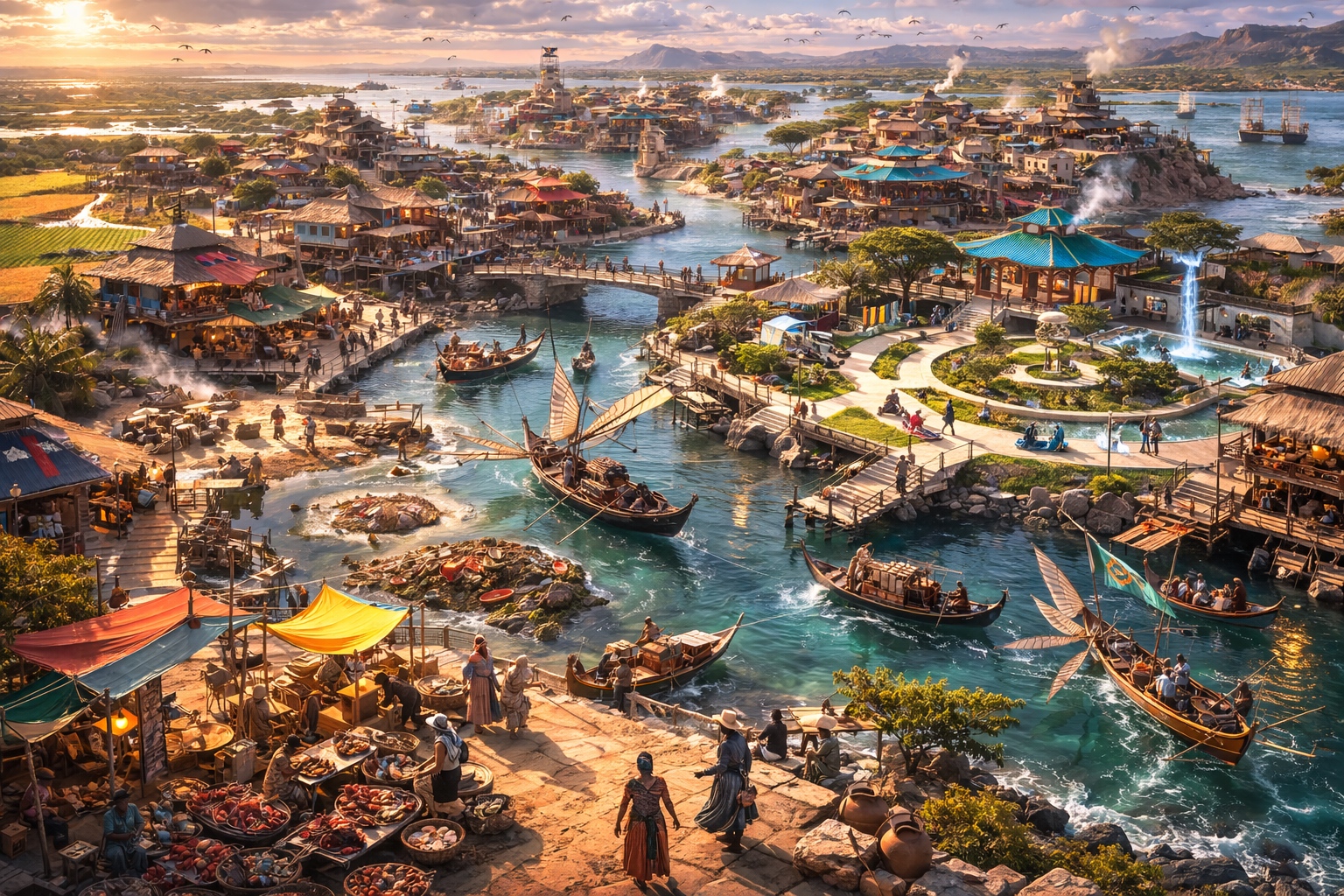
Pambuka announces itself through water before you see land. The Tana Gulf shallows as you approach, and the settlement reveals itself as a network of canals that weave through buildings like a city designed by water rather than inhabited near it. Boats are everywhere: fishing boats, shallow-draft cargo vessels, personal skiffs, even the occasional large raft that serves as a floating market or temporary structure.
The architecture is built around tidal management. Buildings are elevated on stilts or constructed on stone foundations that have channeled water through them for generations. Wooden walkways bridge the canals, and the most direct route from one location to another is often by water rather than land. The entire settlement moves to the rhythm of the tides: when water is high, boats navigate between buildings; when water is low, the exposed flats become impromptu markets and gathering places.
The dominant sound is water: lapping against wooden pilings, flowing through canals, the calls of boatmen navigating the channels, seagulls crying overhead. Children play in the shallow water during low tide and race boats during high tide. The smell is briny and organic: salt, fish, waterlogged wood, growing plants.
Pambuka's architecture is colorful and varied. Some buildings are whitewashed stone, others are timber-frame with painted panels. The wealthier districts upland have more permanent stone construction, while the waterfront is a mix of temporary and semi-permanent structures designed to flex with flooding and erosion. The most distinctive feature is the variety of boats; if Zouar worships ships, Pambuka loves boats in their multitude of forms.
Geography & Setting
Pambuka sits on the eastern coast of Funta, facing the Tana Gulf and the broad Andonia Sea beyond. The Tana Islands shelter the gulf from the worst open-ocean storms, creating a semi-protected maritime environment. The settlement itself sits on a dry coastal plateau of moderate elevation, but the unique characteristic is the extensive tidal mudflat system that extends from the coast inward.
The plateau itself is semi-arid, receiving regular rain but not enough to support large-scale agriculture without irrigation. This is why the canal system is so critical: it serves both for transportation and for bringing water inland to the agricultural fields that feed the settlement.
The tidal range in the Tana Gulf is significant (the difference between high and low tide can exceed six feet), which creates a dynamic environment. The same location can be water-navigable at high tide and a mudflat at low tide. This has driven the development of the canal system: what began as a practical necessity for managing water access has evolved into the defining feature of Pambukan architecture and culture.
The Tana Islands visible offshore are home to smaller settlements and are traded with regularly. The waters around Pambuka are rich in crustacean species and certain fish that prefer shallow water.
Climate is tropical coastal: warm year-round, with higher humidity than inland settlements. The rainy season brings intense afternoon storms but not sustained flooding, thanks to the excellent drainage provided by the natural canal system.
The People
Demographics
Pambuka's population is diverse. Humans form a slight majority, but Sea Elf are present in proportions higher than other Funta settlements, a legacy of Sefu Oni's marriage to Lira (Sea Elf) and the city's general acceptance and integration of them into community life. Dwarves are present in significant numbers due to the maritime trades, where their cultural affinity for construction and material management is valued. Elves, Smalings, and Gnomes are all represented in smaller numbers.
The presence of Lira's school for young spellcasters brings temporary residents, students and teachers of magical training who spend seasons in Pambuka. This creates a community that is somewhat more cosmopolitan and magically aware than other Funta port towns.
Economy
Pambuka's economy rests on three distinct pillars: shallow-water fishing (led by Gavric's Tana Trawlers), sustainable crustacean harvesting (Elysia's operation), and agricultural production (Thalindra's farms and orchards). A fourth pillar, the school for spellcasters, is growing in importance as it attracts coin from distant students and creates unique economic opportunities.
Primary Exports
- Shallow-water fish: Species that prefer the Tana Gulf's sheltered waters, preserved and traded throughout the coast
- Crustaceans: Crab and lobster, particularly notable for sustainable harvesting practices that command premium prices
- Agricultural staples: Cassava, papayas, and goat products, primarily serving regional markets
- Magical services: Spellcasting work performed by Lira's school graduates; consulting on water-based magic
Primary Imports
- Grains and staple carbohydrates: The local agriculture produces vegetables and protein, but grain supplements come from inland settlements
- Metalwork and maritime hardware: Iron, bronze, and specialty materials for boat building and maintenance
- Textiles and luxury goods: Colored cloth, fine clothing, and goods for the wealthy
- Timber: Specialty woods for boat construction; more available here than in Zouar but still imported from inland
Key Industries
-
Tana Trawlers: Run by Gavric Thundervein, a stout male Dwarf in his 60s. Specializes in designing and operating fishing boats optimized for shallow water. The boats are distinctive (lightweight, shallow-drafted, maneuverable) and respected throughout the coast. Gavric has ten active boats and a waiting list of clients wanting similar vessels. He is exacting about quality, slow to anger, and has the Dwarven trait of taking things personally. Losing a boat to a storm affects him for weeks.
-
Oni's Crustacean Cove: Run by Elysia, a Smaling female in her 40s, known for innovative approaches to sustainable harvesting. She has developed practices that maximize yield while preserving breeding populations: crab traps that release juveniles, rotational harvesting zones, and careful monitoring of water conditions. This approach costs more but allows her to command premium prices in distant markets where buyers value sustainability. Elysia is business-minded and interested in the ecological science behind her work.
-
Pambuka Produce: Managed by Thalindra, a female Elf of indeterminate age (appears late 40s/early 50s). She oversees the agricultural lands that feed Pambuka and produce export crops. The operation includes cassava fields, papaya orchards, and significant goat herding. Thalindra is nurturing but firm, treating her employees and the land with equal care. She is building toward developing an irrigation system that would expand productive capacity.
-
The Spellcaster School: Lira's personal project, operating from dedicated facilities near the canals. The school accepts students for seasonal and longer-term training in water-based magic, elemental theory, and practical spellcraft. It employs five permanent instructors and dozens of student-assistants. The school generates significant income from tuition and also creates a cultural atmosphere of magical interest that influences the city's values.
Food & Drink
Pambuka's cuisine is water-forward, emphasizing fish and crustaceans in various preparations. The signature dish is a crab and cassava stew, served with fermented vegetables and plantain. Fresh crustaceans are boiled, grilled, or made into broths. Papaya is eaten fresh when in season and dried when not.
Fermented milk products are imported and expensive but available. The local drink is a ginger-forward tea made from ingredients both local and imported, served cold in the hot season.
The school has influenced food culture; there is a particular type of simple but carefully prepared food valued by scholars and practiced by inns catering to students.
Culture & Social Life
Pambuka's culture emphasizes adaptability and flow. The necessity of living with water (navigating canals, managing tides, building structures that flex with seasonal changes) has created a philosophy that values flexibility, lateral thinking, and accepting what cannot be directly controlled.
There is also a strong value placed on knowledge and education. Lira's school has elevated the status of learning in the community, and magical knowledge is viewed as a form of wealth and social advancement. Families with resources often send a child to the school for a season, whether or not the child shows particular magical talent.
Music and dance are central to social life, with heavy emphasis on rhythm and water-themed symbolism. The call and response pattern common in Funta is adapted here with water-themed vocals and percussion that mimics falling water or lapping waves.
Festivals & Traditions
The Tidal Festival
Celebrated at the spring equinox, when the tidal range is at its most extreme, the Tidal Festival marks the year's beginning in Pambukan tradition. The festival includes boat races on the high tide, the blessing of boats and fishing equipment, communal feasts featuring the season's catch, and the formal opening of Lira's school for new students. Stories about famous tides and the legendary shipwrights are told and retold.
The Calm-Water Days
A four-day festival celebrated in mid-year, marking a period of historically calm seas. The festival includes the showcase of new boats and maritime innovations, the Crustacean Market (where Elysia displays her finest catches and sustainable practices), and the Spellcasting Demonstrations (where Lira's students demonstrate their progress). The festival is partly celebration, partly competition, partly marketplace.
Low-Tide Remembrance
Held at the autumn equinox, this is a more solemn festival honoring the water spirits and the dangers of the sea. It acknowledges the lives lost to maritime accidents, celebrates survival, and includes offerings to Ryujin. Families gather at the canals with offerings of fruit, grain, and symbolic items cast into the water.
Music & Arts
The dominant musical tradition emphasizes water sounds: percussion designed to mimic rainfall and flowing water, along with stringed instruments that are tuned to resonant frequencies. The musical tradition is sophisticated and somewhat scholarly, influenced by Lira's presence.
Visual arts center on boat design and decoration. Individual boats are treated as art projects, with distinctive paint schemes and carved elements that identify their owners and sometimes tell stories. The canals themselves are considered a canvas for urban design and artistic infrastructure.
There is also a strong literary tradition; Pambuka hosts writers and scholars, and the school has produced several documented magical theories and practical guides that are distributed to other settlements.
Religion
Primary Faith
Ryujin, the sea spirit deity, is the primary religious focus in Pambuka. Temples and shrines dedicated to Ryujin are present throughout the settlement, and offerings to the sea are made regularly. The belief is that Ryujin's moods determine the safety and prosperity of the fishing and crustacean trades.
Animist traditions also run strong, with particular reverence for water spirits of the canals, tidal spirits, and the spirits of individual locations (specific canals, important intersections, notable structures). Each canal has a smaller shrine maintained communally.
Sefu Oni honors both traditions, making offerings to Ryujin while also participating in the animist ceremonies. His partnership with Lira (a Sea Elf with inherent magical affinity for water) is seen as a blessing from the water spirits.
Nesara, deity of freshwater rivers, canals, and irrigation, is the spiritual patron of Pambuka's defining infrastructure, the canal system that both provides transportation and carries fresh water to the agricultural fields that feed the settlement. The canal shrines distributed throughout the settlement are, in their essentials, Nesara shrines: each honoring the specific water spirit of that channel in the Funta animist tradition, but drawing from the same theological well as Nesara's more formalized worship. The irrigation stewards who manage water distribution to the farms, the practical people who know which canal gate opens which field, are among the most devoted practitioners, understanding viscerally that Nesara's blessing determines whether the dry season starves the fields.
Secondary Faiths
Echo (stability and fairness) has followers among the merchant class and the school: the civic side of Pambuka that wants rules, calm markets, and canals that keep working. Caminus (craft) is honored by boat builders and artisans, as the forge and fire are essential to their work.
Zopha (knowledge) has gained prominence since Lira's school was established. Many students of the school honor Zopha as the deity of magical knowledge, and Lira herself directs offerings to Zopha for wisdom in teaching.
Hesira, deity of the hearth and domestic life, is honored in Pambuka's household culture, a city whose philosophy of "adaptability and flow" applies to domestic structures as much as to the tides. Sefu Oni's governance specifically includes the welfare of individuals and the flourishing of families as stated goals, which is Hesira's theology expressed in political terms. The strength of family identity visible in the Oni household, and the communal care visible in the mediation-first legal culture, both reflect Hesira's influence on how the city defines good living.
Jusannia, deity of femininity, life, and generative power, has strong quiet presence in Pambuka given the city's prominent women: Lira Oni (co-ruler, educator, and the settlement's magical authority), Thalindra (farm manager), Elysia (crustacean enterprise), and Zola (security advisor). The school for spellcasters has elevated the status of women's knowledge specifically, and Jusannia is honored by midwives, healers, and mothers throughout the settlement in the near-universal manner of settled communities. When Lira's pregnancy is eventually announced, the specific Jusannia ceremonies welcoming new life will mark it as both a personal and civic event.
Anansi, deity of story and communal memory, is present in Pambuka's water-themed musical tradition, the call-and-response pattern common in Funta adapted here with wave-vocals and percussion mimicking falling water. The literary tradition that Lira's school has fostered, the written magical theories and practical guides that students distribute to other settlements, and the strong storytelling culture of the maritime community all belong to Anansi's domain. A fishing culture that tells stories about famous tides and legendary catches is doing Anansi's work whether the deity's name is invoked or not.
Dolen, deity of longing and the sorrow of separation, is the patron of port families whose members are away at sea or at distant settlements for seasons at a time, and of the students who come to Lira's school from far places, carrying homesickness alongside their magical potential. The Low-Tide Remembrance ceremony, which honors lives lost to maritime accidents, is also a Dolen ceremony: the grief of separation made permanent, the families who wait for boats that did not return. The boat-decoration tradition, treating each vessel as an art project with a distinctive paint scheme, is exactly the kind of domestic-adjacent craft Dolen oversees.
Nyxollox, the gentle universal deity of death and peaceful transition, is honored through the Shipwreck Markers monument maintained at the Ryujin Temple, a listing of "boats lost to storms and accidents" visited by "families who lost members to maritime incidents." The Low-Tide Remembrance ceremony at the autumn equinox, which "honors lives lost to maritime accidents, celebrates survival, and includes offerings to Ryujin," is a shared Ryujin-Nyxollox observance: Ryujin receives the maritime deaths as part of the sea's accounting, and Nyxollox receives the acknowledgment that those lives have made a transition rather than simply been lost. In a settlement where the sea's danger is made visible in the monument on the temple wall, Nyxollox's gentle presence alongside Ryujin is theological rather than competitive; they govern adjacent domains that maritime communities must honor simultaneously.
Lantha, deity of the moon, night, and coastal navigation in darkness, is honored by Pambuka's fishing and maritime community for the practical reason that tides do not schedule themselves for daylight hours. The Lighthouse of Sefu at the harbor's edge, "lit during storms and at night to help guide boats safely into harbor", is the most visible Lantha institution in the settlement, maintained "communally" in exactly the way Lantha's universally practical worship tends to operate. The Tidal Observation Platform, which community members use to "read the tidal range" at its extremes, requires night observation when the tidal cycle reaches its most significant points, and the canal system's navigability at various water levels must be understood in the dark as well as the light.
Bridhel, deity of music, dance, poetry, and creative inspiration, is present throughout Pambuka's social life in the specific form the file describes: "music and dance are central to social life, with heavy emphasis on rhythm and water-themed symbolism," practiced as communal expression rather than professional performance. The call-and-response pattern, the percussion that "mimics falling water or lapping waves," and the sophisticated musical tradition that Lira's scholarly presence has influenced, elevating it without displacing its communal roots, are all Bridhel's domain. At the Tidal Festival and Calm-Water Days celebrations, the music that accompanies boat races and spellcasting demonstrations is not incidental to the occasion but constitutive of it: Bridhel's presence in the festival is inseparable from the festival's meaning.
Secret or Forbidden Worship
There is a minor underground tradition honoring the darker aspects of water: drowning, dissolution, the sea's capacity to destroy. It remains secret because it contradicts the community's values around water as life-giving and manageable. The group is small (fewer than ten adherents) and closely watched by community authorities.
Mamaxa, deity of controlled suffering and discipline through hidden power, has a small clandestine presence in the informal social hierarchies of the spellcaster school: the networks of status, mentorship, and influence that exist among those who work with magical power and who understand that some authority operates most effectively when unspoken. This is not worship in any formal sense but a recognition that the dynamics Mamaxa governs are present wherever power concentrates among people who cannot fully acknowledge it openly. The school's growth has intensified these dynamics as advanced students jockey for permanent positions and access to Lira's most closely held knowledge.
History
Founding
Pambuka was established approximately 350 years ago as a seasonal fishing camp by river traders who recognized the tidal mudflats' richness in crustacean species. The settlement gradually became permanent as the economic advantages of the location became clear. The original canal system was purely functional (channels dug to improve drainage and water access), but over centuries evolved into the distinctive system that now defines the city.
Key Events
The Construction of the Grand Canal System
Two centuries ago, the chieftain of the time commissioned the expansion and formalization of the canal system. What had been organic development became engineered infrastructure. This project took thirty years, cost significant resources, and transformed Pambuka from a functional settlement into a architecturally distinctive city. The Grand Canal (the main artery) was dedicated with ceremony, and sections of the system are still referred to by the names of the original overseers.
The Arrival of Lira and the School
Sefu Oni's marriage to Lira was a political alliance between Pambuka and a Sea Elf diplomatic family from a neighboring region. Lira brought with her knowledge of water-based magic and a vision for formal education. The establishment of the school (now 25 years old) has been economically transformative and has given Pambuka a cultural identity beyond fishing and agriculture.
The Sustainable Harvesting Innovation
Fifteen years ago, Elysia developed and began implementing the sustainable crustacean practices that have become her hallmark. This was initially viewed skeptically by other harvesters, but the premium prices her products command have made it the industry standard. The transition required a cultural shift toward viewing the crustacean resource as something to preserve, not merely exploit.
Current State
Pambuka is prosperous and growing. The three traditional economic pillars are stable, the school is expanding, and the settlement is attracting interest from distant traders and scholars. There is some tension between the traditional maritime community and the newer school-based intellectual elite, but the two are beginning to integrate. The city faces questions about managing growth without losing the distinctive character that makes it valuable.
Leadership & Governance
The Oni Council: Overview
Sefu Oni holds chieftain authority as is traditional for Funta, but his governance style is explicitly collaborative. He has formed the Oni Council, which includes himself, Lira (as co-ruler and educational leader), Varian Wyrmbane (military and naval advisor), and rotating representatives from the three major business operations. Decisions of significant scope are made in council, with Sefu's word being final if consensus cannot be reached.
This collaborative style is unusual for Funta but has become accepted because it works and produces good outcomes for the settlement. Sefu's legitimacy is high because people see that collaborative decision-making has created prosperity.
Chieftain Sefu Oni
Human, Male; mid-50s
Sefu is a striking figure: dark brown skin, eyes that shift color depending on light (described as mirroring the sky by those poetically inclined), and a bearing that suggests both competence and genuine ease with power. He wears simple clothing despite his status, and his manner is accessible without being casual.
Personality: Sefu is wise but not distant, compassionate but not sentimental. He makes decisions quickly when information is available but is patient with uncertainty. He is interested in the views of his council and takes their input seriously. He is known for changing his mind when presented with good reasoning.
Motivation: Sefu wants Pambuka to be a place where people flourish: where maritime traditions continue, where learning is valued, where the cooperation between different communities creates something stronger than any single group. His marriage to Lira is both personal and political, but he genuinely values her perspective and considers her a full partner in governance.
Known For: His ability to balance tradition with innovation, his fairness in disputes, and his genuine interest in the welfare of individuals in his settlement. He is respected as a leader of substance.
Lira Oni
Sea Elf, Female; late 40s
Sefu's wife, Lira is a distinctive figure in Funta. Sea Elf are not unknown on the continent, but they are rare, and Lira's assumption of significant authority through marriage is unusual. However, her intelligence, her magical knowledge, and her genuine investment in Pambuka's welfare have won community acceptance.
Personality: Lira is scholarly, thoughtful, and interested in education as a path to advancement and personal growth. She is warm but maintains professional boundaries. She is less comfortable with direct governance than Sefu but is increasingly involved in shaping the settlement's values and direction.
Motivation: Lira's primary motivation is the school and the advancement of magical knowledge and education. She views herself as serving the community through teaching and sees Pambuka as having potential to become a center of learning.
Her relationship with Sefu is genuine partnership. They discuss major decisions together, and her influence on Sefu's thinking is significant, though she is careful to defer final authority to him as the formal chieftain.
Varian Wyrmbane
Drakin, Male; age indeterminate (appears 50s-60s range)
Sefu's military advisor and skilled navigator, Varian serves as commander of Pambuka's modest maritime defense forces and is consulted on all matters relating to security and warfare. He is wise in the ways of naval tactics and has trained Pambuka's defenders effectively.
Varian is quiet but his presence is commanding. He is respected for his competence and his restraint; he does not look for conflict but is prepared for it. He and Sefu have a relationship of long-standing trust.
Zola
Felair, Female; mid-30s
Sefu's personal bodyguard and close companion. Zola is fearless, skilled at combat, and has the Felair natural affinity for movement and navigation. She is protective of Sefu and his family and is known for her attention to detail and her willingness to think creatively about security problems.
Zola is less involved in governance than other advisors but is often present at council meetings and has gradually taken on an informal role as observer and occasional consultant on matters relating to internal security.
Guard & Militia
Pambuka maintains a force of approximately 40 fighters organized into harbor patrol, settlement patrol, and rapid response groups. They are trained by Varian and are semi-professional: some full-time, some called up seasonally. They are effective but are oriented toward local security rather than serious warfare.
Law & Order
Sefu's authority is absolute, but his justice is measured and fair. Disputes are brought before him or the council. Serious crimes are punished with fines, labor, or exile. The settlement is small enough that reputation matters enormously, and public shame is often sufficient punishment for lesser offenses.
There is a cultural emphasis on mediation and reconciliation; punishment is seen as a last resort. Sefu personally mediates disputes when they involve significant community members or sensitive issues.
Notable Figures
Gavric Thundervein: Owner, Tana Trawlers
Dwarf, Male; early 60s
Location: Boatyard near the central market, or aboard one of his fishing vessels
Gavric is a legendary craftsperson whose shallow-draft boats are the reason Pambuka's fishing industry is so successful. He is a genuine genius at understanding water dynamics and boat design, but he is also exacting, proud, and capable of holding grudges.
Personality: Gruff, direct, with zero patience for incompetence or dishonesty. He drinks heavily in the evenings and is known for getting philosophical and occasionally maudlin when drinking. He is fiercely proud of his work and takes any damage to his boats personally.
What He Wants: To create one masterwork boat, his final major design that will represent the culmination of his understanding of the craft. He is nearing the end of his career and wants to leave something that will define his legacy.
What He Knows: Everything about boat building, water dynamics, the Tana Gulf's conditions, and the maritime trades. He is also rumored to know about pirate activity in the gulf and to have contacts with other maritime settlements across the coast.
Elysia Crustacean Harvester: Owner, Oni's Crustacean Cove
Smaling, Female; mid-40s
Location: The Cove (harvesting operation on the northeastern mudflats), or the market district
Elysia is a businesswoman and an ecological thinker who has built a business on the principle that sustainable practices are more profitable than exploitative ones. She is calm, methodical, and interested in the science behind her work.
Personality: Thoughtful, patient, detail-oriented. She does not make quick decisions but once she decides, she commits fully. She is collaborative with her employees and has low turnover in her operation. She is less comfortable in social settings than business settings but is improving.
What She Wants: To expand her sustainable practices across the gulf, potentially creating a network of harvesters using her methods. This would require training and some capital investment, but she believes it is possible.
What She Knows: The population dynamics of crustacean species, the ecological health of the gulf, the sustainable yield of different harvest areas, and the premium price markets that value her practices. She also knows that some harvesters resent her success and would like to see her fail.
Thalindra Farm Manager: Owner, Pambuka Produce
Elf, Female; appears late 40s/early 50s (actual age unknown)
Location: Fields inland from the settlement, or the market district
Thalindra manages the agricultural operations that feed Pambuka and produce export crops. She is a deeply competent farm manager with genuine affection for both the land and the people who work it. She is building toward expanding production through irrigation innovation.
Personality: Nurturing but firm, with a dry sense of humor. She is observant about people and is trusted by her employees. She thinks long-term and is patient with projects that take years to complete. She is less politically engaged than other business leaders but has the implicit support of Sefu.
What She Wants: To develop an expanded irrigation system that would double productive capacity without straining the water resources. This is ambitious and requires capital investment and coordination with the water management councils. She has Sefu's initial support but needs to build broader backing.
What She Knows: The agricultural capacity of the region, the soil conditions, water needs, crop rotation, the capabilities of her workers, and the market demand for various products. She is also quietly concerned about climate patterns shifting in ways that could affect long-term productivity.
Nalu Oni: Chieftain's Son, Marine Biology Enthusiast
Human, Male; late teens/early 20s
Location: Various locations around the Tana Gulf, often at Lira's school
Sefu's human son is developing a reputation as a marine scientist, more interested in understanding the creatures of the gulf than in traditional governance or trade. He is studying under Lira's guidance and is beginning to conduct independent research.
What He Wants: To understand the gulf's ecology comprehensively and potentially develop practices that support both commerce and ecological health. He is idealistic about creating a model for sustainable use of marine resources.
What He Knows: The species present in the gulf, their behaviors, their ecological relationships, and the ways that human activity affects them. He is also the only person systematically recording information about changes in the gulf over time.
Mira Oni: Chieftain's Daughter, Water Magic Talent
Sea Elf, Female; mid-teens
Location: Lira's school, the canals, occasionally at the temples
Sefu's Sea Elf daughter has inherited her mother's magical affinity and is showing remarkable talent for water-based magic. She is a student of Lira's school and is becoming close with several of the permanent instructors. She is young but already demonstrates serious commitment to learning.
What She Wants: To become a master of water magic and potentially to teach alongside her mother. She is ambitious and talented, and the combination is notable.
What She Knows: Water magic basics, the theory behind various spellcasting approaches, and the politics of the school. She also knows that her position as the chieftain's daughter creates expectations that sometimes feel constraining.
Key Locations
Seat of Power
- Oni Estate: A substantial stone structure built on the highest point of the settlement, overlooking the canals and the harbor. It serves as Sefu's residence, the administrative center for the settlement, and the meeting place for the Oni Council. The estate includes gardens, water features (showing Lira's influence), and dedicated spaces for school-related activities. It is designed to be accessible to the community while maintaining the necessary separation for governance.
Houses of Worship
-
The Ryujin Temple: The largest religious structure in Pambuka, dedicated to the sea deity. It sits at the junction of the Grand Canal and the harbor, with a design that allows tidal water to flow through ritual areas. The temple is managed by a priesthood of three (rotating among community members and Lira-trained priests). Regular ceremonies are held at tidal changes and during festivals.
-
The Canal Shrines: Numerous small shrines distributed throughout the settlement's canal system, each dedicated to local water spirits. These are maintained communally and serve as focus points for individual and family religious practice. The shrines are simple but well-maintained.
-
The School of Magic: While not exclusively a religious space, Lira's school has a meditation area and orientation toward spiritual development that makes it quasi-religious. Students practice water meditation and engage with the spiritual dimensions of magic.
Inns & Taverns
-
The Shallow Draft: The primary tavern in Pambuka, located near the central market. It is a gathering place for the maritime community and is where most significant business discussions occur. The owner, a Human named Kastor, keeps an excellent establishment and knows everyone in the settlement. The food is good and the drink is reliable.
-
The Scholar's Rest: A quieter establishment near Lira's school, favored by students, teachers, and the more intellectually oriented residents. It serves tea, fermented grain drinks, and simple but carefully prepared food. It has the atmosphere of a place where thinking happens.
Shops & Services
-
Tana Trawlers Workshop: Gavric's boat-building facility, located near the central harbor. Various boats are in different stages of construction or repair. The workshop is impressive and intimidating; Gavric is fiercely protective of his space and tolerates visitors only if they have legitimate business.
-
Oni's Crustacean Cove Market Stall: Located in the central market, this displays Elysia's current harvest and processed crustacean products. Elysia or her representatives are present during market hours, and she is happy to discuss her sustainable practices with interested customers.
-
Pambuka Produce Market Station: Thalindra's display and sale location for agricultural products. Seasonal goods are rotated, and there is always a supply of cassava, papayas, and preserved vegetables. Thalindra is occasionally present and will discuss farming practices with genuine interest.
-
The School of Magic: Located in a dedicated multi-story structure with classrooms, meditation spaces, residential quarters, and a working library. Lira oversees the operation, and the school is open to students on a seasonal or longer-term basis. Tuition is based on ability to pay, making it accessible to non-wealthy students.
The Market
- Central Market Square: The heart of Pambuka's commerce, located at the intersection of multiple canals. Stalls and semi-permanent shops offer fish, crustaceans, agricultural products, textiles, tools, and goods from distant settlements. The market is busiest at mid-tide when boats can navigate the canals easily. Calm-Water Days transforms the market into a festival atmosphere with competitions and demonstrations.
Other Points of Interest
-
The Tidal Observation Platform: A public structure built at a location where the tidal range is clearly visible. It serves as both a functional reference point for reading tides and a gathering place where people watch the water and observe the patterns. It is particularly active during the Calm-Water Days festival.
-
The Boat-Racing Canal: A section of the waterway that has been widened and marked as the traditional location for boat races during festivals. It is lined with structures that serve as viewing areas during racing events.
-
The Gardens of Reflection: A semi-public area maintained by the school where water flows through carved channels and pools. It serves as a meditation and teaching space and is accessible to the community. The gardens are considered beautiful and are maintained with care.
-
The Lighthouse of Sefu: A navigational structure at the harbor's edge, maintained communally. It is named for the current chieftain and is lit during storms and at night to help guide boats safely into harbor.
-
The Shipwreck Markers: A monument listing the names of boats lost to storms and accidents, maintained at the Ryujin Temple. It is a somber reminder of the sea's power and is visited by families who lost members to maritime incidents.
Secrets, Rumors & Hooks
-
Gavric is aging and has no obvious successor. His boat-building techniques are largely in his head; he has attempted to teach apprentices, but none have matched his understanding. If Gavric dies or becomes unable to work, the loss of his design knowledge could damage Pambuka's maritime competitiveness significantly. There is quiet concern about succession planning.
-
Nalu's marine biology research is documenting significant changes in the gulf's crustacean populations. Some species are declining, others are appearing in unusual numbers, and the patterns suggest something has changed in the gulf's conditions. Nalu has not yet shared this with his parents or with Elysia, but when the data becomes public, it could have serious implications for the crustacean trade.
-
There are rumors of a pirate operation organizing in the offshore islands, planning systematic raids on merchant vessels in the Tana Gulf. Varian has heard these rumors and is recommending increased defenses, but Sefu is hesitant to commit resources without clearer intelligence. There is tension between the desire for economic openness and the need for maritime security.
-
Lira is pregnant. The pregnancy is in early stages and has not been publicly announced, but it is known to Sefu, the family, and a few trusted advisors. If the child is viable, it will have both human and Sea Elf heritage, which could have cultural and political significance.
-
The school is growing rapidly, and there are questions about whether Lira can manage the expansion alone. Several of her advanced students are interested in becoming permanent instructors, but formalizing their status and compensation would require significant resource commitment. Lira is also receiving interest from distant magical practitioners who want to affiliate with the school, which could transform its character.
-
There is a minor philosophical tension between Elysia's sustainable practices and the traditional harvesters' desire to maximize short-term profit. Some of the traditional harvesters resent that Elysia's practices command premium prices while theirs do not, and there is subtle pressure to undermine her reputation or operations. Elysia is aware of this and is strategically building alliances.