Sekimo
Sekimo: Jewel of the Mountain Markets
A town is not made by walls or rulers, but by people who choose to be fair with one another.
Mayor Kofi
At a Glance
| Continent | Funta |
| Region / Province | Eastern Funta, Greater Karoo Mountains |
| Settlement Type | Town |
| Population | ~2,800 |
| Dominant Races | Human, Elf, Half-Elf |
| Ruler / Leader | Mayor Kofi (elected) |
| Ruling Body | Mayor & Town Council (5 elected officials) |
| Primary Deity | Caminus (Craft), Echo (Community), Thulgard (Collective Resilience), Bridhel (Music & Arts), Animist (Earth) |
| Economy | Trade, Agriculture, Artisanry, Forestry |
| Known For | Weekly Forest Faire market; botanical gardens; elected governance |
First Impressions
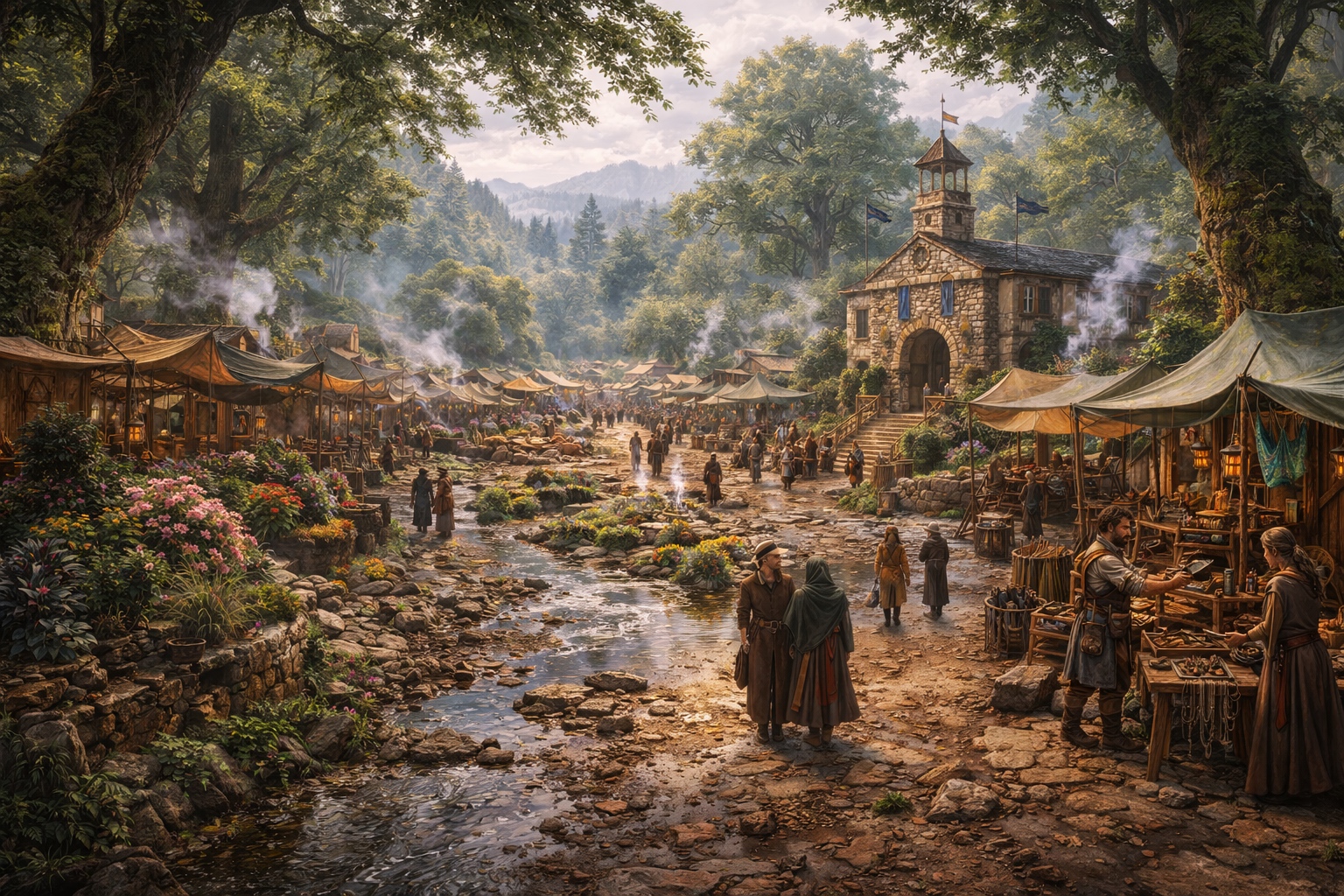
Sekimo emerges from the mountain forest like a secret the woodland shares reluctantly. The approach is green; ancient trees frame winding paths that slope downward into a valley where smoke rises from cookfires and torches glow warmly as evening falls. Unlike the imposing coastal city of Koma or the bustling desert gateway of Tafunzi, Sekimo feels unhurried and intimate, a place where people nod to strangers.
The town center clusters around a market square shaded by enormous trees and open-air structures. The architecture is practical rather than grand: buildings of stone and heavy timber frame with thatched roofs, designed to shed the region's frequent rains. Gardens spill from every corner: vegetable plots, herb gardens, flowering plants in carefully tended rows. The effect is less city than overgrown village, yet with evident order and investment.
The people are visibly prosperous without ostentation. Unlike Koma's color-based class markers, Sekimo's residents dress functionally in sturdy fabrics, their status signaled more by the tools they carry (fine carpentry tools, well-made trade goods, the embroidered belts of guild members) than by elaborate garments. There is a friendliness that seems genuine rather than calculated for profit. Merchants smile at travelers, children play openly in the streets, and the sound of music drifts from various establishments.
For a settlement of only 2,800 souls in tribal Funta, Sekimo is remarkably egalitarian. Visitors quickly sense that something is different here, that the normal hierarchy of chief-and-commoner has been bent into something else.
Geography & Setting
Sekimo sits in a forested mountain valley at moderate elevation (approximately 800-1,100 meters), on the western slope of the Greater Karoo Mountains. The Bubi River, a major tributary feeding the larger Bubi system, runs through the valley, providing fresh water, power for mills, and a transport route for goods.
The climate is humid temperate with significant rainfall, especially in the warmer months. The valley floor is fertile, supporting both food crops and extensive gardens. The surrounding forest is dense with both deciduous and evergreen trees, creating a landscape of perpetual greenery. Lumber is a significant resource, though Sekimo's population and economy are too small to match the Zumbal Forest operations of Koma.
The valley opens to the south and west; to the north and east, the mountains rise steeply. There is only one major pass through the mountains (to the northeast), making Sekimo somewhat isolated but secure from large-scale military assault. The isolation, however, is intentional; the founders deliberately chose a location that was defensible and remote enough to remain independent from the more aggressive western chieftains.
The botanical garden sits on a high terrace on the settlement's eastern edge, overlooking the valley, combining practical cultivation with aesthetic design.
The People
Demographics
Sekimo's population is small (approximately 2,800) but remarkably stable and intentionally managed. Most residents are long-term inhabitants; immigration is not discouraged but is not actively promoted. The population is ethnically mixed: humans comprise about 60%, Elves about 20%, Half-Elves about 12%, with scattered Smalings, Gnomes, and other races making up the remainder.
The population skews older than Koma's, with a significant proportion of residents over 40. This reflects the town's stability and the tendency of successful artisans and merchants to settle permanently rather than chase fortune elsewhere. The birth rate is moderate; growth is slow and controlled through informal consensus rather than enforced policy.
Economy
Sekimo's economy is diversified and intentionally structured to support a broad population without creating extreme inequality. This reflects Mayor Kofi's philosophy and the three guild systems that regulate major industries.
Primary Exports
- Crafted Goods: Pottery, wooden items, metalwork, textiles, and jewelry produced by Artisans Guild members. These goods are high-quality and command good prices in regional markets.
- Agricultural Products: Grains (millet, sorghum, fonio), vegetables, fruits, and preserved goods from the Farmers Guild. The mountain region's cool nights produce particularly flavorful produce.
- Medicinal Herbs & Botanicals: The garden cultivates rare plants, medicinal herbs, and seeds for regional distribution. Some are exported to LaHale's scholars and herbalists in distant cities.
- Forest Products: Sustainable timber, charcoal, and wood-based goods from local forests. Logging is carefully managed to prevent deforestation.
Primary Imports
- Iron & Metalwork: Raw iron and finished metal goods from Dwarf settlements, used to supply local metalworkers.
- Sea Products: Dried fish and salt from coastal settlements, providing protein and preservative for the inland population.
- Luxury Goods & Spices: Goods from Jazirah and Irna, channeled through regional trade routes. These are less abundant and more expensive than in Koma, creating a more modest material culture.
Key Industries
- Artisanry: The Artisans Guild regulates and supports craftspeople: woodworkers, potters, metalworkers, weavers, and jewelers. Quality is enforced; prices are fair. The guild operates a training program for apprentices.
- Agriculture: The Farmers Guild manages farming practices, storage, distribution, and trade. The guild negotiates prices collectively and prevents individual farmers from undercutting each other.
- Mercantile Trade: The Merchants Guild oversees trade both within the town and with external partners. The guild enforces fair dealing and prevents fraud. Unlike Koma's competitive mercantile chaos, trade here is more orderly and regulated.
- Forestry: Small-scale timber operations and charcoal production, managed sustainably by local workers and guild oversight.
- Gardening & Horticulture: The botanical garden employs a staff of gardeners and maintains extensive plantings for medicinal, culinary, and aesthetic purposes.
Food & Drink
Sekimo's cuisine emphasizes local, fresh ingredients: grains, vegetables, legumes, and occasional goat or chicken. Fish is less abundant than in coastal Koma; freshwater fish from the Bubi River provide occasional protein. Preserved foods and fermented milk products are important year-round. The town is known for excellent bread, vegetable soups, and grain-based dishes.
Alcohol is less prevalent than in Koma, though locally brewed beer and mild spirits are consumed socially. Tea made from local herbs is common, particularly among older residents and the scholarly.
Culture & Social Life
Sekimo's culture is distinctly cooperative and community-oriented. The influence of Irna legal traditions and elected governance has created a culture where individual ambition is balanced against collective benefit. This is unusual in tribal Funta, where hierarchical authority is normally unquestioned.
Guild Life: Much of social and economic life is structured through the three guilds. Guild membership provides both economic protection and social status. Apprenticeship is the normal path to guild membership, and the guilds function as both professional organizations and community institutions. Guild gatherings are social events where announcements are made, disputes resolved, and collective decisions discussed.
The Town Council & Democratic Tradition: Sekimo has evolved toward elected governance unusual in Funta. This happened gradually over generations rather than through revolution. The first councils were advisory; over time, they gained authority, and formal elections became practice. Mayor Kofi is the latest (and most popular) elected mayor, with strong support from all guilds. This system is not without tension; some traditionalists view it as a dilution of proper hierarchy, and some reformers want even more democratic power. But most residents accept it as legitimate.
Cooperation & Fairness: These are cultural values genuinely held in Sekimo. There is less violent crime, less fraud, and less obvious inequality than in comparable settlements. This reflects Mayor Kofi's explicit governance philosophy and the town's historical commitment to justice and fair dealing. Newcomers often comment on the civility and trustworthiness they encounter.
Festivals & Public Gatherings: Market days are also social gatherings with music and food. Seasonal celebrations bring the whole town together. Decision-making on major issues sometimes occurs in open town assemblies where any resident can speak.
Festivals & Traditions
Forest Faire (Weekly, Market Day)
The heart of Sekimo's economy and social life. Vendors from surrounding areas travel to the market to sell goods. Local artisans display their wares. Live music and performances occur throughout the day. The Faire generates significant economic activity and serves as a social gathering point. It typically occurs three times per week, though the scale varies.
Harvest Blessing (Autumn)
Thanksgiving to the gods for the year's crops and goods. A community feast using local ingredients. Music, dancing, and storytelling. The festival emphasizes gratitude and community solidarity.
Gardener's Dawn (Spring)
Celebrates the renewal of the growing season. Seeds are planted ceremonially. The botanical garden opens to the public for tours and blessing ceremonies. Emphasis is on the sacred relationship between humans and growing things.
Winter's Rest (Solstice)
A reflective festival honoring rest, contemplation, and ancestors. Fewer celebrations than Harvest Blessing; more spiritual emphasis. Lanterns light the town square at night. Community members gather to share stories of those who have passed.
Music & Arts
Music is community-oriented rather than performance-focused. Instruments are common among residents; evening gatherings often feature informal music-making. The Jungle Oasis (a major tavern) hosts regular performances. Local musicians are more likely to be part-time practitioners (farmers or artisans who also play) than full-time entertainers.
Crafting is central to culture; wood carving, pottery, weaving, and metalwork are not just economic activities but expressions of artistic identity. The Artisans Guild includes galleries where work is displayed and celebrated.
Religion
Primary Faith
Caminus (The Craftmaster) is widely venerated in Sekimo, reflecting the culture's emphasis on skilled work. Artisans invoke Caminus before major projects. There are regular blessings at the Craft House shrine.
Echo (Community) is honored as the patron of stability, fairness, and civic effort. His shrine is at the center of the town square, making it the natural gathering point for assemblies and important announcements.
Animist Traditions: Local earth and ancestral spirits are respected in daily practice. The botanical garden is treated as a sacred space where the divine presence in growing things is acknowledged.
Thulgard (Collective Resilience): Thulgard, deity of protection of hearth and home, community resilience, and the collective strength of ordinary working people, is the spiritual foundation of Sekimo's founding story: a community of farmers, woodworkers, and artisans who fled authoritarian chieftains and chose a remote mountain valley to build something through shared agreement rather than hierarchical force. Every structure Sekimo has built (the guild halls, the Town Hall, the roads, the botanical garden) has been built through collective labor and collective decision, which is Thulgard's theology made civic. The guilds themselves are Thulgard institutions: mechanisms by which ordinary working people protect each other from exploitation.
Bridhel (Music and Creative Expression): Bridhel, deity of music, dance, poetry, and creative inspiration, is honored throughout Sekimo's daily life in the informal music-making that evening gatherings produce, not professional performance but communal creative expression, which is specifically what Bridhel represents at the deepest level. The Jungle Oasis's regular performances, the music that accompanies every major festival, and the instruments that ordinary residents keep and play alongside their farming and crafting work are all Bridhel's domain. For Sekimo, where crafting is central to culture and art is an expression of identity alongside economic function, Bridhel and Caminus share the domain of creative work.
Secondary / Minority Faiths
Hesira (Hearth and Domestic Continuity): Hesira is widely honored among Sekimo's long-established households. Marriage rites, home blessings, and the generational continuity of artisan families fall naturally under Hesira's care, and many homes maintain small hearth shrines that mark the sacred continuity of domestic life.
Nesara (Freshwater and Rivers): Nesara is respected through the Bubi River that sustains the valley. Millers, irrigators, and farmers acknowledge the river's life-giving role through seasonal planting rites and small offerings at the water's edge, particularly at the beginning of the growing season.
Salvius (Healing and Compassion): Salvius has a modest but clear presence through the Herb & Medicine House and the botanical garden's cultivation of medicinal plants. Healers and herbalists in Sekimo commonly invoke Salvius when preparing remedies or treating the sick.
Other deities (including Zopha, Anansi, Kraut, Gramil, Nyxollox, and occasionally Ryujin among traveling merchants) are acknowledged in household or situational ways but do not maintain formal shrines within the town.
Secret or Forbidden Worship
There is no known forbidden worship in Sekimo, and this is a deliberate feature of the town's culture rather than a gap in investigation. The general tolerance means practitioners whose faith would be dangerous elsewhere (animists, healers working with ambiguous plant knowledge, scholars interested in the outer margins of what is known) can practice openly without secrecy. The absence of forbidden worship is itself a theological statement about what Sekimo has chosen to be: a community that trusts its members enough not to police their spiritual lives.
History
Founding
Sekimo was founded approximately twelve generations ago by settlers fleeing more authoritarian western Funtan chieftains. They deliberately chose a remote mountain valley where they could establish a community based on shared agreement rather than hierarchical rule. Early inhabitants were farmers, woodworkers, and artisans seeking autonomy.
Key Events
The Guild Formation (Eight Generations Ago)
As the settlement grew, the founders recognized that stable community required organization. The three guilds (Merchants, Artisans, Farmers) were formally established with written charters (unusual in tribal Funta). The guilds began regulating prices, enforcing quality, and settling disputes. This formalization prevented the emergence of a single powerful family or individual monopolizing power.
The First Election (Five Generations Ago)
Dispute resolution had previously been handled by a council of elder guild leaders. Gradually, the position of "chief negotiator" emerged, then was formalized as "mayor." The innovation of electing the mayor (rather than inheriting the position) occurred about five generations ago and has been unbroken tradition since. This was revolutionary in tribal Funta and remains so.
The Botanical Garden (Three Generations Ago)
A scholar from LaHale came to Sekimo and was so impressed by the fertile valley and peaceful governance that she established her residence there. She began cultivating medicinal and rare plants, turning her private garden into a regional resource. Upon her death, the town formally took over the garden's management. It has since become a unique institution: part practical nursery, part botanical archive, part tourist attraction.
The Prosperity Period (Recent)
Under Mayor Kofi's leadership, Sekimo has experienced steady growth and genuine prosperity. The guild system has been refined to prevent corruption while allowing economic dynamism. The Forest Faire has grown in regional importance. The town has become known as a destination for those seeking fair trade and quality goods. Population has grown modestly, and infrastructure has been invested in. Kofi's popularity is genuine.
Current State
Sekimo is at a peaceful inflection point. It is successful: economically stable, culturally vibrant, and politically just. However, this success creates subtle pressures. Some traditionalists in western Funta view Sekimo's democratic governance as dangerous precedent. Some young residents chafe at guild regulations. Some ambitious merchants want to pursue wealth without collective constraints. Mayor Kofi's challenge is maintaining the system that has made Sekimo special while allowing enough change to keep the culture vital.
Leadership & Governance
The Electoral System: Overview
Sekimo is governed by an elected mayor and an elected town council of five additional members. Elections occur every five years. Voting is limited to guild members and long-term residents (five+ years), not universal, but this still creates a broader electorate than most Funtan settlements. Candidates typically emerge from guild leadership and are generally well-known figures.
The mayor and council meet weekly to discuss town business. Decisions on major matters (infrastructure investment, trade policy, resource allocation) are made by council vote, with the mayor having equal voice. The system is deliberative rather than autocratic.
There is also provision for town assemblies where any resident can voice opinion on matters of public concern. These assemblies do not technically have binding authority, but the council takes them seriously and rarely acts against strong consensus from the assembled community.
This system is influenced by Irna's more legalistic approach to governance, though it evolved organically in Sekimo rather than being imported.
Mayor Kofi
Human, Male; Age 54
Kofi is the elected mayor and has served for two ten-year terms, making him the longest-serving mayor in Sekimo's history. He was reelected with overwhelming support. Kofi began his career as a potter in the Artisans Guild and rose to prominence through both commercial success and visible commitment to community fairness.
As mayor, Kofi is known for listening, patience, and pragmatism. He is not charismatic in the manner of a great warrior or visionary, but he has earned the respect of the guild leaders and common residents through consistent fair dealing and genuine interest in solving problems. He tends to ask questions rather than decree solutions.
His key innovation has been formalizing mechanisms that prevent any guild from gaining excessive power while allowing economic competition within agreed-upon rules. He has also invested heavily in infrastructure (roads, storage facilities, expansion of the market square) in ways that benefit all residents.
Kofi is balanced in his approach: he embraces Irna-influenced legal concepts (written charters, property rights) while respecting traditional Funtan customs (honoring ancestors, maintaining guild elders' authority). This balance is precarious but has worked under his steady hand.
Captain Amara
Half-Elf, Female; Age 48
Captain Amara commands Sekimo's small militia of approximately 40 trained fighters. She is respected throughout the town for her bravery, competence, and fairness. Unlike military forces in more authoritarian settlements, Amara's militia is explicitly accountable to the town council and bound by rules about use of force.
Amara is not warmly personable but is thoroughly professional. She maintains discipline without harshness. Her fighters are better trained than comparable forces in similar-sized settlements, and the militia functions as both military and constabulary force. Serious crimes are rare in Sekimo partly because Amara's reputation discourages foolishness.
She works closely with Mayor Kofi and respects the town's legal framework, viewing the militia as enforcer of community consensus rather than as instrument of personal authority.
The Town Council
The five council members serve specific portfolios: Trade (Merchants Guild leader), Craft (Artisans Guild leader), Agriculture (Farmers Guild leader), and two at-large positions elected from broader community. The at-large members tend to represent younger voices or concerns outside the major guilds.
Council meetings are open to observation, and minutes are kept and posted publicly. This transparency is unusual in Funta and reflects Sekimo's commitment to accountable governance.
Guard & Militia
The militia numbers approximately 40 trained fighters, supplemented by part-time militia service (required of able-bodied males 18-50). The force is disciplined and well-armed with locally made weapons and armor. They train regularly and conduct patrols in and around the settlement.
The militia's primary function is internal policing and defense against bandits or raiders. A larger military campaign would overwhelm them, but they are adequate for local security. They do not serve as instruments of oppression; excessive force is grounds for removal from service.
Law & Order
Sekimo maintains written law codes (unusual in tribal Funta) codified in guild charters and town ordinances. Laws address property rights, fair dealing, crime, and punishment. The codes are available for public reading.
Crimes are investigated by Amara's militia and adjudicated by the mayor and council, often with input from affected guild leaders. Punishment typically involves restitution, labor, or exile rather than corporal punishment. Capital punishment is rare and requires near-unanimous council agreement.
Disputes between merchants or artisans are often settled by guild arbitrators before reaching formal town justice. This encourages community self-regulation and reduces burden on formal law enforcement.
Notable Figures
Kofi's Council Colleagues
Mbuli (Merchants Guild Leader, Male): A sharp-eyed merchant in his sixties who has served on council for three separate terms. He is conservative on spending and pushes for sustainable trade practices that don't deplete resources.
Amina (Artisans Guild Leader, Female): A skilled weaver and strong advocate for supporting artisans. She has pushed for expanded apprenticeship programs and established a fund to help young artisans access materials.
Dambo (Farmers Guild Leader, Male): A patient elder farmer who has held his position for five years. He advocates for irrigation infrastructure and soil management practices that preserve long-term fertility.
Juma (At-Large Council Member, Female): A younger woman in her thirties, representing voices of innovation and reform. She is friendly with Kofi but occasionally pushes for more aggressive economic expansion.
Rafiq (At-Large Council Member, Male): An older merchant and scholar with particular interest in written law and governance. He has been instrumental in documenting Sekimo's legal traditions.
Other Notable Figures
The Botanical Garden Master (Name: Zahara, Female, Age 72): An elderly scholar and horticulturalist who manages the famous garden. She is widely respected and consulted on medicinal plants and rare specimens. Her knowledge makes her a valuable ally to the town's physicians.
Kinu the Master Potter (Male, Age 61): Kofi's peer in the Artisans Guild, a competing potter of exceptional skill. The friendly rivalry between Kinu and Kofi has driven innovation in pottery craft. Kinu's work is particularly prized by wealthy buyers in distant cities.
Bima the Caravan Master (Male, Age 45): Leader of merchant caravans that connect Sekimo to distant markets. He has established trade routes to LaHale and coastal cities, bringing outside goods and knowledge to Sekimo.
Key Locations
Seat of Power
The Town Hall: A substantial stone building near the market square with a large council chamber, administrative offices, and archive room where laws and records are kept. The building is deliberately unpretentious rather than grand, reflecting Sekimo's egalitarian values. Town assemblies and council meetings occur here; the building is open to residents for public business.
Houses of Worship
Echo's Circle: The shrine dedicated to Echo, patron of stability and fairness. It sits at the heart of the market square, a simple but beautiful open-air structure with a large shade tree. Public gatherings, announcements, and blessings occur here. The space is regularly used for town meetings.
The Craft House: A smaller shrine honoring Caminus, located on a hillside overlooking the settlement. Artisans visit to invoke blessings before major projects. The shrine includes a small workshop space where craftspeople work on pieces intended as offerings.
Ancestor Grove: A quiet natural area maintained as a sacred space for honoring the dead and maintaining connection to ancestors. Marked by standing stones and careful landscaping, it is a place of contemplation.
Inns & Taverns
The Bubli River Inn: A comfortable inn operated by a middle-aged human couple. Ten rooms, cozy common room, and a tavern serving local beer and simple food. The inn is clean and friendly, popular with merchants and travelers. Prices are moderate and honestly calculated.
The Jungle Oasis: A larger, more boisterous tavern in the heart of the settlement. The atmosphere is lively, with regular music performances and communal eating. The drinks are strong, the food is good, and the crowd is mixed. The proprietor, Zahrah (female, in her forties), is a skilled manager who keeps the establishment orderly despite the convivial atmosphere. The Jungle Oasis is more social hub than mere tavern; local residents gather here as much as travelers do.
The Storyteller's Rest: A smaller, quieter inn popular with scholars and quiet travelers. The proprietor, an elderly man named Adeyemi, is a former merchant with extensive knowledge of local history and regional geography. His inn has a small library and is known as a place for thoughtful conversation.
Shops & Services
The Market Square District: Multiple permanent and semi-permanent stalls operate in the market area, selling fresh produce, textiles, crafted goods, and foods. The Artisans Guild maintains a collective gallery nearby where members' work is displayed and sold.
Kinu's Pottery Studio: The master potter's workshop and sales space, featuring his finest work. Pieces are expensive but represent exceptional craftsmanship. Custom commissions are accepted but have long waiting lists.
The Botanical Garden: Situated on a high terrace east of the settlement, the garden covers several acres and is maintained as both functional nursery and tourist attraction. Visitors can tour the gardens, purchase seeds and plant cuttings, and consult with gardeners on horticultural matters. A small guesthouse accommodates scholars and botanical enthusiasts. The garden employs eight full-time staff and several apprentices.
The Herb & Medicine House: Run by a knowledgeable healer, this shop sells medicinal herbs, salves, and remedies. The proprietor, Malik (male, age 58), consults with customers about their ailments and provides advice. Trust in his skill is widespread.
Guild Halls: The Merchants Guild, Artisans Guild, and Farmers Guild each maintain a guild hall serving as meeting space, apprenticeship center, and dispute-resolution venue.
The Market
The Forest Faire: The weekly market features dozens of vendors selling goods from surrounding regions. Stalls selling fresh produce, preserved goods, textiles, crafted items, and foodstuffs create a colorful bazaar. The market includes performance space for musicians and storytellers. The Faire is the economic and social heart of Sekimo, particularly on market days (three times per week, though smaller on off-days).
Other Points of Interest
The Bubi River: The river that gives the settlement its water and transport. The riverbanks are pleasant for walking and fishing. A simple bridge crosses the river at the settlement center.
The Forest Paths: Several maintained trails lead into the surrounding forest, popular for walks, hunting, and foraging. Local guides can be hired through the inns for extended explorations.
The Mountain Pass: The passage through the mountains to the northeast leads to the high plateau and eventually to other Funtan settlements. The path is well-maintained and safe for caravans but requires supplies and care.
The Criminal Element
Crime in Sekimo is minimal compared to larger, more chaotic settlements. However, it is not absent.
Petty Theft: Occasional thievery, usually by desperate individuals or passing strangers. Amara's militia is effective at suppression, and community vigilance is high. Caught thieves are typically sentenced to labor rather than violence.
Trade Fraud: Occasionally, an artisan or merchant will misrepresent goods or a trader will cheat on weights and measures. The guilds and town council respond swiftly to reported fraud, and perpetrators lose guild standing and sometimes face exile.
Banditry on Trade Routes: The roads between Sekimo and distant markets occasionally see bandit activity. Merchants typically hire guard escorts for high-value goods, and Bima's caravans travel in defended groups.
Sorcery & Dark Practices: Suspicion of sorcery would draw serious investigation, though no known practitioners operate openly in Sekimo.
Overall, Sekimo is one of the safest settlements in Funta. The combination of Captain Amara's competence, community cohesion, and genuine commitment to justice creates an environment where crime is both less frequent and more likely to be effectively prosecuted.
Secrets, Rumors & Hooks
-
Kofi's Past: Before becoming a merchant and eventually mayor, what was Kofi doing for those missing years when he was absent from the guild records? Some travelers whisper he was a mercenary or soldier in distant lands. Why won't he discuss that period? Does he have enemies who might come looking for him?
-
The Garden's Original Owner: The scholar from LaHale who established the botanical garden left detailed journals and plant catalogs. But some residents have noticed gaps in the journals: missing years, sections deliberately torn out. What was she researching that had to be hidden?
-
The Mountain Pass's Secret: The pass to the northeast is regularly traveled, but local guides speak carefully about what lies beyond. There are ruins in the high places, they say. Some residents claim to have heard strange sounds echoing from deep within the mountains on certain nights. What dwells in the heights?
-
The Guild's Hidden Authority: While Mayor Kofi leads officially, the guild leaders wield significant informal power. Some residents wonder if the elections are truly free or if the guilds manipulate outcomes to ensure favorable candidates. Is democracy in Sekimo genuine, or a sophisticated theater concealing guild control?
-
Juma's Ambitions: The younger council member Juma has been increasingly vocal about economic expansion and pushing Sekimo toward more aggressive trade and growth. Some worry she represents a new generation that may not value the egalitarian traditions that make Sekimo special. Is she a reformer who can adapt the system, or a threat to it?
-
The Traveling Scholar: Occasionally, an Elf scholar appears in Sekimo, stays for several weeks, spends time in the botanical garden and the town archives, then disappears. The same Elf has visited three times in the last decade, always searching for something specific in the written records and plant catalogs. What is he looking for, and does it concern the settlement's founders or hidden history?
Word Count: 3,821