Tafunzi
Tafunzi: Gateway Between Worlds
The sea asks nothing, gives everything, takes without warning. A gateway town teaches you to live with that truth.
Captain Imani Nkruma
At a Glance
| Continent | Funta |
| Region / Province | Northwest Funta, Sodwana Bay, Rhodian Ocean Coast |
| Settlement Type | Town |
| Population | ~3,800 |
| Dominant Races | Human, Elf, Half-Elf, Half-Orc |
| Ruler / Leader | Chieftain Makara Tafunzi |
| Ruling Body | Chieftain with Guard Captain authority on law enforcement |
| Primary Deity | Ryujin (Sea), Caldrin (Roads & Passage), Animist (Desert) |
| Economy | Harbor Trade, Caravan Services, Fishing, Smuggling |
| Known For | Gateway to Irbi and desert interior; criminal underworld |
First Impressions
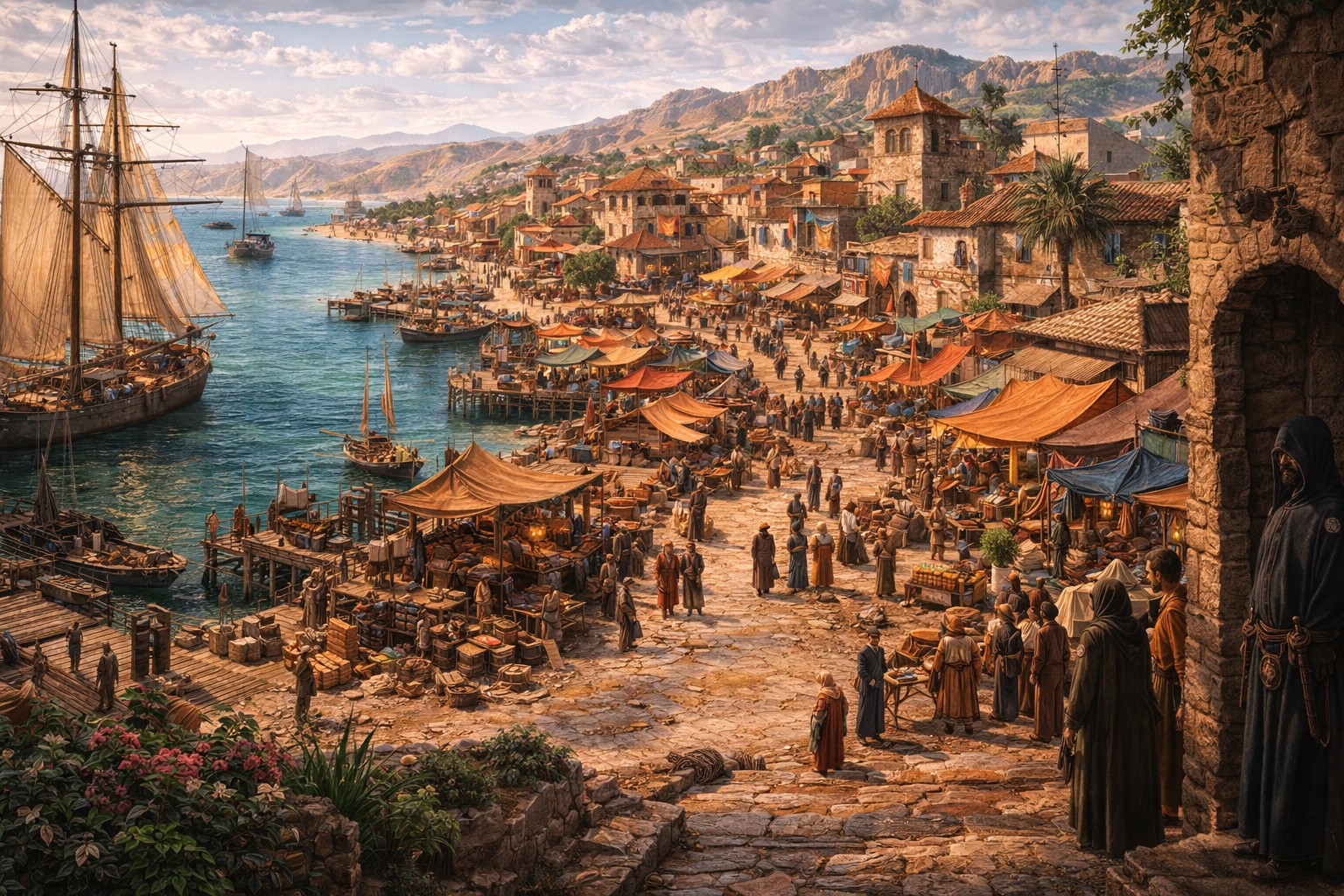
Tafunzi arrives in layers of sensory contradiction. From the deck of an approaching ship, the Sodwana Bay appears invitingly calm, a natural harbor of crystalline waters sheltered by sand spits and rocky outcrops. The town emerges as a settlement of sun-baked clay and pale stone buildings with red and tiled roofs, a blend of local Funtan architecture and foreign influences. Palm trees and hardy vegetation provide scattered greenery. The docks bustle with honest activity: fishing boats unloading fresh catch, merchant vessels being provisioned, crews trading news and currency.
Walk inland, however, and a different Tafunzi reveals itself. The town square is vibrant: musicians play, merchants hawk goods in every language, the smells of a dozen cuisines mingle with salt air. Travelers in exotic garb mingle with locals. The bazaar is chaotic but not chaotic, a careful disorder where almost anything can be acquired if you know who to ask and what to trade.
But there is a shadow. Beneath the honest commerce runs a darker current. Eyes watch from doorways. Certain establishments are clearly not designed for casual travelers. Conversations stop when outsiders approach. The town guard maintains presence but seems oddly thin on the ground for a settlement of this size. Those who know Funta sense that Tafunzi is a place where legitimate commerce and criminal enterprise exist in careful equilibrium, each enabling the other.
The town is not unwelcoming, but it is calculating. Visitors are welcome as long as they spend coin and ask no difficult questions.
Geography & Setting
Tafunzi occupies the eastern shore of Sodwana Bay, itself a natural harbor on the northwest coast of Funta facing the Rhodian Ocean. The settlement sits on the precipice between two worlds: to the west and south, the calm bay and coastal trade routes; to the east and north, the Great Ennedi Desert and the North Tellery Pan, arid badlands that stretch inland.
The bay itself is a sheltered body of water, protected by sandy spits and rock formations. The waters are calm, making it ideal for loading and unloading cargo. Three major rivers feed the bay (the Karnu, the Tafunzi, and the Doro) providing freshwater for the settlement and creating fertile deltas. The land is humid subtropical near the coast, transitioning to dry scrubland and eventually true desert inland.
The town sits at approximately 50 meters elevation, on relatively flat terrain. The harbor is naturally deep enough for medium-sized merchant vessels; larger ships anchor in the bay itself and use small boats for transfer.
The town is positioned at the exact point where the sea trade route meets the caravan route to Irbi (to the northeast). This strategic location makes it a natural trading post and a gathering point for merchants, adventurers, mercenaries, and those fleeing the law.
The People
Demographics
Tafunzi's population of approximately 3,800 is transient and cosmopolitan. Permanent residents comprise only about half the population at any given moment; the other half cycles through every few weeks: merchant sailors, caravan merchants, hired guards, refugees, and adventurers.
Permanent residents are ethnically diverse: humans comprise about 50%, Elves about 15%, Half-Elves about 20%, Half-Orcs about 10%, with scatterings of Smalings, Dwarves, Felair, and other races. The transient population is even more diverse, including representatives from Jazirah, Irna, and distant lands.
The permanent population skews toward middle-aged and older, people who have settled and made lives here. These are merchants with long-standing relationships, retired adventurers, those fleeing unsavory pasts, and a few idealists who believe in the possibility of honest commerce in a chaotic world.
Economy
Tafunzi's economy is dual-track: legitimate and illicit enterprises exist side by side, each aware of the other, neither openly acknowledging the partnership.
Primary Exports
- Processed Fish: Dried, salted, and smoked fish from the bay's abundant marine life, exported inland and to coastal settlements.
- Sea Products: Salt, shells, pearls, and curiosities from the ocean.
- Merchant Goods Redistribution: Tafunzi imports goods from distant coastal settlements and Jazirah and re-sells them to inland merchants and caravan traders.
- Information & Introductions: Merchants and adventurers are connected with services, guides, and opportunities for a fee.
Primary Imports
- Foreign Goods: Spices, silks, wines, and luxury items from Jazirah, Irna, and distant ports.
- Caravan Supplies: Horses, camels, dried goods, and equipment for desert travel.
- Hired Services: Guards, mercenaries, scouts, and other personnel available for contract.
Key Industries
- Harbor Trade: The primary legitimate industry. Merchant ships arrive, trade is conducted, goods are bought and sold. The docks and warehouses are the beating heart of legal commerce.
- Fishing: Hundreds of small boats work Sodwana Bay daily. The catch is processed and sold locally or preserved for export. Fishing families are working-class, honest, and form the backbone of legitimate Tafunzi.
- Caravan Services: Yara the Caravan Leader and her competitors organize merchant expeditions and passenger groups traveling to Irbi and beyond. This is high-margin business; the desert is dangerous, and guards are necessary. Successful caravans command premium fees.
- Hospitality: Inns, taverns, and establishments that cater to transient populations. These are uniformly profitable and well-run, as the steady stream of travelers provides consistent business.
- Smuggling & Black Market Trade: A substantial illegal economy exists, moving contraband, stolen goods, and black-market items through Tafunzi. This economy is sophisticated, organized, and generates significant wealth for those involved. Certain officials tolerate or enable it in exchange for cuts.
- Extortion & Enforcement: Criminal gangs, loan sharks, and hired muscle provide "services" to both legitimate merchants (protection) and illicit operators (enforcement). The line between legitimate security and criminal extortion is blurred.
- Slavery & Human Trafficking: Captain Nadir and others engage in slave trading under the guise of legitimate cargo. This is the most morally abhorrent criminal activity in Tafunzi and the one that most honest merchants and citizens genuinely oppose, though they are often powerless to stop it.
Food & Drink
Tafunzi's cuisine is cosmopolitan and heavily based on fresh seafood. Fish in every preparation (grilled, smoked, dried, in stews) is the daily fare for most residents. Cassava, millet, corn, and yams provide carbohydrate. Spices imported via trade routes make Tafunzi's food notably flavored compared to inland Funtan settlements.
The bazaar includes food stalls offering local Funta cuisine alongside Jazirah and Irna influences. Quality and hygiene vary, but several establishments are excellent.
Alcohol is abundant and important to social life. Local palm wine, imported Jazirah wines and spirits, and locally brewed beer are all available. Taverns serve as social hubs where business is conducted and alliances formed.
Culture & Social Life
Tafunzi's culture is defined by transience, commerce, and the careful negotiation between legitimacy and criminality. There is no single "Tafunzi culture" in the way Koma or Sekimo have coherent identities. Instead, there are subcultures, each aware of the others but not deeply integrated.
Merchant Culture: Legitimate merchants maintain networks, gather in specific establishments, and conduct business according to recognized rules. They value discretion and reliable dealing. They generally avoid entanglement with the criminal elements but know they exist.
Caravan Culture: The desert traders who form caravans have their own codes: oaths about trustworthiness, standards for equipment, unwritten agreements about sharing dangers. The caravan community is tight-knit and suspicious of outsiders.
Sailor Culture: Ship crews have traditions of their own, meeting in harbor taverns, celebrating arrivals and departures, sharing stories of the sea and distant lands.
Criminal Culture: The underworld operates with its own hierarchy, rules, and codes. It is organized enough to function but chaotic enough to generate constant internal conflict. Newer criminals or those with insufficient protection live dangerous lives.
The Underclass: Refugees, the desperately poor, and those fleeing trouble form a large population with minimal economic agency. They labor in docks, work as servants or sex workers, and sometimes turn to crime out of desperation.
Festivals & Traditions
The Blessing of Boats (Spring)
Fishermen and merchant captains gather at the shrine of Ryujin to bless vessels before the heavy sailing season. A community feast follows. This is one of the few genuinely universal celebrations that brings diverse populations together.
The Tide's Richness (Autumn)
Thanksgiving for a good harvest of fish and successful trading season. Markets overflow with fresh catch. Evening celebrations include music and dance. The mood is celebratory and hopeful.
Ancestors' Remembrance (Winter Solstice)
A somber festival where losses at sea are honored and the dead remembered. Lanterns are set adrift on the bay. The atmosphere is reflective rather than festive.
The Herald Market (Irregular)
When particularly important merchant convoys arrive or major caravans depart, impromptu festivals erupt around the bazaar. These are not scheduled but become occasions for celebration, music, and commerce.
Music & Arts
Music in Tafunzi is cosmopolitan. Femi the Bard performs regularly at the tavern, entertaining with stories of faraway lands. Local musicians play traditional Funta instruments, but foreign instruments (Jazirah lyres, Irna drums, exotic pipes) are also common. The style is energetic and varied, reflecting the town's mixed population.
Visual arts are less developed than in Koma or Sekimo, though decorative crafts and shipboard figureheads provide outlets for artistry. The bazaar and market stalls display goods that are appreciated for both function and aesthetics.
Religion
Primary Faith
Ryujin (The Sea) is the dominant deity in Tafunzi, worshipped as the giver of life, source of livelihood, and the mysterious force that defines the town's existence. Fishermen and sailors make regular offerings and invoke Ryujin's protection. The shrine of Ryujin is the most important religious structure in the settlement.
Caldrin (Roads, Crossroads, Safe Passage) is co-primary with Ryujin in Tafunzi, which would be a sea-only settlement if the caravan route to Irbi had not made it what it is. Tafunzi is "positioned at the exact point where the sea trade route meets the caravan route to Irbi," and Caldrin is the deity of exactly this intersection: the crossroads where maritime and desert trade converge. Yara's caravan operation, the entire infrastructure of guides, guards, inns, and provisioners that services the desert crossing, and the town's identity as a gateway between worlds are all Caldrin's domain. His shrine at the caravan staging area is practical rather than grand but receives more consistent offerings than nearly any other religious site in the settlement.
Secondary / Minority Faiths
Animist Traditions: The desert adjacent to the town is treated with reverence by those who cross it. Earth spirits and ancestral connections are honored, particularly by those departing for or arriving from the interior.
Echo (Stability): Acknowledged but less central than in more settled towns. Tafunzi's transient population makes strong community identity hard to sustain, but the dock crews and caravan organizers still invoke Echo when they want the town to keep functioning.
Zopha (Knowledge): A small following exists among merchants, scholars, and those with intellectual pursuits.
Martus (Luck and Risk): Martus is present wherever merchants gamble on trade and sailors gamble on the sea, which is to say Martus is present throughout Tafunzi. The criminal enterprises that run through the settlement are organized forms of calculated risk; the mercenary contracts Yara accepts or declines are bets on weather, road conditions, and human behavior; every fishing boat that goes out is a Martus invocation. Among sailors and the gambling elements of the criminal underworld, Martus is the most commonly invoked deity: the lucky coin, the favorable wind, the contract that pays on delivery rather than falling to piracy.
Anansi (Story and Information): Anansi, deity of story, oral tradition, and trickery without malice, is honored through Femi the Bard, a semi-permanent resident who has "accumulated" Tafunzi's stories and transmits them to audiences at Mama Zalika's tavern. Beyond Femi, the entire economy of information that runs through the settlement (Kesi's market stall news-hub, "Whispering" Waleed's secrets-trade, the caravan oral tradition of shared knowledge between desert crossings) belongs to Anansi's domain. Tafunzi's character as a place where information is as tradable as goods is itself an Anansi feature.
Sylira (Gossip and Reputation): Sylira, deity of gossip, reputation, and the circulation of information, is arguably the most practically influential deity in Tafunzi's daily life: a settlement where "almost anything can be acquired if you know who to ask," where Kesi's market stall functions as a de facto news hub, and where "Whispering" Waleed deals in secrets as a commodity. Every establishment where information changes hands is a de facto Sylira shrine, and the architecture of social reputation that determines who is trustworthy and who is not runs on Sylira's mechanisms. The criminal intelligence networks and merchant reputation systems are both, in theological terms, Sylira institutions.
Dolen (Longing and Separation): Dolen, deity of homesickness and the sorrow of maritime separation, is present among Tafunzi's stable fishing families (those with "deep local roots" whose members go to sea for extended periods) and among the caravan workers who leave families behind for weeks-long desert crossings. The Ancestors' Remembrance ceremony, where "lanterns are set adrift on the bay" to honor losses at sea, is Dolen's most public moment in Tafunzi's religious calendar. The permanent residents who built lives here are often people who left somewhere else, and that original separation is the founding note of Dolen's theology.
Hesira (Hearth and Domestic Continuity): Hesira is honored in Tafunzi's permanent households: the fishing families with generational roots, the established merchants who have built stable homes above the transient commerce below. Mama Zalika's Inn itself embodies a Hesira quality: the establishment that has been a gathering place for long enough to become an institution, the warmth that persists through the town's moral complexity. Jelani the Fisher, "one of the few residents with deep local roots" whose family has fished these waters for generations, is a Hesira figure in a Ryujin town.
Nyxollox (Death and Peaceful Transition): Nyxollox, the gentle universal deity of death and peaceful transition, is honored in Tafunzi's Ancestors' Remembrance, "a somber festival where losses at sea are honored and the dead remembered" and where "lanterns are set adrift on the bay" at the winter solstice. In a settlement where the sea and the desert both claim lives regularly, where the criminal underworld generates its own mortality, and where the transient population means deaths often happen without family nearby, Nyxollox's gentle tradition of peaceful passage is the spiritual common ground that different cultures can share without controversy. The permanent residents who have built lives here across decades maintain Nyxollox's practice in the way of port communities everywhere: quietly, consistently, without seeking religious argument about it.
Lantha (Night, Watchfulness, Hidden Routes): Lantha, deity of the moon, night, watchfulness, and the routes that work best in darkness, is the spiritual presence behind Tafunzi's night economy, both legitimate and criminal. The harbor watches, the caravan guard rotations, and the fishing boats navigating Sodwana Bay by the moon's light are all practical Lantha devotion, as is the night navigation that guides ships safely into a bay that offers no special accommodation to those who miscalculate the approach. More specifically, the criminal operations that "run a darker current beneath the honest commerce," where "eyes watch from doorways" and "conversations stop when outsiders approach," operate in Lantha's domain of privacy, quiet work, and the routes best traveled when those in power are not watching.
Bridhel (Music, Dance, and Arts): Bridhel, deity of music, dance, poetry, and creative inspiration, is present in Tafunzi's cosmopolitan performance culture through Femi the Bard, a semi-permanent resident who "performs regularly at the tavern, entertaining with stories of faraway lands" in a musical tradition described as "energetic and varied, reflecting the town's mixed population." The diversity of instruments in Tafunzi, "Funta instruments, but foreign instruments (Jazirah lyres, Irna drums, exotic pipes) are also common", makes the settlement a genuine confluence of musical traditions from across Dort, and Bridhel governs that confluence. Where Anansi oversees the information-carrying stories that are Tafunzi's social currency, Bridhel governs the music and performance that make the establishments where those stories circulate into places people genuinely want to gather.
Secret or Forbidden Worship
There is no organized forbidden worship, though practitioners of sorcery operate in shadows. Some criminals and assassins are rumored to consult with dark forces, but this is largely speculation. The deep corruption of Tafunzi's criminal underworld sometimes manifests in disturbing rituals or dark pacts, but these are secretive and not openly acknowledged even by the underworld.
Amnyth (Death and Vengeance): Amnyth, deity of death, poison, and the knowledge of the dead, receives hidden offerings from Tafunzi's professional assassination community, specifically associated with Zahra "The Viper," whose mastery of poisons is the definitive practice of Amnyth's portfolio. The "disturbing rituals or dark pacts" that the criminal underworld engages with are, in their most organized form, Amnyth-adjacent practice: death-knowledge, assassination-craft, and the particular violence that operates in shadows. Amnyth's practitioners do not identify themselves to each other but recognize each other by method.
Mamaxa (Hidden Power and Discipline): Mamaxa, deity of controlled suffering and discipline through hidden power structures, is the patron of the arrangement Chieftain Makara has built: a system where criminal enterprises pay for the privilege of operating under his protection, where guard officers are "deeply complicit" in maintaining structures they find morally uncomfortable, and where power operates through layers of implied threat and real capability rather than open authority. The entire governance structure of Tafunzi, where legitimate commerce and criminal enterprise exist in "careful equilibrium," is a Mamaxa institution: control maintained through the knowledge that the arrangement can end badly, managed by those who understand that they cannot acknowledge the system openly without destroying it.
History
Founding
Tafunzi was established as a fishing village centuries ago, taking advantage of the Sodwana Bay's natural harbor. The settlement grew gradually as a place where coastal fishers sold their catch and where occasional merchant ships called for water and supplies.
The real transformation came approximately 150 years ago when the caravan route to Irbi was formalized. Suddenly, Tafunzi became essential infrastructure for desert trade. The population expanded, more permanent structures were built, and the settlement evolved from fishing village to cosmopolitan trade town.
Key Events
The Caravan Route Establishment (150 Years Ago)
Merchants seeking an alternative to the overland routes through the interior realized that moving goods via ship to Sodwana Bay, then overland to Irbi, was faster and more predictable. Tafunzi became the natural staging point. Caravans began organizing regularly. The town's population tripled within two generations.
The Rise of Organized Crime (80 Years Ago)
With increased wealth came criminal interest. Small-time bandits and smugglers began operating in and around the town. Over decades, these criminal enterprises organized into something resembling a system. The authorities (the chieftain and guard captain) were outgunned and eventually came to an accommodation: allow the criminal elements to operate, take a cut of the profits, and maintain the fiction of law and order.
The Great Fire (45 Years Ago)
A fire of unknown origin destroyed much of the original wooden district and several warehouses. The official story was an accident; some whisper it was deliberately set to eliminate evidence of a massacre or to settle a gang war. The rebuilt town incorporated more stone and less flammable materials.
Chieftain Makara's Rise (20 Years Ago)
The previous chieftain died under mysterious circumstances. Makara, a powerful merchant with deep connections to both legitimate and criminal enterprises, claimed the position. He was unchallenged, suggesting he had backing from multiple power centers. Under Makara, the town's dual economy became more formalized. He essentially professionalized corruption; the criminal elements pay taxes to Makara, and he maintains nominal law and order. It works, after a fashion.
Current State
Tafunzi is at an equilibrium point. The legitimate economy is prosperous and stable. The illicit economy is organized and profitable. These two worlds coexist in careful balance. The town is neither genuinely safe nor genuinely lawless; it operates in a gray zone where those who know the rules can thrive and those who don't can easily come to ruin.
Chieftain Makara has proven to be a competent administrator of this system, managing the tensions between different criminal factions, protecting crucial legitimate merchants, and maintaining enough facade of law and order to prevent the situation from becoming obviously intolerable to outsiders.
However, the system is fragile. Younger criminals push against established hierarchies. Reformers occasionally emerge demanding genuine law enforcement. The discovery of Captain Nadir's slave trading is generating pressure for actual justice. Whether Makara can maintain the balance is uncertain.
Leadership & Governance
Chieftaincy: Overview
Tafunzi is ruled by a hereditary chieftain, the tradition common in tribal Funta. However, in practice, Chieftain Makara's authority is constrained by the reality of Tafunzi's dual economy. He must balance the interests of legitimate merchants (who want genuine security and fair dealing), criminal enterprises (who pay him substantial fees for autonomy), and the harbor/caravan interests (who require the town to function as an effective trading hub).
This is not formal governance; it is management of competing interests. Makara's legitimacy derives from his ability to prevent the situation from exploding into open conflict.
Chieftain Makara Tafunzi
Human, Male; Age 62
Makara is a weathered, broad-shouldered man with dark skin burned darker by decades of sun exposure. His beard is streaked with gray, braided with small beads of bronze and silver. His eyes are sharp and constantly assessing, the eyes of someone accustomed to reading danger and opportunity in the details of human behavior.
Makara rose through the merchant ranks before claiming chieftaincy. He was captain of a successful merchant vessel, then owner of a trading company, eventually a major player in Tafunzi's commercial and criminal networks simultaneously. When the previous chieftain died, Makara was the natural choice; he had the respect of merchants, the backing of major criminal operators, and the support of enough of the population to claim legitimacy.
As chieftain, Makara is pragmatic, intelligent, and ruthless in service of stability. He is not idealistic about law and order; he knows that ideal justice is impossible in a town like Tafunzi. Instead, he manages the system to prevent its collapse. He allows criminal enterprises to operate (within limits), takes a cut of their profits, ensures that certain red lines (excessive violence, the worst of the slave trade) are not crossed, and maintains the facade that Tafunzi's guard and militia actually enforce law.
Makara is not loved by honest merchants and citizens, but he is respected as effective. Those who operate outside the system, however, view him as a tyrant, and he has proven willing to crush challenges to his authority with swift violence.
His marriage (to one of his merchant company's officers) is reportedly one of genuine partnership; Makara's wife, Aisha, manages much of the legitimate commercial side while he handles the criminal apparatus. This suggests Makara is capable of loyalty and personal connection, though these qualities serve his interests rather than contradicting them.
Guard Captain Bello
Half-Orc, Male; Age 51
Guard Captain Bello commands Tafunzi's militia of approximately 80 trained fighters. He is stern, disciplined, and deeply committed to security, though the definition of "security" has been molded by Makara's governance philosophy.
Bello is a skilled military administrator and tactician. His militia is well-trained, well-equipped, and capable of responding to genuine threats. However, Bello operates under Makara's direction. He enforces the law selectively: hard against crimes that threaten the town's function (theft from major merchants, violence that disrupts business, excessive murder), but permissive toward the criminal enterprises that operate with Makara's blessing.
This creates moral tension in Bello's character. He is not corrupt in the sense of being privately enriched (he draws a salary and lives modestly), but he is deeply complicit in the system. He has made peace with this compromise or perhaps rationalized it as necessary evil. Those who know him sense his discomfort, but he does his duty with professionalism.
Bello is respected by his troops and by merchants who appreciate his competence. He is feared by criminals, both because his militia is dangerous and because he maintains standards about what criminal behavior is tolerated.
Guard & Militia
The militia numbers approximately 80 trained fighters, supplemented by part-time auxiliary militia (typically conscripted from among able-bodied laborers when needed, though recruitment is infrequent). The force is equipped with decent armor and weapons, though not to the standard of better-funded military forces.
The militia is divided between harbor patrol (dock security, cargo inspection, ship-related matters), caravan guard (escort service for merchant convoys), and city garrison (internal policing). Recruitment is typically from among retired sailors, mercenaries, or younger men seeking steady employment.
The militia's primary function is legitimate security and caravan escort. However, the unspoken understanding is that they will not interfere with criminal enterprises that operate with tacit approval. This creates a double standard where some crimes are vigorously prosecuted while others are largely ignored.
Law & Order
Tafunzi maintains the fiction of law and order, with written codes governing major offenses: theft, murder, violent crime, fraud. These codes are enforced irregularly.
Serious crimes against major merchants are investigated and prosecuted. Petty theft, if the victim is unimportant, may be ignored or the criminal enlisted into forced labor. Murder is prosecuted unless the victim was engaged in illegal activity that Makara wanted suppressed anyway. Fraud is punished severely when it involves deceiving major merchants but largely ignored when it affects poorer populations.
Slavery and human trafficking should be capital offenses under Funtan custom, but Nadir's operations have apparently continued (if with less visibility) for years. The fact that justice has not been served suggests either that Bello has been ordered to tolerate it, that Makara profits from it, or that the victims' lack of political power means their suffering is ignored.
Notable Figures
Captain Imani Nkruma
Human, Male; Age 67
Imani is a seasoned merchant captain of remarkable character. His ship, the Prosperity, has plied the coastal routes for forty years, and he has accumulated both wealth and genuine loyalty from his crew and associates. Imani is charismatic and savvy, brimming with stories about the high seas and distant ports.
Imani's appearance is weathered: dark skin deepened by sun exposure, a neatly trimmed beard showing careful grooming, and eyes that sparkle with knowledge and experience. He is reputed to be scrupulously honest in his dealings, a rare quality in Tafunzi. Some say his ethics have cost him significant wealth (he refuses certain lucrative but morally questionable cargo), while others suggest his reputation for honesty is worth more than any single transaction.
Imani is one of the genuine forces for legitimate commerce in Tafunzi. Merchants new to the town often seek his counsel. He is known to have mentored younger sea captains, passing on both practical knowledge and ethical principles.
Mama Zalika
Human, Female; Age 59
Mama Zalika owns and operates the most popular inn and tavern in Tafunzi. She is warm and motherly, known for generosity and excellent cooking. Her robust form, ever-present apron, and the genuine twinkle in her eye make her instantly approachable. Her establishment is one of the few places in Tafunzi where diverse populations mix naturally.
Zalika's inn is scrupulously neutral ground. She welcomes all comers (merchants, sailors, caravan leaders, even lower-level criminals) as long as they pay and don't cause violence in her establishment. Her cooking is legendary, and her tavern is as much social hub as commercial space. She knows everyone's business (some say she's an intelligence broker), but her discretion is absolute. Those who trust her will confide secrets; those who betray her find themselves isolated, which is a powerful punishment in a small town.
Zalika is independently wealthy and could retire, but she chooses to continue because her place serves a function; it is genuinely neutral ground in a fractious town.
Jelani the Fisher
Human, Male; Age 54
Jelani is a local fisherman with unmatched knowledge of the Sodwana Bay's waters. He is quiet and contemplative, not given to excess in drink or words. However, he is willing to share his extensive knowledge of the bay's seasons, weather patterns, fish movements, and underwater hazards with those who show genuine interest and respect.
Jelani's physical appearance reflects his life: lean and muscular from decades of physical labor, with weather-beaten skin and hands roughened by fishing nets. He is one of the few residents with deep local roots; his family has fished these waters for generations.
Jelani is apolitical and has avoided entanglement with Tafunzi's criminal underworld through simple steadfastness. He fishes, sells his catch, lives modestly, and minds his own business. This approach has kept him safe and respected.
Kesi, the Market Vendor
Human, Female; Age 45
Kesi is a colorful and lively vendor operating a prominent stall in the bazaar. She sells spices, fabrics, and local crafts with infectious energy. Kesi is persuasive and charismatic, possessing a genuine gift for making every customer feel special and valued. Her stall is an explosion of colors and scents, carefully arranged to draw attention and create desire.
Kesi is not a major player in Tafunzi's power structures, but she is well-connected as an information broker. Merchants and travelers share information with her; she has become a de facto news hub for the town. She is careful not to reveal sources and maintains neutrality, which makes her information valuable.
Yara, the Caravan Leader
Half-Orc, Female; Age 56
Yara is an experienced leader of caravans that travel the dangerous route between Tafunzi and Irbi. She is tough, no-nonsense, and has a reputation for getting travelers through the wastelands safely. Her competence and oath-keeping have made her the most trusted caravan organizer in the region.
Yara's appearance (sun-baked skin, hawk-sharp eyes, always checking and rechecking her gear) reflects her meticulous approach to caravan management. She is not warm or personable, but those who travel with her trust her with their lives, and that trust is never misplaced.
Yara is one of the few power brokers in Tafunzi who operates entirely outside the criminal system. Her authority derives from genuine expertise and proven reliability. Makara respects her because her successful caravans are profitable commerce that benefits the town's economy.
Nia the Herbalist
Female, Age 72
Nia is a local healer practicing traditional medicine. She is wise, gentle, and possesses an air of mystique regarding her knowledge of plants and healing. Her hands are delicate despite her age, moving with precision in their craft.
Nia is respected throughout Tafunzi and is sought for treatment of both mundane ailments and mysterious afflictions. She has trained apprentices in herbalism and maintains a reputation for honest dealing and genuine care for her patients. She is one of the moral anchors of the town, representing the possibility of dignity and integrity in a place often lacking both.
Femi the Bard
Half-Elf, Male; Age 38
Femi is a traveling bard who has taken a liking to Tafunzi and established semi-permanent residence. He performs regularly at Mama Zalika's tavern, entertaining crowds with witty stories and captivating tales of faraway lands. His flashy attire and lute are always in evidence; performance is his life and identity.
Femi is charming and talented but also observant. He hears conversations, learns secrets, and understands the currents beneath Tafunzi's surface. Some whisper he is more than a bard, that he gathers intelligence for someone or perhaps for multiple parties. Whether true or not, he maintains the facade of an entertainer and is welcomed in establishments where he might otherwise be viewed with suspicion.
Key Locations
Seat of Power
The Chieftain's Compound: Located on a high point overlooking the harbor, the compound consists of multiple buildings including Makara's residence, administrative offices, guard barracks, and a vault. The structures are built of stone and heavy timber, practical rather than ostentatious. The compound is fortified with walls and defensive positions, making it militarily defensible if necessary. Access is controlled; most business is conducted through guard intermediaries rather than direct audience with Makara.
Houses of Worship
The Shrine of Ryujin: A waterfront temple dedicated to the sea deity. The architecture is open and airy, with columns oriented to capture sea breezes. The shrine hosts regular blessings for ships and crews, particularly during the Blessing of Boats festival. It is one of the few institutions in Tafunzi that commands genuine universal respect and participation.
The Ancestor Stone Grove: A natural area maintained as a sacred space for honoring the dead and maintaining connection to ancestors. Used primarily by those preparing for desert journeys or mourning losses.
Inns & Taverns
Mama Zalika's Inn and Tavern: The heart of Tafunzi's social life. The establishment is clean, well-maintained, and famous for Mama Zalika's excellent cooking. The common room is large and always busy, filled with merchants, sailors, caravan leaders, and locals. The tavern serves quality drinks, and the food ranges from simple hearty fare to more elaborate dishes. There are twelve comfortable rooms for guests. The atmosphere is convivial but not rowdy; Zalika maintains order through personal presence and reputation. This is one of the few places in Tafunzi where the criminal underworld mixes (at lower levels) with legitimate merchants and common citizens.
The Harbor's Rest: A smaller inn near the docks, catering to ship crews and sailors. The atmosphere is rougher than Zalika's, the prices cheaper, the accommodations more spartan. The tavern here serves strong drink and occasional live music. The establishment is popular with working-class dock labor and has a reputation for loose morals and minimal discretion; things said here are often heard by half the criminal underworld within hours.
The Merchant's Lodge: A more upscale establishment catering to wealthier traders and captains. The accommodations are comfortable, the service attentive, and the prices reflect quality. The tavern serves fine wines and spirits imported from Jazirah and Irna. The atmosphere is professional and reserved; business deals are conducted in private rooms. This is where merchants of legitimate commerce gather.
Shops & Services
The Wandering Wave: Run by a retired sailor, this shop stocks nautical equipment, maps of distant seas, and various seafaring gear. The walls are adorned with sea charts; the air smells faintly of salt. For maritime merchants and ocean travelers, this is an essential stop.
Zuri's Textiles: Owned by Zuri, a skilled weaver, this shop offers fabrics, traditional clothing, and tapestries from multiple cultures. The shop is a cascade of colors and textures. Zuri herself is knowledgeable about textiles and can discuss quality, technique, and appropriateness for different purposes.
Bakari's Bountiful Bazaar: A bustling marketplace stall operated by Bakari, known for fresh, locally-sourced fruits, vegetables, and spices. The stall is loud, colorful, and always busy. Prices are negotiable; quality is generally good.
Twilight Tinctures: An apothecary filled with jars of dried herbs, bottles of potions, and ancient books on herbalism. The owner, a knowledgeable herbalist (possibly connected to Nia), is ready with a remedy or advice for any ailment.
The Gilded Lute: A shop filled with instruments ranging from traditional lutes to exotic drums, serving musicians and those interested in music. The owner, a musician herself, offers lessons and occasionally hosts performances.
Forge of the Sun: Run by a master blacksmith, this forge is known for high-quality metal goods. The sound of hammering fills the air; the walls are lined with an array of tools and beautifully crafted weapons. Custom work is available for the right price.
Sea's Secrets: A small, eclectic shop near the docks filled with oceanic curiosities: shells, coral, mysterious deep-sea items. Perfect for those seeking unique souvenirs or gifts.
Sahara Scrolls: A quiet, dimly lit shop with a vast collection of literature, from local folklore and history to rare manuscripts. The owner, an avid collector, is always eager to help patrons find specific texts.
The Mariner's Trove: An Aladdin's cave of curiosities and historical artifacts collected from around the world. Perfect for collectors and history enthusiasts. The owner, a well-traveled collector, has stories for every item.
Jabari's Jewels: Owned by a skilled jeweler, this shop features handcrafted necklaces, bracelets, and rings using local and exotic gemstones. Jabari's craftsmanship is renowned far and wide.
The Scribe's Corner: A must-visit for scholars and letter-writers, offering high-quality writing materials. The scent of ink and parchment fills the air; the owner prides himself on sourcing the finest supplies.
Kai's: A restaurant serving traditional Funta foods: fish preparations, cassava, grains, and local vegetables. Kai's is a favorite of local residents and those seeking authentic local cuisine rather than the cosmopolitan options elsewhere.
The Artisan's Alley: A shop showcasing the work of local artisans: pottery, sculptures, and handmade items. Each piece tells a story of the town's cultural heritage.
Maji's Mystical Menagerie: A unique pet shop where Maji, a lover of creatures, offers exotic pets and animal supplies. The animals are well-cared for, and Maji shares knowledge on pet care.
Wind and Wood: Specializing in wooden items, this shop is filled with hand-carved toys, intricate models, and decorative items. The proprietor is a skilled woodworker with passion for his craft.
Lulu's Lanterns: A shop featuring beautifully designed lanterns, candles, and light fixtures. The space itself glows warmly from its inventory, creating an inviting atmosphere.
The Market
The Bazaar: The heart of Tafunzi's commerce. Multiple permanent and semi-permanent stalls sell everything imaginable: spices, fabrics, local crafts, foodstuffs, magical trinkets, black-market goods (if you know who to ask). The bazaar is always busy, chaotic in a controlled way, and filled with energy. Haggling is expected; deals can be made for nearly anything if you have coin and connections. The bazaar is also where Kesi maintains her prominent stall, making it a hub of information as well as commerce.
Other Points of Interest
The Harbor & Docks: The working waterfront where ships are loaded and unloaded, crews are hired, and maritime business is conducted. The docks are busy from dawn until dusk. Multiple warehouses store goods awaiting transfer or shipment. The harbor master's office coordinates ship schedules and harbor activities.
The Caravan Staging Area: An open area outside the main town where caravans are assembled, animals are provisioned, and merchants prepare for desert journeys. Yara and other caravan leaders operate from here. The staging area is a hub of activity whenever major caravans are preparing.
The Town Square: A central gathering place where merchants vend, musicians perform, announcements are made, and the town's social life occurs. The square is surrounded by the more important shops and establishments. On market days or when caravans arrive, the square becomes exceptionally crowded and lively.
The Guard Headquarters: A fortified building serving as administrative center for Captain Bello's militia, containing offices, barracks, and detention facilities. Prisoners are held here pending trial or punishment. It is not a place average citizens enter willingly.
Sodwana Bay: The natural harbor is beautiful and peaceful. Walks along the shoreline are pleasant; fishing can be done from the sandy beaches. The bay is safe for swimming in certain areas (locals can advise which).
The Criminal Element
Tafunzi's underworld is sophisticated, hierarchical, and deeply embedded in the settlement's structure. There is no single crime boss; instead, multiple criminal enterprises operate under Chieftain Makara's protection (in exchange for substantial payment).
"Sly" Bako & the Crimson Fins
Role: Gang leader and black-market operator
Description: Bako is the cunning leader of the Crimson Fins, known for smuggling and black market dealings. He maintains a sharp mind and network of informants, typically staying two steps ahead of the formal guard. The Crimson Fins are the largest single criminal organization, running the bulk of small-scale smuggling, theft, and black-market trade. Bako operates multiple warehouse fronts and employs dozens of operatives. He is ruthless toward rivals but careful to respect Makara's territorial claims and taxation system.
Kesi the Serpent (No relation to Kesi the Vendor)
Role: Master thief and spy
Description: Kesi the Serpent is feared throughout the underworld for her ability to infiltrate secure locations, retrieve valuable items, and leave no trace. Her stealth and agility are legendary; she has never been caught. She is highly sought as a spy by various unsavory parties and wealthy patrons willing to pay premium rates. Little is known about her personal life; her identity is carefully guarded. She is an independent contractor rather than belonging to any single organization, which makes her both valuable and unpredictable.
Ghalib the "Shark"
Role: Ruthless loan shark
Description: Ghalib preys on the desperate, offering loans at exorbitant interest rates (typically 30-50% monthly). His debt collection methods are brutal, employing a network of thugs who use intimidation and violence to enforce payment. His operations are particularly concentrated among dock workers, transient sailors, and the lower classes. Ghalib is crude and violent, lacking the sophistication of some other criminal operators, but effective at extracting wealth from those already struggling. His presence is described as a "dark cloud" over the poorer quarters of the town. Even Captain Bello views Ghalib with distaste, though Makara's tacit approval keeps the militia from taking action.
Captain Nadir
Role: Corrupt merchant captain engaged in slave trading
Description: Nadir appears as a respectable merchant captain, his ship a legitimate trading vessel. In reality, he engages in human trafficking, transporting enslaved people under the guise of regular cargo. He has bribed certain port officials to ignore his activities or to provide advance warning if investigations begin. His slave trafficking is known to those paying attention but has continued because victims are powerless and because Makara apparently permits it (or profits from it). Nadir is a prime target for those opposing Tafunzi's criminal system.
"Mad" Mwamba & the Tidal Reavers
Role: Pirate leader
Description: Mwamba operates from a hidden cove near Tafunzi, commanding a band of approximately 30 sea pirates known as the Tidal Reavers. He is feared for unpredictable, often brutal behavior and vicious raids on merchant vessels and coastal settlements. Unlike organized smugglers or thieves, Mwamba operates in a semi-independent manner, though he maintains tacit arrangements with Tafunzi's criminal hierarchy. He is a loose cannon: powerful but unstable, capable of generating chaos if circumstances push him that direction.
Zahra "The Viper"
Role: Assassin for hire
Description: Zahra is a deadly professional mercenary with unmatched skill with poisons and daggers. She operates from the shadows, her identity a closely guarded secret known only to those who can afford her services (typically wealthy patrons or major criminal operators). She is not loyal to any single organization but instead works independently for the highest bidder. Her reputation is such that rumors of her involvement in a death cause significant fear. Little is known about her personally or her motivations.
Uzoma the Enforcer
Role: Muscle for hire
Description: Uzoma is a towering figure (Half-Orc, seven feet tall, massively muscular) who offers his services to whoever pays best. He is often seen accompanying "Sly" Bako or other criminal operators, providing intimidation and enforcement. Uzoma is not intelligent, but he is immensely effective at his primary job: making people afraid and comply with threats. He is rumored to lack hesitation about killing, though he typically resorts to violence as final option once intimidation has failed.
"Whispering" Waleed
Role: Information broker and blackmailer
Description: Waleed deals in secrets, using information he gathers to manipulate and blackmail Tafunzi's influential figures. He operates from the shadows, pulling strings to benefit his interests and those of his clients. Waleed is intelligent, patient, and dangerous in subtle ways. He is known to have leverage over multiple major merchants, several guard officers, and possibly even Makara himself. The question of what information he holds and what leverage it provides makes him a feared figure.
Secrets, Rumors & Hooks
-
Makara's History: Before becoming a merchant captain and eventually chieftain, what was Makara doing? Some whisper he was a pirate himself and only turned to "legitimate" trade to launder wealth. Does he have enemies from his past who might come seeking him? Is his support of the criminal underworld actually a desire to control and profit from his former rivals?
-
The Previous Chieftain's Death: The circumstances of the previous chieftain's death, which cleared the way for Makara, remain officially mysterious. Was it assassination? Did Makara arrange it? Does evidence exist that could expose him, and is he looking for it?
-
Captain Nadir's Expansion: Slave trading should be prosecutable, and yet Nadir continues operating. Some residents suspect Makara is actively profiting from Nadir's operations. Others wonder if Nadir has leverage over Makara or Bello. Why hasn't justice been served, and what would trigger a crackdown?
-
The Hidden Cove: Mwamba's pirate base is somewhere near Tafunzi, but its exact location remains secret. Does anyone besides Mwamba and his crew know where it is? If discovered, would eliminating the pirate threat be in Makara's interests or against them?
-
Waleed's Archives: "Whispering" Waleed maintains records of secrets and blackmail material. Where is this archive kept? Who would benefit from stealing or destroying it? Does it contain information that could topple Makara's government?
-
The Legitimate Merchant Network: Captain Imani and other honest merchants are increasingly vocal about reforming Tafunzi's system. Is a genuine reform movement developing? Would Makara tolerate an attempt to actually enforce law, or would he suppress it? Are there merchants powerful enough to challenge his authority?
-
Nia's Knowledge: The elderly herbalist Nia has been in Tafunzi longer than almost anyone. She must have seen things, know secrets, observed the rise of the criminal system. Why does she remain neutral and seemingly unconcerned? Does she have protection? Is she gathering information? What would she reveal if circumstances required?
-
Femi's True Purpose: Is Femi really just a traveling bard, or is he something else? Some suspect he is an intelligence agent for a distant power, gathering information about Tafunzi's criminal underworld. Others suggest he might be a spy for one of the rival criminal organizations. What is his actual purpose, and who employs him?