Zouar
Zouar: Where Sand Meets Sea, and Survival Is an Art
"A ship here is a fortune. A well of fresh water is a miracle. A successful catch is a blessing."
Varook, Lizardfolk advisor to Chieftain Ealdred
At a Glance
| Continent | Funta |
| Region / Province | South-central Funta, Bay of Mahajamba coast |
| Settlement Type | Town |
| Population | ~2,100 |
| Dominant Races | Human, Sand Elf, Zerren, Lizardfolk, Gnome |
| Ruler / Leader | Chieftain Ealdred Stonegrip |
| Ruling Body | The Stonegrip Chieftaincy (advisory council) |
| Primary Deity | Animist traditions, sea spirits, Ryujin, Nesara |
| Economy | Bay fishing, island agriculture, artisanal processing |
| Known For | Precious ships, island-grown sorghum, baobab exports, water purification expertise |
First Impressions
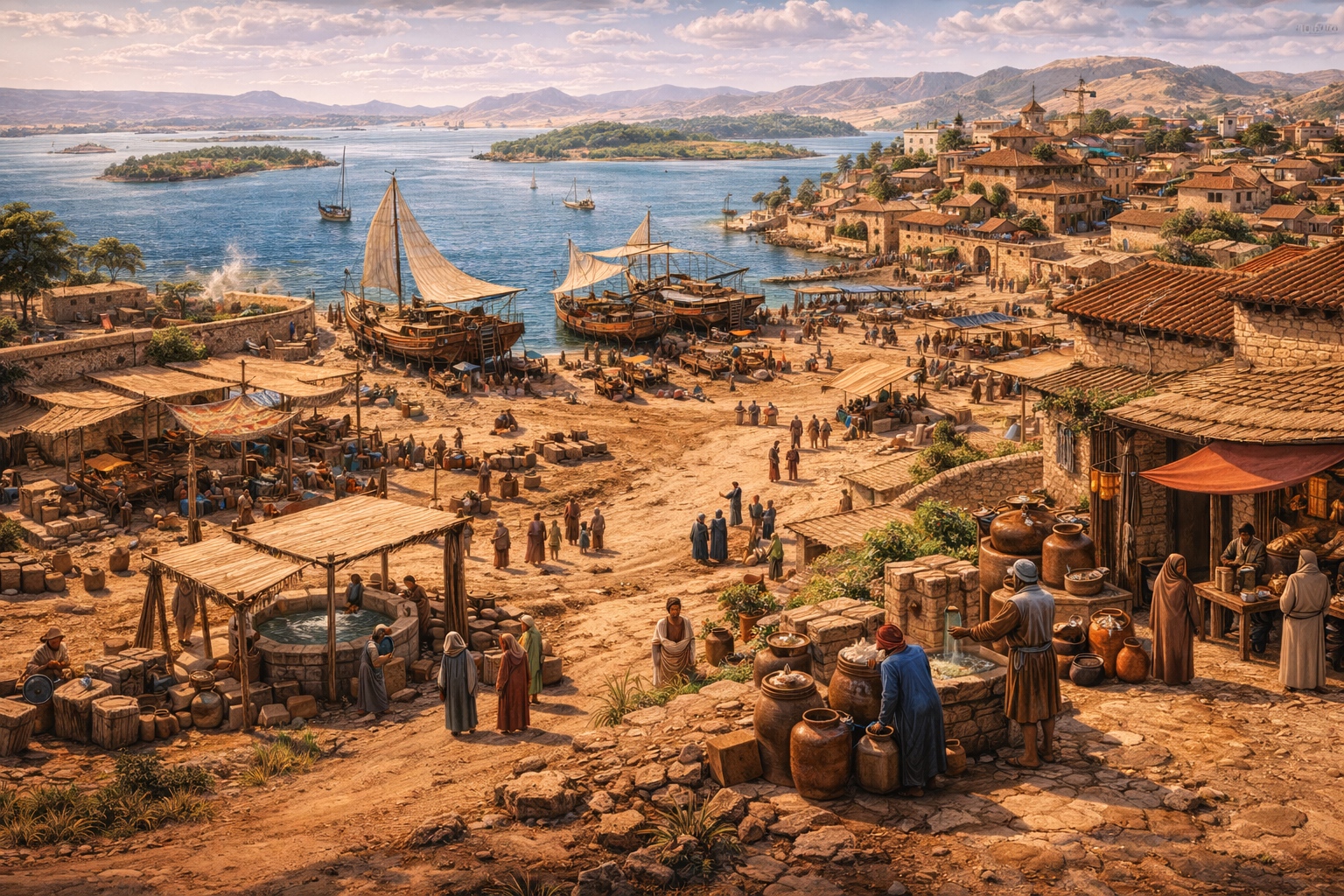
Zouar announces itself in layers of sensation: first the salt-laden air that hits the back of your throat, then the heat that hangs permanent over the dust-colored buildings. The town hugs a sandy basin where the Bay of Mahajamba curves into the shore, and the first visible thing is always water: sometimes glittering, sometimes dull, always there.
The settlement is modest but deliberate. Stone-and-clay structures with thatched or tile roofs cluster near the waterfront, gradually spreading inland toward the garden plots and grazing lands that feed the population. The architecture is built for durability and temperature management: deep eaves, open courtyards, colored walls to reflect or absorb the sun as needed. Everything that can be moved is moved daily according to the heat and wind.
What strikes visitors most is the reverence with which ships are treated. A handful of vessels rest in the harbor or pulled up on the sandy beach, and they are pristine. Maintained with obsessive care. Wood is not scarce everywhere in Funta, but here in Zouar, where the desert dominates and the bay offers no timber islands, wood becomes almost sacred. Ships are wealth. Ships are status. Ships are how the island farms are reached, how distant trade is conducted, how food is reliably brought home. A single ship represents a family's fortune, and the sight of one being built or repaired draws crowds.
The islands visible from shore are where life happens for Zouar's inland food supply. In the distance, you can see the green of cultivated land, the only green that breaks the bay's blue and the desert's gold.
Geography & Setting
Zouar lies on the northern coast of the Bay of Mahajamba, in the Trenland Sea. The settlement sits in a natural basin where a small river (seasonal, reliable) reaches the sea, providing the critical freshwater that makes permanent settlement possible. Immediately inland rises the true challenge: the Great Ennedi Desert. The terrain is sandy coastal flats giving way to rocky inland plateaus, with scattered scrubland marking the desert's edge.
The climate is warm year-round, with a distinct wet season that brings rain and flash flooding to the seasonal river. Humidity from the bay is nearly constant, and the combination of salt air and heat makes metal rust quickly and wood weathering a constant maintenance concern. This is one reason wood is so precious; it requires perpetual care.
The Bay of Mahajamba is semi-enclosed, offering protection from the worst of the Trenland Sea's open-ocean storms, but the waters can still be treacherous. The bay is rich in fish species, particularly those that salt well for trade. Multiple islands dot the bay: most too small or rocky for habitation, but three larger islands have been developed into agricultural settlements dependent on Zouar for trade and protection.
Why here? The river. Everything flows from access to fresh water. Without it, Zouar would be impossible.
The People
Demographics
Zouar's population is a blend of inland-born humans and Elves (particularly Sand Elves, whose heritage suits the climate) mixed with the trading populations and craftspeople who have arrived over generations. Zerrens are present, often occupying merchant and artisan roles. A significant Lizardfolk community maintains its own quarter and brings valuable knowledge of desert ecology. Gnomes have settled here in greater numbers than in other Funta towns, drawn by the opportunities in artisanal processing of island crops.
The constant movement of traders and fishermen means the population has a mobile quality; not everyone settles, and those who do often have roots extending to other bay settlements.
Economy
Zouar's economy rests on a three-way partnership: the fish pulled from the bay, the crops grown on the islands, and the processing and trade infrastructure that gets both to distant markets.
Primary Exports
- Salted and smoked fish: The bay's primary catch, preserved and traded throughout Funta
- Island staples: Sorghum, fonio, and cowpeas, shipped to coastal cities and inland settlements
- Processed baobab: Fruit, juices, medicinal powders, and dried preparations
- Maritime services: Repair, provisioning, and crew for ships traveling the Trenland Sea
Primary Imports
- Grain supplements: When island harvests fall short or emergency food is needed
- Metalwork and tools: Especially items that resist rust: bronze, copper, treated iron
- Luxury textiles: Clothing and cloth imports for the wealthy
- Timber: Ironic but necessary; specialty woods for boat repairs and construction
Key Industries
- Mahajamba Fisheries: Run by Torvald Grimlock, Half-Orc proprietor. Eight active fishing vessels, the largest fleet in Zouar. Exports salted fish to ports across the Trenland coast. Torvald is gruff, capable, and skilled at reading the bay's moods. He drinks heavily but never while fishing. Known for paying his crews fairly and pushing them hard.
- Island Bounty Co.: Managed by Elara, a Human woman with a gift for logistics. She maintains the supply chain between the three agricultural islands and Zouar proper, ensuring consistent harvests reach market and that seasonal shortfalls are managed. She negotiates with island farmers, manages warehousing, and arranges transport. Reliable to the point of predictability, which her clients appreciate.
- Baobab Delights: The personal creation of Faelar, a Gnome craftsperson of genuine invention. He has developed methods for preserving baobab in forms that travel well and command premium prices. His current experiments involve fermented baobab paste and a baobab-based medicinal syrup. Faelar is eccentric, talkative, and invested in his products; he will bore you extensively if you ask about baobab.
- Stonegrip Shipyards: A small but respected operation that repairs vessels and constructs new ones on commission. Owned by Chieftain Ealdred but managed by his wife Selene's brother, a competent craftsperson named Korvin. The yards employ six full-time workers and can mobilize more for large projects.
Food & Drink
The diet is fish-forward: smoked fish over morning fires, fish stewed with island staples for midday meals, fish and grain combinations for evening food. Baobab fruit is incorporated into nearly everything when in season: eaten fresh, made into juice, added to grain porridges, fermented into drinks. Cassava, brought from more southern settlements, supplements the carbohydrates when available.
Fermented milk from the few cattle herds that exist on the desert fringe is a rare trade good. When available, it commands good prices.
The water is managed carefully. Selene's purification magic keeps the main well safe and clean, but the knowledge that safe water is magic-dependent creates a certain cultural anxiety. Everyone knows what would happen to Zouar if Selene stopped being able to purify water, and it is spoken of in low voices.
Culture & Social Life
Zouar culture emphasizes resilience and practical skill. There is no shame in maritime trades or fishing work. The highest social position is held by Chieftain Ealdred and his family, but the distinction between classes is muted compared to coastal cities like Bafao; everyone works, and everyone understands that survival requires participation from all.
Music and storytelling follow Funta traditions but with a maritime flavor. Stories about famous storms, legendary catches, and the founding of Zouar's trade routes are repeated and embellished in taverns and around evening fires. The distinction between history and legend is flexible.
Ships, as mentioned, are treated with reverence. The moment a ship is launched, it is blessed. When a ship is lost to the sea, the entire community mourns; the economic impact is real, but the spiritual one is deeper.
Festivals & Traditions
The Blessing of the Winds
Held at the start of the fishing season, this is a communal ceremony where the town gathers at dawn on the harbor. Ealdred and Selene lead a ritual honoring the spirits of the bay and the protection of the sea gods. Fishing crews are blessed individually. New ships (if any) are launched during this festival.
Island Trade Days
Three times a year (early, middle, and late in the growing season), the island farmers bring their harvests to Zouar for a major market. This is part market, part festival, part census. It's when Zouar proper and the three island settlements interact most directly. News is exchanged, disputes are resolved, and marriages are sometimes arranged.
Storm Remembrance
When the worst storm of the year passes, and the bay experiences at least one significant storm annually, the community marks its passage with a feast. This is part gratitude (the settlement survived), part propitiation (against future storms), and part mourning for any losses incurred. The festival acknowledges the bay's power and Zouar's place within it.
Music & Arts
The dominant musical tradition is drumming and stringed instruments adapted for coastal themes. Wave rhythms, bird calls, and fish sounds are incorporated into compositions. There is an annual song-writing competition where people compose new works about life on the bay.
Visual arts center on boat building and repair; the ships themselves are treated as canvases, with high-status vessels receiving decorative carvings and paint work. Faelar has begun commissioning artisans to create decorative baobab packaging, turning food containers into art objects.
Religion
Primary Faith
Animism dominates Zouar's spiritual life, particularly worship of water spirits, bay spirits, and the seasonal rhythms. The belief system treats the bay as a living entity with agency and moods; safe passage is negotiated, not demanded. Offerings are made to the water before major fishing expeditions.
Chieftain Ealdred and his family honor these traditions while showing practical respect for the tangible: they make offerings, but they also maintain their boats carefully and plan their routes with meteorological sense, not just spiritual guidance.
Ryujin, lord of the saltwater seas and patron of fishermen, coastal traders, and maritime voyagers, is the most powerful divine presence in Zouar's daily life, a settlement where "a ship here is a fortune" and where eight fishing vessels represent families' entire economic existence and are treated with "obsessive care." The Blessing of the Winds ceremony at the start of the fishing season, where Ealdred and Selene "lead a ritual honoring the spirits of the bay and the protection of the sea gods" and fishing crews are "blessed individually", is the most formal Ryujin observance in the settlement calendar. When "a ship is launched, it is blessed," and when "a ship is lost to the sea, the entire community mourns" with a spiritual impact described as "deeper" than even the economic loss: this is Ryujin's covenant with Zouar written in wood and salt water.
Nesara, deity of freshwater, rivers, springs, and the sources of life-sustaining water, is the spiritual anchor of Zouar's most existential asset: the seasonal river at whose mouth the settlement was founded. "Why here? The river. Everything flows from access to fresh water. Without it, Zouar would be impossible." The Well House, where Selene maintains her water purification magic and which "keeps the main well safe and clean," is a Nesara institution administered through arcane means; the knowledge that the well's magical maintenance is all that stands between Zouar and crisis creates "a certain cultural anxiety" that is, in theological terms, the appropriate response to knowing how completely one depends on Nesara's blessing. The first permanent structure built in Zouar was "the well house around the river's mouth"; Nesara's altar predates every other institution in the settlement.
Secondary Faiths
Echo (stability and fairness) has minor worship among Zouar's merchant class: the people who need predictable docks, honest weights, and disputes settled without blood. Selene specifically honors Zopha (knowledge and scholarly pursuits), which has made water-purification magic a point of spiritual significance as well as practical necessity.
Nyxollox, the gentle universal deity of death and peaceful transition, is honored through the Storm Remembrance festival, the annual ceremony that marks Zouar's survival of its worst seasonal storm "with a feast" that is "part gratitude, part propitiation, and part mourning for any losses incurred." The Storm of Sixtieth Year, which took seventeen lives and "nearly destroyed the settlement," gave Nyxollox's tradition in Zouar its defining historical moment: the community that survived understands their survival was not guaranteed, and they honor those who did not survive alongside their own gratitude. Among Torvald Grimlock's fishing crews, who go out "on runs" in conditions that the bay provides without accommodation for human plans, Nyxollox is the deity quietly invoked when a run goes long and night falls before the harbor mouth appears.
Dolen, deity of sorrow, longing, and the domestic crafts of those who wait, is present in Zouar among the families of fishing crews who go out on runs that extend for days, the families of island agricultural workers whose seasons keep them on Mahajamba Prime and the other islands, and the three island settlements whose connection to Zouar through "Island Trade Days" is as much emotional reunion as commercial occasion. The boat-decoration tradition, where "high-status vessels receive decorative carvings and paint work" and ships "are treated as canvases", is exactly the craft-made-beautiful-under-constraint that Dolen oversees: longing turned into artisanship, the anxiety of separation channeled into making something that will return safely. The Storm Remembrance's mourning dimension belongs to Nyxollox; the quiet grief of families watching at the Beacon Point belongs to Dolen.
Lantha, deity of the moon, night, watchfulness, and coastal navigation in darkness, is the patron deity of the Beacon Point: "a rocky outcropping north of the harbor where a simple beacon structure helps guide fishing boats returning in low-light conditions," maintained communally by Zouar's residents. Night fishing runs are not optional in a settlement whose eight active vessels are the primary food supply; Torvald Grimlock, who "reads the bay's moods" and knows "which islands are beginning to have agricultural problems," understands that the Bay of Mahajamba requires respect in conditions that daylight makes manageable and darkness makes deadly. Selene Stonegrip's water-purification practice (done in her "Meditation House," in the quiet work that sustains the community's most critical resource) carries Lantha's character of essential labor that works best when the world is still.
Anansi, deity of story, oral tradition, and communal memory, is present in Zouar through the maritime storytelling culture specific to the community: "stories about famous storms, legendary catches, and the founding of Zouar's trade routes are repeated and embellished in taverns and around evening fires," and "the distinction between history and legend is flexible" in a way that is specifically Anansi's doing. The annual song-writing competition, where community members "compose new works about life on the bay", is a formal Anansi institution: new oral work added to the communal record each year, judged by a community that understands stories as social value. The Storm of Sixtieth Year is Zouar's defining Anansi story: repeated, embellished, and made sacred through the telling until it has become the community's shared understanding of what they survived and what they are.
Secret or Forbidden Worship
There is a small and quiet movement of those who believe the bay's dangers could be appeased through blood sacrifice. It remains secret largely because Chieftain Ealdred has made clear that such practices will be treated as threats to the community. The movement has three or four adherents and is watched by the community council.
History
Founding
Zouar was established two centuries ago as a seasonal fishing camp by Sand Elf traders from inland who recognized the bay's fish wealth and the river's critical water supply. The camp became permanent settlement when merchants realized the island agriculture could support a larger population and the preserved-fish trade could reach distant markets. The first permanent structure was the well house around the river's mouth; Selene's ancestor built the magical purification system that has operated ever since.
Key Events
The Storm of Sixtieth Year
Thirty years ago, an unprecedented hurricane struck the bay, destroying two-thirds of Zouar's fishing fleet and taking seventeen lives. The event nearly destroyed the settlement, but Ealdred (then young) organized the rebuilding and the establishment of the three island settlements as agricultural backup. The community never fully recovered to pre-storm numbers, but the diversification into island agriculture prevented future collapses.
The Discovery of the Baobab Trade
Twelve years ago, Faelar experimentally processed baobab in new ways and discovered that fermented baobab products commanded premium prices in distant Funta settlements. This single innovation revitalized Zouar's economy, creating new employment and trade relationships. The success brought confidence that Zouar could thrive beyond simple fishing.
Current State
Zouar is stable but watchful. The reliance on Selene's water magic creates an unspoken anxiety, what happens when she ages or becomes unable to maintain the purification system? Plans exist to train a successor, but the knowledge is not easily transferred.
The island agricultural system is working, but weather and disease are always concerns. There is an underlying acknowledgment that Zouar survives on the edge of comfortable margins; one truly bad year could create serious hardship.
Leadership & Governance
The Stonegrip Chieftaincy: Overview
Ealdred Stonegrip rules as absolute authority within Zouar, as is traditional for Funta chieftains. However, his governance is genuinely consultative. A council of advisors (Varook, Yara, Selene, and representatives from the three largest businesses) meet regularly to discuss major decisions. Ealdred listens and decides. His reputation for pragmatism means people trust that the decisions will be sensible, even when they disagree with them.
Chieftain Ealdred Stonegrip
Sand Elf, Male; late 50s
Ealdred has the burnished appearance of someone who has spent his entire life in sun and salt. His skin is the color of sun-baked clay, his hair silvered and worn in the traditional Sand Elf braids that mark status. His eyes are polished turquoise, striking and often held as proof of his kinship to the desert and water both.
Personality: Ealdred is pragmatic to the point of being unsentimental. He does not make decisions based on what he wishes were true, but on what is. He is not unkind, but kindness is secondary to sense. He has survived the Sixtieth Year storm, countless bay storms, and the slow decline of Zouar's population; he understands that sentiment cannot stop the tide.
Motivation: His primary concern is Zouar's survival. Everything (the island agricultural system, the investment in Baobab Delights, the training of ship builders) flows from this. He has genuine affection for his family and his settlement, but it is expressed through work, not sentiment.
Known For: His steady rule through crisis, his ability to negotiate with island settlement leaders without heavy-handedness, and his reputation for keeping his word. He is respected more than beloved.
Selene Stonegrip
Moon Elf, Female; late 50s
Ealdred's wife, Selene is his intellectual and spiritual counterweight. Where Ealdred is pragmatic, Selene is philosophical. Where he looks at problems practically, she looks at implications and consequences. She specializes in water purification magic and is the foundation of Zouar's ability to maintain its well system.
Selene is quiet but not shy. She observes carefully and speaks when she has something to say. She has been known to overrule Ealdred's decisions on spiritual or ethical grounds, and he listens.
Their relationship is a genuine partnership. They have been married 30+ years and finish each other's sentences. It is an unusual dynamic for a Funta settlement, where chiefly marriage is usually political, but the people accept it because it works.
Varook
Lizardfolk, Male; age indeterminate (40s-50s range)
Varook serves as Ealdred's chief advisor on resource management and desert-boundary concerns. His deep understanding of desert ecology (what the land can provide, how weather patterns work, where water is hidden) makes him invaluable.
Varook is methodical, patient, and interested in the long-term sustainability of the region. He is not involved in day-to-day governance but is consulted on any decision with resource implications.
Personality: Quiet, observant, with a dry sense of humor. He treats Ealdred as a peer intellectually, though he acknowledges the chieftain's authority. He and Selene share a scholarly interest in water systems and often collaborate.
Yara
Zerren, Female; early 40s
Ealdred's bodyguard and a fighter of genuine skill. Yara was hired fifteen years ago when a ship was attacked by pirates and Ealdred nearly died defending Zouar's docks. Since then, she has been his constant companion and security.
Yara is efficient, alert, and harder to read than most people in Zouar. She does not socialize broadly but is protective of Ealdred's family, treating Lyra (the chieftain's daughter) with a particular loyalty.
Her real role has evolved beyond physical security to being a kind of trusted confidant. Ealdred speaks to Yara about concerns he does not discuss publicly, and she listens without judgment.
Guard & Militia
Zouar maintains a small militia of twenty fighters, mostly local personnel trained by Yara. They patrol the harbor, watch the roads, and respond to emergencies. They are not a professional military force but rather residents trained for defense. During the Storm of Sixtieth Year, they organized rescue and relief operations and were critical to survival.
Law & Order
Ealdred's authority is absolute, but his justice is considered and measured. Disputes are brought before him or his council. Serious crimes (theft, murder, violation of hospitality agreements) are punished harshly. Minor offenses are often resolved through restitution or temporary exile.
There is an understanding that Zouar is small enough that everyone knows everyone, so reputation matters enormously. Public shaming is often more effective than formal punishment.
Notable Figures
Torvald Grimlock: Owner, Mahajamba Fisheries
Half-Orc, Male; late 50s
Location: Harbor district, always somewhere near his boats
Torvald is a figure of tremendous respect in Zouar's fishing community. He owns and operates the largest fishing fleet in the settlement and is responsible for most of the salted fish that leaves Zouar for export. He is gruff, profane, and entirely uninterested in the courtly aspects of governance.
Personality: Loud, direct, with opinions about everything. He drinks heavily (though never while fishing), argues with suppliers regularly, and has a reputation for paying his crews well and working them harder than any other captain. His crews are loyal to him despite (or because of) his demanding nature.
What He Wants: To expand his fleet by one more boat within five years. This would require significant capital investment and probably some political maneuvering with Ealdred, which he is attempting through social channels (shared drinks, camaraderie with Ealdred's advisors).
What He Knows: Torvald has been fishing these waters his entire life and knows them better than anyone except perhaps the ancient river spirits. He knows which islands are beginning to have agricultural problems, which crew members are skimming profits, and which distant markets are becoming unreliable in their purchasing.
Lyra Stonegrip: Chieftain's Daughter, Navigator-in-Training
Sand Elf, Female; mid-20s
Location: Harbor, Stonegrip family estate, or aboard ships being prepared
Ealdred's daughter is an unusual figure for Zouar, a woman in serious training for maritime navigation and ship command. In many Funta settlements, this would be noteworthy. In Zouar, it is accepted because Ealdred accepted it.
Lyra is methodical and studious, spending long hours studying maps, weather patterns, and the stories of successful navigators. She has apprenticed with three different ship captains and is building a reputation as knowledgeable about the bay's navigation challenges.
What She Wants: To command her own ship and prove that a woman can navigate the Trenland Sea as well as any man. This is partly ambition, partly desire to honor her mother (Selene, a woman of unusual power), and partly genuine fascination with the work.
What She Knows: Everything a competent navigator should know about the Bay of Mahajamba and the immediate Trenland coast. She is still learning about broader navigation, but she is learning quickly. She also knows that her father's support for her unusual path is conditional on her being genuinely capable; he will not tolerate failure or half-commitment.
Faelar: Proprietor, Baobab Delights
Gnome, Male; late 30s
Location: Workshop and storefront in the merchant district
Faelar is an eccentric brilliance who discovered by accident that processed baobab could command premium prices. He has built an entire business around this discovery and is constantly experimenting with new preparations.
Personality: Enthusiastic, talkative, intense about his work. He will corner you in the market and describe baobab fermentation processes in exhausting detail if given the opportunity. He is not trying to be annoying; he is genuinely interested in whether people care about what he cares about.
What He Wants: To expand his operation with dedicated drying facilities and develop new markets for his products. He has approached Ealdred for support in constructing a new building, offering the chieftain a percentage of future profits.
What He Knows: The baobab trade is still growing, but he suspects that market saturation may come eventually. He is researching whether medicinal applications could create a more durable market. He also knows that he lacks formal business training and is sometimes inefficient, but he is working to improve.
Key Locations
Seat of Power
- Stonegrip Estate: A substantial stone compound overlooking the harbor, built by Ealdred's ancestor. It contains Ealdred's residence, administrative quarters, and quarters for trusted advisors. The well that supplies the estate is where Selene maintains her water purification magic. The estate is a working home, not a palace, and Ealdred can be found there most afternoons dealing with administrative matters.
Houses of Worship
- The Bay Shrine: A simple stone structure on the harbor's edge where offerings to the water spirits are made. It has no formal priest, but community members organize regular ceremonies at seasonal transitions and before major fishing expeditions. The shrine walls are carved with fish symbols and wave patterns.
- Selene's Meditation House: A small private structure where Selene maintains her magical work and receives people seeking water-based healing or advice. It is open to the community on certain days and serves as an informal spiritual center for those oriented toward her philosophy.
Inns & Taverns
- The Driftwood: The largest tavern in Zouar, located on the harbor road. It is where Torvald and his crew drink, where merchants gather, and where deals are struck. The owner is a sharp-eyed Human woman named Kela who misses nothing that happens in her establishment. The food is adequate, the beer is good, and the gossip is current.
- The Baobab's Rest: A quieter tavern favored by traders and those who want to avoid the noise of The Driftwood. It serves Faelar's fermented baobab drinks alongside traditional offerings. It is smaller and more intimate.
Shops & Services
- Mahajamba Fisheries, Harbor Selling House: Where Torvald's catch is processed, salted, and sold. Large-scale operation open to bulk buyers and individual purchasers. The smell is intense and not pleasant, but the quality of the fish is excellent.
- Island Bounty Co., Main Warehouse: Managed by Elara, this is the distribution center for island agricultural products. Sorghum, fonio, and cowpeas are stored here in large quantities. The facility is meticulously organized with Elara's characteristic precision.
- Baobab Delights, Workshop and Storefront: Faelar's personal operation. Small, crowded with jars and containers, perpetually smelling of fermentation and fruit. Displays samples of his current products. Faelar is usually present and will discuss his work at length.
- Stonegrip Shipyards: Located near the harbor, where Korvin manages repairs and new construction. Several boats are usually in various stages of work. The facility is noisy and active during daylight hours.
- Well House: The central community water source, maintained by Selene with assistance from trained attendants. Water is distributed in community areas and residents bring containers to fill. Access is free to residents.
The Market
- Harbor Road Markets: The main commercial district runs along the harbor, with stalls and permanent shops offering fish, processed foods, textiles, tools, and goods from distant settlements. The market is busiest in early morning and mid-afternoon. Island Trade Days (three times yearly) transform the market into a festival atmosphere.
Other Points of Interest
- The Beacon Point: A rocky outcropping north of the harbor where a simple beacon structure helps guide fishing boats returning in low-light conditions. It is maintained communally and is a traditional place for people to walk when they need to think.
- The Tidal Pools: Rocky areas south of the harbor where children hunt for small crustaceans and shells. It is simultaneously a recreational area and a supplement to the food supply during lean times.
- Island Orchards: The three main islands visible from Zouar contain the orchards and fields where the staple crops are grown. The largest island, Mahajamba Prime, has a population of about 400 and a small settlement. The other two are less developed but economically important.
Secrets, Rumors & Hooks
-
Selene's water purification magic is beginning to fail, though she has told no one. The process has become more difficult year by year, and she fears what will happen when she can no longer maintain it. A competent replacement needs to be found and trained, but she hasn't identified one.
-
There are rumors that pirates are organizing a more coordinated effort to strike the Trenland coast, and Zouar is being discussed as a target because of the island agricultural wealth. Torvald has heard these rumors from distant sailors and is recommending to Ealdred that harbor defenses be strengthened, but Ealdred is hesitant to commit resources without clearer intelligence.
-
Faelar's expansion plans include a proposal to buy farmland on the largest island and develop baobab cultivation directly, rather than relying on wild-harvested fruit. This would shift the island economy significantly and could put existing farmers in conflict with Faelar's vision. It is not yet public.
-
One of Torvald's fishing crews has discovered something unusual in the deeper waters of the bay: unusual fish, unusual currents, unusual sounds. Torvald is not sure whether this is interesting or dangerous and has told only his most trusted crew to research it further. There is something here that doesn't match the normal patterns of the bay.
-
Ealdred is aging and has not yet formally named a successor. By Funta tradition, Lyra could rule if she were supported by the community council, but her gender and her youth make this uncertain. There is quiet political maneuvering among the council members about who should be positioned for succession, with Varook and Yara supporting Lyra, while some of the business leaders favor a different arrangement.