The Sentient Spire of Frosthaven
The Sentient Spire of Frosthaven
The tower on the southwestern hill has a reputation that depends heavily on who you ask. Frosthaven's dockworkers will tell you it is the wizard's tower and to leave it alone. House Frost will tell you, with visible restraint, that it is a private magical institution that has declined every offer made to it. The scholarly community will tell you it is the oldest continuously occupied magical site in Irna, which is true. What almost none of them will tell you, because almost none of them know, is that the tower has opinions about all of this. And about you, specifically, from the moment you come within range of its perception.
The Tower
The Sentient Spire has stood on the southwestern hill adjacent to Frosthaven's docks since 1987 ME, when Elandrin the Ascendant chose the site and spent the better part of two centuries building, enchanting, and thinking into the structure that now bears her legacy. The tower is tall, stone-built, and carries the perpetually weathered appearance of a building that was damaged once and has been living with the damage ever since. The scar from the godstone incident, more on that below, has resisted every repair attempt and the tower appears to have concluded that it is part of the architecture now.
What the Spire actually is, what it became over three thousand years of magical occupancy, is something Elandrin either planned entirely or could not have fully anticipated, and she was a mind of rare precision, so the distinction is unclear. The stone is aware. Not loudly, not demonstrably, not in ways that a visitor pressing a palm to the wall would experience as anything other than cold stone. Aware in the way that a very long-lived creature is aware: patiently, continuously, with the accumulated perspective of watching a great many wizards arrive with their ambitions and depart with their legacies.
The Tower's Philosophy
Elandrin spent 234 years in this tower. What she left in the stone (more than the enchantments, more than the construction) was her conviction about what magic is.
In Elandrin's view, magic is not a tool. A hammer is a tool. A sword is a tool. These accomplish physical tasks through force and will and the physical laws that govern matter. Magic is something categorically different: access to the underlying logic of existence, the ability to participate in the language that reality itself uses. The appropriate relationship to that access is one of reverence: not religion, not ritual, but genuine appreciation for what it is. You do not use magic the way you use a pry bar. You participate in it, and the difference between those two things is everything.
The tower absorbed this over more than two centuries of Elandrin's occupancy, refined it through thousands of years of subsequent contact with practitioners who held it, amended it, ignored it, or demonstrated why it mattered by falling short of it. What has emerged is a disposition: the Spire will tolerate almost anything from an occupant (eccentricity, controversy, the occasional explosion) but not indifference to what magic actually is. An occupant who treats the craft as purely instrumental, who asks only what can this do for me and never what is this, will find the tower becoming less hospitable. The weather enchantment grows uncooperative. The pantry provides less than expected. The alarm activates at three in the morning for reasons that cannot be traced. If the occupant does not take the hint, they eventually find they cannot sleep here, cannot think here, and remove themselves.
The tower has never had to be direct about this. The suggestions have always been sufficient.
Verrell is aware of the general principle and has concluded, perhaps correctly, that his genuine wonder at transmutation, at the philosophical question of what a thing is when its fundamental nature has been changed, keeps him in acceptable standing. The tower is watching him more carefully than he realizes, for reasons that go beyond his relationship to the craft.
Enchantments
The Spire carries three permanent enchantments from its original construction and a fourth that every occupant has attributed to Elandrin and none of them have had right.
Weather
The most visible enchantment maintains a perpetual mild climate around the tower regardless of season: a spring breeze in summer, a cool autumn day in winter, light showers where the outside world is producing a deluge. The radius is approximately thirty feet from the tower's foundation. The tower adjusts for the occupant's preferences when they are clearly communicated. Verrell communicates his preference for warmth by opening every window he can reach. The tower interprets this as adequate guidance.
Alarm
A discreet system that alerts the occupant to approaching visitors before they arrive at the door. Most occupants have been unaware of its existence. Verrell knows it exists because Door told him, and Door told him because a visitor once asked Door about it and Door saw no reason it should be a secret. Verrell's opinion of this event is not something he has discussed calmly.
Food and Water
An ever-full pantry that produces any ingredient the occupant requests, and a well that provides an endless supply of fresh water. The pantry has one restriction: it will not produce alcohol except as an ingredient being used in active preparation of a dish.
This restriction was not part of Elandrin's original enchantments.
Lysandra the Diviner added it during her occupancy from 4754 to 4799 ME. She was a practitioner of considerable divinatory power, and early in her tenure she had a vision she never documented in specific terms but which left her certain that unsupervised alcohol in a tower of sustained arcane energy was a future she did not want to preside over. She modified the pantry enchantment quietly, told no one, and departed in 4799 under circumstances she had apparently seen coming and chosen not to prevent.
When Thoren the Abjurer arrived thirteen years later, he found the restriction, assumed it was Elandrin's own enchantment (a founder's preference, worth the respect of 250 years of compliance) and never challenged it. Every occupant since has made the same assumption. None of them have investigated. The restriction sits in the pantry's enchantment like something load-bearing that nobody wants to test.
Verrell has strong feelings about this. He discusses them with Door at some length. Door relays these discussions to visitors who ask, with the gentle disclaimer that Verrell uses a lot of words I don't fully understand when he talks about the pantry.
The Accident
Around 3100 ME, a party of adventurers brought a godstone to Zenon the Supreme Arcanist, the tower's occupant at the time and a wizard of near-universal magical competence. Zenon's curiosity was as large as his abilities and his caution was somewhat smaller than both. He attempted to analyze the stone. The explosion that followed damaged the upper portions of the tower in ways that have resisted every subsequent repair effort: the magic of the damage has become integral to the structure, and removing it would require dismantling things that ought not be dismantled.
The third-level study now has a corner where the light behaves strangely: angles that don't quite correspond to the sun's position, shadows that don't match their sources. There are drafts on the upper floors that come from no obvious source. Verrell finds both atmospheric. He has also declined every offer from Frosthaven's court mages to have the damage assessed, which the tower approves of.
Zenon survived and continued his occupancy for another 180 years. The tower does not appear to have held the incident against him. Scholars of arcane theory take this as evidence that the tower weighs intent more heavily than outcome. This interpretation is probably correct.
Door
Verrell installed Door in 5260 ME, in the early period of his occupancy, for reasons that seemed straightforward at the time and have since become the source of a complicated ongoing social dynamic.
Door is a large ornate wooden door with intricate carved paneling, a brass doorknob, and brass hardware throughout. His eyes are two peepholes, one at standard height and one lower; he sees both sides of every threshold simultaneously. His mouth is the keyhole, which moves when he speaks. He is the most conversationally active entity in the Spire, which given the tower's demonstrated sentience says something about the tower's preference for listening over speaking.
What Door actually is: a young elemental spirit, bound into the wood and brass at the earliest stage of its awareness, before it had accumulated the context to evaluate whether this was something it wanted. The binding was not cruel in intent. It was simply done before the spirit knew enough to have an opinion. The result is an entity that is constitutively, genuinely cheerful: not performing cheerfulness, not managing it as a coping mechanism, but simply incapable of experiencing its existence as a problem. It has a door's perspective: everyone comes through eventually, and the coming-through is interesting every time. This is, all things considered, a reasonable way to experience eternity.
Door reports what he observes with complete accuracy and a social filter that never fully developed. He does not lie. He will not let in someone Verrell has not authorized. He will not relay information that Verrell has explicitly instructed him to keep private. The category of information that Verrell has explicitly thought to instruct him to keep private is, Door has noticed, considerably smaller than the category of information Verrell apparently believes is protected.
What Door will do (especially for visitors who have left something for him at the threshold, something small and tangible that acknowledges him as a presence rather than a fixture) is be helpful in the ways that Verrell has not technically prohibited. A flower, a coin, an interesting button set against the doorframe will earn, at minimum, an honest assessment of whether the timing of this visit is favorable. It may earn more: whether there are current guests, whether a recent experiment has produced concerning smells, whether the last three days without sleep have left Verrell in a condition that visitors would benefit from knowing about in advance.
He also comments on clothing. Door finds attire genuinely interesting as a concept he himself cannot participate in, and his assessments are delivered with complete sincerity and no awareness of how they land. A visitor who spent considerable effort on their appearance will receive an honest comparative ranking. This is not something Door can be persuaded to stop doing. It is simply what he does.
His proudest hour (returned to in conversation with reliable frequency, offered to anyone who appears interested and several who don't) is the incident in which a group of thieves attempted to access Verrell's study. Door held the frame against them for the better part of an hour and eventually persuaded them the contents were not worth the effort by describing them in terms specifically calculated to reduce interest. This required Door to say things that were not strictly accurate, which he considers a justified exception and the only one he has ever made. He is very clear about this. He wants you to know he is not generally a liar. Just the once.
Tower Levels
Ground Level
Verrell's laboratory occupies the majority of the ground floor and operates at whatever level of organization a project in progress requires, which ranges from meticulous to alarming depending on the project's stage. Also on this level: the foyer where Door operates, the kitchen connected to the enchanted pantry and well, a dining area that has accumulated several displaced experiments, and a bathroom that is the most orderly room on the floor. Verrell's standards for his person are higher than his standards for his workspace.
It should be noted that within the tower, Verrell does not wear clothes. This is a naturalist position, not a statement; he finds the default state more comfortable and has arranged his living situation accordingly. Guests who arrive unannounced are warned by Door if Door likes them or has been recently appreciated. Guests who are neither find out independently. Verrell is unbothered by either outcome.
Second Level
Verrell's private quarters. Door has been specifically instructed that the second level is private and has respected this instruction, which makes it one of two things he reliably declines to discuss. The second is Sera's business, which he also considers hers to share or not. The second level also contains the stairs to the third floor and, apparently, most of the reasons the tower is watching Verrell carefully.
Third Level
The study, two guest rooms, a shared bath, and the corner where the light from the godstone incident has been misbehaving for two thousand years. The study offers a panoramic view of Frosthaven's harbor that Verrell uses as thinking background. The guest rooms have been used often enough by Seraphina Blackrose that she has preferences about them, and Door has been known to prepare the preferred one before she arrives, on the grounds that this falls within the general category of a guest being made comfortable and Verrell has not prohibited it specifically.
Occupants
Verrell the Transmuter (5260 ME – Present)
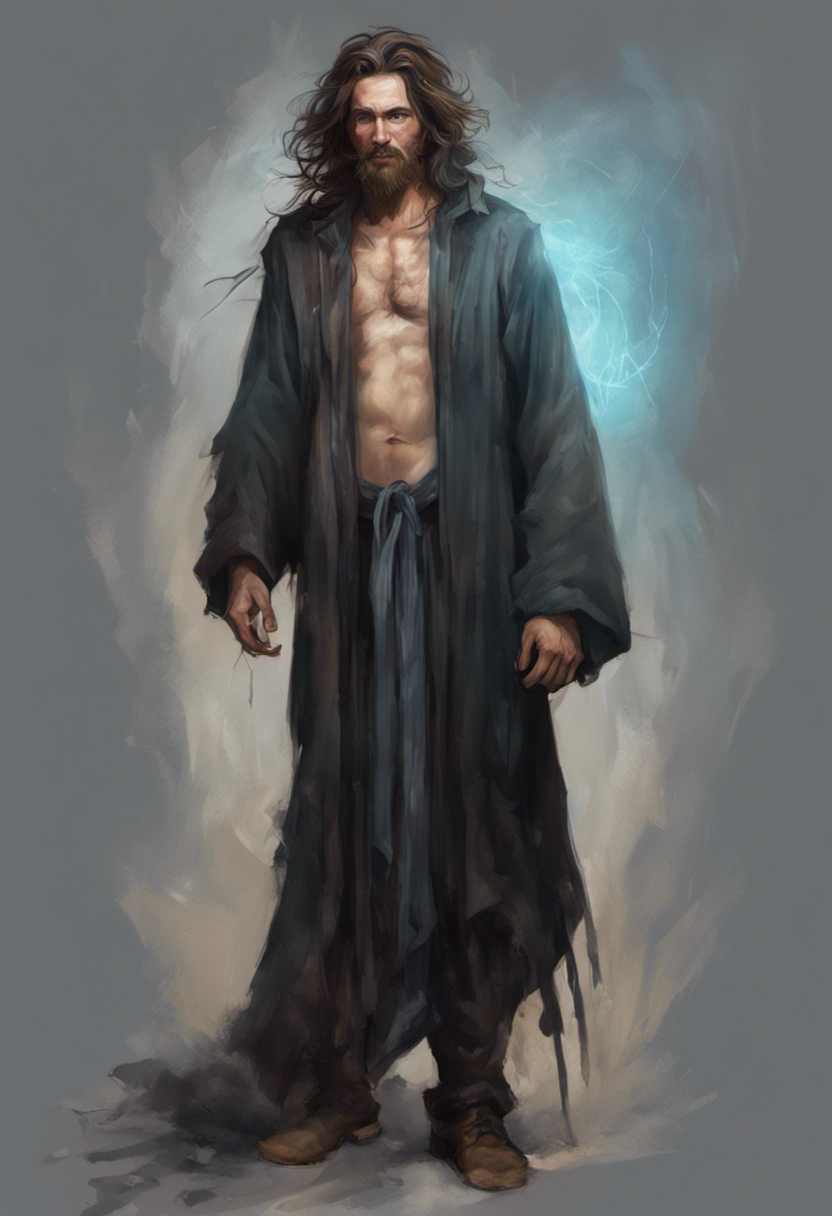
Verrell is a human male wizard: tall, lean, brown-bearded in a way that has never committed to a particular shape, with sharp blue eyes that tend to focus slightly past whoever he is speaking with, on whatever he is actually thinking about. His speciality is transmutation (the transformation of matter from one state to another), and his genuine fascination with what things fundamentally are, and what they could become, is the quality that has kept the tower tolerant of him despite what there is to be tolerated.
What there is to be tolerated is considerable. Verrell is a hedonist in the specific, directed sense of someone who has decided what he enjoys and has arranged his life entirely around having it. He is also, in the assessment of people who have dealt with him at length, a moral slimeball, a characterization he would not dispute and does not lose sleep over. His relationship to ethics is pragmatic and self-serving. He is charming when charm is useful, generous when generosity serves his interests, and capable of actions toward the people he cares about that demonstrate his care is genuine and that his relationship to genuine care is also complicated.
The evidence for this last point is Seraphina "Sera" Blackrose. Sera came to Verrell's attention when she attempted to rob him: a woman of exceptional instinct and skill, from Frosthaven's lower city, who had identified his tower as a target and misjudged how that would go. Rather than involving the constabulary, Verrell offered her instruction. She accepted. What followed is a history that neither of them has fully documented and that Door has witnessed in fragments and relays in fragments, with the earnest incomprehension of someone reporting events whose full context has not been explained to him.
Verrell cursed her. The nature of the curse, the circumstances that produced it, the precise character of the relationship in which someone who is cursed into a medusa transformation by their companion still counts as a companion, these are things neither party discusses with outsiders. What is documented is that the curse was lifted and that Sera, afterward, came back. Her reasons are her own. Verrell does not appear surprised that she returned, which is either confidence or the specific knowledge of someone who understands what they mean to the people they have hurt.
The tower has watched all of this. It has not moved against Verrell. Whether this is tolerance, a conclusion that something was learned, or patience of a kind measured in centuries is not something the stone has communicated clearly.
Verrell's notable creation is the Versatile Vessel, a magical container that becomes whatever form of container the user imagines. It is elegant, useful, and expressive of exactly the kind of curiosity about form and potential that the tower finds acceptable. His work is good. His personal conduct is, by most measures, not, and the two facts coexist in the Spire in the same way they coexist everywhere: uneasily, and for now.
Elara the Illusionist (5140 ME – 5255 ME)

Elara was a half-elf sorcerer whose mastery of illusion ran deeper than the craft's usual reputation for trickery would suggest. She was interested in what illusions are: the philosophical question of whether a perfect copy differs in any meaningful sense from the original, and what the answer implies about reality's claim to uniqueness. Her signature work, the Enchanting Echo, was a spell producing an indistinguishable illusory duplicate of the caster: less a combat technique than a meditation on this question made practical. She was charismatic, vivid, musically inclined, and the Spire was livelier during her tenure than at almost any other point in its history. The five years between her departure and Verrell's arrival were quiet. Door mentions this to people occasionally. He says he missed her. He says this with the specific simplicity of someone who has not learned to understate things.
Thoren the Abjurer (4812 ME – 5062 ME)
Thoren was a dwarven wizard of the abjuration school: the discipline of barriers, counterspells, and interceptions, the magic that asks what is trying to come through and answers nothing, any longer. He was methodical, disciplined, and deeply respectful of what he found when he moved in, including the alcohol restriction he assumed was Elandrin's own enchantment. He honored it without complaint for 250 years, which is either admirable restraint or a testament to how thoroughly a dwarf can respect a predecessor's authority. His Thaumaturgic Theorem, a predictive formula for anticipating and countering incoming spells, has since been incorporated into the magical curriculum of several Irnan academies and is still taught in its original form.
Lysandra the Diviner (4754 ME – 4799 ME)
Lysandra was a human wizard whose speciality in divination left her, by her own account, seeing considerably more of what was coming than she wanted to. She was quiet in a way that suggested she was always processing more than she was sharing, which was accurate. Her 45 years in the tower were characterized by work that was thorough, solitary, and left in better condition than she found it, with one anonymous exception that has shaped every occupancy since.
The vision that prompted the pantry restriction has not been found in any of her surviving notes. Whether she withheld it deliberately or considered it self-explanatory is unknown. Her Luminous Lens, an artifact capable of revealing hidden truths, is in private collection somewhere in the Irnan interior. Her tenure ended in 4799 under circumstances she apparently saw coming and chose not to prevent. This is either acceptance or fatalism. It was probably both.
Gavriel the Evoker (4184 ME – 4754 ME)
Gavriel was an elven wizard of the evocation school who treated the Spire as a base of operations for a life conducted mostly elsewhere. He was present enough to keep the tower satisfied and absent enough that the Spire apparently developed patience as a trait during this period. His Glowing Grasp, a spell creating a hand of pure force energy capable of manipulating objects at considerable range, is still widely used three thousand years after he developed it. He was adventurous, somewhat careless, and lived 570 years in the tower without incident, which is either exceptional luck or exceptional skill and was probably both in proportions that varied by situation.
Ilyana the Enchanter (3923 ME – 4177 ME)
Ilyana was a gnome sorcerer who specialized in the enchantment school: the influence of minds, the adjustment of will, the delicate work of making someone want something they hadn't previously considered. She was charming in the precise sense of someone who has studied charm as a discipline and finds its application genuinely pleasurable. Her Irresistible Invitation, a compulsion spell of remarkable subtlety, was used primarily for social purposes that she found more interesting than combat applications. The tower found her tenure congenial. She also found the pantry restriction irritating, assumed it was Elandrin's, and respected it with the specific compliance of someone who disagrees but is not going to argue with the founder.
Oren the Dimensionalist (3791 ME – 3920 ME)
Oren was a Smaling wizard of the conjuration school, specifically the discipline of creating and sustaining extra-dimensional spaces. His Opulent Oasis, a pocket dimension of comfort and hospitality, was his answer to the question of what should be done with the ability to create any space imaginable. He chose a comfortable room with good food and company. This is considered a reasonable answer. He was the tower's most hospitable occupant in its first two thousand years and the one whose influence on the guest rooms is most directly felt; he had very specific opinions about how a guest should feel and the resources to act on those opinions.
Valsa the Visionary (3760 ME – 3790 ME)
Valsa was a human wizard and diviner who spent thirty years in the tower looking at the world through a crystal ball that could witness events across planes, recording what she saw in a tome that historians now cite as primary source material for events she had no business witnessing in real time. She was meticulous, elaborately robed, and largely uncommunicative with anything that was not a page she was writing on. Thirty years is a brief tenure. Whether the tower found her presence acceptable or merely tolerable has not been established. Her records, at least, proved durable.
Pyrus the Pyromancer (3281 ME – 3758 ME)
Pyrus was an elven wizard of the evocation school who specialized in fire with a commitment his contemporaries found excessive and the tower apparently found within acceptable limits, if not comfortable ones. His everburning fire pits still exist in various locations across Irna and Funta. His flame whip spell is in active use by evokers three thousand years after he developed it. He dressed as though each robe were intended to be read from a distance and conducted himself with the specific arrogance of someone who is very good at something that is visually impressive. The tower's weather enchantment worked harder during his tenure than at any other documented period, managing a great deal of heat from within rather than without.
Zenon the Supreme Arcanist (2911 ME – 3280 ME)
Zenon is the reason the upper tower looks the way it does. He was a wizard of near-universal magical competence (the rare practitioner who has genuinely mastered multiple schools rather than merely studied them), and his tenure at 369 years is the second longest single occupancy in the Spire's history, after Elandrin herself. He was rigorous, dedicated, and careful about most things. The godstone was the exception. He survived the explosion, continued his work for 180 additional years, and appears to have treated the incident as a lesson about the distinction between magical power and magical wisdom. His Zephyr Zone, a weather-control working of considerable scope, reflects priorities that seem to have been reordered by that lesson.
Gellia the Transmuter (2745 ME – 2902 ME)
Gellia was a gnome wizard of the transmutation school who treated her own body as the primary research subject. She transformed herself into a variety of forms throughout her tenure, the most extensively documented of which was a complete draconic transformation sustained for a decade before she returned to gnomish form. The tower's weather enchantment during this period apparently extended its parameters to accommodate a dragon on the second floor. This is the only known instance of the enchantment managing interior conditions rather than exterior ones. Gellia was cheerful, unconcerned with external opinions about her methods, and occasionally difficult to locate because she had become something that was not in the expected position.
Vaeros the Conjurer (2711 ME – 2744 ME)
Vaeros was a human conjuration wizard who specialized in summoning entities from other planes and binding them to service. His tenure lasted 33 years: brief, and apparently strained. The summoned creatures he maintained as household staff created conditions that the tower's enchantments collectively struggled to accommodate, and his relationship to his bound servants demonstrated exactly the kind of instrumental relationship to magical entities that the Spire finds objectionable. He left, or was persuaded to leave, in a manner neither party has documented. The tower returned to its baseline state promptly afterward.
Tharivol the Illusionist (2222 ME – 2707 ME)
Tharivol was an elven illusionist who understood magic as the creation of wonder rather than the exercise of power, a philosophy that aligned naturally with what the tower values. His most famous work was a complete illusory tower that stood in Frosthaven's harbor district for over a year, convincing enough that several residents navigated by it without noticing it was not made of stone. He was mischievous, well-dressed, and difficult to find when he did not want to be found, which was frequently. His tenure of 485 years is among the longer occupancies, and the tower appears to have found it congenial throughout.
Elandrin the Ascendant (1987 ME – 2221 ME)
Elandrin built the tower. This statement does not capture what building the tower meant: not merely the physical construction of a stone structure on a Frosthaven hillside, but the sustained magical investment of 234 years into a project whose full scope she had understood from the beginning and pursued with the patience of a high elf who had decided this was what her centuries were for.
She was an archmage of near-universal competence (her mastery spanned every school of magic), but her guiding philosophy organized all of it around a single conviction: that magic is not a tool but a language, and the proper relationship to it is one of participation rather than use. She built the tower to demonstrate what sustained magical commitment to a place could produce over the kind of time that most practitioners do not spend in one location. She gave the tower its enchantments (the weather system, the alarm, the pantry and well) as practical expressions of this philosophy: magic serving life, continuously, without requiring an act of will to renew. And she spent two centuries in conversation with what she was building, and the building listened, and eventually the conversation became something neither party had fully anticipated.
Elandrin was a diviner among her other competencies. She saw consequences before they arrived. Whether the Spire's eventual sentience was the intended endpoint of her project or its most significant unplanned result is a question her surviving writings don't answer and that the tower, when consulted, declines to address.
What she left when she finally departed in 2221 ME was not a building with magical properties. It was a presence. A disposition toward what magic should be and what the people who practice it owe to it. A standard that every subsequent occupant has been measured against, most without knowing it, and that continues to shape every choice about who lives here and how long they stay.
Her notable works (the Eternal Echo, a time-manipulation working of considerable scope; the Elemental Embrace, a comprehensive elemental command) are academic curiosities now, their techniques absorbed into the tradition that followed. What endures is the tower itself. Three thousand years of operation, uninterrupted, with the standard she set still governing who stays and who is gently, persistently, persuaded to leave.
She departed in 2221 ME. No record explains why she chose that particular year. The tower knows. The tower has been asked.
The tower has not answered.