borun
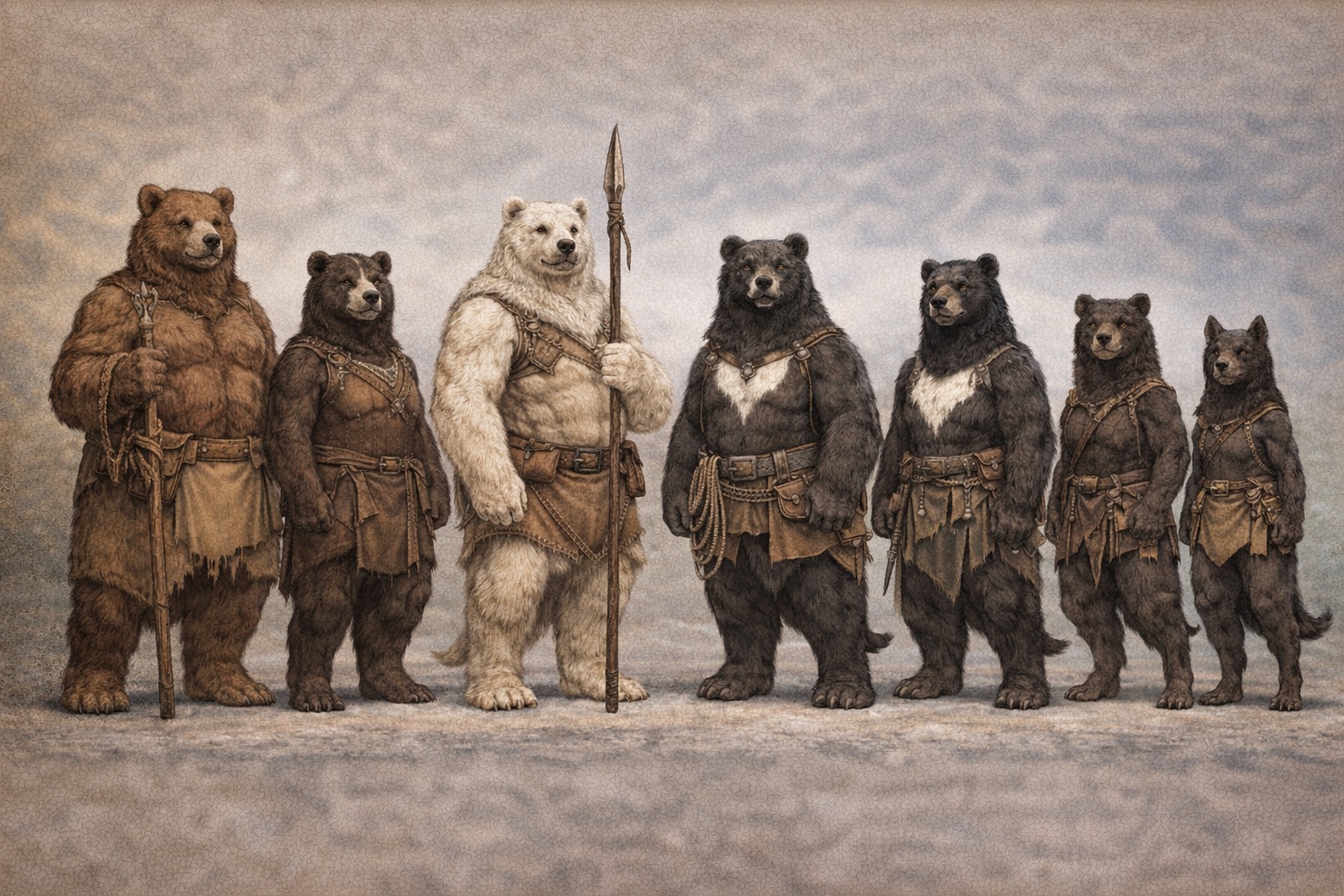
Borun
Playing a Borun? Exodus NDS rules: the free Dort Species Guide from Exodus NDS Sourcebooks. Other systems: see Playing in Dort.
CORE IDENTITY
- Race Name: Borun
- Plural Name: Borun
- Adjective Form: Borun
- Alternate Names: The Forest-People; the Great Clans (used in Irna); the Still Ones (poetic usage)
- Self-Name (Endonym): Borvagen, from the same deep root as their naming tradition; means roughly "those of the deep forest"; used in formal and philosophical contexts
- Outsider Names (Exonyms): Bear-kin (common, neutral); the Unmoved (a Taurik term, offered as genuine respect between two peoples who understand what immovable means); the Heavy Ones (Lapori usage, affectionate); the Forest-Lords (archaic Irna honorific, considered presumptuous by the Borun themselves)
OVERVIEW
Short Description
The Borun are a beastfolk people of bear nature: large, deliberate, and possessed of a stillness that is frequently mistaken for slowness and only slowly revealed as depth. They are organized into clans by forest territory, and clan identity is the primary structure of Borun life, but within that structure each Borun is substantially independent: solitary in their daily ranging, present for the clan in the ways that matter. Their origin traces to mage-work, as with the other shaped peoples, and their naming tradition carries the weight of someone who understood bears as beings of forest interior, of resting strength, of the specific patience that survives a long winter unchanged.
General Reputation
The Borun are regarded throughout Dort with a combination of deep respect and a certain careful courtesy. They are known as reliable, unhurried, and capable of a quality of sustained attention that most other peoples find either reassuring or unsettling depending on whether it is directed toward them or something threatening them. In Irna and northern Shoing, where large Borun clan territories are established, they are considered among the most trustworthy trading partners and territorial neighbors available: not because they are warm or socially accessible, but because their agreements mean what they say and their tolerance for being crowded is a known quantity that no one tests twice. Their physical presence commands attention without requiring effort.
Role in the World
The Borun occupy the civilizational niche of forest stewards, territorial stabilizers, and the people other peoples go to when the question requires someone who has been watching the same stretch of ground for three generations. They are not merchants or navigators or scholars in the conventional sense, but they hold and manage forest and mountain territories whose ecological health other peoples depend on, they produce preserved goods from their territory that no one else makes as well, and their clan-elder councils have served as arbiters of territorial disputes between non-Borun peoples for as long as anyone can document. They are also, simply and directly, the most formidable physical deterrent to certain categories of threat that exist in Dort, and the peoples who live in territories adjacent to Borun clans know this and plan accordingly.
PHYSICAL TRAITS
General Appearance
A Borun reads as bear without ambiguity: the wide deep chest, the round-featured face with small eyes and a significant muzzle, the dense coat, the heavy limbs with their broad paws, and above all the quality of occupying space without apology. They stand fully bipedal, though they can and do drop to a low crouch for certain tasks with an ease that suggests the bipedal posture is comfortable rather than strained. They are not bulky in the awkward sense; Borun move with the precision of something that knows exactly how large it is and exactly how much force every action requires. That precision is, for those who understand it, more imposing than raw size.
Size Ranges
- Typical height: 6'6" – 8'4" (varies by lineage; Ice-kin run largest, Shadow-kin smallest)
- Typical weight/build: Heavy and dense; Borun weight is higher than their height would suggest for any other people. The coat adds apparent bulk beyond the frame.
Distinguishing Features
All Borun share a consistent baseline: dense fur covering the full body in colors that vary by lineage, a significant muzzle with an excellent nose (their olfactory capability is among the strongest of any peoples), small eyes that are more expressive at close range than they appear at distance, rounded external ears, large broad paws with non-retractable claws suited for digging and climbing rather than fighting, and a deliberate quality of movement that looks effortless because it is. Their voices are deep and carry distance without being raised. Borun who are relaxed produce a low rumble in the chest that is not quite a vocalization: more a vibration that other Borun and, with experience, other peoples learn to read as contentment or contemplation.
Sexual Dimorphism
Borun dimorphism is present but less pronounced than outsiders expect. Males across all lineages tend toward larger frame and heavier coat density; females toward somewhat longer endurance on sustained movement. The difference is noted within clans and does not generate meaningfully different social roles.
Aging Patterns
Borun cubs are born small relative to adult size and develop slowly; they remain in close contact with their mother for three to four years, learning the clan territory through accompanied ranging before they begin solo movement. Adult competence is recognized at approximately age twenty, when a young Borun demonstrates the ability to manage a personal territory within the clan range through a full cycle of seasons. Visible aging in Borun appears as coat graying, beginning at the muzzle and spreading progressively across the face and shoulders. Elders whose muzzle is fully grey are called the Grey-Muzzled across all Borun clans and receive a deference that requires no other marker of status.
Regional Variation
Borun appearance is defined by lineage rather than geography. A Den-kin in the warm forests of Funta carries the same brown-to-tawny coat and dense build of that lineage regardless of where they were born. Within lineages, minor generational adaptation occurs, but lineage characteristics remain dominant. Borun are exempt from continental appearance demographic norms; their appearance is defined by bloodline, not birthplace.
BIOLOGY
Diet
Borun are omnivores with a strong emphasis on high-caloric foods: protein from hunting and fishing, dense root vegetables and tubers, and notably honey; the Borun relationship to honey is deep enough to be cultural, but the biological preference for concentrated calories is genuine and consistent across all lineages. They do not require the pure-protein diet of the Felari or Canix, but they consume significantly more food than peoples of equivalent size would need, particularly in the late season as certain lineages build caloric reserves for semi-hibernation.
Sleep Patterns
The Borun seasonal sleep pattern is their most biologically distinctive feature. Den-kin and Mountain-kin enter a semi-hibernation state during the coldest months: a period of weeks to months in which metabolic rate drops significantly, no food is required, and responsiveness is reduced. This is not full deep hibernation (they can be roused, and their bodies maintain enough function to respond to genuine threat), but it is unmistakably a withdrawal from active engagement with the world. Ice-kin and Shadow-kin show lighter seasonal sleep tendencies rather than full semi-hibernation. The cultural significance of this biology is profound: the first days of emergence from winter sleep carry ritual significance across all clans.
Reproduction Basics
Borun give birth to one or two cubs, with single births most common in larger lineages. Gestation is approximately seven to eight months. Cubs are small at birth and completely dependent; the extended developmental period of three to four years of accompanied ranging means that Borun reproduce at longer intervals than most peoples and invest more individual attention per offspring.
Lifespan Ranges
- Typical lifespan: 80–120 years
- Maturity: 18–22 years
- Elderhood: 65–80 years
Environmental Adaptations
Borun cold tolerance is high across all lineages and exceptional in Ice-kin and Mountain-kin. Their fat deposition biology, particularly pronounced in pre-hibernation periods, provides insulation and caloric reserve that serves both cold tolerance and the semi-hibernation cycle. Their paw structure is adapted for soft-ground navigation: the broad paw distributes weight effectively over snow, mud, and forest duff. Ice-kin are competent swimmers with water-shedding coat properties. All Borun have exceptional scent sensitivity; their olfactory range and acuity is one of the most developed of any sapient people.
PSYCHOLOGY & CULTURE
Typical Temperament
Borun present as unhurried, measured, and fully present in a way that is both comfortable and, for those who have not encountered it before, slightly disconcerting. They do not perform engagement: when a Borun gives you their attention, you have all of it, and you know it. When they do not give you their attention, this is equally clear and not personal. Their social baseline is comfortable solitude and comfortable company in roughly equal measure; they do not require company the way Canix do, nor do they perform the composed reserve of the Felari. They simply are, and others learn to work with that.
Cultural Values
- The territory knows: Borun relationship to their territory is the most developed form of place-knowledge in Dort. A Borun clan-elder can tell you the specific scent-signature of a stretch of forest on a still morning in early spring, how it has changed over thirty years, and what those changes mean. This knowledge is not considered property; it is considered responsibility. You know it because you must steward it.
- Strength that rests is still strength: The Borun cultural understanding of power is its most philosophically distinctive contribution. Strength that is at rest is not absent; it is available. The bear that is sleeping is still the bear. The Borun do not need to demonstrate their capacity, and they consider demonstration a form of waste.
- The long patience: Borun decision-making operates on timescales that confuse shorter-cycle peoples. A Borun who says "I will consider this" may be considering it for a month. They are not stalling; they are bringing their full attention to a question that deserves it. The answer, when it comes, is complete.
- The clan holds, the individual ranges: Borun social structure holds these two things simultaneously: deep loyalty to the clan as the unit of identity and belonging, and genuine biological and cultural comfort with extensive periods of solo ranging. These are not in tension. The clan is home; the forest is where you live.
Taboos
- Poisoning the territory: Deliberately damaging the ecology of clan territory (through overhunting, fouling water sources, or harmful introduction) is the deepest Borun violation. The territory is what the clan is. Destroying it is self-destruction.
- Speaking before knowing: Offering an opinion or assessment on a matter you have not personally observed or engaged with sufficiently. Borun intellectual honesty is exacting; confident claims made from insufficient information are treated as a form of disrespect for both the truth and the listener.
- Rousing the winter sleep without cause: Interrupting a Borun's semi-hibernation without genuine need is considered deeply discourteous and, in extreme cases, dangerous. The culture that has grown up around this biology is taken seriously.
Social Structures
The clan is the primary unit of Borun society, a territorial group of between eight and thirty individuals sharing a forest or mountain range. Clans are not densely social in the day-to-day sense; individual Borun range their territory and may go weeks without encountering another clan member. The clan structure is expressed through seasonal gatherings, shared territorial boundaries, collective defense, and the clan-elder councils that make decisions affecting the whole range. Multiple clans in a region form loose alliances called groves, which coordinate territorial boundaries and manage inter-clan disputes.
Family Structure
Borun families are organized around a mother-cub bond as the most intense early social relationship, followed by the gradual expansion of clan-awareness as the young Borun's ranging increases. Adult pair bonds exist and are long-term but not continuously cohabiting; bonded partners range their own territories, intersect regularly, and maintain genuine connection without the constant proximity that more socially dense peoples require.
Leadership Patterns
Clan elders, the Grey-Muzzled, hold council authority. Leadership is a weighted council of demonstrated experience; the elder with the longest and most complete knowledge of the clan territory carries the most influence. Decisions of significant import require consensus among the senior council members; the Borun are deeply uncomfortable with any process by which one member's judgment overrules accumulated collective knowledge without compelling reason.
GEOGRAPHIC DISTRIBUTION
Primary Homelands
- Irna: The primary Borun homeland; dense forests and mountain ranges across the northern and central regions of Irna host the largest Borun populations and the most developed clan-grove structures. Several Irna forests are considered Borun territory without qualification by every other people on the continent.
- Shoing: Mountain forests and highland timber ranges of Shoing are heavily Borun-occupied, primarily Mountain-kin and Den-kin. Shoing Borun have integrated most extensively with the non-Borun peoples of that continent and are represented in several regional governance structures as territorial co-holders.
Secondary Populations (Diaspora)
- Funta: Den-kin and Shadow-kin populations in the forested margins of Funta, smaller but well-established. Funta Borun are in regular contact with Pachari Plains-kin herds and Felari Pride-kin across shared forest-savannah transition zones.
- Antaea: Shadow-kin primarily, adapted to the dense humid forest interior of Antaea. Antaea Borun maintain the smallest clan sizes and the most solitary culture of any regional population.
- Northern coasts: Ice-kin occupy cold coastal and highland regions of northern Irna and Shoing, with some island population in the far northern waters.
Migration Patterns
Borun do not migrate in the displacement sense; they move within territories on seasonal cycles dictated by food availability and semi-hibernation needs. True range expansion happens when a young adult Borun establishes a new personal territory at the edge of the clan range, gradually extending the clan's footprint over generations.
Adaptations by Region
Borun in cold northern regions build winter dens integrated into the landscape; their semi-hibernation biology requires thermally stable underground shelter, and their den-construction techniques work with existing geological features rather than against them. Borun in warm forests eat more actively through what would be the hibernation period for northern lineages and show their reduced-activity period concentrated in the hottest dry months instead. Irna Borun who live near non-Borun communities have adapted to a semi-settled pattern, maintaining a primary den within clan range that functions more like a permanent residence.
Cultural Differences Between Lands
Irna Borun have the most formally developed inter-clan governance traditions. Their grove-councils have formalized protocols, recognized mediators, and accumulated precedent that functions as territorial law. Shoing Borun have integrated most extensively into non-Borun power structures while maintaining clan territory rights. Antaea Borun have drifted furthest from inter-clan coordination; their forest environment supports highly independent clans. Funta Borun have the most developed relationships with non-Borun peoples and the widest cross-race alliances.
HISTORY
Origins
Borun oral history does not treat the mage-shaping as the beginning of their story. The Borun tradition holds that the shaped being emerged from the forest already knowing what it was; the shaping gave form to something that had always been present in the forest's depth. The mage is not named and is not sought. What is preserved is the forest itself: the knowledge of specific places, specific seasonal signs, the accumulated understanding of territory that has been passed from Grey-Muzzled to young Borun for as long as anyone has been asking the question.
Major Turning Points
The Clearing Wars (approximately fifteen centuries before the current era) were a period of prolonged conflict between expanding Irna settlement and established Borun clan territories. The conflict ended with the Compact of the Standing Forest, an agreement establishing recognized Borun clan territories as legally inviolable by non-Borun settlement, in exchange for Borun participation in regional governance of border territories. This compact, in various regional forms, remains the legal basis for Borun territorial recognition across much of Irna and Shoing.
The Great Hunger (approximately eight centuries before the current era) was a multi-year ecological disruption in northern Irna that forced Borun clans out of territories held for centuries. The response, coordinated through the grove-council system, resulted in the first recorded inter-clan territorial exchange: clans with sufficient range absorbing displaced clans as temporary members until the ecology recovered. The moral weight of this period, that the grove must hold even when the forest doesn't, remains central to Borun clan philosophy.
Current Historical Posture
The Borun are, by their own assessment, watching. Their territories are largely stable, their clan-grove systems functioning, and the Compact of the Standing Forest holding in most regions. The persistent concern is what it has been for several centuries: slow pressure of non-Borun settlement at territory edges. Borun clan councils are patient. They have discussed this issue, in its various forms, for longer than most other peoples' written records reach.
LANGUAGE
Language Name(s)
The Borun language is called Boruthis, "the forest-tongue," from the same root as their self-name. It is a deep-register language that sounds, to those hearing it for the first time, like something between speech and the low sounds of a large animal, which is appropriate, because it is both. Boruthis has two major regional variants corresponding to Irna and Shoing populations; they are mutually intelligible with some patience.
Script
Borun writing is called Clawmarks, a notation system developed from territorial scratch-marks, now formalized into a consistent script carved into bark, pressed into clay, and cut into stone for permanent territorial markers. Clawmarks are not elegant; they are unambiguous.
Trade Language Status
Boruthis is not a trade language. Borun who deal regularly with non-Borun peoples learn the relevant regional tongue as a practical matter. They are not quick language learners, but they are thorough ones and retain what they learn permanently. Common carries Borun loanwords primarily in vocabulary related to territory, forest management, seasonal timing, and the specific categories of patience.
Dialect Range
The Irna and Shoing variants are mutually intelligible. Lineage-influenced variation exists (Ice-kin speech has a distinctive register associated with coastal environment), but cross-lineage communication within Boruthis is not difficult.
Naming Agent Cross-Reference
See _Cannon/Race naming ai agents/beastfolk/Beastfolk - Bear.md for full naming rules and generation guidance.
NAMING CONVENTIONS
Borun names follow a given name + clan name structure, both drawn from the Slavic phonological tradition documented in the naming agent file. Names carry weight without aggression: consonant clusters, darker vowels, the quality of something standing in a forest clearing. Names settle after the first syllable.
Clan names describe the founding territory or ancestor. Both given and clan names use the same phonological tradition.
Sex and Name Form
Borun sex-marking rests on a single structural contrast inherited from the Slavic tradition: masculine names close on a consonant, feminine names open into a vowel. This is the cleanest binary of any beastfolk people and it is audible immediately. The masculine endings -ov, -ev, -yn, -an, -ak, -or, -im and -shev contrast with the feminine -a, -ava, -eva, -ina, -yna and -ira, and the feminine is generative: Borvak becomes Borvaka, Voldyn becomes Voldina, Drashor becomes Drashira.
The dark vowels stay dark in both. Feminizing a name must not lighten it, and the characteristic clusters br-, gr-, vl-, str-, -shk-, -vn- appear in women's names identically; a Borun woman named Strava or Vlodina is named exactly as her people name women.
Clan names inflect, and Borun are the only Dort people whose clan names do. Following Slavic practice, a clan called Borvak produces Borvakov for a son and Borvakova for a daughter. The -ushka ending is an affectionate familiar form used within the family, not a birth name.
Name Examples
- Given names (general): Borvak, Gruvan, Medrik, Stravol, Drashev, Voldrak, Brunev, Mirvak, Groznev, Branivok
- Given names (elder / formal address): Same names throughout life; the Grey-Muzzled title distinguishes elders, not a name change
- Clan names: Borvagen, Gruvanev, Stravovsk, Drashimov, Brunvorsk, Voldraken, Mirvovsk
- Honorific / title examples: Grozh- (before the name) for a recognized clan elder holding grove-council standing; -vrak (suffix) for an acknowledged territory master
- Full name examples: Borvak Gruvanev, Drashev Stravovsk, Grozh-Voldrak Brunvorsk, Brunev-vrak Borvagen
SOCIETY
Common Professions
Borun are overrepresented in roles that reward territorial depth, sustained physical presence, and multi-generational ecological knowledge: forest wardens and range managers, apiarists (Borun-territory honey is the most valued in Dort), trackers, preserved-food producers, timber experts, and (somewhat surprisingly to peoples who expect them to be isolationist) respected territorial arbiters for disputes between other peoples. Their position as the most knowledgeable and least politically interested parties in most regional territorial disputes makes them valued mediators.
Craft Traditions
Borun craft centers on materials that reward patient working: wood, bone, stone, and preserved-food traditions. Borun woodwork is not delicate, but it is extraordinarily enduring: furniture, structural timbers, and carved implements built to outlast the person who made them and the person who buys them. Honey and berry preservation, smoked and dried meat, and medicinal herb preparations are their primary trade goods, consistently premium quality throughout Irna and Shoing markets.
Trade Roles
Borun export preserved foods, timber goods, honey, territorial intelligence, and arbitration services. They import worked metal, textile goods, and specific food staples their territory does not produce. Borun bargaining is slow by the standards of peoples like the Lapori. A Borun who has decided to make a trade will make it; a Borun who has decided not to will not be persuaded, and the attempt is regarded as a waste of both parties' time.
Military Tendencies
Borun military character is territorial defense at its absolute most effective and completely without interest in offensive projection. A Borun clan defending its territory is a categorically different situation from a Borun clan at rest, and everyone who has encountered both understands the distinction. Their approach to force is the hibernation-and-emergence model applied to conflict: extended stillness followed by full available force without hesitation. They do not raid; they do not conquer. They hold ground and make the cost of taking it explicit.
Religious Tendencies
Borun spiritual life centers on the territory as sacred: not metaphorically, but in the direct sense that the specific forest, mountain, and stream that the clan ranges is considered a living thing with which the clan has an obligation. Seasonal ceremonies mark the cycle of emergence, ranging, preparation, and sleep as a spiritual as well as practical cycle. The winter sleep itself is treated with profound reverence, a time of communion with something that cannot be accessed while fully conscious. Grey-Muzzled elders who have accumulated many winter sleeps are considered to have access to a depth of understanding that younger Borun cannot yet reach.
INTERACTIONS
Relations with Other Races
- Aviari: A productive territorial relationship. Aviari Sky-kin and Borun clans occupy the same mountain territories in different vertical strata (Borun on the ground and forest floor, Aviari in the air) and have developed explicit territorial conventions that work well. They trade navigation knowledge for territorial information with a directness both peoples appreciate.
- Pachari: Mutual recognition between two peoples who understand long stewardship. The Borun territorial knowledge and the Pachari ecological memory complement each other in overlapping regions, and their councils have collaborated on territorial management for centuries. Both peoples find the other's patience entirely appropriate.
- Gnomes (Zannovi): An unexpected relationship built around honey. Gnome cook guilds consider Borun-territory honey among the finest in Dort, and the commercial relationship brings the two peoples into regular contact. The Gnomes find the Borun deeply impressive; the Borun find the Gnomes genuinely diverting, a form of engagement Borun do not typically initiate but do not discourage.
- Urgrak: A relationship of carefully maintained distance and clear boundary acknowledgment. Urgrak clans and Borun clans have conflicted historically when Urgrak expansion pushed into forest territories, and the memory is present in both peoples' culture. The current norm is acknowledged mutual deterrence: boundaries are clear, violations are responded to without ambiguity, and neither people goes looking for conflict.
Stereotypes (Given and Received)
- Stereotypes about them: That they are slow (false; deliberate is not the same as slow, and Borun who have decided to move are faster than most expect); that they are solitary and antisocial (half-true; they need solitude, but they are not incapable of warmth); that they are threatening at all times (false: the threatening quality is present and available; it is not the default state).
- Stereotypes they hold: That most peoples make too much noise for too little purpose; that Lapori have not yet discovered the value of stillness; that Urgrak would be less troubled if they spent more time in one forest for more than one season; that the Gnomes' honey obsession, despite everything, reflects sound judgment.
Cooperation Patterns
Borun cooperate most readily with peoples who are clear about their terms, respect territorial acknowledgment, and do not require constant reassurance that the cooperation is ongoing. Long-term relationships built on consistent and honest dealing are their preferred mode; once a relationship is established, Borun commitment is the same quality as everything else about them: it does not need to be demonstrated constantly to be present.
Conflict Patterns
Conflict with Borun follows a consistent pattern: territorial encroachment, ecological damage to claimed range, and the persistent pressure that tests whether the Borun's patience means they can be ignored. They cannot. The most common cultural misunderstanding is the assumption that Borun stillness is the absence of a response rather than the preparation for one.
VARIANTS
Physical / Regional Variants
Borun lineages are biologically defined. Within a single clan, multiple lineages may coexist; lineage characteristics remain consistent regardless of clan affiliation.
Den-kin
The forest bear lineage, the most widespread Borun and the most often encountered by other peoples. Den-kin coats range from tawny-gold through brown to near-black, with individual variation. They are mid-range in size and the most adaptable in diet and territory type. Den-kin show the most pronounced semi-hibernation of any lineage: the deepest and longest winter sleep, lasting six weeks to four months depending on season severity. Their emergence from winter sleep is considered the most significant personal event of the year in Den-kin culture.
- Typical height: 6'8" – 7'10"
- Defining biological traits: Semi-hibernation most pronounced; tawny-to-near-black coat; broadest dietary omnivory; most adaptable territory; most widely distributed
- Range: Irna forests and mountain margins; Funta forest transition zones; the most distributed lineage across all continents
Ice-kin
The northern cold-water lineage: the largest Borun, built for cold and water. Ice-kin coats are pale cream to near-white with a slightly oily texture that sheds water effectively. They are exceptional swimmers, the only Borun lineage with genuine aquatic capability. Ice-kin show the lightest semi-hibernation of any lineage; they remain more active through cold seasons than Den-kin or Mountain-kin. They are the most solitary lineage; Ice-kin clans are the smallest with the largest individual ranging territory.
- Typical height: 7'4" – 8'4"
- Defining biological traits: Largest Borun frame; cream-to-white water-shedding coat; genuine swimming capability; lightest semi-hibernation; most solitary; smallest clan size
- Range: Northern Irna coasts and highlands; northern Shoing coastal ranges; any cold coastal environment
Mountain-kin
The highland forest lineage: mid-range in size, with a distinctive pale chest marking against a predominantly dark coat, consistent across the lineage. Mountain-kin are the most agile Borun in vertical terrain; their claw structure and shoulder articulation allows tree-climbing at sizes other lineages cannot manage, and they are the most comfortable Borun at altitude. Semi-hibernation is moderately pronounced, concentrated in the coldest highland months. Mountain-kin maintain particularly precise territorial knowledge of specific mountain features.
- Typical height: 6'6" – 7'8"
- Defining biological traits: Distinctive pale chest marking against dark coat; most agile in vertical terrain; most comfortable at altitude; moderate semi-hibernation; detailed mountain-feature territorial knowledge
- Range: Highland ranges of Shoing and Irna; high mountain forests
Shadow-kin
The forest-depth lineage: the smallest Borun, adapted to warm, dense forest environments. Shadow-kin have the darkest coats, ranging from deep brown to near-black, providing concealment in dense forest shadow. They are the most agile Borun; lighter frame and flexible shoulder structure allows movement through tight understory that other lineages cannot navigate. Their tongue is proportionally longer than other lineages, reflecting origin-biology and assisting in extracting honey, insect nests, and other high-density foods from confined spaces. In warm forest environments they often simply reduce activity rather than fully sleeping.
- Typical height: 6'6" – 7'4"
- Defining biological traits: Smallest Borun frame; darkest coat; most agile forest movement; proportionally longest tongue; lightest semi-hibernation in warm conditions; warm climate adaptation
- Range: Antaea forest interior; Funta forest margins; anywhere dense warm forest provides both food density and concealment
Cultural Branches
The Grove-Walkers
Borun who have taken on recognized inter-clan roles as territorial mediators for disputes between clans whose own elders are parties to the conflict. Grove-Walkers are typically mid-career Borun with territorial knowledge across multiple clan ranges, acknowledged as having no stake in any specific outcome. The role requires extended time away from personal territory, a significant sacrifice for beings as territory-bonded as the Borun.
The City-Denning
A small and debated Borun cultural development: individuals and small family groups who have established permanent residence in non-Borun cities, primarily in Irna. City-Denning Borun maintain their clan affiliations and return to clan territory seasonally for the winter sleep, but their daily life is urban. Traditional clan councils regard this with cautious tolerance; the City-Denning argue, correctly, that their knowledge of non-Borun culture makes them valuable to the grove-council system in negotiations.
DEVELOPMENT NOTES (Author use only, not canon)
Story Hooks
- A Grey-Muzzled Borun elder has failed to emerge from winter sleep at the expected time. The clan does not know whether she is dead, still sleeping, or experiencing something else. She is the sole keeper of the most complete version of the clan's territorial knowledge. The decision about whether and how to rouse her is one the clan cannot agree on.
- The boundary of a Borun clan territory in Irna coincides exactly with the proposed route of a significant new trade road. The road's backers have not approached the clan. The clan is aware of the proposal. The silence is deliberate, and it is not patience; or rather, it is a very specific kind of patience.
- A young Borun who completed their first winter sleep recently has reported something about the experience that no elder recognizes, a description of a place and a presence that has no precedent in any clan's memory. The Grey-Muzzled are not dismissing it. They are concerned.
- An Ice-kin clan in the northern waters is ranging through territory no Ice-kin has mapped before. They are finding signs that something else was there before them. The signs are old and deliberate.
Unresolved Lore / Open Questions
- What is the nature of the winter sleep as a spiritual experience? The Borun treat it with reverence; what do they actually experience that other peoples do not?
- The Compact of the Standing Forest exists in multiple regional forms: has it ever been formally invoked against a state-level actor, and what happened?
- Are there Borun lineages beyond the four documented? The naming agent's taxonomy suggests the mage drew from a broader range of bear species.
- What is the relationship between Borun olfactory depth and the spiritual value they place on territorial knowledge? Is scent memory related to the winter sleep experience?
Development Notes
- Cross-link with Irna and Shoing forest settlement entries when written
- The Compact of the Standing Forest deserves a dedicated canon document
- Borun honey as a specific trade good should appear in city market entries
- Grove-Walker tradition intersects with inter-clan governance; consider whether named groves should appear in regional entries
- City-Denning Borun in Irna cities are good background characters for urban-set stories