canix
Canix
Playing a Canix? Exodus NDS rules: the free Dort Species Guide from Exodus NDS Sourcebooks. Other systems: see Playing in Dort.
CORE IDENTITY
- Race Name: Canix
- Plural Name: Canix
- Adjective Form: Canix
- Alternate Names: The Pack-People; the Mage-Born (same scholarly term used for Felari, sometimes used to group both peoples); the Voiced Ones (poetic, for their vocal range and expressiveness)
- Self-Name (Endonym): Izomar (from Canix speech, roughly "those who run together"), used most often in formal or philosophical contexts; in daily life they simply say the pack name
- Outsider Names (Exonyms): Dog-kin (common, neutral); the Loud Ones (Felari usage, affectionate-dismissive); the Faithful (a Smaling term that Canix find reductive but not offensive); Pack-runners (trader slang)
OVERVIEW
Short Description
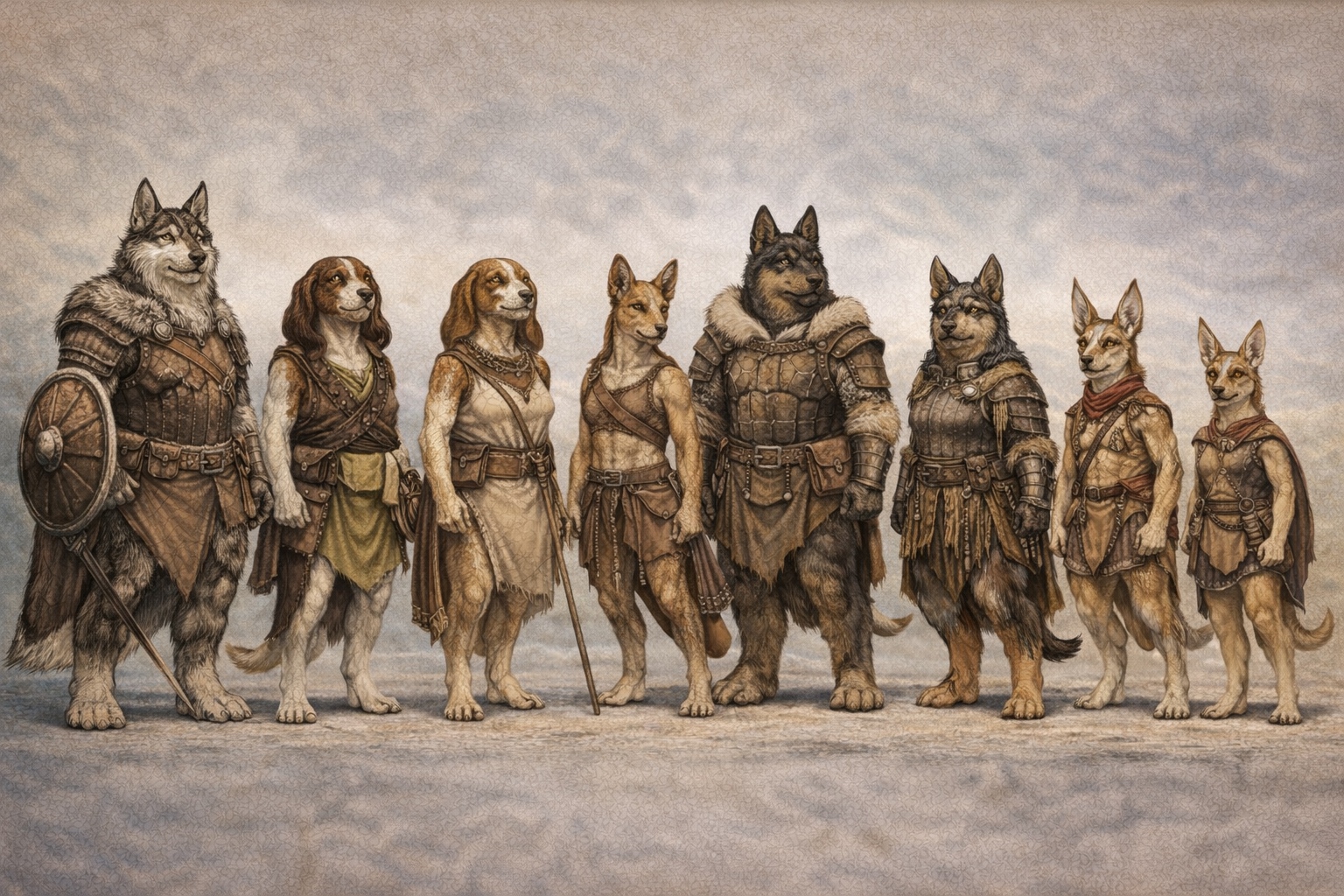
The Canix are a beastfolk people of unmistakably canine nature: upright and bipedal, with mobile, expressive ears, a communicative tail, and a social density of presence that makes itself known the moment they enter a space. Where the Felari presence is felt before it is announced, the Canix presence is announced. They are pack animals in the fullest sense: extraordinarily capable in coordinated groups, deeply attuned to hierarchy and role within that group, and visibly, vocally, physically alive in a way that quieter peoples find either exhilarating or exhausting. Their origins, like those of the Felari, trace to mage-work that encoded a natural form into sapient shape, and Canix regard this as their Canix origin do: with pride, without resentment, and without particular interest in debating what came before the shaping.
General Reputation
The Canix are regarded across most of Dort as reliable, warm, intensely loyal, and capable of both great cooperation and fierce territorial stubbornness, depending on which side of a relationship you are on. Their pack-loyalty is their most noted quality, widely considered the most reliable indicator of Canix behavior in any situation: find out who their packmates are, and you know what they will and will not do. In Funta and Jazirah, where Canix populations are large and established, they are considered valued community members and formidable allies. In Irna, they are a familiar presence in military and working contexts, well-regarded and sometimes underestimated. The Urgrak respect them bluntly and directly, which Canix tend to find appropriate.
Role in the World
The Canix occupy the civilizational niche of coordinators, protectors, and long-distance communicators. Where the Felari hunt in the patient mode of the individual, the Canix hunt in the coordinated mode of the pack, and that same cooperative instinct extends into their broader social role: they build the communication networks, guard the routes, coordinate the responses to shared threats, and remember the relationships between groups. They are not builders of stone cities or forgers of arcane traditions, but they are the reason messages arrive, caravans complete their routes, and distant communities have warning before the trouble reaches them.
PHYSICAL TRAITS
General Appearance
A Canix reads as canine immediately and completely: the upright mobile ears (in some lineages enormous), the long expressive tail, the muzzle with its wet nose and articulate lips capable of a remarkable range of visible expression, and the energy of a creature that is fundamentally oriented toward the world and toward others. They stand fully bipedal and are built for endurance rather than explosive speed in most lineages, with deep chests, strong hindquarters, and legs that are built to keep moving. Fur covers the body; texture, color, and density vary substantially by lineage. Their eyes are characteristically warm in tone (amber, brown, gold), though exceptions exist.
Size Ranges
- Typical height: 5'0" – 6'8" (varies significantly by lineage; see Variants)
- Typical weight/build: Medium-to-heavy across most lineages; endurance musculature rather than mass-for-mass strength; heavier lineages carry significant coat density
Distinguishing Features
All Canix share a baseline set of features regardless of lineage: mobile external ears with independent rotation and a strong connection to emotional state (Canix ears are expressive in ways most other peoples quickly learn to read), a long communicative tail, muzzle with externally visible nose, paw-hands with non-retractable claws, digitigrade foot structure creating a characteristic upright posture. Their voice is distinctive; Canix have the broadest vocal range of any sapient people in Dort, capable of sounds from subsonic rumbles to frequencies that carry across extraordinary distances. They are also the most physically expressive people by conventional measure: tail, ear, body posture, and facial expression all communicate simultaneously and are difficult to mask.
Sexual Dimorphism
Dimorphism in Canix varies by lineage. Most lineages show minimal dimorphism beyond moderate size differences. Guardian-kin and Wolf-kin males tend toward heavier musculature and larger frame; females in the same lineages tend toward slightly longer endurance range and a marginally stronger pack-coordination instinct, though both observations are tendencies rather than rules. Course-kin dimorphism is minimal. Jackal-kin show the least dimorphism of any lineage.
Aging Patterns
Canix pups reach juvenile independence quickly: walking within weeks, functional pack members by age five or six in a practical sense. Adult acknowledgment within the pack comes through a combination of demonstrated contribution and a formal pack-welcome rite that typically occurs between ages fourteen and seventeen. Full adult standing is considered established once a Canix has been part of a pack's significant decisions: guided a hunt, contributed to a territorial negotiation, been relied upon in a crisis. Visible aging in Canix appears first in the muzzle, which greys progressively; by elderhood, most Canix carry a distinctly silver face. Elder Canix are called the Grey-Faced in common speech and the term carries deep respect.
Regional Variation
Like the Felari, Canix appearance is defined by lineage rather than geography. A Wolf-kin in the arid plains of Jazirah carries the same dense coat and frame as a Wolf-kin in the cold forests of Irna. Within lineages, some generational adaptation occurs (Wolf-kin packs in warm climates may run slightly lighter coat density over many generations), but lineage characteristics remain dominant. Canix are exempt from continental appearance demographic norms; their appearance is defined by bloodline, not birthplace.
BIOLOGY
Diet
Canix are omnivores with a strong preference for meat-heavy diets. Unlike Felari, they can digest a meaningful range of plant matter and do so regularly; their biology supports grain, root vegetables, and cooked legumes without difficulty, though a diet lacking significant animal protein leaves them noticeably diminished in energy and mood over time. Pack meals are culturally significant; shared eating is a pack-bonding behavior with a genuine biological component, not merely custom. Canix who eat alone regularly over extended periods show measurable social discomfort, and the pack eating tradition is one of the most consistent cultural practices across all lineages and regions.
Sleep Patterns
Canix are diurnal and prefer uninterrupted overnight sleep, though their sleep is notably lighter than most peoples, a biological adaptation for pack security. Canix sleeping in proximity to packmates sleep more deeply than Canix sleeping alone, measurably so. Pack sleeping in a shared warm space is standard across almost all lineages and regions; the specific arrangement varies by lineage (Guardian-kin pile in a way that would astonish solitary peoples; Wolf-kin typically keep a perimeter orientation even at rest), but the communal element is consistent.
Reproduction Basics
Canix gestation runs approximately six to seven months, producing litters of one to five pups. Litters of two to three are most common. Both parents are involved in pup-rearing; the pack participates actively in pup socialization from the earliest weeks. Young pups are raised by the pack collectively in most lineages; a Canix pup who knows only their birth parents is considered underprepared for pack life, and the broader pack involvement is considered a matter of the pup's welfare, not just convenience.
Lifespan Ranges
- Typical lifespan: 55–75 years
- Maturity: 16–20 years
- Elderhood: 45–55 years
Environmental Adaptations
Cold tolerance varies by lineage: Wolf-kin and Guardian-kin are well-adapted to cold conditions; Jackal-kin are the most heat-adapted. All Canix have endurance characteristics that exceed most peoples in sustained activity over long distances; they are built for keeping pace over hours, not for explosive short bursts. Scent-kin have the most developed olfactory biology of any sapient people in Dort. All Canix have long-distance vocal range that exceeds most races; their howl-calls carry further than is immediately intuitive, and this has been used as a communication system across territories since before recorded history.
PSYCHOLOGY & CULTURE
Typical Temperament
Canix present as warm, direct, and energetically social. They are the sort of people who notice you before you notice them, then make sure you know they've noticed. This is not performance; it is genuine engagement. Canix are oriented toward others as a baseline state; isolation is the exception that requires explanation, not connection. Within the pack, this energy takes the form of relentless mutual awareness: a Canix knows where their packmates are, how they're feeling, and what they need, often before anyone has said anything aloud. Outside the pack, Canix are often experienced as warmly overwhelming (too much presence, too much eye contact, too much obvious attention) by peoples who calibrate differently. They mean all of it.
Cultural Values
- The pack is the self: The Canix sense of identity is fundamentally collective. A Canix does not think of themselves as an individual who has chosen a pack; they think of themselves as a member whose pack is part of who they are. Changing packs is a life event of significant weight.
- Honesty of the body: Canix do not believe in the strategic management of visible emotion. Their ears and tail communicate involuntarily and they generally do not attempt to override them. This creates a culture of remarkable emotional transparency within the pack and a corresponding bluntness in communication that outsiders sometimes find startling.
- The pack remembers: Canix oral memory traditions are extraordinarily developed. Packs maintain generational memory (names of ancestors, records of significant hunts, territorial histories, accounts of relationships with neighboring packs) going back further than written records of other peoples. This is not nostalgia; it is considered a living resource.
- Earned rank, not inherited rank: Within a pack, rank is not simply inherited. Pups born to the pack's alpha pair do not automatically hold high rank when adult; they must demonstrate the same qualities that earned their parents their position. Bloodline is noted but not determinative.
Taboos
- Abandoning a packmate: The absolute prohibition. Context matters (impossible situations are recognized), but a Canix who leaves a living packmate behind when there was any other option carries that mark permanently. Unlike many peoples, Canix do not have a formal forgiveness process for this; the pack either decides to acknowledge the context or it doesn't.
- False scent: The concept of deliberately misrepresenting emotional state, intention, or loyalty to a packmate. Canix recognize that outsiders conceal their feelings regularly and consider this a learned skill of limited virtue; doing it within the pack is considered a kind of internal betrayal.
- Eating alone while packmates go hungry: The shared meal tradition is deep enough that choosing personal comfort over pack welfare in a provisioning situation is a recognized taboo. It is rarely encountered but strongly felt when it is.
Social Structures
The pack is the fundamental unit of Canix society, running typically between ten and sixty individuals. Unlike Felari prides, Canix packs have explicit internal rank structures (alpha, beta, and a recognized hierarchy below that), which are demonstrated through behavior and acknowledged through a combination of posture, vocal, and behavioral signaling that operates continuously and naturally. Multiple packs in a region form alliance networks called runs, which share territorial coordination, inter-pack assistance obligations, and a shared oral history. There is no Canix nation; there are runs, and the largest runs have the political weight of small states.
Family Structure
Canix pair bonds typically form between an alpha pair and are the most publicly acknowledged relationship structure in the pack, but the pack itself is the family unit. Pups are raised collectively. Adoption of individuals from outside the pack is common and fully recognized; a Canix adopted into a pack has every right and obligation of a birth member. Inter-pack bonding (pair bonds that cross pack lines) is a recognized diplomatic relationship, often used deliberately to cement pack alliances.
Leadership Patterns
Alpha rank is earned through demonstrated capability (physical endurance, navigational judgment, conflict resolution, and the respect of the pack) and is acknowledged through the pack's behavioral response rather than through formal election. An alpha who has lost genuine pack confidence is functionally no longer alpha, whatever they believe about themselves. Beta rank serves as both second-in-command and succession, typically held by the individual the pack would most likely turn to in a crisis. In larger packs, a council of senior members provides input to alpha decisions on significant matters.
GEOGRAPHIC DISTRIBUTION
Primary Homelands
- Jazirah: The oldest and most densely populated Canix homeland, where the open desert and scrubland corridors suit the long-range pack movement that Canix endurance is built for. Jazirah Canix packs have been the primary overland communication network of that continent for over fifteen centuries; knowing where the packs run means knowing how messages move.
- Funta: Large, well-established Canix populations spread across the open plains and river margins of Funta. Funta Canix packs tend toward the largest run-networks on any continent, with multi-pack coordination in communication and territorial management that has been compared in complexity to formal state administration.
- Irna: A significant and long-established Canix presence, concentrated in the northern and central regions. Irna Canix have been integrated into the military, courier, and working traditions of the continent for centuries and are among the most comfortable Canix populations in non-Canix institutional structures.
Secondary Populations (Diaspora)
- Shoing: Smaller Canix populations in the eastern and central regions of Shoing, primarily Wolf-kin packs. Shoing Canix have integrated into the region's highland communities as herding specialists and territorial guards, and several have taken formal positions within larger non-Canix political structures.
- Antaea: Scattered Canix packs in Antaea, primarily in the more open northern regions. Their presence is smaller and more recent than in other regions; Antaea Canix often find the Felari-dominated forest interiors uncomfortable territory for pack coordination.
Migration Patterns
Canix expansion has historically followed the long-run pattern: packs move, following game or trade corridors or following the invitation of communities that want the communication and protection services packs provide. Unlike Felari fission-migration, Canix migration tends to be whole-pack: an entire pack relocates, taking its internal structure with it, rather than a segment splitting off to form a new identity. New packs form when internal pack dynamics produce a clear second leadership pair and a large enough group to sustain independence; this is called a branching and is recognized as healthy by all parties.
Adaptations by Region
Canix in the desert territories of Jazirah move in the cool hours, cache water at known waypoints, and have developed a communication convention using long-distance howl-calls that has become so complex in Jazirah that pack-runners can transmit surprisingly detailed messages across days of travel distance. Irna Canix in cold northern regions rely on their coat insulation (particularly Wolf-kin and Guardian-kin, whose coat density is substantial) and have adapted their den-construction traditions to permanent structures where open-country packs would dig seasonal dens. Urban Canix have adapted pack structures to city geography, holding district territories, trade route acknowledgments, and messenger network franchises in place of hunting ranges.
Cultural Differences Between Lands
Jazirah Canix have developed the most sophisticated inter-pack diplomatic traditions, a consequence of managing message-relay networks across multiple packs with competing territorial interests. Funta Canix packs run the largest, most publicly social pack cultures; multi-pack gathering events, shared hunts, and public oral history recitations are common. Irna Canix have adapted most readily to non-Canix institutional culture; Irna packs often hold formal contracts with non-Canix employers and city governments, treating pack-obligations and external contracts as parallel systems that can coexist. Shoing Canix have integrated the most with non-Canix hierarchical structures, sometimes holding formal rank within non-Canix political entities while maintaining pack identity alongside it.
HISTORY
Origins
Canix origins, like Felari origins, trace to mage-work, a shaping of canine nature into sapient form. The Canix tradition calls this the First Run: the moment when shaped beings moved together with intention for the first time, establishing the pack-nature that defines every Canix alive. The mages who performed this work are not recalled by name; Canix oral history names them collectively as the Shapers and considers the naming of them individually to be irrelevant to what they created. The philosophical inheritance is straightforward: the Canix were given a nature that requires others to fulfill (a pack animal's need for the pack), and this is considered a gift, not a limitation. You cannot be fully yourself alone. That is not a flaw. That is the design.
Major Turning Points
The First Great Run (estimated eighteen to twenty-two centuries before the current era) is the oral history term for the period of Canix expansion from their earliest known territories across the continent corridors that would become Jazirah and Funta. The Great Run was not a single event but a sustained multi-generational migration along game trails and water routes; it established the pack-network infrastructure that Canix society still runs on.
The Pack Wars (approximately twelve centuries before the current era) were a period of intense territorial conflict in Funta between expanding pack-networks whose ranges were overlapping in ways the communication systems of the time could not resolve. The resolution was the Compact of the Shared Run, a foundational inter-pack law that established recognized corridor rights: the right of a pack to move through acknowledged territory of another pack on established routes, without challenge, in exchange for reciprocal recognition. This compact underlies every Canix territorial negotiation since.
The Irna Integration (approximately six centuries before the current era) describes the sustained period of Canix engagement with Irna's settled city-states, in which Canix packs were formally contracted into military, courier, and working roles within non-Canix institutions. This was unprecedented (packs existing within non-pack power structures) and generated the internal cultural debate that has never fully resolved: whether integration with outsider institutions is the pack's service to the world or a slow dissolution of what a pack is.
Current Historical Posture
The Canix are, by most measures, ascendant: their communication networks are essential infrastructure across most of Dort's major trade routes, their military value is recognized, their populations are growing, and the Compact of the Shared Run has held for centuries. The internal tension is the same question the Irna Integration raised: what does it mean to be a pack in a world that increasingly offers packs institutional roles that require behaving as something other than a pack? The Grey-Faced elders who hold the oral memory are unworried. The younger generation who grew up in city-packs are working it out.
LANGUAGE
Language Name(s)
The Canix language is called Ighran, derived from the same root as their word for howl-call, suggesting that the spoken language is understood as an extension of the vocal communication tradition that predates speech. Ighran has two primary regional variants: Ighran-Jazirah and Ighran-Funta, which are mutually intelligible with some difficulty. A third variant, Mira-Ighran, is emerging in Irna urban pack communities, incorporating significant borrowed vocabulary.
Script
Canix writing is called Packmarks, a robust, angular script developed from territorial scratch-marks, with strong vertical and diagonal strokes. It is written on stone, bark, and treated hide. Most adult Canix are functionally literate in Packmarks; full mastery of the calligraphic tradition is a recognized craft and is associated with the memory-keeper role within packs. Packmarks are also used on territorial boundary markers throughout Canix range; these are among the most widely visible pieces of Canix writing and are recognizable to non-Canix peoples across Dort even without understanding.
Trade Language Status
Ighran is a recognized trade language in Jazirah and parts of Funta, where pack-network density makes Canix-speaker fluency practical. Canix individuals are competent language learners and typically acquire the dominant regional tongue of wherever their pack ranges. Common carries Canix loanwords primarily in vocabulary related to communication, warning systems, cooperation, and group organization.
Dialect Range
The primary variants (Jazirah, Funta, and emergent Irna urban) are the major splits. Within each, pack-specific vocabulary for territorial features, named runs, and rank titles creates local opacity that outsiders notice quickly. The vocal communication system that runs alongside speech (howl-calls, alert barks, subsonic rumbles) has its own regional variation that is considered a distinct dialect layer separate from the spoken language.
Naming Agent Cross-Reference
See _Cannon/Race naming ai agents/beastfolk/Beastfolk - Canine.md for full naming rules and generation guidance.
NAMING CONVENTIONS
Canix names follow a given name + pack name structure, both drawn from Ighran phonology. Names favor emphatic consonants, -agh endings, and -iz-/-az- infixes, per the naming agent's documented conventions.
Pack names describe the pack's founding territory, a defining deed, or a character quality recognized in the pack's founding generation. They remain in the same phonological tradition as given names. Formal address uses the full name; within a pack, given name alone is standard. Rank titles may substitute for the given name in command contexts; an alpha may be addressed by rank title alone.
Sex and Name Form
Canix sex-marking is the most structurally distinctive of any people on Dort, because Ighran does not mark sex with a suffix; it wraps the name. The feminine is formed by a circumfix: an initial T- and a final -t enclosing the masculine root. Izamagh becomes Tizamt; Tafaren becomes Tafat; Azulan becomes Tazult.
Both halves are required; Tizam and Izamt are equally wrong. The name is enclosed or it is not feminine, and replacing the circumfix with an appended vowel destroys the one feature that makes a Canix name instantly recognizable. The enclosed root keeps its emphatic consonants and its -iz- / -az- infixes unchanged. Where a root already begins with T-, it is not doubled.
Ambiguous forms barely exist: Ighran marking is thorough, and a Canix hearing a name knows immediately. Pack names never take the circumfix; a pack name belongs to everyone in it. The circumfix is also how the Canix mark the distinction in their own word for themselves, which is why the pattern carries weight beyond grammar and why Canix communities treat it as a point of identity rather than mere inflection.
Name Examples
- Given names (general): Izomar, Tafaghan, Azulin, Yughran, Tizaren, Nafzigh, Azuram, Taghlin, Izafar, Yuzban
- Given names (elder / formal address): Same names are used throughout life; elders are distinguished by the -agh honorific appended: Izomaragh, Nafzighagh
- Pack names: Tafaz, Ighrun, Azomar, Yuzban, Nafari, Tizaghun
- Honorific / title examples: Izagh- (before the name) for a recognized alpha; -azin (as suffix) for a memory-keeper
- Full name examples: Tafaghan Ighrun, Izagh-Azulin Tafaz, Nafzighagh Azomar, Tizaren-azin Yuzban
SOCIETY
Common Professions
Canix are overrepresented in roles that require sustained movement, coordination under pressure, and reliable communication over distance: courier and message-runner networks, overland escort, military scouting, and territorial security are their most historically consistent niches. Their nose is a genuine professional asset; Scent-kin in particular find roles in investigation, search, and the tracking of missing persons or contraband that no other peoples can match. Guardian-kin work in protective and herding roles where endurance and intimidation both matter. In urban environments, Canix are disproportionately found in city watch, fire response, and emergency coordination roles: anything that benefits from organized, rapid, pack-structured response. Their oral memory tradition makes Canix excellent teachers, historians, and court witnesses in cultures that value oral testimony.
Craft Traditions
Canix craft centers on durability and utility; they make things that hold up under extended field conditions. Their leatherwork is practical and robust rather than decorative; their rope and cordage work is exceptional, a consequence of needing reliable kit on long runs. Pack records, maintained in Packmarks on treated hide or bark, are often beautiful objects, with the memory-keeper's calligraphic work considered a high art within the pack. Territorial boundary markers, carved or scratched, are considered public craft and receive serious aesthetic attention even when they are also functional warnings.
Trade Roles
Canix packs export courier and escort services, territorial intelligence, and tracking expertise. They also export high-quality preserved field rations and cordage goods. Imports center on metalwork (Canix are not smelters) and on luxury food goods for pack feast occasions. Canix bargaining culture is direct and energetically honest; they tend toward transparent negotiation and respond poorly to feeling deceived, which in a people with their physical expressiveness tends to be obvious when it occurs.
Military Tendencies
Canix military character is built on coordination, endurance, and communication: the pack fighting as a coordinated unit rather than as a collection of individuals. They excel at covering ground, maintaining contact between separated elements, and responding to changing situations faster than most armies can manage because their internal communication systems are faster. Canix do not have a culture of static defense; their instinct is movement, encirclement, and attrition through speed and coordination. Single packs function as light military units in their own right; pack-runs functioning together in coordination have served as the backbone of several major Jazirah and Funta military alliances.
Religious Tendencies
Canix spiritual life centers on the ancestors held in oral memory, the Grey-Faced elders who have died but whose words are still spoken. Memory is not merely historical for Canix; the remembered dead are genuinely present in pack consciousness, and the memory-keeper role carries spiritual as well as archival weight. Most packs maintain a practice of speaking the names of notable deceased pack-members at significant gatherings, which outsiders sometimes observe with confusion and Canix find completely natural. Packs in regions with strong temple traditions participate in local rites without abandoning pack-memory practice; the two systems sit alongside each other without obvious friction.
INTERACTIONS
Relations with Other Races
- Felari: The most complex single relationship in Canix life. Two peoples shaped by mage-work, both pack-and-pride organized, both primarily carnivorous, both operating as territorial non-state peoples, and both aware that their hunting instincts point at the same prey. The relationship across most of Dort ranges from respectful co-existence to genuine alliance; it has never been easy, and inter-species violence is historically documented, but the current norm is cooperation and wary respect. Canix find Felari composure difficult to read and somewhat suspicious; Felari find Canix expressiveness exhausting but useful. Both observations are held fondly as often as critically.
- Urgrak: Orcs and Canix have a direct relationship that both peoples find comfortable: clear hierarchy, honest force, respect for demonstrated capability. Canix and Urgrak have fought each other and fought alongside each other in roughly equal measure; the current relationship is peaceable in most regions and is notable for the near-absence of diplomatic complexity.
- Smalings: An old and generally warm relationship; Smalings farm the territories that Canix often range through, and centuries of working out the practical details have produced a fairly stable system of mutual respect. Canix are among the few peoples that Smalings will reliably hire as territorial security, and Smalings are among the few peoples whose cooking Canix universally enjoy.
- Dwarves (Khazarum): Canix and Dwarves have a specialized relationship built around subterranean boundary-work; Dwarven mines and Canix pack territories intersect in mountain regions, and the negotiation of those intersections has been going on long enough to produce formalized customs. Canix find Dwarven stubbornness admirable in principle and frustrating in practice; Dwarves find Canix noise levels difficult but respect their territorial honesty.
Stereotypes (Given and Received)
- Stereotypes about them: That they are simple or unsophisticated because they are expressive (false; emotional transparency is not intellectual limitation); that they cannot function independently of their pack (half-true; individual Canix operate fine in the world, but extended pack-separation has measurable effects); that they are aggressive or territorial beyond reason (half-true; they are territorial by design, but the Compact of the Shared Run demonstrates a long tradition of negotiated territorial coexistence).
- Stereotypes they hold: That Felari are never telling you everything; that Dwarves would rather lose a limb than change a plan; that Elves have a beautiful relationship with time that Canix find baffling and slightly enviable; that Smalings have figured out something about happiness that the rest of the world hasn't.
Cooperation Patterns
Canix cooperate most readily with peoples who are clear about their terms, respect territorial acknowledgment, and respond to directness with directness. They are reliable long-term partners when the relationship is straightforwardly structured: clear obligations, clear benefits, clear consequences for violation. Canix pack-alliance logic extends to non-Canix relationships more readily than most expect; a community that has treated a local pack honestly for a generation may find that pack treating them as informal allies with obligations that come with that.
Conflict Patterns
Conflict with Canix follows predictable patterns: territorial boundary confusion, perceived deception, or attempts to extract pack services without acknowledgment of pack costs. The last is particularly relevant in institutional settings; Canix contracted into city-watch or military roles who are expected to suppress their pack-coordination and function as interchangeable individuals tend to perform poorly and depart in bad faith.
VARIANTS
Physical / Regional Variants
Canix lineages, like Felari lineages, are biological rather than geographic; lineage characteristics persist regardless of where individuals are born or raised. Mixed-lineage packs exist and are common; the lineage characteristics of each member remain identifiable.
Wolf-kin
The apex pack lineage. Wolf-kin are the largest and heaviest Canix, built for sustained endurance over long distances in cold-to-temperate conditions. Their coats are dense, multi-layered, and typically run in grey, black, cream, and tawny tones, often with a dark saddle pattern across the back. Their howl is the deepest and most far-carrying of any Canix lineage. Wolf-kin packs have the most formally developed internal hierarchy of any lineage, with rank distinctions that are immediately visible in posture and behavior to any Canix observer. They are the endurance hunters, able to maintain coordinated pursuit over terrain and duration that outpaces most prey.
- Typical height: 5'10" – 6'8"
- Defining biological traits: Highest endurance range; densest cold-tolerance coat; deepest howl-register with greatest carry distance; most formally hierarchical internal pack structure; grey-to-black-to-cream coat palette
- Range: Northern Irna, highland Shoing, northern Jazirah; found wherever cold upland territory exists
Scent-kin
The tracking lineage, defined by their sensory biology above all else. Scent-kin are medium in build, with disproportionately large, long, floppy ears that fold forward and down, a different ear structure from the upright mobile ears of most Canix lineages. Their nose is the most developed olfactory organ of any sapient people in Dort, capable of separating scent components that other peoples cannot register as distinct at all. Their voice is a deep, resonant bay that carries distance but lacks the sharp frequency range of the Wolf-kin howl. Scent-kin tend to move with their nose leading, a behavioral characteristic so consistent it is remarked upon. Their coat tends toward tricolor patterns (typically red-brown, black, and cream) with the specific pattern varying by individual.
- Typical height: 5'4" – 6'0"
- Defining biological traits: Exceptional olfactory biology; disproportionately large floppy ears (unique ear structure among Canix); deep baying vocalization; tricolor coat tendency; behavioral nose-forward posture
- Range: Funta and Jazirah primarily; found wherever tracking work is valued
Course-kin
The speed-and-sight lineage. Course-kin are built lean and long: the longest-limbed Canix, with deep but narrow chests, long faces, and eyes set forward in a configuration that maximizes binocular depth perception at distance. They are sight hunters, capable of tracking prey visually over distances that other Canix have lost them entirely. Over open ground, Course-kin are the fastest bipedal people in Dort over medium distances; their running form is distinctive, a long fluid stride that looks effortless and covers ground at a rate that surprises observers. Their coats are short and fine, unsuited for cold environments; they run warm and prefer open terrain. Course-kin packs tend toward smaller, tighter groups (speed is less useful in a crowd), and their internal pack culture is less formally hierarchical than Wolf-kin.
- Typical height: 5'8" – 6'4", lean
- Defining biological traits: Long-limbed lean build; forward-set eyes with superior distance binocular vision; fastest short-to-medium distance runner among Canix; short fine coat; sight-hunter instinct
- Range: Open plains of Funta and Jazirah; Antaea open regions; anywhere with flat open sight lines
Guardian-kin
The working and protection lineage: large, heavy, and built for sustained presence rather than speed or range. Guardian-kin are broad through the chest and shoulder, with thick necks, heavy musculature, and large paws built for standing ground rather than covering it. Their coats are the densest and heaviest of any Canix lineage; double-coated with a thick underfur and long protective outer layer. In shedding season (twice yearly, with a primary shed in early warm season), Guardian-kin lose fur in quantities that defy easy description. It comes off in clumps, in drifts, in continuous stream if a hand is passed through the coat; it accumulates in corners, floats in shafts of light, appears in meals that were prepared in a different room. Their packmates love them unconditionally and complain about the fur constantly. Guardian-kin are the most stoic of the Canix lineages in temperament (steady, patient, not easily provoked), and their protective instinct for their pack-members is the most pronounced of any lineage. Once a Guardian-kin has decided something or someone is under their protection, this decision is effectively permanent unless they actively revoke it.
- Typical height: 5'10" – 6'6", heavy build
- Defining biological traits: Heaviest build and coat of any Canix; double-coat with heavy seasonal shedding (primary shed produces extraordinary fur volume); strongest protective pack instinct; most patient and stoic temperament of the lineages; large paws built for standing rather than running
- Range: Everywhere that working protection roles exist; particularly common in Irna and Funta settled regions; wherever herding, guarding, or patient endurance is needed
Jackal-kin
The most lightly built Canix lineage, and the most verbally communicative. Jackal-kin are small and quick, with large upright ears that are the most mobile and expressive of any Canix lineage, and long, somewhat delicate muzzles. Their coat is typically sandy-to-tan with darker saddle and leg markings, offering natural concealment in arid terrain. Jackal-kin are the best heat-adapted Canix lineage, functioning effectively in desert conditions that stress other lineages considerably. They are the most vocally complex Canix, not in raw volume, but in range: they produce howls, yelps, chattering calls, and a chattering laugh-vocalization unique to this lineage that is simultaneously the most unsettling and most endearing sound a Canix can make, depending on the context. Jackal-kin packs are the smallest typical pack size (eight to fifteen) and are the most flexible in internal hierarchy, sometimes operating with something closer to consensus than ranked structure. They are also, and this is acknowledged without particular embarrassment by Jackal-kin themselves, the most comfortable with opportunism of any Canix lineage: less committed to direct confrontation than to finding the angle, the opening, the approach that works.
- Typical height: 5'0" – 5'8"
- Defining biological traits: Smallest Canix lineage; best heat adaptation; widest vocal range including laugh-chattering unique to this lineage; most mobile and expressive ears; sandy-tan concealment coat; smallest pack size; most flexible hierarchy
- Range: Jazirah deserts and arid plains; southern Funta; any hot, open, or arid environment
Cultural Branches
The Long-Run Packs
Packs that have committed to a nomadic existence along the great overland trade routes, functioning as paid couriers, guides, and security along fixed corridor paths. Found throughout Jazirah and on the main Funta-Irna overland routes. Long-Run packs have developed a specialized culture around route-knowledge: the memory of every watering point, seasonal shortcut, territorial checkpoint, and safe-stopping location along their assigned corridor. This knowledge is the pack's most valuable possession and is held collectively in oral form, not written.
The Institutional Packs
Packs formally embedded within non-Canix political, military, or city-government structures in Irna and some Shoing cities. These packs hold external contracts alongside internal pack obligations and have developed the cultural machinery for managing both simultaneously, not without tension. Institutional Packs are the most internally debated Canix cultural form; traditional packs respect their capabilities while questioning what they are becoming.
DEVELOPMENT NOTES (Author use only, not canon)
Story Hooks
- A Long-Run pack has gone silent on a major Jazirah corridor: not attacked, not scattered, simply not where they should be and not answering howl-calls. The route they covered is now dark, and something is moving through it.
- An Institutional Pack in an Irna city has been contracted by the city government to investigate something that the pack's own internal memory says they should not. Their contract obligations and their pack obligations are pulling in opposite directions.
- A Guardian-kin in a Funta border-town has decided that a particular non-Canix family is under their protection. No one asked. The family is not sure they want this. The Guardian-kin is not sure why they feel this way either, but the feeling is not going away.
- The oral memory of an elder Scent-kin contains something that does not match any other pack's memory of the same events: not a small discrepancy, a fundamental one. Someone is wrong, or someone changed the memory, or the elder's account is the only true version remaining.
Unresolved Lore / Open Questions
- What is the exact nature of the Canix-Felari ancient relationship? Were they shaped by the same mage tradition or by different ones? Does it matter?
- How do Institutional Packs handle situations where city-law and pack-law directly conflict? Is there a precedent case?
- The Compact of the Shared Run has held for twelve centuries. What are its actual terms and enforcement mechanisms? Has it ever been invoked in a serious dispute?
- Are there Canix lineages that have been lost? The five documented do not cover the full range of canine variation.
Development Notes
- Cross-link with Jazirah settlement entries when written; Canix are deeply embedded in Jazirah infrastructure
- The Compact of the Shared Run deserves a dedicated canon document alongside the Pride Compact of the Open Range
- Explicitly address Felari-Canix relationship in both entries when finalized (see note in Felari DEVELOPMENT NOTES)
- Guardian-kin in Irna military and city-watch contexts could be significant background presence in urban stories
- The Long-Run Pack corridor system is a genuine world-infrastructure element that other entries should reference