Dwarves
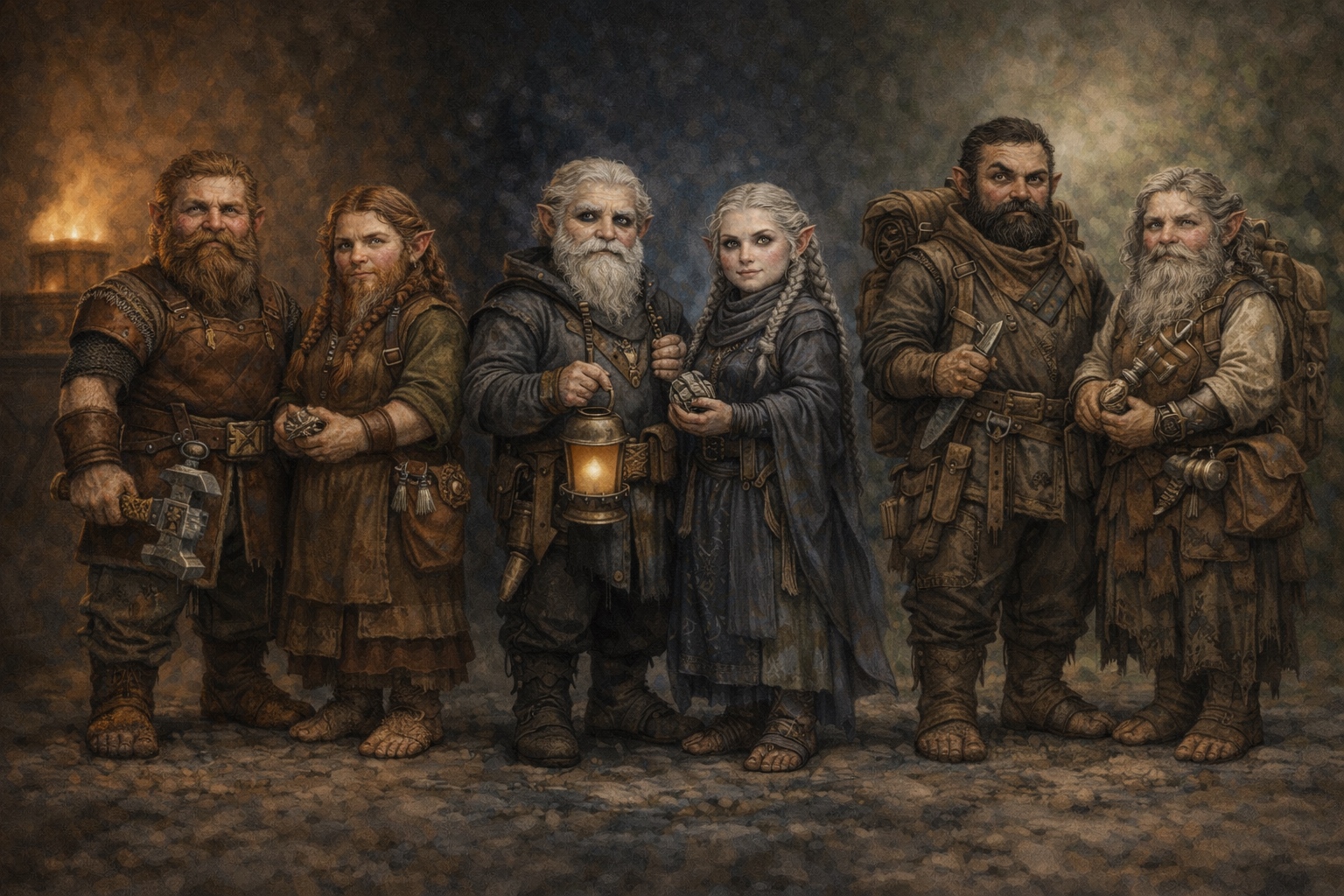
Dwarf
Playing a Dwarf? Exodus NDS rules: Species of Dort on ix.exodusnds.com, or the free Dort Species Guide from Exodus NDS Sourcebooks. Other systems: see Playing in Dort.
CORE IDENTITY
- Race Name: Dwarf
- Plural Name: Dwarves
- Adjective Form: Dwarven
- Alternate Names: Khazarum (formal self-designation used in writing and ceremony); Stone-kin (common in Irna, affectionate); Delvers (trade-neutral, widespread)
- Self-Name (Endonym): Khazarum, meaning roughly "those who hold" or "the enduring ones" in Khazuri
- Outsider Names (Exonyms): Undermasters (Shoing, respectful; references their mastery of subterranean craft); Stonebellies (Funta, mild descriptor, not a slur); Greybeards (Antaea, used regardless of gender, references aged elders specifically; can feel dismissive when applied broadly)
OVERVIEW
Short Description
Dwarves are a stocky, long-lived people defined above all else by craft, endurance, and the unbroken weight of ancestral obligation. They are the foremost builders and miners of Dort's world, responsible for some of the oldest standing structures on multiple continents. What distinguishes them from other peoples is not simply their skill with stone and metal, but the depth of meaning they invest in it; to forge, carve, or build is not merely a trade but an act of continuity between the living and all those who came before.
General Reputation
Across Dort, dwarves are seen as reliable, formidable, and difficult. The reliability is broadly accurate. The difficulty is earned: dwarves negotiate with patience and commit slowly, but once a Khazarum oath is given, it is held with a rigor that other peoples often find inflexible. The broader world admires their craft without reservation; dwarven-made goods carry a presumption of quality that no other race has matched in metalwork or stonework. Fear is rarely the emotion dwarves inspire; instead there is a wary respect, a recognition that a wrong done to a clan will not be forgotten inside a generation, or two.
Role in the World
The Khazarum are Dort's great foundational civilization: not in the sense of empire or conquest, but in the literal sense of stone and structure. They built the oldest roads still in use in Irna, cut the great mine-passages of Funta's interior, and carved the harbor foundations that half of Shoing's coastal cities still rest upon. They do not rule the world's surface, and they largely do not want to. Their civilizational niche is the deep place, the enduring thing, the work that outlasts whoever commissioned it.
PHYSICAL TRAITS
General Appearance
The first read on a dwarf is compact density. They stand noticeably shorter than most peoples but read immediately as solid: broad through the shoulder, thick-necked, with limbs that carry more mass per inch than almost any other humanoid race. There is nothing soft in the silhouette. Faces are typically broad-featured, with strong jaw structure and (in all genders past middle age) notable facial hair that grows thick and fast and is treated as a mark of maturity and status.
Size Ranges
- Typical height: 4'4" to 4'10"; Deep Dwarves run slightly shorter, 4'2" to 4'7"
- Typical weight/build: 150–230 lbs; build is uniformly dense regardless of fat or muscle composition; very little of the variation in dwarven body type reads as "slight"
Distinguishing Features
Dwarves are distinguished above all by their bone density, which is measurably heavier than other humanoids of equivalent stature; their hands, in particular, feel noticeably different in a grip. Eyes are typically set deep under heavy brow ridges and catch light strongly, reflecting a heritage of working in variable firelight and tunnel dark. Hair and beard grow exceptionally thick; both are considered part of personal identity to a degree unusual even among other peoples who value appearance. Skin develops a particular texture with age: not wrinkled in the usual sense, but acquiring something closer to a fine grain, like well-worked leather.
Sexual Dimorphism (if applicable)
Moderate dimorphism is present in build (male-presenting dwarves tend to carry slightly more upper body mass), but the differences are less pronounced than in many peoples, and the overlap range is wide. Facial hair grows across all dwarven genders, though pace and density vary individually. Dwarven culture does not invest the male/female distinction with the significance it holds in some other societies; clan and craft are the primary identity markers.
Aging Patterns
Dwarven childhood is notably long by Dort's standards. A dwarf is considered a child until roughly age 20 and is not extended full adult standing within a clan until they complete their first independent work: a physical object, crafted alone, presented before the clan elders. This is called the Khaz-Tond, the "stone-proof," and its timing varies by individual from age 18 to the late 20s. Visible aging begins slowly around age 90 and accelerates after 150. Elders past 200 carry an unmistakable weathered quality: hair whitened to silver-white, skin deeply grained, eyes often clouded at the edges but sharp in the center. Dwarves regard their own aging with pragmatic acceptance; a very old dwarf is treated as a repository of craft knowledge, not a burden.
Regional Variation
Dwarves in Irna's mountain ranges tend toward pale to ruddy-tan complexions, with hair running from dark brown to black and occasionally copper-red; generations of indoor forge-work and winter cold shape both tone and texture. Dwarves settled in Funta's interior highlands and deep mines carry the rich dark-brown to near-black complexions characteristic of Funta's peoples, with hair that grows dense and close-coiled before the length takes over. In Shoing's mountain ranges, dwarven populations show warm tans and mid-browns, with facial structure that has absorbed centuries of intermarriage with Shoing's surrounding peoples. Deep Dwarves are a partial exception: extreme subterranean isolation has bleached most surface variation, leaving them consistently pale grey-to-ash regardless of the surface population above them.
BIOLOGY
Diet
Dwarves are thoroughgoing omnivores with a pronounced practical orientation toward food; what is nutritious, storable, and available underground matters more culturally than what is considered fine dining. Subterranean mushrooms, cured meats, hard cheeses, root vegetables, and dense grain breads form the backbone of common dwarven diet across all regions. Dwarves have a well-developed capacity to digest heavily fermented foods, and dwarven preserved ales and cured meats have both a practical and ceremonial significance.
Reproduction Basics
Dwarven gestation runs approximately eleven months, longer than most humanoid races. Births are typically single, twin births uncommon and considered notable. Dwarven birth rates are low, and population growth is slow; this is a known source of cultural tension when Khazarum settlements are pressured by faster-breeding neighbors. Both parents are expected to be heavily involved in child-rearing, and the extended clan structure means children are rarely raised by a nuclear family alone.
Lifespan Ranges
- Typical lifespan: 280–320 years; exceptional individuals occasionally reach 350
- Maturity: Full adult standing typically acknowledged between ages 20–30 (completion of the Khaz-Tond)
- Elderhood: Considered elder at approximately 180; those past 250 hold the honorary title Khaz-Dur (deep-stone)
Environmental Adaptations
Dwarves possess superior low-light vision: not true darkvision in an absolute sense, but an exceptional sensitivity to minimal light sources (torch, ember, bioluminescence) that makes them highly functional in caves and tunnels where other peoples would be effectively blind. Their inner ear structure is adapted to pressure changes at depth; dwarves rarely suffer the disorientation that affects other peoples when moving quickly between surface and tunnel. Lung capacity is above average relative to their body size, aiding endurance in poor-ventilation conditions. Deep Dwarves show further adaptation: their surface-light sensitivity is significantly reduced (they find full daylight uncomfortable and prefer shadow), and their low-light vision is markedly superior to surface dwarves.
PSYCHOLOGY & CULTURE
These are shared tendencies and cultural patterns, not absolutes. Dwarves who break from these norms exist in every clan and on every continent. The patterns described below reflect what Khazarum culture values and tends to reproduce, not a biological destiny.
Typical Temperament
Reserved on first acquaintance, frank once comfort is established. Dwarves tend to be deliberate; they do not rush to speak, rush to decide, or rush to react, and they are often perceived as stubborn by peoples who move at a faster pace. Within the clan, however, dwarves can be warmly sociable, loud at feasts, and given to elaborate storytelling traditions. The contrast between the face shown to outsiders (guarded, formal) and the one shown within (expressive, even boisterous) often surprises those who know dwarves only from trade negotiations.
Cultural Values
- Craft-debt: Every dwarven life is understood as having been made possible by the labors of the dead. The living owe the dead their best work. This is not a morbid orientation; it is celebratory. The way you honor your ancestors is by making something that will outlast you.
- Oath-binding: A spoken promise between dwarves carries legal weight equal to a signed document in most other cultures. Breaking a Khazarum oath is one of the most serious social violations possible; it damages not just the individual but their clan's reputation for generations.
- Patience as strength: Rushing is considered a failure of character. A plan executed over twenty years is better than a plan executed over one month, if the result is more durable. This extends to grudges, which dwarves carry with the same patient precision they apply to craft.
- Clan over self: The individual's needs subordinate to the clan's, but this is genuinely felt, not merely enforced. Most dwarves experience their clan as the source of meaning, not the constraint upon it.
Taboos
- Abandoning craft mid-work: Starting a commissioned piece and failing to complete it without just cause is deeply shameful. An unfinished work without a named reason is read as a statement about the craftsperson's character.
- Clan-oath betrayal: Any breach of a sworn oath, particularly one witnessed by elders, stains the individual and their immediate family line. Restoration requires years of demonstrated reliability and, in serious cases, a formal presentation of restitution work before the clan.
- Waste of worked metal: Melting down another's finished work without cause is taboo; the labor invested in a worked piece is considered to give it a kind of dignity. Raw materials are fair game; finished work carries obligation.
- Speaking ill of honored dead without evidence: Criticizing an ancestor's choices or legacy within earshot of their descendants is a social offense. The dead may be critiqued in proper memorial context; casual slander is another matter entirely.
Social Structures
Dwarven society is organized around clans: extended kinship groups that share a hold, a craft tradition, and a recorded lineage stretching back as far as records exist. The clan is the primary legal, economic, and social unit. Cities and holds may contain multiple clans in a complex web of alliance, rivalry, and intermarriage. Above the clan structure, some Khazarum concentrations have developed council-cities where representatives of major clans govern collectively; others remain under the authority of a single dominant clan. Itinerant dwarves (those who have left their hold for trade, exile, or wanderlust) are something of a social anomaly; they are not cast out (that requires a formal declaration), but they exist in an ambiguous space that other Khazarum regard with a mixture of respect and quiet pity.
Family Structure
The extended clan unit is the fundamental household; parents, grandparents, aunts and uncles, and cousins may all share a hold-section. Marriage outside the clan is uncommon but not prohibited; when it occurs, there is a formal negotiation about which clan the new household belongs to, and typically one partner "joins" the other's clan through a ceremony called Khaz-Bor (stone-carrying). Children inherit the clan of the household they are raised in. Adoption into a clan is possible and carries the same weight as blood membership once formally acknowledged by elders.
Leadership Patterns
Clan leadership falls to the Khaz-Rik (stone-ruler), a title held by election among clan elders when the previous holder dies or formally steps down. Election is not democratic in a broad sense; only full clan members past their Khaz-Tond and recognized by at least two elders may vote, and in practice, leadership tends to stay within a few well-regarded family lines. Merit in craft and demonstrated patience in negotiation are the primary qualifications; Khazarum distrust leaders who moved too fast to power. In council-cities, the Khaz-Rik of each represented clan holds a seat, and decisions require majority agreement.
GEOGRAPHIC DISTRIBUTION
Primary Homelands
- Irna: The oldest and most concentrated dwarven populations are in Irna's central and northern mountain ranges. Holds here date back thousands of years, and the oldest Khazarum cities, carved directly into living rock, are found in these highlands. The surface above many of these holds shows generations of dwarven road-building and fortification, making Irna's mountain passes among the most engineered terrain on any continent.
- Funta: Dwarves in Funta are predominantly concentrated in the continent's interior high terrain and its famously rich deep-mine networks. These communities are somewhat newer than the Irna holds in terms of continuous habitation but have developed distinct cultural expressions shaped by Funta's climate and the surrounding peoples. Funta dwarves are known as particularly skilled at deep excavation and have developed mining techniques not found anywhere else.
- Shoing: Mountain-range populations in Shoing are smaller and more isolated than those in Irna or Funta, but they are ancient and notably independent. Shoing dwarves have more mixed heritage and broader integration with surrounding Shoing peoples than their Irna counterparts, and their craft traditions reflect this; Shoing dwarven metalwork incorporates aesthetic elements found nowhere else in Khazarum production.
Secondary Populations (Diaspora)
- Jazirah: Small dwarven communities in Jazirah exist primarily in rocky highland and canyon regions; these are mostly descended from trade-route settlers rather than hold-builders, and they tend toward merchant and artisan roles rather than mining operations.
- Antaea: Scattered hold-settlements exist in Antaea's mountain spine, primarily dwarves who followed mineral surveys several centuries back. These communities are small, tightly insular, and maintain closer cultural ties to Irna than to their geographic neighbors.
Migration Patterns
The primary historical migrations were expansion-driven; as the old holds filled and resources were claimed, younger clans pushed out to find new mountain ranges worth carving. Forced displacement has also occurred: the collapse of the old united hold-empire (see History) scattered whole clans that have never recovered their original holds. Trade has pulled dwarves to coastal and city contexts against their usual instincts toward the inland and subterranean. The primary push factor for a dwarf leaving a hold is almost always material: a vein exhausted, a clan conflict, or a hold fallen to disaster. Pull factors are rarer but include commissioned work of sufficient prestige to justify the travel.
Adaptations by Region
Irna mountain dwarves build with the assumption of permanence and cold: thick-walled hold-sections with carved ventilation channels, double-door cold-locks, and central forge-heating. Funta dwarves adapted to higher ambient temperatures have developed well-ventilated designs with passive cooling channels and an architectural aesthetic that runs toward wide horizontal cuts rather than tall vertical ones. Shoing dwarves build with a precision-fit stone technique that requires no mortar and has proven remarkably resistant to the seismic activity common in those ranges. In all climates, clothing tends toward practical layering with functional leather and reinforced fabric near forge-work, and more formal woven cloth reserved for ceremony.
Cultural Differences Between Lands
Irna dwarves are the cultural reference point against which all other Khazarum populations define themselves. They carry the most weight of old tradition and formality, and their clan structures are the most elaborate. Funta dwarves are generally regarded as more pragmatic and less bound by old forms; they innovated quickly when old methods failed to serve the new environment, and this is both admired and occasionally resented by Irna holds as a loosening of proper tradition. Shoing dwarves have the deepest integration with non-dwarven peoples and are the most open to outside ideas, which their Irna kin regard with mild suspicion and their Funta kin tend to find useful. Diaspora communities in Jazirah and Antaea hold their traditions with a particular intensity that comes from being surrounded by peoples who do not share them; the further from the heartland, the more fiercely the old forms are preserved.
HISTORY
Origins
The Khazarum do not have a mythic creation story in the conventional sense. Their foundational narrative is geological: the first dwarves were already in the mountains when the world's memory begins, as if they grew from the stone itself. The eldest recorded clan genealogies in Irna trace continuous lineage back approximately four thousand years, though scholars argue that the records before the third millennium are more ceremonial than factual. The Khazarum broadly believe they were among the first peoples of Dort, and most other races' histories do not contradict this claim.
Major Turning Points
The Khar-Durak Compact: Roughly twenty-five hundred years ago, the great holds of Irna achieved an unprecedented political unity under the Compact of Khar-Durak, a council agreement that pooled trade, military alliance, and craft standards across seventeen clans. This is retrospectively called the First Great Hold, and it is remembered as the height of Khazarum civilizational reach. Roads were built, the Funta mines were opened, and dwarven-engineered infrastructure spread across much of Irna.
The Sundering: Approximately seventeen hundred years ago, the Khar-Durak Compact collapsed under the weight of a dispute over mineral rights in the deep northern ranges that the records describe as beginning as a trade argument and ending as a war. The details are contested and clan-specific; each major clan's genealogy assigns blame differently. The outcome is not contested: the Compact shattered, at least six holds were abandoned or destroyed in the conflict, and the unity of Irna's dwarven civilization has never been restored. The Sundering is the great wound in Khazarum history, referenced in craft, ceremony, and grudge-keeping to this day.
The Deep Migration: In the centuries following the Sundering, one significant population, the ancestors of what are now called Deep Dwarves, retreated further underground rather than take sides in surface clan politics. They are believed to have pushed below the traditional holds into entirely new excavations, and contact with surface Khazarum communities was severed so completely that for roughly three centuries they were presumed dead. When contact re-established, they were recognizably changed.
The Funta Founding: Roughly eight hundred years ago, a coalition of Irna clans sponsored the systematic opening of Funta's deep mine networks. This was not a conquest; the Khazarum negotiated with Funta's surface peoples and established mutual extraction agreements. It was, however, transformative: the Funta mines proved richer than the Irna holds had been at their height, and the communities established there rapidly developed their own character.
Current Historical Posture
The Khazarum are enduring, which is not the same as thriving. The Sundering's damage has never fully healed; old clan grudges from that period are still carried, and the dream of restored unity is invoked in ceremony without being seriously pursued in practice. Dwarves today are stable, widely distributed, and culturally confident in their craft traditions. Their population grows slowly; they are aware that their presence in the world is denser in specific geographic niches than it is broadly. The oldest living Khazarum elders remember a time when the holds felt fuller, and that memory lives in their architecture, which was always built for more people than currently use it.
LANGUAGE
Language Name(s)
Khazuri: the tongue of the Khazarum. Spoken Khazuri is percussive and vowel-sparse, favoring hard stops and guttural constructions; it sounds, to outside ears, something like stone being shaped. There are three major dialect groups: Irna Khazuri (the prestige dialect, used in formal writing and commerce between holds), Funta Khazuri (more fluid, with a broader vowel range influenced by surrounding languages), and Deep Khazuri (a significantly diverged form spoken by Deep Dwarves, which surface Khazarum can partially understand but not speak fluidly).
Script
Khaz-Rund: the stone-mark writing system, composed of angular characters designed to be carved rather than drawn. Each character is a series of straight cuts that can be made with a single chisel without lifting it from the surface; there are no curved lines. Khaz-Rund is traditionally carved into stone, metal, and fired clay. It has been adapted to ink-and-paper use for trade documents, but Khazarum regard paper records as less authoritative than carved ones: "what is written on skin may be burned; what is cut in stone outlasts the argument."
Trade Language Status
Most dwarves working in trade or diplomatic contexts learn the common tongue of their surrounding region. Khazuri itself is not a trade language by choice; the Khazarum have never been interested in teaching it to outsiders, and its complexity makes casual acquisition difficult. In contexts where dwarves do most of the business, Irna common is typically the working language rather than Khazuri.
Dialect Range
The three main dialects are mutually intelligible with effort, with the exception of Deep Khazuri, which has diverged enough that surface dwarves and Deep Dwarves typically need several weeks of immersion before fluid communication is established. Within surface dialects, hold-specific variations exist but do not impede communication between educated speakers.
Naming Agent Cross-Reference
See _Cannon/Race naming ai agents/Fantasy Race Name Generator.md (Dwarven section) for full phonological rules and generation guidelines.
NAMING CONVENTIONS
Personal Name Structure
Given name followed by clan name. Both are required in formal contexts; familiar address uses the given name only within the clan, the full name outside of it.
Clan / House / Line Names
Clan names are compound Khazuri roots, two dwarven morphemes joined according to dwarven phonotactics (hard clusters, closed syllables, no soft endings). They are never English word compounds. The meaning is present in Khazuri but is not translated in use; a clan called "Narkrag" is addressed as Narkrag, not as "Forge-Mountain."
Regional Name Differences
Irna holds favor older, shorter root combinations; many prestigious Irna clan names are monosyllabic compounds worn smooth by centuries of use. Funta clans developed new root combinations reflecting their environment: a higher proportion of roots meaning "depth," "heat," and "foundation." Shoing dwarves have integrated some Shoing phonological influences; their given names occasionally include sound combinations not standard in Irna Khazuri, which Irna dwarves sometimes raise an eyebrow at.
Formal vs. Informal Names
Within the clan, dwarves are addressed by shortened or familiar forms of their given names. The full given-name + clan-name construction is used in formal settings, introductions to outsiders, legal contexts, and the recitation of craft lineage. Nicknames derived from a dwarf's craft or a notable deed are common and often outlast the original context ("Nardim" as a given nickname for a dwarf who works particularly hot fires, for example).
Titles & Honorifics
- Khaz-Rik: Clan leader; used as both title and address. "Khaz-Rik Brondur of Vordal" in full formal context.
- Khaz-Dur: Elder of deep years (past 250); honorary, not elected. Used before the given name.
- Tond-Master: Master craftsperson in a recognized trade; bestowed by peer consensus within a craft guild, not by the clan. Carries prestige across clan lines.
- Khaz-Gar: Warrior-defender; formal military title for dwarves who have held defensive action for a hold. Not a general soldier designation; it specifically marks those who have stood ground in the defense of Khazarum lives.
Sex and Name Form
Khazuri produces the single most distinctive sex-marking rule of any Dort people: the Dwarven feminine does not open into a vowel. Every other tradition marks the feminine by softening or by resolving an ending into -a. Khazuri cannot, because its phonotactics forbid trailing vowels outright; dwarves do not trail off. A woman's name lands exactly as hard as a man's.
The masculine endings -in, -un, -ur, -ak, -ek, -gar, -rik, -bor, -dim, -ond and -tond contrast with the feminine -dis, -run, -hild, -rid, -unn, -laug, -bjor and -gunn, all of which close on consonants. The feminine is generative by exchange: Kurdak becomes Kurdis, Brondur becomes Brondis, Zanrak becomes Zanrun, Vorkal becomes Vorhild. Appending a vowel (Kurdaka, Brondura) produces a form Khazuri does not permit.
Initial stress is absolute for both, and the hard clusters belong to both: a dwarf named Brakhild or Grimrun is named the way dwarves name women. The monosyllabic standalone roots (Grim, Vald, Zorn, Brond, Krag, Thagn) are unisex, and they are the tradition's neutral option.
Clan names never take a feminine ending. Where a clan is matriarchal the name passes unchanged through the female line; Narkrag is Narkrag for every dwarf who carries it. Craft and trade surnames do not inflect either.
Name Examples
- Given names (general): Kurdak, Brondur, Thagrin, Vorkal, Zanrak, Nardim, Balgur, Throkun
- Given names (formal/elder): Durkonur, Brondvald, Narkragur, Zanrikond (longer forms used in ceremony)
- Clan names: Narkrag, Vordal, Gordim, Brakond, Zanrik, Kurbor, Dartond, Balgrond
- Honorific / title examples: Khaz-Rik Brondur, Khaz-Dur Gordim, Tond-Master Zanrak
- Full name examples: Kurdak Narkrag, Brondur Vordal, Thagrin Gordim, Vorkal Brakond, Zanrak Zanrik
SOCIETY
Common Professions
Mining and excavation are the foundational Khazarum trades: not just extraction, but the engineering of safe, lasting subterranean passages and chambers. Metalsmithing is perhaps the most visible face of dwarven craft to the outside world; dwarven-made weapons, armor, and tools carry a reputation for reliability that commands significant price premiums. Stone-cutting and architectural masonry are equally significant, though less romanticized by outsiders. Beyond the headline crafts, dwarves fill a wide range of roles: gemcutters, brewers, archivists of carven record, engineers of surface infrastructure, and (in holds that are large enough) lawyers and negotiators who specialize in clan-compact mediation. Dwarves are not monoculturally focused on forge-craft; it is simply the craft the outside world most consistently notices.
Craft Traditions
Dwarven craft is governed by a guild system that crosscuts clan membership. The major guilds (Stonecutters, Forgemasters, Deepminers, and the smaller Gembinders) each maintain their own apprenticeship programs, standards of quality, and records of master practitioners. A piece of work authenticated by a guild master carries a carved mark identifying the maker, which functions as both signature and warranty. The aesthetic ideal in dwarven craft is functional perfection expressed through material quality and structural integrity; ornamentation exists but is always secondary to the object's use. A dwarven blade is beautiful because it is perfectly made, not because it is decorated.
Trade Roles
Dwarves export metalwork, stonework, gemstones, and (in large quantity) engineering labor. Their roads and foundations are found across the world because other peoples have consistently been willing to pay for Khazarum skill in construction. They import timber (holds need wood for fuel and certain structural elements), agricultural produce (underground farming cannot meet full nutritional needs at scale), and increasingly, luxury materials like fine fabric and dyes that have become part of ceremonial dress. Dwarven merchants are patient negotiators who prefer long-term trade relationships with agreed annual terms over spot-market buying and selling.
Military Tendencies
Dwarven military doctrine is almost entirely defensive. They build to hold, not to advance. The classic Khazarum military engagement is a chokepoint defense (bottlenecking an attacking force into a passage or gate where numbers cannot deploy), and their architecture assumes eventual military use, with kill-angles, fallback positions, and sealed emergency passages standard in any major hold. Open-field combat is uncomfortable to most Khazarum soldiers, not because they are weak but because it removes the advantage of prepared terrain. In extreme circumstances, dwarven war-parties have prosecuted extended siege campaigns against those who have wronged them: patient, methodical, and prepared to wait years if needed.
Religious Tendencies
Dwarven religious practice is ancestor-focused at its core. The Khazarum do not, as a general practice, build temples to named gods; instead, each hold maintains a deep chamber called the Kaz-Dhur, the memory-deep, where carved records of notable ancestors are kept and offerings are left. The ancestors are the primary objects of veneration. Broader divine acknowledgment varies by region and clan; some Khazarum communities in Irna have absorbed civic religious practices from surrounding peoples, while Deep Dwarves have developed a distinctly different spiritual orientation focused on the silence and pressure of deep stone as a divine presence rather than an ancestral one.
INTERACTIONS
Relations with Other Races
- Elves: Old mutual respect between two long-lived peoples who have coexisted in Irna for millennia. The relationship is not warm (elves move on a different timeline and have a different relationship to permanence), but it is stable and occasionally collaborative on large architectural or historical projects.
- Gnomes: A productive and occasionally frustrating relationship. Gnomes buy dwarven metalwork in quantity, often for mechanical applications dwarves find frivolous. Dwarves respect gnomish cleverness but find their approach to craft, focused on function and ingenuity over permanence, fundamentally alien to Khazarum values.
- Smalings: Quiet goodwill, mostly based on geography; Smaling farming communities and dwarven holds in Irna have traded necessities for centuries without significant friction. Dwarves supply metalwork tools; Smalings supply food surpluses. Neither culture particularly seeks to understand the other, but they get along.
- Orcs: The relationship depends entirely on the clan and the region. Some orc clans have historically raided dwarven holds; others have served as competent if dangerous mercenary escorts on surface trade routes. The Khazarum do not generalize about orcs as a group; they categorize by clan and judge by conduct.
- Humans: The most variable relationship, since humans are found everywhere and in the most diverse configurations. Dwarves tend to respect human energy and creativity while finding their cultural ephemerality baffling: a human institution rarely outlasts the humans who built it, which dwarves find both impressive in its urgency and sad in its impermanence.
Stereotypes (Given and Received)
- Stereotypes about them: That they are all miners and smiths (half-true; these are dominant and valued vocations, but the range of Khazarum professions is wide); that they never forget a grudge (substantially true, and Khazarum do not consider this a flaw); that they are greedy (false; what outsiders read as greed is usually a fair assessment of craft value and unwillingness to undercharge for it); that they are all male and all bearded (false on both counts, though facial hair is gender-neutral among Khazarum).
- Stereotypes they hold: That surface peoples are careless with materials and structures (partially true; the Khazarum standard for quality is not universal); that elves are passive to the point of uselessness in a crisis (unfair but persistent, rooted in the fact that elves' long view makes them appear unresponsive in the short term); that orcs will always eventually fight (false as a universal; Khazarum who have worked closely with specific orc clans hold more nuanced views, but the baseline assumption persists in holds with limited contact).
Cooperation Patterns
Natural alliance forms with any people who value long-term trade relationships over quick advantage. Gnomes and dwarves are natural commercial partners. Dwarves and Smaling farming communities are natural supply-chain partners. In Funta, Khazarum dwarves have developed deep cooperative relationships with Funta's indigenous peoples around the mine-networks, built on generations of negotiated extraction agreements. Dwarves form reliable military alliances with anyone who needs a static defense held; their role in coalition warfare is almost always "hold this position."
Conflict Patterns
Territory is the core friction point: specifically, mineral rights and subterranean access. Multiple Khazarum conflicts across history have begun as disputes about who has the right to excavate where. The other major friction is the grudge: an old wrong, carried patiently across generations, which eventually comes due when the offending party has forgotten what it was about. Dwarves and orcs have a recurring conflict pattern rooted in surface-raiding of hold trade routes; this has never escalated to total war but has never fully ceased.
VARIANTS
Physical / Regional Variants
Deep Dwarves (Kaz-Dhur)
- Defining traits: Descended from Khazarum clans that retreated to extreme depth following the Sundering and maintained separation for roughly three centuries. Paler than any surface dwarven population; skin runs from grey-white to ash, regardless of what surface population is above them. Eyes are larger and more sensitive, with pupils that dilate extremely wide in darkness; surface daylight is uncomfortable and can cause persistent headache with extended exposure. Slightly shorter on average than surface dwarves, and more heavily built even relative to the already-dense Khazarum norm. Deep Khazuri dialect is distinctly diverged.
- Range / location: Found at extreme depth beneath Irna's oldest mountain ranges; scattered smaller pockets beneath Funta's deepest mines. No surface presence to speak of.
- Notes: Deep Dwarves have a complicated relationship with surface Khazarum; they regard surface dwarves as having chosen softness and distraction, while surface dwarves regard the Deep with a mixture of guilt (over the Sundering that drove them down), reverence (they are the most purely Khazarum people in some cultural respects), and unease. Encounters between surface and Deep Dwarves are infrequent and charged. Deep Dwarf spiritual practice centers on "the Deep Silence" (a quasi-divine presence experienced in truly lightless and soundless stone), which diverges significantly from surface Khazarum ancestor-veneration.
Cultural Branches
The Wandering Clans
- Defining traits: Dwarves who left their holds without exile: voluntarily departing the hold-system to operate as itinerant craftspeople, merchants, or engineers for hire on the surface world. Retain Khazarum identity and language but are not beholden to any specific clan structure. Form temporary compact-groups of 10–30 individuals who move together for mutual protection and shared reputation.
- Range / location: Found in concentrations along major trade routes in Irna and Funta; small numbers in every continent's commercial cities.
- Notes: Hold-dwarves regard Wanderers with a complicated mix of admiration (they carry dwarven craft to the wider world) and pity (they have no hold to return to, no elders to vote for, no Kaz-Dhur to leave offerings in). Wanderers themselves tend to perform a loud pride in their freedom. The truth is more mixed: many Wanderers left under social pressure of one kind or another, even if no formal exile was declared.
DEVELOPMENT NOTES (Author use only, not canon)
Story Hooks
- A Deep Dwarf delegation arrives at a surface hold for the first time in living memory, seeking something. What they want is not immediately clear, and their Deep Khazuri is difficult to translate.
- A Wandering Clan arrives in a city claiming to hold the original deed to a piece of land that a current major power built an important structure upon, and the deed, carved in stone per Khazarum law, is technically valid.
- An old Sundering-era grudge comes due: a clan whose ancestor was wronged seventeen hundred years ago presents formal demands to the descendants of those responsible, who have long since forgotten the original offense.
Unresolved Lore / Open Questions
- What specifically caused the Sundering? The multiple-clan-narrative problem means no single account can be treated as authoritative.
- Do Deep Dwarves have a leadership structure? Are there Deep holds with their own Khaz-Rik traditions, or something entirely different?
- What is the current state of the Khar-Durak Compact's physical remains: are the old Council chambers accessible, and if so, who guards them?
Development Notes
- Cross-link Khazarum holds with settlement files when those are written (Irna, Funta, Shoing)
- The Flesh-Torn orc tribe's raiding history likely crosses paths with specific Khazarum trade routes; worth establishing which holds have the most active orc-conflict history
- Consider whether a "reformed Compact" political movement exists among younger clans as a story driver