felari
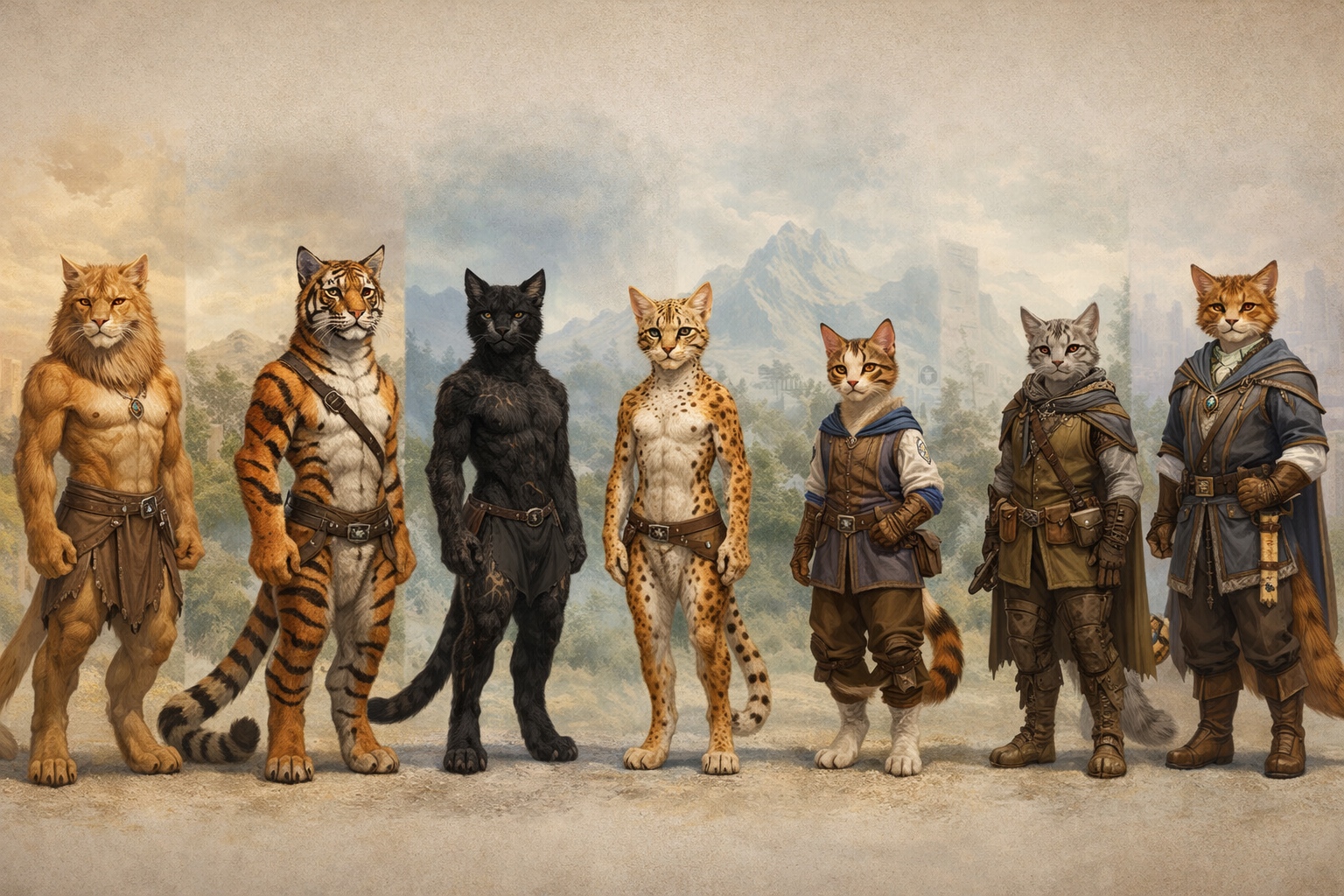
Felari
Playing a Felari? Exodus NDS rules: the free Dort Species Guide from Exodus NDS Sourcebooks. Other systems: see Playing in Dort.
CORE IDENTITY
- Race Name: Felari
- Plural Name: Felari
- Adjective Form: Felari
- Alternate Names: The Pride-People; the Shaped Ones (archaic, from outside); the Mage-Born (scholarly term)
- Self-Name (Endonym): Felari; the word in their own tongue means simply "we who move," with connotations of grace, purpose, and belonging
- Outsider Names (Exonyms): Cat-kin (common, neutral); the Prideful (Irna slang, sometimes derogatory); Simawa's Children (poetic, used in Funta regions); the Clawed (Urgrak usage, meant as respect)
OVERVIEW
Short Description
The Felari are a beastfolk people of unmistakable feline bearing: upright and bipedal, with retractable claws, mobile ears, expressive tails, and the fluid economy of movement that marks every lineage of their kind. They are organized into prides rather than nations, and pride identity runs as deep as blood. Their origins lie with a tradition of mage-work that encoded feline nature into a sapient form; Felari themselves do not debate this; they regard their shaped nature as a completed gift, not an ongoing question.
General Reputation
The Felari are widely regarded as composed, perceptive, and quietly formidable: the sort of people you notice before you notice them noticing you. Outsiders often mistake their economy of expression for coldness, and their pride-loyalty for insularity. In Funta and Antaea, where large Felari populations have existed for centuries, they are considered valued neighbors and respected traders. In Irna, they are viewed with more fascination than familiarity, their prides treated as something between a guild and a mystery. Urgrak clans consider a Felari's decision to fight alongside them a meaningful compliment.
Role in the World
The Felari occupy a broad but distinct civilizational niche: they are hunters, scouts, traders of rare goods, pride-court diplomats, and (in several regions) the most reliable long-range overland guides known. Their pride structure makes them simultaneously local and cosmopolitan; a Felari in a foreign city is still accountable to their pride, and that accountability grants them a trustworthiness that purely individual travelers lack. They are not empire-builders by nature, but their prides have negotiated treaties, brokered peace between other peoples, and held territorial corridors that other races depended on for trade.
PHYSICAL TRAITS
General Appearance
A Felari reads immediately as feline: the mobile, upright ears, the long expressive tail, the forward-set eyes with vertical slit pupils, and above all the quality of their movement, which even in stillness carries a coiled readiness. They stand fully bipedal and humanoid in proportion, though their musculature is arranged differently than most peoples: power concentrates through the core and hindquarters, and their shoulders move with a rolling independence that no flat-boned race quite replicates. Fur covers the entirety of the body; color, pattern, and density vary substantially by lineage.
Size Ranges
- Typical height: 5'0" – 7'0" (varies significantly by lineage; see Variants)
- Typical weight/build: Lean to heavy-muscled; weight is consistently higher than visual impression suggests due to bone density and musculature
Distinguishing Features
All Felari share a set of baseline features regardless of lineage: retractable claws on both hands and feet (varying in retraction selectivity by lineage), vertical slit pupils that expand in low light to near-round, mobile external ears with independent rotation, a long muscular tail used for balance and expression, whisker-bearing muzzle with short feline nose, and digitigrade foot structure that creates a distinctive upright-on-toes posture. Their voices carry a natural resonance in the chest register, and most lineages produce some form of purring or chuffing vocalization distinct from speech.
Sexual Dimorphism
Dimorphism is minimal across most Felari lineages; males typically run slightly heavier in the shoulder and chest, females slightly longer in the limb, but the difference is not dramatic and varies by individual. The exception is the Pride-kin lineage, where male-presenting individuals develop a distinctive mane of longer, denser fur around the neck, jaw, and upper chest. This trait is unique to that lineage and does not appear in others.
Aging Patterns
Felari kittens (the term is used without any diminutive intention) are mobile within weeks and reach juvenile independence faster than most humanoid races. A Felari of ten years is considered a young adult in practical terms, though formal pride-entry rites typically occur between twelve and fifteen. Full adult standing is recognized between eighteen and twenty-two, after a period of supervised contribution to the pride. Visible aging in Felari is subtle until quite late; the coat gradually lightens at the muzzle and around the eyes, and the vertical pupils take longer to fully dilate. Elderhood is recognized functionally (when a Felari's counsel is sought more than their physical contribution) and is considered a position of honor without exception.
Regional Variation
Felari appearance is defined by lineage, not geography. A Pride-kin born in the cold highlands of Irna still carries the tawny coat and mane potential of that lineage; a Frost-kin raised in the lowlands of Funta retains the double coat and broad paws of their kind. Within lineages, minor variation exists (extended time in high-heat environments may result in slightly shorter coat density across generations, and prides with mixed-lineage ancestry occasionally produce individuals with blended traits), but the lineage characteristics remain dominant. Felari are exempt from continental appearance demographic norms; their appearance is defined by bloodline, not birthplace.
BIOLOGY
Diet
Felari are obligate carnivores. Plant matter can be consumed in small quantities and is used medicinally, but the Felari digestive system requires animal protein as its primary fuel. Pride territories are often defined as much by hunting range as by any other factor, and Felari cuisine, to the extent it is shared with outside peoples, centers on preparation methods for meat rather than grain or vegetable traditions. Felari in dense urban environments have learned to purchase from butchers and hunters, and a thriving trade in preserved meats has historically followed wherever Felari prides establish themselves.
Sleep Patterns
Felari are most naturally active in the low-light hours of dawn and dusk, a tendency inherited from their lineage origins. Most have adapted comfortably to the rhythms of the societies they inhabit, but given free choice, a Felari will often sleep in two shorter periods rather than one long one, a mid-afternoon rest and a longer overnight sleep. Communal resting is biologically neutral but culturally common; pride-mates often sleep in shared warm spaces, which carries strong social and bonding significance.
Reproduction Basics
Felari gestation runs approximately six months, producing litters of one to four kittens. Litters of two are most common. Both parents are typically involved in kitten-rearing, and the broader pride participates in early socialization; juveniles are rarely the sole responsibility of their birth parents. Multiple females in a pride may nurse each other's young without distinction, particularly in prides with close lineage ties.
Lifespan Ranges
- Typical lifespan: 65–90 years
- Maturity: 18–22 years
- Elderhood: 55–65 years
Environmental Adaptations
Felari biology varies meaningfully by lineage in terms of cold tolerance, heat tolerance, altitude adaptation, and moisture resistance; these are documented in the Variants section. Across all lineages, Felari have superior low-light vision, exceptional spatial awareness at short-to-medium range, and an acute sensitivity to vibration through their paws and whiskers. All lineages are capable climbers to some degree, though reach and grip vary. The retractable claw structure provides grip on irregular surfaces that few non-climbing peoples can match.
PSYCHOLOGY & CULTURE
Typical Temperament
Felari tend toward a composed, observational baseline; they take in before they speak, and they prefer to understand a situation before committing to a position within it. This is not passivity; it is assessment. When a Felari acts, they act with intention, and that quality gives their decisions a weight that others notice. Within the pride, this composure often relaxes into warmth, playfulness, and a dry humor that can catch outsiders off guard. The idea that Felari are cold is a consistent misread of their public presentation.
Cultural Values
- Pride before self: The pride is not a family so much as an identity. A Felari's reputation is their pride's reputation, and vice versa; individual failure and individual honor both reflect outward. This is not shame culture so much as accountability culture, the expectation that one's actions are never entirely private.
- Economy of motion: A Felari aesthetic principle that extends far beyond movement into speech, craft, and decision-making. The cleanest solution, the most direct path, the fewest words that carry the needed weight: these are virtues. Excess is considered a form of confusion.
- The hunt as philosophy: Hunting is not merely subsistence for Felari; it is the paradigm through which patience, timing, preparation, and decisive action are understood. Even non-hunting Felari in urban trades tend to think in terms of the hunt: read the situation, wait for the moment, commit fully when you move.
- Territorial honesty: A Felari pride is transparent about what it claims and what it will defend. This extends culturally to personal relationships; a Felari who claims friendship is understood to mean it, and a Felari who withdraws acknowledgment of a relationship is understood to have made a deliberate statement.
Taboos
- Abandoning a pridemate in need: The deepest social violation. A Felari who leaves a pride-member without aid when aid was possible, regardless of the circumstances, is considered broken in some fundamental way. Exceptions exist for impossible situations; no one is expected to die for a lost cause. But the line is taken seriously.
- Claiming a kill you did not make: In its literal sense this is simply dishonesty, but the taboo extends broadly to any form of false credit-taking. The pride knows who did what. Pretending otherwise is an insult to everyone present.
- Disrupting a bonded pair's rest: Felari bonded pairs have a recognized right to undisturbed rest together, and disturbing it without genuine emergency is considered a deep discourtesy, one of the few that can generate genuine anger in otherwise composed individuals.
Social Structures
The pride is the fundamental unit of Felari society. A pride is typically between eight and forty individuals, though very large prides may extend further. Prides are not purely blood-related (adoption of individuals and absorption of smaller groups are both common), but most prides have a core lineage ancestry that provides cultural continuity. Multiple prides may form alliances, sharing hunting ranges and trading goods, but they remain distinct entities. There is no Felari nation as such; the closest equivalent is a pride-confederation, which tends to form in response to external pressure and dissolve when the pressure lifts.
Family Structure
Felari pair bonds are typically long-term and publicly recognized by the pride, but they are not exclusive in all lineages; the Frost-kin and Shadow-kin tend toward stricter pair bonding, while the Hearth-kin and Pride-kin have traditions of looser bonding structures within pride-family. Kittens are raised by the pride collectively; the birth parents are known and important, but the kitten who knows only their birth parents is considered somewhat impoverished by Felari standards. Inheritance passes through pride membership more than through blood line; what a Felari inherits is primarily their place and standing within the pride.
Leadership Patterns
Prides are led by a Pride-Head, chosen by demonstrated competence and acknowledged by consensus of adult pride members. The selection is not purely democratic (elders carry additional weight, and a deeply respected senior hunter or negotiator's endorsement can settle a contested succession), but a Pride-Head who has lost the genuine respect of their pride is considered to have already lost the position, whether or not they have been formally replaced. Leadership is not gendered; the Pride-Head tradition predates any such distinction.
GEOGRAPHIC DISTRIBUTION
Primary Homelands
- Funta: The largest Felari populations exist here, concentrated in the open savannah and forest margins of the continent's interior and southern coast. Pride territories in Funta tend to be large and well-established, with multi-generational histories. Pride-kin and Swift-kin are the dominant lineages here.
- Shoing: The mountain and forest regions of Shoing's northern and central ranges host the Storm-kin primarily, with smaller Frost-kin populations at the high altitudes. Shoing Felari prides have been part of the region's political landscape for over a thousand years and are sometimes incorporated into larger non-Felari power structures as autonomous allies rather than absorbed populations.
- Antaea: The dense canopy forests and highland interiors of Antaea are Shadow-kin territory, where their climbing and concealment traits translate to genuine environmental mastery. Antaea Felari prides are often smaller and more territorially discrete than Funta or Shoing counterparts.
Secondary Populations (Diaspora)
- Irna: Felari prides in Irna are a significant minority presence, most concentrated in the warmer southern regions. Hearth-kin are by far the most common Irna Felari, having adapted readily to dense settlement patterns. Urban Irna Felari often identify primarily as members of a pride that has itself become urban in character: a different mode of pride life than the territorial prides of Funta or Shoing, but considered no less legitimate.
- Jazirah: Small Felari populations exist here, primarily Swift-kin who have adapted to arid conditions. These prides are highly mobile and tend toward trade roles rather than territorial settlement.
Migration Patterns
Felari expansion has historically followed the pattern of pride-fission: when a pride grows large enough that its territory cannot sustain it, a group of adults (typically younger, more adventurous members) splits off to establish a new pride elsewhere. This is not exile; it is recognized as healthy growth. The fission-pride maintains ties to its origin, and multi-generational pride networks can span considerable geographic range. Felari were not conquest migrants; they moved into territories that their hunting needs and lineage adaptations suited, and established prides that fit the landscape rather than reshaping it.
Adaptations by Region
Felari in the high mountains of Shoing and northern Irna supplement their diet with concentrated preserved meats and rely on their coat's insulation rather than external layering, though most wear minimal protective coverings over the extremities in extreme cold. Desert-adapted Swift-kin prides in Jazirah move primarily at dawn and dusk, cache water in clay vessels buried at pride waypoints, and have developed preserved meat preparation methods that resist spoilage in high heat. Urban Felari in Irna cities have adapted their traditional claw-maintenance practices to stone surfaces and their hunting instincts to the guild and trade structures of settled life.
Cultural Differences Between Lands
Funta Felari prides tend toward the most openly social pride structure: larger prides, more public celebration of hunt success, stronger emphasis on the collective voice in Pride-Head selection. Shoing Felari prides, shaped by centuries of interaction with more hierarchically structured neighboring peoples, often have more formalized internal rank distinctions, with titles given to specialized roles within the pride. Antaea Felari have the most secretive pride cultures, a reflection of their environment; Shadow-kin discretion is a value that bleeds into the broader cultural character of prides in that region. Irna urban Felari have developed a distinct pride culture that emphasizes trade relationships and contractual obligations in ways that traditional territorial prides sometimes view as overly transactional.
HISTORY
Origins
Felari history begins with the work of mages whose names have been swallowed by time, individuals who shaped feline nature into sapient form through a process the Felari themselves call the First Shaping. Whether this was a single mage, a school, or a tradition spread across generations is unknown; Felari oral history does not attempt to resolve the question and regards the attempt as mildly beside the point. What the tradition preserves is the philosophical inheritance of that shaping: the Felari were made with intention, given their pride-nature deliberately, and have been complete since the moment of that making. The First Prides are mythologized as those who understood themselves immediately, who recognized what they were and chose to be it fully.
Major Turning Points
The Scattering of the First Prides (estimated seventeen to twenty centuries before the current era) marks the point at which Felari prides moved from a concentrated regional population into their current multi-continental distribution. The reasons are debated (overpopulation of a home range, catastrophic conflict with a now-unnamed people, simple adventuring fission), and Felari oral tradition holds all three explanations without privileging any.
The Great Pride Wars (approximately nine centuries before the current era) were a period of sustained conflict between Funta pride-confederations over territorial boundaries as Felari populations expanded. The resolution was the Pride Compact of the Open Range, a foundational document of Felari inter-pride law that established the principle of acknowledged territory: a pride's range is what it can demonstrate it has hunted and maintained, not what it claims in the abstract. This compact, re-affirmed in various forms across the centuries, remains the basis of inter-pride territorial negotiation.
The Urban Turn (approximately four centuries before the current era) describes the period when significant Hearth-kin populations first established themselves as permanent residents of non-Felari cities in Irna, creating the first genuinely urban pride model. This was controversial at the time and remains a topic of philosophical debate within Felari culture, though the urban prides are now fully acknowledged and their model has spread to other lineages in smaller numbers.
Current Historical Posture
The Felari are a people in confident, if not complacent, equilibrium. Their population is stable, their prides are established across all major continents, and the Pride Compact framework has prevented large-scale inter-pride conflict for centuries. The current tension is internal and philosophical: the growing urban pride model challenges traditional assumptions about what a pride is, whether it requires territory, whether hunting is essential or merely symbolic, whether prides in different cultural contexts can remain meaningfully the same kind of thing. The Felari do not have a consensus answer. They are characteristically patient about not having one.
LANGUAGE
Language Name(s)
The Felari language is called Felathis, "the moving tongue," with the same root as their self-name. It is a single language with meaningful regional variation rather than true dialectal splits; a Funta pride-speaker and a Shoing pride-speaker can converse with some effort and occasional misunderstanding, but they are intelligible to each other. The urban Irna variant, called Mira-Felathis (hearth-tongue) by outsiders and simply the city-speech by its speakers, has drifted farthest from the continental baseline.
Script
Felari writing is called Pridemarks, a flowing, connected script developed from the physical impressions of claws on bark and soft clay, which gives it a characteristic long-stroke aesthetic. It is written on any available surface, but bark-paper and treated leather are traditional. Most Felari are literate in Pridemarks to at least a basic degree; full calligraphic mastery is a recognized craft skill within prides. Urban Felari have adopted script conventions from neighboring peoples where necessary for trade and legal documentation, but Pridemarks remain the language of pride records and personal correspondence.
Trade Language Status
Felathis is not a dominant trade language anywhere outside Felari-majority regions, but Felari individuals are known to be reliable language learners, and most adult Felari who travel or trade speak at least one non-Felathis tongue fluently. Common carries more Felari loanwords than most speakers realize, particularly in vocabulary related to hunting, tracking, territorial negotiation, and rest.
Dialect Range
The major regional variants correspond to the primary homelands: Funta-Felathis, Shoing-Felathis, Antaea-Felathis, and Mira-Felathis. These are mutually intelligible with effort. Within each variant, pride-specific vocabulary (particularly for territorial features, named hunts, and internal rank terms) creates genuine opacity for outsiders even when the grammar is shared.
Naming Agent Cross-Reference
See _Cannon/Race naming ai agents/beastfolk/Beastfolk - Feline.md for full naming rules and generation guidance.
NAMING CONVENTIONS
Felari names follow a given name + pride name structure, both drawn from Felathis phonology. Names are vowel-final and built from open syllables, reflecting the naming agent's documented phonological pattern.
Pride names describe the pride's founding character, territory, or a defining deed; they are short, vowel-final, and formed in the same phonological tradition as given names. Formal address uses the full name; among pride-mates, given name alone is standard.
Sex and Name Form
Felari names are largely unisex, and this is a feature of Felathis rather than a gap in it. The mage enforced phonological tidiness on the Felari; they did not enforce a gender system, and none developed. No Felari ending marks sex; -ri, -ki, -zi, -ni, -bi, -wa, -mo, -si, -ka, -li and -bu are all borne by anyone.
What carries sex is the semantic field the root draws on. The hunt, the lion-nature and forward motion (Sim-, Jab-, Taz-) lean masculine; grace, stillness, the deep water and the clean line (Naz-, Maz-, Safi-, Zub-) lean feminine; and cleverness, companionship, patience and quiet strength (Zan-, Raf-, Kam-, Tob-, Nal-) are borne by either: the largest group of the three, and the one most names should come from.
These are conventions rather than rules. A Felari woman named Simozi is entirely plausible: a pride that saw the lion-nature in a daughter named her for it, and the tradition treats individual excellence as the thing worth naming. Asking which sex a name like Kamari indicates is a question most Felari would find odd.
Adding a gendered suffix imports an instinct Felathis does not have and is the error most likely to appear. Pride names never mark sex, and neither do the Kama- prefix for a Pride-Head or the -ra suffix for an acknowledged elder hunter; both attach to anyone who holds the standing.
Name Examples
- Given names (general): Simozi, Jabari, Zaniki, Rafiku, Tazubi, Kamari, Mazini, Safiwa, Tobire, Naliku
- Given names (elder / formal address): The same names are used; elders are distinguished by title prefix, not name change
- Pride names: Simawa, Jaboni, Tazuka, Maziri, Rafona, Kemazu
- Honorific / title examples: Kama- (before the name) for a Pride-Head; -ra (as suffix) for an acknowledged elder hunter
- Full name examples: Jabari Simawa, Kamari-kama Tazuka, Safiwa Rafona, Tazubira Maziri
SOCIETY
Common Professions
Felari across all regions are overrepresented in roles that require observation, patience, and decisive action at the right moment: hunters and trackers by tradition, but also scouts, couriers of sensitive information, overland guides, and negotiators of territorial disputes (particularly between non-Felari parties who find a neutral Felari pride a credible mediator). Urban Felari have moved into craft trades with a strong precision component (fine leatherwork, detailed cartography, instrument-making) and into the performing arts, where their natural physicality commands attention. A disproportionate number of Felari in cities work as night-watch and security, a practical consequence of their low-light vision and their willingness to work hours other races find difficult.
Craft Traditions
Felari craft centers on materials with a tactile quality (leather, bone, dense wood, worked stone), and their aesthetic favors clean lines with a single point of visual interest rather than complexity for its own sake. This is economy of motion expressed in object form. Pride records are kept in bound bark-books with claw-script; these volumes are considered private documents and are not typically shared outside the pride. Urban Felari have developed a tradition of precision mapmaking, adapting their territorial-awareness instinct to cartographic form, and Felari-made maps command a price premium throughout Irna and Funta.
Trade Roles
Felari prides export preserved meat products, fine leather goods, precision maps, and guided overland passage. They import grain and vegetable staples (not for direct consumption, but for trade barter), worked metal, and textile goods they do not produce themselves. Felari bargaining culture values directness and dislikes extended negotiation theater; they tend to state their price once, adjust it once if genuinely moved to, and withdraw from trades that require more back-and-forth than that. Merchants who understand this do well with Felari; merchants who interpret directness as naivety quickly learn otherwise.
Military Tendencies
Felari prides are not conquest forces, but they are capable defensive and raiding combatants whose tactics consistently surprise opponents expecting straightforward engagement. The pride approach to force is the hunt applied to conflict: patience, positioning, choosing the moment, committing without hesitation when that moment arrives. Prides rarely maintain standing warrior classes (all adult Felari hunt and all can fight), but larger prides often have acknowledged specialists in territorial defense whose knowledge is respected in a crisis. Felari mercenary companies exist in several regions and are valued for their tactical patience and their reliable execution of agreed terms.
Religious Tendencies
Felari spiritual life is oriented around acknowledgment rather than supplication, the sense that the world is full of forces worth recognizing without necessarily petitioning. Most prides maintain a tradition of hunt-acknowledgment: a brief, formal recognition of what was taken and what will be returned when the hunt is completed. This is not a prayer system so much as a courtesy system, and it does not require a priesthood. Prides in regions with strong temple traditions have often integrated local religious practice alongside their own, attending public rites without abandoning private acknowledgment customs.
INTERACTIONS
Relations with Other Races
- Smalings: A long-standing trade relationship that functions better than anyone expects it should. Smalings produce grain and preserved vegetable goods that Felari use as barter stock; Felari provide overland guide services and territorial security that Smaling farming communities benefit from. The cultural mismatch is considerable (Smaling communal warmth versus Felari composed reserve), but both peoples are honest dealers and that goes a long way.
- Gnomes: Felari and Gnome contact has historically been limited, but Gnome tinker guilds have found a ready market in Felari prides for precision instruments. The Gnome cook guilds have had more complex interactions with Felari culinary traditions; some Gnome chefs regard Felari meat-preparation techniques as a source of significant inspiration, carefully not acknowledged.
- Urgrak: Orcs and Felari have a complicated respect. Orcs find Felari patience and calculation frustrating in direct conflict and admirable in allies. Felari find Orcish tribal directness refreshing after the oblique social maneuvering of some peoples, and the two have cooperated as often as they have clashed.
- Elves (Aelvari): Relations are generally neutral to warm, with a slight edge of mutual aesthetic appreciation; both peoples place value on elegance and restraint. Aelvari scholars have documented Felari culture extensively, which Felari find alternately flattering and presumptuous.
Stereotypes (Given and Received)
- Stereotypes about them: That they are cold, unfeeling, or incapable of warmth (false, a consistent misread of composed public presentation); that they are treacherous or unpredictable (false; they are among the more contractually reliable peoples in Dort, and their taboo against false credit-taking extends to false promise-making); that all Felari are exceptional fighters (half-true; all are capable, not all are extraordinary).
- Stereotypes they hold: That non-Felari peoples say far more than they mean; that Urgrak confuse volume with weight; that Gnomes would live forever if they ever stopped moving; that Smalings are the most genuinely content people alive, which the Felari find both admirable and slightly baffling.
Cooperation Patterns
Felari prides cooperate most readily with peoples who are honest about their terms, respect territorial acknowledgment, and do not interpret composure as submission. Trade agreements, escort contracts, and territorial-neighbor relationships are the most common points of cooperation. Felari are reliable alliance partners once a relationship is established because they hold to agreed terms as a matter of pride-reputation; breaking a stated commitment is one of the more serious internal taboos.
Conflict Patterns
Conflict arises most predictably when territorial boundaries are not clearly acknowledged, when Felari are expected to negotiate indefinitely rather than being given clear terms, or when their reserve is interpreted as weakness and tested. Prides respond to territorial incursion with measured, deliberate escalation (a single warning, a demonstration, then action) and are often surprised when other peoples find this sequence alarming rather than reasonable.
VARIANTS
Physical / Regional Variants
The Felari lineages are not subraces in the sense of being geographically isolated populations; lineages mix within prides, and a pride may contain members of two or three lineages. However, each lineage carries distinct biological traits that remain consistent regardless of where its members are born or raised.
Pride-kin
The lion lineage. Pride-kin are among the largest Felari, powerfully built through the chest and shoulders, with tawny-to-amber coats that may carry faint ghost-spots from juvenility. They are the only lineage in which male-presenting individuals develop a mane, a denser, longer growth of fur covering the neck, jaw, and upper chest that deepens with age. Pride-kin are also the only lineage capable of a true full-chest roar, distinct from the chuffing vocalizations most Felari produce. Their heat tolerance is exceptional. They are primarily associated with the open savannah territories of Funta.
- Typical height: 5'10" – 6'8"
- Defining biological traits: Mane development (male-presenting only); true roar vocalization; highest heat tolerance of any lineage; strongest social bonding drive; Pride-kin outside a pride context show measurable behavioral change
- Range: Primary Funta savannah and forest margins; significant diaspora in Irna
Storm-kin
The tiger lineage, and the largest Felari overall. Storm-kin are heavily muscled with striking stripe patterning (vertical dark stripes over a ground coat that ranges from pale amber to deep russet-orange), and each individual's pattern is unique as a fingerprint. They are the only lineage with a natural affinity for swimming; their shoulder and hip joints rotate in a manner that produces an efficient in-water stroke, and their coat has measurable water-resistance. Cold tolerance is high. They can produce a sound in the roar register, though it is more a sustained rumble than the explosive roar of the Pride-kin.
- Typical height: 6'0" – 7'0"
- Defining biological traits: Unique stripe pattern per individual; swimming-adapted joint rotation; water-resistant coat; highest cold tolerance after Frost-kin; large frame with corresponding mass
- Range: Primary mountain and forest regions of Shoing; found throughout but densest in the northern ranges
Shadow-kin
The panther and jaguar lineage. Shadow-kin are mid-to-large in build with melanistic coats (appearing solid black in most lighting) but carrying ghost rosettes visible only in oblique or strong direct light, a biological marker of their spotted ancestry. Their shoulder and wrist joints allow a degree of rotation that makes them superior climbers among Felari; they can descend vertical surfaces face-first in a manner no other lineage manages. Their paw pads are denser and more concave than other lineages, producing the quietest movement in the family. Night vision is superior even among Felari. Their primary vocalization, distinct from other lineages, is a deep resonant cough-bark that carries through dense forest without dissipating.
- Typical height: 5'8" – 6'4"
- Defining biological traits: Melanistic coat with visible ghost rosettes; superior climbing from modified shoulder/wrist rotation; quietest movement profile; strongest night vision; cough-bark vocalization
- Range: Primary Antaea forest and highland interiors; smaller populations in forested Funta
Swift-kin
The cheetah lineage: the lightest Felari, built for speed over power. Swift-kin are lean and long-limbed with tear-mark facial streaks, dark lines running from the inner corner of each eye down toward the jaw, which are unique to this lineage. Their claws are only semi-retractable; the retraction is less complete than other lineages and produces a faint clicking on hard surfaces as they walk. Their vocalization range sits in a higher register than other Felari; they produce a distinctive high-frequency chirp-cry that carries over distance differently than a roar, and it is notably carrying in open terrain. Their metabolism runs faster than other lineages; they eat more frequently and go hungry faster when provisioning is disrupted. The trade-off is speed and endurance over short distances that no other Felari can match. Swift-kin have a known vulnerability to illness in dense, crowded environments that other lineages handle more easily; their immune response is calibrated for open-range conditions.
- Typical height: 5'4" – 5'10"
- Defining biological traits: Tear-mark facial streaks; semi-retractable claws with characteristic click; high-frequency chirp-cry vocalization; faster metabolism requiring more frequent feeding; reduced immune resilience in dense urban or crowded environments
- Range: Open plains of Funta; smaller populations in Jazirah arid zones
Frost-kin
The snow leopard lineage. Frost-kin have the thickest coats of any Felari (a true double layer with a dense underfur and longer, rougher guard hairs), and their coats run from pale grey to blue-grey to warm buff, typically with dark spots and diffuse rosettes on a lighter ground. Their paws are proportionally broader than other lineages, acting as natural snowshoes on soft or uneven terrain. Their tails are exceptionally heavy and long, used for balance on irregular terrain and wrapped for warmth during rest. Altitude adaptation is pronounced; Frost-kin show no measurable distress at elevations that trouble other peoples. Their vocal expression is distinctive: they produce a non-explosive chuff-purr combination that carries further than it seems it should in thin air. Frost-kin are the most naturally solitary of the lineages; prides run small (four to twelve is typical) and territory per individual is the largest of any Felari group.
- Typical height: 5'6" – 6'2"
- Defining biological traits: Double-layer insulating coat; broad snowshoe paws; heavy balancing tail; altitude adaptation; chuff-purr vocalization; strongest solitary tendency; smallest natural pride size
- Range: High mountain ranges of Shoing and northern Irna; found wherever significant altitude exists
Hearth-kin
The domestic and small feline lineage: the most varied in appearance of all Felari, and the smallest. Hearth-kin coats come in every pattern: solid, tabby-striped, tortoiseshell mosaic, point-colored, dilute and bright in equal measure. No other lineage offers this range of variation; meeting two Hearth-kin is rarely meeting two who look alike at first glance. Their claw retraction is the most refined of any lineage (full individual claw selectivity, meaning they can extend a single claw without extending others), and their whiskers are functional sensory organs rather than ornamental, providing spatial awareness data that other Felari must compensate for in other ways. Their ears are proportionally the largest relative to head size. Hearth-kin are the only Felari lineage that produces a true purr: a continuous, resonant vibration during both inhalation and exhalation, distinct from the chuffing and rumbling of other lineages. Their urban adaptation is unmatched; Hearth-kin are equally at home in a city of fifty thousand as in open countryside. They are found on every continent.
- Typical height: 5'0" – 5'6"
- Defining biological traits: Highest coat pattern variety; individual claw selectivity in retraction; functional whisker sensory organs; proportionally largest ears; true purr vocalization; superior urban adaptation
- Range: Every continent; the only lineage with no primary homeland; they have been urban and distributed from the earliest recorded history
Cultural Branches
The Ranging Prides
Prides that have fully committed to mobile, non-territorial existence, following hunting corridors across vast distances over the course of a year rather than holding fixed range. Found primarily in Funta and on the overland routes between Shoing and Jazirah. The Ranging Prides maintain the same internal social structure as settled prides but have elevated mobility to a near-philosophical principle; they view settled prides with mild concern that life has become too much about the territory and not enough about the hunt.
The Urban Prides
Prides established within cities, primarily in Irna but spreading. Urban prides have adapted the territorial acknowledgment system to urban geography; a pride may "hold" a specific district, a particular trade route through a city, or a set of professional relationships rather than a hunting range. Their members typically work in non-hunting trades. Traditional prides debate whether Urban Prides are fully Felari in cultural terms or a new thing wearing familiar structure; Urban Prides are, characteristically, not particularly troubled by the debate.
DEVELOPMENT NOTES (Author use only, not canon)
Story Hooks
- A Swift-kin pride has been established in a dense Irna city for three generations. Illness has hit them harder than other communities each winter. The cause may be biological, may be something in the water district they hold, or may be something else entirely.
- Two long-standing Funta prides are disputing a territorial boundary; the Pride Compact framework requires a neutral mediator, and the nearest available party is an Urban Pride whose legitimacy one of the disputing prides does not fully acknowledge.
- A Frost-kin solitary has been living on the edge of a mountain village for two years, close but not within the village. They have not identified any pride, given no name when asked, and have twice helped village members in danger without being asked. What are they, and what do they want?
- The naming convention of a newly encountered pride matches no known Felathis phonology. Their Pridemarks are legible but the vocabulary is ancient, possibly pre-Scattering.
Unresolved Lore / Open Questions
- What was the homeland of the First Prides? The Felari do not claim to know, and the oral tradition is genuinely ambiguous.
- Are there Felari lineages that have been lost? The six documented lineages do not cover the full spectrum of feline variation; some scholars suggest there were others.
- What is the exact relationship between Felari and the Mage traditions that shaped them? The mages themselves are gone; their schools may not be.
- How does the Pride Compact handle prides in non-Felari political structures, particularly Urban Prides who operate under city law?
Development Notes
- Cross-link with Funta settlement entries when written
- The Pride Compact of the Open Range deserves a dedicated canon document at some point
- Hearth-kin urban expansion in Irna could be a significant subplot backdrop for city-set stories
- Felari relations with Canix should be explicitly addressed once Canix entry is written; predator-and-predator dynamics will need nuance
- Consider whether any named Felari prides should appear in the world entries for major cities