gnome
Gnome
Playing a Gnome? Exodus NDS rules: Species of Dort on ix.exodusnds.com, or the free Dort Species Guide from Exodus NDS Sourcebooks. Other systems: see Playing in Dort.
CORE IDENTITY
- Race Name: Gnome
- Plural Name: Gnomes
- Adjective Form: Gnomish
- Alternate Names: Zannovi (formal self-designation, used in guild documentation and ceremony); Smallfolk (used interchangeably with Smalings in regions that don't know them well, inaccurate and mildly annoying to both peoples); Tinkermen / Tinkerfolk (common trade term, emphasizes craft; not offensive but reductive)
- Self-Name (Endonym): Zannovi, meaning roughly "the clever-kind" or "those who find the way" in Zannori
- Outsider Names (Exonyms): Cogborn (Shoing, mildly affectionate, references mechanical aptitude); Sauciers (Funta, used specifically for gnomish cooks who have established themselves in Funta markets; complimentary); Pocketwisdom (Irna rural areas, a backhanded compliment implying gnomes are smart but small)
OVERVIEW
Short Description
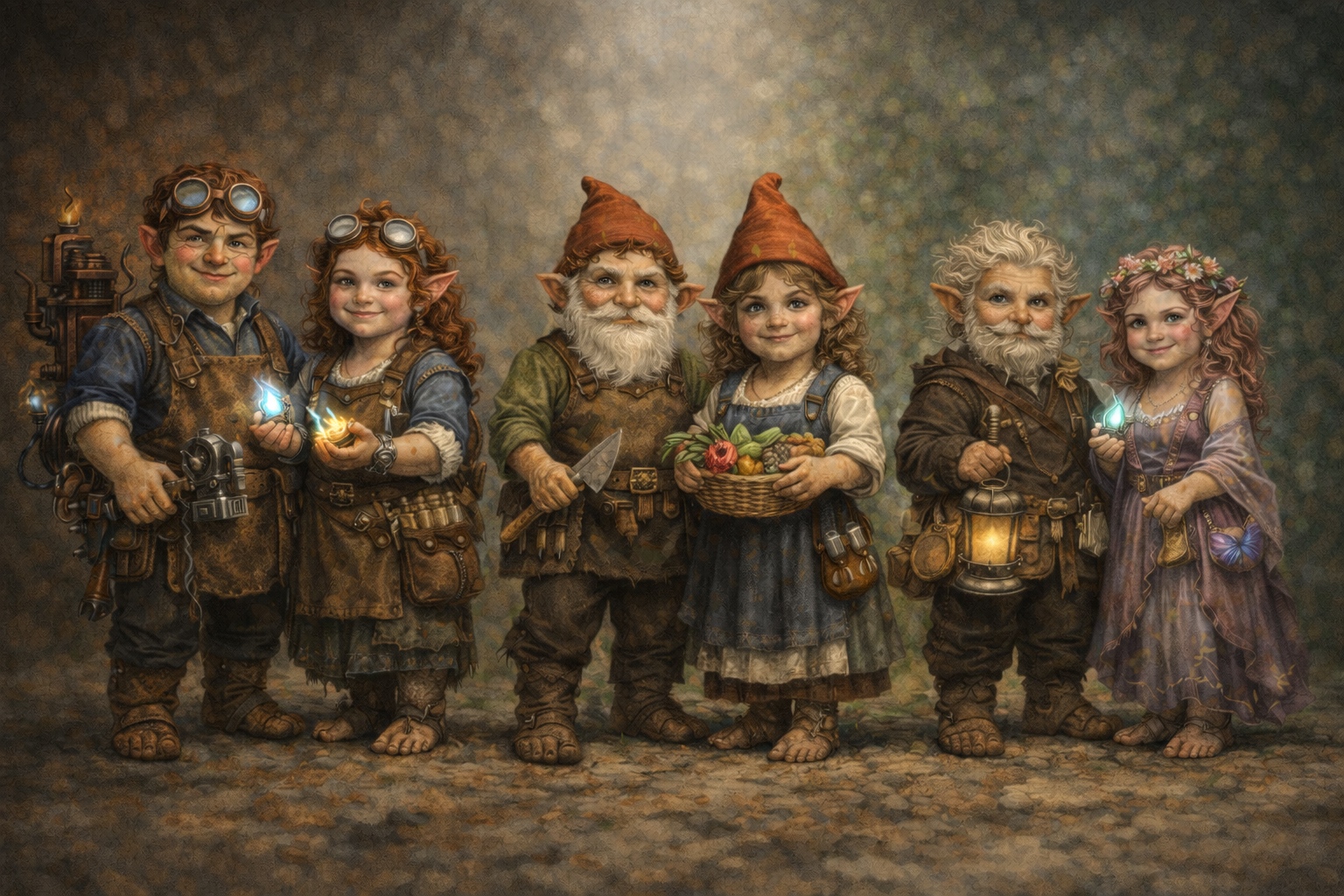
Gnomes are a small, inventive, and intensely curious people whose civilization is built around two great obsessions: the mechanical and the culinary. These are not separate concerns; to a gnome, both are expressions of the same underlying drive to understand how things work, improve on what exists, and keep the best of what is discovered absolutely secret. Gnomish society is organized around guilds that function as family, professional order, and secret-keeping fraternity simultaneously, and the most powerful institutions in gnomish life are the Tinkerer Guilds and the Cook Guilds, whose rivalries and alliances shape the political landscape of every gnomish community.
General Reputation
The world knows gnomes as brilliant, entertaining, slightly unpredictable, and absolutely not to be trusted with a confidence if you expect it to stay kept from other gnomes. The brilliance is accurate. The entertainment is accurate. The confidence problem is specific to guild secrets; gnomes keep their own guild's secrets with fanatical intensity and are intensely curious about everyone else's, which creates a culture that is simultaneously the most secretive and the most information-hungry on Dort. Outside their guild dynamics, gnomes are regarded as excellent neighbors: they generate economic activity, manufacture useful things, cook extraordinary food, and do not tend to start wars. They are trusted as individuals and studied carefully as organizations.
Role in the World
Gnomes are Dort's inventors and its great chefs. These roles are not perceived as equally prestigious by other peoples (the tinkerers get more attention in courts and armies, the cooks get more attention at tables and festivals), but the gnomish worldview treats them as equivalent expressions of mastery. At the civilizational scale, gnomish innovation has driven significant material improvements in infrastructure (their mechanical water-lifting systems appear in dwarven holds and human cities alike) and gnomish culinary knowledge has shaped the agriculture and food culture of every continent they have settled. They have never built an empire. They have occasionally fed one.
PHYSICAL TRAITS
General Appearance
The first read on a gnome is compact energy. They stand between 3'4" and 3'10", notably shorter than most humanoids, with a build that is neither stocky like a dwarf nor reedy, but simply proportionally small. The immediate impression is aliveness: gnomes in motion tend to be fully in motion, and even gnomes at rest have a quality of suspended readiness, like a spring wound but not released. Faces are expressive and mobile, with large eyes and a tendency toward pronounced facial animation that conveys more information per second than most peoples' expressions.
Size Ranges
- Typical height: 3'4" to 3'10"
- Typical weight/build: 50–80 lbs; build is proportional to height; gnomes are not soft, their daily life is physically active, but they do not present as muscular by humanoid standards
Distinguishing Features
Gnomish ears are slightly larger than humanoid baseline relative to head size and have a mild point that is less pronounced than elven ears. Eyes are notably large, with an iris that tends to occupy most of the visible eye surface; they catch detail well and read as unusually alert. Gnomish hair is famously resistant to being controlled; it grows quickly, is often thick and unruly, and carries something of an independence that gnomes tend to either lean into completely (elaborate managed chaos) or fight with total commitment (very tight braids or very close crops). Hands are small but have a fine-motor precision that makes them remarkable in both workshop and kitchen contexts; gnomish fingers move with a dexterity most peoples cannot match.
Aging Patterns
Gnomish childhood is energetic and educational in a structured sense; gnome children are apprenticed young, often to a family guild at age 8 or 9, to begin learning foundational skills before their formal apprenticeship begins at 14. Full adult standing is granted at 20, coinciding with the completion of the First Work (for Tinkerers) or the First Recipe (for Cooks), the individual's first fully independent creative contribution to their guild. Visible aging is gentle; gnomes past 80 show silver in their hair and a slight deepening of the lines around their eyes, but retain their characteristic energy well into their second century. Very old gnomes, past 150, tend to become either extraordinarily expansive (even more curious and active) or extraordinarily focused, developing a narrow obsession that occupies the last decades of their life.
Regional Variation
Gnomes in Irna range from light to warm-tan complexions, with hair predominantly in dark brown, black, and the occasional striking auburn. Their Shoing populations show the warm yellows and tans characteristic of Shoing's peoples, with eyes that run frequently to amber and hazel. Gnomish communities in Funta (primarily trade-settled rather than ancient) show deeper browns and the characteristic Funta complexion range. Given gnomes' tendency to integrate into surrounding populations through trade and partnership, their continental communities have developed more pronounced regional appearance variation than most races of equivalent size.
BIOLOGY
Diet
Gnomes eat with professional seriousness. Their biological preferences lean toward complexity and variety rather than volume; a gnome will reliably choose a small portion of something interesting over a large portion of something familiar. Gnomish digestion handles spice, ferment, and exotic combinations well; there is a reasonable theory among their physicians that centuries of experimental cooking have shaped gnomish biology toward broader dietary tolerance, though this is contested. What is not contested is that gnomes have a pronounced sensitivity to food quality: they taste more, detect more, and react more strongly to both excellent and poor cooking than most peoples can manage.
Reproduction Basics
Gnomish gestation is approximately nine months. Twins are fairly common by humanoid standards (roughly one in eight births) and are considered lucky in most gnomish communities. Gnomes have moderate birth rates by the standards of their population size; they do not grow as slowly as elves or as fast as orcs. Children are raised by the immediate family and, critically, by the extended guild community; gnome children grow up surrounded by their guild's knowledge, relationships, and competitive dynamics from very early.
Lifespan Ranges
- Typical lifespan: 350–400 years; exceptional individuals occasionally reach 450
- Maturity: Adult standing granted at 20 on completion of First Work or First Recipe
- Elderhood: Considered elder at approximately 200; those past 300 hold significant authority in guild structure
Environmental Adaptations
Gnomes are not dramatically specialized for any environment; their success in multiple continents is a function of cultural adaptability rather than biological specialization. Their most notable physiological characteristic is their fine-motor precision and sensory acuity in taste and smell, which is significantly above humanoid baseline. In practical terms, a gnomish cook detects nuances in flavor that a non-gnome would need training and instrument to identify, and a gnomish tinker can feel imprecision in a mechanism through fingertip contact that a larger-handed person would need magnification to see.
PSYCHOLOGY & CULTURE
Gnomish psychology is shaped by curiosity and competition in equal measure. These tendencies reflect the culture that gnomes build and reproduce, not an inevitable biological character.
Typical Temperament
Warm, quick, and always calculating something. Gnomes tend toward rapid speech, expansive gesture, and a genuine enthusiasm for whatever is currently in front of them that can read as either delightful or exhausting depending on the observer. This is not performance; gnomish curiosity is sincere, and their engagement with new ideas and problems is genuine. The calculating quality runs underneath the warmth: a gnome in a room is almost always tracking who knows what, what advantage might be present, and what information might be worth pursuing. This does not make them untrustworthy as individuals; it makes them very good at the environments they build and inhabit.
Cultural Values
- The Secret Held: A guild secret is sacred property. Sharing your guild's core techniques, recipes, or inventions with outsiders (or worse, with a rival guild) is the deepest betrayal a gnome can commit. The value placed on this is not merely competitive; it is treated as a form of respect for those who developed the knowledge and suffered to refine it.
- The Work Perfected: Good enough is not good enough. The gnomish ideal is the version that could not be improved, and the pursuit of that version is expected to be ongoing. A gnome who stops refining their work is considered, by their peers, to have given up on something essential.
- Curiosity as virtue: The desire to understand how things work (all things, not just things in one's specialty) is treated as a positive character trait. A gnome who doesn't want to know is regarded with mild pity or suspicion.
- The Guild as family: Guild membership is the primary social identity. The loyalty, support, and obligation one owes to guild-mates exceeds what is owed to blood relatives in many formal contexts, and in practice the two categories heavily overlap because guilds recruit within family lines.
Taboos
- Sharing guild secrets with outsiders: The highest taboo. This includes not just core techniques but proprietary ingredients, mechanical principles, and even the names of key suppliers in some guild traditions. Penalties range from expulsion from the guild to permanent social exile depending on severity.
- Deliberate sabotage of another gnome's work: Inter-guild competition is fierce and sometimes cutthroat in legitimate ways (poaching apprentices, undercutting prices, securing exclusive supply arrangements), but physical destruction or intentional ruination of another gnome's work is considered beneath the contest. It attacks the work rather than competing with it.
- Claiming another's invention or recipe as one's own: Within gnomish society, attribution matters enormously. The lineage of a technique (who invented it, who refined it, who passed it on) is tracked and defended with a fervor that outsiders find disproportionate. False attribution is considered a form of theft.
- Wasting quality materials on careless work: Using premium materials without the skill or attention to honor them is offensive in a way that is almost physical to a gnome craftsperson. The material deserves the best work you can do.
Social Structures
Gnomish society is primarily organized around guilds, which in larger communities form a complex competitive ecosystem with formal relations between them: alliances, trade agreements, disputes, and the occasional spectacular falling-out. A gnomish city has a Council of Guilds rather than a traditional government, with the larger and more established guilds holding more seats. Within the guild, structure is hierarchical by seniority and demonstrated skill: apprentice, journeyman, full member, master, and the rare and exalted Grand Master, who may hold the title for decades and whose recipe or invention is considered the highest current standard of the guild's art.
Family Structure
Gnomish families tend to be guild-organized, extended family clusters where multiple generations work in the same or allied guild traditions, with children growing up inside the knowledge framework of their family's specialty. Marriage across guild lines is common and is often treated as a soft form of alliance between guilds, with careful attention to which family the children will affiliate with. Found-family arrangements within a guild (taking in an apprentice who effectively becomes a family member) are culturally normalized and common.
Leadership Patterns
Guild Councils govern gnomish communities, with leadership within the Council rotating by guild seniority and influence. The Grand Masters of the most powerful guilds are the de facto political leadership, though formal executive authority is usually held by a Council-elected Presiding Master whose term is limited. Gnomish leadership is expected to be demonstrated through excellence in the guild's art; a Grand Master of a Cook Guild who is a poor cook has no real standing regardless of their political acumen.
GEOGRAPHIC DISTRIBUTION
Primary Homelands
- Irna: The oldest and largest gnomish communities are in Irna's river-valley lowlands and smaller inland cities, where gnomish craft and cooking traditions have existed alongside human and Smaling communities for thousands of years. Irna is the cultural reference point for gnomish institutional structure; the oldest Cook Guilds and Tinkerer Guilds trace their founding documents here.
- Shoing: The second-largest gnomish population outside Irna, concentrated in Shoing's port cities and trade hubs. Shoing gnomish communities have developed distinctive mechanical traditions shaped by Shoing's approach to precision craftsmanship and have produced some of the most celebrated gnomish culinary innovations of the last three centuries.
Secondary Populations (Diaspora)
- Funta: Gnomish trade communities in Funta's major cities are smaller but economically significant. Funta gnomes tend to operate in specialized luxury markets, the highest-end cooking and the most complex mechanical commissions, rather than as mass producers.
- Antaea: Modest communities in Antaea's port cities, established primarily through trade routes; these communities are tightly connected to their Irna counterparts and have not significantly diverged.
- Jazirah: Very small gnomish presence, almost entirely itinerant merchants and engineers contracted for specific large projects.
Migration Patterns
Gnomish migration follows trade and opportunity. The major expansions out of Irna occurred in waves following significant guild growth: when a guild became large enough that Irna could not absorb all its members at standard quality of living, established members would sponsor satellite communities in other regions. Forced migration is rare in gnomish history; their small size and high usefulness to surrounding powers has generally kept them from being targeted for displacement. The most common individual migration pattern is a journeyman gnome leaving their home community to gain experience in a different guild context before returning, or not returning, if they find the new community more stimulating.
Adaptations by Region
Irna gnomish workshops and kitchens are built for permanence: stone foundations, well-ventilated (both for forge-work and for cooking), with carefully designed storage for both ingredients and materials. Shoing gnomish communities favor portable and modular workshop setups, reflecting Shoing's commercial culture of mobility and rapid redeployment. Funta gnomes, dealing with heat, have developed remarkable passive-cooling techniques in both food storage and workshop design that are used by other Funta peoples regardless of race.
Cultural Differences Between Lands
Irna gnomish culture is the most formally structured in terms of guild hierarchy and inter-guild protocol; it has had the longest time to develop elaborate rules for how guilds compete and cooperate. Shoing gnomish culture is more fluid and fast-moving, with a tolerance for cross-guild collaboration that Irna traditionalists regard as dangerously loose. Funta gnomish communities have developed a distinctive emphasis on using local ingredients and materials that has produced novel culinary and mechanical traditions not found in Irna, which generates mixed reactions: admiration for the innovation, occasional condescension from Irna houses who consider local-material adaptation a lesser form of mastery.
HISTORY
Origins
Gnomish mythology does not claim first-arrival status. Zannovi oral tradition describes their ancestors as people who were always present in the spaces between other peoples' civilizations, the clever ones who built in the margins and survived there by being too useful to remove. This is probably an idealized self-portrait, but it is consistent with the material record: gnomish communities appear throughout Irna's early history not as a distinct civilization with territory and armies but as a specialized presence within and alongside larger populations, already doing what gnomes do.
Major Turning Points
The First Guild Compact: Approximately two thousand years ago in Irna, a formal agreement between seven existing gnomish craft communities established the legal framework for the guild system: dispute resolution, apprenticeship standards, the definition of a guild secret as property, and the prohibition on deliberate sabotage. This is treated as the founding document of gnomish civilization proper. The seven founding guilds no longer all exist, but the Compact framework does.
The Great Recipe War: Roughly eight hundred years ago, a dispute between two major Cook Guilds over a foundational sauce technique escalated, through a sequence of escalating reprisals that reads as both tragic and absurd in retrospect, into a conflict that drew in multiple Tinkerer Guilds through alliance obligations and caused significant damage to the gnomish communities of three Irna cities before outside intervention and a mediating Council brought it to a formal settlement. The Great Recipe War is now part of gnomish cultural memory as both a cautionary tale and, privately, a source of some dark pride; it is evidence that gnomes take their work seriously enough to fight over it.
The Shoing Establishment: Approximately five hundred years ago, a coalition of Irna guild families sponsored the first formal permanent gnomish community in Shoing, which grew over two centuries into the second major center of gnomish institutional life. The Shoing communities have since produced innovations (in both mechanical design and culinary technique) that have been adopted back into Irna practice, which required Irna guild culture to accept that expertise could develop outside its home territory. This is still a source of occasional tension.
Current Historical Posture
Gnomish civilization is active, prosperous, and internally contentious: the three states it is most comfortable in, and in which it seems to do its best work. The guild ecosystem in Irna and Shoing is at a point of significant creative tension: new materials and techniques are available that old guild structures were not designed to handle, and the question of how to manage innovation within a secret-keeping framework is generating active political debate. Gnomes do not regard this as a crisis; they regard it as an interesting problem.
LANGUAGE
Language Name(s)
Zannori: the gnomish tongue, a bouncy, vowel-forward language with frequent diminutive constructions and a musicality to its rhythm that makes it immediately identifiable. Most gnomes also speak the common tongue of whatever region they inhabit, and multilingualism is practically universal in gnomish communities; Zannori is maintained as the internal guild language and the language of intimate family address rather than as a public or commercial tongue.
Script
Gnomish uses a modified form of Irna common script with supplementary characters added for sounds specific to Zannori phonology. Guild documentation has a separate technical notation system (distinct between Tinkerer and Cook guilds) that combines standard text with diagrams and shorthand that outside the guild is effectively unreadable. This is partly encryption and partly efficiency; guild notation is designed to convey complex mechanical or culinary information in minimum space.
Trade Language Status
Gnomes are among the most linguistically adaptable peoples in Dort; their commercial culture requires communication with whoever is in the market, and they are pragmatic about it. Zannori is not a trade language and they do not promote it as one. Common language fluency (in multiple regional commons) is standard in gnomish communities. A gnome who does not speak the local common tongue is considered to have a significant personal handicap.
Dialect Range
Zannori varies between Irna and Shoing communities in accent and a significant vocabulary divergence in technical terms; the two guild ecosystems developed their specialized language independently for enough time that a Shoing gnomish tinker's workshop Zannori may confuse an Irna gnome until they spend a few days together. The underlying grammar is essentially identical. Diaspora communities elsewhere tend to use Irna Zannori as the standard reference.
Naming Agent Cross-Reference
See _Cannon/Race naming ai agents/Fantasy Race Name Generator.md (Gnome section) for full phonological rules and generation guidelines.
NAMING CONVENTIONS
Personal Name Structure
Given name followed by family name. Both used in formal address; given name or nickname in casual address. Nicknames are culturally ubiquitous; most gnomes have at least one, often several, that have stuck from childhood, apprenticeship, or a notable event.
Clan / House / Line Names
Family names follow Zannori phonological patterns: Italian-style morphology or Dutch-style Van-/De- constructions, never English mechanical compound words. The meaning encoded in the name is present in Zannori but is not translated into use. "Zannozzo" is used as a name, not called "the trickster-lineage" in conversation.
Regional Name Differences
Irna gnomish names lean toward Italian-style morphology with vowel-final given names and long, musical family names. Shoing gnomish communities have incorporated some local phonological influence; their names occasionally show a clipped quality in given names (shorter, sharper endings) that distinguishes them from Irna counterparts. Dutch-style family names are more common in the older Irna trading communities near coastal ports.
Formal vs. Informal Names
Guild contexts use full given name + family name. Intimate address uses a nickname or shortened given name. Grand Masters are addressed by title and full name in formal context; in casual guild interaction, even very senior gnomes are addressed by nickname. The informality is not disrespect; it is an acknowledgment that within the guild, what matters is the work, not the ceremony of rank.
Titles & Honorifics
- Grand Master: Highest individual achievement within a guild; used as title before full name in formal context
- Tond-Zanno (Tinkerer-specific): Master-level acknowledgment in mechanical arts; used peer-to-peer among accomplished practitioners
- Vel-Zanni (Cook-specific): "Voice of the sauce", a colloquial but genuine honorific for a cook whose recipes are considered foundational within their guild lineage
- Piccavett: A fond term for a gnome who has been in the guild longer than anyone can reliably remember; technically means "the little old one" in Zannori; received as high honor
Sex and Name Form
Gnomish sex-marking is transparent and generative, carried entirely in the final vowel of its Italian-derived stratum, while the Dutch-derived stratum marks nothing at all, which gives the tradition a built-in neutral option.
The masculine -o, the diminutives -ino, -etto, -ozzo and the simple -i contrast with the feminine -a and its diminutives -ina, -etta, -azza. The feminine is exact vowel exchange: Felizino becomes Felizina, Gimoletto becomes Gimoletta, Zannuzzo becomes Zannuzza. The Dutch endings -je, -ke, -nik and -nix are neutral, and a gnome named Wilvike or Tippnix carries no sex marking; for a name generated without a specified sex, these are the natural choice.
Double consonants are sex-neutral; Zannuzza is as characteristically gnomish as Zannuzzo.
Family names take the Italian plural -i and do not inflect. Zannozzo the person becomes Zannozzi the family, and every member carries Zannozzi regardless of sex, because it is a plural rather than a masculine; producing Zannozza as a woman's family name is the error most likely to appear. Dutch-style family names are fixed as well.
Both sexes stay warm and bouncy. A feminine gnome name must not drift toward the delicate: Felizina is playful, not pretty. Gnomes are not a decorative people.
Name Examples
- Given names (general): Felizino, Zannuzzo, Gimoletto, Niccaffi, Wilvike, Tippnix, Alfizze, Beltrino, Giminke
- Given names (formal/elder): Piccavetti, Felizzone, Zannozzo (longer forms used in ceremony and elder address)
- Family names: Zannozzo, Gimoletti, Beltraffini, Alfazetti, Tivvolino, Felizoni, Van Gimmink, De Zannike
- Honorific / title examples: Grand Master Felizino Zannozzo, Vel-Zanni Piccavetti Gimoletti
- Full name examples: Felizino Zannozzo, Niccaffi Beltraffini, Wilvike Van Gimmink, Tippnix De Zannike, Gimoletto Alfazetti
SOCIETY
Common Professions
The two dominant and most socially prestigious professions are mechanical engineering (Tinkerer Guild affiliation) and high cookery (Cook Guild affiliation). Below these in prestige but significant in number are alchemists (who occupy an uneasy middle space between both major guilds), gnomish physicians (who apply both culinary and mechanical thinking to health), cartographers, and architects. Gnomes in non-gnomish cities tend toward any profession that rewards fine-motor precision, pattern recognition, and the ability to see how systems work; jewelers, surgeons, instrument-makers, and translators are common cross-cultural gnomish niches.
Craft Traditions
The Tinkerer Guilds: Mechanical engineering is the Tinkerer Guild's domain, and they approach it with the same secret-keeping intensity that Cook Guilds apply to recipes. The foundational principle is that a mechanism should be elegant (achieving maximum effect with minimum complication), and any mechanism that can be improved, must be. Tinkerer Guild apprentices spend their first three years learning to disassemble and reassemble existing mechanisms before they are allowed to design new ones; "you must understand what exists before you can improve it" is the closest thing the guilds have to a universal moral statement. Materials tend toward precision metals, refined glass, and purpose-grown hardwoods; gnomish mechanisms have a visual cleanliness to them that is part of their appeal.
The Cook Guilds: The Cook Guilds hold that cooking is the highest art form because it is the only art that disappears completely when consumed, and must therefore be perfect every time, because there is no lasting record of imperfection to learn from. Guild recipes are hereditary property, passed through strict lineage of master-to-apprentice, and the original source of a foundational technique is tracked across hundreds of years. A gnomish cook does not merely know a recipe; they know who created it, who modified it and why, and who they received it from, as a lineage of transmission that can be recited like ancestry. The Cook Guilds deal in ingredients the way Tinkerer Guilds deal in mechanisms, with obsessive attention to source, quality, and the difference a specific variation makes. Supplier relationships are guild secrets as tightly kept as the recipes themselves.
Trade Roles
Gnomes export precision goods (mechanisms, instruments, prepared specialty foods) and import the quality raw materials their guilds require: specific metals, rare ingredients, unusual materials that do not occur near their communities. They are among the most active and sophisticated traders in Dort not because they move the most volume but because they negotiate the most carefully. Gnomish trade agreements often include provisions that would not occur to other parties: exclusivity clauses for specific ingredient supply chains, non-disclosure agreements for commissioned work, and what gnomish traders consider standard "quality guarantee" terms that other peoples often find startlingly detailed.
Military Tendencies
Gnomes have no military tradition in the conventional sense. Their approach to conflict is asymmetric; they are not soldiers but they are brilliant engineers, and gnomish mechanical ingenuity in a siege or defensive context has historically been significantly more valuable than their direct combat capacity. They hire protection, build it, or negotiate their way out of needing it. A gnomish community under serious threat will typically deploy a combination of mechanical defenses and alliance-network leveraging rather than field armies. They are not pacifists (they will fight when cornered, and they fight cleverly), but organized warfare is not a gnomish expression.
Religious Tendencies
Gnomish religious practice is eclectic and tends to track the surrounding community rather than maintaining a distinct tradition. Individual gnomes may observe the religious customs of wherever they live with genuine sincerity. The closest thing to a universal Zannovi spiritual practice is what might be called the Religion of the Work: the belief, often not formally articulated, that a piece of work done to genuine mastery has a kind of sanctity to it. Grand Masters who complete what is considered their finest work often speak of it in terms that other peoples recognize as spiritual, regardless of their formal religious affiliation. Both major guilds have ceremonial elements built into their practices (the First Recipe presentation, the First Work demonstration) that function as rites of passage with the weight of religious ceremony even in communities that formally practice other faiths.
INTERACTIONS
Relations with Other Races
- Dwarves: A natural commercial partnership with an underlying aesthetic disagreement. Dwarves make the best metal and stone. Gnomes need the best metal and stone. Trade is consistent and mutually beneficial. The philosophical friction is that dwarves build for permanence and gnomes build for improvement: a dwarven artifact is meant to last forever unchanged; a gnomish mechanism is meant to be superseded by a better one. These are incompatible values, and both peoples know it, and they maintain the commercial relationship anyway.
- Elves: Gnomes find elves fascinating and occasionally try their patience. Elven time-scale and gnomish pace of innovation are dramatically mismatched; an elf who invested in a gnomish mechanism in the expectation it would still be in use in three hundred years has typically been disappointed. The relationship is warm at the individual level and commercially productive in both directions: gnomes want elven materials and arcane knowledge, elves want gnomish precision instruments and, privately, access to gnomish culinary excellence.
- Smalings: The most natural friendship in Dort. Smalings grow the finest ingredients; gnomes have the most sophisticated ways to use them. This is not a coincidence; it is a relationship of centuries, and Smaling farming communities and gnomish cooking guilds have evolved together in many Irna regions, with each people's development shaped by the other's needs and output. Gnomes regard Smalings with genuine warmth, and Smalings regard gnomes with the comfortable trust of old neighbors.
- Orcs: Limited direct contact in most contexts; gnomish communities avoid orc raiding ranges by preference. When interaction occurs, gnomish mechanical ingenuity is occasionally valuable enough to orc warbands that they will pay for it, and gnomish pragmatism about who pays for what means that gnomish engineers have been known to work for orc commissions without moral distress. The Cook Guilds have no particular relationship with orc culture, which does not prize culinary subtlety.
- Humans: The most consistent commercial relationship gnomes have across all continents. Humans are everywhere, buy everything, and have needs that gnomish craft addresses efficiently. The relationship is transactional in structure but often warm in practice; gnomish communities are fixtures of human cities, and humans tend to regard local gnomes with a proprietary affection.
Stereotypes (Given and Received)
- Stereotypes about them: That they are all mechanical geniuses (false; roughly half the guild population is culinary-focused, and mechanical aptitude varies widely even among tinkerers); that they are untrustworthy because they will always try to find out your secrets (partially true; they are curious and opportunistic about information, but this does not extend to active betrayal of trusted relationships); that they are comic figures, small and excitable (reductive; accurate about the excitable part on first impression, deeply unfair to anyone who has spent time in the room when a gnomish Grand Master is at work).
- Stereotypes they hold: That non-gnomish cooking is sincere but underinformed; that dwarves are too in love with permanence to appreciate improvement; that humans will buy anything if it has an impressive demonstration; that elves could learn something by caring a little less about how long something lasts and a little more about how good it is right now.
Cooperation Patterns
Natural partnerships form around the intersection of quality materials and quality work; gnomes cooperate well with any people who either produce superior raw materials or need superior finished goods. The Smaling-gnome agricultural/culinary relationship is the strongest cross-racial cooperation structure in gnomish experience. Gnomish communities also cooperate well with scholars and arcane practitioners who need precision instruments, making them consistent partners of elven and human academic institutions.
Conflict Patterns
The most consistent point of friction is intellectual property; other peoples' tendency to use gnomish techniques without attribution or compensation generates ongoing legal and diplomatic disputes. The other recurring conflict is economic: gnomish quality commands premium prices, and communities that want gnomish goods without paying gnomish prices eventually generate tension. Internal gnomish conflict (inter-guild rivalry) is a constant background condition and only occasionally becomes a problem for surrounding peoples.
VARIANTS
Cultural Branches
The Tinkerer Guilds
- Defining traits: The mechanical arts branch of gnomish civilization. Tinkerer Guild culture emphasizes precision, elegance, and systematic improvement. Their apprenticeship is the most technically demanding in gnomish society. They are more likely to collaborate across guild lines with dwarven craftspeople and elven arcane practitioners than Cook Guilds are.
- Range / location: Present in every gnomish community; largest concentrations in Irna and Shoing where they have the densest access to precision materials
- Notes: The internal politics of the Tinkerer Guilds are organized around specific innovation lineages: who invented what, who improved it, and whose current design represents the best available version. These disputes are perpetual and productive. The major Tinkerer families are well-known across Dort as the originators of specific widespread mechanical technologies.
The Cook Guilds
- Defining traits: The culinary arts branch of gnomish civilization. Cook Guild culture emphasizes tradition, transmission, and the perfection of received knowledge alongside carefully managed innovation. They are arguably more secretive than the Tinkerer Guilds because the gap between an excellent recipe and a great one is smaller and harder to verify than the gap between a working mechanism and a broken one; secrecy compensates for the difficulty of proving superiority.
- Range / location: Present in every gnomish community; particularly powerful in Irna and Funta, where their influence on the regional food culture of surrounding peoples is most visible
- Notes: A gnomish Grand Master Cook is one of the most sought-after figures at any court, festival, or diplomatic occasion in Dort. The power of a great Cook Guild franchise, the network of former apprentices who carry that guild's foundational techniques into the world, is genuinely significant politically. More than one diplomatic negotiation has been softened by what was served before it began.
The Unaffiliated (the Wandering Spark)
- Defining traits: Gnomes who have left guild affiliation, voluntarily or through expulsion, and operate independently. They carry their knowledge with them but are no longer bound by guild secrecy or supported by guild networks. This makes them both more free and significantly more vulnerable. In practice, many become itinerant inventors or cooks-for-hire, selling work without the guild premium but also without the guild protection.
- Range / location: Found everywhere gnomish trade routes reach; more common in non-gnomish cities where guild structure has less reach
- Notes: Guild-affiliated gnomes regard Wandering Sparks with a complex mixture of sympathy, suspicion (what did they do, or what was done to them?), and occasional envy. A Wandering Spark who has built a successful independent reputation is treated with careful respect; they clearly have skills worth having, and they are not obligated to anyone.
DEVELOPMENT NOTES (Author use only, not canon)
Story Hooks
- A gnomish Grand Master Cook has died, and her recipe vault (a physical object, locked, held in a neutral location) must now pass to a named heir. Three guilds claim that heir is theirs. The vault's contents are worth significant political power.
- A gnomish tinker in a non-gnomish city has built something that works in a way he cannot explain and did not intend. He is terrified, not excited. He wants someone to help him understand it before his guild finds out it exists.
- A Cook Guild and a Tinkerer Guild have formed an unprecedented alliance. Other gnomish guilds are alarmed; the alliance's purpose is not publicly stated. It has something to do with a supply chain for an ingredient no one else knew existed.
Unresolved Lore / Open Questions
- What exactly was the disputed sauce technique at the heart of the Great Recipe War? This is kept deliberately vague in gnomish public history, which itself suggests the technique may still exist and still be at the center of guild tension.
- Is there any surviving founding-Guild documentation from the First Compact? If so, where is it kept, and who has access to it?
- How do gnomish guilds handle a member who develops a technique while working a commission outside the guild: does the guild own the technique or does the client?
Development Notes
- Cross-link gnomish communities with Irna and Shoing settlement files when written
- The Smaling-gnome agricultural/culinary relationship is worth expanding; consider a canon document about shared crop development or ingredient sourcing agreements
- The Cook Guilds' political influence at courts is worth establishing in specific settlement files: which courts have a gnomish Grand Master on retainer?