goliath
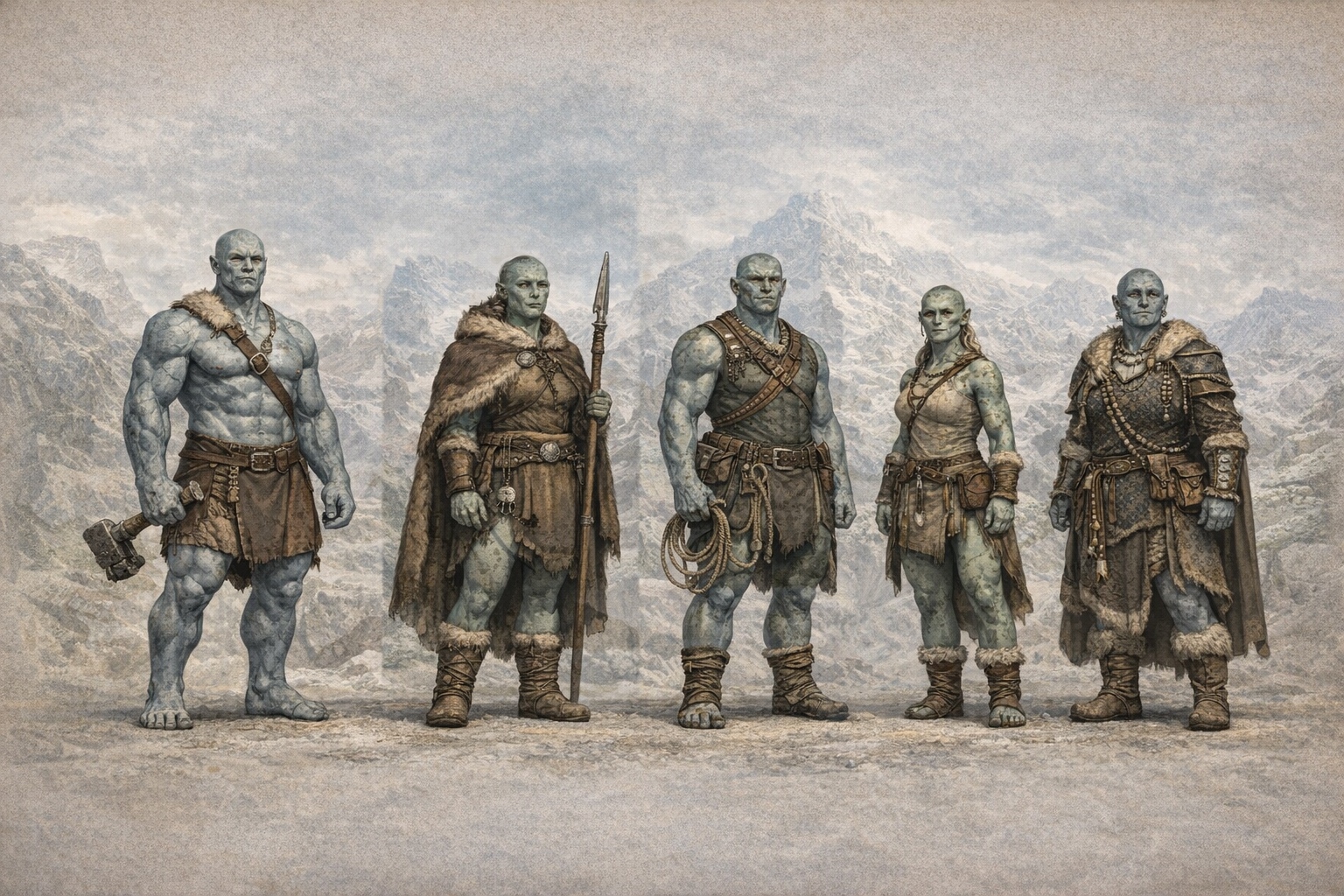
Goliath
Playing a Goliath? Exodus NDS rules: Species of Dort on ix.exodusnds.com, or the free Dort Species Guide from Exodus NDS Sourcebooks. Other systems: see Playing in Dort.
Core Identity
Pronunciation: GOH-lee-ath
Singular/Plural: Goliath / Goliaths
Demonym: Goliath
Classification: Giant-kin, between human-scale and true giant
Also called: Stone-blooded (a compliment in most mountain contexts), Deed-folk (reference to their naming culture), High-born (Irna highland term, meaning born at altitude; not a status claim)
The Goliaths are the people who live where other peoples cannot. Not through magic, not through any acquired technique, but because their bodies are adapted to conditions that kill most beings of comparable intelligence: extreme altitude, sustained cold, the physical violence of mountain existence. They stand between the fully human-scale peoples and the ancient giants in every sense: larger than the former, smaller than the latter; older in mountain tradition than most highland human settlements, younger in recorded history than the giants.
They do not have libraries. They have not built cities. What they have is the deed-name tradition (a living record of achievement that changes with the person who carries it) and the tactical intelligence of a people who have been winning fights against everything that mountains throw at you for a very long time.
Overview
Goliaths are a highland people, concentrated in the mountain ranges and high plateaus that other peoples use primarily as boundaries. Where an Irna lowland kingdom sees a mountain range as the edge of its territory, a Goliath clan sees home. Where other peoples send expeditions into altitude, Goliaths are already there, have been there for generations, and know things about the terrain that no expedition has ever brought back.
They are not scholarly. They do not maintain large accumulated archives of written knowledge, elaborate philosophical traditions, or institutional structures built to last across centuries. Their knowledge is practical, oral, and precise within its domain. A Goliath elder may not be able to tell you the political history of an Irna lowland kingdom three centuries back, but they can tell you every reliable water source within fifty miles of their clan territory, every weather sign that precedes a killing storm, and exactly how to fight three of you with one of them in this specific pass at this time of year.
That last category of knowledge is where Goliath intelligence is most visible. They are cunning fighters, not merely powerful ones. The popular image of the Goliath as a being who wins through strength is accurate but incomplete. They win through strength positioned correctly, and the positioning is calculated.
Physical Traits
All Goliaths share the fundamental physical character that makes them immediately recognizable across any mixed-population context:
- Scale. Goliaths are significantly larger than any fully human-scale people. Adults range from 7'4" to 8'6" depending on individual and family line, with proportionate mass; a Goliath at the upper end of the range weighs considerably more than height alone would suggest. This is not unusual fat distribution; it is dense, load-bearing musculature and bone structure that runs throughout the body.
- Skin color. Goliath skin does not occur in any of the tones found in fully human peoples. The Goliath skin spectrum runs from pale grey-blue through teal, seafoam, slate, sage green, forest green, and deep blue-grey. No individual Goliath has brown, tawny, pink, or black skin in the human sense. The specific shade varies by individual and has no consistent relationship to altitude, temperature, or family line; it is individual variation within the blue-green spectrum, present from birth and consistent throughout life. This coloring is the most immediately visible distinction between Goliaths and all other peoples.
- Pigmentation markings. Goliaths have natural patches of deeper or lighter pigmentation distributed across their skin, areas where the blue or green shades concentrate into darker or paler zones. These are not tattoos, not scarring, and not symbolic systems. They are natural pigmentation variation, present from birth, similar to how certain animals have patterning that emerges from underlying melanin distribution. No two Goliaths have identical marking patterns. The markings sometimes concentrate at joints, along muscle ridges, or around the scalp and face, but not consistently so.
- Bone structure and musculature. Goliath bones are denser than other peoples of comparable size. The muscle-to-frame ratio is the highest of any people on Dort; their physical strength is not a function of size alone but of having more muscle per unit of body than most beings manage. This density makes Goliaths heavier than they look and harder to move or knock down than their size already suggests.
- Altitude adaptation. Goliath lungs and cardiovascular systems are substantially more efficient at low-oxygen environments than any other non-Goliath people's. They do not slow down at altitude. They do not become breathless at elevations that compromise other peoples' function. At very high altitude, where most peoples are cognitively impaired, Goliaths are operating normally.
- Lifespan. 90–130 years. Goliaths mature quickly: functional adults by 16–18, full physical capacity by 20. They do not live as long as many of the other peoples on Dort. In a culture without institutional memory archives, the elders who hold 70 or 80 years of practical mountain knowledge are irreplaceable when they die.
Biology
Density and weight. The Goliath skeletal and muscular density is the primary biological fact shaping their physical experience. A Goliath cannot swim casually; they sink faster than their limb-mass can compensate for. Goliaths who live near water learn specific swimming techniques to account for this, and most do not swim recreationally. The density that makes them immovable on land makes water a neutral-to-hostile environment.
Altitude physiology. Goliath lung capacity is roughly 40% larger by volume than a same-sized human's. The efficiency with which they extract oxygen from thin air is correspondingly higher. This is not something they develop through training; it is present from birth and functions continuously without conscious effort. At sea level, this capacity is not particularly notable; they breathe as other peoples breathe, just slightly more easily. At 10,000 feet, where most peoples are gasping, Goliaths are not. At 15,000 feet, where most peoples cannot function without preparation, Goliaths slow somewhat but remain fully capable.
Cold tolerance. Goliaths have substantial subcutaneous fat distribution that is not visible as bulk but functions as excellent thermal insulation. Combined with their high resting metabolic rate (fueling the dense muscle mass requires constant caloric burn), Goliaths produce significant body heat. They are comfortable at temperatures that most other peoples require heavy clothing to tolerate. In extreme cold, they require the same precautions as other peoples, but their threshold for dangerous cold is significantly lower.
Diet and caloric needs. The high muscle density and constant metabolic burn mean Goliaths require substantially more calories per day than other peoples of comparable size. A working Goliath adult needs roughly double the caloric intake of a working human adult. This is a major logistical factor in Goliath clan planning; any territory they inhabit must be capable of sustaining their food requirements. Mountain territory that supports Goliaths typically has no surplus and requires active management.
Reproduction. Single births are strongly preferred by biology; twins are possible and survive at moderate rates but require more intensive support in early life. Goliath infants are large by any standard, more than twice the birth size of human infants. Mothers recover more quickly from birth than most peoples but require substantial caloric supplementation during and immediately following. The childhood period is short: Goliath children reach functional physical competence earlier than most peoples' children and are expected to contribute to clan work by age 10–12.
Genitalia. Goliath genitalia are proportionally smaller than their overall scale would suggest, significantly so. A Goliath's external anatomy in this regard is closer in absolute size to a mid-range human's than to what scaling from their height would produce. This is simply how they are built; it carries no cultural weight within Goliath communities, who regard it as unremarkable. Other peoples, particularly those encountering Goliaths for the first time, occasionally find this surprising given the rest of the package.
Psychology and Culture
The deed-name tradition is the axis of Goliath psychological and cultural life. It is not merely a naming convention. It is the way Goliath individuals understand identity, the way communities track who has earned what, and the philosophical framework within which Goliath values are expressed.
The deed name. Every Goliath is born with a birth name: short, simple, given at birth, carrying no particular meaning. The birth name is a placeholder. The deed name is earned: awarded by the clan for a significant act that demonstrates something about the person's character under pressure. A deed name describes what was done in a way that captures something essential about how it was done. A Goliath who survived a storm that killed three others is not merely storm-survivor; the deed name captures what they did specifically: the choice they made, the obstacle they overcame, the quality it demonstrated. A deed name is a compressed story, readable in full by anyone who knows the context.
The deed name can change. When a greater deed supersedes the old one (when the person does something that reveals them more completely than their previous deed name captured), the clan awards a new deed name and the old one is formally retired. An elder Goliath's full history includes all the deed names they have carried, recited on formal occasions in chronological order, each one a chapter of their life. In daily use, only the current deed name is used.
What qualifies as a deed. Not all deeds are combat. A Goliath who kept an infant alive through a killing winter when the food stores ran out may carry a deed name for that. A Goliath who found the pass through a previously unnavigable mountain range. A Goliath who held a trade negotiation steady when the other party tried to manipulate them through three days of pressure. The deed tradition values survival, protection, navigation, endurance, and leadership under pressure, across all their forms, not only the martial ones. That said, combat deeds are the most common because the mountain environment produces them most regularly.
Cunning over force. A persistent Goliath self-image is that they are not simply powerful but right about the fight before it happens. The tactical tradition (passed orally through generations, refined by accumulated experience, taught to children through structured scenario practice) is one of the most developed combat-knowledge traditions on Dort within its specific domain. Goliaths fight in terrain they understand, at times they select, from positions they have already assessed. They do not prefer even fights. They prefer fights they have already won before the first contact, and they spend considerable effort making sure those are the fights they enter.
This extends to non-combat contexts. A Goliath in a negotiation is assessing the room the way they would assess terrain. Who is the strongest party, where are the exits, what is the other person protecting, what are they actually afraid of. The tactical mind does not turn off when there is no immediate physical threat.
Oral tradition. Goliaths do not maintain large written archives. Their knowledge is carried in the memories of living practitioners, transmitted through apprenticeship and structured teaching. This makes their accumulated knowledge highly resilient to physical disaster (no library to burn) and highly vulnerable to catastrophic population loss (no text to reconstruct from). The death of a skilled elder without successors is a genuine knowledge disaster. Goliath communities invest significantly in ensuring that valued knowledge (tactical traditions, terrain knowledge, herbalism, weather reading) has multiple living carriers at any time.
Not wealthy. Goliath clans are not materially poor by survival standards; they have what they need and they manage it carefully. They are poor by the standards of lowland civilizations that accumulate surplus, build monuments, trade luxury goods, and measure status through material display. Goliath status is not displayed through possessions or architecture. It is carried in the deed name. The most respected elder in a Goliath clan may live identically to any other clan member in material terms; the difference is entirely in what they have done and what they know.
Geographic Distribution
Goliaths are almost exclusively found in mountain and high-plateau environments. They are present in the major mountain ranges of every continent but are most densely established in the central Irna highland ranges and the high plateaus of northern Shoing. They are rare at sea level and essentially absent from lowland territories, not because they are barred from them but because their adapted biology and cultural framework are fully matched to altitude and partially mismatched to lowland conditions. At sea level, the altitude advantage that is their greatest physical edge disappears; in flat terrain, the tactical landscape knowledge that is their greatest mental edge does not apply.
Small Goliath populations are found in lowland mixed cities, typically individuals who descended for specific purposes (trade, marriage into another people, political negotiation) and stayed. These urban Goliaths exist in a particular cultural tension: maintaining deed-name identity without the traditional clan structure to formally award and witness deed names requires adaptation. Urban Goliath communities have developed their own modified practices for this.
History
The Mountain Origin. Goliath tradition holds that they have always been in the mountains: not descended from giants who grew smaller or humans who grew larger, but their own thing from the beginning. The origin stories are simple and concrete rather than mythological: the first Goliaths survived a winter that should have killed them, and everything since has been more of that.
The Compact of the High Road (~14 centuries ago). The earliest documented Goliath inter-clan agreement, establishing shared use of the major mountain passes between several large clan territories. The High Road Compact prevented the pass-control wars that might otherwise have repeatedly devastated clans whose survival routes ran through each other's territory. The High Road Compact is still referenced in Goliath inter-clan disputes and has been revised and renewed across generations.
The Deed Wars (~10 centuries ago). A period of extended inter-clan conflict driven primarily by disputed deed names: cases where multiple Goliaths claimed the same deed, cases where deed names were seen as disrespectful to another clan's honored dead, cases where the deed-name tradition was used to justify territorial claims. The Deed Wars produced, in their resolution, the formal codification of the deed-name witnessing tradition: the requirement that a deed name be awarded by the clan council with formal witnesses, not self-declared. Pre-Deed-Wars deed-name claims were less regulated; the aftermath established the current system.
The Mountain Settlements (~8 centuries ago). A series of formal agreements between Goliath clans and the highland border kingdoms of Irna establishing Goliath territorial rights in the mountain ranges, in exchange for Goliath cooperation in pass management: specifically, guaranteeing safe passage through Goliath territories for authorized traffic and controlling banditry in the high passes. The Mountain Settlements were largely favorable to Goliath clans; the highland kingdoms needed the pass access and had no realistic ability to take it by force. The pass-management relationship has evolved significantly over the centuries but the core framework of the Mountain Settlements underlies most current Goliath-Irna formal relationships.
The Lowland Contact (~5 centuries ago). As Irna's mountain road network expanded, more sustained contact between Goliath clans and lowland populations became regular rather than occasional. This period established the Goliath mercenary tradition; Goliath fighters, particularly at altitude, are a premium resource that lowland military operations have consistently sought access to. The mercenary relationship is complicated: Goliaths who serve in lowland military contexts are not viewed negatively by their clans in principle, but extended lowland service that produces no deed of equivalent value to the time spent is considered a loss. Goliaths serving as mercenaries are expected to bring something back (knowledge, resources, a significant deed), or the service is not worth the absence.
Language
Spoken language: Skaalthis ("mountain-tongue"; from the deed-name root skaal, the cold, the mountain condition, and -this for tongue/speech). Skaalthis is a functional, direct language without substantial philosophical vocabulary. It has excellent precision for terrain description, weather, physical states, and tactical conditions. It has limited vocabulary for abstract concepts, emotional states, and anything with no immediate practical application. This is not a deficiency; it is the language shaped by what Goliaths needed to communicate clearly and quickly in conditions where miscommunication costs lives.
Goliaths who spend significant time in non-Goliath contexts typically learn a second language for those contexts and use Skaalthis among themselves for anything that requires the specific precision it provides.
Written script: Deed-marks. Goliath written tradition is minimal and specific. Deed-marks are a simplified notation system, not a full syllabic or alphabetic script, used primarily to record deed names, clan agreements, and territorial markers. A Deed-marks inscription typically records who, what deed, when (expressed in seasons/years), and witnesses. The system has roughly 40 characters, enough to record these specific things efficiently and not much else. Extended text in Deed-marks is awkward; the system was never designed for it.
Most Goliaths who maintain written records of any complexity use a second script, typically whatever script is dominant in the nearest lowland civilization, for anything requiring extended text.
Naming tradition. The Goliath two-name system, birth name and deed name, comes from the Proto-Indo-European steppe-culture phonological tradition established by the Goliath naming mage. Birth names are short and simple (1–2 syllables, clean). Deed names describe the deed itself in Goliath phonology (2–3 syllables, concept roots, mountain-texture consonants). The full formal name used in clan contexts is both names; in casual contexts, both names are used but the deed name is more identifying.
Example full names: Kavak Kraathon, Stremat Strommal, Moren Grethak, Thalen Morthenath, Dravet Vakstron, Nokem Skaalath, Sormath Thraalon, Vaskot Kremathon
Naming Conventions
Naming Agent Cross-Reference
See _Cannon/Race naming ai agents/Fantasy Name Generator - Giants.md, Register 2 and the Dort Application: The GOLIATH section, for full naming rules and generation guidance.
Personal Name Structure
The Goliath two-name system, birth name and deed name, comes from the Proto-Indo-European steppe-culture phonological tradition established by the Goliath naming mage. Birth names are short and simple: one or two syllables, clean, carrying no particular meaning, given at birth as a placeholder. Deed names describe the deed itself in Goliath phonology: two or three syllables built from concept roots, with mountain-texture consonants.
The full formal name used in clan contexts is both names. In casual contexts both are still used, but the deed name is the more identifying element; a Goliath is better known for what they did than for what they were called at birth.
The Deed Name Changes
A deed name is earned and can be replaced when a greater deed supersedes it. An elder Goliath may have carried several across a life, and only the current one follows the birth name in use. Previous deed names are never erased; they are known by the clan and recited at formal occasions, which makes an elder's full recitation a biography.
Clan Names
Clan names are a third element used only in formal contexts: [Birth name] [Deed name] of [Clan]. They follow deed-name phonology, built from concept roots and endings.
Sex and Name Form
Goliath naming does not encode sex at all, and this is culturally significant rather than an omission. A birth name is a placeholder that carries no meaning yet; a deed name describes the deed. Neither has anything to say about the bearer beyond what they have done. In a culture that marks achievement because achievement means survival, what you survived is the interesting fact.
Birth name endings -ak, -av, -or, -at, -en, -im, -on, -ek and deed name endings -on, -ath, -an, -ok, -or, -ek are borne by anyone. Deed names never inflect; Kraathon means stone-cleaver regardless of who cleaved the stone, and constructing a feminine form would imply the deed was a woman's deed rather than a deed, which no clan would recognize. Clan names do not inflect either.
Name Examples
- Birth names: Kavak, Stremat, Moren, Thalen, Dravet, Nokem, Sormath, Krath, Vaskot, Gretak
- Deed names: Kraathon (stone-cleaver), Strommal (peak-reacher), Grethak (the enduring), Morthenath (death-marked survivor), Vakstron (the guardian), Skaalath (cold-survivor), Thraalon (the vast), Draavek (the descent)
- Clan names: Kraathon-ek, Strommalor, Grethavan
- Full name examples: Kavak Kraathon; Stremat Strommal; Moren Grethak of Grethavan; Thalen Morthenath, formerly Thalen Skaalath
Society
Clans. The basic Goliath social unit is the clan: typically 30–80 members, encompassing family lines, allied individuals, and any outsiders formally adopted into clan membership. The clan holds territory, makes collective decisions, awards and witnesses deed names, and manages collective survival. Clan decisions are made by the elder council, the group of recognized senior deed-name carriers, with significant weight given to the most recent deed name holders in any relevant domain. Tactical decisions weigh the tactical elders; territory decisions weigh the territorial elders. The division of authority by expertise is practical, not symbolic.
Deed-name witnessing. The formal award of a deed name requires the clan council to convene, the deed to be described (by the person or by witnesses), the council to confirm it meets the threshold for naming, and the name to be agreed. This process typically takes a day and involves significant debate. The threshold for deed-name award is deliberately high: not everything notable is deed-worthy. An elder who awards deed names too freely is considered to be cheapening the tradition, and this is a serious social criticism.
Inter-clan relations. Goliath clans maintain formal compact relationships with neighboring clans: pass-use agreements, marriage-compact frameworks, resource-sharing protocols. These are not warm alliances in most cases; they are functional management of necessary interdependence. Clans that dislike each other maintain compacts anyway because the alternative, unmanaged competition in the same mountain range, is worse than the discipline of formal agreement.
Mercenary tradition. The Goliath willingness to fight for non-Goliath peoples in exchange for resources or formal recognition is established enough to be considered a cultural institution. A Goliath in mercenary service is expected to be genuinely useful, not to fulfill a contract minimally but to do the job the deed-name tradition would recognize. A Goliath mercenary who performs adequately is not celebrated; one who performs in a way that earns a new deed name is.
Interactions with Other Peoples
Borun. A mountain-and-forest people's relationship: Goliaths hold the high passes; Borun manage the forest below. The two peoples have functional territorial agreements in the highland-to-forest transition zones of Irna. They respect each other for the specific competences that each holds in their respective terrain and are wary of each other in the overlapping zones. The relationship is professional rather than warm; they have compact frameworks, not friendship.
Taurik. An unexpected resonance: both peoples have a strong tradition of territorial endurance and both have a healthy suspicion of urgency. Taurik build compacts in stone; Goliaths build them in deed-name records. The two peoples negotiate effectively when they encounter each other's boundaries because both take the concept of territorial agreement seriously. The Goliath mercenary tradition and Taurik infrastructure projects have intersected productively on several occasions.
Irna lowland peoples (general). The Goliath relationship with lowland Irna peoples is primarily transactional and has been for centuries; the Mountain Settlements established the framework, and it has been revised without being fundamentally changed. Lowland peoples want pass access and occasionally want Goliath fighters; Goliaths want resources they cannot produce at altitude and formal recognition of their territorial rights. Both parties have generally found this trade viable, which is why it has persisted.
Giants. The Goliath relationship with true giant populations, who also inhabit highland and extreme terrain, is the most complicated in Goliath experience. Goliaths are smaller than giants but large enough not to be casually ignored by them. They are not kin in the social sense (giant populations do not regard Goliaths as fellow giants), but the terrain overlap is real and the competence overlap is real. In regions where both peoples have presence, the relationship is handled through very direct territorial clarity. Giants and Goliaths do not share territory easily; they mark and respect boundaries with equal seriousness.
Development Notes
On "between humans and giants." Goliaths occupy a specific scale position that has narrative implications. They are too large to be treated as regular people in most architectural contexts; doors, furniture, and seating designed for humans are problematic. They are small enough to be present in human-scale spaces with some difficulty, which is different from Taurik (who simply cannot enter most standard buildings). A Goliath in a human-scale tavern is awkward, not impossible.
On skin color. The blue-to-green spectrum is the Goliath's defining visual trait. This should be mentioned when a Goliath character appears for the first time in any narrative context; it is immediately striking to other peoples. The color is natural, lifelong, and varies individually. There is no meaning attached to specific shades; a sage-green Goliath is not ranked differently from a pale-blue Goliath. It is simply what they look like.
On the deed name. The deed-name system is available as active narrative material throughout any story involving Goliath characters. A Goliath's current deed name tells you something about the most significant thing they have done so far. The occasion of earning a new deed name is a significant life event. A Goliath who has done something deed-worthy but has not yet been formally named for it is in a particular cultural state; the deed is real, but the identity hasn't caught up yet.
On cunning versus strength. The most interesting Goliath characters are the ones where tactical intelligence is the primary characteristic, not raw physical power. Their strength is real and it matters, but what makes them formidable is that they are usually three steps ahead of the fight. A story that treats a Goliath character as simply a large person who hits hard has missed the specific character of the people.
On oral knowledge. The absence of written archives is not a failure; it is a design that is fully appropriate to mountain existence. When including Goliath knowledge in a story, it is transmitted person-to-person, demonstrated rather than read, and held by specific living people who can be sought out or lost. This creates narrative stakes around Goliath elders that written archives do not.