lapori
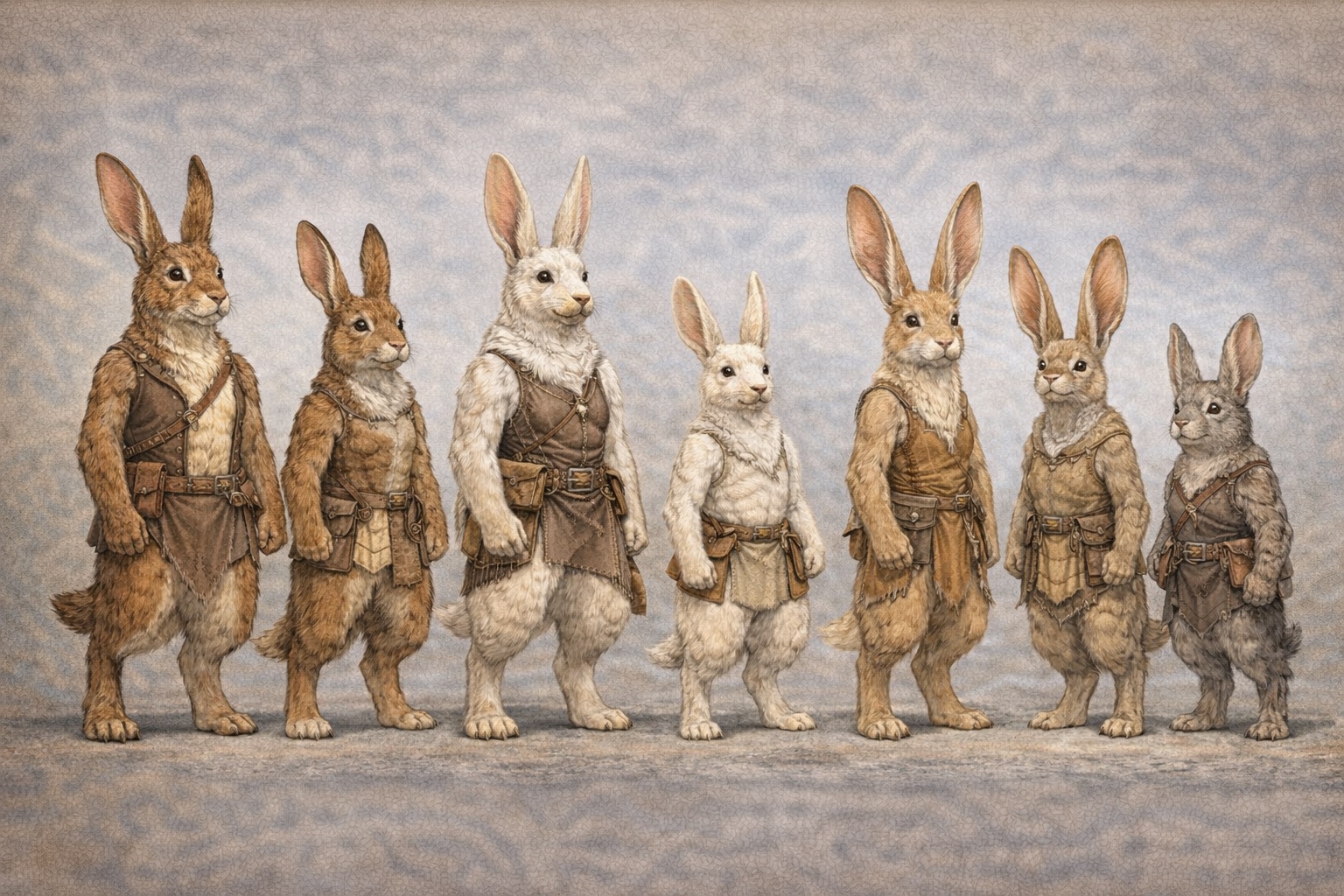
Lapori
Playing a Lapori? Exodus NDS rules: the free Dort Species Guide from Exodus NDS Sourcebooks. Other systems: see Playing in Dort.
CORE IDENTITY
- Race Name: Lapori
- Plural Name: Lapori
- Adjective Form: Lapori
- Alternate Names: Warren-folk (common, neutral); the Quick (general use, affectionate); the Listeners (Aviari usage, accurate and meant respectfully)
- Self-Name (Endonym): Arnavel, "the swift-valley people," from the same root stock as their naming tradition; used in formal or philosophical contexts
- Outsider Names (Exonyms): Hare-kin (common, neutral); Soft-ears (mildly reductive, used in Irna; Lapori find it inaccurate as an assessment and technically wrong); the Quick-Minded (a Gnome term, offered as a genuine compliment); the Courier People (trader slang, a reference to their communication network roles)
OVERVIEW
Short Description
The Lapori are a beastfolk people of lagomorph nature: upright, bipedal, with large mobile ears, powerful hind legs, and a quality of attention to the world that is best described as complete. They process everything: sound, movement, context, and implication all arrive simultaneously, and the Lapori response to that input is faster than most peoples find comfortable. They are not nervous people; they are fast people, which is a different thing entirely. Their warrens are the basic unit of Lapori society (extensive underground networks that are simultaneously home, archive, and communication hub), and their civilizational contribution is the web of information and quick connection that those warrens enable. The Lapori know what is happening before most peoples have heard the question.
General Reputation
The Lapori are regarded across Dort as sharp-minded, quick-tongued, and reliably better-informed than they have any obvious reason to be. The last quality is the one other peoples most consistently remark on: Lapori merchants seem to know prices at distant markets before travelers from those markets arrive; Lapori warren-networks appear to carry news that ground-based courier systems do not have. This is not considered sinister, merely noted. In Irna and Antaea, where large Lapori populations have been established for many centuries, they are considered valuable community members, skilled negotiators, and the people to know if you need to know something. In Funta, where Running-kin are the dominant lineage, they are respected as formidable open-country travelers and long-distance traders.
Role in the World
The Lapori occupy the civilizational niche of connectors and communicators: the people who know everyone, know what everyone knows, and move between communities fast enough to make that knowledge useful. Their warren-network infrastructure is one of Dort's most significant information systems: interconnected warren communities sharing news, prices, warnings, and opportunities through a chain of fast-moving Lapori that outpaces anything that depends on roads and horses. They are traders, negotiators, couriers, and the people in diplomatic contexts who often know the actual position of every party before the formal negotiation begins. They do not typically build walls or forge armies, but every city that has a significant Lapori warren population is better-connected to the world than it would otherwise be.
PHYSICAL TRAITS
General Appearance
A Lapori reads immediately and distinctly: the large upright ears (independently mobile and in some lineages extraordinarily long relative to body size), the compact powerful hindquarters built for explosive movement, the short fine muzzle with a twitching nose that is in almost constant motion, and the bright forward-set eyes that carry an alertness so complete it reads as intensity before familiarity. They stand fully bipedal, are built leaner than they appear at first glance, and move in a way that suggests capacity for sudden rapid change of direction or speed even when standing still. Fur covers the body; color, pattern, and density vary substantially by lineage and individual.
Size Ranges
- Typical height: 4'6" – 5'10" (varies substantially by lineage; see Variants)
- Typical weight/build: Light to medium; the hindquarters carry the most mass, giving a slightly bottom-heavy silhouette. Lapori are significantly stronger in the leg than their overall frame suggests.
Distinguishing Features
All Lapori share a baseline set of features regardless of lineage: large, independently mobile ears with strong connection to emotional and attention state (a Lapori's ears tell you where their attention is and what they think of what they're hearing), powerful digitigrade hind legs built for explosive movement, a short dense-furred tail (ranging from minimal to moderate depending on lineage), a mobile nose that processes olfactory information continuously, and forward-set bright eyes. Their hands are fully capable of fine manipulation. Their reaction time is measurably faster than most peoples; Lapori who play competitive games involving rapid response are rarely competitive, because the other players find playing them unpleasant.
Sexual Dimorphism
Lapori dimorphism is minimal across most lineages. Males in Running-kin lineages tend slightly larger and heavier in the hind leg; females in Warren-kin lines show marginally stronger warren-architecture instincts as a behavioral tendency. Neither difference is consistent enough to be considered meaningful, and both are noted as tendencies that individual variation overrides frequently.
Aging Patterns
Lapori young are born in litters and are mobile and alert within days. Warren-kin in particular are notable for how quickly young Lapori develop warren-navigation competence, the ability to move through the warren without guidance. Adult acknowledgment within the warren comes at the point when a young Lapori demonstrates reliable information-handling: carrying a message accurately, assessing a trade situation correctly, or navigating between warrens without error. This typically occurs between ages twelve and sixteen. Visible aging in Lapori appears as a softening of the coat color: the ears lighten first, then the muzzle, then progressively across the body. Lapori elders are called the Light-Eared with the same respect the term carries in Canix and Aviari culture.
Regional Variation
Like other beastfolk peoples, Lapori appearance is defined by lineage rather than geography. A Running-kin raised in the cold forests of northern Irna carries the same long hind legs and open-country build as one born in the warm grasslands of Funta. Within lineages, minor adaptation occurs over many generations (Frost-kin in particularly warm climates may develop slightly thinner coats over time), but lineage characteristics remain dominant. Lapori are exempt from continental appearance demographic norms; their appearance is defined by bloodline, not birthplace.
BIOLOGY
Diet
Lapori are herbivores with a strongly developed sense of plant quality. They can assess grain condition, root freshness, and herb potency by scent and taste with a precision that has made Lapori a valued presence in agricultural communities regardless of their broader social role. Their diet requires significant volume relative to body size (the metabolic demand of their activity level and digestive biology is high), and the Lapori cultural emphasis on food quality and variety reflects a genuine biological need for dietary range rather than simply preference. Lapori who eat monotonous diets show measurable health and cognitive effects over time.
Sleep Patterns
Lapori are crepuscular: most naturally active at dawn and dusk, with a mid-day rest period and lighter overnight sleep. Most Lapori in mixed-race communities adapt readily to local schedules but retain a preference for early morning as their sharpest processing time. Warren sleeping is communal by design; the warren's warmth and security allows deeper rest than individual sleeping. Lapori who sleep outside their warren context sleep noticeably lighter than those inside it, a biological consequence of the warren's function as a primary safety environment.
Reproduction Basics
Lapori have litters of two to six young, with three to four being most common. Gestation is short (approximately six to eight weeks), and multiple litters in a year are biologically possible, though warren resources and social convention regulate actual reproduction rate well below the biological maximum. The warren raises young collectively; a litter's birth parents are known and important, but all adults in the warren participate in young-rearing with essentially equal standing. The biological reproductive capacity of Lapori is the subject of considerable outsider comment; Lapori consider this observation tedious and point to their life expectancy and population stability as evidence that the actual rate is not what the theoretical maximum would suggest.
Lifespan Ranges
- Typical lifespan: 60–80 years
- Maturity: 12–16 years
- Elderhood: 50–60 years
Environmental Adaptations
Lapori hind-leg musculature is their most striking biological adaptation: explosive lateral and vertical movement capability that exceeds any comparably sized people and allows navigation of terrain that would be impassable to most ground-bound peoples. Their ears are active environmental sensors: independently mobile, capable of precise directional sound localization, and sensitive to frequencies below and above what most peoples register. In cold environments, Frost-kin biology achieves seasonal coat density adjustment; other lineages adapt through material means. Dust-kin ear biology includes a surface-area function that assists heat regulation in high-temperature environments, making their notably larger ears functional rather than merely distinctive.
PSYCHOLOGY & CULTURE
Typical Temperament
Lapori present as quick, direct, and alert; their social baseline is engaged rather than reserved. They pick up conversational threads faster than most peoples can lay them down, which creates a communication dynamic that can feel overwhelming to slower-speaking peoples and refreshing to faster ones. The directness is not aggression; it is the natural expression of a being that has already assessed the situation and is moving to useful engagement. Within the warren, this pace takes on a communal quality; Lapori communities are busy, information-dense, and rarely quiet, but the activity is purposeful rather than anxious. The distinction between nervous and fast is one Lapori consider important and are accustomed to making for outsiders.
Cultural Values
- The warren holds: The warren is not merely shelter; it is the accumulated investment of generations of Lapori who dug, expanded, and maintained it. Lapori identity is tied to their warren in a way that transcends the individual members currently living in it. To maintain the warren is a form of respect for everyone who dug before you and everyone who will live after.
- Information is gift, not commodity: Within the warren, information moves freely. Lapori who hoard knowledge they possess that would benefit their warren-mates are considered to have committed a small but genuine violation of the community. Between warrens, information has value and is traded; within a warren, it is shared.
- The quick answer is not always the right answer: A counterintuitive Lapori cultural value that exists in tension with their natural pace. Lapori know they are fast. They also know that fast processing can be wrong processing, and that the failure mode of their temperament is conclusion-jumping. The cultural value of sitting with a question (sometimes literally, which means something very specific in Lapori practice) is a taught corrective to a biological tendency.
- Every warren remembers: The oral record of a Lapori warren is extensive, reaching back generations through the line of warren-keepers who have maintained the accumulated knowledge. This is not sentimentality; it is considered a resource. Someone has been in this situation before. What did they do?
Taboos
- Warren-breaking: The worst violation, damaging the warren itself through negligence or deliberate action. The warren is the intergenerational work of the community; breaking it is an attack on everyone who contributed to it, living and dead.
- Silent passing: Receiving information that would benefit the warren and not sharing it. The taboo scales with the stakes: failing to mention a minor price fluctuation is a small social failing; withholding knowledge of an incoming threat is something the warren does not forget.
- The false quick: Providing a rapid answer that sounds confident but is not accurate. The cultural value of the quick answer requires that it be a good answer. A fast wrong answer is considered worse than a slow right one, because it implies contempt for the person being misled, the assumption that speed will substitute for accuracy.
Social Structures
The warren is the primary unit of Lapori society: an extended family and neighbor grouping that shares a physical underground network, common resources, and collective memory. Warrens typically house between twenty and two hundred individuals; large urban warrens may run larger. Multiple warrens in a region form a web: an informal network of regular information exchange, mutual aid obligations, and shared courier infrastructure. The web has no formal government; it operates through a dense network of relationships and obligations that experienced Lapori navigate by memory. There is no Lapori nation, but the web that connects Lapori warrens across continents is one of the more effective information systems in Dort.
Family Structure
Lapori family structure is warren-collective rather than nuclear. A litter's birth parents are acknowledged and maintain a distinct relationship with their young, but all adults in the warren take active roles in child-rearing, and young Lapori address all adult warren-members with familial terms. Pair bonds exist but are not the primary structural unit of the community; warren membership is. Inheritance is primarily of warren-standing rather than individual property; a Lapori inherits their place and role within the warren, and any individual goods are considered secondary to that position.
Leadership Patterns
Warrens are led by a Warren-Keep, a title that emphasizes maintenance and memory over authority. The Warren-Keep is the individual who holds the most complete current knowledge of the warren's relationships, debts, obligations, and history, and who is acknowledged by the community as the most reliable reader of situations requiring warren-level decision. Warren-Keeps are not elected through formal process; they emerge through demonstrated reliability and are acknowledged by the community shifting its consultation toward them in preference to others. The transition is typically gradual and rarely contested because the community's acknowledgment of competence is usually unambiguous by the time it is complete.
GEOGRAPHIC DISTRIBUTION
Primary Homelands
- Irna: The largest and most established Lapori populations are in Irna, concentrated in the temperate midlands and southern coast. Irna warrens have been part of the continent's settlement fabric for over fifteen centuries; some Irna cities have Lapori warrens that are older than the surface city above them. Warren-kin are the dominant lineage here, and the web of Irna warrens is considered the most sophisticated Lapori communication network in Dort.
- Antaea: Large Lapori populations in the northern highlands and forest margins, with a mix of Warren-kin and Running-kin. Antaea Lapori have a distinct web-culture character that reflects the continent's less-dense settlement patterns; warrens are more widely spaced and the courier tradition between them is more physically demanding than in Irna.
- Funta: Open plains and savannah regions host significant Running-kin populations, with Warren-kin in the wetter margins. Funta Lapori maintain some of the longest overland courier routes of any Lapori web, and the Running-kin tradition is strongest here.
Secondary Populations (Diaspora)
- Jazirah: Dust-kin are the primary Jazirah Lapori lineage, well-adapted to the heat and arid conditions. Jazirah Lapori warrens are often built deeper than those in temperate regions, reaching stable-temperature layers underground that function as effective climate control. Their web integrates with Canix long-run communication networks in ways that are mutually beneficial.
- Shoing: Smaller Lapori populations in the agricultural and trading regions of Shoing, primarily Warren-kin. Shoing Lapori are a significant minority presence in several major trade cities.
- Irna highlands / Shoing mountains: Frost-kin are found in cold highland regions of both Irna and Shoing, smaller populations but well-established in alpine community roles.
Migration Patterns
Lapori expansion follows warren-fission: when a warren grows beyond the capacity of its existing tunnel network to comfortably support, a group of young adults, typically those who have been most active in long-range courier work and who know the surrounding territory best, establishes a daughter-warren at a suitable distance. The daughter-warren maintains formal ties to its parent through web obligations and courier exchange. This pattern of gradual outward expansion has been consistent across Lapori history and produces a web density that increases naturally with population.
Adaptations by Region
Lapori warrens in urban environments are more architecturally complex than rural warrens (urban warrens must navigate around foundations, existing infrastructure, and the compressed ground conditions of dense settlement), and urban Lapori have developed construction techniques that allow warren-building in conditions that would defeat simpler approaches. Frost-kin in cold highland regions line their warrens with harvested dry grass and dense fur-molt material for insulation; their above-ground activity is primarily concentrated in the brief warm season. Dust-kin warrens in Jazirah are the deepest in Dort, reaching twenty to thirty feet below surface in some cases to access thermally stable zones. The specific depth and structural techniques of deep warrens are considered valuable knowledge and are shared within the web selectively.
Cultural Differences Between Lands
Irna Lapori have the most formally developed web-governance traditions, shaped by centuries of managing a dense network of warrens across a heavily settled continent. The Irna web has informal protocols, recognized mediators for warren disputes, and a body of accumulated precedent that functions as unwritten law. Antaea Lapori maintain stronger individual warren independence than Irna; the web is more informal and less precedent-bound. Funta Running-kin culture is the most physically oriented of any Lapori regional tradition; the esteem given to long-distance running, endurance, and open-country navigation rivals the cultural weight that Warren-kin give to architecture and information management. Jazirah Dust-kin have developed the strongest integration with Canix pack-networks of any Lapori regional group, and the combined communication systems of Jazirah Lapori warrens and Canix long-runs represent the most effective information infrastructure on that continent.
HISTORY
Origins
Lapori origins, like those of the other beastfolk peoples, trace to mage-work. Their tradition calls this origin the First Run, a parallel to the Canix tradition but with a distinct flavor: where the Canix First Run is about the pack moving together, the Lapori First Run is about the individual discovering the extent of the world and returning home with news of it. The mage's philosophical inheritance is readable in Lapori culture's tension between deep warren-rootedness and the irresistible pull of the next horizon. Both are true. Both were designed in.
Major Turning Points
The Warren Wars (approximately fourteen centuries before the current era) were a period of sustained territorial conflict among expanding Irna warrens competing for underground real estate in the same geographic zones. The conflict was resolved through the Compact of the Shared Depth, an inter-warren agreement establishing the principle that subsurface territory is negotiated by demonstrated occupancy and maintenance, not surface-claim. This compact, adopted progressively by warrens across multiple continents, underlies all inter-warren territorial negotiation and has held in principle even through periods of significant conflict.
The Long Roads (approximately ten centuries before the current era) describe the sustained period of Lapori expansion across multiple continents: not displacement, but the deliberate establishment of daughter-warren networks along trade routes that had previously been served only intermittently. The Long Roads created the multi-continental web structure that Lapori use today and established the courier system that became the foundation of their civilizational role.
The Web Famine (approximately five centuries before the current era) was a period of severe disruption to Irna Lapori warren networks caused by a combination of crop failure and a sustained military conflict between non-Lapori powers that disrupted above-ground movement. The Lapori response, a coordinated web-wide redistribution of food resources through the courier network, is considered the clearest single demonstration of what the web is capable of when operating at full function. The Warren-Keep of Arnavel Guilvellon, who coordinated the response across three continents, is the most cited historical figure in Lapori oral tradition.
Current Historical Posture
The Lapori are ascendant in the quiet mode; they are not building empires or winning wars, but they are more deeply embedded in the infrastructure of Dort's information economy than any century before. The web is larger than it has ever been, the courier systems more reliable, the inter-warren protocols more sophisticated. The current philosophical debate in Lapori culture is about the limits of the web: how much of Lapori identity is the warren itself, and how much can transfer to above-ground urban life? Urban Lapori warrens exist and thrive, but some Warren-Keeps argue that an above-ground Lapori community without a working underground warren is not, in some foundational sense, a warren at all.
LANGUAGE
Language Name(s)
The Lapori language is called Arnothis, "the swift-tongue," with the same root as their self-name and naming tradition. It is spoken faster than most peoples find comfortable to listen to, a biological baseline rather than cultural choice; Lapori who interact regularly with other peoples adapt their pace without thinking of it as translation. The language has two recognized variants: Arnothis-Irna and Arnothis-Funta, which are mutually intelligible. A third, Deep Arnothis, is the tonal and slightly more formal variant used in warren-record-keeping.
Script
Lapori writing is called Warrenmarks, a compact, efficient notation system developed around the constraint of writing quickly in enclosed spaces, originally with claw-marks on packed earth. It is characteristically small and dense; a Lapori letter contains more information per surface area than most peoples' scripts. Most adult Lapori are fully literate. Warren records are kept in bound bark volumes with Warrenmarks script; these records are considered the property of the warren and are not shared outside it as a matter of course. Warren-keeps maintain the master record; individual members maintain personal message logs that contribute to the collective archive.
Trade Language Status
Arnothis is used as an informal trade language within established Lapori web corridors; merchants who travel the same routes as Lapori couriers often learn enough to use it. Lapori individuals are fast language learners (the same processing speed that characterizes them in other domains applies here) and typically acquire the dominant regional tongue of their warren's city or territory with relatively little effort. Common carries significant Lapori influence in vocabulary related to information, speed, network, and negotiation.
Dialect Range
The Irna and Funta variants are the primary split; the differences are vocabulary and pace rather than fundamental grammar. Deep Arnothis is a stylistic rather than dialectal variation. Within each variant, warren-specific shorthand, developed for rapid inter-warren message transfer, creates significant opacity for outsiders even when the base language is shared.
Naming Agent Cross-Reference
See _Cannon/Race naming ai agents/beastfolk/Beastfolk - Rabbit.md for full naming rules and generation guidance.
NAMING CONVENTIONS
Lapori names follow a given name + warren name structure, both drawn from the Occitan phonological tradition documented in the naming agent file. Names favor soft consonants, nasal endings (-an, -on, -en, -el, -vel), and a lightness that reflects the "quick without being small" design principle, names that arrive before you expect them.
Warren names follow the same phonological tradition and describe the warren's founding character or territory. Formal address uses the full name; within the warren, given name or a shortened form is standard.
Sex and Name Form
Lapori sex-marking turns on the register's defining feature, the nasal vowel: masculine names keep the nasal; feminine names resolve it into a clear vowel and a spoken final consonant. The masculine endings -an, -on, -en, -in, -van, -vin, -lon, -el and -vel resolve into the feminine -ine, -aine, -anne, -onne, -enne, -elle, -ette and -ie. Arnan becomes Arnine or Arnanne; Arnvel becomes Arnvelle; Guilon becomes Guilonne.
The tradition resolves rather than appends, and the difference matters; Arnana is a borrowed instinct that produces a name Occitan would not recognize. Soft consonants stay soft in both sexes; there is no harder masculine variant, and the ban on gutturals applies throughout.
The -let ending is the status diminutive and does not mark sex; canon notes it is a "diminutive of higher status, counterintuitively," borne by anyone whose standing has earned it. Warren names never inflect.
Both sexes must stay quick. A feminine Lapori name that has grown long and ornamental has failed the tradition even when every ending is correct; the -elle and -ette forms are light and fast, not decorative.
Name Examples
- Given names (general): Arnvel, Guilon, Bertvan, Folvel, Lavnon, Servel, Mirvan, Raimbel, Peiran, Blavon
- Given names (elder / formal address): Same names throughout life; elders are acknowledged by the title Avel- (before the name): Avel-Arnvel, Avel-Servel
- Warren names: Arnavel, Guilvellon, Bertranvel, Folvanon, Lavnonel, Mirvanon, Blavavel
- Honorific / title examples: Avel- (before the name) for a recognized Warren-Keep; -vel (suffix) for a recognized long-distance courier; -let (suffix) for a young adult courier completing their first solo run, a higher-status honorific than it sounds
- Full name examples: Arnvel Guilvellon, Guilon Arnavel, Avel-Servel Bertranvel, Lavnon-vel Folvanon
SOCIETY
Common Professions
Lapori are overrepresented in roles requiring rapid information processing, quick reliable communication, and the social skill to extract and verify information from diverse sources: couriers and message runners are the oldest and most consistent Lapori profession, but the information-brokerage role (knowing prices, positions, and news before others do) is equally central. Lapori merchants are known as among the most accurately-informed traders in any market they participate in. In agricultural communities, Lapori serve in advisory roles related to soil quality, crop health, and planting timing where their olfactory assessment of plant condition provides genuine value. Urban Lapori are disproportionately represented in negotiation, legal advocacy, and diplomatic support roles; the ability to process what all parties have said and identify the actual point of agreement or conflict faster than the parties themselves is a useful professional skill.
Craft Traditions
Lapori craft centers on materials and methods that can be transported and stored in warren environments: written records, textile work, herb-processing and preservation, and small-object craft. Their most distinctive craft tradition is warren-architecture: the planning and construction of underground networks that are simultaneously functional living space, document archive, and defensible shelter. Warren-architecture knowledge is the most carefully maintained craft tradition in Lapori culture; master warren-builders are highly sought across any community where underground construction is relevant.
Trade Roles
Lapori export information (current pricing, news, route conditions), courier services, warren-architecture consultation, and herb and plant products. They import materials their underground lifestyle does not produce (metal goods, worked stone, large timber) and luxury food items. Lapori bargaining is fast and detailed: they tend to know the actual value of what they're trading before the negotiation begins, which shapes the process significantly. Merchants who try to exploit assumed Lapori ignorance of market conditions typically discover their assumption was wrong within the first exchange.
Military Tendencies
Lapori are not conquest-oriented and do not maintain standing armies, but their military value as intelligence providers, advance scouts, and underground siege-survivers is significant. The warren's primary defensive function is evasion and underground refuge; a community that can disappear into a warren network before a hostile force arrives is difficult to defeat on those grounds alone. Lapori have been central to the defense of several besieged communities by providing early warning of approaching forces before the force itself could detect that warning had been given. Their role in wartime is information infrastructure more than direct combat, and the value of that role is consistently underestimated by peoples who count soldiers.
Religious Tendencies
Lapori spiritual life centers on the warren and its continuity through time, the sense that one is living within something created by people long dead and that will be occupied by people not yet born. The warren-ancestor tradition, maintenance of the record of every Warren-Keep who has held the position before, is as much spiritual as archival. Most warrens hold a seasonal gathering called the Remembering, where the names of significant past warren-members are spoken aloud and their decisions and challenges reviewed, not as nostalgia but as practical consultation with precedent. Lapori in regions with strong temple traditions participate in local religious practice without abandoning this ancestral orientation.
INTERACTIONS
Relations with Other Races
- Smalings: The deepest cross-race relationship in Lapori life, built on centuries of complementary proximity; Smalings farm the surface above Lapori warrens in many regions, and the relationship that developed from that literal overlap became something more. Smalings feed Lapori; Lapori give Smalings early warning of anything moving through the territory. The practical interdependence has developed into genuine cultural warmth.
- Gnomes (Zannovi): A long-standing relationship of mutual professional respect. Gnome tinkerers and Lapori warrens interact around underground engineering; Gnome mechanical expertise and Lapori architectural knowledge have produced several significant collaborative construction projects. Gnome cook guilds and Lapori have a separate and somewhat more complex relationship, as Lapori assessment of plant and herb quality competes with Gnome culinary proprietary knowledge in several markets.
- Canix: A working relationship that is closer than it looks from outside. In Jazirah especially, Lapori warren-networks and Canix long-run pack-routes form an integrated communication system where each covers what the other cannot: Canix carry messages over surface terrain at speed; Lapori provide underground shelter and node-points along routes that make the whole system more resilient. The cultural styles are very different (Lapori find Canix social density occasionally exhausting, Canix find Lapori indoor-orientation puzzling), but the working respect is genuine.
- Urgrak: Orcs and Lapori have historically not interacted extensively; the Urgrak territorial character and the Lapori warren character simply do not overlap in many regions. Where they do, relations are cautiously neutral. Urgrak raids on surface communities have occasionally hit communities with Lapori warrens, where the Lapori response (vanishing underground before the raid, sending information about the raid outward through the network, and maintaining underground community survival until the raiders moved on) left a specific impression on Urgrak tactical culture.
Stereotypes (Given and Received)
- Stereotypes about them: That they are timid or easily frightened (false; the freeze response is tactical assessment, not fear, and a Lapori who has decided to fight is fighting someone who can move faster than they can); that they hoard information as a form of control (false within the warren, partially true between warrens; information has value, and Lapori treat that value honestly); that their rapid speech means they are not listening (false; they are listening and have already processed what you said).
- Stereotypes they hold: That most peoples make decisions too slowly and then blame the outcomes on circumstances; that Smalings have the right idea about meals; that Aviari would be more useful if they came down more often; that Urgrak would be significantly less dangerous if anyone had told them what was coming before it arrived.
Cooperation Patterns
Lapori cooperate most readily with peoples who are straightforward about their needs and willing to pay fairly for accurate information. The web's function depends on relationships with non-Lapori communities who benefit from courier and intelligence services; those relationships are maintained by consistent reliability and fair dealing. Lapori are among the more consistent cross-race alliance partners in Dort because their network value is too important to jeopardize for short-term advantage.
Conflict Patterns
Conflict arises most consistently when warren integrity is threatened: surface construction that damages existing warrens, authority claims over underground space that warrens pre-date, or military sieges that attempt to starve out above-ground populations without accounting for the underground one. The second pattern is information conflict: Lapori who are caught in a position where their web obligations and external relationship obligations point in different directions make choices that outsiders sometimes find surprising and Lapori find obvious.
VARIANTS
Physical / Regional Variants
Lapori lineages, like other beastfolk peoples, are defined biologically rather than geographically. Mixed-lineage warrens are common in regions where multiple lineages have historically co-existed, and individual lineage characteristics remain identifiable.
Running-kin
The hare lineage: the largest Lapori, built for sustained endurance over open terrain. Running-kin are significantly larger than other lineages, long-legged and lean, with the most pronounced hindquarter musculature and the most extended ear length of any non-Dust-kin lineage. Their sustained running endurance at high speed exceeds any comparably sized people in Dort. They hold their own above ground more comfortably than other lineages: not preferring it, but capable of extended open-country activity that Warren-kin find taxing. Running-kin warrens tend toward simpler construction: fewer chambers, longer connecting tunnels, designed for speed of transit more than complex habitation. Their coats run toward warm tawny-brown with white underside, darkening on the back saddle.
- Typical height: 5'4" – 5'10"
- Defining biological traits: Largest Lapori; most endurance running capability; longest sustained above-ground comfort; longest ear relative to head (after Dust-kin); tawny-to-brown coloring
- Range: Open grasslands of Funta and Irna; anywhere open terrain requires covering at speed
Warren-kin
The common rabbit lineage and the most widespread Lapori. Warren-kin are medium-built, shorter-legged than Running-kin, and the most architecturally sophisticated builders of any lineage; their instinct for underground construction is the strongest expressed, and Warren-kin are responsible for the most complex and well-designed warrens in Dort's Lapori communities. Their coats vary significantly by individual: solid, banded, spotted, and mixed patterns all occur in the same warren community. Warren-kin are the most socially dense lineage; they maintain the largest warrens and the strongest collective-living traditions of any Lapori group.
- Typical height: 4'8" – 5'4"
- Defining biological traits: Most architecturally developed underground-building instinct; widest individual coat pattern variation; most socially collective; medium endurance; strongest warren-attachment instinct
- Range: Temperate zones across all continents; the dominant lineage in Irna
Frost-kin
The arctic and snowshoe hare lineage, built for cold and highland conditions. Frost-kin undergo a seasonal coat shift: their summer coat is tawny-to-grey-brown, and their winter coat grows in white to near-white, a shift that is biologically involuntary and occurs with seasonal light change rather than temperature. Their ears are shorter relative to body size than other lineages (a heat-conservation adaptation), and their feet are broader, providing traction on packed snow and ice. Their underfur in winter is the densest of any Lapori lineage. Frost-kin warrens are built shallower than other lineages would prefer; they rely on the insulating snow layer above rather than depth below, and their seasonal activity cycles are the most pronounced of any lineage.
- Typical height: 4'10" – 5'6"
- Defining biological traits: Seasonal coat shift (tawny-summer to white-winter); shortest ears relative to body of any lineage; broadest feet for snow traction; densest winter underfur; most seasonal activity variation
- Range: Cold highlands of Irna and Shoing; any subarctic or high-altitude environment
Dust-kin
The desert hare lineage, defined above all else by their ears. Dust-kin ears are proportionally the largest of any Lapori lineage, large enough that the functional heat-regulation role they play is visible: the extensive surface area allows blood cooling in high-temperature environments that would stress other Lapori significantly. Their build is the leanest of any lineage, their legs the longest relative to body after Running-kin, and their coloring runs toward pale sand through tawny, providing concealment in arid terrain. Dust-kin are more comfortable in high heat than any other Lapori and can tolerate direct sun exposure for periods that would require shade-seeking from other lineages. Their warrens in Jazirah and arid Funta reach depths that other lineages find excessive; the temperature differential at depth in desert ground is genuinely necessary for their biology.
- Typical height: 5'0" – 5'8", very lean
- Defining biological traits: Largest ears of any Lapori (heat regulation function); leanest build; best heat tolerance; deepest warren-building instinct; sand-to-tawny coloring
- Range: Jazirah desert and arid plains; arid southern Funta; wherever sustained heat demands biological adaptation
Stone-kin
The smallest Lapori lineage, and the most altitude-adapted. Stone-kin are compact and densely built relative to their size, with the shortest visible tail of any lineage and ears that are large for their head but proportionally moderate for their body. They are associated with rocky alpine terrain (scree slopes, boulder fields, and high passes) where their compact build allows navigation of spaces that larger lineages cannot enter. Stone-kin are the most vocally active lineage: they produce a characteristic sharp alarm call that carries distance through mountain terrain and which serves as the primary warning system for Stone-kin alpine communities. Their warrens are the shallowest (dug into existing rock shelters and cave systems rather than through open ground) and the most limited in complexity, compensated by their natural terrain providing much of the protection that other lineages build.
- Typical height: 4'6" – 5'0"
- Defining biological traits: Smallest Lapori; most compact build; minimal visible tail; highest altitude adaptation; most vocal, characteristic sharp alarm call; rock-shelter warren construction rather than open-ground digging
- Range: High alpine zones of Shoing and Irna; any high rocky mountain terrain
Cultural Branches
The Long-Run Couriers
Lapori who have effectively detached from a specific warren to operate as independent professional couriers across the web. Long-Run Couriers maintain web-membership and pass through warrens as nodes rather than homes; their identity is their route rather than their residence. The role is typically undertaken for a defined period in young adulthood, and most return to warren life eventually, but some Long-Run Couriers maintain the lifestyle for decades. Their knowledge of the web across vast distances is unmatched.
The Urban Warrens
Warren communities established within cities, often pre-dating the surface city in some cases. Urban warrens have adapted their construction traditions to above-ground urban conditions: their entrances are concealed within buildings, their tunnel networks navigate existing foundations, and their above-ground members may be entirely indistinguishable from urban non-Lapori residents for most of the day. Urban warrens maintain all the essential functions of a traditional warren (collective record, shared information, courier connection to the wider web) within a context that traditional warrens sometimes debate as equivalent.
DEVELOPMENT NOTES (Author use only, not canon)
Story Hooks
- The web in a specific Irna corridor has gone quiet: not broken, not interrupted, simply not reporting. Every courier who was sent to investigate has continued onward to the next warren rather than returning. The Warren-Keeps on either side of the gap cannot agree on what to do, and each is starting to suspect the other knows something.
- A Stone-kin alarm call network in a high Shoing pass has been sounding for three days. The Stone-kin who maintain it cannot identify what is triggering the call. Whatever it is, it is not visible to them. It is also not leaving.
- An Urban Warren in an Irna city has been maintaining a secret: not information they are hoarding, but something that was deposited in the warren's record-keeping by a non-Lapori figure two hundred years ago and sealed by a Warren-Keep who has since been dead for a century. The current Warren-Keep has opened it. She is not sure what to do.
- A Long-Run Courier arrived at a destination warren with a message that the sending warren denies sending. The message is in legitimate Warrenmarks. The courier has no memory of receiving it, only of delivering it. The content of the message would benefit the destination warren significantly if acted upon.
Unresolved Lore / Open Questions
- Who was the mage who shaped the Lapori? The troubadour-scholar phonological inheritance is distinctive enough that it might be traceable. Does it matter?
- The Warren-Keep of Arnavel Guilvellon who managed the Web Famine response is the most cited historical figure in Lapori oral tradition. What else do we know about her?
- How deep is the oldest known Lapori warren? Are there warrens so ancient that they predate the surface structures above them by more than a millennium?
- What is the full scope of the inter-Lapori and inter-Canix communication system in Jazirah? How far does the combined network reach?
Development Notes
- Cross-link with Smaling entries; the Lapori-Smaling relationship is the most developed cross-race relationship in both entries and should be consistently portrayed
- The Compact of the Shared Depth deserves a dedicated canon document alongside the other foundational Compacts
- Urban Warrens in Irna cities are a significant background-setting element for any city-set story
- Consider whether any named warrens should appear in major city or regional entries
- Long-Run Courier culture would make excellent character background for individual Lapori characters