orc
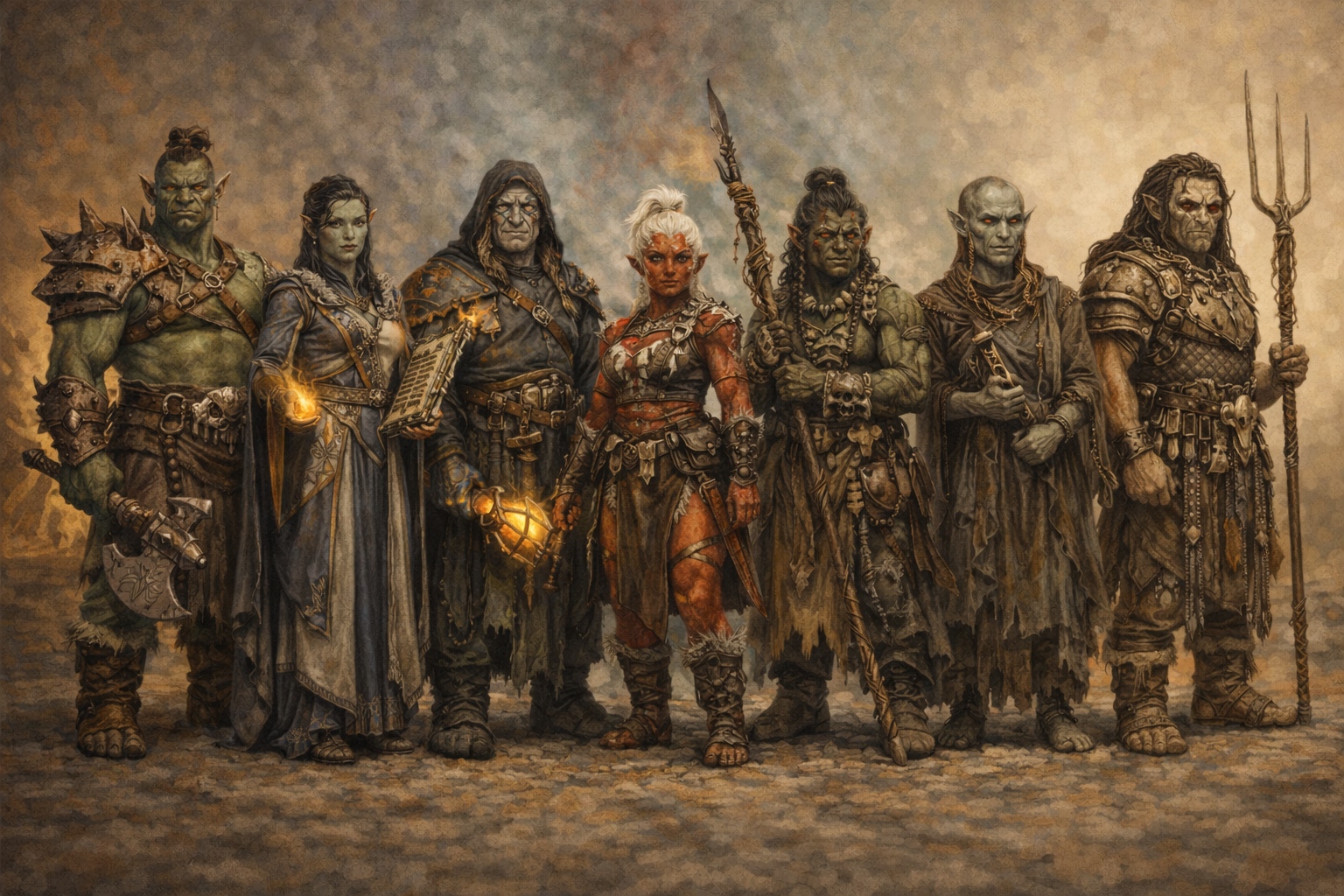
Orc
Playing an Orc? Exodus NDS rules: Species of Dort on ix.exodusnds.com, or the free Dort Species Guide from Exodus NDS Sourcebooks. Other systems: see Playing in Dort.
CORE IDENTITY
- Race Name: Orc
- Plural Name: Orcs
- Adjective Form: Orcish
- Alternate Names: Urgrak (self-designation, used in both singular and collective; "the Urgrak" in common speech); the Green (a widespread common term, describing the most visible physical characteristic; neither compliment nor slur, just the most immediately accurate descriptor outsiders reach for)
- Self-Name (Endonym): Urgrak, meaning simply "the strong ones" or "the ones who fight" in Urgrakki; there is no deeper philosophical gloss on the name within orc culture; it means exactly what it says
- Outsider Names (Exonyms): Greenskins (common across Irna, Funta, Shoing; descriptive, mildly reductive, not considered a slur by orcs themselves who regard their coloring as a point of pride); Warbands (Jazirah, refers specifically to their tribal organization rather than their race; sometimes used for full groups rather than individuals); Clansborn (Antaea, respectful acknowledgment of their clan-based social organization)
OVERVIEW
Short Description
Orcs are a powerful, intensely tribal people for whom warfare, clan identity, and the pursuit of strength are not merely cultural preferences but the organizing logic of existence. They are found on every continent in Dort: not as settlers or builders, but as a persistent, explosive presence that no other civilization has managed to eliminate, contain, or fundamentally change. What makes orcs remarkable is not their strength, though they are physically formidable, but the ferocity and coherence of their clan culture: an orc without a clan is a diminished thing, but an orc clan at full strength, united behind a Boss who has proven worth following, is one of the most dangerous forces in the world.
General Reputation
The world does not have a neutral view of orcs. Fear is the most common register: not the distant, theoretical fear one might have of a natural disaster, but the specific, alert fear of a threat that is local, real, and capable of arriving without warning. Alongside fear, and somewhat begrudgingly acknowledged, is respect: most peoples who have lived near orc clans for any length of time have come to recognize that orcs are not mindless; they are different-minded, operating by a logic that is internally coherent even when it is incompatible with the preferences of everyone around them. The world also knows that fighting an orc is considerably harder than it looks, that their raids can be tactically sophisticated, and that their capacity to absorb punishment and keep coming is legendary.
Role in the World
Orcs are Dort's great pressure force, the constant kinetic energy in the world's political and geographic landscape. They do not build empires that last, but they have repeatedly forced other peoples to build walls, forge alliances, and relocate that they would not otherwise have needed. This is not a romanticized role (it has caused enormous suffering), but it is the accurate civilizational-scale description of what the Urgrak do to the world around them. Periods of great Orcish unification, when a Warboss strong enough to hold multiple clans together rises, are understood by scholars of every other race as turning points: things change in those periods in ways they do not change otherwise.
PHYSICAL TRAITS
General Appearance
The first read on an orc is large, green, and dangerous. They stand significantly taller than most humanoids and are built in a way that suggests the upper body received more than its share of everything: shoulders wide, arms heavy, neck thick. The skin is the most immediately distinctive feature: a grey-green to deep forest-green that is entirely uniform within an individual and varies across the population from the pale grey-green of some northern clans to a deep, saturated green in others. There is nothing subtle about orcish physical presence; they are built to be seen and to be taken seriously when seen.
Size Ranges
- Typical height: 6'2" to 7'0"; clan variation exists, with Grakkan averaging larger than Zaggon, for example
- Typical weight/build: 220–320 lbs; almost entirely dense muscle and bone; body fat is minimal in active adults; the build is functional and massive simultaneously
Distinguishing Features
The grey-green to deep green skin is the most immediately recognizable feature and is inherent to the race; it does not vary by continent or environment, though it varies by individual and clan lineage. Tusks are the second defining feature: upward-curving lower canines that protrude past the upper lip, used for display, intimidation, and in close fighting; their size varies by individual and is considered attractive in both large and well-maintained forms. Orcish eyes are small relative to face size and tend toward dark tones: deep brown, grey, and occasionally an unsettling amber. Ears are slightly larger than humanoid baseline and come to a blunt point. Brow ridges are pronounced, giving the face a permanent look of intensity that outsiders read as aggression even when the orc is relaxed.
Sexual Dimorphism (if applicable)
Moderate dimorphism in size (male-presenting orcs average somewhat larger), but the overlap range is wide and strong female-presenting orcs are not unusual by any population standard. Tusks develop in all genders; size variation is individual, not gendered. Orcish culture invests no gender significance in physical difference; clan status is determined entirely by demonstrated strength and combat record, regardless of the individual's sex.
Aging Patterns
Orcish childhood is brief and actively accelerated by culture. Orc children are expected to begin practical combat training by age 8 and are considered full adult clan members, with all attendant rights and obligations, at 16 or 17, when they complete their first real fight (as opposed to training). The transition is marked by the Urgnak: the first-blood naming, in which the young orc's full clan name is formally acknowledged by the Boss and the clan. Visible aging is relatively rapid after the physical peak (roughly age 30–45 for most orcs): heavy muscle begins to loosen, tusk growth slows, and the scars accumulate to the point where they become a primary feature of appearance. An old orc, past 60, carries the history of their life in their body in a way few other peoples match.
Regional Variation
Orc skin color is not influenced by continental demographics; it is an inherent racial trait, not an environmental one. A green orc raised in Funta is green, not dark-skinned in the Funta demographic sense; their coloring is orcish, full stop. The meaningful physical variation between orc populations is clan-based rather than geographic. Grakkan orcs trend toward larger and broader builds; Zaggon orcs are leaner and more wiry; Urgzog clan members are known for an unusual vein-prominence in their forearms and neck that becomes more pronounced in what they call the battle-heat. These are tendencies rather than defining traits, and significant individual variation exists within every clan.
BIOLOGY
Diet
Orcs are opportunistic omnivores with a strong cultural preference for meat: specifically, for the largest and most impressive kill available. This preference is cultural as much as biological: eating well-hunted meat is a social signal as much as nutrition. Orcs can and do eat everything available, including grains, vegetables, and foraged foods, but a camp that is eating roots and grain is a camp that failed at hunting, and this is not a comfortable position to be in. Orcish digestion is robust and handles a wide range of inputs, including food that other peoples would consider spoiled.
Reproduction Basics
Orcish gestation runs approximately eight months, slightly shorter than humanoid average. Births are frequently multiple; twins and triplets are common enough to be unremarkable. Birth rates are high, and orcish population recovers rapidly from losses, which is a significant military and political factor for surrounding peoples. Parenting in orcish culture is collective within the clan; children are raised by the clan community rather than a nuclear family pair, and there is limited social investment in specific parent-child bonds compared to most other peoples' norms.
Lifespan Ranges
- Typical lifespan: 60–80 years; a significant number do not reach this from combat death, but those who survive active clan warfare into their 50s and 60s are often extremely tough
- Maturity: Full clan-member status at 16–17 on completion of the Urgnak
- Elderhood: Orcs past 55 are considered elder; those past 65 are a small population and carry significant authority simply by having survived that long
Environmental Adaptations
Orcs have a notably high pain threshold: not the absence of pain sensation, but a genuine physiological capacity to continue functioning through levels of injury that would incapacitate most other peoples. This is not a cultural claim (though orcish culture celebrates it); it is biologically measurable. Related to this, their surface wound healing is fast; cuts and bruises that would take a week to resolve in most peoples clear in two or three days in an orc at full health. Serious wounds (deep cuts, fractures) heal at normal rates, but the speed of surface recovery means an orc can be back in the fight while still technically injured by other peoples' standards. They are adapted to a wide temperature range and handle cold particularly well, which explains significant orc presence in Irna's rougher northern terrain.
PSYCHOLOGY & CULTURE
Orcish culture is consistent in its values but enormously variable in expression. A Zaggon scout and a Grakkan champion are both orcs with the same foundational values (strength, clan, victory) and would describe themselves as completely different kinds of people.
Typical Temperament
Direct, physical, and present. Orcs do not invest in long-horizon planning the way dwarves or elves do; they invest in the immediate: the current fight, the current meal, the current Boss. This is not stupidity; it is a fundamentally different relationship to time and consequence. An orc who has proven themselves in ten fights has more standing than an orc with a better plan for eleven. Emotionally, orcs are expressive and loud in contexts of success, anger, and celebration, and relatively indifferent to situations that other peoples would find upsetting, such as loss and pain. Grief exists in orcish culture but has a short expected duration; extended mourning is regarded as a failure to continue.
Cultural Values
- Strength demonstrated, not claimed: An orc's standing is entirely based on what they have done, not what they say they can do. Boasting is acceptable and common, but boasts must eventually be backed. An orc who boasts without delivery loses standing rapidly and permanently.
- Boss-right: The strongest and most capable individual leads. This is not merely a custom; it is treated as a natural law. A Boss who loses to a challenger loses the right to command, and a Boss who cannot hold a clan together against internal challenge was never truly Boss. The system produces both effective leaders (when the best fighter is also clever) and catastrophic ones (when the best fighter is clever only about fighting), and orcish culture is entirely comfortable with this.
- The clan is the self: An orc without a clan is nothing: not a moral judgment, a practical reality. The clan provides everything: standing, identity, purpose, protection, and the context in which an orc's deeds have meaning. Clan-name matters more to an orc than given name; being named "Grakur Grakkan" is being named as a Grakkan first, a Grakur second.
- Victory is the point: Not survival: victory. The difference is important. An orc who survives by running is not simply alive; they are diminished in a way that will follow them. Victory means the fight was won, the enemy respected the outcome, and you're standing when it's over. This value is what makes orcs dangerous and what makes them manageable; a clear defeat is accepted and processed, which gives other peoples a working lever.
Taboos
- Fleeing battle without Boss's order: Running from a fight the clan is in is one of the deepest betrayals possible. It weakens everyone and marks the individual as someone who cannot be relied upon at the moment that matters. The consequences range from social exile to death depending on the Boss and the circumstances.
- Challenging the Boss outside of proper challenge: There is a right way to challenge a Boss: openly, in front of the clan, naming the challenge clearly. Ambushing your own Boss, poisoning them, or having someone else do the fight for you is cowardice even if you win. The clan will not follow a coward, and other clans will hear about it.
- Betraying the clan to outsiders: Passing clan information to an enemy for personal advantage is the single most disqualifying act in orcish life. An orc who does this is not exiled (exile implies continued existence); they are simply ended by their own clan. There is no appeal and no recovery.
- Dying without a fight: To die of sickness, old age, or accident without ever having faced a real fight is considered, in the most literal sense, an incomplete life. This does not mean orcs seek suicide; it means that a life in which no serious test was faced is not a life the culture recognizes as fully orcish.
Social Structures
Orcish society is organized entirely around clans, which are defined by Boss allegiance rather than strict bloodline. A Boss leads a clan; when the Boss changes, through death or defeat, the clan continues under the new Boss. The clan is not a static family unit: it recruits, it absorbs defeated rivals, it loses members to other clans' challenges. Clans range from small warbands of 30–50 to large armies of several thousand following an especially powerful Boss. Above the clan level, stable organization is rare and temporary; a Warboss who unifies multiple clans is a significant political force, but these coalitions hold only as long as the Warboss holds them.
Family Structure
Blood family is secondary to clan in orcish culture, and the two concepts overlap in ways that are difficult to separate. Children are raised by the clan collectively; specific parental bonds exist but do not carry the legal and social weight they do in other cultures. An orc's loyalties are to their Boss, their clan-mates, and their own demonstrated strength, in that order. Parental relationships are warm when they exist and unremarked when the parent is absent or dead. "Family" as a concept is expressed through the clan.
Leadership Patterns
The Boss is whoever is strongest enough to be Boss. In practice, this means the best fighter who is also smart enough to hold the clan's loyalty; pure muscle without any of the craft of leadership produces a Boss who gets challenged constantly. A good Boss is one who wins fights, distributes the clan's gains fairly enough to keep people from leaving, reads which fights to take, and is visibly unafraid of anything. A great Boss is all of this and can hold multiple clans together through a combination of overwhelming personal force and a secondary leadership structure of Seconds and Specialists who handle what the Boss does not. No Boss lasts forever; the only endings are death, defeat, or the rare retirement when a Boss is old enough that the smartest move is to name a successor before the succession happens to them.
GEOGRAPHIC DISTRIBUTION
Primary Homelands
- Irna: The largest and oldest orc populations in continuous habitation are in Irna's rougher northern and interior territories: terrain that other peoples have never fully settled, which the Urgrak have held and raided from for as long as Irna's history is recorded. The major clan concentrations here are the historical origin point of several of the primary clans.
- Funta: Significant orc populations in Funta's interior, concentrated in the transitional zones between agricultural land and less inhabited terrain. Funta clans developed distinct fighting traditions shaped by the continent's larger fauna and more complex territorial contests with Funta's indigenous peoples.
- Antaea: Orc presence in Antaea arrived through raiding waves roughly a thousand years ago and has become permanent; these clans are smaller than Irna concentrations but established.
- Shoing and Jazirah: Smaller populations, present primarily as mercenary forces or small independent warbands rather than the large established clans of Irna and Funta. Shoing orc groups have been employed as sea-guards; Jazirah orcs tend to operate in the desert margins where their endurance is an asset.
Migration Patterns
Orc migration follows conflict and resource. When a region is fought over thoroughly enough that its resources are depleted, clans move on, which brings them into new territory and new conflicts. The largest historical migration events were the Antaea waves, which moved enough Urgrak population to establish permanent clans on a continent they had not previously settled. Individual orcs move when their clan is destroyed: they find a new clan or they die; there is no orc equivalent of the solitary wanderer lifestyle that other peoples can sustain.
Adaptations by Region
Irna northern clans dress for cold: heavy hide layering, close-fitting head coverings (though helmets and formal armor are preferred in combat), and gear designed for extended outdoor operation. Funta clans in the interior have adapted to heat and to the different fauna available for materials; their armor and clothing incorporate large-animal hides not available in Irna. All regional adaptations are practical and combat-functional; orcish material culture does not invest in comfort or decoration beyond what carries clan identity.
Cultural Differences Between Lands
The deepest cultural difference between Irna and Funta orc clans is in their relationship to the hunt. Irna orcs in rougher terrain have developed raiding and conflict as the primary expression of strength; Funta orcs with access to large and dangerous game have developed hunting culture, the taking of something enormous and dangerous, as an equally valid expression of strength alongside combat. This creates Funta orcs who are slightly more patient hunters than their Irna counterparts, which Irna orcs occasionally mock and Funta orcs regard as simply efficient. Antaea orcs are the most recent to establish and have a higher degree of cultural mixing between Irna-origin traditions and whatever local context has shaped them in the last thousand years.
HISTORY
Origins
The Urgrak have no origin mythology: none that has been preserved, and probably none that was ever widely maintained. History is not an orcish cultural priority; what happened before does not determine what can be done now, and a Boss who talks about the past too much when there are clans to lead is either wasting time or making excuses. There are no orcish creation stories in common circulation. The Urgrak were here, fighting, and they are still here, fighting. That is considered a sufficient account of origins.
Major Turning Points
The First Great Unification: The oldest reliably documented period of significant orcish unity, approximately two thousand years ago in Irna, when a Warboss whose name the Urgrak still use as the honorific Grak-Ur (the first strength) held an unprecedented coalition of eight clans for approximately forty years. The roads that were later rebuilt as dwarven roads in Irna were, in some cases, following paths that this coalition's armies established. The First Great Unification ended when the Grak-Ur died of a wound sustained in his last campaign; no successor held what he had built, and the coalition dissolved into its component clans within a decade.
The Funta Push: Roughly twelve hundred years ago, what began as seasonal raiding across the gap between Irna's southern coast and Funta's northern territories became a permanent population movement. Specific clans established in Funta crossed in sufficient numbers to found permanent camps that became the ancestors of current Funta clans. This was not planned colonization; it was individual clan decisions to go where the fighting was productive, accumulating into a demographic shift.
The Antaea Waves: A series of raiding expeditions roughly a thousand years ago that overran significant portions of Antaea's coastal territories, some of which were followed by permanent settlement when the raiding clans found the terrain and resources more productive to hold than to raid and leave. These were disruptive enough that Antaea's other peoples still reference this period as a civilizational inflection point.
The Second Great Unification (The Kharband Coalition): Approximately three hundred years ago, the Kharband clan's then-Boss, known as the Grak-Khar (the blood-strength), achieved the largest orc coalition since the First Unification, bringing together eleven major clans across Irna in a military alliance that held for nearly sixty years. The Kharband Coalition's campaigns restructured the political landscape of central Irna and are the most recent major example of what organized orcish military power can accomplish. It ended through succession failure: the Grak-Khar's chosen successor was challenged and killed within two years, and the coalition fractured into seven years of internal warfare before stabilizing.
Current Historical Posture
The Urgrak are in their natural state: fragmented, active, and searching. Every major clan is currently led by a Boss who is either consolidating their own position or actively raiding. The memory of the Kharband Coalition is three hundred years old and is simultaneously a source of pride (proof of what the Urgrak can do when united) and frustration (the unity ended, as it always does). There is always, somewhere in the orc clan landscape, a Boss who believes they can be the next Grak-Ur, and usually several Bosses simultaneously making this claim against each other. Most will fail. One, eventually, will not.
LANGUAGE
Language Name(s)
Urgrakki: the orcish tongue, harsh, percussive, and economical. Urgrakki functions adequately for everything an orc needs to communicate: battle orders, clan hierarchy, challenge terms, clan history passed through oral repetition, and the basic negotiations of trade and territory. It does not have extensive vocabulary for abstract philosophy, long-horizon planning, or emotional nuance; these are not concepts orcs invest much time in, and the language reflects this. Clan-specific dialects exist and are significant markers of identity; an orc's dialect places them immediately. The Grakkan dialect is considered the "plain" form; others are identifiable by specific phonological features.
Script
Urgmarks: a rudimentary incised notation system that is not a full writing system in the conventional sense. Urgmarks are used to identify clan territory (boundary markers), record a Boss's victories (trophy marks cut into significant surfaces), and convey minimal logistical information in camp contexts. They are not used for correspondence, record-keeping, or literary purposes. Orcs who operate in mixed contexts (mercenary work, trade, occupied territories) learn enough of the local common script for functional literacy; this is treated as a trade tool, not a cultural achievement.
Trade Language Status
Most orcs who operate outside purely orcish contexts learn enough of the local common tongue to function commercially. Urgrakki is not a language other peoples learn; the power dynamics have never required it. Multilingual orcs exist and are usually Seconds or specialist advisors to Bosses who deal with outside powers.
Dialect Range
Clan dialects are significant enough that an orc can usually identify another's clan of origin from speech within a few sentences. Grakkan, Kharband, and Dakrim dialects are the most widely understood because their clans are the most widely distributed; Zaggon dialect is considered the hardest to follow by most orcs and is occasionally used as a form of coded communication.
Naming Agent Cross-Reference
See _Cannon/Race naming ai agents/Fantasy Race Name Generator.md (Orc / Half-Orc section) for full phonological rules and generation guidelines.
NAMING CONVENTIONS
Personal Name Structure
Given name followed by clan name. The clan name comes first in formal address within orcish context, "Grakkan Grakur", because clan identity is primary. In common-tongue contexts, the order typically reverses to meet outside convention, which orcs allow without considering it meaningful.
Clan / House / Line Names
Clan names are short, hard orcish compounds built from Urgrakki phonology: guttural, consonant-heavy, ending in hard stops. The meaning is present in Urgrakki but is not translated in use. English war-compound names ("Bloodfang," "Skullcrusher") are entirely wrong; the meaning may be equivalent, but the language must be orcish.
Regional Name Differences
Irna clan dialects produce given names that favor harder initial clusters (Grak-, Khar-, Urg-). Funta clan dialects have developed some phonological softening that produces slightly different initial sounds, though the overall structure remains unmistakably orcish. Veterans who have earned a war-name carry a third element (a single hard syllable earned after a significant deed), which is the highest personal distinction in orcish naming.
Formal vs. Informal Names
Within the clan, orcs are addressed by given name only; adding the clan name in clan-internal address implies either formality or that you are reminding someone of their obligations, which can be a challenge. The full tri-name (given + clan + war-name) is used in formal challenge declarations and in the oral recitation of a Boss's victories.
Titles & Honorifics
- Boss: The clan leader; used as title before name in direct address. "Boss Grakur Grakkan" in full formal context.
- Second: The Boss's designated lieutenant; used as title when addressing the Second in any context where their role matters
- Grak-Ur / Grak-Khar / Grak-[Root]: Historical honorific titles for exceptional Warbosses, only applied posthumously or at the height of a successful unification; using this title of a living orc who has not achieved the relevant level is considered mockery
- Nak: A suffix added to a given name to indicate veteran status: Grakur-Nak, meaning Grakur who has earned a war-name; used respectfully among warriors
Sex and Name Form
Orcish faces a problem no other Dort tongue has: the usual way to mark a feminine name is unavailable to it. Every other tradition softens: opens the ending into a vowel, resolves a nasal, appends -a. Orcish phonotactics forbid all of it, since names do not end softly and L, W, Y and TH are excluded as too gentle.
So Orcish marks sex with a second hard suffix class. The feminine is not softer; it is a different set of endings that land with identical weight. The masculine -ak, -ok, -ug, -og, -ar, -ur, -zag, -nak and -nik contrast with the feminine -ish, -esh, -izh, -uzh, -akh, -ekh, -un and -in, and the feminine is generative by exchange: Grakur becomes Grakish, Urgnak becomes Urgizh, Kharzog becomes Kharakh, Dakug becomes Dakish. Forms like Graka or Kharzoga break the tradition outright.
An orc woman's name must still land. If a name could be mistaken for Elvish or Antaean, it has failed. Kharakh is a woman's name and it hits like a dropped anvil, which is correct. Guttural openers and heavy initial stress apply to both sexes. The clan-marker endings -gon and -kan are neutral, as are the monosyllabic roots.
Clan names never inflect; a daughter of Grakkan is Grakkan. War-names never inflect, since they are conferred on the deed rather than the doer. Half-Orc softening is independent of sex and applies to feminine names the same way (Darkish, Marizh); it is a separate signal from sex-marking and conflating the two loses both.
Name Examples
- Given names (general): Grakur, Urgnak, Kharzog, Zagbrak, Rokkan, Dakug, Morgon, Braknar, Narzig, Kharuk
- Given names (formal/elder): Grakkur, Urgnakar (longer forms in formal challenge contexts)
- Clan names: Urgzog, Grakkan, Kharband, Dakrim, Roknar, Narkan, Zaggon, Morgon, Brakur
- War-names (single syllables, earned): Grak, Khar, Zog, Urg, Dak, Rok, Nar
- Full name examples: Grakur Urgzog, Kharzog Grakkan, Dakug Kharband, Morgon Dakrim; veteran: Urgnak Grakkan Zog
SOCIETY
Common Professions
Within orcish clan society, the categories are not "professions" in the artisan sense but functional roles within the clan's fighting and survival structure: warrior, raider, Scout, specialist (a recognized expert in one area: poisons, trap-making, siege equipment, large-animal handling), and the Boss's Second. Outside orcish society, orcs in contact with other peoples most often appear as mercenary fighters, bounty hunters, caravan guards, and (for those with specific skills) siege engineers or hunting guides. Orcish practical knowledge is valuable in commercial contexts, even when orcish social presence is not welcome.
Craft Traditions
Orcish craft is entirely functional and combat-oriented. Weapons and armor are made to be used, not displayed; an ornate orcish weapon is ornamented with clan marks and trophies, not with fine art. The craft tradition is centered on what survives a campaign: durable, heavy, and repairable with minimal resources in the field. Some clans have developed specialized weapon traditions (Roknar clan favors heavy siege equipment; Narkan clan has developed light, fast cavalry gear), but none of these are craft traditions in the guild or aesthetic sense. They are military technology, and they work.
Trade Roles
Orcs trade in what they have: captured goods, hunting yields, metalwork (usually repurposed from raids rather than originally produced), and their own martial services. They are not sophisticated commercial traders in the multi-continent sense; their trade is local and immediate, governed by the Boss's current priorities. When a clan is in a period of relative stability, not actively raiding, they may establish more formal trade relationships with surrounding peoples, primarily for the food, materials, and tools they do not produce themselves.
Military Tendencies
This is the section where the Urgrak need no summary. Their military culture is not a doctrine in the analytical sense but a way of being: identify the fight, commit fully, win. Orcish raids favor speed and overwhelming initial force: get in before a defense can organize, take what the raid was for, and leave before a counter-force arrives. Clan warfare between orc groups follows different dynamics: here, the Boss's personal prowess matters enormously, because orcish armies follow strength and a Boss seen losing begins losing support in real time. At the height of a major unification, orcish military logistics improve dramatically (great Warbosses have historically had sophisticated campaign planning), but the baseline clan warfare is fast, hard, and decisive.
Religious Tendencies
Orcish spiritual practice is not formally organized. There are no orcish temples, no dedicated priestly class, and no coherent theological framework that most outsiders would recognize as religion. What exists is a set of practices: battle-offerings made before significant fights (blood, sometimes food, sometimes a broken weapon; whatever the local Boss has determined is appropriate), the oral tradition of Boss lineage that has a ceremonial quality even when it is not liturgical, and (in specific clans) organized ritual practices that can be intense. The Flesh-Torn clan's pain-ritual is an extreme example; the Urgzog clan's pre-combat frenzy-work is another. These are not universal orc religion but specific clan expressions of a general tendency to invest spiritual weight in the moment of conflict. The Grakkan clan, the largest and most widespread, has the least formal ritual practice and the most pragmatic relationship to the spiritual; they fight because they fight, not because a god told them to.
INTERACTIONS
Relations with Other Races
- Dwarves: The most consistent historical conflict. Dwarven trade routes pass through terrain orcs occupy, and the mathematical overlap between "valuable cargo moving through the wilderness" and "what a raiding clan needs" has driven centuries of mutual hostility. Individual relationships between orcs and dwarves are possible and occasionally productive; at the clan/hold level, there is a nearly unbroken history of conflict.
- Elves: Orcs find elves fundamentally confusing in a way that produces a specific form of disrespect: not hatred, but the contempt reserved for a powerful thing that will not fight when it could. Elves have not historically been primary targets of orcish raiding (their defenses are too precise and their value in loot too low relative to risk), but the cultural misunderstanding runs deep.
- Gnomes: Orcs know gnomes make useful things and sometimes hire them to make things. The relationship is entirely transactional. An orc who needs a specific mechanism will find and pay a gnome; the gnome will complete the work without moral commentary; both will proceed with their separate lives. No warmth or resentment is involved.
- Smalings: Complicated by proximity and interdependence. Smaling agricultural regions produce food; orc clans need food. The raiding dynamic is real and has caused genuine suffering in Smaling communities. Most orc Bosses, however, have discovered that raiding a Smaling community into destruction eliminates a food source, and some have arrived at stable tribute arrangements (which Smalings regard as extortion and pay as the pragmatic cost of not being raided). The fact that orcs do not typically destroy Smaling communities entirely, just take from them, is the primary reason Smaling settlements survive in orc-adjacent regions.
- Humans: The most variable relationship. Human kingdoms are the primary organized military opposition that orc clans face, which makes them the primary source of significant defeat in orcish history, but also the primary source of significant orcish military employment, because humans fight each other as much as they fight orcs and have discovered that orcish mercenaries are extremely effective. Human-orc coexistence ranges from active persecution to formal military alliance depending on the kingdom, the era, and the particular clans involved.
Stereotypes (Given and Received)
- Stereotypes about them: That they are mindlessly violent (false: orcish violence is purposeful and governed by internal logic; it is not random); that they have no culture (false, but the culture is not recognized as such by peoples whose definition of culture requires writing, permanent architecture, and stable institutions); that they cannot be dealt with diplomatically (partially false: orcs respond to demonstrated strength and respected agreements; the challenge is that what constitutes demonstrated strength is different from what most diplomats offer).
- Stereotypes they hold: That settled peoples are soft (partially true; sedentary life produces different physical development, which orcs interpret as weakness, though "soft" is not a useful descriptor for a dwarven soldier); that non-orcish leadership is always subject to replacement by a stronger person when the time comes (functionally accurate, expressed in terms that outsiders find threatening); that their own clan is better than other clans (universal, specific, and genuinely believed).
Cooperation Patterns
Orcs cooperate most readily with anyone who has proven strong enough to be worth cooperating with and who offers something concrete in return. Mercenary arrangements are the most common and stable form of orc-outside cooperation: the terms are simple, the payment is immediate, and the relationship does not require cultural understanding on either side. The most enduring cross-racial cooperation in orcish experience has been with specific human military commanders who understood boss-culture well enough to work within it.
Conflict Patterns
The most common conflict pattern between orcs and settled peoples is the raiding cycle: raids, counter-raids, eventual negotiation (usually from a position of some exhaustion on both sides), unstable truce, followed by raids again when a new Boss sees the truce as either expired or exploitable. The other major conflict pattern is the expansion response: a period of significant orcish unification during which multiple clans move outward simultaneously is qualitatively different from individual clan raiding and has historically produced permanent territorial changes.
VARIANTS
Physical / Regional Variants
Not applicable at the current level of canon development. Physical variation between orc populations is clan-based rather than geographic, and while meaningful, does not rise to the level of distinct biological variant. This section should be revisited if specific clan physical divergence is established in further canon.
Cultural Branches
The Eight Major Clans
Grakkan: The Crushers
- Defining traits: The most widespread and numerically largest clan; the cultural reference point for "generic orc" in outsider perception. Grakkan doctrine is direct force: go at the hardest point, push through, win by being harder to stop than anything else. Their Boss-selection favors the largest and strongest individual. Grakkan orcs are typically larger than other clans' average.
- Range / location: Distributed across Irna's interior and significant presence in Funta; the most geographically widespread clan
- Notes: Other clans simultaneously respect and mock the Grakkan for their lack of subtlety. The Grakkan themselves regard this as proof that they don't need subtlety.
Urgzog: The Frenzy
- Defining traits: The Urgzog have ritualized the battle-madness that other orcs experience occasionally into a deliberate practice. Before significant engagements, Urgzog warriors work themselves into a state of controlled fury through ritual chanting, mutual cutting, and the consumption of specific preparations. In this state they are exceptionally dangerous and largely indifferent to injury. Outside of combat, Urgzog orcs are often quieter and more contemplative than Grakkan; the intensity has to go somewhere.
- Range / location: Concentrated in Irna's northern territories; scattered smaller groups elsewhere
- Notes: Other clans find the Urgzog unsettling even by orc standards. Fighting alongside them is considered an asset; fighting against them is considered a genuine problem.
Kharband: The Blood-Sworn
- Defining traits: The most "disciplined" of the major clans, a relative term, but real. Kharband culture places unusual emphasis on the oath and its keeping: a Kharband orc who swears to something is expected to hold it absolutely, which makes them the most predictable orcish negotiating partners other peoples have encountered. They are the clan most often involved in mercenary contracts, because other peoples have learned that a Kharband contract will be fulfilled. Their Boss-selection still favors strength but weights political acumen more than most clans do.
- Range / location: Irna and Antaea; the clan whose history includes the Kharband Coalition (the Second Great Unification)
- Notes: Kharband's reputation for oath-keeping is the source of the coalition's historical success; other clans trusted the alliance because Kharband's Boss would not break it first. The clan's current status reflects post-coalition fragmentation but they maintain their distinctive culture.
Dakrim: The Death-Marked
- Defining traits: Fear as a weapon. The Dakrim specialize in psychological warfare: arriving before the battle and leaving signs, making their presence felt through seemingly impossible infiltrations, using darkness and silence as tools. Their fighters are not the largest, but they are deeply effective against opponents whose morale they have already damaged. The Dakrim Boss is typically the most tactically sophisticated fighter in the clan rather than the physically largest.
- Range / location: Spread across Irna and Jazirah's margins; their operations-in-shadow make their actual distribution difficult to determine
- Notes: Other orcish clans regard the Dakrim with unease and a certain reluctant respect. Fear is a legitimate weapon in orcish doctrine; the Dakrim use it more deliberately and more skillfully than anyone else.
Roknar: The Stone-Rage
- Defining traits: If orcs rarely hold ground, Roknar is the exception. Their doctrine is defensive-offensive: take a position, fortify it with extraordinary speed and ingenuity, and then dare anyone to remove them. They are the only major orc clan with a developed tradition of field engineering: siege berms, sharpened-stake perimeters, basic catapult construction. Their patience, by orc standards, is remarkable.
- Range / location: Primarily Funta, with significant presence in Irna's mountainous terrain
- Notes: Roknar fortifications built during a campaign and then abandoned are considered remarkable achievements by dwarven engineers who have examined them: produced under field conditions, without formal planning tools, in hours.
Narkan: The Rage-Riders
- Defining traits: Speed above all. Narkan doctrine involves fast strikes, fast withdrawal, and the capacity to be somewhere else entirely before a response is organized. They are the primary mounted orc clan, with a tradition of large-animal riding that other clans lack. Their raids cover more ground than any other clan's and hit targets that other clans would consider unreachably deep in defended territory.
- Range / location: Irna's open terrain and Antaea's plains; anywhere that mounted movement is practical
- Notes: Narkan's mounts are an ongoing point of competitive interest between clans; the specific large fauna they use are partially trained, partially intimidated, and consistently impressive.
Zaggon: The Shadow-Clan
- Defining traits: The scouts, the listeners, the ones who come and go without being noticed. By orc standards, the Zaggon are something close to a pariah clan; their methods (stealth, information-gathering, avoidance of direct combat) are regarded by other clans as borderline cowardly, and their willingness to observe without engaging is seen as dishonest. The Zaggon regard this assessment as proof that other clans are predictable, which is an asset. Their Boss-selection is entirely meritocratic; only the most effective scout and intelligence-gatherer leads.
- Range / location: No fixed territory; present everywhere, visible nowhere; they are the hardest orc clan to locate or count
- Notes: Every major Warboss who succeeded in a significant unification used Zaggon information to do it, while publicly treating the Zaggon as lesser. The Zaggon are aware of this pattern and consider it a form of tribute.
Flesh-Torn: The Rawhides
- Defining traits: Pain-worship taken to its furthest expression. The Flesh-Torn believe the body must be stripped of its protection to honor the gods of battle; their rituals involve deliberate scarification, burning, and in extreme cases, controlled flaying. Their skin has typically turned raw and pink from generations of this practice. They are fanatical to a degree that disturbs even other orcs, and their chanting in combat escalates until it becomes a form of collective madness.
- Range / location: Driven from most settled territories by both enemy action and the unease of other orc clans; found in contested wilderness zones
- Notes: The Flesh-Torn are the most extreme expression of orcish pain-tolerance as spiritual practice. They have recently been destabilized by the presence of a surviving Hells Hound in their territory; their chanting has grown louder and more desperate as they attempt to drown out their fear of it. This is a current canon event.
DEVELOPMENT NOTES (Author use only, not canon)
Story Hooks
- A Kharband Boss approaches an outside party with a contract, and honors it to the letter while everyone expects betrayal. What they contracted for, and why they needed it done by outsiders specifically, is the actual story.
- A Warboss is assembling the third great unification. They have six clans. The seventh they need is the Zaggon, and the Zaggon will not commit until they have been given something they want. Nobody knows what the Zaggon want.
- A Narkan raid hit a target that should not have been vulnerable. Something about the raid's timing and target selection suggests someone gave the Narkan information from inside. Finding out who leads back to a political crisis that has nothing to do with orcs.
- The Flesh-Torn's Hells Hound problem is getting worse. Driven out of their territory by the escalating madness of their rituals, a Flesh-Torn warband is moving into the territory of a settled community. They are not raiding; they are fleeing something. This might be the first time anyone has seen orcs genuinely afraid.
Unresolved Lore / Open Questions
- Is there a Grak-Ur rising? Who is the current Boss most likely to attempt the third great unification, and how far along is that attempt?
- What is the actual internal Zaggon social structure? No outsider has ever mapped it; the Zaggon have not chosen to share.
- Do orc clans have any spiritual tradition around the Flesh-Torn that goes beyond the surface description: is the pain-god they worship named anywhere in orcish oral tradition?
- What happened to the Grak-Khar's chosen successor during the Kharband Coalition succession crisis?
Development Notes
- The Flesh-Torn are already canon with stat blocks in the Creatures/Monsters folder; cross-reference that entry when writing stories involving them
- Clan relationships need to be mapped more specifically: which clans are currently allied, which are at war, which are in neutral coexistence
- The mercenary orc tradition (especially Kharband) should be noted in relevant settlement and military files
- Consider whether a ninth or tenth major clan exists in Shoing or Jazirah that has developed a distinct character from geographic isolation