pachari
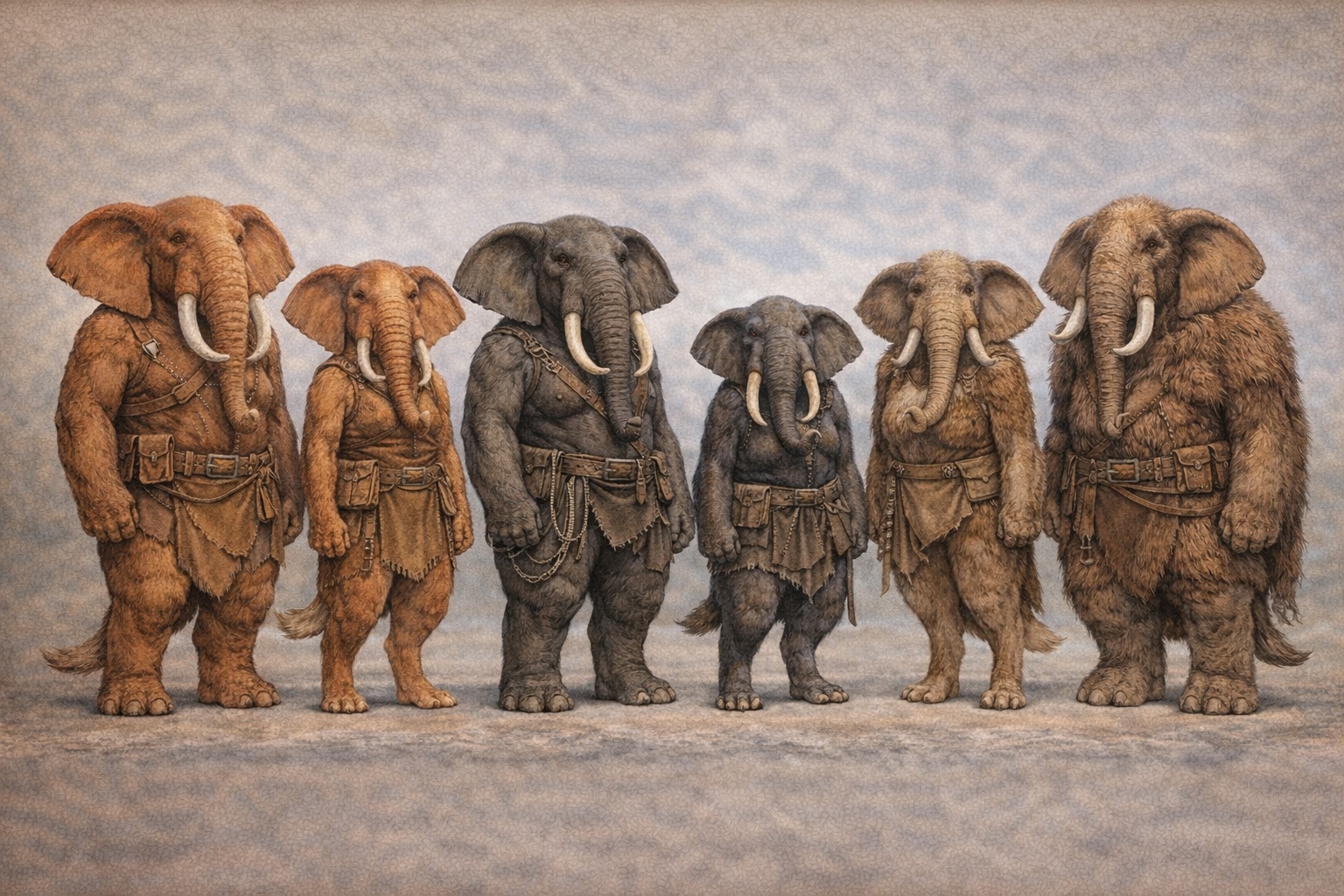
Pachari
Playing a Pachari? Exodus NDS rules: the free Dort Species Guide from Exodus NDS Sourcebooks. Other systems: see Playing in Dort.
CORE IDENTITY
- Race Name: Pachari
- Plural Name: Pachari
- Adjective Form: Pachari
- Alternate Names: The Great People (a near-universal outsider honorific, used across all cultures); the Memory-Keepers (scholarly and poetic usage); the Eldest (archaic and ceremonial)
- Self-Name (Endonym): Kazhivan, "those who know the path," from the deep root of their naming tradition; used in formal address and philosophical contexts; in daily speech Pachari simply use the race name
- Outsider Names (Exonyms): Elephant-folk (common, neutral but considered slightly reductive by some Pachari who note it emphasizes the physical above all else); the Grey-Walkers (Canix usage, respectful); the Remembered (Lapori usage, deeply respectful); the Old Ones (Urgrak usage; the highest respect Urgrak culture extends, and the Pachari receive it with appropriate gravity)
OVERVIEW
Short Description
The Pachari are a beastfolk people of elephant nature: the largest sapient people in Dort, matriarchal, long-lived, and possessed of a memory that functions differently from the memory of shorter-lived races. A Pachari does not remember the way others remember. They carry the past as a living present: the drought that killed a third of the Plains-kin herd four hundred years ago is not history to a Pachari elder who learned of it from someone who was there, whose account was given by someone who survived it. Memory of this quality is not nostalgia. It is capacity. The Pachari are what they are because they remember everything, and what they do with that memory (the counsel they offer, the conflicts they prevent, the connections they make between present situations and their ten-thousand-year archive of precedent) is their primary contribution to the world.
General Reputation
The Pachari are universally regarded with a combination of respect and something approaching awe that they themselves find unnecessary and mildly tiring. Their size commands attention; their reputation for complete memory commands deference; their demonstrated patience and wisdom commands genuine admiration from most peoples. They are not treated as remote or divine (Pachari participate fully in trade, politics, and daily life), but there is a quality to the way other peoples address them in formal contexts that carries the weight of "we are aware we are speaking to someone who will remember this conversation for two centuries." The Pachari, for their part, try not to make this awareness oppressive. They do not always succeed.
Role in the World
The Pachari are the world's memory. Not in an abstract sense: in the direct, functional sense that they are the only people who carry a continuous unbroken oral record across multiple millennia, verified and cross-checked through the matriarch-line transmission system that has remained consistent since before written records in most other cultures. They are the people other peoples go to when the important question is: "What happened before?" Their civilizational role is as living archives, mediators of long-standing disputes (they remember the original terms; others rarely do), and the keepers of geographic, ecological, and climatic knowledge that no written record covers as thoroughly. They are also, more practically, significant agricultural advisors, long-distance trading partners, and the people whose presence in a negotiation tends to make all other parties' claimed memories of previous agreements suddenly more careful.
PHYSICAL TRAITS
General Appearance
The Pachari are immediately and unmistakably the largest people in any room they enter. Their silhouette is unmistakable: the great rounded head with its broad ears, the trunk (a fully functional manipulative organ that extends from the face and serves many of the same purposes as a hand), the pillar-like legs, and the dense, smooth or moderately-furred skin that varies in color from pale grey through warm brown to deep charcoal. They are bipedal and upright but carry their mass differently than any other people; the Pachari's weight distribution creates a characteristic low-centered-gravity posture that makes their movement quieter and more deliberate than the frame would suggest. When a Pachari chooses to be silent, they are silent. The awareness that something capable of that stillness is watching is something most peoples experience before they consciously register what they are seeing.
Size Ranges
- Typical height: 7'0" – 9'6" (varies by lineage; Forest-kin run smallest, Plains-kin and Highland-kin largest)
- Typical weight/build: Immense; the heaviest sapient people in Dort by considerable margin. Build varies between lean-massive (Plains-kin) and heavy-dense (Highland-kin), but all Pachari carry mass that makes them the physical dominant presence in any mixed-race setting.
Distinguishing Features
All Pachari share a consistent set of features: the trunk, which is the most distinctive and functionally significant feature; it serves as the primary manipulative organ, a sensory organ of exceptional olfactory capability, a social signal device, a tool for lifting and carrying, and an emotional expressiveness channel that other peoples learn to read as they would facial expression. Tusks are present in most Pachari individuals, varying in size, curvature, and prominence by lineage and individual; tusk prominence is not gender-linked in Pachari biology. The great mobile ears, which are largest in Plains-kin and smallest in Highland-kin, serve both olfactory cooling and social signaling. Pachari skin is sparsely to moderately covered with short, stiff hair in most lineages; Highland-kin carry a dense full coat. Eyes are set deeply in the skull and are disproportionately expressive; Pachari eyes convey emotional state with a directness that many peoples find immediately readable.
Sexual Dimorphism
Pachari dimorphism is minimal and does not follow patterns that other peoples expect. In Plains-kin, males tend toward larger tusk development on average but not exclusively. Highland-kin show minimal dimorphism. Forest-kin show the least of any lineage. The Pachari themselves regard the question as less interesting than outsiders assume, since neither social role nor status is determined by any dimorphic trait.
Aging Patterns
Pachari calves (the term is used without diminution) are mobile within hours and remarkably capable within days, but their full integration into herd life is a multi-decade process. A young Pachari absorbs the herd's knowledge continuously from birth; the formal recognition of adulthood typically comes between ages twenty-five and thirty-five, when the young Pachari's own memory is considered deep enough to be consulted rather than only receiving. The milestone is always acknowledged by the herd's matriarch. Elderhood in Pachari terms is not an age category but a recognition, the moment when the community's consultation begins more often than not seeking a specific Pachari's perspective on difficult questions. This typically occurs between ages seventy and ninety, but it is not fixed. The most visible aging sign in Pachari is the deepening of skin creases, particularly around the face and trunk, and a gradual lightening or greying of skin tone toward the muzzle and around the eyes. Elder Pachari are physically still: not frail, but having developed the economy of motion that comes from complete confidence in exactly how much force any situation requires.
Regional Variation
Pachari appearance is defined by lineage rather than geography. Plains-kin carrying the large-eared heat-regulation biology of their ancestors maintain that biology whether their herd lives in warm Funta or in the cooler margins of Irna. Highland-kin coats remain dense wherever the lineage is found. Pachari are exempt from continental appearance demographic norms; their appearance is defined by bloodline, not birthplace.
BIOLOGY
Diet
Pachari are herbivores with a massive caloric requirement; maintaining their biology requires continuous intake throughout waking hours, and a Pachari's relationship to food is fundamentally different from shorter-term feeders. The Pachari are not grazers in the pastoral sense; they move through food environments systematically, taking from multiple sources, and their feeding patterns have significant ecological impact on the territories they occupy. This impact is not destructive in the way casual observation might suggest; Pachari feeding creates specific ecological conditions that are beneficial to many other species, and the herds have known this for centuries and managed it deliberately. The agricultural knowledge this gives them is among their most practically valued contributions to other peoples.
Sleep Patterns
Pachari sleep less than most peoples, in shorter distributed periods across the day and night rather than a single extended rest. This is a biological baseline; extended unconsciousness leaves a large animal vulnerable in ways that selection pressure addressed over millennia, and the adapted pattern has carried through to the sapient form. Pachari elders are often encountered in a state of apparent rest (standing still, eyes partially closed) that is not quite sleep and not quite wakefulness, a processing state that younger Pachari describe as "walking the memory," when the archive of recalled experience is reviewed, cross-referenced, and indexed. Interrupting a Pachari in this state is possible and acceptable; they do not regard it as the disruption that most sleeping peoples would.
Reproduction Basics
Pachari gestation is the longest of any sapient people in Dort, approximately twenty-two months. A single calf is the norm; twins are rare and are regarded as cosmologically significant by the herd. The calf is raised by the mother and the entire herd, which maintains near-continuous physical proximity for the first several years of the calf's life. The matriarch line takes specific responsibility for the calf's memory education; the formal transmission of herd knowledge begins earlier than any other formalized education tradition in Dort.
Lifespan Ranges
- Typical lifespan: 140–200 years
- Maturity: 25–35 years
- Elderhood: 80–100 years
Environmental Adaptations
Plains-kin biology is adapted for open savannah conditions: high heat tolerance, large ear surface area for blood cooling, a tolerance for the dietary variability of open plains. Forest-kin are adapted for dense vegetation: smaller frame for navigation through tight forest space, different tusk angle to avoid snagging. Highland-kin are adapted for cold highland conditions: dense coat, smaller ears (reduced surface area to conserve heat), the heaviest body mass of any lineage for thermal regulation. All Pachari share a seismic sensitivity (an ability to detect low-frequency vibration through the feet) that functions as long-range communication within herds and as an environmental awareness tool that outsiders who learn to recognize it find remarkable.
PSYCHOLOGY & CULTURE
Typical Temperament
The Pachari temperament is steady in a way that shorter-lived peoples sometimes mistake for slowness and only later recognize as depth. They are unhurried because they have time: not merely the subjective sense of having time, but the genuine biological allocation of two centuries in which to act and decide. A Pachari's patience is not learned equanimity; it is the natural state of a being for whom most urgency is relative. Within this steadiness is a warmth that surprises outsiders who expect the immense and long-lived to be remote: Pachari are genuinely interested in other peoples, including very short-lived ones, and they bring to every relationship the same quality they bring to memory: full attention, careful retention, and the understanding that small things remembered become large things understood.
Cultural Values
- Memory is sacred: This is not metaphor. The Pachari treat the obligation to remember accurately, to preserve what happened rather than what one wishes had happened, as a moral baseline. Memory-error through carelessness is a fault; deliberate false memory is a violation of something foundational to Pachari identity. The accuracy of the record is what makes the record valuable.
- The herd decides: No significant Pachari decision is made alone. The matriarch leads and holds final authority, but she leads by knowing what the herd knows collectively and acting on that whole rather than her individual perspective. A matriarch who habitually overrules her herd without compelling cause will find, gradually and without announcement, that the herd's consultation with her diminishes.
- Gentleness as choice: The Pachari are the largest people in Dort. The capacity for force is present and recognized without comment by everyone who encounters them. The choice not to use it (the consistent, deliberate, maintained choice to find the non-destructive path) is considered a cultural practice that requires active ongoing commitment. Pachari do not take their own gentleness for granted.
- The long view: Pachari planning and counsel habitually operates on timescales that other peoples find uncomfortable. A Pachari who advises a course of action "for the benefit of the next three generations" is not being abstract; they are making a practical calculation. This quality is their greatest gift to alliances and their most common source of frustration with peoples whose planning horizon is one season.
Taboos
- Memory-killing: The deliberate destruction of the oral record: forcing a herd-member to abandon what they know, drowning out the transmission chain through violence or coercion, killing matriarchs specifically to break the lineage record. This is the deepest possible violation in Pachari culture; it is considered a wound to the world, not just the herd, because the record of the world that the Pachari carry is not the Pachari's property alone.
- The rushed decision: Acting on incomplete information when waiting for more was possible. This is not absolute (genuine emergencies are recognized), but Pachari culture treats "I was impatient" as a more damning explanation than most other peoples would. The time was there. Why was it not used?
- Abandoning the calf: Any calf, including other peoples' young, to danger that the Pachari could address. The protective instinct toward young is deeply biological and is codified culturally as an absolute obligation.
Social Structures
The herd is the primary unit of Pachari society. Herds range from twelve to forty members and are organized around the matriarch line, the continuous chain of mother-to-daughter transmission through which the herd's memory is formally passed. The matriarch is not simply the eldest; she is the individual in whom the most complete and most reliably accurate herd memory resides, and her authority derives from that completeness. Multiple herds in a region form loose confederations called ranging-grounds, which share grazing territory rights, transmit inter-herd news through designated meeting-point traditions, and maintain the cross-herd record that prevents any single herd's memory from becoming the sole version of shared events. There is no Pachari nation; ranging-grounds are the largest Pachari political unit, and they are explicitly not governments.
Family Structure
The herd is the family. The maternal line is the formal genealogical record; Pachari inheritance, identity, and memory transmission flows matrilineally, and a Pachari's place in the herd is defined primarily by their position within the matriarch line. Males in traditional herd structures spend portions of adulthood in more solitary ranging before returning to herd association; this is biological tendency, not rule, and many male Pachari maintain continuous herd membership throughout adult life. Young calves are raised by the full herd, with specific adults taking on designated memory-teaching roles as the calf develops. The matriarch identifies who among the herd is best positioned to teach each component of the collective knowledge.
Leadership Patterns
The matriarch's authority is earned through the completeness and accuracy of her memory, demonstrated over a lifetime of being consulted on difficult questions and being right more than she is wrong. Succession is typically recognized rather than contested; the herd's memory-practice means that the question "who has the most complete and accurate herd memory" is usually answerable, and the answer is observable. When the current matriarch's memory begins to show its limits, when she begins to defer to others on questions she would previously have answered, the succession is already underway. The formal acknowledgment is a ceremony of memory transmission, in which the matriarch passes the oldest and most complete accounts she holds to her recognized successor.
GEOGRAPHIC DISTRIBUTION
Primary Homelands
- Funta: The great open plains and forest margins of Funta are the primary Pachari homeland; Plains-kin herds have held ranging-grounds here for longer than any other race's recorded history on the continent, and the savannah ecosystem in significant portions of Funta reflects thousands of years of Pachari stewardship. Forest-kin occupy the forest margins and deep forest zones. Funta Pachari herds are the most numerous and the most deeply integrated into the continent's ecological management.
- Antaea: Forest-kin are the dominant lineage in Antaea, concentrated in the deep forest interior and river-margin zones. Antaea Pachari herds have maintained ranging-grounds in the most interior forest regions for centuries and are considered by other Antaea peoples as among the most ancient continuous presences on the continent.
Secondary Populations (Diaspora)
- Irna: Highland-kin occupy the northern mountain zones of Irna, where their cold-adaptation and high-altitude endurance give them access to ranging grounds that other Pachari lineages would find difficult. Irna Pachari are a smaller presence than in Funta or Antaea but deeply established, and the Highland-kin memory record of Irna's northern geography is considered irreplaceable by every non-Pachari people who has needed to cross those mountains in winter.
- Shoing: Highland-kin in the high interior ranges of Shoing, smaller population but similarly deep establishment. Shoing Highland-kin have a particularly developed relationship with Aviari Sky-kin flocks whose territories overlap the same mountain ranges; the combination of ground-level Pachari ecological knowledge and aerial Aviari perspective is remarked upon by both peoples as genuinely productive.
Migration Patterns
Pachari herds move within their ranging grounds on seasonal cycles that are so well-established that other peoples who share the landscape can set their own seasonal timing by them. These are not migrations in the displacement sense; they are the annual expression of a landscape-management understanding that the herd has refined over generations. Genuine range expansion, a herd establishing new permanent ranging grounds, is uncommon and always preceded by extended scouting by young ranging males who report back to the herd before any commitment is made. The decision to expand is a full herd decision, reviewed against the memory of every previous expansion in the herd's record.
Adaptations by Region
Plains-kin herds in high-heat savannah conditions maintain the traditional ear-cooling biology without supplementation; they are physiologically well-calibrated for the environment and do not require significant material adaptation. Forest-kin have developed techniques for forest-floor travel that minimize their impact on the understory (a consequence of their size making careless movement destructive), and their reputation for moving quietly through dense forest is well-earned. Highland-kin in cold mountain regions rely on coat density and group thermal management; Pachari herds in cold conditions sleep in close physical proximity (a behavior that Highland-kin in particular maintain consistently) and consume high-caloric plant material during the pre-winter period in quantities that other peoples who share the landscape note and account for in their own autumn provisioning.
Cultural Differences Between Lands
Funta Plains-kin herd culture is the most openly engaged with non-Pachari peoples; centuries of sharing the continent's most productive land with Canix packs, Felari prides, and Urgrak clans have produced a Funta Pachari culture that is thoroughly practiced in inter-race negotiation, mediation, and the management of competing territorial claims. Antaea Forest-kin are the most insular of the Pachari regional cultures, not by hostility but by circumstance; the deep forest provides fewer natural contact points with non-Pachari peoples, and Forest-kin memory records are consequently more internally focused than those of Funta herds. Highland-kin across both Irna and Shoing share a culture shaped by altitude and seasonality: more self-sufficient than plains herds, more conservative in ranging-ground negotiation, and more likely to be the people others go to when the question requires someone who has seen this valley in every season for a hundred years.
HISTORY
Origins
Pachari history does not have a beginning in the mage-shaping sense; or rather, the Pachari have chosen not to make the shaping the beginning of their story. Their tradition holds that the first Pachari were already old when the first other peoples were young, and that the shaping, whatever it was, took something already ancient and gave it the capacity to carry what it knew across time in words as well as experience. The mage who shaped them is not named in any Pachari record; this is deliberate. The Pachari position is that the shaper's identity is irrelevant to what was shaped. What matters is the memory, and the memory predates the naming of it.
What the Pachari do preserve with absolute care is their landscape memory, the record of how specific places looked, behaved, and changed across the centuries. This is their foundational history: not dynasties or battles, but the long record of how the world has moved and changed and what it looked like before.
Major Turning Points
The First Remembering is the oldest formal ceremony in Pachari tradition, not an event but a practice established at some point in the deep past when the first matriarchs recognized that their memory was not merely personal but heritable, and that it required formal transmission protocols to preserve accurately. The First Remembering is the moment the Pachari became the Pachari in the cultural sense: not shaped beings, but beings who understood what their shaping had given them and chose to use it for the world.
The Funta Range Wars (approximately seventeen centuries before the current era) were the most sustained Pachari inter-herd conflict in recorded memory, arising from ranging-ground compression as multiple species expanded into the same territory. The Pachari response was the Compact of the Shared Ground, not a boundary-drawing exercise but a landscape-sharing agreement that established the principle of rotating ranging rights and multi-species territorial time-sharing. This compact, and the ecological management tradition it created, is considered one of the foundational documents of inter-species land-use across Funta.
The Great Drought (approximately four centuries before the current era) was a multi-decade climate event that devastated Funta. The Pachari memory of similar droughts from fifteen hundred years earlier (the routes to surviving water sources, the plants that indicate subsurface moisture, the geological features that mark aquifer presence) was directly responsible for the survival of multiple non-Pachari peoples who would otherwise have lost the knowledge needed to find water. The Great Drought is the event cited most often by other peoples when explaining why the Pachari are given the deference they receive. The Pachari remember the drought itself; they also remember what it felt like to be asked for help by peoples who had lived beside them for centuries without understanding what they carried.
Current Historical Posture
The Pachari are, in the long view, unchanged. They are what they have always been: the world's memory, the long record, the patient counsel. In the medium term, the current moment is one of moderate concern: the pace of change in Dort's political and ecological landscape has accelerated in the last three centuries in ways the Pachari recognize from their record as historically unusual. They are watching. They are remembering. They are offering counsel to those who ask, with more urgency than they typically show, which is itself a signal that herds around them are learning to read.
LANGUAGE
Language Name(s)
The Pachari language is called Kazhithis, "the path-tongue," from the same root as their self-name. It is a deep, resonant language with a characteristic weight that reflects the biological voice range of a Pachari; their natural speaking register is in a lower range than most peoples produce, and the language is built around it. Kazhithis has no significant dialectal split, a consequence of the formal memory-transmission system that actively maintains linguistic consistency across herds. Variation exists in the seismic register: the low-frequency vibration-communication that operates below normal hearing range is an auxiliary channel of Kazhithis, distinct from spoken language but considered part of it.
Script
Pachari writing is called Herdmarks, a formal, deliberate notation system developed for permanence in outdoor conditions: carved into stone and cast in clay, designed to survive centuries of exposure. Herdmarks are not compact or efficient; they are legible and permanent, and those qualities take priority over any others. The script is considered difficult to learn by other peoples, not because it is conceptually complex but because the stroke discipline required to form the marks correctly is demanding. Pachari who maintain formal records carve them with tusk-tools; the connection between tusk and record is a noted element of Pachari craft tradition. Most adult Pachari are literate in Herdmarks; mastery of the formal calligraphic tradition is held by designated memory-keepers within each herd.
Trade Language Status
Kazhithis is not a trade language anywhere outside Pachari-majority regions, but Pachari individuals learn other peoples' languages readily: not with the speed of a Lapori, but with the thoroughness of someone who intends to keep what they learn permanently. Most adult Pachari who interact regularly with non-Pachari peoples speak multiple languages fluently and have spoken them for decades. Common carries Pachari loanwords primarily in vocabulary related to memory, history, time, land, and ecological observation.
Dialect Range
Kazhithis maintains remarkable consistency across herds and continents; the formal memory-transmission system includes language as part of the record that must be preserved accurately, and drift is actively corrected. The only meaningful variation is between the spoken and seismic registers, and between formal record-keeping Kazhithis and the more conversational spoken form used within herds.
Naming Agent Cross-Reference
See _Cannon/Race naming ai agents/beastfolk/Beastfolk - Elephant.md for full naming rules and generation guidance.
NAMING CONVENTIONS
Pachari names follow a given name + matriarch lineage name structure, drawn from the Tamil phonological tradition documented in the naming agent file. Names carry weight without heaviness: deliberate, warm, and chosen for someone who will carry them for two centuries. Retroflex consonants appear in most names; -an, -am, -ar, -al, and -avan endings are the dominant forms. Long vowels (aa, ii, uu) mark elder and formal register.
Matriarch lineage names track the maternal line through which memory passes; they are the most important part of a Pachari's name in formal contexts and the deepest marker of identity.
Sex and Name Form
Pachari sex-marking is systematic, ending-borne, and braided together with vowel length. The masculine endings -an, -am, -ar, -avan, -ivan, -evan, -ukan and -iman contrast with the feminine -i, -a, -ai, -avi, -eni and the formal -aal, -iyaal, and the feminine is generative: Kumaran becomes Kumari, Aravan becomes Aravi, Selvan becomes Selvi, Thiruvan becomes Thiruveni. The -al ending is genuinely ambiguous and carries no sex information, which is part of why it is common.
Long vowels mark age and formality in both sexes, not sex itself. The aa, ii and uu forms read as elder or ceremonially formal whoever bears them: a young Pachari of either sex has short vowels, an elder of either sex may have long ones. Retroflex consonants and the distinctive zh are sex-neutral, and removing a woman's retroflexes to soften her name is an error.
Matriarch lineage names never inflect; the lineage is shared by everyone in it.
Name Examples
- Given names (general): Kumaran, Kazhivan, Veeraman, Muruvan, Thirukam, Palavan, Aravam, Namivan, Selvaran, Maranam
- Given names (elder / formal register): Long-vowel forms: Kumaaran, Veeraavan, Kazhiivanam; the vowel lengthening signals accumulated years and standing
- Matriarch lineage names: Kumarvaan, Kazhivaran, Veeramanam, Selvakumar, Palavanam, Namivaran, Thirukavan
- Honorific / title examples: Kaan- (before the name) for a recognized matriarch; -avam (suffix) for a designated memory-keeper; -ivan (suffix) for a formal ranging-ground mediator
- Full name examples: Kazhivan Kumarvaan, Palavan Veeramanam, Kaan-Muruvan Palavanam, Selvaran-avam Kazhivaran
SOCIETY
Common Professions
Pachari are overrepresented in roles that require deep accumulated knowledge and the patience to apply it: ecological consultants for agricultural communities, long-range geographical advisors for expeditions crossing unfamiliar terrain, formal memory-keepers for non-Pachari institutions that want their records to outlast their own organizational continuity, and mediators of disputes in which the claimed history of all parties needs to be compared against someone who was there, or knows someone who was. Urban Pachari are found in advisory and archival roles more than any other trade, though their physical scale limits the practical environments in which they work. Pachari herbalists and agricultural advisors are considered among the most reliable in Dort; their multi-century knowledge of how specific plants grow in specific soils under specific conditions is not something any other tradition replicates.
Craft Traditions
Pachari craft is built for permanence. Stone-carving is their primary and most developed tradition; the tusk-tool methodology for carving Herdmarks has evolved into a full artistic practice, and Pachari-carved record-stones are found at important geographical features across all their ranging grounds. These stones are not ownership markers; they are information deposits, recording what the herd knows about a location at the time of carving. Non-Pachari peoples who learn to read Herdmarks can extract centuries of ecological data from a single carved stone. Pachari also work in fired clay, cast bronze, and the pressed-earth tablet tradition that is the working medium for shorter-term records. Their aesthetic favors clarity and survival over decoration; a beautiful Pachari carving is one that will be legible in five hundred years.
Trade Roles
Pachari export knowledge, advisory services, ecological consultation, and preserved foodstuffs from their agricultural management traditions. They import worked precision tools (their size makes fine metalwork difficult despite the knowledge of what is needed), and specialist materials for record-keeping. Pachari commercial negotiation is among the most thorough in Dort: they do not rush, they have usually done more preparation than the other party, and they remember every previous agreement they have ever made with the trading partner in question. The negotiation style is patient, detailed, and terminal for partners who attempt to misrepresent the history of the relationship.
Military Tendencies
The Pachari are not a military people by tradition, culture, or preference. They do not build armies, maintain warrior castes, or plan campaigns. They are also the hardest people in Dort to threaten militarily, and this is not coincidence. A people with complete memory of every previous threat to their ranging grounds, complete knowledge of the landscape that any attacker must cross, and the physical capacity to absorb violence that would stop smaller peoples, while remaining calm enough to use all of that knowledge, is not a simple target. Pachari who have been forced into direct conflict in defense of their herds are remembered in the records of every people who has attempted such conflict, without exception, as a category of experience not to be repeated. The Pachari keep this information in the same record where they keep everything else.
Religious Tendencies
Pachari spiritual life is continuous with their memory practice; the ancestors held in the matriarch-line record are genuinely present in herd life in a way that has spiritual weight alongside its archival function. The Remembering ceremony, held seasonally across all herds, is simultaneously a religious practice and a practical knowledge-maintenance exercise. The oldest records in the herd memory, passed across sufficient generations that no living Pachari has direct connection to a witness, are treated with the same care as living testimony: not because they are considered infallible, but because they are the best available account and must be preserved accurately until a better one appears. The Pachari relationship to divinity is generally that of respectful acknowledgment: forces larger than any individual exist; accurate observation of them is appropriate; claiming to know their intentions is probably premature.
INTERACTIONS
Relations with Other Races
- Felari: A long and complex relationship that has settled into stable mutual respect in most regions. The Pachari hold Felari in deep regard as fellow peoples with ancient roots; the Felari regard the Pachari with respect for their memory and a certain private recognition that the Pachari's patience is the patience of something genuinely large. Territorial negotiations between Felari pride-territories and Pachari ranging-grounds are among the most carefully conducted inter-race diplomatic exercises in Dort.
- Canix: A working relationship of mutual appreciation. Canix pack-memory and Pachari herd-memory serve complementary functions: Canix remember the recent past in extraordinary detail; Pachari remember the distant past in extraordinary completeness. Their combination in any advisory context is formidable. Canix are among the peoples that Pachari find most naturally comfortable to cooperate with, partly because Canix directness makes them easy to trust.
- Smalings: A specific, warm, and long-standing relationship across most of Funta and southern Irna. Smalings farm land that Pachari ranging grounds adjoin or overlap, and the relationship between the two peoples for management of that shared landscape is considered a model by both. Pachari give Smalings the long agricultural memory; Smalings give Pachari a quality of generous neighborliness that the Pachari, who deal regularly with peoples who come to them only for what the Pachari know, find restorative.
- Urgrak: The most complicated major inter-race relationship in Pachari experience. The Urgrak tribal record and the Pachari memory of Urgrak interactions reach back far enough that both peoples know the full history of the relationship: the conflicts, the periods of stability, the specific tribes that are reliably cooperative and the specific ones that are not. The Pachari do not treat Urgrak as a monolith; they know individual clans. The Urgrak respect the Pachari entirely and challenge them rarely, which the Pachari appreciate while remaining fully aware that the memory of why the Urgrak respect them includes events the Urgrak would prefer the Pachari didn't remember. The Pachari remember.
- Elves (Aelvari): Among the most naturally aligned inter-race relationships in Dort: both peoples are long-lived, both value the deep past, both bring significant accumulated knowledge to any interaction. The tension between them is philosophical and productive: Aelvari knowledge tends toward the archival and the aesthetic; Pachari knowledge tends toward the ecological and the functional. Both find the other's emphasis incomplete in interesting ways.
Stereotypes (Given and Received)
- Stereotypes about them: That they are slow (false in the meaningful sense: Pachari physical pace is deliberate; their cognitive pace is faster than most peoples recognize because it operates on a longer timescale); that they remember everything perfectly (partially true; they have exceptional memory with formal transmission protocols that maintain accuracy, but they do not claim infallibility and their records include noted uncertainties); that they are gentle and harmless (half-true: they are genuinely gentle by preference and the choice is maintained actively; the "harmless" part is a misunderstanding that has been corrected on several historically documented occasions).
- Stereotypes they hold: That shorter-lived peoples make their decisions as if the past were not available as a resource; that Urgrak understand violence better than any other people and governance worse; that Smalings have found a way to be happy that the Pachari admire and do not fully comprehend; that Aviari have the best possible relationship with the present moment and would benefit from somewhat more attention to what preceded it.
Cooperation Patterns
Pachari cooperate most readily with peoples who are honest about their purposes, willing to operate on longer timescales than their immediate interest, and interested in what the Pachari know rather than simply what the Pachari can do. Their most sustained and valuable alliances are with peoples who understand that the Pachari's memory is a shared resource and treat it with corresponding respect.
Conflict Patterns
Conflict with Pachari follows patterns that are predictable to anyone who has studied their history: challenges to ranging-ground integrity, attempts to destroy or suppress Pachari records, violence against herds, and (most reliably) the kind of bad-faith negotiation that assumes the Pachari do not remember a previous agreement that contradicts the current position. The Pachari response to these provocations is patient, deliberate, and has a very long memory.
VARIANTS
Physical / Regional Variants
Pachari lineages are biologically defined, not geographically. Lineage characteristics persist regardless of where a herd ranges.
Plains-kin
The savannah and open plains lineage, the largest Pachari and the most widespread. Plains-kin are defined by their ears, which are the largest of any Pachari lineage and serve a primary heat-regulation function: the extensive blood-vessel surface area allows significant cooling through ear movement in high-temperature environments. Their skin color runs from warm grey through reddish-brown; skin texture is smooth and sparse-haired compared to the other lineages. Plains-kin are the most socially engaged Pachari lineage, maintaining the largest herds and the most complex inter-herd confederation relationships of any lineage. Their ranging grounds in Funta are the oldest continuously maintained land-management territories in recorded history.
- Typical height: 8'0" – 9'6"
- Defining biological traits: Largest ears of any Pachari (heat regulation); largest frame; smooth sparse-haired skin; warmest coloring (reddish-grey to brown-grey); most socially complex herd structure; highest heat tolerance
- Range: Funta open plains and savannah; the primary lineage in the continent; smaller populations in warm lowland Antaea and Jazirah margins
Forest-kin
The deep forest lineage: the smallest Pachari, built for navigation through dense vegetation. Forest-kin are proportionally more compact and shorter-limbed than Plains-kin, with tusks that curve downward rather than forward, an adaptation that reduces snagging in forest understory. Their skin is darker, running toward deep charcoal and slate-grey, which provides concealment in forest shadow. They move through forest with a quietness that consistently surprises non-Pachari, a consequence of learned technique applied to biological capacity. Forest-kin herds are smaller than Plains-kin herds and more tightly bounded in their ranging ground; the forest contains them more than the open plains contains the Plains-kin.
- Typical height: 7'0" – 8'6"
- Defining biological traits: Smallest Pachari frame; downward-curving tusks for forest navigation; darkest coloring (charcoal to deep slate); quietest movement technique; medium-sized ears; most thermally stable biology (forest provides shade)
- Range: Deep forest interior of Antaea; Funta forest margins; anywhere dense canopy requires adaptation
Highland-kin
The mountain and cold-highland lineage, the most heavily coated Pachari. Highland-kin carry a full shaggy coat that varies from deep russet-brown to grey-brown, covering the body in dense insulating layers that make them appear even larger than their frame warrants. Their ears are the smallest of any Pachari lineage, a heat-conservation adaptation that inverts the Plains-kin function; less surface area means less heat loss. Their tusks are the most curved of any lineage, sweeping broadly upward and outward. Highland-kin are the most cold-adapted sapient people of significant size in Dort; they are comfortable in conditions that other large peoples require significant material preparation to survive. Their herds maintain the most detailed altitude and seasonal records of any Pachari lineage; the Highland-kin memory of mountain passes, their seasonal behavior, their conditions in drought years and flood years, is the practical basis of most reliable highland navigation knowledge in Dort.
- Typical height: 7'8" – 9'0", heaviest build relative to height
- Defining biological traits: Full shaggy coat (densest Pachari coat); smallest ears (heat conservation); most curved and broadly-swept tusks; highest cold tolerance; heaviest body mass per height; most detailed altitude and seasonal memory tradition
- Range: Northern Irna highlands; interior Shoing mountain ranges; any high-altitude cold environment
Cultural Branches
The Ranging Counselors
Pachari who have taken up a recognized inter-herd role as formal mediators and advisors: traveling between herds and between races, carrying cross-herd knowledge and offering counsel at the request of any party that needs it. Ranging Counselors maintain no permanent herd affiliation during their active period in this role, though they remain members of their birth herd. The role typically runs for twenty to forty years before the Counselor returns to herd life. Ranging Counselors are the most widely traveled Pachari and the ones most likely to be encountered in non-Pachari urban or political contexts.
The City Herds
Herds that have established permanent presence within non-Pachari cities, adapting the traditional herd structure to an urban context. City Herds are smaller than plains or forest herds (typically twelve to twenty members) and maintain their memory traditions in urban settings, with the practical adjustment that much of their ranging-ground knowledge is replaced by accumulated urban and political knowledge. City Herds are considered a relatively recent development (the oldest established City Herd has been present in its city for approximately two centuries), and traditional plains herds maintain careful opinions about whether the urban context produces or diminishes the quality of the memory being maintained.
DEVELOPMENT NOTES (Author use only, not canon)
Story Hooks
- The matriarch of a Plains-kin herd in Funta has died before completing a memory transmission that the herd knows was in progress. The portion transmitted is clear; the portion not transmitted is, by definition, unknown. But other herds' records suggest it involved something specific about a particular geographic feature that is now central to a territorial dispute between three non-Pachari peoples.
- A Highland-kin herd in northern Irna has moved out of their traditional ranging ground for the first time in six hundred years. They have offered no explanation. They are not in distress. They are simply somewhere else. This has not happened before.
- A Ranging Counselor has arrived at a city that did not ask for one. She says she was called. No one in the city called her, or admits to having done so. She is patient about the confusion. She shows no sign of leaving.
- The carved record-stones at a Pachari waypoint in Antaea have been defaced: not destroyed, but selectively altered, with specific sections re-carved. The original marks are gone. A Forest-kin herd holds the oral record of what was on those stones. Two other herds hold slightly different accounts of the same stones. All three herds are certain of their version.
Unresolved Lore / Open Questions
- What do the Pachari know about the world before the other sapient peoples appeared? Their records reach back far enough that this is a real question, not a theoretical one.
- The "Prime species" designation: what exactly does this mean in Dort's cosmological or political framework? Who designated the Pachari, Felari, and Borun as Prime species, and why those three?
- What is in the oldest, deepest layers of Pachari memory, the accounts that have been transmitted so many times that no living Pachari has direct connection to a witness? Are any of those accounts things that the Pachari have chosen not to share?
- How do City Herds handle the tension between urban political knowledge and traditional ecological memory? Are their memories considered equally valid by traditional herds?
Development Notes
- The "Prime species" status needs to be addressed at the world-setting level: what does it mean? What are the implications for Pachari relations with other peoples?
- Cross-link with Funta settlement entries when written; Pachari are deeply integrated into Funta ecology and history
- The Compact of the Shared Ground in Funta deserves a dedicated canon document
- Ranging Counselors are excellent character backgrounds for individual Pachari in non-herd settings
- The Great Drought story is a worldbuilding moment with significant potential for expansion
- Pachari relations with Urgrak should be tracked as clans are developed; the individual-clan level is where Pachari-Urgrak history becomes specific