Serathi
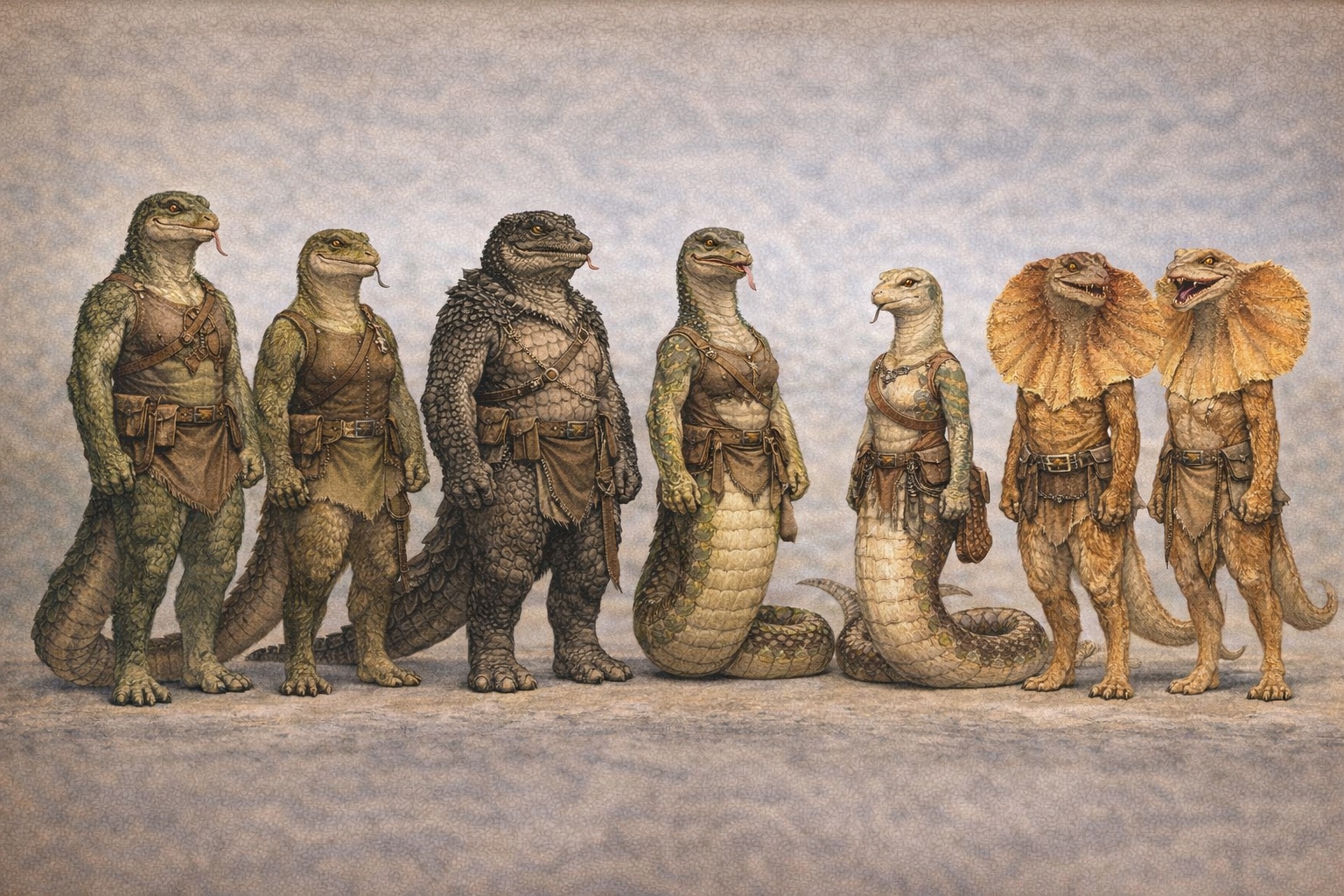
Serathi
Playing a Serathi? Exodus NDS rules: the free Dort Species Guide from Exodus NDS Sourcebooks. Other systems: see Playing in Dort.
Core Identity
Pronunciation: Seh-RAH-thee
Singular/Plural: Serathi (singular and plural identical)
Demonym: Serathi
Classification: Beastfolk, Reptilian
Also called: Scale-folk, River-kin (when referring specifically to the crocodilian lineage), Coil-folk (when referring specifically to the serpentine lineage)
The Serathi are reptilian beastfolk shaped by a mage who was fascinated by the oldest living things: the creatures that survived every age of the world by moving slowly, conserving carefully, and waiting longer than anything else was willing to wait. Cold-blooded in the truest biological sense, the Serathi are beings whose physical activity is genuinely bound to temperature in ways that mammalian folk find strange and occasionally eerie. What reads to other peoples as stillness, patience, or detachment is simply how a Serathi exists in a cold room. What reads as intensity or sudden focus is simply what a sun-warmed Serathi looks like.
They are not cold in spirit. They are precise, considered, and possessed of a depth of patience that outlasts almost every crisis put before them.
Overview
The Serathi are a widely distributed beastfolk people with significant biological variation across four established lineages. They are found across most of Dort's warm and temperate regions, with their smallest populations in the deep north. They are among the longer-lived beastfolk peoples (most Serathi live between 120 and 160 years, with elders reaching 180 in rare cases), and this extended lifespan shapes their relationship with history, learning, and with shorter-lived peoples.
Serathi civilizations tend to be oriented around scholarship, long-view resource management, and river engineering. Their oral and written traditions stretch further back with less distortion than most peoples because individual Serathi scholars may study a subject for eighty or ninety years before passing their work to a student. Information moves through Serathi scholarly lineages with remarkable fidelity.
Other peoples often misread Serathi social behavior. A Serathi who has not yet basked in the morning sun may be visibly slower and less reactive than the same individual in afternoon warmth; this is physiological, not emotional. A Serathi who becomes very still during conflict is not withdrawing; stillness is a Serathi expression of focus, readiness, and assessment. The forked tongue, which moves constantly in sensory sampling of the air, is not a threat display or social gesture. These misreadings have caused diplomatic friction throughout Serathi history with peoples unfamiliar with their biology.
Physical Traits
Serathi are bipedal reptilian beings, though the degree of upright posture and the specific body plan varies significantly by lineage. All Serathi share:
- Scaled skin covering the entire body, varying in texture, color, and scale size by lineage and individual. Scales are living tissue, periodically shed in patches (not full-body shed; Serathi shed individual scale patches throughout the year rather than a single seasonal shed).
- Forked tongue used in constant air-sampling. The tongue is the primary sensory organ for chemical detection; smell is processed primarily through the tongue and the sensory organ on the upper palate. Serathi can detect what other beings cannot smell at all.
- Nictitating membrane: a translucent third eyelid that closes horizontally in bright light or underwater. In direct sun, a Serathi's eyes may appear partially veiled; this is protective, not a mood indicator.
- Cold-blooded physiology. Serathi internal temperature follows ambient temperature within a range. They are not sluggish at cold temperatures; they are genuinely cognitively and physically slower. They are not agitated at high temperatures; they are simply operating at full capacity. A Serathi who controls their thermal environment (warm rooms, morning basking, access to sun) functions at consistent peak capacity. A Serathi trapped in cold conditions for days is genuinely compromised, not pretending.
- Morning basking behavior. All Serathi require a period of sun or heat exposure after waking to reach full metabolic function. This is not a preference or a ritual (though it has become one in many cultures); it is a biological necessity. Serathi who cannot bask are functionally impaired for the morning hours.
- Lifespan: 120–180 years, with slow maturation (considered adult at approximately 20 years, full cognitive maturity typically around 30).
Height varies significantly by lineage. The Coil-kin present uniquely; their lower body is serpentine, making standing height a difficult measurement.
Biology
Temperature dependency. The Serathi relationship with ambient temperature is the most misunderstood aspect of their biology among other peoples. At cold temperatures (below approximately 15 degrees, in rough terms), Serathi experience reduced metabolic function: slower reflexes, somewhat slower cognition, reduced appetite, reduced speech speed. At ideal temperatures (warm to hot, 25–35 degrees), they are fully functional and capable of sustained high-intensity activity. This creates natural rhythms: Serathi are typically most active in afternoon and early evening, slowest in cold mornings or cool weather. They manage this through environmental control wherever possible: heated living spaces, morning basking practice, strategic clothing and architecture.
Scale shedding. Rather than a single annual shed, Serathi shed scales in patches throughout the year. Old scales loosen and fall away, replaced by new growth underneath. The cycle repeats region by region across the body. During active shed in a particular area, that skin is more sensitive. Serathi typically manage shed patches with oil and careful attention. Scale coloring may shift slightly with each shed cycle, particularly in younger individuals; coloring stabilizes in adulthood.
Forked tongue and scent-sensing. The Serathi tongue is primarily a chemoreceptive organ. The fork allows directional scent detection; by sampling from two points simultaneously, a Serathi can identify direction and intensity of a chemical signal. This gives Serathi a sensory range that other peoples largely lack. Serathi can often detect emotional states, illness, recent activity, and environmental changes through air-sampling alone. This is a practical sense, not supernatural.
Diet. Serathi are predominantly carnivorous, with most lineages consuming a significant proportion of raw or minimally prepared meat. They have a lower overall caloric need than same-sized mammalian beings due to their lower resting metabolic rate. Serathi can fast for extended periods without serious health consequence; River-kin, with the lowest metabolism, can fast for weeks when necessary.
Reproduction. Serathi are oviparous; they lay eggs. Clutch size varies by lineage (typically 2–6 eggs). Eggs require warmth for development and are tended carefully. The incubation period is approximately six months. Hatchlings are small but immediately mobile and capable of independent feeding within weeks. Parental investment is significant through the first five years; clutch-siblings are considered close kin and maintain strong bonds throughout life.
Psychology and Culture
The Serathi cultural character is shaped above all by two forces: their long lives and their temperature physiology. A people who live 150 years and who experience the world's pace as somewhat fast-moving develop a particular relationship with patience, deliberation, and the long view. A people whose cognition is literally faster in warmth than in cold develop a particular sensitivity to environmental conditions as a factor in decision-making.
Scholarship and memory. Serathi cultures consistently produce scholars, historians, and archivists. An individual who lives 150 years and spends 80 of them studying a single river system accumulates a depth of knowledge that is genuinely difficult to match. Serathi scholarly lineages (where a master passes their work to a student who continues it for another 80 years, who passes it again) can maintain unbroken lines of study stretching over a millennium. The Serathi river-engineering traditions are among the most sophisticated on Dort for exactly this reason: the engineers who built the last great flood-control system are the grandstudents of those who studied the flood patterns three centuries ago.
The still-wait. Serathi cultivate a contemplative state called the still-wait, a deliberate practice of absolute stillness combined with total environmental attention. In the still-wait, a Serathi is not meditating in the sense of detachment; they are present to everything, processing fully, simply not moving or speaking. The still-wait can last minutes or hours. It is practiced before difficult decisions, during conflict resolution, as morning and evening ritual, and as scholarly practice. Other peoples who do not know the Serathi can find this behavior unsettling.
Temperature hospitality. In Serathi communities, one of the deepest forms of care for a guest is ensuring they are thermally comfortable. Keeping visitors warm is as important as feeding them. Cold-blooded or not, offering warmth is understood as offering capacity, the ability to think and act at full function. A host who allows a Serathi guest to sit cold has failed fundamentally. This extends to how Serathi negotiate with other peoples: a Serathi who feels cold in a meeting room will ask for heat directly, without embarrassment, because thermal management is understood as a practical necessity, not a comfort preference.
Scale art. The visual art tradition of the Serathi is closely tied to scale patterns; the natural arrangements of scales across the body have aesthetic significance, and the study of scale patterns is a developed artistic and symbolic tradition. Scale-painters apply pigments to scales in elaborate patterns for ceremonial purposes. Scale-pattern reading, interpreting the natural patterns on an individual as meaningful, is practiced by some lineages as a form of divination or character assessment, though its reliability is widely debated.
Geographic Distribution
Serathi are found across all warm and temperate regions of Dort. Their distribution is densest along river systems and coastal areas, which provide both the warm temperatures they prefer and the water access that most lineages value.
- Scale-kin are the most widely distributed, present across all warm and temperate continents. They are the Serathi most often encountered by peoples of other races in mixed settlements.
- River-kin cluster along Dort's major river systems; the great river valleys of Funta and Antaea hold the largest River-kin populations. They are less common in Irna and largely absent from the cold north.
- Coil-kin are concentrated in warm forest regions of Antaea and the southern reaches of Funta. They are rare in Jazirah, which they find too dry, and largely absent from Irna.
- Desert-kin are found almost exclusively in Jazirah and the arid interior zones of Funta. They are the Serathi most comfortable at extreme heat and the lineage most represented in Jazirah mixed-population cities.
All Serathi populations thin significantly north of mid-Irna, where the cold months create genuine functional difficulty. Small Serathi populations in cold northern cities exist in purpose-built thermally managed environments.
History
The First Coiling. Serathi origin mythology (the Navasari, "the first stillness") describes the first Serathi emerging from the warmth of deep stone, fully formed, already patient. The mage-origin of all beastfolk is understood intellectually by most Serathi scholars, but the Navasari remains the cultural framing of what it means to be Serathi: the ones who were given time, and who use it.
The River Compact (~18 centuries ago). The earliest recorded inter-Serathi political formation was the River Compact, an agreement between the three largest River-kin clan-dens and several Scale-kin communities along the great Funta river systems. The Compact established shared flood-plain rights, regulated fishing territories, and created the first of the inter-lineage scholarly councils. The River Compact is considered the foundational moment of Serathi civilization by most Serathi historians, though its actual content has been interpreted, reinterpreted, and mythologized extensively in the centuries since.
The Coil-kin Question (~14 centuries ago). A period of significant internal Serathi tension centered on whether Coil-kin were fully Serathi. Their body plan is sufficiently different from other lineages (no functional lower limbs, serpentine lower body, different basking posture and thermal needs) that several Scale-kin and River-kin scholar-councils argued the Coil-kin were a separate creation entirely. The resolution, after roughly two centuries of debate and several minor territorial conflicts, was a formal declaration by the largest inter-lineage scholarly council that Coil-kin were Serathi. The declaration was not universally accepted at the time and its reverberations persisted for centuries. Most Serathi today regard the debate as an embarrassing historical failure. A smaller number of Scale-kin traditionalists still hold modified versions of the old position.
The Great Drought Integration (~9 centuries ago). When a multi-decade drought devastated large portions of Funta and Jazirah, the Serathi river-engineering tradition became critically important to survival across multiple peoples. Serathi hydro-scholars had been studying water management in dry cycles for centuries; their records of previous drought management reached back further than any other people's living memory. The period of the Great Drought and the decades following represent the most intensive Serathi contact with other peoples' institutions and the beginning of Serathi presence in major mixed-population cities. Many Serathi today date their communities' integration into mixed civilizational spaces to this period.
The Cold-Halls Dispute (~5 centuries ago). As Serathi populations grew in Irna's mixed cities, a sustained conflict arose over building standards. The existing construction in most Irna cities was cold by Serathi functional standards; the heating systems were built for warm-blooded peoples. Serathi communities repeatedly requested and were repeatedly denied the right to build heated neighborhoods within city structures. The dispute varied in intensity from city to city; in some it was resolved through negotiation and modified building codes, in others it remained a persistent source of tension. The result was the development of a distinct Serathi architectural tradition in mixed cities: the warm-nest building style, characterized by maximum thermal retention, southern orientation, and communal basking courts.
Language
Spoken language: Sarithis ("still-tongue"). Sarithis is a deliberate, unhurried language with a strongly sibilant character; the sounds of Sarithis are soft, warm, and patient. It is not a slow language; a fluent Serathi speaks Sarithis quickly when warmed and engaged. What makes it distinctive is the absence of urgency; the language does not contain constructions that express panic or rushed demand. Serathi who need to express urgency in Sarithis do so through tonal shift and context, not dedicated urgency-grammar.
Other peoples who learn Sarithis often note that it forces a certain cognitive slowing; the structure of Sarithis sentences requires establishing context before establishing action, always. You say where, when, and for whom before you say what happened.
Written script: Scaleworks. The traditional Serathi writing system is impressed into clay or incised into stone, designed from origin for water survival. Scaleworks is a syllabic script with approximately 80 characters. It is not the fastest script to write, but it is nearly indestructible when properly rendered in fired clay or carved stone. The Serathi scholarly tradition produces enormous amounts of clay-tablet and stone-inscription record. A Serathi archive is among the most durable physical repositories of knowledge on Dort.
A secondary informal script, Driftmark, uses softer materials (ink, wax, sand) for daily use, trade, and correspondence. Driftmark is not standardized; it varies by region and lineage. Scaleworks is the formal scholarly standard.
Naming tradition. Serathi names draw from the phonological tradition of the mage who shaped them: warm vowels, sibilant consonants, names that settle into their middles. Most names are 2–3 syllables. The sibilant-warm quality is the defining characteristic: names should feel patient, not urgent, sibilant without being harsh. Serathi carry both a given name and a scale-kin clan name.
Example given names: Navaki, Keshava, Sarani, Vasiran, Pravanu, Nadisha, Amavan, Takshira, Shivaka, Virani
Example clan names: Vashari, Takshavan, Navashiva, Saravan, Pravanika
Naming Conventions
Naming Agent Cross-Reference
See _Cannon/Race naming ai agents/beastfolk/Beastfolk - Reptile.md for full naming rules and generation guidance.
Personal Name Structure
Serathi carry a given name and a scale-kin clan name. Both draw from the phonological tradition of the mage who shaped them: warm vowels, sibilant consonants, names that settle into their middles. Most names are two or three syllables. The sibilant-warm quality is the defining characteristic: names should feel patient rather than urgent, sibilant without being harsh.
A Serathi who holds a scholarly lineage gives three elements on introduction, name, clan-den, and lineage: I am Keshava Saravan, of the Thiruvaan water-study.
Sex and Name Form
Sex is marked in the ending, systematically but softly, with a wide genuinely-ambiguous middle that suits a patient people. The masculine endings -a, -an, -avan, -anu, -av, -ak and -esh contrast with the feminine -i, -ika, -ara, -ira, -isha and -ani, and the feminine is generative: Keshava becomes Keshavi, Shivaka becomes Shivika, Pravanu becomes Pravanika. A short -a reads masculine while a long -aa is genuinely ambiguous, a real distinction in the register rather than an orthographic accident.
The sibilant-warm quality belongs to both sexes equally. Making feminine names more sibilant as a shortcut pushes the register toward a serpent-hiss cliché it explicitly avoids, and the soft aspirates bh and kh should appear across both.
Scale-kin clan names do not inflect; Vashari is Vashari for anyone. Scholarly lineage designations do not inflect either, since the lineage is a body of work rather than a family; canon is explicit that the master-student bond "is distinct from biological kinship and in many cases supersedes it."
Name Examples
- Given names: Navaki, Keshava, Sarani, Vasiran, Pravanu, Nadisha, Amavan, Takshira, Shivaka, Virani
- Given names (feminine forms): Keshavi, Shivika, Pravanika, Navara, Vasiri, Keshira, Virisha, Shivani
- Clan names: Vashari, Takshavan, Navashiva, Saravan, Pravanika
- Full name examples: Keshava Saravan, of the Thiruvaan water-study; Navaki Vashari; Virani Takshavan; Shivika Navashiva
Society
Clan-dens. The basic Serathi social unit is the clan-den: a group of 15–50 individuals organized primarily by lineage (Scale-kin, River-kin, Coil-kin, Desert-kin) but in practice often mixed, particularly in urban settings. The clan-den shares thermal infrastructure (communal basking spaces, heated sleeping quarters) and scholarly resources. The clan-den's most senior scholar (the Vasthan, "the still-elder") holds decision-making authority on matters affecting the whole group.
Scholarly lineages. Within and across clan-dens, Serathi scholars form lineage-chains of knowledge: a master who teaches a student who teaches a student, each generation contributing to a running body of work. These scholarly lineages are not family lines; the master-student bond is distinct from biological kinship and in many cases supersedes it in terms of identity and loyalty. A Serathi who introduces themselves will typically give their name, their clan-den, and their scholarly lineage (if they have one): I am Keshava Saravan, of the Thiruvaan water-study.
River Councils. For matters affecting multiple clan-dens (particularly river use, flood management, and territorial overlap), Serathi organize through River Councils, which bring together representatives from all affected clan-dens. River Councils move slowly by the standards of other peoples and extremely quickly by the standards of Serathi scholars. A major water-management decision may take years to reach consensus; the resulting decision typically stands for centuries.
The warm-nest. In Serathi communities, thermal management is collective. The warm-nest, whether a purpose-built heated building in a cold city or a sun-court in a warm village, is community infrastructure. Maintaining the warm-nest is a shared responsibility. Refusing to contribute to its upkeep is one of the more serious social failures within a Serathi community.
Interactions with Other Peoples
The Serathi's most important inter-people relationships are shaped by their scholarly tradition and their extended lifespan.
Pachari. Among the few peoples whose oral tradition and depth of historical memory approaches the Serathi written record. Serathi scholars and Pachari matriarch-memory-keepers have maintained a distinguished tradition of collaborative historiography for centuries; comparing Serathi stone-records against Pachari oral memory is one of the most reliable methods of historical verification available on Dort. The relationship is warm, mutual, and occasionally competitive: each tradition is convinced its own method of preservation is superior, and both are probably right about different kinds of knowledge.
Torten. A relationship of particular resonance, two long-lived peoples who exist in longer time-scales than most. Serathi and Torten scholars have a long tradition of philosophical exchange, particularly around questions of patience, stillness, and what constitutes wisdom accumulated over time. The two peoples tend to understand each other's pace instinctively in a way that shorter-lived peoples sometimes do not.
Borun. Serathi River-kin and Borun Den-kin share river-system territories extensively and have developed functional territorial management protocols over centuries, refined through multiple iterations of conflict and compact. The relationship is professionally respectful; Borun's physical presence and territorial directness pairs with Serathi's long institutional memory in ways that produce stable management systems. The two peoples do not always like each other, but they have learned to negotiate effectively.
Shorter-lived peoples (general). Serathi have a complicated history with peoples whose lifespans are half or a third of their own. The Serathi scholarly tradition produces individuals whose knowledge genuinely exceeds what any shorter-lived person could accumulate, but Serathi can be slow to recognize when that knowledge is outdated or locally inapplicable. Serathi scholars have a known tendency to treat their 80-year-old records as more reliable than the lived experience of the community they're currently advising. This has caused real harm on multiple occasions and is an ongoing source of self-critique within Serathi scholarly culture.
Biological Lineages
The Serathi encompass four distinct biological lineages, each shaped by a different ecological ancestor-type. Lineage characteristics are heritable and persist regardless of where an individual is born or raised. Lineages interbreed at moderate frequency; offspring of mixed-lineage pairings typically express one lineage's traits more strongly, with minor blending of secondary traits.
Scale-kin
Lizard / monitor type. The most numerous and widely distributed Serathi lineage.
Physical character. Scale-kin are the most generalized Serathi body plan: fully bipedal, strong balancing tail, moderate upright posture. Their scales are mid-sized, smooth to the touch, and cover all exposed skin. Scale coloring spans the widest range of any lineage: green, brown, grey, russet, olive, and their blends; many individuals have subtle patterning (banding, speckling, back-stripe) that becomes more pronounced during shed cycles. Adults range from 5'8" to 6'6" with a significant muscular tail accounting for roughly a third of total body length.
Their thermal range is the broadest of the four lineages; Scale-kin can function in cooler temperatures than River-kin or Coil-kin, though still require basking to reach full capacity. This broader tolerance explains their wider geographic distribution.
Distinguishing biology. Scale-kin have the most pronounced nictitating membrane response; in bright direct sunlight, the inner eyelid is clearly visible, giving Scale-kin a characteristic veiled-eye appearance outdoors. Their tongue-sensing range is the most generalized: good at directional tracking, chemical identification, and environmental sampling, without the specialized depth of other lineages.
Cultural character. Scale-kin are the Serathi lineage with the broadest presence in mixed-population urban settings. They are most often the Serathi that other peoples have met. Their cultural role tends toward the scholarly generalist, not specialized in one domain but trained across several. Scale-kin are overrepresented among Serathi historians, diplomats, and teachers; they are the lineage most practiced at translating between Serathi culture and the expectations of shorter-lived peoples.
River-kin
Crocodilian type. Heavy, armored, water-adapted, extraordinarily patient.
Physical character. River-kin are the broadest and most heavily built Serathi: stockier proportions, lower center of gravity, and a wider stance than Scale-kin. Their scales are large, heavily keratinized, and arranged in the characteristic crocodilian pattern: rows of raised, plate-like osteoderms along the back and tail. These provide genuine physical protection. Back coloring tends to dark: deep green, black-brown, charcoal. The underside is typically paler. Adults range from 5'6" to 6'8", appearing broader and more massive than height suggests.
River-kin are the most water-adapted Serathi lineage. Their eyes close with both the nictitating membrane and a secondary transparent protective layer for full submersion. Their webbed feet allow sustained swimming. They can hold breath for extended periods during water activity.
Distinguishing biology. River-kin have the lowest resting metabolism of any Serathi lineage and are therefore the most capable of extended fasting. In cold conditions, River-kin enter a light torpor state more readily than other lineages: not true hibernation, but a reduced-function state that can last weeks in sustained cold. River-kin in cold climates must manage this carefully; it is both a survival adaptation and a practical vulnerability. Their tongue-sensing is specialized for water-chemical detection; River-kin can read a river's upstream condition from a single mouthful of water with remarkable precision.
Cultural character. River-kin are the engineers and territorial stewards of Serathi civilization. Their mastery of river systems (flood prediction, water-management engineering, fish-population management, irrigation design) is the Serathi contribution to Dort's agricultural infrastructure. River-kin clan-dens typically hold formal territorial relationships with the river systems they inhabit. The River Compact (~18 centuries ago) was primarily a River-kin institution. Their patience is the most extreme of any Serathi lineage; a River-kin elder who has been monitoring a river for ninety years will not be rushed in their assessment of what is happening to it.
Coil-kin
Serpentine / naga-adjacent type. No functional lower limbs; serpentine lower body.
Physical character. Coil-kin are the most visually distinctive Serathi lineage and the one whose status as Serathi was historically contested. The upper body is fully bipedal: arms, torso, head identical in structure to other Serathi lineages. Below the waist, there are no legs; the body transitions into a muscular serpentine lower section ranging from 8 to 14 feet in length. Coil-kin move by muscular lateral undulation, which is both silent and surprisingly fast. They can elevate their upper body by coiling the lower section beneath them, reaching heights equivalent to a standing person of their torso length. They cannot walk.
Coil-kin scales are typically the finest in texture of any lineage: smooth, overlapping scales that flow continuously from upper body to tail tip. Coloring is highly variable: the richest pattern variety of any Serathi lineage. Many Coil-kin display full-body patterning (banding, diamonds, speckling) that changes subtly over shed cycles.
Distinguishing biology. Coil-kin have the highest thermal need of all Serathi lineages; they require warmth across the full length of their body to function at capacity. They are therefore the most sensitive to cold and the most stringent about thermal environment management. In warm environments, their larger body mass means they retain heat well once acquired. Their jaw structure has the most flexibility of any Serathi lineage; Coil-kin can open their mouths to angles that appear impossible. This is not a threat display; it is simply jaw anatomy. Their tongue-sensing is the most sensitive of any lineage in close-range chemical detection.
Cultural character. The Coil-kin experience in Serathi society carries the weight of the historical Coil-kin Question, the centuries of debate over their status. This has produced a particular cultural disposition: Coil-kin communities are tightly internally cohesive, tend to maintain clearly articulated formal relationships with other Serathi communities rather than informal assumptions, and have a longer institutional memory of inter-lineage politics than most. Coil-kin scholars are overrepresented in the legal and formal-relations traditions of Serathi inter-community governance. They are the lineage most likely to insist on written compacts rather than verbal agreements.
Desert-kin
Frilled / desert lizard type. Lightest build, most heat-adapted, most reactive by Serathi standards.
Physical character. Desert-kin are the lightest and most upright Serathi lineage: long-limbed, narrow-framed, with a posture more fully vertical than Scale-kin. Their most distinctive feature is the frill: a wide membrane extending from behind the jaw to the shoulders, supported by elongated neck spines. The frill is involuntary; it extends automatically in response to threat-assessment, high temperature, intense focus, or arousal. Desert-kin cannot prevent this response; they can learn to manage situations that trigger it, but the frill itself is not under conscious control. This makes their emotional states somewhat more legible to other peoples than other Serathi lineages, which Desert-kin typically find irritating.
Desert-kin scales are small, granular-textured, and almost always in the tawny-to-sand-to-rust color range. Very little green. Underside paler, often nearly cream. Adults range from 5'4" to 6'0".
Distinguishing biology. Desert-kin are the most heat-tolerant Serathi lineage; they can function at temperatures that would overheat most other peoples and can sustain activity in direct sun for longer than any other Serathi lineage. They are, by Serathi standards, the fastest lineage in terms of reactive movement. In the context of other beastfolk, they are not exceptionally fast; in the context of Serathi, their reaction speed stands out. Their thermal range has the narrowest cold tolerance; Desert-kin in cool Irna winters experience more functional impairment than other lineages in similar conditions.
Cultural character. Desert-kin communities in Jazirah and the arid Funta interior are the most commercially oriented Serathi. The trade networks of Jazirah's deep desert are extensively routed through Desert-kin settlements, which have developed over centuries as reliable way-stations with excellent water management. Desert-kin scholars specialize in desert ecology, water-finding, and arid-region engineering rather than river management. Their cultural character has a quicker tempo than most Serathi: not rushed by Serathi standards, but noticeably faster-paced than River-kin. Desert-kin communities hold their still-wait practice but tend toward the shorter range of it.
Development Notes
On cold-bloodedness. The temperature physiology of the Serathi is intended to be taken seriously as a worldbuilding element: not as a limitation to be hand-waved, but as a genuine biological condition that shapes everything from architecture to diplomacy to daily scheduling. Serathi who control their thermal environment function at full capacity. Serathi who cannot are genuinely impaired. Stories set in cold environments with Serathi characters should engage with this honestly.
On the Coil-kin Question. This is available as historical lore rather than current conflict; most Serathi today regard it as settled and embarrassing. But it is recent enough (resolved roughly 12 centuries ago) that its effects persist in Coil-kin institutional culture. Writers can use it as background texture or bring it forward if exploring Serathi inter-lineage dynamics.
On lifespan dynamics. The Serathi scholar who has spent 80 years on one subject creates a genuine knowledge asymmetry with shorter-lived peoples. This should cut both ways: the scholar may know things genuinely irreplaceable, and may also be genuinely wrong in ways they cannot see because their frame of reference is too long. Both are available as story material.
Scale-kin as the default. In most narrative contexts, an unspecified Serathi will be Scale-kin. The other lineages are more specialized; lean into their specifics when they appear in story.