Serren
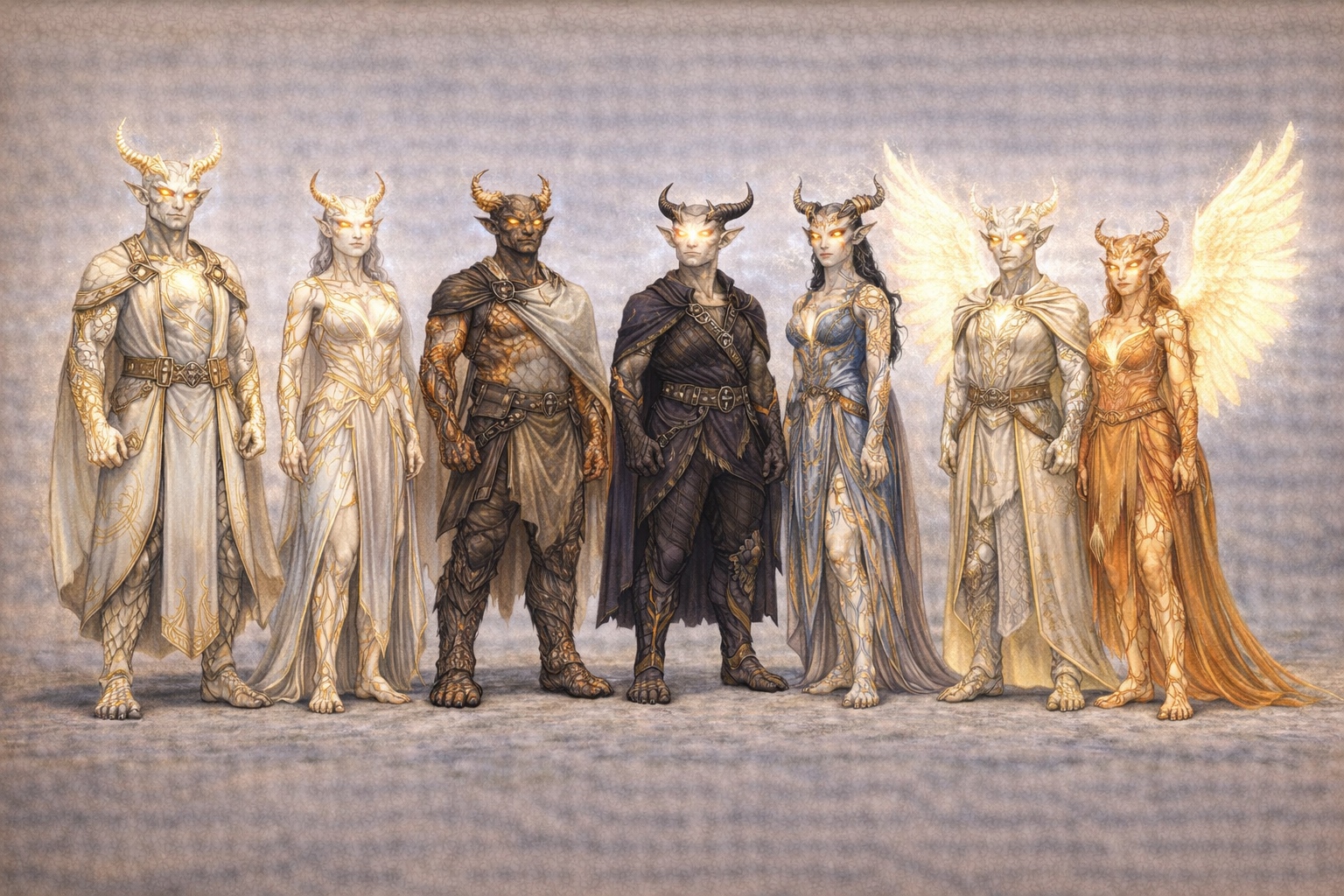
Serren
Playing a Serren? Exodus NDS rules: Species of Dort on ix.exodusnds.com, or the free Dort Species Guide from Exodus NDS Sourcebooks. Other systems: see Playing in Dort.
CORE IDENTITY
- Race Name: Serren
- Plural Name: Serren
- Adjective Form: Serren (attributive); Serric (formal written)
- Alternate Names: The Blessed (rural usage; not a slur, but frequently unwanted); Haloborn (informal, cosmopolitan); Gracetouched (archaic)
- Self-Name (Endonym): Serren, adopted from the same root as their common name; most Serren have made peace with the term even if its implications are complicated
- Outsider Names (Exonyms): The Blessed (rural areas, often with reverence attached); Halos (cosmopolitan slang, neutral to slightly reductive); Graceborn (Irna trade-city usage)
OVERVIEW
Short Description
The Serren are a people of celestial descent, born of unions between the Aelar of Paradiso and mortal men and women in generations past. When the gods forbade such congress, the Aelar largely honored the prohibition, which is why Serren are fewer and rarer than their infernal-heritage counterparts. They carry the light of Paradiso in their blood as a quality: visible, legible, and frequently inconvenient. The life of a Serren is in large part a negotiation between what they appear to be and what they actually are.
General Reputation
The Serren are regarded with reverence in some places and with ordinary indifference in others. In rural and isolated communities, Serren, particularly those bearing the more visible markers of celestial heritage, are often received as sacred figures, representatives of divine presence, or living evidence of a higher order. This is frequently unwelcome to the Serren themselves. In cosmopolitan trading centers and cities accustomed to diverse peoples, Serren are treated as one unusual people among many, their markings and glowing eyes noting them as notable without making them objects of worship. Neither reception is without complication.
Role in the World
Serren occupy a peculiar position between the mortal and the celestial: fully neither, formally claimed by neither. They are too mortal for the Aelar, who regard the circumstances of their creation with discomfort, and too visibly other for easy integration into ordinary mortal society in places where their appearance is legible. The roles they tend to fill reflect both their nature and this in-between position: medicine and tending, diplomatic work, the arbitration of community conflicts, and (sometimes reluctantly) religious roles that their appearance makes it difficult to refuse. Their rarity means each Serren's individual choices carry unusual weight in how others understand what Serren are.
PHYSICAL TRAITS
General Appearance
Serren are humanoid in proportion and silhouette, close enough to the mortal baseline to move unnoticed at distance. The identifying features become apparent in proximity: the flowing patterns tracing their skin, the upward-curving structures at the crown, and the eyes that cast their own light. In certain light conditions, a Serren in a crowd is visible before they are recognized as anything specific.
Size Ranges
- Typical height: Comparable to the human range, with modest variation between lineages. Radiant Serren tend slightly toward average-to-tall; Mercy Serren toward average-to-slight. Neither is absolute.
- Typical weight/build: Generally lean, with a quality of contained energy that is more physiological than behavioral; Serren at rest look as though something in them is still moving.
Distinguishing Features
Four features are common across all Serren: flowing skin markings, upward crown structures, eyes that project outward light, and (in some individuals) wings.
Skin markings run across the body in patterns that suggest movement rather than damage. They resemble water tracing a surface, breath condensing on glass, or light diffused through water: always fluid, always flowing toward something. They are present from birth and are invariant in structure through life, though they brighten and clarify with age. No two Serren share the same pattern. In Radiant Serren, the flow is more precise: lines that converge and resolve cleanly, patterns that suggest order finding its channel. In Mercy Serren, the markings are looser and warmer: branching rather than converging, spreading across the body in softer arcs.
Crown structures grow from the skull and curve upward or outward-and-upward, never downward. In Radiant Serren these are typically smooth, arch-like structures: paired and symmetrical, reading almost architectural in their precision. In Mercy Serren they are more organic in curve, with a warmth to the arc that makes them feel grown rather than formed. Mixed-lineage Serren bear structures that draw from both parents: symmetrical but soft, precise but warm. These structures have a faint luminescence of their own at close range.
Eyes glow outward. Unlike the Zerren's contained internal ember, Serren eyes project their light, a soft, consistent illumination that reaches a handspan or two from the face in full darkness. The glow does not function as usable lamplight but is clearly visible. Colors range from clear white through soft gold, warm silver, and pale blue. In a lit room, the glow is subtle; in darkness, it is the first thing noticed.
Wings are present in some Serren and absent in others. They do not reliably track by lineage; both Radiant and Mercy Serren may carry them, and both may not. They are large enough to be functional, though most Serren with wings do not rely on them as primary transport. They fold close against the back and are frequently covered in contexts where drawing attention is unwelcome. Wing-bearing Serren are the most likely to be met with rural reverence, and the most likely to find that reverence suffocating.
Sexual Dimorphism
Minimal in the baseline. Crown structure variation does not reliably track by sex. Wing presence and absence are equally distributed.
Aging Patterns
Serren reach adulthood in their early twenties, roughly comparable to the human timeline. Visible aging is slow through the middle decades. Elder Serren show deepened markings (brighter rather than darker, as though the pattern has been illuminated from further in) and crown structures that become more pronounced with age. The glow in elderly Serren is often more visible than in younger individuals. Most Serren live between 130 and 160 years.
Regional Variation
Serren who have lived for generations in a given region show modest adaptation in base skin tone and facial structure that mirrors the local population. The skin markings, crown structures, and eye glow are invariant regardless of ancestry or environment. A Serren family long established in [Jazirah](Jazirah/Welcome to Jazirah) will read as Jazirian by feature structure while remaining identifiably Serren by the markings and light.
BIOLOGY
Diet
Omnivorous with no meaningful biological constraints distinct from the humanoid baseline. Some Mercy-lineage Serren show a preference for light, unadorned food; whether this is physiological or cultural drift is unclear.
Reproduction Basics
Serren reproduction follows humanoid norms. Gestation is comparable to the human range. The trait expression in offspring follows the same unusual rule as the Zerren: two Serren parents produce a Serren child. A Serren who has a child with a non-Serren, non-Zerren partner produces a child who is entirely and without remainder of the other parent's people: no Serren traits carry over, no partial expression, no in-between. The heritage is fully present or fully absent.
Serren and Zerren cannot produce offspring together.
Within the Serren lineages: a Radiant and Mercy pairing produces a child bearing traits from both, markings that blend precision and flow, crown structures that are symmetrical but warmer in curve. These mixed-lineage Serren are sometimes called Kindled informally within Serren communities.
Lifespan Ranges
- Typical lifespan: 130–160 years
- Maturity: approximately 20–22
- Elderhood: approximately 110–120
Environmental Adaptations
No significant physiological adaptations beyond the humanoid baseline. Serren show a modest ease in cold and elevated environments; whether this reflects something in their celestial origin or is incidental is not established.
PSYCHOLOGY & CULTURE
Tendencies described here are common patterns, not universals. The single most important variable in a Serren's psychological development is whether they were raised to believe they must be what they appear to be.
Typical Temperament
Serren who have made peace with the gap between their appearance and their actual inner life tend toward warmth, directness, and a quality of genuine presence; they have learned not to perform, because performance has usually caused them more trouble than it resolved. Serren who are still negotiating that gap, who feel the weight of what they are supposed to be, often present as earnest to the point of exhaustion, or quietly withdrawn behind a surface that meets expectations just enough to deflect scrutiny.
The single most common Serren psychological pattern is a relationship to guilt that outsiders frequently misread as either arrogance or self-deprecation. It is neither. It is the specific weight of being expected to be better than you are, by people who believe this expectation is a compliment.
Cultural Values
- Honest presence: The Serren who are doing well have usually arrived at this: that being genuinely, clearly themselves (without performance of either virtue or normalcy) is more sustainable than any other approach. This is harder than it sounds and not everyone manages it.
- Care as choice: Mercy-lineage Serren in particular hold strongly that care given because it is expected or because it matches one's appearance is not the same thing as care given because it is chosen. The distinction matters culturally.
- Appropriate witness: Serren have a tradition, stronger in Radiant communities, of bearing precise witness to what actually happened: not judgment, not comfort, but accuracy. This comes from the lineage's connection to the truth-oriented layers of Paradiso and has become a cultural value somewhat independent of its origin.
Taboos
- Accepting worship: Receiving genuine worship from mortals, allowing people to organize their spiritual lives around you as a Serren specifically, is viewed within most Serren communities as a corruption of something important, even if the Serren doing it means well. The distinction between being respected and being worshipped is one most Serren communities maintain carefully.
- Performing divinity: Presenting oneself as having divine authority or as a representative of Paradiso's will (when you are not, in fact, authorized to speak for Paradiso) is a serious transgression. Serren are not Aelar. Acting as though the lineage makes them one is considered a kind of fundamental dishonesty.
Social Structures
Serren communities are small and scattered by the rarity of their population. Where they have gathered in meaningful numbers, the communities tend toward flat structure with high investment in shared deliberation, partly because their small size makes hierarchy impractical, and partly because Serren have an above-average sensitivity to the coercive use of moral authority, having been its target throughout their lives.
Family Structure
Serren families are typically small. The trait inheritance follows the same absolute rule as with Zerren: two Serren parents produce a Serren child; a Serren who pairs with a non-Serren, non-Zerren partner will not produce a Serren child. Because Serren are rare to begin with, Serren communities place some cultural weight on Serren-Serren partnerships as a matter of simple continuation, but this is expressed as preference and value, not pressure.
Children raised by an Aelar parent who remained in the mortal world have a different formation than those raised in purely mortal households. The Aelar's cultural view of mortals as contaminating creates a specific dynamic for Serren with Aelar-parent upbringings: they are often simultaneously overinvested in as proof that the union was not entirely transgressive, and treated with a quality of reserve that makes ordinary affection feel earned rather than given.
Leadership Patterns
In communities with meaningful Serren populations, leadership tends to emerge through demonstrated trustworthiness and shared deliberation rather than formal structures. Radiant-lineage communities often develop more structured processes; Mercy-lineage communities more relational ones. Both are suspicious, in different ways, of leaders who seem to enjoy the position.
GEOGRAPHIC DISTRIBUTION
The Serren have no homeland. They exist throughout Dort as a scattered minority, rarer than the Zerren by a significant margin.
Primary Homelands
- [Irna](Irna/Welcome to Irna): Irna's cosmopolitan centers are the most normalizing environment for Serren. In large trading cities, Serren are one unusual people among many and are treated accordingly: notable, not revered. Some Serren have deliberately sought these environments out.
- [Antaea](Antaea/Welcome to Antaea): Smaller, more isolated communities in Antaea produce the rural worship dynamic in its clearest form. Serren who settle in Antaea's interior may find themselves the object of genuine organized religious attention whether they invited it or not.
Secondary Populations (Diaspora)
- [Shoing](Shoing/Welcome to Shoing): Scattered presence in coastal trading centers.
- [Funta](Funta/Welcome to Funta): Rare; the continent's ongoing instability creates both danger and unusual pockets of welcome.
- [Jazirah](Jazirah/Welcome to Jazirah): The religious culture of parts of Jazirah creates complicated reception for Serren: some Jazirian communities receive Serren as blessed figures aligned with divine order; others find the celestial heritage theologically suspect or threatening to established religious authority.
Migration Patterns
Serren move toward environments where their appearance is either normalized or manageable. Wing-bearing Serren often find rural environments initially welcoming and then confining, and many migrate toward cities as they age. Those who find the city's indifference preferable to the country's reverence tend to stay.
Adaptations by Region
Standard regional adaptation in clothing, shelter, and diet. Serren who live in environments where their markings and glow attract unwanted attention often develop practical habits around management of visibility: clothing that covers markings, adjustments to where and when they appear in public. Wing-bearing Serren have developed a range of approaches to covering or presenting their wings depending on context.
Cultural Differences Between Lands
Serren in cosmopolitan urban centers tend toward deliberate ordinariness as a strategy, presenting as simply a person who happens to look a particular way. Serren in rural environments are more often pushed into the role their appearance assigns them and develop coping strategies around that pressure. The tension between accepting the role and rejecting it produces meaningfully different community cultures depending on which approach a given community has normalized.
Radiant-lineage communities in trading centers have sometimes developed reputations for precise arbitration, a functional role that draws on the lineage's connection to order and truth without requiring anyone to be worshipped.
HISTORY
Origins
The Serren came into being before the gods formalized their prohibition against celestial congress with mortals. The Aelar, unlike the inhabitants of the Hells, honored the prohibition when it arrived. Their compliance was genuine and relatively consistent, which is the primary reason Serren are fewer than Zerren. The origins of the Aelar who did not comply before the prohibition are largely not documented; most Aelar would prefer this period not be dwelt upon.
What this means for living Serren is that each of them is the descendant of a transgression the celestial side has since formally renounced. The Aelar of Paradiso do not generally acknowledge Serren as kin. They are not indifferent to their existence (the cosmic conflict gives them a kind of muted interest in whether Serren align with celestial or infernal interests), but they do not claim them. This is a fact most Serren eventually have to find a way to live with.
Major Turning Points
The defining historical pattern for Serren is not persecution (which they face less consistently than Zerren) but instrumentalization. In various periods across different continents, Serren have been incorporated into religious structures, made into symbols, or used as legitimizing figures by communities that wanted the appearance of divine sanction. These periods vary in how well or badly they went for the Serren involved. The experience of being used by people who believed they were honoring you is one of the more consistent threads in Serren historical consciousness.
Current Historical Posture
Serren exist in a quiet project of self-definition: an ongoing, distributed, largely individual negotiation over what it means to carry this heritage without being consumed by what others want it to mean. There is no unified Serren political or religious movement. There is a widely shared, if rarely formalized, understanding that the primary work of a Serren life is deciding for themselves what they are.
LANGUAGE
Language Name(s)
Serren have no native language of their own origination. Their primary language is Common, with regional inflection matching wherever they were raised. Some Serren, those raised by an Aelar parent or who have developed a genuine relationship with Paradiso, speak the language of the Aelar, which is the tongue used across the celestial layers. This is not a Serren language; it is the Aelar tongue. Hearing a Serren speak it produces complicated reactions in Aelar observers.
Script
No proprietary script. Common writing systems are used throughout.
Trade Language Status
Common is the operational language. The Aelar tongue is used between those who share it and occasionally in specific contexts involving celestial interests.
Dialect Range
Serren communities in different regions develop their own speech patterns within Common (particular idioms, borrowed vocabulary, slang that tracks lineage or community experience), but these are dialects of Common, not a separate language.
Naming Agent Cross-Reference
No dedicated naming agent file yet established.
NAMING CONVENTIONS
Naming Agent Cross-Reference
See _Cannon/Race naming ai agents/Fantasy Name Generator - Celestial.md, Register 3 and the Dort Application: The SERREN section, for full naming rules and generation guidance. Because Serren names begin from the region that raised them, generation also requires the relevant register of _Cannon/Race naming ai agents/Fantasy Name Generator - Human.md (or the appropriate race file, for Serren raised among non-human peoples).
Personal Name Structure
Serren typically carry a personal name and a family name following the convention of the region where they were raised. Serren names are therefore highly variable by continent.
Serren with strong connection to an Aelar parent often carry names that echo the Aelar's phonetic style: vowel-forward, flowing sounds, soft consonants, names that tend to end in vowels or open syllables. These are not a distinct language but a phonetic inheritance from the Aelar naming style.
Three traditions are in use. The first and most common is an entirely unmodified regional name; for many Serren this is deliberate, since an unremarkable name is one of the few available defenses against being received as a sacred object rather than a person. The second is an Aelar-phonetic given name, drawn from either the Radiant or the Mercy heritage inventory and paired either with a regional family name or with a lineage-root joined by a binding particle: ael for Radiant lineage, mir for Mercy. A single-element name with no lineage-root at all is equally correct and is in fact the common case, since the Aelar rarely acknowledge Serren descent. The third tradition, concentrated in Jazirah and rural Irna, is a grace or virtue name drawn from what a family hoped the child would carry.
Whether a Serren uses the particle construction or a regional family name is a statement about whether they are claiming the lineage or living past it.
Because the Aelar largely honored the prohibition on congress with mortals, Serren have never been numerous enough in any one place to standardize a naming culture. There is no Serren naming tradition in the way there is a Felari or Dwarven one, and no Serren clan or house names exist. Each family improvises. A Serren without a mortal family to supply a family name (not a rare circumstance, given how Serren are received) may carry a single name only, or a virtue name standing alone.
Sex and Name Form
Serren sex-marking is inherited from the register that raised them rather than from anything celestial: a Serren raised in Jazirah marks sex the way Jazirah does, one raised in Shoing's eastern register marks it lexically, one raised among the Vaelhari does not mark it at all.
Aelar-phonetic given names carry only a light tendency of their own: vowel-final forms in -a, -e, -ia, -elle lean feminine, consonant-final open syllables in -n, -r, -l, -th lean masculine, and the -ael, -iel, -avel endings are genuinely ambiguous and common for both. The weakness of this marking is the canon position, not a gap in it. Grace and virtue names are unmarked entirely.
Formal vs. Informal Names
In communities with strong internal culture, Serren may maintain both a community-internal name drawn from Aelar phonetics and a Common-convention name used outside that community. This is a form of code-switching that is not considered deceptive by those who practice it.
Titles & Honorifics
- Kindled: Used within Serren communities to identify Radiant/Mercy mixed-lineage individuals. Informal and generally positive in connotation within communities.
- Witness: An honorific used within Radiant-lineage communities for individuals recognized as reliable and precise observers of events: not judges, but accurate recorders. Conferred by community usage.
Name Examples
- Given names (Radiant-heritage phonetics): Caelos, Vereth, Azhon, Sorin, Lirax
- Given names (Mercy-heritage phonetics): Sael, Paeva, Kurith, Serael, Caera
- Family names: Follow local regional conventions; no standard Serren family name tradition
- Aelar-heritage full name examples: Sorin ael Vereth, Caelis, Paeva mir Sael
SOCIETY
Common Professions
Serren appear throughout the trades and professions of the places they live. The professions where they are disproportionately represented reflect both the pull of their lineage and the expectations others project onto them. Medicine and healing work draw Serren at higher rates than their population would suggest: partly lineage affinity, partly the fact that communities often direct Serren toward these roles whether they sought them or not. Diplomacy and mediation similarly. Religious offices are frequently offered to Serren; the number who accept is considerably lower than the number offered. Access to roles requiring a low visible profile is practically difficult for wing-bearing Serren in contexts where visibility is a liability.
Craft Traditions
No unified Serren craft tradition. In communities with established Serren populations, work in translucent or light-responsive materials (glass, certain treated stones, specific textile dyeing techniques) has emerged with some regularity, echoing the markings and glow aesthetically. Whether this is intentional cultural expression is contested.
Trade Roles
Serren do not dominate any particular trade good or route. Radiant-lineage Serren have sometimes developed roles in arbitration and recorded witness, drawing on a reputation for precision. The same community trust that creates this niche also creates pressure to use it in ways the Serren may not have chosen.
Military Tendencies
No unified military tradition. Serren in most contexts serve within the military structures of the societies they inhabit, or remain outside military life entirely. The cosmic conflict between Paradiso and the Hells is real and ongoing, but Serren are not automatically participants in it despite their heritage; the Aelar do not formally coordinate with them, and most Serren approach the conflict as something they have opinions about rather than obligations to.
Religious Tendencies
Religious practice among Serren is as varied as their geographic spread. Many Serren avoid formal religious life specifically because their appearance makes it difficult to participate without becoming an object of attention. Some Serren maintain private observances connected to the celestial heritage: not worship of the Aelar, but acknowledgment of what they carry. Some engage deeply with the religious traditions of their home community. What is broadly absent is any organized Serren religious institution, a Serren-led theology or clergy. The Serren who have come closest to creating one have generally attracted more outside attention than they wanted.
INTERACTIONS
Relations with Other Races
- Zerren: The infernal-heritage counterpart is known to most Serren. The relationship between individual Serren and Zerren varies enormously. The impossibility between them (they cannot produce offspring together) is a practical fact. The ideological weight their origins carry is something individuals navigate differently, from the Serren who finds Zerren troubling on principle, to the Serren who finds them more straightforwardly legible than people who don't carry the experience of being definitively categorized by their appearance.
- Humans: The most frequent relationship, given Serren exist primarily in human-majority territories. In urban contexts this is generally ordinary coexistence; in rural contexts it shades toward reverence.
- Vaelhari: Where both are present, Serren and Vaelhari sometimes find a mutual understanding; both carry a heritage that makes others project onto them, and both have developed cultures of negotiating those projections. The forms of the projection are very different, but the experience is recognizable.
Stereotypes (Given and Received)
- Stereotypes about them: That Serren are inherently good or virtuous (common; false as a universal; the lineage creates a pull toward certain qualities but does not guarantee them any more than Zerren heritage guarantees cruelty); that Serren are closer to the gods than ordinary people (widespread in rural areas; the Serren themselves are usually the most emphatic in contesting this); that wing-bearing Serren are especially sacred (concentrated in rural communities with less exposure to the full range of Serren experience).
- Stereotypes they hold: That being believed to be perfect is one of the lonelier experiences available. That most people would rather have a symbol than a person. That Zerren probably understand some of this from the other direction.
Cooperation Patterns
Urban contexts where different peoples move freely create the most sustainable conditions for Serren cooperation with other peoples. Serren who have found communities that receive them as individuals rather than symbols are often deeply invested in maintaining those relationships. The Serren capacity for precise witness and genuine mediation makes them sought partners when those qualities are what's actually needed.
Conflict Patterns
Rural worship that becomes expectation and then obligation. Religious structures that incorporate Serren as symbols without their consent. Aelar indifference or contempt, encountered by Serren who seek connection with their celestial heritage and find the Aelar's view of mortals as contaminating applies to them too. The quiet, specific grief of being told you are blessed while being treated as useful.
VARIANTS
Physical / Regional Variants
Radiant Serren
- Defining traits: Precise, structured appearance throughout: symmetrical crown structures with clean architectural arcs, flowing markings that converge and resolve rather than spread, eye glow that reads as steady and directional.
- Range / location: Present across all regions where Serren exist; disproportionately represented in arbitration, diplomatic, and witness-bearing roles.
- Notes: Their precise, ordered appearance tends to produce expectations of judgment and structure. Radiant Serren often find themselves navigating the gap between being expected to render verdicts and their own preference simply to observe accurately.
Mercy Serren
- Defining traits: Warmer, more organic appearance: crown structures that curve with a grown quality, flowing markings that spread and branch rather than converge, eye glow that reads as ambient and encompassing.
- Range / location: Present across all regions; disproportionately associated in outsider perception with healing and care work.
- Notes: Their appearance produces expectations of comfort and healing regardless of the individual's actual inclinations. Mercy Serren who are not especially drawn to healing roles spend meaningful effort redirecting these expectations.
Kindled (Mixed Lineage)
- Defining traits: Features from both Radiant and Mercy parents: crown structures that are symmetrical but warmer in curve, markings that converge in some areas and spread in others, eye glow that is both steady and ambient.
- Range / location: Present wherever both Radiant and Mercy Serren coexist.
- Notes: Often more self-aware of the tension between precision and warmth as complementary rather than competing, having navigated both perspectives from childhood. Sometimes more comfortable in roles that require both qualities than either pure lineage.
Winged Serren
- Defining traits: Large wings proportional to the body, present in both Radiant and Mercy lineages without clear pattern. Wings have the same luminescent quality as the crown structures at close range. They fold close against the back when not in use.
- Range / location: Found across all regions; no geographic concentration.
- Notes: The most immediately recognizable variant to outsiders, and the variant most associated with rural worship. Wing-bearing Serren are disproportionately represented in the historical record of Serren being incorporated into religious structures against their preference. A distinct subculture exists among winged Serren around strategies for managing the attention the wings generate.
DEVELOPMENT NOTES (Author use only, not canon)
Story Hooks
- A Mercy Serren who has spent decades resisting the role of healer is forced by circumstances to occupy that role completely, and discovers whether their resistance was preference or fear.
- A Radiant Serren operating as an arbitrator in a trading city is asked to render a verdict that is technically accurate and will cause serious harm to a community that trusts them.
- A wing-bearing Serren who escaped rural worship and built a genuinely ordinary life in a city finds their past following them when their place of origin sends representatives who believe they belong back there.
- A Serren who sought out Paradiso and found the Aelar's contempt for mortals extended to them, and who now has to decide what to do with the knowledge that their celestial heritage does not mean they have a home there.
- A Kindled Serren and a Shardborn Zerren who discover they understand each other's experience better than anyone else in their lives, without being able to produce a future together.
Unresolved Lore / Open Questions
- Do the Graces, Paradiso's seven mortal-world agents, have any relationship with Serren bloodlines, or do they treat Serren as ordinary mortals?
- How does the Aelar hierarchy formally regard Serren? Is there an official position, or deliberate institutional silence?
- Are there any Serren who have achieved a working relationship with specific Aelar, or is the contempt for mortal presence consistent enough to prevent this?
- Have any Serren attempted to participate formally in the cosmic conflict between Paradiso and the Hells, and if so, how were they received?
Development Notes
- Color palettes for skin markings, crown structures, and eye glow not yet established; flag for update when palettes are finalized.
- Geographic distribution values in the Races & Lands table are approximate; review against more detailed continent lore when available.
- Naming conventions for non-Aelar-heritage Serren need regional examples by continent.
- The Graces cross-reference is worth developing; whether any specific Grace has a historical or ongoing relationship with Serren bloodlines is unresolved.
- Cross-link with Paradiso and The Graces when those entries are finalized.
Race Template v2.0, Dort World Races