Torten
Torten
Playing a Torten? Exodus NDS rules: the free Dort Species Guide from Exodus NDS Sourcebooks. Other systems: see Playing in Dort.
Core Identity
Pronunciation: TOR-ten
Singular/Plural: Torten (singular and plural identical)
Demonym: Torten
Classification: Beastfolk, Chelonian
Also called: Shell-folk, Home-carriers, Navigators (when referring specifically to Deep-kin navigational tradition)
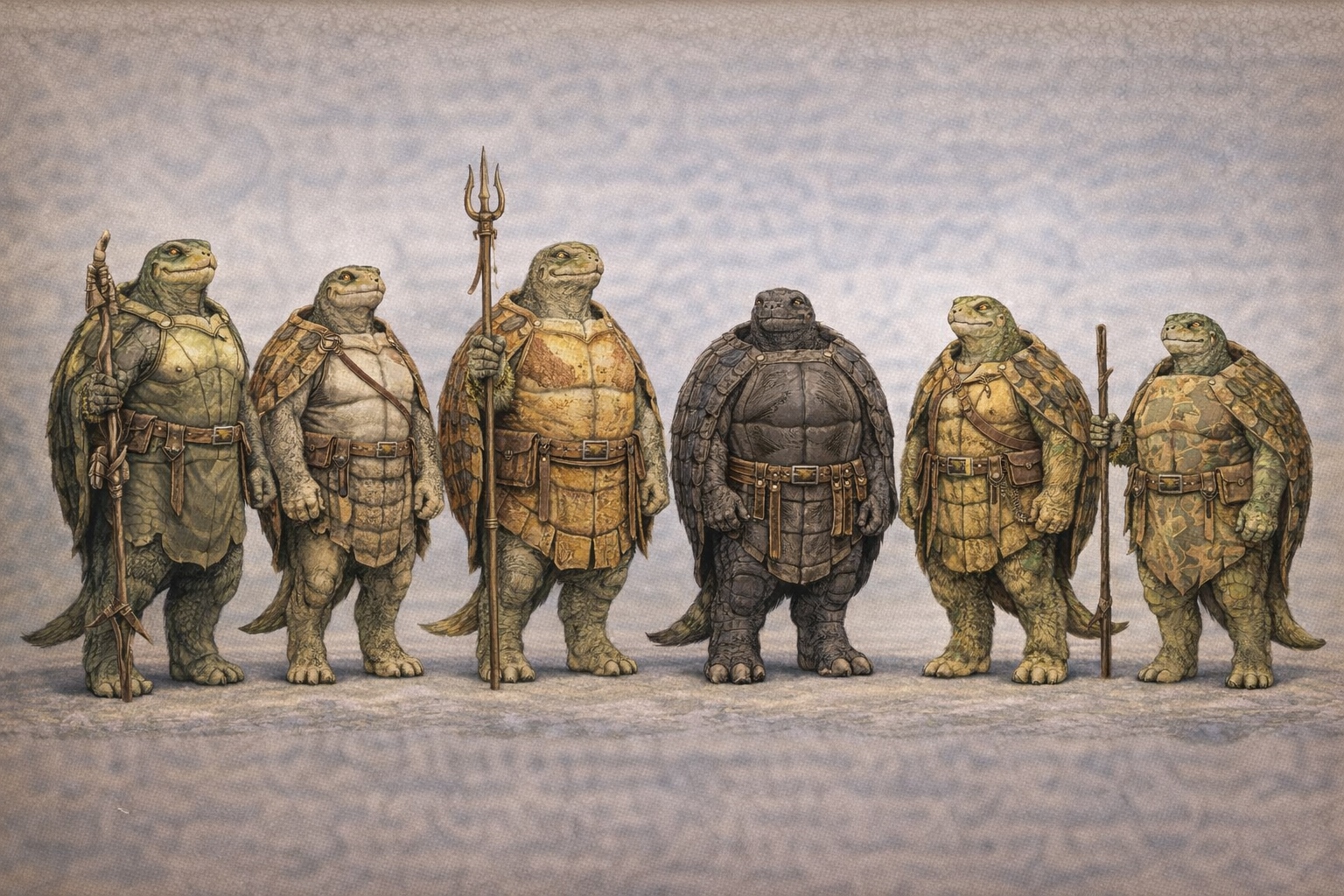
The Torten are turtle-folk shaped by a mage who was fascinated by a particular philosophical question: what is it to carry your home with you everywhere? The shell is not armor. It is not a house the Torten live inside. It is their spine and their ribcage; they are bonded to it at the most fundamental anatomical level, from the moment they hatch. A Torten's shell is as much them as their face is. The mage who designed the Torten was thinking about belonging, about what it means to be home regardless of where you are, and they built a people whose body answers that question before they ever have to speak it.
The Torten are unhurried. They are ancient. They are, of all the beastfolk peoples, the most comfortable with very long timescales, because several of them have lived those timescales personally.
Overview
The Torten are a medium-to-large people found primarily along coasts, river systems, and ocean islands. They are among the longest-lived peoples on Dort; most Torten live 180 to 250 years, with Land-kin elders reaching 300 or beyond in rare cases. This extreme lifespan shapes everything about Torten culture: their relationship with time, with shorter-lived peoples, with philosophical questions about impermanence, and with the specific quality of patience that can only come from having personally watched two or three generations of other peoples live and pass.
They are not sedentary. The popular image of a turtle as slow and stationary does not describe Torten civilization, which is built around navigation, migration, and the confident movement of a being who is always home because home is always with them. Torten communities shift over time. Torten individuals travel in ways that other peoples plan for years and Torten accomplish in the same spirit as a morning walk. The ocean is not an obstacle. It is a road that requires knowledge to use correctly, and the Torten have been accumulating that knowledge for a very long time.
Physical Traits
All Torten share the fundamental chelonian biology that defines their people:
- The shell. The Torten shell is an integral anatomical structure: the dorsal shell (carapace) is fused to the spine and ribcage; the ventral shell (plastron) covers the underside. Torten cannot be removed from their shells any more than any being can be removed from their skeleton. The shell grows with the individual from hatching. It is living tissue with nerve endings; damage to the shell is painful in the same way that bone damage is painful. The shell's outer layer is composed of scutes: sections of keratinous tissue that grow and are periodically replaced as the animal ages, recording something of growth history in their layers. Elder Torten shells have a weathered, layered texture; young Torten shells are smooth and bright-scuted. Shell shape, dome height, and patterning vary significantly by lineage and individual.
- Retraction. Torten can partially retract their head, limbs, and tail into the shell. Full retraction, completely enclosing all soft tissue, is not possible at Torten size; a Torten can pull their head and limbs inside to protect them, but the apertures are not fully closeable. Retraction is an automatic response to serious threat, not a social or deliberate action.
- Limb structure. Torten hands are fully functional for tool use, writing, and fine work, though the fingers are somewhat shorter and broader than most humanoid peoples. Forelimbs vary by lineage (most paddle-like in Deep-kin, most hand-like in Land-kin and River-kin). Torten move on plantigrade feet that are more mobile than strictly reptilian, supporting upright bipedal movement, though with a gait that is lower and more deliberate than most peoples.
- Moderate ectothermy. Torten are broadly ectothermic (their metabolism is slower than warm-blooded peoples and responsive to temperature), but less dramatically so than Serathi. A Torten in cold weather is slower; a Torten in warm weather is quicker; but the differential is less extreme than in Serathi. Torten do not require morning basking to function, though they seek warmth when available and are noticeably more active in warm conditions.
- Size. Height varies by lineage, from 5'0" (River-kin) to 7'0" (Land-kin). The shell adds apparent bulk significantly beyond bare height measurements; a Torten at any height appears more massive than their height suggests.
- Lifespan: 180–300+ years across lineages, with Land-kin longest. Maturation is slow: Torten are not considered adult until approximately age 25–30. Cognitive and philosophical maturity is treated as an ongoing process, with no clear end point; a 200-year-old Land-kin is considered to still be learning.
Biology
The shell as self. The Torten shell is the most important biological fact about the species, and it is the one most misunderstood by peoples who have not spent time with them. The shell does not come off. It cannot be removed, damaged without pain, or altered without affecting the Torten directly. Peoples who ask whether Torten can "take off" their shells are asking something equivalent to asking a person to take off their spine. The shell grows with the Torten, records their history in its layers, and is as individual as a face. No two Torten shells are identical.
The shell creates real physical constraints: Torten cannot lie flat on their back (the carapace prevents it), cannot fit through the same spaces as a being of equivalent height, and require more physical clearance above them than most peoples. Torten-appropriate seating has a gap or cut-out for the shell. Most Torten, rather than seeking special accommodation, sit on forward-leaning stools or benches, a distinctive posture that other peoples learn to recognize as characteristically Torten.
Ectothermy. Torten metabolism is temperature-responsive but with a broader functional range than Serathi. Below approximately 10 degrees, Torten begin to experience meaningful metabolic slowing. Below 5 degrees, they may enter a torpor state if sustained. In warm conditions (above 20 degrees), they function at full capacity. In hot conditions (above 35 degrees), they seek water; their shells can retain heat to an uncomfortable degree in sustained extreme heat. Deep-kin and River-kin manage heat through water immersion; Land-kin prefer shade and seek cooler ground.
Longevity and growth. Torten do not have a defined maximum lifespan in the way most peoples do; they do not "age out" of function but gradually slow over centuries, their metabolic processes becoming more economical. The very oldest Land-kin are distinguished by extreme shell growth (the shell continues adding mass throughout life), deliberate movement, and a quality of attention that shorter-lived peoples often describe as uncanny: a sustained, complete focus that comes from having spent centuries cultivating it. Torten do not die of old age in the conventional sense; they eventually slow to the point where they stop eating, enter extended torpor, and do not emerge. This end is not considered tragic in Torten culture; it is the shell going home.
Diet. Torten are omnivorous with broad dietary flexibility: most lineages eat plant material, fish, crustaceans, mollusks, and opportunistically other food sources as available. Their digestive systems are adapted to extract maximum nutrition from available food, and their low resting metabolic rate means their caloric needs are modest compared to similarly sized warm-blooded peoples. Torten can fast effectively for weeks without significant health impact.
Reproduction. Torten are oviparous; they lay eggs in clutches of 4–20 (more in Deep-kin and River-kin, fewer in Land-kin). Eggs are laid in prepared nesting sites and require warmth to develop. Incubation varies by lineage but typically takes 3–6 months. Hatchlings emerge small (roughly the size of a large melon) and fully independent; there is no parental care period in the mammalian sense, though most Torten communities provide communal protection of nesting grounds and collective orientation of new hatchlings. The hatchling-to-adult period is the most vulnerable phase of a Torten's life; survival rates vary by lineage and environment.
Psychology and Culture
The defining Torten philosophical principle is called Moanatoa ("the ocean's strength"), which is best understood as the specific confidence of a being who cannot be made homeless. Whatever else changes, the shell is here. Whatever ground is underfoot, it is a temporary arrangement that the Torten chooses or does not choose; it does not define them. This is not indifference to place. Torten love specific places and return to them across centuries. It is the recognition that being attached to a place and being defined by it are different, and the Torten are characterized by the former without the latter.
Navigation as philosophy. The Torten navigation tradition, primarily maintained by Deep-kin but honored across all lineages, treats ocean-crossing not as a journey from home to elsewhere but as the ocean itself being a kind of home: a space requiring knowledge, attention, and respect. The navigator who knows the currents, the stars, the wave-patterns, and the deepwater signs is not imposing a route on the ocean; they are reading what the ocean is already saying. This philosophy extends beyond literal navigation to how Torten approach all complex situations: you learn what is already there before you decide where to go.
The long view. Two-hundred-year lifespans produce a particular orientation to events. A Torten elder who has personally watched four generations of shorter-lived peoples live, die, and be replaced carries a perspective that is genuinely hard to replicate through institutional memory. Torten elders do not typically offer advice quickly; they have seen too many situations that appeared unique and were not, too many urgencies that seemed absolute and passed, too many alliances that looked permanent and dissolved. The Torten patience is not philosophical only; it is experiential. They have waited before. They know how this ends. (They are sometimes wrong about this. Very long experience can generate false pattern-matching. Torten philosophical tradition has a name for this failure: Waironeke, "the river that thinks it knows the sea.")
Pilgrimage culture. Torten communities practice a form of pilgrimage called the Crossing, a journey made at significant life transitions (maturation, transition to elder status, the period following a significant loss, and occasionally simply when the shell feels too stationary). The Crossing is not a journey to a destination; it is a journey toward whatever is encountered. A young Torten completing their first Crossing may travel for years before feeling that it is complete. Elder Torten Crossings are often shorter; the elder has already accumulated enough experience of the unknown that the journey needs less distance to do its work.
Shell-tending culture. Caring for another's shell is one of the most intimate forms of affection in Torten culture: the shell cannot be fully maintained by the individual it belongs to; the areas of the back and the joins between carapace and plastron require another person's hands. Shell-tending relationships (regularly cleaning, oiling, checking for cracks, and maintaining the scute surface of another Torten's shell) are among the most significant relationship-types in Torten communities. Long-term shell-tending partners are a formal recognized relationship category.
Geographic Distribution
Torten are found along every major coastline and river system on Dort, with smaller populations in landlocked highland regions. Their distribution reflects their biology: access to water is important to all lineages; proximity to ocean is important to Deep-kin; warmth is preferred across all lineages.
- Deep-kin have the widest distribution of any Torten lineage; they range across all major oceans and are found in ports and coastal communities on every continent. They are the Torten lineage most encountered by peoples in maritime trade contexts.
- Shore-kin are concentrated along coastlines, particularly the temperate and warm coasts of Irna, Funta, and Antaea. They are the most commonly settled Torten lineage, maintaining established communities in coastal mixed cities.
- Land-kin have the most specific distribution; they prefer warm highland plateaus and sheltered inland valleys. Their communities are present in southern Irna, the interior highlands of Funta, and parts of Antaea. Land-kin are uncommon in northern Irna and the cold north generally.
- River-kin range along all major river systems on every continent, with the largest populations in the river valleys of Funta and Antaea. They are the Torten lineage most integrated into interior mixed communities far from any coast.
History
The First Crossing. The Torten origin myth (Moanatoa Hinu, "the ocean's first light") describes the first Torten hatching on the edge of a great ocean and walking directly into the water without stopping, drawn by a knowledge that was already present at the moment of emergence. The myth does not describe the mage. It describes the ocean recognizing the Torten: the water making room. This is the founding image of Torten philosophy, not that the Torten conquered the ocean but that the ocean agreed to be known.
The Navigation Compacts (~15 centuries ago). As Torten Deep-kin communities developed systematic ocean-crossing traditions, they formalized knowledge-sharing agreements with other ocean-traveling peoples, primarily coastal trading communities across Funta and early Antaean seafaring groups. The Navigation Compacts established Torten wayfinding knowledge as a shared resource (in exchange for port access and provisioning agreements) and are generally credited with making long-distance oceanic trade viable well before any other peoples had the navigational capacity to manage it independently. The Navigation Compacts are the earliest Torten engagement with inter-people formal agreements.
The Great Crossing (~12 centuries ago). The largest documented Torten migration in recorded history, a sustained multi-generational movement of Deep-kin and Shore-kin communities across the deep ocean between Funta's southern coast and the island chains of what is now Antaea's outer islands. The Great Crossing was not a flight from disaster but a deliberate exploration undertaken by a coalition of home-water communities who had accumulated enough navigational knowledge to believe the crossing possible. They were correct. The communities established during and after the Great Crossing are among the oldest continuously inhabited Torten settlements.
The Shore Wars (~8 centuries ago). A period of sustained conflict between Deep-kin coastal communities and expanding maritime empires that disputed the coastal territories the Torten had used as nesting grounds for generations. The Shore Wars were not primarily military; Torten have no standing armies and the conflicts were more accurately a series of territorial disputes prosecuted through harassment, formal protest, targeted destruction of property, and occasional direct confrontation. The Shore Wars concluded with a series of agreements collectively called the Coastal Settlements: formal recognition of Torten nesting territories along major coastlines, in exchange for Torten wayfinding cooperation with the expanding maritime powers. The Coastal Settlements are still cited in contemporary disputes about coastal land rights in several Funta and Irna port cities.
The Land Accords (~5 centuries ago). The formal integration of Land-kin highland communities into the political and economic frameworks of Irna's interior peoples. Land-kin communities had been present in the Irna highlands for centuries but had maintained deliberate distance from the expanding lowland civilizations. As Irna's agricultural reach extended into highland zones, the Land Accords negotiated formal recognition of Land-kin territory, Land-kin access to lowland trade markets, and (critically) formal acknowledgment of Land-kin elder testimony in legal disputes as valid historical evidence. This last provision reflected the practical reality that a 250-year-old Land-kin had personally witnessed events that affected the legal questions at hand. The elder-testimony provision remains in effect in several Irna legal systems.
The River-Road Agreements (~3 centuries ago). A series of navigation and access agreements between River-kin communities and the peoples of the major Funta river systems, establishing River-kin rights of passage, nesting access, and trade activity along rivers that cross multiple territorial boundaries. The River-Road Agreements are still the governing framework for River-kin movement on most of Dort's major inland waterways.
Language
Spoken language: Moanthis ("ocean-tongue"). Moanthis is a vowel-rich, open, musical language; the mage who shaped the Torten built extreme vowel richness into the naming tradition, and the spoken language reflects this same quality. Every syllable breathes. Moanthis is comfortable spoken at ocean distances: its carrying quality is notable; Torten can make themselves clearly understood at ranges that most peoples would need to shout across. This is not volume but phonological design: open vowels carry.
Moanthis is not a language of rushing. Its sentence structure places setting and context first: you say where and when and in what condition before you say what happened. This is similar to Sarithis in this regard; Torten and Serathi who have learned each other's language note the structural affinity.
A significant feature of Moanthis is its system of water-tones, tonal variations that distinguish the same word spoken in different emotional or circumstantial contexts. There are seven standard water-tones, named for types of water: the still-tone, the surface-current tone, the deeptide tone, the storm-tone, the estuary-tone, the spring-tone, and the shore-break tone. These tones are not a separate register; they thread through all speech, adjusting meaning. Non-Torten speakers who learn Moanthis typically learn the words long before they learn the tones.
Written script: Wavework. The Torten writing system was developed for portability. Wavework characters are designed to be incised into smooth wood, pressed into wax, or carved into shell-scute material: small, precise, and durable without requiring stone. A Torten text block can be carried across an ocean. The script is syllabic (approximately 60 characters) with diacritics for the water-tone system. The characters have a flowing quality, rounded forms with directional marks that give experienced readers an almost immediate sense of the text's emotional register before they parse the content.
A standard Wavework text is compact and travels well. The Torten tradition of carrying written documents has made Wavework one of the most widely encountered non-Irna scripts on Dort, particularly in ports.
Naming tradition. Torten names draw from the Polynesian-influenced phonological tradition of the mage who shaped them: open syllables, vowel-rich, musical, with the distinctive ng consonant appearing in many names. Names feel unhurried: they should be sayable slowly without feeling incomplete and quickly without feeling rushed. Torten carry a given name and a home-water name: the specific ocean region, coast, or river community they are associated with.
Example given names: Moanake, Taaneko, Hinatoa, Rongana, Mauike, Wairuna, Ngaaroka, Kaahune, Atuana, Tawhitoa
Example home-water names: Moanatoa, Waironeke, Taanehua, Hinaaroha, Rongotika
Naming Conventions
Naming Agent Cross-Reference
See _Cannon/Race naming ai agents/beastfolk/Beastfolk - Tortle.md for full naming rules and generation guidance.
Personal Name Structure
Torten carry a given name and a home-water name: the specific ocean region, coast, or river community they are associated with. Both are drawn from Moanthis phonology: open syllables, vowel-rich, musical, with the distinctive ng consonant appearing in many names. Names should be sayable slowly without feeling incomplete and quickly without feeling rushed.
Because the home-water is "a defined relationship with a particular water-space" rather than a fixed location, a Torten's home-water name travels with them. Those who leave on a Crossing keep it and return to it; those who settle permanently elsewhere either establish a new home-water or are formally adopted into an existing one, and the name changes accordingly.
Sex and Name Form
Torten names carry sex in the root rather than the ending, and no Torten ending marks sex at all; -a, -o, -e, -na, -ne, -ka, -ti, -nga, -hu and -toa are borne by anyone. What carries sex is what the root refers to: the sky, navigator, peace and protector roots (Tane-, Maui-, Rongo-, Tawhi-) lean masculine, while the moon, water and hidden roots (Hina-, Wai-, Ngaa-) lean feminine. The ocean, divine and eagle roots (Moana-, Atua-, Kaa-) are borne by either, and Moana- is the most-used root in the register, so a large share of Torten names carry no sex information, which is correct rather than a gap.
Hinatoa and Tanetoa share an ending and differ in sex entirely because of what precedes it. Appending a vowel to mark the feminine destroys the system, since -a is already among the commonest endings for everyone.
Doubled vowels mark age and weight, not sex. Home-water names never mark sex; every Torten of that water carries it identically.
Name Examples
- Given names: Moanake, Taaneko, Hinatoa, Rongana, Mauike, Wairuna, Ngaaroka, Kaahune, Atuana, Tawhitoa
- Home-water names: Moanatoa, Waironeke, Taanehua, Hinaaroha, Rongotika
- Full name examples: Moanake of Moanatoa; Hinatoa of Hinaaroha; Wairuna of Waironeke; Tawhitoa of Rongotika
Society
Home-waters. The basic Torten social unit is the home-water, a community organized around a specific body of water (an ocean stretch, a coastline, a river section, a lake). The home-water is not a fixed location; it is a defined relationship with a particular water-space. Torten who leave for a Crossing maintain their home-water identity; they return to it. Torten who settle permanently in a new place eventually establish a new home-water or are formally adopted into an existing one.
Home-water communities typically number 30–150 members, with Land-kin communities on the smaller end and coastal Deep-kin communities on the larger end. The community's decision-making authority rests with the Shell-elder: the oldest member of the community whose longevity is taken, in Torten culture, as evidence of accumulated relevant experience rather than mere duration. The Shell-elder does not command; they advise and, when consensus is needed, facilitate it.
The Navigator tradition. In Deep-kin communities and in any home-water community that has ocean access, the Navigator is a specific recognized role, the individual who has mastered the deep ocean-reading tradition and is responsible for the community's movement decisions. Navigator status is not inherited; it is earned through demonstrated competence and recognized by the community. The Navigator's knowledge (star-charts, current-maps, weather-reading traditions, deep-ocean sign reading) is maintained in Wavework text and passed to apprentices across generations. The Torten navigational archive, distributed across dozens of home-water communities, represents the most comprehensive ocean knowledge on Dort.
Crossing communities. Individuals on Crossing are not homeless. A Torten on Crossing is understood by all other Torten communities they pass through as a protected guest; the obligation to host, provision, and assist a Crossing Torten is universal across all lineages. A Torten who turns away someone on Crossing without extraordinary reason has committed a serious social failure. This practice also functions as a continental information-exchange network: Crossings bring news, stories, and practical knowledge between communities that may rarely otherwise interact.
Interactions with Other Peoples
Serathi. Two long-lived peoples with mutual recognition of each other's timescales. Torten and Serathi have a specific philosophical affinity: both deal with the question of how to exist in patient relation to a world that often moves faster than they choose to. The Torten Moanatoa and the Serathi still-wait are different practices that address a similar existential territory. Torten-Serathi philosophical exchange has a long tradition, particularly in cities where both communities are well established. Each tends to find the other's patience legible in a way that shorter-lived peoples' urgency is not.
Taurik. A productive relationship organized around complementary orientations to permanence. Taurik build things that last centuries in stone; Torten carry things that last centuries in memory and text. Where Taurik communities have been established for generations, Torten communities often maintain a roving presence; the Torten who have been returning to a Taurik city for 150 years know the city's institutional history in ways the Taurik themselves have sometimes lost track of. The compact-culture of the Taurik and the record-culture of the Torten have produced, in several major cities, formal Torten-Taurik archive partnerships.
Lapori. A relationship organized around complementary speeds. Lapori move fast; Torten move slowly and over very long time horizons. In mixed port cities where both are established, Lapori warren networks provide the rapid-communication and quick-reaction capacity that Torten communities lack, while Torten elders provide historical context and long-view assessment that Lapori warren councils appreciate. The two peoples have developed genuine inter-community partnership forms in several locations.
Maritime trading peoples (general). The Torten's most consistent and complex inter-people relationship is with the various maritime trading communities whose ocean-crossing ambitions intersect with Torten navigational knowledge. The Navigation Compacts established the framework: Torten share wayfinding knowledge in exchange for port access and provisioning rights. This exchange remains active. A ship captain who has a good relationship with the local Deep-kin community has access to ocean knowledge that no instrument can replicate. The relationship is not always equal; historically, maritime empires have sometimes attempted to extract Torten navigational knowledge without fair exchange, with mixed success.
Biological Lineages
The Torten encompass four biological lineages, each tracing to a distinct chelonian ancestor-type. All share the shell, the longevity, and the Moanatoa philosophical core. Lineage differences are primarily in shell morphology, body proportion, environmental specialization, and lifespan within the broad Torten long-life range.
Deep-kin
Sea turtle type. Ocean-adapted, widest range, most nomadic lineage.
Physical character. Deep-kin have the most hydrodynamic shell of any Torten lineage: a flatter, more streamlined carapace with a lower dome profile that reduces water resistance. Their forelimbs are the most paddle-like of any lineage: longer, broader, and more adapted for sustained swimming. On land, Deep-kin are less comfortable than other lineages; the paddle-adapted forelimbs are less functional for fine work and movement on uneven ground. In water, they are fully at home: capable of sustained ocean swimming and deep dives. Shell coloring is typically dark olive, grey-green, or charcoal with pale markings. Adults range from 5'8" to 6'4".
Cultural character. Deep-kin are the Navigator lineage. Their deep-ocean knowledge tradition is the most sophisticated navigation system on Dort, accumulated over fifteen centuries of systematic observation and record-keeping. Deep-kin communities are the most mobile of any Torten lineage; they may not maintain a permanent ground-settlement at all, treating specific anchorages and ports as temporary home-waters that shift with season and need. Their cultural identity is the most explicitly Moanatoa; they carry their home on their back and carry their knowledge in their Wavework records.
Shore-kin
Coastal turtle type. Balanced land-sea adaptation, most integrated with mixed-people communities.
Physical character. Shore-kin have the most balanced body plan of any Torten lineage: comfortable on land and in water, with a moderately domed shell and well-proportioned limbs that serve both environments adequately without excelling in either. Their shells display the most visible patterning of any lineage: distinctive color arrangements of brown, olive, orange, and gold scutes that vary widely between individuals. No two Shore-kin shells are visually identical. Adults range from 5'4" to 6'0".
Cultural character. Shore-kin are the most community-rooted Torten lineage. They maintain established home-water settlements on coastlines across Dort and are the Torten lineage most commonly seen in mixed-population coastal cities. Their cultural role tends toward the communal: Shore-kin organize port-community relationships, maintain Coastal Settlement agreements, manage nesting-ground rights, and serve as the primary Torten presence in multi-people urban coastal environments. They are also the lineage most likely to establish permanent buildings rather than maintaining purely portable lives; Shore-kin communities in major ports may have physical shell-appropriate structures that have been in use for generations.
Land-kin
Giant tortoise type. Largest, most domed shell, greatest longevity, least water-dependent.
Physical character. Land-kin are the largest Torten lineage and the most distinctively different from the aquatic types. Their shell is highly domed; the carapace rises significantly above the shoulder line, creating the most architecturally complete shell of any lineage. Land-kin shells are massive: the shell of an adult Land-kin elder may weigh more than the equivalent of the rest of their body. Shell coloring is typically grey, dark brown, or near-black, often developing complex texture through the accumulated scute layers of centuries. Their forelimbs are the most hand-like of any lineage: well-adapted for grasping, tool use, and fine work, at the cost of any swimming ability. Adults range from 6'0" to 7'0" in height but appear considerably larger due to shell profile.
Land-kin have the longest lifespan of any non-Draconic people on Dort. Most Land-kin live 200–280 years; the oldest confirmed Land-kin elders have reached 320. The metabolic economy that enables this comes with trade-offs: Land-kin are the slowest-moving Torten lineage and require the most warmth to function at capacity.
Cultural character. Land-kin are the philosophical tradition of the Torten people in its most concentrated form. A 280-year-old Land-kin has personally witnessed history that most peoples know only as records, and has had 250 years to think about it. Land-kin elder communities are centers of philosophical and historical knowledge; the formal elder-testimony provisions in several Irna legal systems exist because of Land-kin elders who could provide firsthand accounts of events two centuries past. Land-kin are the least navigational lineage; their culture is less about movement across water and more about depth of understanding of a specific place accumulated across centuries. A Land-kin who has lived in the same highland valley for 150 years knows that valley with a completeness that no other people can match.
River-kin
Freshwater turtle type. Smallest lineage, flattest shell, most inland-adapted.
Physical character. River-kin are the smallest Torten lineage: compact, with the flattest shell profile of any lineage (a low dome well-suited to river navigation and moving under banks and through shallower water). Their coloring is the most variable of any lineage: greens, browns, yellow-greens, russet, and their combinations, often with a complex pattern of markings that changes across shed cycles. River-kin are the most agile Torten lineage on land; their lighter build and flatter profile make them more mobile in irregular terrain. Adults range from 5'0" to 5'8".
River-kin are the most freshwater-adapted Torten lineage; they prefer rivers, lakes, and wetlands over ocean, and deep-ocean saltwater is genuinely uncomfortable for them over extended periods (their salt-processing biology is adapted for freshwater). River-kin are excellent swimmers in their preferred environments: moving water, shallow river beds, and the mixed inshore zones of rivers near coastlines.
Cultural character. River-kin communities are distributed across the inland waterway systems of every continent and are the Torten most often encountered by peoples who live far from any coast. They carry the Moanatoa philosophy inland: the river is their ocean; the current is their tide. River-kin communities serve as communication and trade intermediaries along river systems in ways that parallel Deep-kin roles in coastal and ocean trade. Their home-water communities are typically the most mobile within their river systems, moving up and down river with season, establishing temporary communities at particularly productive or significant sites. The River-Road Agreements govern their movement and are the framework for most River-kin inter-community relations with non-Torten peoples.
Development Notes
On the shell as self. The most important thing to get right about Torten is that the shell is not armor and cannot be removed. This should have narrative weight when it comes up; damage to a Torten's shell is injury to the Torten, not to their equipment. The shell is also beautiful, individual, and aging with the character: an elder Torten's shell carries the history of centuries.
On longevity asymmetry. A Land-kin character who is 200 years old has personally lived through things that other peoples know only as history. This is available as narrative material in both directions: the Land-kin who has wisdom that cannot be replicated, and the Land-kin who has calcified around 200-year-old conclusions that have not kept pace with how the world has changed. Both are true of different individuals.
On pace. Torten are unhurried but not passive. Moanatoa is the confidence of someone who is already home; they are not in a hurry because urgency is something others impose, not something the situation requires. A Torten character under genuine immediate threat moves quickly. A Torten character being pressured by someone else's artificial urgency does not.
On the Deep-kin navigation tradition. This is a major available civilizational asset: the most comprehensive ocean knowledge on Dort, maintained in distributed Wavework archives across dozens of communities. Any story involving serious ocean travel should consider what relationship it has to the Torten navigation tradition.
On the Crossing. Every Torten has done at least one Crossing, and the experience shapes them significantly. Torten characters who are currently on Crossing are in a particular cultural state, not adrift but actively in the process of finding what is encountered. This is available as a character situation with real cultural weight.